P. (continued 6)
Reading edition
D is one of the intermediate forms given by the potter to the ball of clay, as it revolves upon the head of the lathe.
In large potteries, the whole of the lathes, both for throwing and turning, are put in motion by a steam-engine. The vertical spindle of the lathe has a bevel wheel on it, which works in another bevel toothed wheel fixed to a horizontal shaft. This shaft is provided with a long conical wooden drum, from which a strap ascends to a similar conical drum on the main lying shaft. The apex of the one cone corresponds to the base of the other, which allows the strap to retain the same degree of tension (see the conical drum apparatus of the Stearine-press), while it is made to traverse horizontally, in order to vary the speed of the lathe at pleasure. When the belt is at the base of the driving-cone, it works near the vortex of the driven one, so as to give a maximum velocity to the lathe, and vice versâ.
During the throwing of any article, a separate mechanism is conducted by a boy, which makes the strap move parallel to itself along these conical drums, and nicely regulates the speed of the lathe. When the strap runs at the middle of the cones, the velocity of each shaft is equal. By this elegant contrivance of parallel cones reversed, the velocity rises gradually to its maximum, and returns to its minimum or slower motion when the workman is about finishing the article thrown. The strap is then transferred to a pair of loose pulleys, and the lathe stops. The vessel is now cut off at the base with a small wire; is dried, turned on a power lathe, and polished as above described.
The same degree of dryness which admits of the clay being turned on the lathe, also suits for fixing on the handles and other appendages to the vessels. The parts to be attached being previously prepared, are joined to the circular work by means of a thin paste which the workmen call slip, and the seams are then smoothed off with a wet sponge. They are now taken to a stove-room heated to 80° or 90° F., and fitted up with a great many shelves. When they are fully dried, they are smoothed over with a small bundle of hemp, if the articles be fine, and are then ready for the kiln, which is to convert the tender clay into the hard biscuit.
A great variety of pottery wares, however, cannot be fashioned on the lathe, as they are not of a circular form. These are made by two different methods, the one called press-work, and the other casting. The press-work is done in moulds made of Paris plaster, the one half of the pattern being formed in the one side of the mould, and the other half on the other side: these moulding-pieces fit accurately together. All vessels of an oval form, and such as have flat sides, are made in this way. Handles of tea-pots, and fluted solid rods of various shapes, are formed by pressure also; viz., by squeezing the dough contained in a pump-barrel through different shaped orifices at its bottom, by working a screw applied to the piston-rod. The worm-shaped dough, as it issues, is cut to proper lengths, and bent into the desired form. Tubes may be also made on the same pressure principle, only a tubular opening must be provided in the bottom plate of the clay-forcing pump. The other method of fashioning earthenware articles is called casting, and is, perhaps, the most elegant for such as have an irregular shape. This operation consists in pouring the clay, in the state of pap or slip, into plaster moulds, which are kept in a desiccated state. These moulds, as well as the pressure ones, are made in halves, which nicely correspond together. The slip is poured in till the cavity is quite full, and is left in the mould for a certain time, more or less, according to the intended thickness of the vessel. The absorbent power of the plaster soon abstracts the water, and makes the coat of clay in contact with it quite doughy and stiff, so that the part still liquid being poured out, a hollow shape remains, which when removed from the mould constitutes the half of the vessel, bearing externally the exact impress of the mould. The thickness of the clay varies with the time that the paste has stood upon the plaster. These cast articles are dried to the green state, like the preceding, and then joined accurately with slip. Imitations of flowers and foliage are elegantly executed in this way. This operation, which is called furnishing, requires very delicate and dexterous manipulation.
The saggers for the unglazed coloured stoneware should be covered inside with a glaze composed of 12 parts of common salt and 30 of potash, or 6 parts of potash and 14 of salt; which may be mixed with a little of the common enamel for the glazed pottery saggers. The bottom of each sagger has some bits of flints sprinkled upon it, which become so adherent after the first firing as to form a multitude of little prominences for setting the ware upon, when this does not consist of plates. It is the duty of the workmen belonging to the glaze kiln to make the saggers during the intervals of their work; or if there be a relay of hands, the man who is not firing makes the saggers.
The English kilns differ from those of France and Germany, in their construction, in the nature of their fuel, and in the high temperature required to produce a surface sufficiently hard for a perfectly fine glaze.
When the ware is sufficiently dry, and in sufficient quantity to fill a kiln, the next process is placing the various articles in the baked fire-clay vessels, which may be either of a cylindrical or oval shape; called gazettes, Fr.; kapseln, Germ. These are from 6 to 8 inches deep, and from 12 to 18 inches in diameter. When packed full of the dry ware, they are piled over each other in the kiln. The bottom of the upper sagger forms the lid of its fellow below; and the junction of the two is luted with a ring of soft clay applied between them. These dishes protect the ware from being suddenly and unequally heated, and from being soiled by the smoke and vapours of the fuel. Each pile of saggers is called a bung.
POTTERY KILN OF STAFFORDSHIRE.
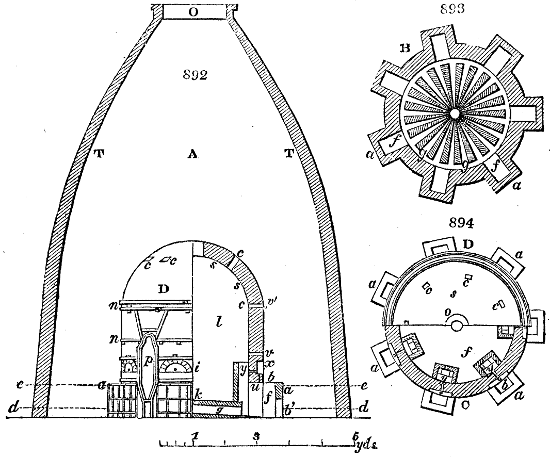
Figs. 892, 893, 894, 895, 896., represent the kiln for baking the biscuit, and also for running the glaze, in the English potteries.
a, a, figs. 892, 893, and 894, are the furnaces which heat the kiln; of which b, in fig. 892., are the upper mouths, and b′ the lower; the former being closed more or less by the fire-tile z, shown in fig. 896.
f is one fireplace; for the manner of distributing the fuel in it, see fig. 896.
g, y, figs. 892. and 896., are the horizontal and vertical flues and chimneys for conducting the flame and smoke. l is the laboratory, or body of the kiln; having its floor k sloping slightly downwards from the centre to the circumference. x, y, is the slit of the horizontal register, leading to the chimney flue y of the furnace, being the first regulator; x, u, is the vertical register conduit, leading to the furnace or mouth f, being the second regulator; v is the register slit above the furnace, and its vertical flue leading into the body of the kiln; v′, c, slit for regulating flue at the shoulder of the kiln; i is an arch which supports the walls of the kiln, when the furnace is under repair; c, c, are small flues in the vault s of the laboratory. h, fig. 893., is the central flue, called lunette, of the laboratory.
T, T, is the conical tower or howell, strengthened with a series of iron hoops, O′ is the great chimney or lunette of the tower; p is the door of the laboratory, bound inside with an iron frame.
A, is the complete kiln and howell, with all its appurtenances.
B, fig. 893., is the plan at the level d, d, of the floor, to show the arrangement and distribution of all the horizontal flues, both circular and radiating.
C, fig. 894., is a plan at the level e, e, of the upper mouths b, of the furnaces, to show the disposition of the fireplaces of the vertical flues, and of the horizontal registers, or peep-holes.
D, fig. 894., is a bird’s-eye view of the top of the vault or dome s, to show the disposition of the vent-holes c, c.
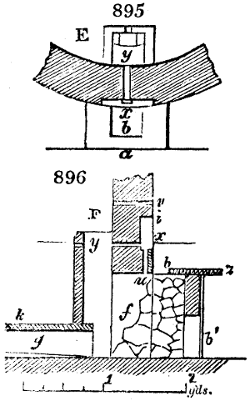
E, fig. 895., is a detailed plan at the level c, c, of one furnace and its dependencies.
F, fig. 896., is a transverse section, in detail, of one furnace and its dependencies.
The same letters in all the figures indicate the same objects.
Charging of the kiln.—The saggers are piled up first in the space between each of the upright furnaces, till they rise to the top of the flues. These contain the smaller articles. Above this level, large fire tiles are laid, for supporting other saggers, filled with teacups, sugar-basins, &c. In the bottom part of the pile, within the preceding, the same sorts of articles are put; but in the upper part all such articles are placed as require a high heat. Four piles of small saggers, with a middle one 10 inches in height, complete the charge. As there are 6 piles between each furnace, and as the biscuit kiln has 8 furnaces, a charge consequently amounts to 48 or 50 bungs, each composed of from 18 to 19 saggers. The inclination of the bungs ought always to follow the form of the kiln, and should therefore tend towards the centre, lest the strong draught of the furnaces should make the saggers fall against the walls of the kiln, an accident apt to happen were these piles perpendicular. The last sagger of each bung is covered with an unbaked one, three inches deep, in place of a round lid. The watches are small cups, of the same biscuit as the charge, placed in saggers, four in number, above the level of the flue-tops. They are taken hastily out of the saggers, lest they should get smoked, and are thrown into cold water.
When the charging is completed, the firing is commenced, with coal of the best quality. The management of the furnaces is a matter of great consequence to the success of the process. No greater heat should be employed for some time than may be necessary to agglutinate the particles which enter into the composition of the paste, by evaporating all the humidity; and the heat should never be raised so high as to endanger the fusion of the ware, which would make it very brittle.
When ever the mouth or door of the kiln is built up, a child prepares several fires in the neighbourhood of the howell, while a labourer transports in a wheelbarrow a supply of coals, and introduces into each furnace a number of lumps. These lumps divide the furnace into two parts; those for the upper flues being placed above, and those for the ground flues below, which must be kept unobstructed.
The fire-mouths being charged, they are kindled to begin the baking, the regulator tile z, fig. 896., being now opened; an hour afterwards the bricks at the bottom of the furnace are stopped up. The fire is usually kindled at 6 o’clock in the evening, and progressively increased till 10, when it begins to gain force, and the flame rises half-way up the chimney. The second charge is put in at 8 o’clock, and the mouths of the furnaces are then covered with tiles; by which time the flame issues through the vent of the tower. An hour afterwards a fresh charge is made; the tiles z, which cover the furnaces, are slipped back; the cinders are drawn to the front, and replaced with small coal. About half-past 11 o’clock the kiln-man examines his furnaces, to see that their draught is properly regulated. An hour afterwards a new charge of coal is applied; a practice repeated hourly till 6 o’clock in the morning. At this moment he takes out his first watch, to see how the baking goes on. It should be at a very pale-red heat; but the watch of 7 o’clock should be a deeper red. He removes the tiles from those furnaces which appear to have been burning too strongly, or whose flame issues by the orifices made in the shoulder of the kiln; and puts tiles upon those which are not hot enough. The flames glide along briskly in a regular manner. At this period he draws out the watches every quarter of an hour, and compares them with those reserved from a previous standard kiln; and if he observes a similarity of appearance, he allows the furnaces to burn a little longer; then opens the mouths carefully and by slow degrees; so as to lower the heat, and finish the round.
The baking usually lasts from 40 to 42 hours; in which time the biscuit kiln may consume 14 tons of coals; of which four are put in the first day, seven the next day and following night, and the four last give the strong finishing heat.
Emptying the kiln.—The kiln is allowed to cool very slowly. On taking the ware out of the saggers, the biscuit is not subjected to friction, as in the foreign potteries, because it is smooth enough; but is immediately transported to the place where it is to be dipped in the glaze or enamel tub. A child makes the pieces ring, by striking with the handle of the brush, as he dusts them, and then immerses them into the glaze cream; from which tub they are taken out by the enameller, and shaken in the air. The tub usually contains no more than 4 or 5 inches depth of the glaze, to enable the workman to pick out the articles more readily, and to lay them upon a board, whence they are taken by a child to the glaze kiln.
Glazing.—A good enamel is an essential element of fine stoneware; it should experience the same dilatation and contraction by heat and cold as the biscuit which it covers. The English enamels contain nothing prejudicial to health, as many of the foreign glazes do; no more lead being added to the former than is absolutely necessary to convert the siliceous and aluminous matters with which it is mixed into a perfectly neutral glass.
Three kinds of glazes are used in Staffordshire; one for the common pipe-clay or cream-coloured ware; another for the finer pipe-clay ware to receive impressions, called printing body; a third for the ware which is to be ornamented by painting with the pencil.
The glaze of the first or common ware is composed of 53 parts of white lead, 16 of Cornish stone, 36 of ground flints, and 4 of flint glass; or of 40 of white lead, 36 of Cornish stone, 12 of flints, and 4 of flint or crystal glass. These compositions are not fritted; but are employed after being simply triturated with water into a thin paste.
The following is the composition of the glaze intended to cover all kinds of figures printed in metallic colours: 26 parts of white felspar are fritted with 6 parts of soda, 2 of nitre, and 1 of borax; to 20 pounds of this frit, 26 parts of felspar, 20 of white lead, 6 of ground flints, 4 of chalk, 1 of oxide of tin, and a small quantity of oxide of cobalt, to take off the brown cast, and give a faint azure tint, are added.
The following recipe may also be used. Frit together 20 parts of flint glass, 6 of flints, 2 of nitre, and 1 of borax; add to 12 parts of that frit, 40 parts of white lead, 36 of felspar, 8 of flints, and 6 of flint glass; then grind the whole together into an uniform cream-consistenced paste.
As to the stoneware which is to be painted, it is covered with a glaze composed of 13 parts of the printing-colour frit, to which are added 50 parts of red lead, 40 of white lead, and 12 of flint; the whole having been ground together.
The above compositions produce a very hard glaze, which cannot be scratched by the knife, is not acted upon by vegetable acids, and does no injury to potable or edible articles kept in the vessels covered with it. It preserves for an indefinite time the glassy lustre, and is not subject to crack and exfoliate, like most of the Continental stoneware, made from common pipe-clay.
In order that the saggers in which the articles are baked, after receiving the glaze, may not absorb some of the vitrifying matter, they are themselves coated, as above mentioned, with a glaze composed of 13 parts of common salt, and 30 parts of potash, simply dissolved in water, and brushed over them.
Glaze kiln.—This is usually smaller than the biscuit kiln, and contains no more than 40 or 45 bungs or columns, each composed of 16 or 17 saggers. Those of the first bung rest upon round tiles, and are well luted together with a finely ground fire-clay of only moderate cohesion; those of the second bung are supported by an additional tile. The lower saggers contain the cream-coloured articles, in which the glaze is softer than that which covers the blue printed ware; this being always placed in the intervals between the furnaces, and in the uppermost saggers of the columns. The bottom of the kiln, where the glazed ware is not baked, is occupied by printed biscuit ware.
Pyrometric balls of red clay, coated with a very fusible lead enamel, are employed in the English potteries to ascertain the temperature of the glaze kilns. This enamel is so rich, and the clay upon which it is spread, is so fine-grained and compact, that even when exposed for three hours to the briskest flame, it does not lose its lustre. The colour of the clay alone changes, whereby the workman is enabled to judge of the degree of heat within the kiln. At first the balls have a pale red appearance; but they become browner with the increase of the temperature. The balls, when of a slightly dark-red colour, indicate the degree of baking for the hard glaze of pipeclay ware; but if they become dark brown, the glaze will be much too hard, being that suited for ironstone ware; lastly, when they acquire an almost black hue, they show a degree of heat suited to the formation of a glaze upon porcelain.
The glazer provides himself at each round with a stock of these ball watches, reserved from the preceding baking, to serve as objects of comparison; and he never slackens the firing till he has obtained the same depth of shade, or even somewhat more; for it may be remarked, that the more rounds a glaze kiln has made, the browner the balls are apt to become. A new kiln bakes a round of enamel-ware sooner than an old one; as also with less fuel, and at a lower temperature. The watch-balls of these first rounds have generally not so deep a colour as if they were tried in a furnace three or four months old. After this period, cracks begin to appear in the furnaces; the horizontal flues get partially obstructed, the joinings of the brickwork become loose; in consequence of which there is a loss of heat and waste of fuel; the baking of the glaze takes a longer time, and the pyrometric balls assume a different shade from what they had on being taken out of the new kiln, so that the first watches are of no comparable use after two months. The baking of enamel is commenced at a low temperature, and the heat is progressively increased; when it reaches the melting point of the glaze, it must be maintained steadily, and the furnace mouths be carefully looked after, lest the heat should be suffered to fall. The firing is continued 14 hours, and then gradually lowered by slight additions of fuel; after which the kiln is allowed from 5 to 6 hours to cool.
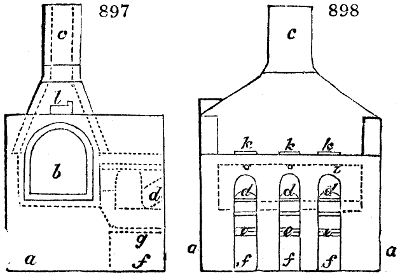
Muffles.—The paintings and the printed figures applied to the glaze of stoneware and porcelain are baked in muffles of a peculiar form. Fig. 897. is a lateral elevation of one of these muffles; fig. 898. is a front view. The same letters denote the same parts in the two figures.
a is the furnace; b, the oblong muffle, made of fire-clay, surmounted with a dome pierced with three apertures k, k, k, for the escape of the vaporous matters of the colours and volatile oils with which they are ground up; c is the chimney; d, d, feed-holes, by which the fuel is introduced; e, the fire-grate; f, the ash-pit; channels are left in the bottom of the furnace to facilitate the passage of the flame beneath the muffle; g is a lateral hole, which makes a communication across the furnace in the muffle, enabling the kiln man to ascertain what is passing within; k, k, are the lateral chinks for observing the progress of the firing or flame; l, is an opening scooped out in the front of the chimney to modify its draught.
The articles which are printed or painted upon the glaze are placed in the muffle without saggers, upon tripods, or movable supports furnished with feet. The muffle being charged, its mouth is closed with a fire-tile well luted round its edges. The fuel is then kindled in the fireplaces d, d, and the door of the furnace is closed with bricks, in which a small opening is left for taking out samples, and for examining the interior of the muffle. These sample or trial pieces, attached to a strong iron wire, show the progress of the baking operation. The front of the fireplaces is covered with a sheet-iron plate, which slides to one side, and may be shut whenever the kiln is charged. Soon after the fire is lighted, the flame, which communicates laterally from one furnace to another, envelopes the muffle on all sides, and thence rises up the chimney.
Printing of stoneware.—The printing under the stoneware glaze is generally performed by means of cobalt, and has different shades of blue according to the quantity of colouring matter employed. After having subjected this oxide to the processes requisite for its purification, it is mixed with a certain quantity of ground flints and sulphate of baryta, proportioned to the dilution of the shade. These materials are fritted and ground; but before they are used, they must be mixed with a flux consisting of equal parts by weight of flint glass and ground flints, which serves to fix the colour upon the biscuit, so that the immersion in the glaze liquor may not displace the lines printed on, as also to aid in fluxing the cobalt.
The following are the processes usually practised in Staffordshire for printing under the glaze.
The cobalt, or whatever colour is employed, should be ground upon a porphyry slab, with a varnish prepared as follows:—A pint of linseed oil is to be boiled to the consistence of thick honey, along with 4 ounces of rosin, half a pound of tar, and half a pint of oil of amber. This is very tenacious, and can be used only when liquefied by heat; which the printer effects by spreading it upon a hot cast-iron plate.
The printing plates are made of copper, engraved with pretty deep lines in the common way. The printer, with a leather muller, spreads upon the engraved plate, previously heated, his colour, mixed up with the above oil varnish, and removes what is superfluous with a pallet knife; then cleans the plate with a dossil filled with bran, tapping and wiping as if he were removing dust from it. This operation being finished, he takes the paper intended to receive the impression, soaks it with soap-water, and lays it moist upon the copper-plate. The soap makes the paper part more readily from the copper, and the thick ink part more readily from the biscuit. The copper-plate is now passed through the engraver’s cylinder press, the proof leaf is lifted off and handed to the women, who cut it into detached pieces, which they apply to the surface of the biscuit. The paper best fitted for this purpose is made entirely of linen rags; it is very thin, of a yellow colour, and unsized, like tissue blotting-paper.
The stoneware biscuit never receives any preparation before being imprinted, the oil of the colour being of such a nature as to fix the figures firmly. The printed paper is pressed and rubbed on with a roll of flannel, about an inch and a half in diameter, and 12 or 15 inches long, bound round with twine, like a roll of tobacco. This is used as a burnisher, one end of it being rested against the shoulder, and the other end being rubbed upon the paper; by which means it transfers all the engraved traces to the biscuit. The piece of biscuit is laid aside for a little, in order that the colour may take fast hold; it is then plunged into water, and the paper is washed away with a sponge.
When the paper is detached, the piece of ware is dipped into a caustic alkaline lye to saponify the oil, after which it is immersed in the glaze liquor, with which the printed figures readily adhere. This process, which is easy to execute, and very economical, is much preferable to the old plan of passing the biscuit into the muffle after it had been printed, for the purpose of fixing and volatilizing the oils. When the paper impression is applied to pieces of porcelain, they are heated before being dipped in the water, because, being already semi-vitrified, the paper sticks more closely to them than to the biscuit, and can be removed only by a hard brush.
The impression above the glaze is done by quite a different process, which dispenses with the use of the press. A quantity of fine clean glue is melted and poured hot upon a large flat dish, so as to form a layer about a quarter of an inch thick, and of the consistence of jelly. When cold it is divided into cakes of the size of the copper-plates it is intended to cover.
The operative (a woman) rubs the engraved copper-plate gently over with linseed oil boiled thick, immediately after which she applies the cake of glue, which she presses down with a silk dossil filled with bran. The cake licks up all the oil out of the engraved lines; it is then cautiously lifted off, and transferred to the surface of the glazed ware which it is intended to print. The glue cake being removed, the enamel surface must be rubbed with a little cotton, whereby the metallic colours are attached only on the lines charged with oil; the piece is then heated under the muffle. The same cake of glue may serve for several impressions.
Ornaments and colouring.—Common stoneware is coloured by means of two kinds of apparatus; the one called the blowing-pot, the other the worming-pot. The ornaments made in relief in France, are made hollow (intaglio) in England, by means of a mould engraved in relief, which is passed over the article. The impression which it produces is filled with a thick clay paste, which the workman throws on with the blowing-pot. This is a vessel like tea-pot, having a spout, but it is hermetically sealed at top with a clay plug, after being filled with the pasty liquor. The workman, by blowing in at the spout, causes the liquor to fly out through a quill pipe which goes down through the clay plug into the liquor. The jet is made to play upon the piece while it is being turned upon the lathe; so that the hollows previously made in it by the mould or stamp are filled with a paste of a colour different from that of the body. When the piece has acquired sufficient firmness to bear working, the excess of the paste is removed by an instrument called a tournasin, till the ornamental figure produced by the stamp be laid bare; in which case merely the colour appears at the bottom of the impression. By passing in this manner several layers of clay liquor of different colours over each other with the blowing-pot, net-work and decorations of different colours and shades are very rapidly produced.
The serpentine or snake pots, established on the same principle, are made of tin plate in three compartments, each containing a different colour. These open at the top of the vessel in a common orifice, terminated by small quill tubes. On inclining the vessel, the three colours flow out at once in the same proportion at the one orifice, and are let fall upon the piece while it is being slowly turned upon the lathe; whereby curious serpent-like ornaments may be readily obtained. The clay liquor ought to be in keeping with the stoneware paste. The blues succeed best when the ornaments are made with the finer pottery mixtures given above.
Metallic lustres applied to stoneware.—The metallic lustre being applied only to the outer surface of vessels, can have no bad effect on health, whatever substances be employed for the purpose; and as the glaze intended to receive it is sufficiently fusible, from the quantity of lead it contains, there is no need of adding a flux to the metallic coating. The glaze is in this case composed of 60 parts of litharge, 36 of felspar, and 15 of flints.
The silver and platina lustres are usually laid upon a white ground, while those of gold and copper, on account of their transparency, succeed only upon a coloured ground. The dark-coloured stoneware is, however, preferable, as it shows off the colours to most advantage; and thus the shades may be varied by varying the colours of the ornamental figures applied by the blowing-pot.
The gold and platina lustre is almost always applied to a paste body made on purpose, and coated with the above-described lead glaze. This paste is brown, and consists of 4 parts of clay, 4 parts of flints, an equal quantity of kaolin (china clay), and 6 parts of felspar. To make brown figures in relief upon a body of white paste, a liquor is mixed up with this paste, which ought to weigh 26 ounces per pint, in order to unite well with the other paste, and not to exfoliate after it is baked.
Preparation of gold lustre.—Dissolve first in the cold, and then with heat, 48 grains of fine gold in 288 grains of an aqua regia, composed of 1 ounce of nitric acid and 3 ounces of muriatic acid; add to that solution 41⁄2 grains of grain tin, bit by bit; and then pour some of that compound solution into 20 grains of balsam of sulphur diluted with 10 grains of oil of turpentine. The balsam of sulphur is prepared by heating a pint of linseed oil, and 2 ounces of flowers of sulphur, stirring them continually till the mixture begins to boil; it is then cooled, by setting the vessel in cold water; after which it is stirred afresh, and strained-through linen. The above ingredients, after being well mixed, are to be allowed to settle for a few minutes; then the remainder of the solution of gold is to be poured in, and the whole is to be triturated till the mass has assumed such a consistence that the pestle will stand upright in it; lastly, there must be added to the mixture 30 grains of oil of turpentine, which being ground in, the gold lustre is ready to be applied. If the lustre is too light or pale, more gold must be added, and if it have not a sufficiently violet or purple tint, more tin must be used.
Platina lustre.—Of this there are two kinds; one similar to polished steel, another lighter and of a silver-white hue. To give stoneware the steel colour with platina, this metal must be dissolved in an aqua regia composed of 2 parts of muriatic acid, and 1 part of nitric. The solution being cooled, and poured into a capsule, there must be added to it, drop by drop, with continual stirring with a glass rod, a spirit of tar, composed of equal parts of tar and sulphur boiled in linseed oil and filtered. If the platina solution be too strong, more spirit of tar must be added to it; but if too weak, it must be concentrated by boiling. Thus being brought to the proper pitch, the mixture may be spread ever the piece, which being put into the muffle, will take the aspect of steel.
The oxide of platina, by means of which the silver lustre is given to stoneware, is prepared as follows:—After having dissolved to saturation the metal in an aqua regia composed of equal parts of nitric and muriatic acid, the solution is to be poured into a quantity of boiling water. At the same time, a capsule, containing solution of sal-ammoniac is placed upon a sand-bath, and the platina solution being poured into it, the metal will fall down in the form of the well-known yellow precipitate, which is to be washed with cold water till it is perfectly edulcorated, then dried, and put up for use.
This metallic lustre is applied very smoothly by means of a flat camel’s hair brush. It is then to be passed through the muffle kiln; but it requires a second application of the platinum to have a sufficient body of lustre. The articles sometimes come black out of the kiln, but they get their proper appearance by being rubbed with cotton.
Platina and gold lustre; by other recipes.
Platina lustre.—Dissolve 1 ounce of platinum in aqua regia formed of 2 parts of muriatic acid and 1 part of nitric acid, with heat upon a sand-bath, till the liquid is reduced to two-thirds of its volume; let it cool; decant into a clean vessel, and pour into it, drop by drop, with constant stirring, some distilled tar, until such a mixture is produced as will give a good result in a trial upon the ware in the kiln. If the lustre be too intense, more tar must be added; if it be too weak, the mixture must be concentrated by further evaporation.
Gold lustre.—Dissolve four shillings’ worth of gold in aqua regia with a gentle heat. To the solution, when cool, add 2 grains of grain tin, which will immediately dissolve. Prepare a mixture of half an ounce of balsam of sulphur with a little essence of turpentine, beating them together till they assume the appearance of milk. Pour this mixture into the solution of gold and tin, drop by drop, with continual stirring; and place the whole in a warm situation for some time.
It is absolutely necessary to apply this lustre only upon an enamel or glaze which has already passed through the fire, otherwise the sulphur would tarnish the composition.
These lustres are applied with most advantage upon chocolate and other dark grounds. Much skill is required in their firing, and a perfect acquaintance with the quality of the glaze on which they are applied.
An iron lustre, is obtained by dissolving a bit of steel or iron in muriatic acid, mixing this solution with the spirit of tar, and applying it to the surface of the ware.
Aventurine glaze.—Mix a certain quantity of silver leaf with the above-described soft glaze, grind the mixture along with some honey and boiling water, till the metal assume the appearance of fine particles of sand. The glaze being naturally of a yellowish hue, gives a golden tint to the small fragments of silver disseminated through it. Molybdena may also be applied to produce the aventurine aspect.
The granite-like gold lustre, is produced by throwing lightly with a brush a few drops of oil of turpentine upon the goods already covered with the preparation for gold lustre. These cause it to separate and appear in particles resembling the surface of granite. When marbling is to be given to stoneware, the lustres of gold, platina, and iron are used at once, which blending in the fusion, form veins like those of marble.
Pottery and stoneware of the Wedgewood colour.—This is a kind of semi-vitrified ware, called dry bodies, which is not susceptible of receiving a superficial glaze. This pottery is composed in two ways: the first is with barytic earths, which act as fluxes upon the clays, and form enamels: thus the Wedgewood jasper ware is made.
The white vitrifying pastes, fit for receiving all sorts of metallic colours, are composed of 47 parts of sulphate of barytes, 15 of felspar, 26 of Devonshire clay, 6 of sulphate of lime, 15 of flints, and 10 of sulphate of strontites. This composition is capable of receiving the tints of the metallic oxides and of the ochrous metallic earths. Manganese produces the dark purple colour; gold precipitated by tin, a rose colour; antimony, orange; cobalt, different shades of blue; copper is employed for the browns and the dead-leaf greens; nickel gives, with potash, greenish colours.
One per cent. of oxide of cobalt is added; but one half, or even one quarter, of a per cent. would be sufficient, to produce the fine Wedgewood blue, when the nickel and manganese constitute 3 per cent. as well as the carbonate of iron. For the blacks of this kind, some English manufacturers mix black oxide of manganese with the black oxide of iron, or with ochre. Nickel and umber afford a fine brown. Carbonate of iron, mixed with bole or terra di Sienna, gives a beautiful tint to the paste; as also manganese with cobalt, or cobalt with nickel. Antimony produces a very fine colour when combined with the carbonate of iron in the proportion of 2 per cent., along with the ingredients necessary to form the above-described vitrifying paste.
The following is another vitrifying paste, of a much softer nature than the preceding. Felspar, 30 parts; sulphate of lime, 23; silex, 17; potter’s clay, 15; kaolin of Cornwall (china clay), 15; sulphate of baryta, 10.
These vitrifying pastes are very plastic, and may be worked with as much facility as English pipe-clay. The round ware is usually turned upon the lathe. It may, however, be moulded, as the oval pieces always are. The more delicate ornaments are cast in hollow moulds of baked clay, by women and children, and applied with remarkable dexterity upon the turned and moulded articles. The coloured pastes have such an affinity for each other, that the detached ornaments may be applied not only with a little gum water upon the convex and concave forms, but they may be made to adhere without experiencing the least cracking or chinks. The coloured pastes receive only one fire, unless the inner surface is to be glazed; but a gloss is given to the outer surface. The enamel for the interior of the black Wedgewood ware, is composed of 6 parts of red lead, 1 of silex, and 2 ounces of manganese, when the mixture is made in pounds’ weight.
The operation called smearing, consists in giving an external lustre to the unglazed semi-vitrified ware. The articles do not in this way receive any immersion, nor even the aid of the brush or pencil of the artist; but they require a second fire. The saggers are coated with the salt glaze already described. These cases, or saggers, communicate by reverberation the lustre so remarkable on the surface of the English stoneware; which one might suppose to be the result of the glaze tub, or of the brush. Occasionally also a very fusible composition is thrown upon the inner surface of the muffle, and 5 or 6 pieces called refractories are set in the middle of it, coated with the same composition. The intensity of the heat converts the flux into vapour; a part of this is condensed upon the surfaces of the contiguous articles, so as to give them the desired brilliancy.
Mortar body, is a paste composed of 6 parts of clay, 3 of felspar, 2 of silex, and 1 of china clay.
White and yellow figures upon dark-coloured grounds are a good deal employed. To produce yellow impressions upon brown stoneware, ochre is ground up with a small quantity of antimony. The flux consists of flint glass and flints in equal weights. The composition for white designs is made by grinding silex up with that flux, and printing it on, as for blue colours, upon brown or other coloured stoneware, which shows off the light hues.
English porcelain or china.—Most of this belongs to the class called tender or soft porcelain by the French and German manufacturers. It is not, therefore, composed simply of kaolin and petuntse. The English china is generally baked at a much lower heat than that of Sèvres, Dresden, and Berlin; and it is covered with a mere glass. Being manufactured upon a prodigious scale, with great economy and certainty, and little expenditure of fuel, it is sold at a very moderate price compared with the foreign porcelain, and in external appearance is now not much inferior.
Some of the English porcelain has been called ironstone china. This is composed usually of 60 parts of Cornish stone, 40 of china clay, and 2 of flint glass; or of 42 of the felspar, the same quantity of clay, 10 parts of flints ground, and 8 of flint glass.
The glaze for the first composition is made with 20 parts of felspar, 15 of flints, 6 of red lead, and 5 of soda, which are fritted together; with 44 parts of the frit, 22 parts of flint glass, and 15 parts of white lead, are ground.
The glaze for the second composition is formed of 8 parts of flint glass, 36 of felspar, 40 of white lead, and 20 of silex (ground flints).
The English manufacturers employ three sorts of compositions for the porcelain biscuit; namely, two compositions not fritted; one of them for the ordinary table service; another for the dessert service and tea dishes; the third, which is fritted, corresponds to the paste used in France for sculpture; and with it all delicate kinds of ornaments are made.
First composition. Second composition. Third composition.
Ground flints 75 66 Lynn sand 150
Calcined bones 180 100 300
China clay 40 96 100
Clay 70 Granite 80 Potash 10
The glaze for the first two of the preceding compositions consists of, felspar 45, flints 9, borax 21, flint glass 20, nickel 4. After fritting that mixture, add 12 parts of red lead. For the third composition, which is the most fusible, the glaze must receive 12 parts of ground flints, instead of 9; and there should be only 15 parts of borax, instead of 21.
PLAN OF AN ENGLISH POTTERY.
A stoneware manufactory should be placed by the side of a canal or navigable river, because the articles manufactured do not well bear land carriage.
A Staffordshire pottery is usually built as a quadrangle, each side being about 100 feet long, the walls 10 feet high, and the ridge of the roof 5 feet more. The base of the edifice consists of a bed of bricks, 18 inches high, and 16 inches thick; upon which a mud wall in a wooden frame, called pisé, is raised. Cellars are formed in front of the buildings, as depôts for the pastes prepared in the establishment. The wall of the yard or court is 9 feet high, and 18 inches thick.
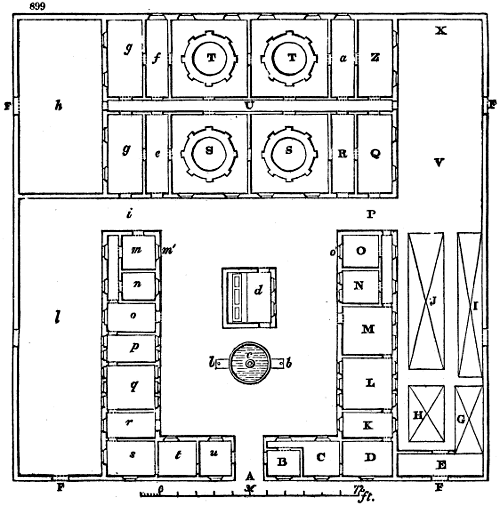
Fig. 899. A, is the entrance door; B, the porter’s lodge; C, a particular warehouse; D, workshop of the plaster-moulder; E, the clay depôt; F, F, large gates, 6 feet 8 inches high; G, the winter evaporation stove; H, the shop for sifting the paste liquors; I, sheds for the paste liquor tubs; J, paste liquor pits; K, workshop for the moulder of hollow ware; L, ditto of the dish or plate moulder; M, the plate drying-stove; N, workshop of the biscuit-printers; O, ditto of the biscuit, with o′, a long window; P, passage leading to the paste liquor pits; Q, biscuit warehouse; R, place where the biscuit is cleaned as it comes out of the biscuit kilns, S S; T, T, enamel or glaze kilns; U, long passage; V, space left for supplementary workshops; X, space appointed as a depôt for the sagger fire-clay, as also for making the saggers; Z, the workshop for applying the glaze liquor to the biscuits; a, apartment for cleaning the glazed ware; b, b, pumps; c, basin; d, muffles; e, warehouse for the finished stoneware; f, that of the glazed goods; g, g, another warehouse; h, a large space for the smith’s forge, carpenter’s shop, packing room, depôt of clays, saggers, &c. The packing and loading of the goods are performed in front of the warehouse, which has two outlets, in order to facilitate the work; i, a passage to the court or yard; l, a space for the wooden sheds for keeping hay, clay, and other miscellaneous articles, m, room for putting the biscuit into the saggers; m′, a long window; n, workshop with lathes and fly-wheels; o, drying-room; p, room for mounting or furnishing the pieces; q, repairing room; r, drying room of the goods roughly turned; s, rough turning or blocking-out room; t, room for beating the paste or dough; u, counting-house.
The declared value of the earthenware exported in 1836, was 837,774l.; in 1837, 558,682l.
There are from 33,000 to 35,000 tons of clay exported annually from Poole, in Dorsetshire, to the English and Scotch potteries. A good deal of clay is also sent from Devonshire and Cornwall.
The Spanish alcarazzas, or cooling vessels, are made porous, to favour the exudation of water through them, and maintain a constantly moist evaporating surface. Lasteyrie says, that granular sea salt is an ingredient of the paste of the Spanish alcarazzas; which being expelled partly by the heat of the baking, and partly by the subsequent watery percolation, leaves the body very open. The biscuit should be charged with a considerable proportion of sand, and very moderately fired.
OF PORCELAIN.
Porcelain is a kind of pottery ware whose paste is fine grained, compact, very hard, and faintly translucid; and whose biscuit softens slightly in the kiln. Its ordinary whiteness cannot form a definite character, since there are porcelain pastes variously coloured. There are two species of porcelain, very different in their nature, the essential properties of which it is of consequence to establish; the one is called hard, and the other tender; important distinctions, the neglect of which has introduced great confusion into many treatises on this elegant manufacture.
Hard porcelain is essentially composed, first, of a natural clay containing some silica, infusible, and preserving its whiteness in a strong heat; this is almost always a true kaolin; secondly, of a flux, consisting of silica and lime, composing a quartzose felspar rock, called pe-tun-tse. The glaze of this porcelain, likewise earthy, admits of no metallic substance or alkali.
Tender porcelain, styled also vitreous porcelain, has no relation with the preceding in its composition; it always consists of a vitreous frit, rendered opaque and less fusible by the addition of a calcareous or marly clay. Its glaze is an artificial glass or crystal, into which silica, alkalis, and lead enter.
This porcelain has a more vitreous biscuit, more transparent, a little less hard, and less fragile, but much more fusible than that of the hard porcelain. Its glaze is more glossy, more transparent, a little less white, much tenderer, and more fusible.
The biscuit of the hard porcelain made at the French national manufactory of Sèvres is generally composed of a kaolin clay, and of a decomposed felspar rock; analogous to the china clay of Cornwall, and Cornish stone. Both of the above French materials come from Saint Yriex-la-perche, near Limoges.
After many experiments, the following composition has been adopted for the service paste of the royal manufactory of Sèvres; that is, for all the ware which is to be glazed: silica, 59; alumina, 35·2; potash, 2·2; lime, 3·3. The conditions of such a compound are pretty nearly fulfilled by taking from 63 to 70 of the washed kaolin or china clay, 22 to 15 of the felspar; nearly 10 of flint powder, and about 5 of chalk. The glaze is composed solely of solid felspar, calcined, crushed, and then ground fine at the mill. This rock pretty uniformly consists of silica 73, alumina 16·2, potash 8·4, and water 0·6.
The kaolin is washed at the pit, and sent in this state to Sèvres, under the name of decanted earth. At the manufactory it is washed and elutriated with care; and its slip is passed through fine sieves. This forms the plastic, infusible, and opaque ingredient to which the substance must be added which gives it a certain degree of fusibility and semi-transparency. The felspar rock used for this purpose, should contain neither dark mica nor iron, either as an oxide or sulphuret. It is calcined to make it crushable, under stamp-pestles driven by machinery, then ground fine in hornstone mills, as represented in figs. 897, 898, 899, and 900. This pulverulent matter being diffused through water, is mixed in certain proportions, regulated by its quality, with the argillaceous slip. The mixture is deprived of the chief part of its water in shallow plaster pans without heat; and the resulting paste is set aside to ripen, in damp cellars, for many months.
When wanted for use, it is placed in hemispherical pans of plaster, which absorb the redundant moisture; after which it is divided into small lumps, and completely dried. It is next pulverized, moistened a little, and laid on a floor, and trodden upon by a workman marching over it with bare feet in every direction; the parings and fragments of soft moulded articles being intermixed, which improve the plasticity of the whole. When sufficiently tramped, it is made up into masses of the size of a man’s head, and kept damp till required.
The dough is now in a state fit for the potter’s lathe; but it is much less plastic than stoneware paste, and is more difficult to fashion into the various articles; and hence one cause of the higher price of porcelain.
The round plates and dishes are shaped on plaster moulds; but sometimes the paste is laid on as a crust, and at others it is turned into shape on the lathe. When a crust is to be made, a moistened sheep-skin is spread on a marble table; and over this the dough is extended with a rolling pin, supported on two guide-rules. The crust is then transferred over the plaster mould, by lifting it upon the skin; for it wants tenacity to bear raising by itself. When the piece is to be fashioned on the lathe, a lump of the dough is thrown on the centre of the horizontal wooden disc, and turned into form as directed in treating of stoneware, only it must be left much thicker than in its finished state. After it dries to a certain degree on the plaster mould, the workman replaces it on the lathe, by moistening it on its base with a wet sponge, and finishes its form with an iron tool. A good workman at Sèvres makes no more than from 15 to 20 porcelain plates in a day; whereas an English potter, with two boys, makes from 1000 to 1200 plates of stoneware in the same time. The pieces which are not round, are shaped in plaster moulds, and finished by hand. When the articles are very large, as wash-hand basins, salads, &c., a flat cake is spread above a skin on the marble slab, which is then applied to the mould with the sponge, as for plates; and they are finished by hand.
The projecting pieces, such as handles, beaks, spouts, and ornaments, are moulded and adjusted separately; and are cemented to the bodies of china-ware with slip, or porcelain dough thinned with water. In fact, the mechanical processes with porcelain and the finer stoneware are substantially the same; only they require more time and greater nicety. The least defect in the fabrication, the smallest bit added, an unequal pressure, the cracks of the moulds, although well repaired, and seemingly effaced in the clay shape, re-appear after it is baked. The articles should be allowed to dry very slowly; if hurried but a little, they are liable to be spoiled. When quite dry, they are taken to the kiln.
The kiln for hard porcelain at Sèvres, is a kind of tower in two flats, constructed of fire-bricks; and resembles, in other respects, the stoneware kiln already figured and described. The fuel is young aspin wood, very dry, and cleft very small; it is put into the apertures of the four outside furnaces or fire-mouths, which discharge their flame into the inside of the kiln; each floor being closed in above, by a dome pierced with holes. The whole is covered in by a roof with an open passage, placed at a proper distance from the uppermost dome. There is, therefore, no chimney proper so called. See Stone, artificial.
The raw pieces are put into the upper floor of the kiln; where they receive a heat of about the 60th degree of Wedgewood’s pyrometer, and a commencement of baking, which, without altering their shape, or causing a perceptible shrinking of their bulk, makes them completely dry, and gives them sufficient solidity to bear handling. By this preliminary baking, the clay loses its property of forming a paste with water; and the pieces become fit for receiving the glazing coat, as they may be dipped in water without risk of breakage.
The glaze of hard porcelain is a felspar rock: this being ground to a very fine powder, is worked into a paste with water mingled with a little vinegar. All the articles are dipped into this milky liquid for an instant; and as they are very porous, they absorb the water greedily, whereby a layer of the felspar glaze is deposited on their surface, in a nearly dry state, as soon as they are lifted out. Glaze-pap is afterwards applied with a hair brush to the projecting edges, or any points where it had not taken; and the powder is then removed from the part on which the article is to stand, lest it should get fixed to its support in the fire. After these operations it is replaced in the kiln, to be completely baked.
The articles are put into saggers, like those of fine stoneware; and this operation is one of the most delicate and expensive in the manufacture of porcelain. The saggers are made of the plastic or potter’s clay of Abondant, to which about a third part of cement of broken saggers has been added.
As the porcelain pieces soften somewhat in the fire, they cannot be set above each other, even were they free from glaze; for the same reason, they cannot be baked on tripods, several of them being in one case, as is done with stoneware. Every piece of porcelain requires a sagger for itself. They must, moreover, be placed on a perfectly flat surface, because in softening they would be apt to conform to the irregularities of a rough one. When therefore any piece, a soup plate for example, is to be saggered, there is laid on the bottom of the case a perfectly true disc or round cake of stoneware, made of the sagger material, and it is secured in its place on three small props of a clay-lute, consisting of potter’s clay mixed with a great deal of sand. When the cake is carefully levelled, it is moistened, and dusted over with sand, or coated with a film of fire-clay slip, and the porcelain is carefully set on it. The sand or fire-clay hinders it from sticking to the cake. Several small articles may be set on the same cake, provided they do not touch one another.
The saggers containing the pieces thus arranged, are piled up in the kiln over each other, in the columnar form, till the whole space be occupied; leaving very moderate intervals between the columns to favour the draught of the fires. The whole being arranged with these precautions, and several others, too minute to be specified here, the door of the kiln is built up with 3 rows of bricks, leaving merely an opening 8 inches square, through which there is access to a sagger with the nearest side cut off. In this sagger are put fragments of porcelain intended to be withdrawn from time to time, in order to judge of the progress of the baking. These are called time-pieces or watches (montres). This opening into the watches is closed by a stopper of stoneware.
The firing begins by throwing into the furnace-mouths some pretty large pieces of white wood, and the heat is maintained for about 15 hours, gradually raising it by the addition of a larger quantity of the wood, till at the end of that period the kiln has a cherry-red colour within. The heat is now greatly increased by the operation termed covering the fire. Instead of throwing billets vertically into the four furnaces, there is placed horizontally on the openings of these furnaces, aspin wood of a sound texture, cleft small, laid in a sloping position. The brisk and long flame which it yields dips into the tunnels, penetrates the kiln, and circulates round the sagger-piles. The heat augments rapidly, and, at the end of 13 or 15 hours of this firing, the interior of the kiln is so white, that the watches can hardly be distinguished. The draught, indeed, is so rapid at this time, that one may place his hand on the slope of the wood without feeling incommoded by the heat. Every thing is consumed, no small charcoal remains, smoke is no longer produced, and even the wood-ash is dissipated. It is obvious that the kiln and the saggers must be composed of a very refractory clay, in order to resist such a fire. The heat in the Sèvres kilns mounts so high as the 134th degree of Wedgewood.
At the end of 15 or 20 hours of the great fire; that is, after from 30 to 36 hours’ firing, the porcelain is baked; as is ascertained by taking out and examining the watches. The kiln is suffered to cool during 3 or 4 days, and is then opened and discharged. The sand strewed on the cakes to prevent the adhesion of the articles to them, gets attached to their sole, and is removed by friction with a hard sandstone; an operation which one woman can perform for a whole kiln in less than 10 days; and is the last applied to hard porcelain, unless it needs to be returned into the hot kiln to have some defects repaired.
The materials of fine porcelain are very rare; and there would be no advantage in making a gray-white porcelain with coarser and somewhat cheaper materials, for the other sources of expense above detailed, and which are of most consequence, would still exist; while the porcelain, losing much of its brightness, would lose the main part of its value.
Its pap or dough, which requires tedious grinding and manipulation, is also more difficult to work into shapes, in the ratio of 80 to 1, compared to fine stoneware. Each porcelain plate requires a separate sagger; so that 12 occupy in the kiln a space sufficient for at least 38 stoneware plates. The temperature of a hard porcelain kiln being very high, involves a proportionate consumption of fuel and waste of saggers. With 40 steres (cubic metres) of wood, 12,000 stoneware plates may be completely fired, both in the biscuit and glaze kilns; while the same quantity of wood would bake at most only 1000 plates of porcelain.
To these causes of high price, which are constant and essential, we ought to add the numerous accidents to which porcelain is exposed at every step of its preparation, and particularly in the kiln; these accidents damage upwards of one-third of the pieces, and frequently more, when articles of singular form and large dimensions are adventured.
The best English porcelain is made from a mixture of the Cornish kaolin (called china clay), ground flints, ground Cornish stone, and calcined bones in powder, or bone-ash, besides some other materials, according to the fancy of the manufacturers. A liquid pap is made with these materials, compounded in certain proportions, and diluted with water. The fluid part is then withdrawn by the absorbent action of dry stucco basins or pans. The dough, brought to a proper stiffness, and perfectly worked and kneaded on the principles detailed above, is fashioned on the lathe, by the hands of modellers, or by pressure in moulds. The pieces are then baked to the state of biscuit in a kiln, being enclosed, of course, in saggers.
This biscuit has the aspect of white sugar, and being very porous, must receive a vitreous coating. The glaze consists of ground felspar or Cornish stone. Into this, diffused in water, along with a little flint-powder and potash, the biscuit ware is dipped, as already described, under stoneware. The pieces are then fired in the glaze-kiln, care being taken, before putting them into their saggers, to remove the glaze powder from their bottom parts, to prevent their adhesion to the fire-clay vessel.
TENDER PORCELAIN.
Tender porcelain, or soft china-ware, is made with a vitreous frit, rendered less fusible and opaque by an addition of white marl or bone-ash. The frit is, therefore, first prepared. This, at Sèvres, is a composition, made with some nitre, a little sea salt, Alicant barilla, alum, gypsum, and much siliceous sand or ground flints. That mixture is subjected to an incipient pasty fusion in a furnace, where it is stirred about to blend the materials well; and thus a very white spongy frit is obtained. It is pulverized, and to every three parts of it, one of the white marl of Argenteuil is added; and when the whole are well ground, and intimately mixed, the paste of tender porcelain is formed.
As this paste has no tenacity, it cannot bear working till a mucilage of gum or black soap be added, which gives it a kind of plasticity, though even then it will not bear the lathe. Hence it must be fashioned in the press, between two moulds of plaster. The pieces are left thicker than they should be; and when dried, are finished on the lathe with iron tools.
In this state they are baked, without any glaze being applied; but as this porcelain softens far more during the baking than the hard porcelain, it needs to be supported on every side. This is done by baking on earthen moulds all such pieces as can be treated in this way, namely plates, saucers, &c. The pieces are reversed on these moulds, and undergo their shrinkage without losing their form. Beneath other articles, supports of a like paste are laid, which suffer in baking the same contraction as the articles, and of course can serve only once. In this operation saggers are used, in which the pieces and their supports are fired.
The kiln for the tender porcelain at Sèvres is absolutely similar to that for the common stoneware; but it has two floors; and while the biscuit is baked in the lower story, the glaze is fused in the upper one; which causes considerable economy of fuel. The glaze of soft porcelain is a species of glass or crystal prepared on purpose. It is composed of flint, siliceous sand, a little potash or soda, and about two-fifth parts of lead oxide. This mixture is melted in crucibles or pots beneath the kiln. The resulting glass is ground fine, and diffused through water mixed with a little vinegar to the consistence of cream. All the pieces of biscuit are covered with this glazy matter, by pouring this slip over them, since their substance is not absorbent enough to take it on by immersion.
The pieces are encased once more each in a separate sagger, but without any supports; for the heat of the upper floor of the kiln, though adequate to melt the glaze, is not strong enough to soften the biscuit. But as this first vitreous coat is not very equal, a second one is applied, and the pieces are returned to the kiln for the third time. See Stone, artificial, for a view of this kiln.
The manufacture of soft porcelain is longer and more difficult than that of hard; its biscuit is dearer, although the raw materials may be found every where; and it furnishes also more refuse. Many of the pieces split asunder, receive fissures, or become deformed in the biscuit-kiln, in spite of the supports; and this vitreous porcelain, moreover, is always yellower, more transparent, and incapable of bearing rapid transitions of temperature, so that even the heat of boiling water frequently cracks it. It possesses some advantages as to painting, and may be made so gaudy and brilliant in its decorations, as to captivate the vulgar eye.
DESCRIPTION OF THE PORCELAIN MILL.
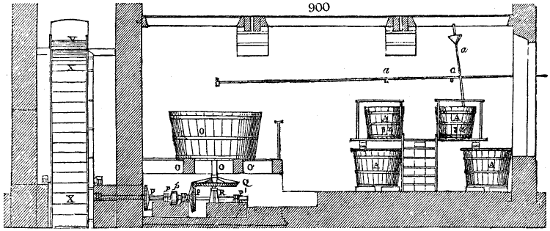
Fig. 900 enlarged (192 kB)
1. The following figures of a felspar and flint mill are taken from plans of apparatus lately constructed by Mr. Hall of Dartford, and erected by him in the royal manufactory of Sèvres. There are two similar sets of apparatus, fig. 900., which may be employed together or in succession; composed each of an elevated tub A, and of three successive vats of reception A′, and two behind it, whose top edges are upon a lower level than the bottom of the casks A, A, to allow of the liquid running out of them with a sufficient slope. A proper charge of kaolin is first put into the cask A, then water is gradually run into it by the gutter adapted to the stopcock a, after which the mixture is agitated powerfully in every direction by hand with the stirring-bar, which is hung within a hole in the ceiling, and has at its upper end a small tin-plate funnel to prevent dirt or rust from dropping down into the clay. The stirrer may be raised or lowered so as to touch any part of the cask. The semi-fluid mass is left to settle for a few minutes, and then the finer argillaceous pap is run off by the stopcock a′, placed a little above the gritty deposit, into the zinc pipe which conveys it into one of the tubs A′; but as this semi-liquid matter may still contain some granular substances, it must be passed through a sieve before it is admitted into the tub. There is, therefore, at the spot upon the tub where the zinc pipe terminates, a wire-cloth sieve, of an extremely close texture, to receive the liquid paste. This sieve is shaken upon its support, in order to make it discharge the washed argillaceous kaolin. After the clay has subsided, the water is drawn off from its surface by a zinc syphon. The vats A′ have covers, to protect their contents from dust. In the pottery factories of England, the agitation is produced by machinery, instead of the hand. A vertical shaft, with horizontal or oblique paddles, is made to revolve in the vats for this purpose.
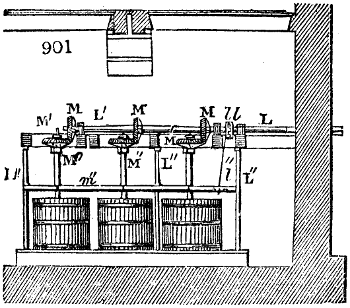
The small triturating mill is represented in fig. 901. There are three similar grinding-tubs on the same line. The details of the construction are shown in figs. 902, 903, where it is seen to consist principally of a revolving millstone B (fig. 902.), of a fast or sleeper millstone B′, and of a vat C, hooped with iron, with its top raised above the upper millstone. The lower block of hornstone rests upon a very firm basis, b′; it is surrounded immediately by the strong wooden circle c, which slopes out funnel-wise above, in order to throw back the earthy matters as they are pushed up by the attrition of the stones. That piece is hollowed out, partially to admit the key C, opposite to which is the faucet and spigot c′, for emptying the tub. When one operation is completed, the key C is lifted out by means of a peg put into the holes at its top; the spigot is then drawn, and the thin paste is run out into vats. The upper grindstone, B d, like the lower one, is about two feet in diameter, and must be cut in a peculiar manner. At first there is scooped out a hollowing in the form of a sector, denoted by d e f, fig. 903.; the arc d f is about one-sixth of the circumference, so that the vacuity of the turning grindstone is one-sixth of its surface; moreover, the stone must be channelled, in order to grind or crush the hard gritty substances. For this purpose, a wedge-shaped groove d e g, about an inch and a quarter deep, is made on its under face, whereby the stone, as it turns in the direction indicated by the arrow, acts with this inclined plane upon all the particles in its course, crushing them and forcing them in between the stones, till they be triturated to an impalpable powder. When the grindstone wears unequally on its lower surface, it is useful to trace upon it little furrows, proceeding from the centre to the circumference, like those shown by the dotted lines e′ e′′. It must, moreover, be indented with rough points by the hammer.
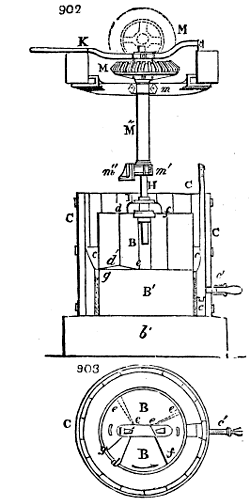
The turning hornstone-block is set in motion by the vertical shaft H, which is fixed by the clamp-iron cross I to the top of the stone. When the stone is new, its thickness is about 14 inches, and it is made to answer for grinding till it be reduced to about 8 inches, by lowering the clamp I upon the shaft, so that it may continue to keep its hold of the stone. The manner in which the grindstones are turned, is obvious from inspection of fig. 901., where the horizontal axis L, which receives its impulsion from the great water-wheel, turns the prolonged shaft L′, or leaves it at rest, according as the clutch l, l′, is locked or opened. This second shaft bears the three bevel wheels M, M, M. These work in three corresponding bevel wheels M′ M′ M′, made fast respectively to the three vertical shafts of the millstones, which pass through the cast-iron guide tubes M′′ M′′. These are fixed in a truly vertical position by the collar-bar m′′, m′, fig. 902. In this figure we see at m how the strong cross-bar of cast iron is made fast to the wooden beams which support all the upper mechanism of the mill-work. The bearing m′ is disposed in an analogous manner; but it is supported against two cast-iron columns, shown at L′′ L′′, in fig. 901. The guide tubes M′′ are bored smooth for a small distance from each of their extremities, and their interjacent calibre is wider, so that the vertical shafts touch only at two places. It is obvious, that whenever the shaft L′ is set a-going, it necessarily turns the wheels M and M′, and their guide tubes M′′; but the vertical shaft may remain either at rest, or revolve, according to the position of the lever click or catch K, at the top, which is made to slide upon the shaft, and can let fall a finger into a vertical groove cut in the surface of that shaft. The clamp-fork of the click is thus made to catch upon the horizontal bevel-wheel M′, or to release it, according as the lever K is lowered or lifted up. Thus each millstone may be thrown out of or into geer at pleasure.
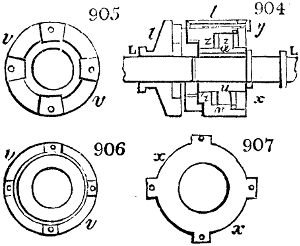
These stones make upon an average 11 or 12 turns in a minute, corresponding to 3 revolutions of the water-wheel, which moves through a space of 3 feet 4 inches in the second, its outer circumference being 66 feet. The weight of the upper stone, with its iron mountings, is about 6 cwt., when new. The charge of each mill in dry material is 2 cwt.; and the water may be estimated at from one-half to the whole of this weight; whence the total load may be reckoned to be at least 3 cwt.; the stone, by displacement of the magma, loses fully 400 pounds of its weight, and weighs therefore in reality only 2 cwt. It is charged in successive portions, but it is discharged all at once. When the grinding of the siliceous or felspar matters is nearly complete, a remarkable phenomenon occurs; the substance precipitates to the bottom, and assumes in a few seconds so strong a degree of cohesion, that it is hardly possible to restore it again to the pasty or magma state; hence if a millstone turns too slowly, or if it be accidentally stopped for a few minutes, the upper stone gets so firmly cemented to the under one, that it is difficult to separate them. It has been discovered, but without knowing why, that a little vinegar added to the water of the magma almost infallibly prevents that sudden stiffening of the deposit and stoppage of the stones. If the mills come to be set fast in this way, the shafts or geering would be certainly broken, were not some safety provision to be made in the machinery against such accidents. Mr. Hall’s contrivance to obviate the above danger is highly ingenious. The clutch l, l′, fig. 901., is not a locking crab, fixed in the common way, upon the shaft L; but it is composed, as shown in figs. 904, 905, 906, 907, of a hoop u, fixed upon the shaft by means of a key, of a collar v, and of a flat ring or washer x, with four projections, which are fitted to the collar v, by four bolts y. Fig. 905. represents the collar v seen in front; that is, by the face which carries the clutch teeth; and fig. 906. represents its other face, which receives the flat ring x, fig. 907., in four notches corresponding to the four projections of the washer-ring. Since the ring u is fixed upon the shaft L, and necessarily turns with it, it has the two other pieces at its disposal, namely the collar v, and the washer x, because they are always connected with it by the four bolts y, so as to turn with the ring u, when the resistance they encounter upon the shaft L′ is not too great, and to remain at rest, letting the ring u turn by itself, when that resistance increases to a certain pitch. To give this degree of friction, we need only interpose the leather washers z, z′, fig. 904.; and now as the collar coupling-box, v, slides pretty freely upon the ring u, it is obvious that by tightening more or less the screw bolts y, these washers will become as it were a lateral brake, to tighten more or less the bearing of the ring u, to which they are applied: by regulating this pressure, every thing may be easily adjusted. When the resistance becomes too great, the leather washers, pressed upon one side by the collar v, of the washer x, and rubbed upon the other side by the prominence of the ring u, get heated to such a degree, that they are apt to become carbonized, and require replacement.
This safety clutch may be recommended to the notice of mechanicians, as susceptible of beneficial application in a variety of circumstances.
GREAT PORCELAIN MILL.
The large felspar and kaolin mill, made by Mr. Hall, for Sèvres, has a flat bed of hornstone, in one block, laid at the bottom of a great tub, hooped strongly with iron. In most of the English potteries, however, that bed consists of several flat pieces of chert or hornstone, laid level with each other. There is, as usual, a spigot and faucet at the side, for drawing off the liquid paste. The whole system of the mechanism is very substantial, and is supported by wooden beams.
The following is the manner of turning the upper blocks. In fig. 900. the main horizontal shaft P bears at one of its extremities a toothed wheel, usually mounted upon the periphery of the great water-wheel (fig. 908. shows this toothed wheel by a dotted line) at its other end; P carries the fixed portion p of a coupling-box, similar to the one just described as belonging to the little mill. On the prolongation of P, there is a second shaft P′, which bears the movable portion of that box, and an upright bevel wheel P′′. Lastly, in figs. 900. and 908. there is shown the vertical shaft Q, which carries at its upper end a large horizontal cast-iron wheel Q′, not seen in this view, because it is sunk within the upper surface of the turning hornstone, like the clamp d, f, in fig. 902. At the lower end of the shaft Q, there is the bevel wheel Q′′, which receives motion from the wheel P′′, fig. 900.
The shaft P always revolves with the water-wheel; but transmits its motion to the shaft P′ only when the latter is thrown into geer with the coupling-box p′, by means of its forked lever. Then the bevel wheel P′ turns round with the shaft P′, and communicates its rotation to the bevel wheel Q′′, which transmits it to the shaft Q, and to the large cast-iron wheel, which is sunk into the upper surface of the revolving hornstone.
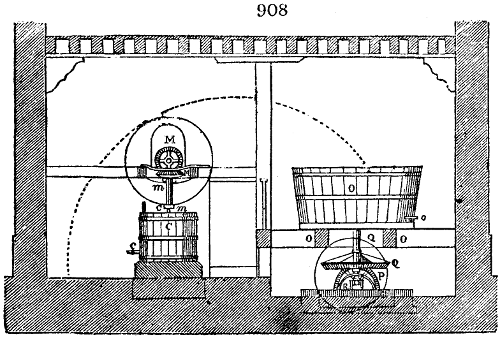
The shaft Q is supported and centred by a simple and solid adjustment; at its lower part, it rests in a step R, which is supported upon a cast-iron arch Q′, seen in profile in fig. 900.; its base is solidly fixed by four strong bolts. Four set screws above R, fig. 900., serve to set the shaft Q truly perpendicular: thus supported, and held securely at its lower end, in the step at R, figs. 900. and 908., it is embraced near the upper end by a brass bush or collar, composed of two pieces, which may be drawn closer together by means of a screw. This collar is set into the summit of a great truncated cone of cast-iron, which rises within the tub through two-thirds of the thickness of the hornstone bed; having its base firmly fixed by bolts to the bottom of the tub, and having a brass collet to secure its top. The iron cone is cased in wood. When all these pieces are well adjusted and properly screwed up, the shaft Q revolves without the least vacillation, and carries round with it the large iron wheel Q′, cast in one piece, and which consists of an outer rim, three arms or radii, and a strong central nave, made fast by a key to the top of the shaft Q, and resting upon a shoulder nicely turned to receive it. Upon each of the three arms, there are adjusted, with bolts, three upright substantial bars of oak, which descend vertically through the body of the revolving mill to within a small distance of the bed-stone; and upon each of the three arcs of that wheel-ring, comprised between its three strong arms, there are adjusted, in like manner, five similar uprights, which fit into hollows cut in the periphery of the moving stone. They ought to be cut to a level at their lower part, to suit the slope of the bottom of the tub o, figs. 900. and 908., so as to glide past it pretty closely, without touching.
The speed of this large mill is eight revolutions in the minute. The turning hornstone describes a mean circumference of 1411⁄3 inches (its diameter being 45 inches), and of course moves through about 100 feet per second. The tub O, is 52 inches wide at bottom, 56 at the surface of the sleeper block (which is 16 inches thick), and 64 at top, inside measure. It sometimes happens that the millstone throws the pasty mixture out of the vessel, though its top is 6 inches under the lip of the tub o; an inconvenience which can be obviated only by making the pap a little thicker; that, is by allowing only from 25 to 30 per cent. of water; then its density becomes nearly equal to 2·00, while that of the millstones themselves is only 2·7; whence, supposing them to weigh only 2 cwt., there would remain an effective weight of less than 1⁄2 cwt. for pressing upon the bottom and grinding the granular particles. This weight appears to be somewhat too small to do much work in a short time; and therefore it would be better to increase the quantity of water, and put covers of some convenient form over the tubs. It is estimated that this mill will grind nearly 5 cwt. of hard kaolin or felspar gravel, in 24 hours, into a proper pap.
To the preceding methodical account of the porcelain manufacture, I shall now subjoin some practical details relative to certain styles of work, with comparisons between the methods pursued in this country and upon the Continent, but chiefly by our jealous rivals the French.
The blue printed ware of England has been hitherto a hopeless object of emulation in France. M. Alexandre Brongniart, membre de l’Institut, and director of the Manufacture Royal de Sèvres, characterizes the French imitations of the Fayence fine, ou Anglaise, in the following terms: “Les défauts de cette poterie, qui tiennent à sa nature, sont de ne pouvoir aller sur le feu pour les usages domestiques, et d’avoir un vernis tendre, qui se laisse aisément entamer par les instruments d’acier et de fer. Mais lorsque cette poterie est mal fabriquée, ou fabriquée avec une économie mal entendue, ses défauts deviennent bien plus graves; son vernis jaunâtre et tendre tressaille souvent; il se laisse entamer ou user avec la plus grande facilité par les instruments de fer, ou par l’usage ordinaire. Les fissures que ce tressaillement ou ces rayures ouvrent dans le vernis permettent aux matières grasses de pénétrer dans le biscuit, que dans les poteries affectées de ce défaut, a presque toujours une texture lâche; les pièces se salissent, s’empuantissent, et se brisent même avec la plus grande facilité.”[42]
What a glaze, to be scratched or grooved with soft iron; to fly off in scales, so as to let grease soak into the biscuit or body of the ware; to become foul, stink, and break with the utmost ease! The refuse crockery of the coarsest pottery works in the United Kingdom would hardly deserve such censure.
In the minutes of evidence of the Enquête Ministérielle, published in 1835, MM. de Saint Cricq and Lebeuf, large manufacturers of pottery-ware at Creil and Montereau, give a very gratifying account of the English stoneware manufacture. They declare that the English possess magnificent mines of potter’s clay, many leagues in extent; while those of the French are mere patches or pots. Besides, England, they say, having upwards of 200 potteries, can constantly employ a great many public flint-mills, and thereby obtain that indispensable material of the best quality, and at the lowest rate. “The mill erected by M. Brongniart, at Sèvres, does its work at twice the price of the English mills. The fuel costs in England one-fourth of what it does in France. The expense of a kiln-round, in the latter country, is 200 francs; while in the former it is not more than 60.” After a two-months tour among the English potteries, these gentlemen made the following additional observations to their first official statement:—
“The clay, which goes by water carriage from the counties of Devon and Dorset, into Staffordshire, to supply more than 200 potteries, clustered together, is delivered to them at a cost of 4 francs (3s. 2d.) the 100 kilogrammes (2 cwt.); at Creil, it costs 4f. 50c., and at Montereau, only 2f. 40c. There appears, therefore, to be no essential difference in the price of the clay; but the quality of the English is much superior, being incontestably whiter, purer, more homogeneous, and not turning red at a high heat, like the French.” The grinding of the flints costs the English potter 41⁄2d. per 100 kilos., and the French 6d.; but as that of the latter is in general ground dry, it is a coarser article. The kaolin, or china clay, is imported from Cornwall for the use of many French potteries; but the transport of merchandise is so ill managed in France, that while 2 cwts. cost in Staffordshire only 8f. 75c. (about 7s. 1d.), they cost 12f. at Creil, and 13f. 50c. at Montereau. The white lead and massicot, so much employed for glazes, are 62 per cent. dearer to the French potters than the English. As no French mill has succeeded in making unsized paper fit for printing upon stoneware, our potters are under the necessity of fetching it from England; and, under favour of our own custom-house, are allowed to import it at a duty of 165f. per 100 kilogrammes, or about 8d. per pound English. No large stock of materials need be kept by the English, because every article may be had when wanted from its appropriate wholesale dealers; but the case is quite different with the French, whose stocks, even in small works, can never safely be less in value than 150,000f. or 200,000f.; constituting a loss to them, in interest upon their capital, of from 7,500f. to 10,000f. per annum. The capital sunk in buildings is far less in England than in France, in consequence of the different styles of erecting stoneware factories in the two countries. M. de Saint Cricq informs us, that Mr. Clewes, of Shelton, rents his works for 10,000f. (380l.) per annum; while the similar ones of Creil and Montereau, in France, have cost each a capital outlay of from 500,000f. to 600,000f., and in which the products are not more than one half of Mr. Clewes’. “This forms a balance against us,” says M. St. C., “of about 20,000f. per annum; or nearly 800l. sterling. Finally, we have the most formidable rival to our potteries in the extreme dexterity of the English artisans. An enormous fabrication permits the manufacturers to employ the same workmen during the whole year upon the same piece; thus I have seen at Shelton a furnisher, for sixpence, turn off 100 pieces, which cost at Creil and Montereau 30 sous (1s. 21⁄2d.); yet the English workman earns 18f. 75c. a week, while the French never earns more than 15f. I have likewise seen an English moulder expert enough to make 25 waterpots a day, which, at the rate of 2d. a piece, bring him 4s. 2d. of daily wages; while the French moulder, at daily wages also of 4s. 2d., turns out of his hands only 7, or at most 8 pots. In regard to hollow wares, the English may be fairly allowed to have an advantage over us, in the cost of labour, of 100 per cent.; which they derive from the circumstance, that there are in Staffordshire 60,000 operatives, men, women, and children, entirely dedicated to the stoneware manufacture; concentrating all their energies within a space of 10 square leagues. Hence a most auspicious choice of good practical potters, which cannot be found in France.”
M. Saint Amans, a French gentleman, who spent some years in Staffordshire, and has lately erected a large pottery in France, says the English surpass all other nations in manufacturing a peculiar stoneware, remarkable for its lightness, strength, and elegance; as also in printing blue figures upon it of every tint, equal to that of the Chinese, by processes of singular facility and promptitude. After the biscuit is taken out of the kiln, the fresh impression of the engraving is transferred to it from thin unsized paper, previously immersed in strong soap water; the ink for this purpose being a compound of arseniate of cobalt with a flux, ground up with properly boiled linseed oil. The copper-plates are formed by the graving tool with deeper or shallower lines according to the variable depth of shades in the design. The cobalt pigment, on melting, spreads so as to give the soft effect of water-colour drawing. The paper being still moist, is readily applied to the slightly rough and adhesive surface of the biscuit, and may be rubbed on more closely by a dossil of flannel. The piece is then dipped in a tub of water, whereby the paper gets soft, and may be easily removed, leaving upon the pottery the pigment of the engraved impression. After being gently dried, the piece is dipped into the glaze mixture, and put into the enamel oven.
Composition of the Earthy Mixtures.
The basis of the English stoneware is, as formerly stated, a bluish clay, brought from Dorsetshire and Devonshire, which lies at the depth of from 25 to 30 feet beneath the surface. It is composed of about 24 parts of alumina, and 76 of silica, with some other ingredients in very small proportions. This clay is very refractory in high heats, a property which, joined to its whiteness when burned, renders it peculiarly valuable for pottery. It is also the basis of all the yellow biscuit-ware called cream colour, and in general of what is called the printing body; as also for the semi-vitrified porcelain of Wedgewood’s invention, and of the tender porcelain.
The constituents of the stoneware are, that clay, the powder of calcined flints, and of the decomposed felspar called Cornish stone. The proportions are varied by the different manufacturers. The following are those generally adopted in one of the principal establishments of Staffordshire:—
For cream colour, Silex or ground flints 20 parts.
Clay 100
Cornish stone 2
Composition of the Paste for receiving the Printing Body under the Glaze.
For this purpose the proportions of the flint and the felspar must be increased. The substances are mixed separately with water into the consistence of a thick cream, which weighs per pint, for the flints 32 ounces, and for the Cornish stone 28. The china clay of Cornwall is added to the same mixture of flint and felspar, when a finer pottery or porcelain is required. That clay cream weighs 24 ounces per pint. These 24 ounces in weight are reduced to one-third of their bulk by evaporation. The pint of dry Cornish clay weighs 17 ounces, and in its first pasty state 24, as just stated. The dry flint powder weighs 141⁄2 ounces per pint; which when made into a cream weighs 32 ounces. To 40 measures of Devonshire clay-cream there are added,
13 measures of flint liquor.
12 — Cornish clay ditto.
1 — Cornish stone ditto.
The whole are well mixed by proper agitation, half dried in the troughs of the slip-kiln, and then subjected to the machine for cutting up the clay into junks. The above paste, when baked, is very white, hard, sonorous, and susceptible of receiving all sorts of impressions from the paper engravings. When the silica is mixed with the alumina in the above proportions, it forms a compact ware, and the impression remains fixed between the biscuit and the glaze, without communicating to either any portion of the tint of the metallic colour employed in the engraver’s press. The felspar gives strength to the biscuit, and renders it sonorous after being baked; while the china clay has the double advantage of imparting an agreeable whiteness and great closeness of grain.
PRECIPITATE, is any matter separated in minute particles from the bosom of a fluid, which subsides to the bottom of the vessel in a pulverulent form.
PRECIPITATION, is the actual subsidence of a precipitate.
PRESS, HYDRAULIC. Though the explanation of the principles of this powerful machine belongs to a work upon mechanical engineering, rather than to one upon manufactures, yet as it is often referred to in this volume, a brief description of it cannot be unacceptable to many of my readers.
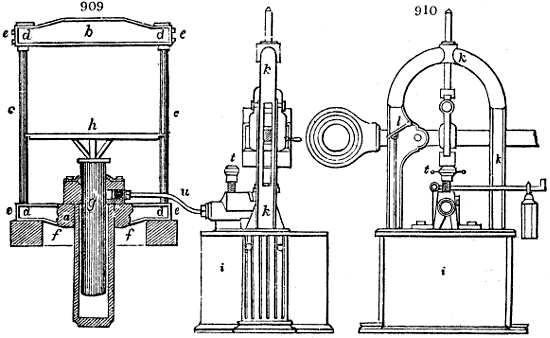
The framing consists of two stout cast-iron plates a, b, which are strengthened by projecting ribs, not seen in the section, fig. 909. The top or crown plate b, and the base-plate a, a, are bound most firmly together by 4 cylinders of the best wrought iron, c, c, which pass up through holes near the ends of the said plates, and are fast wedged in them. The flat pieces e, e, are screwed to the ends of the crown and base plates, so as to bind the columns laterally. f, is the hollow cylinder of the press, which, as well as the ram g, is made of cast iron. The upper part of the cavity of the cylinder is cast narrow, but is truly and smoothly rounded at the boring-mill, so as to fit pretty closely round a well-turned ram or piston; the under part of it is left somewhat wider in the casting. A stout cup of leather, perforated in the middle, is put upon the ram, and serves as a valve to render the neck of the cylinder perfectly water-tight, by filling up the space between it and the ram; and since the mouth of the cup is turned downwards, the greater the pressure of water upwards, the more forcibly are the edges of the leather valve pressed against the inside of the cylinder, and the tighter does the joint become. This was Bramah’s beautiful invention.
Upon the top of the ram, the press-plate or table, strengthened with projecting ridges, rests, which is commonly called the follower, because it follows the ram closely in its descent. This plate has a half-round hole at each of its four corners, corresponding to the shape of the four iron columns along which it glides in its up-and-down motions of compression and relaxation.
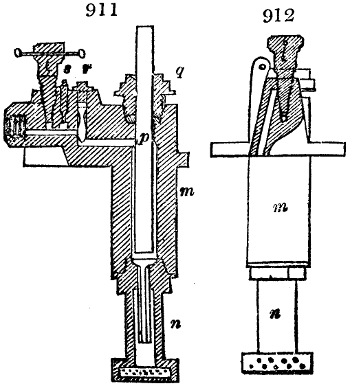
k, k, figs. 909. and 910., is the framing of a force pump with a narrow barrel; i is the well for containing water to supply the pump. To spare room in the engraving, the pump is set close to the press, but it may be removed to any convenient distance by lengthening the water-pipe u, which connects the discharge of the force pump with the inside of the cylinder of the press. Fig. 911. is a section of the pump and its valves. The pump m, is of bronze; the suction-pipe n, has a conical valve with a long tail; the solid piston or plunger p, is smaller than the barrel in which it plays, and passes at its top through a stuffing-box q; r is the pressure-valve, s is the safety-valve, which, in fig. 910., is seen to be loaded with a weighted lever; t is the discharge-valve, for letting the water escape, from the cylinder beneath the ram, back into the well. See the winding passages in fig. 912. u is the tube which conveys the water from the pump into the press-cylinder. In fig. 910. two centres of motion for the pump-lever are shown. By shifting the bolt into the centre nearest the pump-rod, the mechanical advantage of the workman may be doubled. Two pumps are generally mounted in one frame for one hydraulic press; the larger to give a rapid motion to the ram at the beginning, when the resistance is small; the smaller to give a slower but more powerful impulsion, when the resistance is much increased. A pressure of 500 tons may be obtained from a well-made hydraulic press with a ten-inch ram, and a two and a one inch set of pumps. See Stearine Press.