M. (continued 4)
Reading edition
Fig. 721. is a transverse section of a walled drain-gallery, from the grand gallery of the Hartz; see also fig. 722. a is the rock which needs to be supported only at the sides and top; b, the masonwork, a curve formed of the three circular arcs upon one level; c, the floor for the watercourse. Fig. 719. is a cross section of a walled gallery, as at Schneeberg, Rothenburg, Idria, &c.; d, is the rock, which is not solid either at the flanks, roof, or floor; e, the elliptic masonwork; f, the wooden floor for the waggons, which is sometimes, however, arched in brick to allow of a watercourse beneath it.
Fig. 720. shows two vertical projections of a portion of a walled shaft with buttresses, as built at the mine Vater Abraham, near Marienberg. J is a section in the direction of the vein g h, to show the roof of the shaft. I, a section exhibiting the slope of the vein g h, into which the shaft is sunk; m is the wall of the vein; k is the roof of the same vein; n, buttresses resting upon the flanks of the shaft; g, great arcs on which the buttresses bear; y, vertical masonwork; z, a wall which divides the shaft into two compartments, of which the larger p is that for extracting the ore, and the smaller for the draining and descent of the miners.
Fig. 722. C D is the shaft in which the vertical crank-rods c g, e d, move up and down. F, is a double hydraulic wheel, which can be stopped at pleasure by a brake mounted upon the machine of extraction. G, is the drum of the gig or whim for raising the corves or tubs (tonnes); H, is the level of the ground, with the carpentry which supports the whim and its roof. k, is the key-stone of the ogee arch which covers the water-wheel; a, is the opening or window, traversed by the extremity of the driving shaft, upon each side of the water-wheel, through which a workman may enter to adjust or repair it; c b, line of conduits for the streams of water which fall upon the hydraulic wheel; c, g, double crank with rods, whose motion is taken off the left side of the wheel; e, d, the same upon the right side. The distance from H to F is about 22 yards.
Figs. 723. 724. present two vertical sections of the shaft of a mine walled, like the roof of a cavern, communicating with the galleries of the roof and the wall of the vein, and well arranged for both the extraction of the ore, and the descent of the miners. The vertical partition of the shaft for separating the passage for the corves or tubs from the ladders is omitted in the figure, for the sake of clearness.
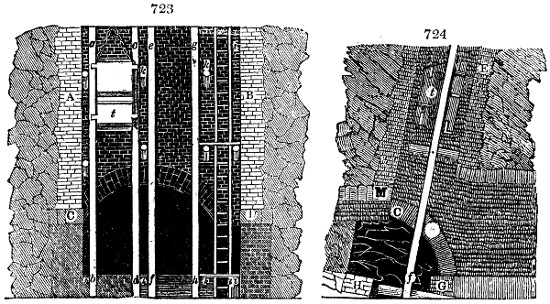
Fig. 723 and 724 enlarged (264 kB)
In fig. 723., A, B are the side walls supported upon the buttresses C and D; in fig. 724., E is the masonry of the wall, borne upon the arch F at the entrance to a gallery; the continuation being at G, which is sustained by a similar arch built lower.
L, is the vault arch of the roof, supported upon another vault M, which presents a double curvature, at the entrance of a gallery; at H is the continuation of the arch or vault L, which underneath is supported in like manner at the entrance of a lower gallery.
a b, c d, fig. 723., are small upright guide-bars or rods for one of the corves, or kibbles.
e f, g h, are similar guide-bars for the other corf.
i i, are cross-bars of wood, which support the stays of the ladders of descent.
k k, are also cross-bars by which the guide-rods are secured.
t, a corf, or extraction kibble, furnished with friction rollers; the other corf is supposed to be drawn up to a higher level, in the other vertical passage.
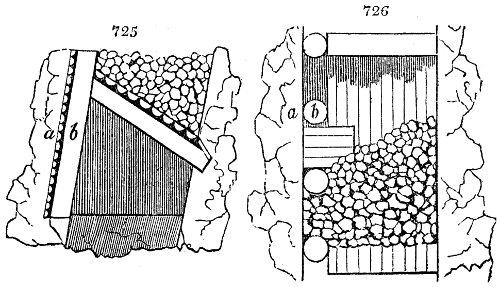
Figs. 725. 726. represent in a vertical section the mode of timbering the galleries of the silver and lead mines at Andreasberg in the Hartz. Fig. 725. shows the plan viewed from above. Upon the roof of the timbering, the workman throws the waste rubbish, and in the empty space below, which is shaded black, he transports in his waggons or wheelbarrows the ores towards the mouth of the mine. Fig. 726. is the cross section of the gallery. In the two figures, a represents the rock, and b the timbering; round which there is a garniture of small spars or lathes for the purpose of drainage and ventilation, with the view of promoting the durability of the wood-work.
The working of minerals by the mass is well exemplified a few leagues to the north of Siegen, near the village of Müsen, in a mine of iron and other metals, called Stahlberg, which forms the main wealth of the country. The plan of working is termed the excavation of a direct or transverse mass. It shows in its upper part the danger of bad mining, and in its inferior portion, the regular workings, by whose means art has eventually prevented the destruction of a precious mineral deposit.
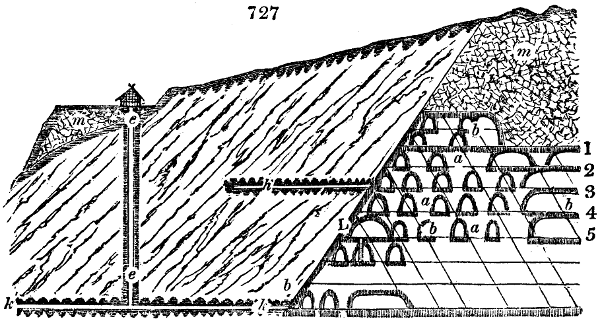
Fig. 727. is a vertical section of the bed of ore, which is a direct mass of spathose iron, contained in transition rock (greywacke). a, a, a, are pillars of the sparry ore, reserved to support the successive stages or floors, which are numbered 1. 2. 3. &c.; b, b, b, are excavations worked in the ore; which exhibit at the present day several floors of arches, of greater or less magnitude, according to the localities. It may be remarked, that where the metallic deposit forms one entire mass, rich in spathose iron ore of good quality, there is generally given to the vaults a height of three fathoms; leaving a thickness over the roof of two fathoms, on account of the numerous fissures which pervade the mass. But where this mass is divided into three principal branches, the roof of the vaults has only a fathom and a half of thickness, while the excavation is three fathoms and a half high. In the actual state of the workings, it may be estimated that from all this direct mass, there is obtained no more out of every floor than one-third of the mineral. Two-thirds remain as labours of reserve, which may be resumed at some future day, in consequence of the regularity and the continuation of the subterranean workings. e is a shaft for extraction, communicating below with the gallery of efflux k; h is an upper gallery of drainage, which runs in different directions (one only being visible in this section) over a length of 400 fathoms. The lower gallery k runs 646 fathoms in a straight line. The mine of Stahlberg has furnished annually on an average since 1760 about 25,000 cubic feet (French) of an excellent spathose ore of iron. m m, represents the mass of sparry iron.
Figs. 728, 729, 730. represent the cross system of mining, which consists in forming galleries through a mineral deposit, from its wall or floor towards its roof, and not, as usual, in the direction of its length. This mode was contrived towards the middle of the 18th century, for working the very thick veins of the Schemnitz mine in Hungary, and it is now employed with advantage in many places, particularly at Idria in Carniola. In the two sections figs. 728., 730., as well as in the ground plan fig. 729., the wall is denoted by m m, and the roof by t t. A first gallery of prolongation E F, fig. 730., being formed to the wall, transverse cuts, a a, are next established at right angles to this gallery, so that between every two there may be room enough to place three others, b, c, b, fig. 729. From each of the cuts a, ore is procured by advancing with the help of timbering, till the roof t be reached. When this is done, these first cuts a, are filled up with rubbish, laid upon pieces of timber with which the ground is covered, so that if eventually, it should be wished to mine underneath, no downfall of detritus is to be feared. These heaps of rubbish rise only to within a few inches of the top of the cuts a, in order that the working of the upper story may be easier, the bed of ore being there already laid open upon its lower face.
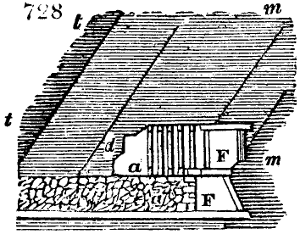
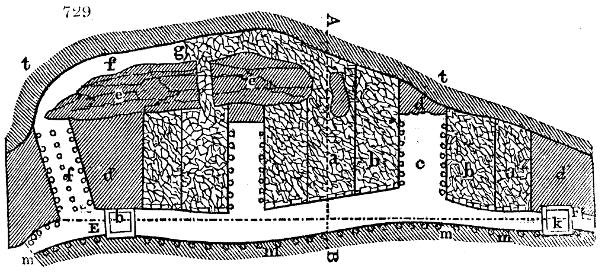
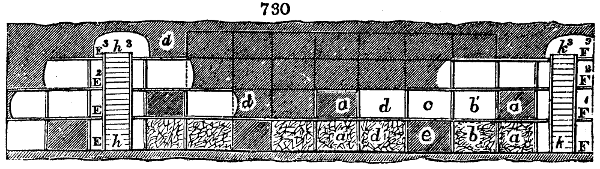
In proportion as the cuts a, of the first story E F, are thus filled up, the greater part of the timbering is withdrawn, and made use of elsewhere. The intermediate cuts b, c, b, are next mined in like manner, either beginning with the cuts c, or the cuts b, according to the localities. From fig. 729. it appears that the working may be so arranged, that in case of necessity, there may be always between two cuts in activity the distance of three cuts, either not made, or filled up with rubbish. Hence, all the portion of the bed of ore may be removed, which corresponds to a first story E F fig. 730., and this portion is replaced by rubbish.
The exploration of the upper stories E′ F′, E2 F2, E3 F3, is now prepared in a similar manner; with which view shafts h h3, k k3, are formed from below upwards in the wall m of the deposit, and from these shafts oblong galleries proceed, established successively on a level with the stories thus raised over one another. See fig. 730. The following objects may be specified in the figures:—
a a, the first cuts filled up with rubbish, upon the first story E F, fig. 729.
b b, other cuts subsequently filled up, upon the same story.
c, the cut actually working.
d, the front of the cut, or place of actual excavation of the mineral deposit.
e, masses of the barren rock, reserved in the cutting, as pillars of safety.
f, galleries, by means of which the workmen may turn round the mass e, in order to form, in the roof t, an excavation in the direction of the deposit.
g, rubbish behind the mass e.
k k, two shafts leading from the first story E F, to the upper stories of the workings, as already stated.
m, the wall, and t the roof of the mineral bed.
In the second story E′ F′, the gallery of prolongation F′, figs. 728. and 730., is not entirely perforated; but it is further advanced than that of the third story, which, in its turn, is more than the gallery of the fourth.
From this arrangement there is produced upon fig. 730. the general aspect of a working by reversed steps.
Whenever the workings of the cuts c in the first story are finished, those of the second, a′ a′, may be begun in the second; and thus by mounting from story to story, the whole deposit of ore may be taken out and replaced with rubbish. One great advantage of this method is, that nothing is lost; but it is not the only one. The facilities offered by the system of cross workings for disposing of the rubbish, most frequently a nuisance to the miner, and expensive to get rid of, the solidity which it procures by the banking up, the consequent economy of timbering, and saving of expense in the excavation of the rock, reckoning from the second story, are so many important circumstances which recommend this mode of mining. Sometimes, indeed, rubbish may be wanted to fill up, but this may always be procured by a few accessory perforations; it being easy to establish in the vicinity of the workings a vast excavation in the form of a vault, or kind of subterraneous quarry, which may be allowed to fall in with proper precautions, and where rubbish will thus accumulate in a short time, at little cost.
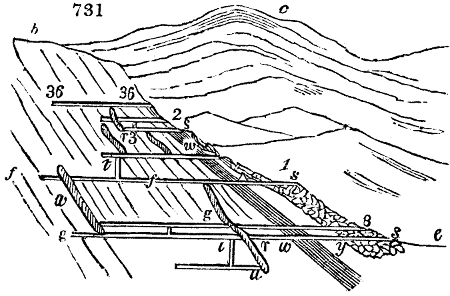
Fig. 731. represents a section of the celebrated lead mines of Bleyberg in Carinthia, not far from Villach.
b, c, is the ridge of the mountains of compact limestone, in whose bosom the workings are carried on.
e, is the metalliferous valley, running from east to west, between the two parallel valleys of the Gail and the Drave, but at a level considerably above the waters of these rivers.
f g, is the direction of a great many vertical beds of metalliferous limestone.
On considering the direction and dip of the marly schist, and metalliferous limestone, in the space w, w, to the west of the line 1, s, it would appear that a great portion of this system of mountains has suffered a slip between 1, s, and a parallel one towards the east; whereby, probably, that vertical position of the strata has been produced, which exists through a considerable extent. The metalliferous limestone is covered to a certain thickness with a marly schist, and other more recent rocks. It is in this schist that the fine marble known under the name of the lumachella of Bleyberg is quarried.
The galena occurs in the bosom of this rock in flattened masses, or blocks of a considerable volume, which are not separated from the rest of the calcareous beds by any seam. It is accompanied by zinc ore (calamine), especially in the upper parts of the mountain.
Several of the workable masses are indicated by r, r3; each presents itself as a solid analogous to a very elongated ellipse, whose axis dips, not according to the inclination of the surrounding rock, but to an oblique or intermediate line between this inclination, and the direction of the beds of limestone; as shown by r w, r′ u. Every thing indicates the contemporaneous formation of the limestone, and the lying beds of the lead ore.
The accidents or faults called kluft (rent) at Bleyberg are visible on the surface of the ground. Experienced miners have remarked that the rich masses occur more frequently in the direction of these accidents than elsewhere.
It is in general by galleries cut horizontally in the body of the mountain, and at different levels, s, g, s f, that the miner advances towards the masses of ore r, r3. Many of these galleries are 500 fathoms long before they reach a workable mass. The several galleries are placed in communication by a few shafts, such as t; but few of these are sunk deeper than the level of the valley e.
The total length of the mines of Bleyberg is about 10,000 yards, parallel to the valley e; in which space there are 500 concessions granted by the government to various individuals or joint stock societies, either by themselves or associated with the government.
The metalliferous valley contains 5000 inhabitants, all deriving subsistence from the mines; 300 of whom are occupied in the government works.
Each concession has a number and a name; as Antoni, Christoph, Matthæus, Oswaldi, 2, 8, 36, &c.
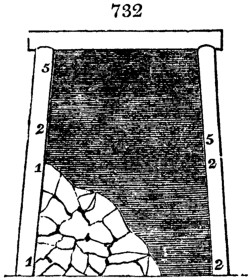
Fig.. 732 is a section in the quicksilver mine of Idria. 1. is the gray-limestone; 2. is a blackish slate; 5. is a grayish slate. Immediately above these transition rocks lies the bed containing the ores called corallenerz, which consist of an intimate mixture of sulphuret of mercury and argillaceous limestone; in which four men can cut out, in a month, 21⁄2 toises cube of rock.
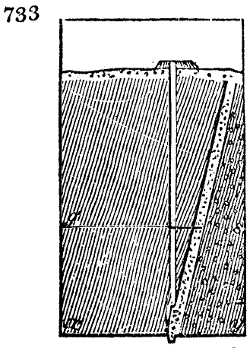
Fig. 733. represents a section of part of the copper mine of Mansfeldt; containing the cellular limestone, called rauchwacke, always with the compact marl-limestone called zechstein; the cupreous schist, or kupferschiefer; the wall of grayish-white sandstone, called the weisse liegende; and the wall of red sandstone, or the rothe liegende. The thin dotted stratum at top is vegetable mould; the large dotted portion to the right of the figure is oolite; the vein at its side is sand; next is rauchwacke; and lastly, the main body of fetid limestone, or stinkstein.
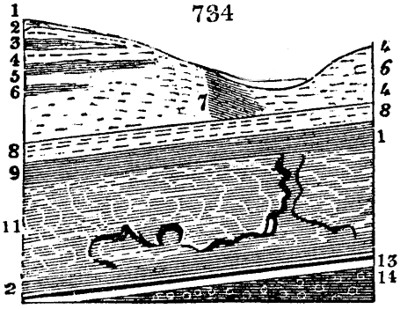
Fig. 734. represents one of the Mansfeldt copper schist mines in the district called Burgoerner, or Preusshoheit.
1. Vegetable mould, with siliceous gravel.
2. Ferruginous clay or loam.
3. Sand, with fragments of quartz.
4. Red clay, a bed of variable thickness as well as the lower strata, according as the cupreous schist is nearer or farther from the surface.
5. Oolite (roogenstein).
6. Newer variegated sandstone, (bunter sandstein).
7. Newer gypsum; below which, there is
8. A bluish marly clay.
9. Stinkstone, or lucullite.
10. Friable grayish marl.
11. Older gypsum, a rock totally wanting in the other districts of the mines of Rothenberg; but abounding in Saxon Mansfeldt, where it includes vast caverns known among the miners by the name of schlotten, as indicated in the figure.
12. The calcareous rock called zechstein. The lower part of this stratum shows symptoms of the cupriferous schist that lies underneath. It presents three thin bands, differently modified, which the miner distinguishes as he descends by the names of the sterile or rotten (faüle) rock; the roof (dachklotz); and the main rock (oberberg.)
13. Is a bed of cupriferous schist (kupferschiefer), also called the bitumino-marly schist, in which may be noted, in going down, but not marked in the figure:—
a, the lochberg, a seam 4 inches thick.
b, the kammschale, 1⁄4 of an inch thick.
c, the kopfschale, one inch thick.
These seams are not worth smelting; the following, however, are:—
d, the schiefer kopf, the main copper-schist, 2 inches thick.
e, a layer called lochen, one inch thick.
14. The wall of sandstone, resting upon a porphyry.
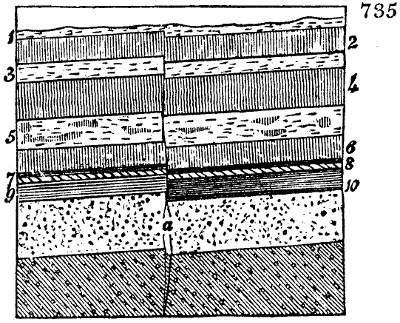
Fig. 735. is a section of the mines of Kiegelsdorf in Hessia, presenting—
1. Vegetable mould.
2. Limestone distinctly stratified, frequently of a yellowish colour, called lagerhafter kalkstein.
3. Clay, sometimes red, sometimes blue, sometimes a mixture of red, blue, and yellow.
4. The cellular limestone (rauhkalk). This rock differs both in nature and position from the rock of the same name at Mansfeldt.
5. Clay, usually red, containing veins of white gypsum, and fine crystals of selenite.
6. Massive gypsum of recent formation.
7. Fetid limestone, compact and blackish gray, or cellular and yellowish gray.
8. Pulverulent limestone, with solid fragments interspersed.
9. Compact marl-limestone, or zechstein, which changes from a brownish colour above to a blackish schist below, as it comes nearer the cupreous schist, which seems to form a part of it.
10. Cupreous schist (kuperschiefer), of which the bottom portion, from 4 to 6 inches thick, is that selected for metallurgic operations. Beneath it, is found the usual wall or bed of sandstone. A vein of cobalt ore a, which is rich only in the grayish-white sandstone (weisse liegende), traverses and deranges all the beds wherever it comes.
Of working mines by fire.—The celebrated mine worked since the tenth century in the mountain called Rammelsberg, in the Hartz, to the south of Goslar, presents a stratified mass of ores, among the beds of the rock which constitute that mountain. The mineral deposit is situated in the earth, like an enormous inverted wedge, so that its thickness (power), inconsiderable near the surface of the ground, increases as it descends. At about 100 yards from its outcrop, reckoning in the direction of the slope of the deposit, it is divided into two portions or branches, which are separated from each other, throughout the whole known depth, by a mass of very hard clay slate, which passes into flinty slate. The substances composing the workable mass are copper and iron pyrites with sulphuret of lead (galena), accompanied by quartz, carbonate of lime, compact sulphate of baryta, and sometimes gray copper ore, sulphuret of zinc, and arsenical pyrites. The ores of lead and copper contain silver and gold, but in small proportion, particularly as to the last.
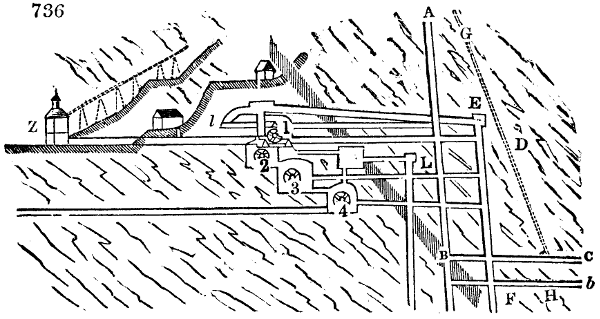
A mine so ancient as that of Rammelsberg, and which was formerly divided among several adventurous companies, cannot fail to present a great many shafts and excavations; but out of the 15 pits, only two are employed for the present workings; namely, those marked A B and E F, in fig. 736., by which the whole extraction and drainage are executed.—The general system of exploitation by fire, as practised in this mine, consists of the following operations:—
1. An advance is made towards the deposits of ore, successively at different levels, by transverse galleries which proceed from the shaft of extraction, and terminate at the wall of the stratiform mass.
2. There is formed in the level to be worked, large vaults in the heart of the ore, by means of fire, as we shall presently describe.
3. The floor of these vaults is raised up by means of terraces formed from the rubbish, in proportion as the roof is scooped out.
4. The ores detached by the fire from their bed, are picked and gathered; sometimes the larger blocks are blasted with gunpowder.
5. Lastly, the ores thus obtained are wheeled towards the shaft of extraction, and turned out to the day.
Let us now see how the excavation by fire is practised; and in that view, let us consider the state of the workings in the mines of Rammelsberg in 1809. We may remark in fig. 736. the regularity of the vaults previously scooped out above the level B C, and the other vaults which are in full activity of operation. It is, therefore, towards the lower levels that the new workings must be directed. For this purpose, the transverse gallery being already completed, there is prepared on the first of these floors a vault of exploitation at b, which eventually is to become similar to those of the superior levels. At the same time, there is commenced at the starting point below it, reached by a small well dug in the line of the mineral deposit, a transverse gallery in the rock, by means of blasting with gunpowder. The rock is also attacked at the starting-point by a similar cut, which advances to meet the first perforation. In this way, whenever the vaults of the level C are exhausted of ore and terraced up with rubbish, those of the level beneath it will be in full activity.
Others will then be prepared at a lower level; and the exploitation may afterwards be driven below this level by pursuing the same plan, by which the actual depth of excavation has been gained.
In workings by fire we must distinguish, 1. The case where it is necessary to open a vault immediately from the floor; 2. The case where the vault having already a certain elevation, it is necessary to heighten its roof. In the former case, the wall or floor of the mineral deposit is first penetrated by blasting with gunpowder. As soon as this penetration is effected over a certain length, parallel to the direction of the future vault, as happens at b, there is arranged on the bottom a horizontal layer of billets of firwood, over which other billets are piled in nearly a vertical position, which rest upon the ore, so that the flame in its expansion comes to play against the mineral mass to be detached. When after some similar operations, the flame of the pile can no longer reach the ore of the roof on account of its height, a small terrace of rubbish must be raised on the floor of the deposit; and over this terrace, a new pile of faggots is to be heaped up as above described. The ancient miners committed the fault of constantly placing such terraces close to the roof, and consequently arranging the faggots against this portion of the ore, so that the flame circulated from the roof down to the floor. The result of such procedure was the weakening of the roof, and the loss of much of the ore which could not be extracted from so unstable a fabric; and besides, much more wood was burned than at the present day, because the action of the flame was dissipated in part against the whole mass of the roof, instead of being concentred on the portion of the ore which it was desired to dislodge. Now, the flame is usually made to circulate from the floor to the roof, in commencing a new vault.
When the vault has already a certain height, care is always taken that between the roof of the vault and the rubbish on which the pile is arranged, no more than two yards of space should intervene, in order that the flame may embrace equally the whole concavity of the vault, and produce an uniform effect on all its parts. Here, the pile is formed of horizontal beds, disposed crosswise above one another, and presents four free vertical faces, whence it has been called a chest by the miners.
It is usually on Saturday that the fire is applied to all the piles of faggots distributed through the course of the week. Those in the upper floors of exploitation are first burned, in order that the inferior piles may not obstruct by their vitiated air, the combustion of the former. Thus, at 4 o’clock in the morning, the fires are kindled in the upper ranges; from pile to pile, the fireman and his assistant descend towards the lower floors, which occupies them till 3 o’clock in the afternoon. Vainly should we endeavour to describe the majestic and terrific spectacle which the fire presents, as it unfolds its wings under its metallic vaults, soon filled with vast volumes of smoke and flame. Let us mark the useful effect which it produces.
When the flame has beat for a few instants on the beds of ore, a strong odour of sulphur, and sometimes of arsenic is perceived; and soon thereafter loud detonations are heard in the vaults. Suddenly the flame is seen to assume a blue colour, or even a white; and at this period, after a slight explosion, flakes of the ore, of greater or less magnitude, usually fall down on the fire, but the chief portion of the heated mineral still remains fixed to the vault. The ores pass now into a shattered and divided condition, which allows them afterwards to be detached by long forks of iron. In this manner the fire, volatilizing entirely some principles, such as sulphur, zinc, arsenic, and water, changing the aggregation of the constituent parts of the ore, and causing fissures by their unequal expansibilities, facilitates the excavation of such materials as resist by their tenacity the action of gunpowder.
The combustion goes on without any person entering the mine from Saturday evening till Monday morning, on which day, the fireman and his assistants proceed to extinguish the remains of the bonfires. On Monday also some piles are constructed in the parts where the effect of the former ones has been incomplete; and they are kindled after the workmen have quitted the mine. On Tuesday all hands are employed in detaching the ores, in sorting them, taking them out, and preparing new piles against the next Saturday.
The labour of a week consists for every man of five posts during the day, each of 8 hours, and of one post of four hours for Saturday. Moreover, an extra allowance is made to such workmen as employ themselves some posts during the night.
The labour of one compartment or atelier of the mine consists therefore in arranging the faggots, in detaching the ore which has already experienced the action of the fire, in breaking the blocks obtained, in separating the ore from the débris of the pile, and whenever it may be practicable or useful, in boring holes for blasting with gunpowder. The heat is so great in this kind of mine, that the men are obliged to work in it without clothing.
We have already remarked, that besides the working by fire, which is chiefly used here, recourse is sometimes had to blasting by gunpowder. This is done in order either to recover the bottom part or ground of the vaults on which the fire can act but imperfectly, to clear away some projections which would interfere with the effect of the pile, or lastly to strip the surrounding rock from the mass of the ore, and thence to obtain schist proper for the construction of the rubbish-terraces.
The blasting process is employed when the foremen of the workshop or mine-chamber judge that a hole well placed may separate enough of ore to pay the time, the repair of tools, and the gunpowder expended. But this indemnification is rarely obtained. The following statement will give an idea of the tenacity which the mineral deposit often presents.
In 1808, in a portion of the Rammelsberg mine, the ore, consisting of extremely compact iron and copper pyrites, was attacked by a single man, who bored a mining hole. After 11 posts of obstinate labour, occupying altogether 88 hours, the workman, being vigilantly superintended, had been able to advance the hole to a depth of no more than 4 inches; in doing which he had rendered entirely unserviceable 126 punches or borers, besides 26 others which had been re-tipped with steel, and 201 which had been sharpened; 61⁄4 pounds of oil had been consumed in giving him light; and half a pound of gunpowder was required for blasting the bore. It was found from a calculation made upon these facts by the administration of mines, that every inch deep of this hole cost, at their low price of labour, nearly a florin, value two shillings and sixpence.
It is therefore evident that though the timber, of which the consumption is prodigiously great, were much less abundant and dearer than it still is at Rammelsberg, mining by fire would be preferable to every other mode of exploitation. It is even certain, that on any supposition, the employment of gunpowder would not be practicable for every part of the mine; and if fuel came to fail, it would be requisite to renounce the workings at Rammelsberg, although this mountain still contains a large quantity of metals.
If in all mines the free circulation of air be an object of the highest importance, we must perceive how indispensable it must be in every part of a mine where the mode of exploitation maintains the temperature of the air at 112° Fahr., when the workmen return into it after the combustion of the piles, and in which besides it is necessary that this combustion be effected with activity in their absence. But in consequence of the extent and mutual ramifications of the workings, the number of the shafts, galleries, and their differences of level, the ventilation of the mine is in a manner spontaneously maintained. The high temperature is peculiarly favourable to it. The aid of art consists merely in placing some doors judiciously, which may be opened or shut at pleasure, to carry on the circulation of the air.
In considering the Rammelsberg from its summit, which rises about 400 yards above the town of Goslar, we observe, first, beds of slaty sandstone, which become the more horizontal the nearer they approach to the surface. At about 160 yards below the top level there occurs, in the bosom of the slaty graywacke, a powerful stratum of shells impasted in a ferruginous sandstone. See D, fig. 730. In descending towards the face of the ore, the parallel stratification of the clay-slate which forms its walls and roof grows more and more manifest. Here the slate is black, compact, and thinly foliated. The inclination of the different beds of rock is indicated at B. The substance of the workable mass is copper and iron pyrites, along with sulphuret of lead, accompanied by quartz, carbonate of lime, compact sulphate of baryta, and occasionally gray copper (fahlerz), sulphuret of zinc, and arsenical pyrites.
The ores are argentiferous and auriferous, but very slightly so, especially as to the gold. It is the ores of lead and copper which contain the silver, and in the latter the gold is found, but without its being well ascertained in what mineral it is deposited. Sometimes the copper occurs in the native state, or as copper of cementation. Beautiful crystals of sulphate of lime are found in the old workings.
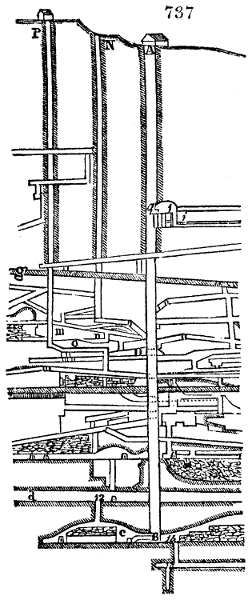
Fig. 737 enlarged (150 kB)
In figs. 736. 737., A B is the shaft of extraction, called the Kahnenkuhler; N is the ventilation shaft, called Breitlingerwetterschacht; P is the extraction shaft, called Innier-schacht.
E F, is a new extraction-shaft, called Neuer treibschacht, by which also the water is pumped up; by A B, and E F, the whole extraction and draining are carried on. The ores are raised in these shafts to the level of the waggon-gallery (galerie de roulage) i, by the whims l, q, provided with ropes and buckets. 1, 2, 3, 4, fig. 736., represent the positions of four water-wheels for working the whims; the first two being employed in extracting the ores, the last two in draining. The driving stream is led to the wheel 1, along the drift l; whence it falls in succession upon the wheels 2, 3, 4. The general system of working consists of the following operation;—
1. The bed of ore is got at by the transverse galleries, m, n, o, q, r, s, which branch off from the extraction shaft, and terminate at the wall of the main bed;
2. Great vaults are scooped out at the level of the workings, by means of fire;
3. The roofs of these vaults are progressively propped with mounds of rubbish;
4. The ores thus detached, or by blasting with gunpowder, are then collected;
5. Lastly, they are wheeled out to the day; and washed near Z.
Comparative Table of celebrated Mines in Europe and America. By F. Burr, Esq. (Quarterly Mining Review for July, 1835, p. 60.)
Consolidated and United Mines. Veta Grande Mines. Mine of Valenciana. Mine of Himmelsfürst.
(At present the richest mines in Cornwall.) (At present the richest mines in Mexico.) (Richest of the Mexican mines at the beginning of the present century.) (Richest of the Saxon mines at the beginning of the present century.)
Situation Two miles east of Redruth. Four miles north of Zacatecas. One mile north of Guanaxuato. Two miles south-east of Freyberg.
Elevation Elevation of the surface above the level of the sea, from 200 to 300 ft.; depth of the bottom of the mine below the level of the sea, about 1,370 feet. Elevation of the surface above the level of the sea, supposed to be about 6000 feet. Elevation of the bottom of the mine above the level of the sea, probably near 5,000 feet. Elevation of the surface above the level of the sea, 7,617 feet. Elevation of the bottom of the mine above the level of the sea, 5,730 feet. Elevation of the surface above the level of the sea, 1,346 feet. Elevation of the bottom of the mine above the level of the sea, 263 feet.
Nature of the rock The Veta Madre of Guanaxuato, upon which this mine is worked, traverses both clay slate and porphyry, but it is most productive in the former rock. The clay slate is considered by Humboldt to belong to the transition class, but situate near the limits of primary formations. This rock in depth, passes into chlorite slate, and talc slate. It contains subordinate beds of syenite, hornblende slate, and serpentine. The porphyry rests upon the clay slate, and is conformable to it, both in direction and stratification. The rock prevailing in the neighbourhood of Freyberg, in which this and most of the other mines are situate, is a formation of primary gneiss. Primary clay slate resting immediately on granite, a short distance westward of the mines. The clay slate is intersected by numerous channels of porphyry, which have nearly the same direction as the mineral veins, and are often of considerable width. The porphyry sometimes appears also to form large irregular masses in the clay slate. Both rocks are traversed by veins of quartz and clay intersecting the metalliferous veins. Transition clay slate, alternating with dolomite, and occasionally with greywacke. This clay slate is sometimes decomposed; it rests on syenitic rocks, and is in some places covered with porphyry.
Nature of the metalliferous deposits In the consolidated mines, the eight following lodes are extensively worked:—Wheal Fortune lode, Cusvea lode, Deeble’s lode, Old lode, Taylor’s lode, Tregonning’s lode, Martin’s lode, and Glover’s lode. In the united mines, the principal workings are upon the Old lode, and about five or six others are more or less productive. Numerous smaller lodes or “branches” occur also in both mines. The principal lodes are from 2 or 3, to 7 or 8 feet wide; the “branches” are generally 12 or 18 inches wide. The direction of the lodes varies from nearly east and west to about 20 degrees north of east and south of west. The underlie of the principal lodes, is from 2 to 3 feet per fathom north, that of the smaller ones about the same south. One principal vein (the Veta Grande) which is generally separated into three branches, and sometimes into four. When ramified, the width extends to 60 or 70 feet; when united, it varies from 8 or 10 to 20 or 30 feet. The branches are generally about 10 or 12 feet wide, and the upper one is most productive. The direction of the Veta Grande, is from 30 to 40 degrees south of east, and north of west, and its underlie, from two to three feet per fathom south. Other veins of less size, occur in the neighbourhood of the Veta Grande, which cross it at an acute angle. One of these appears to heave the vein for about 700 feet, being the most remarkable derangement of the kind on record. One Veta (the Veta Madre) which is often separated into three branches, extending from 130 to 160 feet in width. When not ramified, its width varies from 20 or 30 to 60 or 70 feet, but is more commonly from 40 to 50 feet. The direction of the vein, is north-west and south-east; its underlie is south, and about five or six feet per fathom. There are five veins worked in this mine. The principal vein (Teichflache) is from one foot six inches, to three feet in width, the others are from six to 12 inches wide. The direction of this vein, is nearly north and south, its underlie is west, and about three feet per fathom. Some of the other veins intersect it.
Ores Chiefly copper ore, occasionally native copper, blue and green carbonate of copper. Tin, or oxide of tin, also occurs, but not in very great abundance. Chiefly red silver, native silver, sulphuret of silver, and argentiferous pyrites. Sulphuret of silver, native silver, prismatic black silver, red silver, native gold, argentiferous galena. Argentiferous sulphuret of lead, native silver, sulphuret of silver, red silver.
Produce of the ores 91⁄4 per cent. of fine copper; average produce in 100 parts of ore. 31⁄2 oz. per quintal. Four ounces of silver per quintal of 100 lbs., equivalent to 21⁄2 parts of metal in 1,000 of ore, or 1⁄4 per cent. Six to seven ounces of silver per quintal of 100 lbs. Equivalent to from 33⁄4 to 41⁄2 parts of metal in 1,000 of ore, or from 3-8ths to nearly 1⁄2 per cent.
Veinstone Chiefly quartz, of which many varieties occur. Chiefly quartz, occasionally amethyst, carbonate of lime, and sulphate of barytes. Quartz, amethyst, carbonate of lime, pearlspar, and hornstone. Quartz, pearlspar, and calcareous spar.
Mineral substances The ores are generally accompanied by “gossan”[34] in the backs of the lodes, by blende, and by iron, and arsenical pyrites in depth. The ores are generally accompanied by blende, sulphuret of antimony, and iron pyrites. The ores are accompanied by blende, spathose iron, copper and iron pyrites. The ores are accompanied by blende, spathose iron, and a little iron and arsenical pyrites.
Depth of the principal shafts Woolf’s engine-shaft, 248 fathoms; Pearce’s engine-shaft, 275 fathoms. Some of the other engine shafts are scarcely inferior in depth. Tiro General, 182 fathoms; Gallega shaft, 138 fathoms. Tiro General, 310 fathoms. Frankenschacht, 180 fathoms.
Depth of adit at the principle shafts At Woolf’s engine-shaft, 13 fathoms. The average depth of the adit at the other engine-shafts is about 30 or 40 fathoms. There is no adit to this mine. There is no adit to this mine. The adit at the shaft called Frankenschacht is 47 fathoms in depth.
Quantity of water Varies from 2,000 to 3,000 gallons per minute. About 80 gallons per minute. The Valenciana was a dry mine from its commencement in 1760 to 1780, when it first became troubled with water, in consequence of some of the workings being inadvertently communicated with the adjoining mine of Tepeyac; which, although upon the same vein, was extremely wet. The quantity of water raised during the late working appears to have been about 110 gallons per minute, but the regular influx was much less. 50 gallons per minute.
Height to which the water is raised About 230 fathoms at the consolidated mines, at the united mines, about 110 fathoms. On an average about 150 fathoms. 310 fathoms. 133 fathoms.
Power employed in drainage 9 steam-engines; 3 of 90-inch cylinder, 3 of 85, 1 of 80, and 2 of 65. A water wheel, 48 feet in diameter. Usually 10 malacates.[b] A steam-engine of 30-inch cylinder, and 7 malacates. Two water-wheels, each 42 feet in diameter.
Probable equivalent in actual horsepower 1,500 constantly at work, or a total number of above 4,500. 32 horses constantly working, or a total number of about 100 horses.[c] 65 horses constantly at work, or a total number of about 200. 16 horses constantly at work or a total number of about 50.[d]
Average annual expense in drainage 12,700l. taking the average of the last ten years.[a] 20,000l. per annum.[c] About 40,000l., per annum.[d] Cannot be ascertained, but evidently very small.[d]
Quantity of ore annually produced 16,400 tons of copper ore, a few tons of tin ore.[a] 21,380 tons of silver ore.[c] 32,500 tons of silver ore.[d] 630 tons of silver ore.[d]
Produce in metal 1,517 tons of fine copper, a little tin.[a] 153,000 lbs. troy of silver.[c] 221,900 lbs. troy silver.[d] 6,160 lbs. troy of silver.[d]
Total returns, or value of the above 119,800l.[a] 423,400l. per annum.[c] About 600,000l.[d] About 18,000l.[d]
Total costs of the mine 93,500l. exclusive of lord’s dues; 98,600l. including lord’s dues.[a] 252,170l. per annum.[c] 197,900l. per annum.[d] 9,500l. per annum.[d]
Clear profit to the proprietors 21,000l. per annum.[a] 171,240l. per annum.[c] 118,750l. per annum.[d] 3,560l. per annum.[d]
Amount of capital invested 75,000l.[a] 130,000l.[c] Cannot be ascertained, but known to have been very small.[d] Cannot be ascertained, but probably very small.[d]
Interest on capital invested 280 per cent. after paying back the original capital.[a] Nearly 700 per cent. after paying back the original capital.[c] Not known, but certainly many hundred per cent.[d] Not known, but probably very high.[d]
Proportion of costs to returns Costs exclusive of lord’s dues, 78 per cent.[a] About 591⁄2 per cent. Costs 60 per cent. In the nine years following, the proportion was 80 per cent., at the end of that time the working of the mine was stopped by the revolution, in the year 1809.[d] Costs 73 per cent.[d]
Number of men employed About 2,500 persons, of whom about 1,450 are employed under ground. About 900, of whom nearly 600 are employed under ground. 3,100 Indians and Mestizoes, of whom 1,800 are employed under ground. 700 miners of whom 550 are employed under ground.
Wages of the mines per day Probably about 3 shillings on an average. About 8 or 9 shillings per day. From 4 to 5 shillings. About 1s. 6d. per day.
Quantity and expense of powder 1,420 cwt.; value 15,830l. 240 cwt.; value 1,070l.
Manner in which the ores are disposed of Sold to the smelting companies, and smelted by them at Swansea, in South Wales. Chiefly reduced by the company at the hacienda of Sanceda, by smelting and amalgamation. Sold to the Rescatadores, and reduced by smelting and amalgamation at haciendas, in the neighbourhood of Guanaxuato. Delivered to the government reduction works in the neighbourhood of Freyberg, where they are partly smelted, and partly amalgamated.
[a] Average of the last Ten Years. [b] Malacate; a horse whim. [c] Average of the last Six Years. [d] Average year at the end of the Eighteenth Century.
VENTILATION OF MINES.
When men penetrate by narrow passages into the interior of the earth, their respiration, joined to the combustion of candle and gunpowder, are not long of vitiating the air. The decomposition of wood contributes to the same effect, as also the mineral bed itself, especially in coal mines, by the carburetted hydrogen and carbonic acid evolved, and from the absorption of oxygen by pyrites. In many cases, arsenical and mercurial vapours are disengaged. Hence the necessity of maintaining in subterranean cavities a continual circulation of air, which may renew the atmosphere round the miners. The whole of the means employed to produce this effect, constitutes what is called the ventilation of mines.
These means are divided into natural and artificial. The natural means are the currents produced by the difference of density between the air of mines and the external air; the artificial are air-exhausters or condensers, fires, &c.
The temperature of the air of the subterranean workings surpasses the mean temperature of the place in which the mine is opened. Hence it is lighter in winter, but in summer often heavier than the air of the atmosphere. For this reason, when the mine presents two openings at different levels, the air naturally flows out by the most elevated in winter, and by the lowest in summer. We may take advantage of this circumstance, to lead the air into the bottom of even a very long gallery, opening into the side of the mountain, by piercing a shaft into its roof at some distance from the entrance, and dividing the gallery by a horizontal floor into two parts, which have no mutual communication, except at the furthest extremity—the upper part communicating with the shaft, and the under with the mouth of the gallery. If the two compartments have different dimensions, the air in the smaller sooner comes into an equilibrium of temperature with the rock; and the difference of temperature of the two compartments is sufficient to produce a current. If a streamlet of water flows through this gallery, it facilitates the flow of the air along the lower compartment. If a mine has several openings situated on the same level, it rarely happens but some peculiar circumstance destroys, during the colds of winter and the heats of summer, the equilibrium of the air. But in spring and autumn, when the external air is nearly of the same temperature with that of the mines, the above-named causes are almost always too feeble to excite an issuing current. This effect is, however, frequently obtained by raising over one of the shafts a chimney 20 or 30 yards high, which alone produces the effect of an opening at a different level. It has been remarked that stormy weather usually deranges every system of ventilation. See Pitcoal and Ventilation.
MINIUM. (Eng. and Fr., Red lead; Mennige, Germ.) This pigment is a peculiar oxide of lead, consisting of two atoms of the protoxide and one of the peroxide; but, as found in commerce, it always contains a little extra protoxide, or yellow massicot. It is prepared by calcining lead upon a reverberatory hearth with a slow fire, and frequent renewal of the surface with a rake, till it becomes an oxide, taking care not to fuse it. The calcined mass is triturated into a fine powder in a paint mill, where it is elutriated with a stream of water, to carry off the finely levigated particles, and to deposit them afterwards in tanks. The powder thus obtained being dried, is called massicot. It is converted into minium, by being put in quantities of about 50 pounds into iron trays, 1 foot square, and 4 or 5 inches deep. These are piled up upon the reverberatory hearth, and exposed during the night, for economy of fuel, to the residuary heat of the furnace, whereby the massicot absorbs more oxygen, and becomes partially red lead. This, after being stirred about, and subjected to a similar low calcining heat once and again, will be found to form a marketable red lead.
The best minium, however, called orange mine, is made by the slow calcination of good white lead (carbonate) in iron trays. If the lead contains either iron or copper, it affords a minium which cannot be employed with advantage in the manufacture of flint-glass, for pottery glazes, or for house-painting.
Dumas found several samples of red lead which he examined to consist of the chemical sesquioxide and the protoxide, in proportions varying from 50 of the former and 50 of the latter, to 95·3 of the former and 4·7 of the latter. The more oxygen gas it gives out when heated, the better it is, generally speaking. See Naples Yellow.
MINT. (Monnaie, Fr.; Münze, Germ.) The chief use of gold and silver is to serve for the medium of exchange in the sale and purchase of commodities, a function for which they are pre-eminently fitted by their scarcity, by being unalterable by common agents, and condensing a great value in a small volume. It would be very inconvenient in general to barter objects of consumption against each other, because their carriage would be expensive, and their qualities, in many cases, easily injured by external agents, &c. Gold is exempt from spontaneous change, and little costly in conveyance. Mankind at a very early period recognised how much easier it was to exchange a certain weight of gold or silver for objects of commerce, than to barter these objects themselves; and thenceforth all agreed to pay for their purchases in bars or ingots of these precious metals. But as their intrinsic value depends upon their purity, it became necessary to stamp on these bars their standard quality and their weight.
The inconvenience of using ingots in general trade, on account of the difficulty of defining fractional values, has determined governments to coin pieces of money, that is, quantities of metal whose weight and standard were made known and guaranteed by the effigies of the prince. It is true, indeed, that kings have become frequently coiners of base money, by altering the weight and purity of the pieces apparently guaranteed by their impress. By such reductions modern coins represent less of the precious metal than they did long ago. The ordonnance of 755, for the coining of sous in France, proves that there was then as much fine silver in a single sous, as there is now in a piece of 5 francs. During the last two centuries, indeed, silver coins have been diminished two thirds in weight.
But since knowledge has become more generally diffused, it has been shown that these frauds are equally injurious to the prince and to public faith. A sovereign may, it is true, declare by a decree that a shilling-piece is to be held worth five; but let us consider the consequences of this decree. All the individuals who have rents or capital sums to receive, will be ruined, by getting in metallic value only one-fifth of what is due to them; for although the nominal value should be the same as what they are entitled to, the intrinsic value would be but a fifth of the former; so that when they go to purchase the necessaries or comforts of life, the dealer who sells them will at once raise their price five-fold. Each article of merchandise would thus acquire a nominal price 5 times greater; and he who had received payment of a debt in that money, could not with it procure more than one-fifth of the goods he could have previously commanded. That fraudulent law would, therefore, favour the debtors at the expense of the creditors; and as the state is commonly a great debtor, especially when it has recourse to the depreciation of the currency, it is obvious, that however illicit the gain which it makes, it still does gain; and this is the reason why princes have so often tampered with the mint. But let us examine the other consequences of this decree.
If the sovereign is a debtor, he is also a creditor and consumer, and even the most considerable of any. The taxes which he imposes are paid him in this deteriorated money, returned to him at its nominal value; and the purveyors of his armies, his buildings, and his household, sell him their commodities only at the actual market price. We may infer from this simple development that the coin with which he pays for any object has the same intrinsic value as the object; and that the name given to the coin is of no consequence. The prince may call it a crown, a ducat, or a rix-dollar at his pleasure; and he may assign any value to it that his caprice may suggest, yet this will not affect its value; for this is fixed beyond his control by the general nature of things. The prince may, indeed, at the outset, have profited by defrauding his creditors, and by authorizing each debtor to imitate him, but he will soon lose whatever he may have gained; and he will thus learn to his cost that it was bad policy to sacrifice his character by giving an example of a fraud so truly unprofitable in the issue. Moreover, he will lose still as much in the following years, because his treasury will receive only one-fifth part of the taxes, unless he has quintupled the imposts. It may be said, indeed, that he might do the one thing along with the other. But every one knows that this power is neither generally permitted to princes, nor if it were, could it be safely exercised. Serious political crises would combine to endanger the stability of the government; which besides, as the main consumer in the nation, must lose always as much as it seems to gain.
It is therefore manifest that the alteration of the standard and weight of the coinage is at once a crime and a ruinous action for the sovereign power to commit; and hence such disastrous measures have been long abandoned in all well-regulated states. A gold sovereign is intrinsically worth 20 shillings minus the cost of coinage; for were it worth more, all our sovereign pieces would be exported or melted down, to obtain the difference of value, however trifling it might be; and were it worth less, it would be the source of loss similar to what the state occasions when it depreciates the coin.
To comprehend the true value of a coin, we must regard this piece as an article of merchandise, whose value depends, as that of every thing else, on its usefulness, the esteem in which it is held, and the demand for it in the market. Grain increases in value when there are few sellers and many buyers; gold and silver are in the same predicament. The value of these metals is much augmented, indeed, by the universal currency they obtain when struck into money; a value additional to what they possess as objects of the arts. This value of the precious metals changes with time and place, like that of every merchandise; their abundance, since the discovery of America, has greatly lowered their value; that is, with the same weight of metal, we cannot at the present day purchase the same quantity of corn, land, wool, &c. as formerly. In the countries where silver abounds, this metal has less value, or, in other terms, commodities are dearer. Hence the metal tends to resume its equilibrium in flowing into those places where it is rarer; which means, that the consumer prefers purchasing his commodities there rather than in another place, if he can easily transport them to where they are dearer.
It was formerly believed that a country is rich when it has a great deal of gold and silver; but this popular illusion has passed away. Spain has never been poorer than since the discovery of America, because its national industry has been ruined, and the capitals merely passed through its hands to spread over the rest of Europe, from which it was obliged to import every thing that its want of home manufactures made it necessary to procure from abroad. We may add to these, the prodigalities of the court, which, supposing its wealth inexhaustible, tried to corrupt all the ministers of the other powers, in furtherance of the chimera of universal dominion. The richest state is that in which there is most industry, whereby the inhabitants may procure every thing indispensable to the conveniences and comforts of life. Gold as a useful metal, and a medium of exchange, is undoubtedly very precious, and an adequate quantity for these exchanges must be had; but as it is good for very little besides, nay, as an excess is even hurtful, it soon begins to fly of itself towards the places where it is more needed or less common.
With regard to the relative value of gold and silver, several details have already been given in our view of the mineral wealth of the globe. Three centuries ago, an ounce of gold was worth at London or Paris 10 ounces of silver; now it may be exchanged for 15 ounces and a half.
The par of two coins results from the comparison of their weight and standard fineness. Let us take for an example the conversion of English gold sovereigns worth 20 shillings or a pound sterling, in relation to the French louis of 20 francs. The standard of the sovereign gold is 0·917, fine gold being 1000; its weight is 125·256 gr. English, or 7·980855 grammes; by multiplying this weight into its standard, we have a product of 7·318444035; this is, in grammes, the quantity of pure gold contained in the sovereign piece. The piece of 20 francs has a legal standard of 0·9; and multiplying this number by the weight of the louis, 6·45161 grammes, we find that it contains 5·806449 of pure metal. We then make this proportion:—
As 5·806449 : 20 francs ∷ 7·31844 : 25·2079 francs; or the value of the English sovereign is nearly 25·21 francs, in French gold coin. A similar calculation may be made for silver coins. The French rule for finding the par of a foreign gold coin, or its intrinsic value in francs, is to multiply its weight by its standard or titre, and that product by 34⁄9. The par of foreign silver money, or its intrinsic value in francs, is obtained by multiplying its weight in grammes by its standard in thousand parts, and by 2⁄9. The French 5-franc piece has its standard or titre at 0·9, and weighs 25 grammes.
The assaying of gold for coin and trinkets requires very delicate management. The French take half a gramme at most (about 71⁄2 grains) of gold, and fuse it with thrice its weight of silver, as already described under Assay. The parting is the next operation. For this purpose the button of gold and silver alloy is first hammered flat on a piece of steel, and then made feebly red hot in burning charcoal or over a lamp flame. After being thus annealed, the metal is passed through the rolling press, till it be converted into a plate about 1⁄70 of an inch thick. After annealing this riband, it is coiled into a spiral form, introduced immediately into a small matrass of a pear shape, an assay matrass, and about 500 grains of nitric acid, sp. grav. 1·185, are poured over it. Heat being now applied to the vessel, the solution of the silver and copper alloys ensues, and after 22 minutes of constant ebullition, the liquid is poured off and replaced by an equal quantity of nitric acid, likewise very pure, but of the density 1·28. This is made to boil for about 10 minutes, and is then poured off, when the matrass is filled up with distilled water to the brim. In conclusion, a small annealing crucible is inverted as a cup over the mouth of the matrass, which is now turned upside down with a steady hand; the slip of metal falls into the crucible through the water; which by sustaining a part of its weight, softens its descent and prevents its tearing. The matrass is then dexterously removed, without letting its water overflow the crucible. The water is gently decanted from the crucible, which is next covered, placed in the middle of burning charcoal, and withdrawn whenever it becomes red hot. After cooling, the metal slip is weighed very exactly, whence the weight of fine gold in the alloy is known. Stronger acid than that prescribed above would be apt to tear the metallic riband to pieces, and it would be difficult to gather the fine particles of gold together again. The metallic plate becomes at last merely a golden sieve, with very little cohesion. When copper is to be separated from gold by cupellation, a higher temperature is requisite than in cupelling silver coin.
The coining apparatus of the Royal Mint of London is justly esteemed a masterpiece of mechanical skill and workmanship. It was erected in 1811, under the direction of the inventor, Mr. Boulton; and has since been kept in almost constant employment.
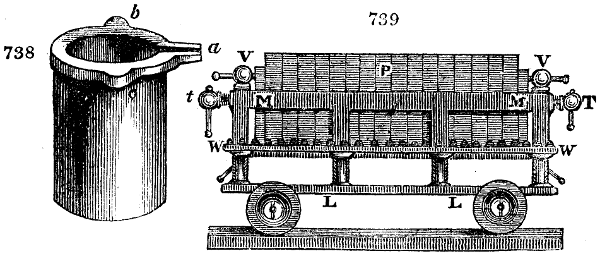
The melting pots (fig. 738.) are made of cast iron, and hold conveniently 400 pounds of metal. They are furnished with a spout or lip for pouring out the metal, and with two ears, on which the tongs of the crane lay hold in lifting them out of the furnace. The pot rests on pedestals on the grate of the furnace, and has a ring cast on its edge to prevent the fuel falling into it. Whenever it becomes red hot, the metal properly prepared and mixed, so as to produce an alloy containing 0·915 parts of gold, is put in, and during the melting, which occupies some hours, it is occasionally stirred. The moulds are meanwhile prepared by warming them in a stove, and thereafter by rubbing their inside surfaces with a cloth dipped in oil, by which means the ingots cast in them get a better surface. Fig. 739. represents a side view of the carriage, charged with its moulds. When the proper number of moulds is introduced, the screws at the end, represented at t T, are screwed fast, to fix them all tight.
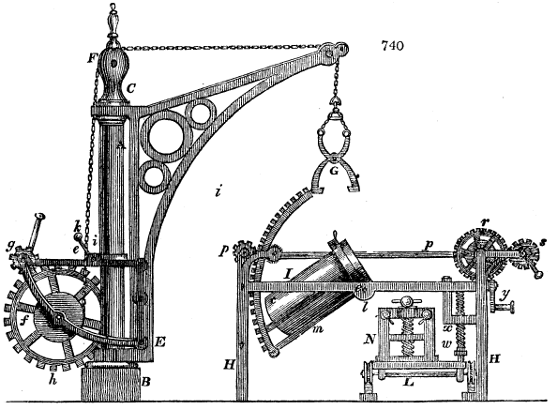
The pot of fused metal is lifted out of the furnace by the crane (fig. 740.), then swung round, and lowered down into the cradle l, m, n, o of the pouring machine, until the ring on the edge of it rests on the iron hoop n, which, being screwed tight up, holds it secure, and the crane-tongs are removed. One of the assistants now takes the winch handle s in one hand, and y in the other. By turning y he moves the carriage forward, so as to bring the first mould beneath the lip of the melting pot; and by turning s, he inclines the pot, and pours the metal into the mould. He then fills the other moulds in succession. The first portion of liquid metal is received in a small iron spoon, and is reserved for the assay-master; a second sample is taken from the centre of the pot, and a third from the bottom part. Each of these is examined as to its quality.
The ingots, which are about 10 inches long, 7 broad, and 6 tenths of an inch thick, are now carried to the rolling mill.
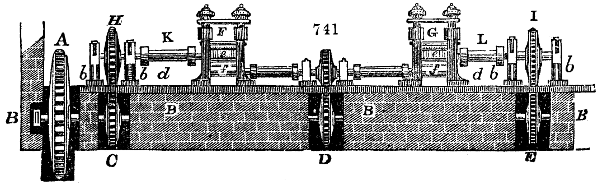
Fig. 741., where A represents a large spur wheel, fixed on the extremity of a long horizontal shaft B B, extending beneath the whole mill. This wheel and shaft are driven by a smaller wheel, fixed on the main or fly-wheel shaft of a steam engine of 36-horse power. The main shaft B of the rolling mill has wheels C, D, E fixed upon it, to give motion to the respective rollers, which are mounted at F and G, in strong iron frames, bolted to the iron sills a a, which extend through the whole length of the mill, and rest upon the masonry, in which the wheels are concealed. The two large wheels C and E give motion to the wheels H, I, which are supported on bearings between two standards b, b, bolted down to the ground sills. On the ends of the axes of these wheels are heads for the reception of coupling boxes d, d, which unite them to short connecting shafts K L; and these again, by means of coupling boxes, convey motion to the upper rollers e, e, of each pair, at F and G. The middle wheel D upon the-main shaft B gives motion to the lower rollers in a similar manner. Thus both the rollers e, f of each frame receive their motion from the main shaft with equal velocity, by means of wheels of large radius, which act with much more certainty than the small pinions usually employed in rolling mills to connect the upper and lower rollers, and cause them to move together.
The rolling mill contains four pairs of rollers, each driven by its train of wheel work; the mill, therefore, consists of two such sets of wheels and rollers as are represented in our figure. The two shafts are situated parallel to each other, and receive their motion from the same steam engine. This admirable rolling mill was erected by John Rennie, Esq.
The ingots are heated to redness in a furnace before they are rolled. The two furnaces for this purpose are situated before two pairs of rollers, which, from being used to consolidate the metal by rolling whilst hot, are termed breaking-down rollers. Two men are employed in this operation; one taking the metal from the furnace with a pair of tongs, introduces it between the rollers; and the other, catching it as it comes through, lifts it over the top roller, and returns it to his fellow, who puts it through again, having previously approximated the rollers a little by their adjusting screws. After having been rolled in this manner four or five times, they are reduced to nearly two-tenths of an inch thick, and increased lengthwise to about four times the breadth of the ingot. These plates, while still warm, are rubbed over with a dilute acid or pickle, to remove the colour produced by the heat, and are then cut up into narrow slips across the breadth of the plate, by means of the circular shears fig. 742.
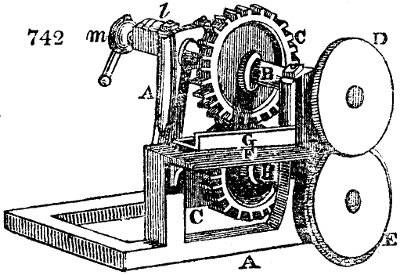
This machine is worked by a spur-wheel at the extremity of the main shaft B of the rolling mill (fig. 741.) It consists of a framing of iron A A, supporting two shafts B B, which are parallel to each other, and move together by means of two equal spur-wheels C C, the lower one of which works with the teeth of the great wheel above mentioned, upon the main shaft of the rolling mill. At the extremities of the two shafts, wheels or circular cutters are fixed with their edges overlapping each other a little way. F represents a shelf on which the plate is laid, and advanced forward to present it to the cutter; and G is a ledge or guide, screwed down on it, to conduct the metal and to regulate the breadth of the piece to be cut off. Hence the screws which fasten down the ledge are fitted in oblong holes, which admit of adjustment. The workman holds the plate flat upon the surface F, and pushing it towards the shears, they will lay hold of it, and draw it through until they have cut the whole length. The divided parts are also prevented from curling up into scrolls, as they do when cut by a common pair of shears; because small shoulders on E and D, behind the cutting edge, keep them straight. Behind the standard, supporting the back pivots of the shafts B B of the cutter, is a frame l, with a screw m tapped through it. This is used to draw the axis of the upper cutter D endwise, and keep its edge in close contact with the edge of the other cutter E. The slips or ribands of plate are now carried to the other two pairs of rollers in the rolling mill, which are made of case-hardened iron, and better polished than the breaking-down rollers. The plates are passed cold between these, to bring them to exactly the same thickness; whence they are called adjusting or planishing rollers. The workman here tries every piece by a common gauge, as it comes through. This is a piece of steel having a notch in it; the inside lines of which are very straight, and inclined to one another at a very acute angle. They are divided by fine lines, so that the edge of the plate being pressed into the notch, will have its thickness truly determined by the depth to which it enters, the divisions showing the thickness in fractions of an inch.
In rolling the plate the second time, all the plates are successively passed through the rollers; then the rollers being adjusted, they are passed through another time. This is repeated thrice or even four times; after which they are all tried by the gauge, and thus sorted into as many parcels as there are different thicknesses. It is a curious circumstance, that though the rollers are no less than 14 inches in diameter, and their frame proportionally strong, they will yield in some degree, so as to reduce a thick plate in a less degree than a thin one; thus the plates which have all passed through the same rollers, may be of 3 or 4 different degrees of thickness, which being sorted by the gauge into as many parcels, are next reduced to the exact dimension, by adapting the rollers to each parcel. The first of the parcel which now comes through is tried, by cutting out a circular piece with a small hand machine, and weighing it. If it proves either too light or too heavy, the rollers are adjusted accordingly, till by a few such trials they are found to be correct, when all the parcel is rolled through. The trial plates which turn out to be too thin, are returned as waste to the melting-house. By these numerous precautions, the blanks or circular discs, when cut out by the next machine, will be very nearly of the same weight; which they would scarcely be, even if the gauge determined all the plates to the same thickness, because some being more condensed than others, they would weigh differently under the same volume.
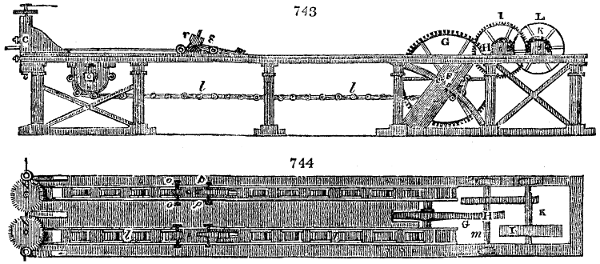
Fig. 743 and 744 enlarged (232 kB)
A great improvement has been made on that mode of lamination, by the late Mr. Barton’s machine for equalizing the thickness of slips of metal for making coin, which has been for several years introduced into the British mint. A side elevation is shown in fig. 743., and a plan in fig. 744. It operates in the same way as wire-drawing mechanisms; namely, pulls the slips of metal forcibly through an oblong opening, left between two surfaces of hardened steel. The box or case which contains the steel dies, composed of two hardened cylinders, is represented at C in fig. 743. The pincers employed to hold the metal, and draw it through, are shown at s r.
The slips of metal to be operated on by the drawing machine, are first rendered thinner at one end, that they may be introduced between the dies, and also between the jaws of the pincers. This thinning of the ends is effected by another machine, consisting of a small pair of rollers, mounted in an iron frame, similar to a rolling-mill. The upper roller is cylindrical, but the lower is formed with 3 flat sides, leaving merely portions of the cylinder entire, between these flat sides. The distance between the centres of the rollers is regulated by screws, furnished with wheels on their upper ends, similar to what is seen in the drawing dies at C. The two rollers have pinions on their axes, which make them revolve together; they are set in motion by an endless strap passing round a drum, upon whose axis is a pinion working into the teeth of a wheel fixed upon the axis of the lower roller.
The end of a slip of metal is presented between the rollers while they are in motion, not on that side of the roller which would operate to draw in the slip between them, as in the rolling-press above described, but on the contrary side, so that when one of the flat sides of the under roller fronts horizontally the circumference of the upper roller, an opening is formed, through which the slip of metal is to be inserted until it bears against a fixed stop at the back of the rollers. As the rollers continue to turn round, the cylindrical portions come opposite to each other, and press the metal between them, forcing it outwards, and rendering the part which has been introduced between the rollers as thin as the space between their cylindrical surfaces. Thus the end of the slip of metal becomes attenuated enough to pass between the dies of the drawing machine, and to be seized by the pincers.
In using the drawing machine, a boy takes hold of the handle s of the pincers, their hook of connexion with the endless chain l, l, not shown in the present figure, being disengaged, and he moves them upon their wheels towards the die-box C. In this movement the jaws of the pincers get opened, and they are pushed up so close to the die-box that their jaws enter a hollow, which brings them near the dies, enabling them to seize the end of the slip of metal introduced between them by the action of the preparatory rollers. The boy now holds the handle s on the top of the pincers fast, and with his other hand draws the handle x backwards. Thus the jaws are closed, and the metal firmly griped. He now presses down the handle x till a hook on the under side of the pincers seizes the endless chain as it moves along, when it carries the pincers, and their slip of metal, onwards with it. Whenever the whole length of the metallic riband has passed through between the dies, the strain on the pincers is suddenly relieved, which causes the weight r to raise their hook out of the chain, and stop their motion. The machine in the mint has two sets of dies, and two endless chains, as represented in the plan, fig. 744. N N, are toothed wheels in the upper end of the die-box, furnished with pinions and levers, for turning them round, and adjusting the distance between the dies. A large spur-wheel G, is fixed upon the axis F, to give motion to the endless chains; see both figures. This spur-wheel is turned by a pinion H, fixed upon an axis m, extending across the top of the frame, and working in bearings at each end. A spur-wheel I, is fixed upon the axis m, and works into the teeth of a pinion K, upon a second axis across the frame, which carries likewise a drum wheel L, through which motion is communicated to the whole mechanism by an endless strap.
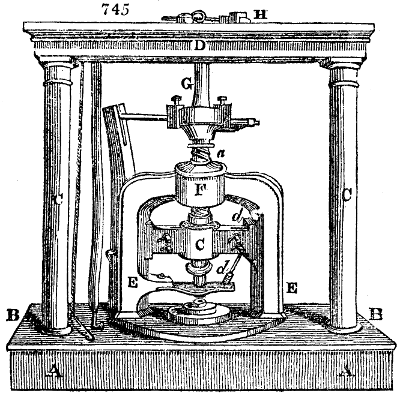
The cutting-out machine is exhibited in fig. 745. A A is a basement of stone to support an iron plate B B, on which stand the columns C C, that bear the upper part D of the frame. The iron frame of the machine E, F, E, is fixed down upon the iron plate B, B. The punch d is fixed in the lower part of the inner frame, and is moved up and down by the screw a, which is worked by wipers turned by a steam engine, impelling the lever H, and turning backwards and forwards the axis G, through a sufficient space for cutting the thickness of the metallic lamina. A boy manages this machine. There are twelve of them mounted on the same basement frame in a circular range contained in an elegant room, lighted from the roof. The whole are moved by a steam engine of 16-horse power.
The blanks or planchets thus cut out, were formerly adjusted by filing the edges, to bring them to the exact weight; a step which Mr. Barton’s ingenious mechanism has rendered in a great measure unnecessary. The edge is then milled, by a process which Mr. Boulton desires to keep secret, and which is therefore not shown in our mint.
But the French mint employs a very elegant machine for the purpose of lettering or milling the edges, called the cordon des monnaies, invented by M. Gengembre, which has entirely superseded the older milling machine of M. Castaing, described in the Encyclopedias. The Napoleon coins of France bear on the edge, in sunk letters, the legend, Dieu protège la France; and those of the king, Domine salvum fac regem. This is marked before striking the blank or flan. One machine imprints this legend, and its service is so prompt and easy, that a single man marks in a day 20,000 pieces of 5 francs, or 100,000 francs.
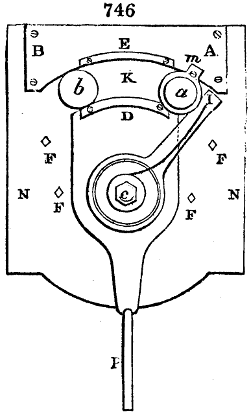
Each of the two arc dies E, D, (fig. 746.) carries one half of the legend, engraved in relief on the curved face; these arcs are pieces of steel tempered very hard, and fixed with two screws, one immoveably at E, on the sill which bears the apparatus; the other at D, at the extremity of the lever P, D, which turns round the axis C. The letters of these demi-legends are exactly parallel, and inscribed in an inverse order on the dies. An alternating circular motion is communicated to the handle P. The curvatures of the two dies are arcs of circles described from the centre C; and the interval which separates them, or the difference of the radii, is precisely the diameter of the piece to be milled.
As the centre C sustains the whole strain of the milling, and produces, of consequence, a hard friction, this axis must possess a considerable size. It is composed of a squat truncated cone of tempered steel, which enters into an eye of the moveable piece P, D. This cone is kept on the plate of the metal N N, which bears the whole machine, by a nut, whose screw, by being tightened or slackened, gives as much freedom as is requisite for the movement of rotation, or removes the shake which hard service gives to the cone in its eye. The middle thickness of the hole of the moveable piece P, D, and the axis of the lever P, which terminates it, are exactly on a level with the engraved letters of the die, so that no strain can derange the movable piece, or disturb the centre by its oscillations.
At a is a vertical tube, containing a pile of blanks for milling. It is kept constantly full; the tube being open at both ends, a little elevated above the circular space a, K, b, which separates the dies, and fixed by a tail m with a screw to the motionless piece A, B. The branch I, c, movable with the piece P, D, passes under the tube, and pushes before it the blank at the bottom of the column, which is received into a small excavation in the form of a circular step, and carried forwards. Matters are thus so arranged as to regulate the issue of the blanks, one by one, on the small step, called the posoir (bed.)
As soon as the blank is pushed forwards into contact with the lower edge of the engraved grooves, it is seized by them, and carried on by the strain of milling, without exposing the upper or under surfaces of the blank to any action which may obstruct the printing on its edge.
The blank is observed to revolve between the two dies according as the lever P completes its course, and this blank passing from a to K, then to b, meets a circular aperture b, through which it falls into a drawer placed under the sill.
The range of the movable lever P is regulated by four pieces, F, F, F, F, solidly sunk in the plate N, N, which bears the whole apparatus. A stud placed on this lever towards D, makes the arm of the posoir I c retire no farther than is necessary for the little blank to issue from the column; and a spring fixed to the centre c, and supported on a peg, brings back the posoir; so that when a screw I comes to strike against the column, the posoir stops, and the movable die D, which continues its progress, finds the blank in a fit position for pressing, seizing, and carrying it on, by reaction of the fixed die E. Thus the edge of the blank is lettered in half a second. A hundred may easily be marked in about three minutes.
The coining press is the most beautiful part of the whole mechanism in the British mint; but the limits of this volume will not allow of its being figured upon an adequate scale. An engraving of it may be seen in the Encyclopedia Britannica.
The only attention which this noble machine requires is that of a little boy, who stands in a sunk place before the press, and always keeps the tube full of blanks. He has two strings, one of which, when pulled, will put the press in motion by the concealed mechanism in the apartment above; and the other string, when snatched, stops the press. This coining operation goes on at the rate of 60 or 70 strokes per minute; and with very few interruptions during the whole day. The press-room at the Royal Mint contains eight machines, all supported on the same stone base; and the iron beams between the columns serve equally for the presses on each side. The whole has therefore a magnificent appearance. The eight presses will strike more than 19,000 coins in an hour, with only a child to supply each. The grand improvement in these presses, consists; 1. in the precision with which they operate to strike every coin with equal force, which could not be ensured by the old press impelled by manual labour; 2. The rising collar or steel ring in which they are struck, keeps them all of one size, and makes a fair edge, which was not the case with the old coins, as they were often rounded and defaced by the expansion of the metal under the blow; 3. The twisting motion of the upper die is thought to produce a better surface on the flat parts of the coin; but this is somewhat doubtful; 4. The feeding mechanism is very complete, and enables the machine to work much quicker than the old press did, where the workman, being in constant danger of having his fingers caught, was obliged to proceed cautiously, as well as to place the coin true on the die, which was seldom perfectly done. The feeding mechanism of the above press is a French invention; but Mr. Boulton is supposed to have improved upon it.
MIRRORS. See Copper and Glass.
MISPICKEL, is arsenical pyrites.
MOHAIR, is the hair of a goat which inhabits the mountains in the vicinity of Angora, in Asia Minor.
MOIRÉE METALLIQUE, called in this country crystallized tin-plate, is a variegated primrose appearance, produced upon the surface of tin-plate, by applying to it in a heated state some dilute nitro-muriatic acid for a few seconds, then washing it with water, drying, and coating it with lacquer. The figures are more or less beautiful and diversified, according to the degree of heat, and relative dilution of the acid. This mode of ornamenting tin-plate is much less in vogue now than it was a few years ago.
MOLASSE, is a sandstone belonging to the tertiary strata, employed under that name by the Swiss for building.
MOLASSES, is the brown viscid uncrystallizable liquor, which drains from cane sugar in the colonies. See Sugar.
MOLYBDENUM (Molybdène, Fr.; Molybdan, Germ.); is a rare metal which occurs in nature sometimes as a sulphuret, sometimes as molybdic acid, and at others as molybdate of lead. Its reduction from the acid state by charcoal requires a very high heat, and affords not very satisfactory results. When reduced by passing hydrogen over the ignited acid, it appears as an ash-gray powder, susceptible of acquiring metallic lustre by being rubbed with a steel burnisher; when reduced and fused with charcoal, it possesses a silver white colour, is very brilliant, hard, brittle, of specific gravity 8·6; it melts in a powerful air-furnace, oxidizes with heat and air, burns at an intense heat into molybdic acid, dissolves in neither dilute sulphuric, muriatic, nor fluoric acids, but in the concentrated sulphuric and nitric.
The protoxide consists of 85·69 of metal, and 14·31 of oxygen; the deutoxide consists of 75 of metal, and 25 of oxygen; and the peroxide, or molybdic acid, of 66·6 of metal, and 33·4 of oxygen. These substances are too rare at present to be used in any manufacture.
MORDANT, in dyeing and calico-printing, denotes a body which, having a twofold attraction for organic fibres and colouring particles, serves as a bond of union between them, and thus gives fixity to dyes; or it signifies a substance which, by combining with colouring particles in the pores of textile filaments, renders them insoluble in hot soapy and weak alkaline solutions. In order properly to appreciate the utility and the true functions of mordants, we must bear in mind that colouring matters are peculiar compounds possessed of certain affinities, their distinctive characters being not to be either acid or alkaline, and yet to be capable of combining with many bodies, and especially with salifiable bases, and of receiving from each of them modifications in their colour, solubility, and alterability. Organic colouring substances, when pure, have a very energetic attraction for certain bodies, feeble for others, and none at all for some. Among these immediate products of animal or vegetable life, some are soluble in pure water, and others become so only through peculiar agents. We may thus readily conceive, that whenever a dye-stuff possesses a certain affinity for the organic fibre, it will be able to become fixed on it, or to dye it without the intervention of mordants, if it be insoluble by itself in water, which, in fact, is the case with the colouring matters of safflower, annotto, and indigo. The first two are soluble in alkalis; hence, in order to use them, they need only be dissolved in a weak alkaline lye, be thus applied to the stuffs, and then have their tinctorial substance precipitated within their pores, by abstracting their solvent alkali with an acid. The colouring matter, at the instant of ceasing to be liquid, is in an extremely divided state, and is in contact with the organic fibres for which it has a certain affinity. It therefore unites with them, and, being naturally insoluble in water, that is, having no affinity for this vehicle, the subsequent washings have no effect upon the dye. The same thing may be said of indigo, although its solubility in the dye-bath does not depend upon a similar cause, but is due to a modification of its constituent elements, in consequence of which it becomes soluble in alkalis. Stuffs plunged into this indigo bath get impregnated with the solution, so that when again exposed to the air, the dyeing substance resumes at once its primitive colour and insolubility, and washing can carry off only the portions in excess above the intimate combination, or which are merely deposited upon the surface of the stuff.
Such is the result with insoluble colouring matters; but for those which are soluble it should be quite the reverse, since they do not possess an affinity for the organic fibres which can counterbalance their affinity for water. In such circumstances, the dyer must have recourse to intermediate bodies, which add their affinity for the colouring matter to that possessed by the particles of the stuff, and increase by this twofold action the intimacy and the stability of the combination. These intermediate bodies are the true mordants.
Mordants are in general found among the metallic bases or oxides; whence they might be supposed to be very numerous, like the metals; but as they must unite the twofold condition of possessing a strong affinity for both the colouring matter and the organic fibre, and as the insoluble bases are almost the only ones fit to form insoluble combinations, we may thus perceive that their number may be very limited. It is well known, that although lime and magnesia, for example, have a considerable affinity for colouring particles, and form insoluble compounds with them, yet they cannot be employed as mordants, because they possess no affinity for the textile fibres.
Experience has proved, that of all the bases, those which succeed best as mordants are alumina, tin, and oxide of iron; the first two of which, being naturally white, are the only ones which can be employed for preserving to the colour its original tint, at least without much variation. But whenever the mordant is itself coloured, it will cause the dye to take a compound colour quite different from its own. If, as is usually said, the mordant enters into a real chemical union with the stuff to be dyed, the application of the mordant should obviously be made in such circumstances as are known to be most favourable to the combination taking place; and this is the principle of every day’s practice in the dyehouse.
In order that a combination may result between two bodies, they must not only be in contact, but they must be reduced to their ultimate molecules. The mordants that are to be united with stuffs are, as we have seen, insoluble of themselves, for which reason their particles must be divided by solution in an appropriate vehicle. Now this solvent or menstruum will exert in its own favour an affinity for the mordant, which will prove to that extent an obstacle to its attraction for the stuff. Hence we must select such solvents as have a weaker affinity for the mordants than the mordants have for the stuffs. Of all the acids which can be employed to dissolve alumina, for example, vinegar is the one which will retain it with least energy, for which reason the acetate of alumina is now generally substituted for alum, because the acetic acid gives up the alumina with such readiness, that mere elevation of temperature is sufficient to effect the separation of these two substances. Before this substitution of the acetate, alum alone was employed; but without knowing the true reason, all the French dyers preferred the alum of Rome, simply regarding it to be the purest; it is only within these few years that they have understood the real grounds of this preference. This alum has not, in fact, the same composition as the alums of France, England, and Germany, but it consists chiefly of cubic alum having a larger proportion of base. Now this extra portion of base is held by the sulphuric acid more feebly than the rest, and hence is more readily detached in the form of a mordant. Nay, when a solution of cubic alum is heated, this redundant alumina falls down in the state of a subsulphate, long before it reaches the boiling point. This difference had not, however, been recognised, because Roman alum, being usually soiled with ochre on the surface, gives a turbid solution, whereby the precipitate of subsulphate of alumina escaped observation. When the liquid was filtered, and crystallized afresh, common octahedral alum alone was obtained; whence it was most erroneously concluded, that the preference given to Roman alum was unjustifiable, and that its only superiority was in being freer from iron.
Here a remarkable anecdote illustrates the necessity of extreme caution, before we venture to condemn from theory a practice found to be useful in the arts, or set about changing it. When the French were masters in Rome, one of their ablest chemists was sent thither to inspect the different manufactures, and to place them upon a level with the state of chemical knowledge. One of the fabrics, which seemed to him furthest behindhand, was precisely that of alum, and he was particularly hostile to the construction of the furnaces, in which vast boilers received heat merely at their bottoms, and could not be made to boil. He strenuously advised them to be new modelled upon a plan of his own; but, notwithstanding his advice, which was no doubt very scientific, the old routine kept its ground, supported by utility and reputation, and very fortunately, too, for the manufacture; for had the higher heat been given to the boilers, no more genuine cubical alum would have been made, since it is decomposed at a temperature of about 120° F., and common octahedral alum would alone have been produced. The addition of a little alkali to common alum brings it into the same basic state as the alum of Rome.
The two principal conditions, namely, extreme tenuity of particles, and liberty of action, being found in a mordant, its operation is certain. But as the combination to be effected is merely the result of a play of affinity between the solvent and the stuff to be dyed, a sort of partition must take place, proportioned to the mass of the solvent, as well as to its attractive force. Hence the stuff will retain more of the mordant when its solution is more concentrated, that is, when the base diffused through it is not so much protected by a large mass of menstruum; a fact applied to very valuable uses by the practical man. On impregnating in calico printing, for example, different spots of the same web with the same mordant in different degrees of concentration, there is obtained in the dye-bath a depth of colour upon these spots intense in proportion to the strength of their various mordants. Thus, with solution of acetate of alumina in different grades of density, and with madder, every shade can be produced, from the fullest red to the lightest pink; and, with acetate of iron and madder, every shade from black to pale violet.
We hereby perceive that recourse must indispensably be had to mordants at different stages of concentration; a circumstance readily realized by varying the proportions of the watery vehicle. See Calico-printing and Madder. When these mordants are to be topically applied, to produce partial dyes upon cloth, they must be thickened with starch or gum, to prevent their spreading, and to permit a sufficient body of them to become attached to the stuff. Starch answers best for the more neutral mordants, and gum for the acidulous; but so much of them should never be used, as to impede the attraction of the mordant for the cloth. Nor should the thickened mordants be of too desiccative a nature, lest they become hard, and imprison the chemical agent before it has had an opportunity of combining with the cloth, during the slow evaporation of its water and acid. Hence the mordanted goods, in such a case, should be hung up to dry in a gradual manner, and when oxygen is necessary to the fixation of the base, they should be largely exposed to the atmosphere. The foreman of the factory ought, therefore, to be thoroughly conversant with all the minutiæ of chemical reaction. In cold and damp weather he must raise the temperature of his drying-house, in order to command a more decided evaporation; and when the atmosphere is unusually dry and warm, he should add deliquescent correctives to his thickening, as I have particularized in treating of some styles of calico-printing. But, supposing the application of the mordant and its desiccation to have been properly managed, the operation is by no means complete; nay, what remains to be done is not the least important to success, nor the least delicate of execution. Let us bear in mind that the mordant is intended to combine not only with the organic fibre, but afterwards also with the colouring matter, and that, consequently, it must be laid entirely bare, or scraped clean, so to speak, that is, completely disengaged from all foreign substances which might invest it, and obstruct its intimate contact with the colouring matters. This is the principle and the object of two operations, to which the names of dunging and clearing have been given.