A.
Reading edition
ABB-WOOL. Among clothiers, this term signifies the woof or weft.
ACETATE. (Acétate, Fr.; Essigsäure, Germ.) Any saline compound of which the acetic is the acid constituent; as acetate of soda, of iron, of copper, &c.
ACETATE OF ALUMINA, see Red Liquor and Mordant; of Copper, see Copper; of Iron, see Iron; of Lead, see Lead; of Lime, see Pyrolignous Acid.
ACETIC ACID (Acide Acétique, Fr.; Essigsäure, Germ.) is the name of the sour principle which exists in vinegar. It occurs, ready formed, in several products of the vegetable kingdom, and is generated during the spontaneous fermentation of many vegetable and animal juices. The sambucus nigra, or black elder, the phœnix dactilifera, and the rhus typhinus are plants which afford a notable quantity of vinegar. It is found, likewise, in the sweat, urine, milk, and stomach of animals. All infusions of animal or vegetable matters in water, when exposed for some time to the air, at a moderate temperature, ferment into vinegar; and most vegetables, when subjected to decomposition by fire, give off condensable vapours of acetic acid. All liquids containing alcohol are susceptible of passing into the state of vinegar; but the pre-existence of alcohol is not necessary to this change, as we learn from the acetification of vegetable soups, infusion of cabbage, starch—paste, &c.
Vinegar may be distinguished into four varieties, according to the mode of its production, though all of them are capable of being converted, by chemical means, into one identical acetic acid. 1. Wine vinegar. 2. Malt vinegar. 3. Sugar vinegar. 4. Wood vinegar, or pyrolignous acid. Fermentation is the source of the acid in the first three varieties. Here alcohol is first generated, and is next converted into vinegar by the influence of the air at a genial temperature; a change which will be investigated under Fermentation. But the conversion of spirit of wine into acetic acid may be demonstrated by direct experiment. When the vapour of alcohol is brought into contact in the atmosphere with the black powder obtained by mixing muriate of platina, potash, and alcohol, vinegar is rapidly formed at the expense of the alcohol. In Germany, where crude alcohol bears a low price, the manufacture of vinegar has been arranged upon that principle, which, as throwing some light on the process of acetification, I shall briefly describe. See Platinum for the mode of preparing the above powder.
Under a large case, which for experimental purposes may be made of glass, several saucer-shaped dishes of pottery or wood are to be placed in rows, upon shelves over each other, a few inches apart. A portion of the black platina powder moistened being suspended over each dish, let as much vinous spirits be put into them as the oxygen of the included air shall be adequate to acidify. This quantity may be inferred from the fact, that 1000 cubic inches of air can oxygenate 110 grains of absolute alcohol, converting them into 122 grains of absolute acetic acid, and 641⁄2 grains of water.
The above simple apparatus is to be set in a light place (in sunshine, if convenient), at a temperature of from 68° to 86° Fahr., and the evaporation of the alcohol is to be promoted by hanging several leaves of porous paper in the case, with their bottom edges dipped in the spirit. In the course of a few minutes, a most interesting phenomenon will be perceived. The mutual action of the platina and the alcohol will be displayed by an increase of temperature, and a generation of acid vapours, which, condensing on the sides of the glass-case, trickle in streams to the bottom. This striking transformation continues till all the oxygen of the air be consumed. If we wish, then, to renew the process, we must open the case for a little, and replenish it with air. With a box of 12 cubic feet in capacity, and with a provision of 7 or 8 ounces of the platina powder we can, in the course of a day, convert one pound of alcohol into pure acetic acid, fit for every purpose, culinary or chemical. With from 20 to 30 pounds of the platina powder (which does not waste), we may transform, daily, nearly 300 pounds of bad spirits into the finest vinegar. Though our revenue laws preclude the adoption of this elegant process upon the manufacturing scale in this country, it may be regarded as one of the greatest triumphs of chemistry, where art has rivalled nature in one of her most mysterious operations.
To readers acquainted with chemical symbols, the following numerical representation of the conversion of alcohol into acetic acid may be acceptable:—
580·64 parts by weight of alcohol = H12 C4 O2 consist of
74·88 of hydrogen = H12
305·76 of carbon = C4
200·00 of oxygen = O2
If we combine with this mixture, 400 parts of oxygen = O4, we have,—
of water = 337·44 = H6 O3
acetic acid = 643·20 = H6 C4 O3
Hence, in this formation of vinegar, 100 parts by weight of alcohol take 68·89 parts of oxygen; and there are produced 58·11 parts of water, and 110·78 of acetic acid.
These beautiful experiments prove, that when in a mere mixture of alcohol and water, under the influence of the atmospheric air and heat, some vinegar comes to be formed after a considerable time, the same formation of vinegar takes place in a similar, but more effective, manner, when a ferment is present, which acts here in a somewhat analogous way to the platina powder in the preceding case. Several azotized substances serve as re-agents towards the acetous fermentation,—such as vinegar ready-made, vinegar-yeast, or lees, barley bread, leaven, beer barm, and similar vegetable matters, which contain gluten. The best and purest ferment is, however, vinegar itself. With this ferment we must conjoin, as an essential condition of acetification, the free access of atmospheric air.
It is a well-known fact, that spirituous liquors, as weak brandy, wine, and beer, &c., may be preserved for years in close vessels, without undergoing the acetous fermentation, even when they repose upon a layer of lees. It is equally well known, that these very liquors, if they stand for some time in open vessels, become readily sour, especially if exposed, also, to a somewhat high temperature. If we fill a flask with common brandy, and subject it, without a stopper, to the influence of air and warmth, the contained liquor may, at the end of many weeks, discover no sensible acidity: if we add to the same brandy a ferment, and stop the flask air-tight, everything will still remain unchanged; but if we leave a portion of air in the flask, or leave it uncorked, vinegar will soon make its appearance in the brandy.
If we investigate the nature of the air which remains over brandy in the act of acetification, we shall find that it consists entirely of carbonic acid and azote, the oxygen being absorbed and combined in the acetic acid and water formed.
Since this absorption of oxygen from the air can take place only at the surface of the fermenting liquors, we thus see the necessity and the practical importance of amplifying that surface, in order to accelerate and complete the acetification, by multiplying the points of contact between the alcohol and the oxygen. The essence of the new German method of rapid acetification depends upon this principle.
Temperature has also a remarkable influence on the formation of vinegar. The acid fermentation proceeds very feebly in the cold, but takes an accelerated pace as the heat is raised. It would even appear that spirituous vapours brought by themselves in contact with atmospheric air, without the aid of any ferment, are capable of being converted into acetic acid, since it has happened in the rectification of brandy, in a still furnished with a large capital and adopter pipe into which air was allowed to enter, that vinegar made its appearance. Hence, warmth does not seem to act as a promoter of the combination of alcohol with oxygen in a merely chemical point of view, but it acts, so to speak, physically. Over the warm liquor a stratum of spirit vapour appears to float, which, coming there into conflict with the atmospherical oxygen, probably causes the generation of some acetic acid, and thus accelerates the operation, much more than by the mere contact of the oxygen with the liquid surface.
When we expose any spirituous liquors, as wine, beer, &c., with the requisite ferment, to the external air, at a temperature of from 64° to 68° Fahr., the fluid, however clear before, becomes soon turbid; filamentous slimy particles begin to appear moving in the middle and on the sides of the vessel, and then form a scum on the top of the liquor. When this scum has acquired a certain thickness and consistence, it falls in a sediment to the bottom. The Germans call it the vinegar mother, as it serves to excite acetification in fresh liquors. Meanwhile, the liquor has become warmer than the surrounding air, and the vinegar process betrays itself by diffusing a peculiar aroma in the apartment. Whenever all the alcohol present has been converted into acetic acid, the liquor comes into a state of repose; its temperature sinks to the pitch of the atmosphere; it becomes bright, and is the article well known by its taste and smell under the name of vinegar.
Genuine wine or raisin vinegar differs from that formed either from apples, or sugar, beer, &c., in containing wine-stone or tartar; by which peculiarity it may be distinguished, except in those cases where crude tartar has been artificially added to the other vinegars, as a disguise. Barley-malt vinegar contains some phosphoric acid, in the state of phosphate of lime or magnesia, derived from the grain.
After these general observations upon acetification, we shall now proceed to describe the processes for manufacturing vinegar on the commercial scale.
1. Wine vinegar.—The first consideration with a vinegar maker is a good fermenting room, in which the wines may be exposed to a steady temperature, with an adequate supply of atmospherical air. As this air is soon deprived of its oxygenous constituent, facilities ought to be provided for a renewal of it by moderate ventilation. The air holes for this purpose ought to be so contrived that they may be shut up when the temperature begins to fall too low, or in windy weather. The best mode of communicating the proper warmth to a chamber of this kind is by means of fire-flues or hot water pipes, running along its floor at the sides and ends, as in a hothouse; the fireplace being on the outside, so that no dust may be created by it within. The flue is best made of bricks, and may have a cross section of 10 or 12 inches by 15 deep. The soot deposited, even when coals are burned, will find ample space in the bottom of the flue, without interfering essentially with the draught, for a very long period, if it be made of the above dimensions. Low-roofed apartments are preferable to high ones; and those built with thick walls, of imperfectly conducting materials, such as bricks, lined with lath and plaster work. Should the chamber, however, have a high ceiling, the fermenting tuns must be raised to a suitable height on scaffolding, so as to benefit by the warmest air. Sometimes the vinegar vessels are placed at different levels; in which case the upper ones acetify their contents much sooner than the under, unless they are emptied and filled alternately, which is a good plan.
Orleans is the place most famous for vinegars. The building there destined to their manufacture is called a vinaigrerie, and is placed, indifferently, either on the ground floor or the floor above it; but it has always a southern exposure, to receive the influence of the sunbeams. The vessels employed for carrying on the fermentation are casks, called mothers. Formerly they were of a large capacity, containing about 460 litres (115 gallons, Eng.); but at the present day they are barrels of half that capacity, or somewhat less than an old English hogshead. It is now known that the wine passes sooner into vinegar the smaller the mass operated upon, the more extensive its contact with the air, and the more genial its warmth. These casks were formerly arranged in three ranks by means of massive scaffolding; they are now set in four ranks, but they rest on much smaller rafters, sustained by uprights, and can be packed closer together. The casks, which are laid horizontally, are pierced at the upper surface of their front end with two holes: one, to which the name of eye is given, is two inches in diameter; it serves for putting in the charge, and drawing off the vinegar when it is made; the other hole is much smaller, and is placed immediately alongside; it is merely an air hole, and is necessary to allow the air to escape, because the funnel completely fills the other hole in the act of filling the cask.
When new vessels are mounted in a vinegar work, they must be one third filled with the best vinegar that can be procured, which becomes the true mother of the vinegar to be made; because it is upon this portion that the wine to be acidified is successively added. At the ordinary rate of work, they put at first upon the mother, which occupies one third of the vessel, a broc of 10 litres of red or white wine; eight days afterwards they add a second broc; then a third, and a fourth, always observing the same interval of time, 8 days. After this last charge, they draw off about 40 litres of vinegar, and then recommence the successive additions.
It is necessary that the vessel be always one third empty if we wish the acetification to go on steadily; but as a portion of the tartar and the lees forms and accumulates in the lower part of the cask, so as eventually to counteract the fermentation, the time arrives when it is requisite to interrupt it, in order to remove this residuum, by clearing out all the contents. The whole materials must be renovated every 10 years; but the casks, if well made and repaired, will serve for 25 years.
We have mentioned a definite period at which the vinegar may be drawn off; but that was on the supposition that the process had all the success we could wish: there are circumstances, difficult to appreciate, which modify its progress, as we shall presently show. We ought, therefore, before discharging the vinegar, to test and see if the fermentation has been complete. We proceed as follows: we plunge into the liquor a white stick or rod, bent at one end, and then draw it out in a horizontal direction: if it be covered with a white thick froth, to which is given the name of work (travail), we judge that the operation is terminated; but if the work, instead of being white and pearly, be red, the manufacturers regard the fermentation to be unfinished, and they endeavour to make it advance, by adding fresh wine, or by increasing the heat of the apartment.
It is not always easy to explain why the fermentation does not go on as rapidly in one case as in another. There are even certain things which seem at present to be entirely inexplicable. It happens sometimes, for example, that although all the vessels have been equally charged, and with the same wine, yet the fermentation does not form in the same manner in the whole; it will move rapidly in some, be languid, or altogether inert, in others. This is a very puzzling anomaly; which has been ascribed to electrical and other obscure causes, because it is not owing to want of heat, the casks in the warmest positions being frequently in fault; nor to the timber of the cask. It, however, paralyses the process so completely that the most expert vinegar makers have nothing else for it, when this accident happens, than to empty entirely what they call the lazy cask, and to fill it with their best vinegar. The fermentation now begins, and proceeds as well in it as in the others. See Fermentation.
We must here make an important remark, relatively to the temperature which should prevail in the fermentation room. In many chemical works we find it stated, that the heat should not exceed 18° R., or 65° Fahr., for fear of obtaining bad products. But the vinegar makers constantly keep up the heat at from 24° to 25° R., 75° to 77° F.; when the acetification advances much more rapidly, and the vinegar is equally strong. The best proof of this heat not being too high is, that under it, the vessels in the upper part of the room, work best and quickest. In Orleans, cast-iron stoves and wood fuel are used for communicating the requisite warmth.
Before pouring the wine into the mothers, it is clarified in the following manner. There are tuns which can contain from 12 to 15 pieces of wine. Their upper end has at its centre an opening of four or five inches diameter, which may be closed afterwards with a wooden cover; this opening is for the purpose of receiving a large funnel. The inside of the tun is filled with chips of beechwood, well pressed down. The wine is poured upon these chips, allowed to remain for some time, and then gently drawn off by a pipe in the lower part of the vessel. The lees are deposited upon the chips, and the wine runs off quite clear. However, it happens sometimes, notwithstanding this precaution, that the vinegar, after it is made, requires to be clarified, more particularly if the wine employed had been weak. The vinegar must be filtered in the same way; and it derives an advantage from it, as the products of different casks get thereby mixed and made uniform.
By this Orleans method several weeks elapse before the acetification is finished; but a plan has been lately devised in Germany to quicken greatly the acid fermentation by peculiar constructions. This system is called, the quick vinegar work, because it will complete the process in the course of 2 or 3 days, or even in a shorter time. It depends, chiefly, upon the peculiar construction of the fermenting vessels, whereby the vinous liquor is exposed on a vastly expanded surface to the action of the atmospheric air.
An oaken tub, somewhat narrower at the bottom than the top, from 6 to 7 feet high and 3 feet in diameter, is furnished with a well-fitted grooved, but loose, cover. About half a foot from its mouth, the tub has a strong oak or beech hoop fitted to its inside surface, sufficiently firm to support a second cover, also well fitted, but moveable. The space under this second cover is destined to contain the vinous liquor, and in order to bring it very amply into contact with the atmosphere, the following contrivances have been resorted to: This cover is perforated, like a sieve, with small holes, of from 1 to 2 lines in diameter, and about 11⁄2 inch apart. Through each of these holes a wick of pack-thread or cotton is drawn, about 6 inches long, which is prevented from falling through by a knot on its upper end, while its under part hangs free in the lower space. The wicks must be just so thick as to allow of the liquor poured above the cover passing through the holes in drops. The edges of the lid must be packed with tow or hemp to prevent the liquor running down through the interval.
The whole lower compartment is now to be filled with chips of beechwood up to nearly the perforated cover. The liquor, as it trickles through the holes, diffuses itself over the chips, and, sinking slowly, collects at the bottom of the tub. The chips should be prepared for this purpose by being repeatedly scalded in boiling water, then dried, and imbued with hot vinegar. The same measures may also be adopted for the tub. To provide for the renewal of the air, the tub is perforated at about a foot from its bottom with eight holes, set equally apart round the circumference, two thirds of an inch wide, and sloping down, through which the air may enter into this lower compartment, without the trickling liquor being allowed to flow out. In order that the foul air which has become useless may escape, four large holes are pierced in the sieve cover, at equal distances asunder and from the centre, whose united areas are rather smaller than the total areas of the holes in the side of the tub. Into these four holes open glass tubes must be inserted, so as to stand some inches above the cover, and to prevent any of the liquor from running through them. The proper circulation of the air takes place through these draught holes. This air may afterwards pass off through a hole of 21⁄2 inches diameter in the uppermost cover, in which a funnel is placed for the supply of liquor as it is wanted to keep up the percolation.
The temperature of the fermenting compartment is ascertained by means of a thermometer, whose bulb is inserted in a hole through its side, and fastened by a perforated cork. The liquor collected in the under vessel runs off by a syphon inserted near its bottom, the leg of which turns up to nearly the level of the ventilating air pipes before it is bent outwards and downwards. Thus the liquor will begin to flow out of the under compartment only when it stands in it a little below the sieve cover, and then it will run slowly off at the inclined mouth of the syphon, at a level of about 3 inches below the lower end of the glass tubes. There is a vessel placed below, upon the ground, to receive it. The tub itself is supported upon a wooden frame, or a pier of brickwork, a foot or 18 inches high.
A tub constructed like the above is called a GRADUATION VESSEL, which see. It is worked in the following way:—The vinegar room must be, in the first place, heated to from 100° to 110° F., or till the thermometer in the graduation vessel indicates at least 77°. The heat may then be modified. We now pour through the uppermost cover of the tub a mixture, warmed to 144° F., of 8 parts proof spirits, 25 parts soft water, 15 parts of good vinegar, and as much clear wine or beer. The water should be first heated, and then the vinegar, spirits, and wine may be added to it. Of this mixture, so much should be poured in as is necessary to cover over the second lid, 2 or 3 inches deep, with the liquor; after which, the rest may be poured slowly in, as it is wanted.
When the liquor has run for the first time through the graduation vessel, it is not yet sufficiently acidified; but the weak vinegar collected in the exterior receiving cistern must be a second time, and, if need be, a third time, passed through the graduation tub, in order to convert all the alcohol into acetic acid. In general, we may remark, that the stronger the vinous liquor the more difficult and tedious is its conversion into vinegar, but it is so much the stronger. To lessen this difficulty somewhat, it would be well not to put all the spirits at first into the wash, or mixed liquors, but to add a little more of it at the second and the third running, especially when we desire to have very strong vinegar.
After the graduation vessel has been some days at work, it is no longer necessary to add vinegar to the mixture of spirits and water, since the sides of the graduation tub, the beech chips, and the packthreads, are all impregnated with the ferment, and supply its place. The mixture must, however, be always maintained at the temperature of 100°.
Instead of the above mixture of brandy, water, and wine, we may employ, according to Dingler, a clear fermented wort of malt, mixed with a little spirits. The perfect vinegar, which collects in the receiving cistern, may be immediately racked off into the store casks for sale.
It has been objected to this process, that, in consequence of the mixture of saccharine and glutinous materials, which are contained in beer or worts, along with the acetous fermentation, there is also, partially, a vinous fermentation, and much carbonic acid, thereby disengaged, so as to obstruct the acetification. This obstruction may be remedied by a freer circulation of air, or by the exposure of quicklime in the chamber. It is a more substantial objection, that, from the addition of beer, &c., more lees, or dregs, are deposited in the graduation tub, whereby a more frequent cleansing of it, and of the beech chips, with a loss of time and vinegar, becomes necessary. The only mode of obviating this difficulty is, to take well-clarified fermented wash.
Another evil attendant on the quick process is, the evaporation of the spirituous liquors. Since, in the graduation tub, there is a temperature of 110°, it is impossible to avoid a loss of spirit from the circulation and efflux of the air. The air, indeed, that issues from the top hole in the uppermost cover, might be conducted over an extensive surface of fresh water, where its spirit would be condensed in a great measure. But, after all, this fear of great loss is, I believe, groundless; because the spirit is rapidly acidified by the oxygen of the air, and thereby rapidly loses its volatility.
The supply of the warm wash should be drawn from a cistern placed near the ceiling, where the temperature of the apartment is hottest; and it may be replenished from the partly acetified liquor in the cistern on the floor. With this view, two cisterns should be placed above, so that one of them may always contain liquor sufficiently hot, and thus the process will suffer no interruption.
When malt wash is used for this quick process, the resulting vinegar must be clarified in a tun with beech chips, as above described. In two or three days the impurities will be deposited, and the fine vinegar may be racked off.
The following prescription, for preparing what he calls malt wine, is given by Dr. Kastner. Eighty pounds of pale barley malt, and 40 pounds of pale wheat malt, are to be crushed together. These 120 pounds are to be infused with 150 quarts of water, at the temperature of 122° Fahr., afterwards with 300 quarts of boiling water, and the whole body is to be mashed thoroughly, till all the lumps disappear. It is then to be left at rest in a large covered tub, for two or three hours, to allow the grains to settle down, from which the wort is to be drawn off. When it has fallen to the temperature of 64° Fahr., 15 pounds of good yeast are to be stirred in, and it must now be left for two or three days to ferment, in a loosely covered tun. When the vinous fermentation has taken place, the clear liquor must be drawn off by a tap hole, a little above the bottom, so as to leave the lees and scum in the tun. This malt wine, he adds, may be kept for a long time in close vessels, and is always ready for making quick vinegar.
2. Malt Vinegar.—The greater part of British vinegar is made from malt, by the following process:—1 boll of good barley malt, properly crushed, is to be mashed with water at 160° Fahr. The first water should have that temperature; the second must be hotter than 160°, and the third water, for the extraction of all the soluble matter, may be boiling hot. Upon the whole, not more than 100 gallons of wort should be extracted. After the liquor has cooled to 75° Fahr., 3 or 4 gallons of beer yeast are poured in, and well mixed with a proper stirrer. In 36 or 40 hours, according to the temperature of the air, and the fermenting quality of the wash, it is racked off into casks, which are laid upon their sides in the fermenting apartment of the vinegar work, which should be kept at a temperature of 70° at least; in summer partly by the heat of the sun, but in general by the agency of proper stoves, as above described. The bung-holes should be left open, and the casks should not be full, in order that the air may act over an extensive surface of the liquor. It would be proper to secure a freer circulation to the air, by boring a hole in each end of the cask, near its upper edge. As the liquor, by evaporation, would be generally a few degrees colder than the air of the apartment, a circulation of air would be established in at the bung-hole, and out by the end holes. By the ordinary methods, three months are required to make this vinegar marketable, or fit for the manufacture of sugar of lead.
In making vinegar for domestic purposes, the casks are usually set on their ends; and they have, sometimes, a false bottom, pierced with holes, placed about a foot above the true one. On this bottom, a quantity of rape, or the refuse raisins, &c. from the making of British wines, is laid. The malt liquor has a proper quantity of yeast added to it. In about 24 hours it becomes warm, and is then racked off into another similar cask. After some time, this racking process is discontinued, and the vinegar is allowed to complete its fermentation quietly. The proper temperature must always be kept up, by placing the cask in a warm situation. A little wine-stone (argal) added to the malt wash, would make the vinegar liker that made from wine. Sometimes a little isinglass is employed to clarify vinegar. A portion of sulphuric acid is often added to it.
3. Sugar vinegar.—By pursuing the following plan, an excellent sugar vinegar may be made. In 158 quarts of boiling water dissolve 10 pounds of sugar, and 6 pounds of wine-stone; put the solution into a fermenting cask, and when it is cooled to the temperature of from 75° to 80°, add 4 quarts of beer yeast to it. Stir the mixture well, then cover the vessel loosely, and expose it for 6 or 8 days to the vinous fermentation, at a temperature of from 70° to 75° Fahr. When it has become clear, draw off the vinous liquor, and either acetify it in the graduation tub above described, or by the common vinegar process. Before it is finished, we should add to it 12 quarts of strong spirits (brandy), and 15 quarts of good vinegar, to complete the acetous fermentation. With a graduation tub which has been used, this addition of vinegar is unnecessary.
The following simpler prescription for making sugar vinegar deserves attention. For every gallon of hot water take 18 ounces of sugar; and when the syrup has cooled to 75°, add 4 per cent., by measure, of yeast. When the vinous fermentation is pretty well advanced, in the course of 2 or 3 days, rack off the clear wash from the lees into a proper cask, and add 1 ounce of wine-stone, and 1 of crushed raisins, for every gallon of water. Expose it in a proper manner, and for a proper time, to the acetifying process; and then rack off the vinegar, and fine it upon beech chips. It should be afterwards put into bottles, which are to be well corked.
Vinegar obtained by the preceding methods has always a yellowish or brownish colour. It may be rendered colourless by distillation. For nicer chemical purposes, this is done in a glass retort; but on a large scale, it is usually performed in a clean copper still, furnished with a capital and worm-refrigeratory, either of silver or block tin. It is volatile at the boiling temperature of water; and if the process be carried on briskly, it will not sensibly corrode the copper. But we can never obtain, in this way, a strong article; for, as soon as the vinegar gets concentrated to a certain degree, we cannot force off the remainder by heat, for fear of giving it an empyreumatic odour; because the gluten, colouring matter, &c. begin to adhere to the bottom of the still. We are, therefore, obliged to suspend the operation at the very time when the acid is acquiring strength. It has been also proposed to concentrate vinegar by the process of congelation; but much of it remains entangled among the frozen water; and common distilled vinegar is so weak, that it congeals in one mass.
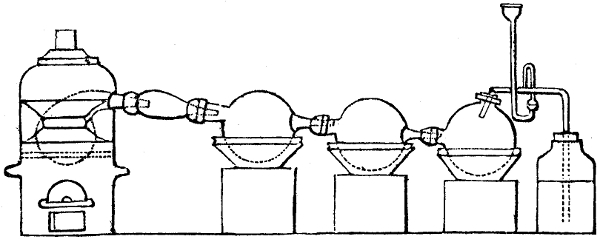
Fig. 1.
Before the process for pyrolignous acid, or wood vinegar, was known, there was only one method of obtaining strong vinegar practised by chemists; and it is still followed by some operators, to prepare what is called radical or aromatic vinegar. This consists in decomposing, by heat alone, the crystallised binacetate of copper, commonly, but improperly, called distilled verdigris. With this view, we take a stoneware retort, (fig. 1.) of a size suited to the quantity we wish to operate upon; and coat it with a mixture of fire clay and horsedung, to make it stand the heat better. When this coating is dry, we introduce into the retort the crystallised acetate slightly bruised, but very dry; we fill it as far as it will hold without spilling when the beak is considerably inclined. We then set it in a proper furnace. We attach to its neck an adopter pipe, and two or three globes with opposite tubulures, and a last globe with a vertical tubulure. The apparatus is terminated by a Welter’s tube, with a double branch; the shorter issues from the last globe, and the other dips into a flask filled with distilled vinegar. Every thing being thus arranged, we lute the joinings with a putty made of pipeclay and linseed oil, and cover them with glue paper. Each globe is placed in a separate basin of cold water, or the whole may be put into an oblong trough, through which a constant stream of cold water is made to flow. The tubes must be allowed a day to dry. Next day we proceed to the distillation, tempering the heat very nicely at the beginning, and increasing it by very slow degrees till we see the drops follow each other pretty rapidly from the neck of the retort, or the end of the adopter tube. The vapours which pass over are very hot, whence a series of globes are necessary to condense them. We should renew, from time to time, the water of the basins, and keep moist pieces of cloth upon the globes; but this demands great care, especially if the fire be a little too brisk, for the vessels become, in that case, so hot, that they would infallibly be broken, if touched suddenly with cold water. It is always easy for us to regulate this operation, according to the emission of gas from the extremity of the apparatus. When the air bubbles succeed each other with great rapidity, we must damp the fire.
The liquor which passes in the first half hour is weakest; it proceeds, in some measure, from a little water sometimes left in the crystals, which when well made, however, ought to be anhydrous. A period arrives towards the middle of the process when we see the extremity of the beak of the retort, and of the adopter, covered with crystals of a lamellar or needle shape, and of a pale green tint. By degrees these crystals are carried into the condensed liquid by the acid vapours, and give a colour to the product. These crystals are merely some of the cupreous salt forced over by the heat. As the process approaches its conclusion, we find more difficulty in raising the vapours; and we must then augment the intensity of the heat, in order to continue their disengagement. Finally, we judge that the process is altogether finished, when the globes become cold, notwithstanding the furnace is at the hottest, and when no more vapours are evolved. The fire may then be allowed to go out, and the retort to cool.
As the acid thus obtained is slightly tinged with copper, it must be rectified before bringing it into the market. For this purpose we may make use of the same apparatus, only substituting for the stoneware retort a glass one, placed in a sand bath. All the globes ought to be perfectly clean and dry. The distillation is to be conducted in the usual way. If we divide the product into thirds, the first yields the feeblest acid, and the third the strongest. We should not push the process quite to dryness, because there remains in the last portions certain impurities, which would injure the flavour of the acid.
The total acid thus obtained forms nearly one half of the weight of the acetate employed, and the residuum forms three tenths; so that about two tenths of the acid have been decomposed by the heat, and are lost. As the oxide of copper is readily reduced to the metallic state, its oxygen goes to the elements of one part of the acid, and forms water, which mingles with the products of carbonic acid, carburetted hydrogen, and carbonic oxide gases which are disengaged; and there remains in the retort some charcoal mixed with metallic copper. These two combustibles are in such a state of division, that the residuum is pyrophoric. Hence it often takes fire the moment of its being removed from the cold retort. The very considerable loss experienced in this operation has induced chemists to try different methods to obtain all the acid contained in the acetate. Thus, for example, a certain addition of sulphuric acid has been prescribed; but, besides that the radical vinegar obtained in this way always contains sulphurous acid, from which it is difficult to free it, it is thereby deprived of that spirit called the pyro-acetic, which tempers the sharpness of its smell, and gives it an agreeable aroma. It is to be presumed, therefore, that the preceding process will continue to be preferred for making aromatic vinegar. Its odour is often further modified by essential oils, such as those of rosemary, lavender, &c.
4. Pyrolignous Acid, or Wood Vinegar.—The process for making this acid is founded upon the general property of heat, to separate the elements of vegetable substances, and to unite them anew in another order, with the production of compounds which did not exist in the bodies subjected to its action. The respective proportion of these products varies, not only in the different substances, but also in the same substance, according as the degree of heat has been greater or less, or conducted with more or less skill. When we distil a vegetable body in a close vessel, we obtain at first the included water, or that of vegetation; there is next formed another portion of water, at the expense of the oxygen and hydrogen of the body; a proportional quantity of charcoal is set free, and, with the successive increase of the heat, a small portion of charcoal combines with the oxygen and hydrogen to form acetic acid. This was considered, for some time, as a peculiar acid, and was accordingly called pyrolignous acid. As the proportion of carbon becomes preponderant, it combines with the other principles, and then some empyreumatic oil is volatilised, of little colour, but which becomes thicker, and of a darker tint, always getting more loaded with carbon.
Several elastic fluids accompany these different products. Carbonic acid comes over, but in small quantity, much carburetted hydrogen, and, towards the end, a considerable proportion of carbonic oxide. The remainder of the charcoal, which could not be carried off in these several combinations, is found in the retort, and preserves, usually, the form of the vegetable body which furnished it. Since mankind have begun to reason on the different operations of the arts, and to raise them to a level with scientific researches they have introduced into several branches of manufacture a multitude of improvements, of which, formerly, they would hardly have deemed them susceptible. Thus, in particular, the process for carbonising wood has been singularly meliorated, and in reference to the preceding observations, advantage has been derived from several products that formerly were not even collected.
Fig. 2.
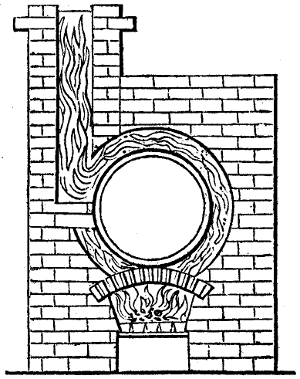
The apparatus employed for obtaining crude vinegar from wood, by the agency of heat, are large iron cylinders. In this country they are made of cast iron, and are laid horizontally in the furnace; in France, they are made of sheet iron riveted together, and they are set upright in the fire. Fig. 2. will give an accurate idea of the British plan, which is much the same as that adopted for decomposing pit coal in gas works, only that the cylinders for the pyrolignous acid manufacture are generally larger, being frequently 4 feet in diameter, and 6 or 8 feet long, and built horizontally in brickwork, so that the flame of one furnace may play around two of them. It would, probably, answer better, if their size were brought nearer the dimensions of the gas-light retorts, and if the whole system of working them were assimilated to that of coal gas.
The following arrangement is adopted in an excellent establishment in Glasgow, where the above large cylinders are 6 feet long, and both ends of them project a very little beyond the brickwork. One end has a disc or round plate of cast iron, well fitted, and firmly bolted to it, from the centre of which disc an iron tube, about 6 inches diameter, proceeds and enters, at a right angle, the main tube of refrigeration. The diameter of this tube may be from 9 to 14 inches, according to the number of cylinders. The other end of the cylinder is called the mouth of the retort; this is closed by a disc of iron, smeared round its edge by clay lute, and secured in its place by fir wedges. The charge of wood for such a cylinder is about 8 cwt. The hard woods—oak, ash, birch, and beech—are alone used; fir does not answer. The heat is kept up during the day-time, and the furnace is allowed to cool during the night. Next morning, the door is opened, the charcoal removed, and a new charge of wood is introduced. The average product of crude vinegar called pyrolignous acid, is 35 gallons. It is much contaminated with tar, is of a deep brown colour, and has a sp. gr. of 1·025. Its total weight is therefore about 300 lbs., but the residuary charcoal is found to weigh no more than one fifth of the wood employed; hence nearly one half of the ponderable matter of the wood is dissipated in incondensable gases. Count Rumford states, that the charcoal is equal in weight to more than four tenths of the wood from which it is made. The count’s error seems to have arisen from the slight heat of an oven to which his wood was exposed in a glass cylinder. The result now given, is the experience of an eminent manufacturing chemist.
The crude pyrolignous acid is rectified by a second distillation in a copper still, in the body of which about 20 gallons of viscid tarry matter are left from every 100. It has now become a transparent brown vinegar, having a considerably empyreumatic smell, and a sp. gr. of 1·013. Its acid powers are superior to those of the best household vinegar, in the proportion of three to two. By redistillation, saturation with quicklime, evaporation of the liquid acetate to dryness, and conversion into acetate of soda by sulphate of soda, the empyreumatic matter is so completely dissipated, that on decomposing the pure acetate of soda by sulphuric acid, a perfectly colourless and grateful vinegar rises in distillation. Its strength will be proportionable to the concentration of the decomposing acid.
The acetic acid of the chemist may be prepared also in the following modes:—1. Two parts of fused acetate of potash, with one of the strongest oil of vitriol, yield, by slow distillation from a glass retort into a refrigerated receiver, concentrated acetic acid. A small portion of sulphurous acid, which contaminates it, may be removed by redistillation from a little acetate of lead. 2. Or four parts of good sugar of lead, with one part of sulphuric acid, treated in the same way, afford a slightly weaker acetic acid. 3. Gently calcined sulphate of iron, or green vitriol, mixed with sugar of lead, in the proportion of 1 of the former to 21⁄2 of the latter, or with acetate of copper, and carefully distilled from a porcelain retort into a cool receiver, may be also considered an economical process. But that with binacetate of copper above described, is preferable to any of these.
Fig. 3.
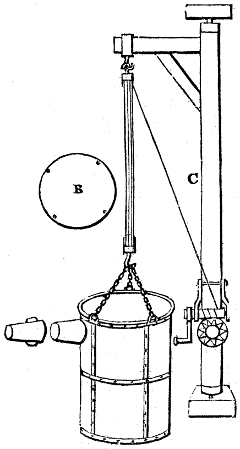
The manufacture of pyrolignous acid is conducted in the following way in France. Into large cylindrical vessels (fig. 3.) made of rivetted sheet iron, and having at their top and side a small sheet iron cylinder, the wood intended for making charcoal is introduced. To the upper part of this vessel a cover of sheet iron, B, is adapted, which is fixed with bolts. This vessel, thus closed, represents, as we see, a vast retort. When it is prepared, as we have said, it is lifted by means of a swing crane, C, and placed in a furnace, D, (fig. 4.) of a form relative to that of the vessel, and the opening of the furnace is covered with a dome, E, made of masonry or brickwork. The whole being thus arranged, heat is applied in the furnace at the bottom. The moisture of the wood is first dissipated, but by degrees the liquor ceases to be transparent, and becomes sooty. An adopter tube, A, is then fitted to the lateral cylinder. This adopter enters into another tube at the same degree of inclination which commences the condensing apparatus. The means of condensation vary according to the localities. In certain works they cool by means of air, by making the vapour pass through a long series of cylinders, or sometimes, even, through a series of casks connected together; but most usually water is used for condensing, when it can be easily procured in abundance. The most simple apparatus employed for this purpose consists of two cylinders, F, F, (fig. 4.) the one within the other, and which leave between them a sufficient space to allow a considerable body of water to circulate along and cool the vapours. This double cylinder is adapted to the distilling vessel, and placed at a certain inclination. To the first double tube, F, F, a second, and sometimes a third, entirely similar, are connected, which, to save space, return upon themselves in a zigzag fashion. The water is set in circulation by an ingenious means now adopted in many different manufactories. From the lower extremity, G, of the system of condensers, a perpendicular tube rises, whose length should be a little more than the most elevated point of the system. The water, furnished by a reservoir, L, enters by means of the perpendicular tube through the lower part of the system, and fills the whole space between the double cylinders. When the apparatus is in action, the vapours, as they condense, raise the temperature of the water, which, by the column in L G, is pressed to the upper part of the cylinders, and runs over by the spout K. To this point a very short tube is attached, which is bent towards the ground, and serves as an overflow.
Fig. 4.
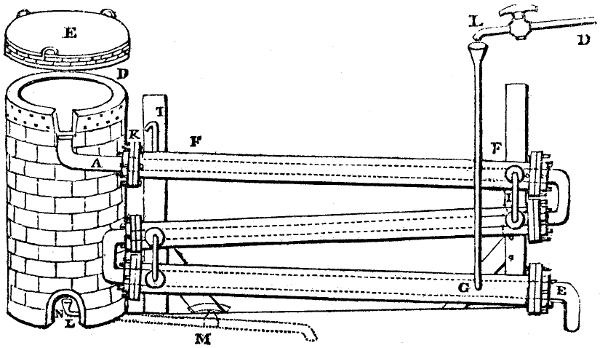
The condensing apparatus is terminated by a conduit in bricks covered and sunk in the ground. At the extremity of this species of gutter is a bent tube, E, which discharges the liquid product into the first cistern. When it is full, it empties itself, by means of an overflow pipe, into a great reservoir; the tube which terminates the gutter plunges into the liquid, and thus intercepts communication with the inside of the apparatus. The disengaged gas is brought back by means of pipes M L, from one of the sides of the conduit to the under part of the ash pit of the furnace. These pipes are furnished with stopcocks M, at some distance in front of the furnace, for the purpose of regulating the jet of the gas, and interrupting, at pleasure, communication with the inside of the apparatus. The part of the pipes which terminates in the furnace rises perpendicularly several inches above the ground, and is expanded like the rose of a watering can, N. The gas, by means of this disposition, can distribute itself uniformly under the vessel, without suffering the pipe which conducts it to be obstructed by the fuel or the ashes.
The temperature necessary to effect the carbonisation is not considerable: however, at the last it is raised so high as to make the vessels red hot; and the duration of the process is necessarily proportional to the quantity of wood carbonised. For a vessel which shall contain about 5 meters cube (nearly 6 cubic yds.), 8 hours of fire is sufficient. It is known that the carbonisation is complete by the colour of the flame of the gas: it is first of a yellowish red; it becomes afterwards blue, when more carbonic oxide than carbonic hydrogen is evolved; and towards the end it becomes entirely white,—a circumstance owing, probably, to the furnace being more heated at this period, and the combustion being more complete. There is still another means of knowing the state of the process, to which recourse is more frequently had; that is the cooling of the first tubes, which are not surrounded with water: a few drops of this fluid are thrown upon their surface, and if they evaporate quietly, it is judged that the calcination is sufficient. The adopter tube is then unluted, and is slid into its junction pipe; the orifices are immediately stopped with plates of iron and plaster loam. The brick cover, E, of the furnace is first removed by means of the swing crane, then the cylinder itself is lifted out and replaced immediately by another one previously charged. When the cylinder which has been taken out of the furnace is entirely cooled, its cover is removed, and the charcoal is emptied. Five cubic meters of wood furnish about 7 chaldrons (voies) and a half of charcoal. (For modifications of the wood-vinegar apparatus, see Charcoal and Pyrolignous Acid.)
The different qualities of wood employed in this operation give nearly similar product in reference to the acid; but this is not the case with the charcoal, for it is better the harder the wood; and it has been remarked, that wood long exposed to the air furnishes a charcoal of a worse quality than wood carbonised soon after it is cut.
Having described the kind of apparatus employed to obtain pyrolignous acid, I shall now detail the best mode of purifying it. This acid has a reddish brown colour; it holds in solution a portion of empyreumatic oil and of the tar which were formed at the same time; another portion of these products is in the state of a simple mixture; the latter may be separated by repose alone. It is stated, above, that the distilling apparatus terminates in a subterranean reservoir, where the products of all the vessels are mixed. A common pump communicates with the reservoir, and sinks to its very bottom, in order that it may draw off only the stratum of tar, which, according to its greater density, occupies the lower part. From time to time the pump is worked to remove the tar as it is deposited. The reservoir has at its top an overflow pipe, which discharges the clearest acid into a cistern, from which it is taken by means of a second pump.
The pyrolignous acid thus separated from the undissolved tar is transferred from this cistern into large sheet iron boilers, where its saturation is effected either by quicklime or by chalk; the latter of which is preferable, as the lime is apt to take some of the tar into combination. The acid parts by saturation with a new portion of the tar, which is removed by skimmers. The neutral solution is then allowed to rest for a sufficient time to let its clear parts be drawn off by decantation.
The acetate of lime thus obtained indicates by the hydrometer, before being mixed with the waters of edulcoration, a degree corresponding to the acidimetric degree of the acid employed. This solution must be evaporated till it reaches a specific gravity of 1·114 (15° Baumé), after which there is added to it a saturated solution of sulphate of soda. The acids exchange bases; sulphate of lime precipitates, and acetate of soda remains in solution. In some manufactures, instead of pursuing the above plan, the sulphate of soda is dissolved in the hot pyrolignous acid, which is afterwards saturated with chalk or lime. By this means no water need be employed to dissolve the sulphate, and accordingly the liquor is obtained in a concentrated form without evaporation. In both modes the sulphate of lime is allowed to settle, and the solution of acetate of soda is decanted. The residuum is set aside to be edulcorated, and the last waters are employed for washing fresh portions.
The acetate of soda which results from this double decomposition is afterwards evaporated till it attains to the density of 1·225 or 1·23, according to the season. This solution is poured into large crystallising vessels, from which, at the end of 3 or 4 days, according to their capacity, the mother waters are decanted, and a first crystallisation is obtained of rhomboidal prisms, which are highly coloured and very bulky. Their facettes are finely polished, and their edges very sharp. The mother waters are submitted to successive evaporations and crystallisations till they refuse to crystallise, and they are then burnt to convert them into carbonate of soda.
To avoid guesswork proportions, which are always injurious, by the loss of time which they occasion, and by the bad results to which they often lead, we should determine experimentally, beforehand, the quantities absolutely necessary for the reciprocal decomposition, especially when we change the acid or the sulphate. But it may be remarked that, notwithstanding all the precautions we can take, there is always a notable quantity of sulphate of soda and acetic acid, which disappear totally in this decomposition. This arises from the circumstance that sulphate of soda and acetate of lime do not completely decompose each other, as I have ascertained by experiments on a very considerable scale; and thus a portion of each of them is always lost with the mother waters. It might be supposed that by calcining the acetate of lime we could completely destroy its empyreumatic oil; but, though I have made many experiments, with this view I never could obtain an acetate capable of affording a tolerable acid. Some manufacturers prefer to make the acetate of soda by direct saturation of the acid with the alkali, and think that the higher price of this substance is compensated by the economy of time and fuel which it produces.
The acetate of soda is easily purified by crystallisations and torrefaction; the latter process, when well conducted, freeing it completely from every particle of tar. This torrefaction, to which the name of fusion may be given, requires great care and dexterity. It is usually done in shallow cast iron boilers of a hemispherical shape. During all the time that the heat of about 500° Fahr. is applied, the fused mass must be diligently worked with rakes; an operation which continues about 24 hours for half a ton of materials. We must carefully avoid raising the temperature so high as to decompose the acetate, and be sure that the heat is equally distributed; for if any point of the mass enters into decomposition, it is propagated with such rapidity, as to be excessively difficult to stop its progress in destroying the whole. The heat should never be so great as to disengage any smoke, even when the whole acetate is liquefied. When there is no more frothing up, and the mass flows like oil, the operation is finished. It is now allowed to cool in a body, or it may be ladled out into moulds, which is preferable.
When the acetate is dissolved in water, the charcoaly matter proceeding from the decomposition of the tar must be separated by filtration, or by boiling up the liquor to the specific gravity 1·114, when the carbonaceous matter falls to the bottom. On evaporating the clear liquor, we obtain an acetate perfectly fine, which yields beautiful crystals on cooling. In this state of purity it is decomposed by sulphuric acid, in order to separate its acetic acid.
This last operation, however simple it appears, requires no little care and skill. The acetate of soda crystallised and ground is put into a copper, and the necessary quantity of sulphuric acid of 1·842 (about 35 per cent. of the salt) to decompose almost, but not all, the acetate, is poured on. The materials are left to act on each other; by degrees the acetic acid quits its combination, and swims upon the surface; the greater part of the resulting sulphate of soda falls in a pulverulent form, or in small granular crystals, to the bottom. Another portion remains dissolved in the liquid, which has a specific gravity of 1·08. By distillation we separate this remainder of the sulphate, and finally obtain acetic acid, having a specific gravity of 1·05, an agreeable taste and smell, though towards the end it becomes a little empyreumatic, and coloured; for which reason, the last portions must be kept apart. The acid destined for table use ought to be distilled in an alembic whose capital and condensing worm are of silver; and to make it very fine, it may be afterwards infused over a little washed bone-black. It is usually obtained in a pretty concentrated state; but when we wish to give it the highest degree of concentration, we mix with it a quantity of dry muriate of lime, and distil anew. This acid may be afterwards exposed to congelation, when the strongest will crystallise. It is decanted, and the crystals are melted by exposing them to a temperature of from 60° to 70° Fahr.; this process is repeated till the acid congeals without remainder, at the temperature of 55° Fahr. It has then attained its maximum strength, and has a specific gravity of 1·063.
We shall add an observation on the above mode of decomposing the acetate of soda by sulphuric acid. Many difficulties are experienced in this process, if the sulphuric acid be poured on in small quantities at a time; for then such acrid fumes of acetic acid are disengaged, that the workmen are obliged to retire. This inconvenience may be saved by adding all the sulphuric acid at once; it occupies the lower part of the vessel, and decomposes only the portion of the acetate in contact with it; the heat evolved in consequence of this reaction is diffused through a great mass, and produces no sensible effect. When the sulphuric acid forms an opening, or a species of little crater, the workman, by means of a rake, depresses the acetate into it by degrees, and then the decomposition proceeds as slowly as he desires.
The acetic acid, like the nitric, chloric, and some others, has not hitherto been obtained free from water, and the greatest degree of concentration which we have been able to give it is that in which it contains only the quantity of water equivalent to the atomic weight of another oxidized body; a quantity which amounts to 14·89 per cent. The processes prescribed for preparing concentrated acetic acid sometimes tend to deprive it of that water without which it could not exist: hence, in all such cases, there is a part of the acid itself decomposed to furnish the water necessary to the constitution of the remainder. The constituent principles of the decomposed portion then form a peculiar, intoxicating, highly inflammatory liquid, called the PYRO-ACETIC SPIRIT.
The most highly concentrated acid of 1·063 becomes denser by the addition of a certain quantity of water up to a certain point. According to Berzelius, the prime equivalent of this acid is 643·189, oxygen being reckoned 100. Now, the above strongest acid consists of one prime of acid, and one of water = 1124·79. When it contains three atoms of water, that is, 337·437 parts to 643·189, or 34·41 to 65·59 in 100, it then has taken its maximum density of 1·075; after which the further addition of water diminishes its specific gravity, as the following table of Mollerat shows. His supposed anhydrous or dry acid contains, at 1·0630, 0·114 parts of water.
Table of Acetic Acid.
Water in 100 parts. Specific gravity.
0·00 1 ·0630
8·37 1 ·0742
17·00 1 ·0770
23·00 1 ·0791
28·10 1 ·0763
33·83 1 ·0742
37·60 1 ·0728
47·00 1 ·0658
50·00 1 ·0637
51·80 1 ·063
Acetic acid readily takes fire when it is heated in open vessels to the boiling point, and it burns with a blue flame, nearly like alcohol. It must be kept in close vessels, otherwise it loses its strength, by attracting humidity from the air. When concentrated, it is used only as a scent, or pungent exciter of the olfactory organs, in sickness and fainting fits. Its anti-epidemic qualities are apocryphal. What is met with in the shops under the name of salts of vinegar is nothing but sulphate of potash, put up in small phials, and impregnated with acetic acid, sometimes rendered aromatic with oil of rosemary or lavender.
Acetic acid, in its dry state, as it exists in fused acetate of potash or soda, is composed of
47·536 carbon
5·822 hydrogen
46·642 oxygen
100·000
And its symbol by Berzelius is H6 C4 O3 = A. We must bear in mind that his atomic weight for hydrogen is only one half of the number usually assigned to it by British chemists, in consequence of his making water a compound of two atoms of hydrogen and one of oxygen.
When the vapour of acetic acid is made to traverse a red-hot tube of iron, it is converted into water, carbonic acid, carburetted hydrogen, but chiefly pyro-acetic spirit. Acetic acid is a solvent of several organic products; such as camphor, gluten, gum-resins, resins, the fibrine of blood, the white of egg, &c.
It is an important problem to ascertain the purity and strength of vinegar. Spurious acidity is too often given to it by cheaper acids, such as the sulphuric and the nitric. The former, may most surely be detected by the nitrate of baryta, or even by acetate of lead, which occasion a white precipitate in such adulterated vinegar. For the case of nitric, which is more insidious, the proper test is, a bit of gold leaf, wetted with a few drops of muriatic acid. If the leaf dissolves, on heating the mixture in a watch glass, we may be sure that nitric acid is present.
Specific gravity, if determined by a sensible hydrometer, is a good test of the strength of the genuine vinegar; and the following table of Messrs. Taylor is nearly correct, or sufficiently so for commercial transactions.
Revenue proof vinegar, called by the English manufacturer No. 24., has a specific gravity of
1·0085 and contains of real acid in 100— 5
1·0170 10
1·0257 15
1·0320 20
1·0470 30
1·0580 40
An excise duty of 2d. is levied on every gallon of the above proof vinegar. Its strength is not, however, estimated directly by its specific gravity, but by the specific gravity which it assumes when saturated with quicklime. The decimal fraction of the specific gravity of the calcareous acetate is very nearly the double of that of the pure vinegar; or, 1·009 in vinegar becomes 1·018 in acetate of lime. The vinegar of malt contains so much mucilage or gluten, that when it has only the same acid strength as the above, it has a density of 1·0014, but it becomes only 1·023 when converted into acetate of lime: indeed, 0·005 of its density is due to mucilaginous matter. This fact shows the fallacy of trusting to the hydrometer for determining the strength of vinegars, which may be more or less loaded with vegetable gluten. The proper test of this, as of all other acids, is, the quantity of alkaline matter which a given weight or measure of it will saturate. For this purpose the bicarbonate of potash, commonly called, in the London shops, carbonate, may be employed very conveniently. As it is a very uniform substance, and its atomic weight, by the hydrogen radix, is 100·584, while the atomic weight of acetic acid, by the same radix, is 51·563, if we estimate 2 grains of the bicarbonate as equivalent to 1 of the real acid, we shall commit no appreciable error. Hence, a solution of the carbonate containing 200 grains in 100 measures, will form an acetimeter of the most perfect and convenient kind; for the measures of test liquid expended in saturating any measure,—for instance, an ounce or 1000 grains of acid,—will indicate the number of grains of real acetic acid in that quantity. Thus, 1000 grains of the above proof, would require 50 measures of the acetimetrical alkaline solution, showing that it contains 50 grains of real acetic acid in 1000, or 5 per cent.
It is common to add to purified wood vinegar, a little acetic ether, or caramelised (burnt) sugar to colour it, also, in France, even wine, to flavour it. Its blanching effect upon red cabbage, which it has been employed to pickle, is owing to a little sulphurous acid. This may be removed by redistillation with peroxide of manganese. Indeed, Stoltze professes to purify the pyrolignous acid solely by distilling it with peroxide of manganese, and then digesting it with bruised wood charcoal; or by distilling it with a mixture of sulphuric acid and manganese. But much acid is lost in this case by the formation of acetate of that metal.
Birch and beech afford most Pyrolignous acid, and pine the least. It is exclusively employed in the arts, for most purposes of which it need not be very highly purified. It is much used in calico printing, for preparing acetate of iron called Iron Liquor, and acetate of alumina, called Red Liquor; which see. It serves also to make sugar of lead; yet when it contains its usual quantity, after rectification, of tarry matter, the acetate of lead will hardly crystallise, but forms cauliflower concretions. This evil may be remedied, I believe, by boiling the saline solution with a very little nitric acid, which causes the precipitation of a brown granular substance, and gives the liquor a reddish tinge. The solution being afterwards treated with bruised charcoal, becomes colourless, and furnishes regular crystals of acetate or sugar of lead.
Pyrolignous acid possesses, in a very eminent degree, anti-putrescent properties. Flesh steeped in it for a few hours may be afterwards dried in the air without corrupting; but it becomes hard, and somewhat leather-like: so that this mode of preservation does not answer well for butcher’s meat. Fish are sometimes cured with it. See Pyro-acetic Spirit; Pyroxilic Ether; Pyroxolic Spirit; Pyrolignous Acid and Vinegar.
ACETIMETER. An apparatus for determining the strength of vinegar. See the conclusion of the preceding article for a description of my simple method of acetimetry.
ACETONE. The new chemical name of pyro-acetic spirit.
ACID OF ARSENIC. (Acide Arsenique, Fr.; Arseniksäure, Germ.)
ACIDS. A class of chemical substances characterised by the property of combining with and neutralising the alkaline and other bases, and of thereby forming a peculiar class of bodies called salts. The acids which constitute objects of special manufacture for commercial purposes are the following:—acetic, arsenious, carbonic, chromic, citric, malic, muriatic, nitric, oxalic, phosphoric, sulphuric, tartaric, which see.
ACROSPIRE. (Plumule, Fr.; Blattkeim, Germ.) That part of a germinating seed which botanists call the plumula, or plumes. See Beer and Malt.
ADDITIONS. Such articles as are added to the fermenting wash of the distiller are distinguished by this trivial name.
ADIPOCIRE. Fr. (Fettwachs, Germ.) The fatty matter generated in dead bodies buried under peculiar circumstances. In 1786 and 1787, when the churchyard of the Innocents, at Paris, was cleaned out, and the bones transported to the catacombs, it was discovered that not a few of the cadavres were converted into a saponaceous white substance, more especially many of those which had been interred for fifteen years in one pit, to the amount of 1500, in coffins closely packed together. These bodies were flattened, in consequence of their mutual pressure; and, though they generally retained their shape, there was deposited round the bones of several a grayish white, somewhat soft, flexible substance. Fourcroy presented to the Academy of Sciences, in 1789, a comprehensive memoir upon this phenomenon, which appeared to prove that the fatty body was an ammoniacal soap, containing phosphate of lime; that the fat was similar to spermaceti, as it assumed on slow cooling a foliated crystalline structure; as also to wax, as, when rapidly cooled, it became granular: hence he called it Adipocire. Its melting point was 52·5° C. (126·5° Fahr.). He likewise compared this soap to the fat of gall-stones, and supposed it to be a natural product of the slow decomposition of all animal matter, except bones, nails, and hairs.
This substance was again examined by Chevreul in 1812, and was found by him to contain margaric acid, oleic acid, combined with a yellow colouring, odorous matter, besides ammonia, a little lime, potash, oxide of iron, salts of lactic acid, an azotized substance; and was therefore considered as a combination of margaric and oleic acids, in variable proportions (whence arose its variable fusibility), but that it was not analogous with either spermaceti or cholesterine (gallstones). These fat acids are obviously generated by the reaction of the ammonia upon the margarine and oleine, though they eventually lose the greater part of that volatile alkali.
According to the views of both Gay Lussac and Chevreul, this adipocire proceeds solely from the pre-existing fat of the dead body, and not from the flesh, tendons, or cartilages, as had been previously imagined; which had led to some expensive and abortive attempts, upon the great scale of manufacture, to convert the dead bodies of cattle into adipocire, for the purposes of the candle-maker or soap-boiler, by exposing them for some time to the action of moisture.
Von Hartkol made experiments during 25 years upon this subject, from which he inferred, that there is no formation of adipocire in bodies buried in dry ground; that in moist earth the fat of the dead body does not increase, but changes into a fetid saponaceous substance, incapable of being worked into either soap or candles; that the dead bodies of mammalia immersed in running water, leave behind after 3 years a pure fat, which is more abundant from young than from old animals; that the intestines afford more fat than the muscles; that from this fat, without any purification, candles may be made, as void of smell, as hard, and as white, as from bleached wax; that from cadavers immersed for 3 years in stagnant water, more fat is procured than from those in running water, but that it needs to be purified before it can be made into soap or candles.
The cause of the difference between Hartkol’s and Chevreul’s results cannot be assigned, as the latter has not published his promised remarks upon the subject. At any rate, dead animal matter can be worked up more profitably than in making artificial adipocire.
ADIT. The horizontal entrance of a mine. It is sometimes called the drift. See Mining and Metallurgy.
ADULTERATION. The debasing any product of manufacture, especially chemical, by the introduction of cheap materials. The art of ascertaining the genuineness of the several products will be taught under the specific objects of manufacture.
ÆTHER. See Ether.
AFFINITY. The chemical term denoting the peculiar attractive force which produces the combination of dissimilar substances; such as of an alkali with an acid, or of sulphur with a metal.
AGARIC. A species of boletus or fungus, which grows in dunghills; with the salts of iron it affords a black dye. It is said to be convertible into a kind of china ink.
AGATE. A siliceous mineral which is cut into seals and other forms for the coarser kinds of jewellery. See Gem.
AIR. See Ventilation.
ALABASTER, is a stone usually white, and soft enough to be scratched by iron. There are two kinds of it: the gypseous, which is merely a natural semi-crystalline sulphate of lime; and the calcareous alabaster, which is a carbonate of lime. The oriental alabaster is always of the latter kind, and is most esteemed, because it is agreeably variegated with lively colours, and especially with zones of honey-yellow, yellow-brown, red, &c.; it is, moreover, susceptible of taking a marble polish.
The fineness of the grain of alabaster, the uniformity of its texture, the beauty of its polished surface, and its semi-transparency, are the qualities which render it valuable to the sculptor and to the manufacturer of ornamental toys.
The limestone alabaster is frequently found as a yellowish-white deposit in certain fountains. The most celebrated spring of this kind is that of the baths of San Filippo, in Tuscany. The water, almost boiling hot, runs over an enormous mass of stalactites, which it has formed, and holds the carbonate of lime in solution by means of sulphuretted hydrogen (according to M. Alexandre Brongniart), which escapes by contact of the atmosphere. Advantage has been taken of this property to make basso relievos of considerable hardness, by placing moulds of sulphur very obliquely, or almost upright, in wooden tubs open at the bottom. These tubs are surmounted at the top with a large wooden cross. The water of the spring, after having deposited in an external conduit or cistern the coarser sediment, is made to flow upon this wooden cross, where it is scattered into little streamlets, and thence lets fall, upon the sulphur casts, a precipitate so much the finer the more nearly vertical the mould. From one to four months are required for this operation, according to the thickness of the deposited crust. By analogous processes, the artists have succeeded in moulding vases, figures of animals, and other objects, in relief, of every different form, which require only to be trimmed a little, and afterwards polished.
The common alabaster is composed of sulphuric acid and lime, though some kinds of it effervesce with acids, and therefore contain some carbonate of lime. This alabaster occurs in many different colours, and of very different degrees of hardness, but it is always softer than marble. It forms, usually, the lowest beds of the gypsum quarries. The sculptors prefer the hardest, the whitest, and those of a granular texture, like Carrara marble, and so like that they can only be distinguished by the hardness.
The alabaster is worked with the same tools as marble; and as it is many degrees softer, it is so much the more easily cut; but it is more difficult to polish, from its little solidity. After it has been fashioned into the desired form, and smoothed down with pumice stone, it is polished with a pap-like mixture of chalk, soap, and milk; and, last of all, finished by friction with flannel. It is apt to acquire a yellowish tinge.
Besides the harder kinds, employed for the sculpture of large figures, there is a softer alabaster, pure white and semi-transparent, from which small ornamental objects are made, such as boxes, vases, lamps, stands of time-pieces, &c. This branch of business is much prosecuted in Florence, Leghorn, Milan, &c., and employs a great many turning lathes. Of all the alabasters the Florentine merits the preference, on account of its beauty and uniformity, so that it may be fashioned into figures of considerable size; for which purpose there are large work-shops where it is cut with steel saws into blocks and masses of various shapes. Other sorts of gypsum, such as that of Salzburg and Austria, contain sand veins, and hard nodules, and require to be quarried by cleaving and blasting operations, which are apt to crack it, and unfit it for all delicate objects of sculpture. It is, besides, of a gray shade, and often stained with darker colours.
The alabaster best adapted for the fine arts is pretty white when newly broken, and becomes whiter on the surface by drying. It may be easily cut with the knife or chisel, and formed into many pleasing shapes by suitable steel tools. It is worked either by the hand alone, or with the aid of a turning lathe. The turning tools should not be too thin or sharp-edged; but such as are employed for ivory and brass are most suitable for alabaster, and are chiefly used to shave and to scratch the surface. The objects which cannot be turned may be fashioned by the rasping tools, or with minute files, such as variegated foliage. Fine chisels and graving tools are also used for the better pieces of statuary.
For polishing such works, a peculiar process is required: pumice stone, in fine powder, serves to smooth down the surfaces very well, but it soils the whiteness of the alabaster. To take away the unevennesses and roughnesses dried shave-grass (equisetum) answers best. Frictions with this plant and water polish down the asperities left by the chisel: the fine streaks left by the grass may be removed by rubbing the pieces with slaked lime, finely pulverised and sifted, made into a paste, or putty, with water. The polish and satin-lustre of the surface are communicated by friction, first with soap-water and lime, and finally with powdered and elutriated talc or French chalk.
Such articles as consist of several pieces are joined by a cement composed of quicklime and white of egg, or of well-calcined and well-sifted Paris plaster, mixed with the least possible quantity of water.
Alabaster objects are liable to become yellow by keeping, and are especially injured by smoke, dust, &c. They may be in some measure restored by washing with soap and water, then with clear water, and again polished with shave-grass. Grease spots may be removed either by rubbing with talc powder, or with oil of turpentine.
The surface of alabaster may be etched by covering over the parts that are not to be touched with a solution of wax in oil of turpentine, thickened with white lead, and immersing the articles in pure water after the varnish has set. The action of the water is continued from 20 to 50 hours, more or less, according to the depth to which the etching is to be cut. After removing the varnish with oil of turpentine, the etched places, which are necessarily deprived of their polish, should be rubbed with a brush dipped in finely-powdered gypsum, which gives a kind of opacity, contrasting well with the rest of the surface.
Alabaster may be stained either with metallic solutions, with spirituous tinctures of dyeing plants, or with coloured oils, in the same way as marbles.
This substance has been hardened, it is said, by exposing it to the heat of a baker’s oven for 10 or 20 hours, after taking it out of the quarry, and giving it the figure, roughly, which it is intended to have. After this exposure, it must be dipped for two minutes in running water; when it is cold, it must be dipped a second time for the same period. On being exposed to the air for a few days, alabaster so treated acquires a marble-like hardness. I doubt the truth of this statement.
ALBUM GRÆCUM. The white dung of dogs, sometimes used to soften leather in the process of dressing it after the depilatory action of lime.
ALCARAZZAS. A species of porous earthenware, made in Spain, for cooling liquors. See Pottery.
ALCOHOL. The well-known intoxicating liquor procured by distillation from various vegetable juices, and infusions of a saccharine nature, which have undergone the vinous fermentation. Common alcohol, or proof spirit, as it is called, contains about one half its weight of water. It may be concentrated till its specific gravity becomes so low as 0·825, by simple redistillation at a steam or water-bath heat; but to make it stronger, we must mix with it, in the still or retort, dry carbonate of potash, muriate of lime, or some other substances strongly attractive of water, and then it may be obtained of a specific gravity so low as 0·791 at 16° Reaumur (68° Fahr.), water being 1·000. At 0·825, it contains, still, 11 per cent. of water; and in this state it is as volatile as absolute alcohol, on account of the inferior density of the aqueous vapour, compared to the alcoholic. Indeed, according to Yelin and Fuchs, the boiling point of anhydrous alcohol is higher than of that which contains 2 or 3 per cent. of water; hence, in the distillation of alcohol of 94 per cent., the first portions that come over are more aqueous than the following. Absolute alcohol has its boiling point at 1681⁄2° Fahr.: but when it holds more than 6 per cent. of water, the first portions that come over are richest in alcohol, and the temperature of the boiling point, or of the spirituous vapour, is always higher the longer the distillation continues. According to Gröning’s researches, the following temperatures of the alcoholic vapours correspond to the accompanying contents of alcohol in per centage of volume, which are disengaged in the boiling of the spirituous liquid.
Temperature. Alcoholic content of the vapour. Alcoholic content of the boiling liquid.
Fahr. 170 ·0 93 92
171 ·8 92 90
172 91 85
172 ·8 90 1⁄2 80
174 90 70
174 ·6 89 70
176 87 65
178 ·3 85 50
180 ·8 82 40
183 80 35
185 78 30
187 ·4 76 25
189 ·8 71 20
192 ·0 68 18
164 66 15
196 ·4 61 12
198 ·6 55 10
201 50 7
203 42 5
205 ·4 36 3
207 ·7 28 2
210 13 1
212 0 0
Gröning undertook this investigation in order to employ the thermometer as an alcoholmeter in the distillation of spirits; for which purpose he thrust the bulb of the thermometer through a cork, inserted into a tube fixed in the capital of the still. The state of the barometer ought also to be considered in making comparative experiments of this kind. Since, by this method, the alcoholic content may be compared with the temperature of the vapour that passes over at any time, so, also, the contents of the whole distillation may be found approximately; and the method serves as a convenient means of making continual observations on the progress of the distillation.
The temperature, corresponding to a certain per centage of alcohol in vapour, suggests the employment of a convenient method for obtaining, at one process, a spirit as free from water as it can be made by mere distillation. We place over the top of the capital a water-bath, and lead up through it a spiral pipe from the still, which there passes obliquely downwards, and proceeds to the refrigeratory. If this bath be maintained, by a constant influx of cold water, at a certain temperature, only the alcoholic vapour corresponding to that temperature will pass over, and the rest will be recondensed and returned into the still. If we keep the temperature of the water at 174°, for example, the spirituous vapour which passes over will contain 90 per cent. of absolute alcohol, according to the preceding table. The skilful use of this principle constitutes the main improvement in modern distilleries. See Distillation and Still.
Another method for concentrating alcohol is that discovered by Sömmering, founded upon the property of ox bladders to allow water to pass through and evaporate out of them, but not to permit alcohol to transpire, or only in a slight degree. Hence, if an ox’s bladder is filled with spirit of wine, well tied at the mouth, and suspended in a warm place, the water will continually exhale, and the alcohol will become nearly anhydrous; for in this way alcohol of 97 or 98 per cent. may be obtained.
According to Sömmering, we should take for this purpose the bladder of an ox or a calf, soak it for some time in water, then inflate it and free it from the fat and the attached vessels; which is to be also done to the other surface, by turning it inside out. After it is again inflated and dried, we must smear over the outer side twice, and the inner side four times, with a solution of isinglass, by which its texture is made closer, and the concentration of the alcohol goes on better. A bladder so prepared may serve more than a hundred times. It must be charged with the spirits to be concentrated, leaving a small space vacant, it is then to be tightly bound at the mouth, and suspended in a warm situation, at a temperature of 122° Fahr., over a sand-bath, or in the neighbourhood of an oven. The surface of the bladder remains moist with the water, as long as the sp. gr. of the contained spirit is greater than 0·952. Weak spirit loses its water quicker than strong; but in from 6 to 12 hours the alcohol may be concentrated, when a suitable heat is employed. This economical method is particularly applicable in obtaining alcohol for the preparation of varnishes. When the alcohol is to serve for other purposes, it must be freed, by distillation, from certain matters dissolved out of the bladder. Alcohol may likewise be strengthened, as Sömmering has ascertained when the vessel that contains the spirit is bound over with a bladder which does not come into contact with the liquid. Thus, too, all other liquors containing alcohol and water, as wine, cider, &c., may be made more spirituous.
To procure absolute alcohol, we must take chloride of calcium recently fused, reduce it to coarse powder, and mix it with its own weight of spirit of wine, of sp. gr. 0·833, in a bottle, which is to be well stoppered, and to be agitated till the salt is dissolved. The clear solution is to be poured into a retort, and half of the volume of the alcohol employed, or so much as has the sp. gr. 0·791 at 68° Fahr., is to be distilled off at a gentle heat. Quicklime has also been employed for the same purpose, but it is less powerful and convenient. Alcohol, nearly free from water, may be obtained without distillation, by adding dry carbonate of potash to a spirit of wine, of sp. gr. 0·825. The water combines with the potash, and falls to the bottom in a dense liquid, while the pure spirit floats on the surface. This contains however a little alkali, which can only be separated by distillation.
Anhydrous alcohol is composed by weight of 52·66 carbon, 12·90 hydrogen, and 34·44 of oxygen. It has a very powerful attraction for water, and absorbs it from the atmosphere; therefore it must be kept in well-closed vessels. It also robs vegetable and animal bodies of their moisture; and hence common alcohol is employed for preserving anatomical preparations. Alcohol is a solvent for many substances: resins, essential oils, camphor, are abundantly dissolved by it, forming varnishes, perfumed spirits, &c. The solution of a resin or essential oil in alcohol becomes milky on the addition of water, which, by its attraction for alcohol, separates these substances. Several salts, especially the deliquescent, are dissolved by it, and some of them give a colour to its flame; thus, the solutions of the salts of strontia in alcohol burn with a crimson flame, those of copper and borax green, lime reddish, and baryta yellow.
When water is mixed with alcohol, heat and a condensation of volume are the result; these effects being greatest with 54 per cent. of alcohol and 46 of water, and thence decreasing with a greater proportion of water. For alcohol which contains 90 per cent. of water, this condensation amounts to 1·94 per cent. of the volume; for 80 per cent., 2·87; for 70 per cent., 3·44; for 60 per cent., 3·73; for 40 per cent., 3·44; for 30 per cent., 2·72; for 20 per cent., 1·72; for 10 per cent., 0·72. Hence, to estimate the quantity of alcohol in any spirit it is necessary that the specific gravity be ascertained for each determinate proportion of alcohol and water that are mixed together. When this is done, we may, by means of an areometer constructed for liquids lighter than water, determine the strength of the spirit, either by a scale of specific gravities or by an arbitrary graduation corresponding to certain commercial objects, and thus we may determine the per centage of alcohol in whisky or brandy of any strength or purity. An areometer intended for this use has been called an alcoholmeter, in particular when the scale of it is so graduated that, instead of the specific gravity, it indicates immediately the per centage of anhydrous alcohol in a given weight or volume of the liquid. The scale graduated according to the per centage of pure alcohol by weight, constitutes the alcoholmeter of Richter; and that by the per centage in volume, the alcoholmeter of Tralles and Gay Lussac.
As liquors are sold in general by the measure, not by the weight, it is convenient, therefore, to know the alcoholic content of the mixtures in the per centage by volume. Tralles has constructed new tables upon the principles of those of Gilpin, in which the proportion is given by volume, and anhydrous alcohol is assumed for the basis; which, at 60° Fahr., has a specific gravity of 0·7939 compared with water at its maximum density, or a specific gravity 0·7946 compared with water of the temperature of 60° Fahr. Gilpin’s alcohol of 0·825 contains 92·6 per cent. by volume of anhydrous alcohol.
The following table exhibits the per centage of anhydrous alcohol by volume, at a temperature of 60° Fahr., in correspondence with the specific gravities of the spirits, water being considered at 60° Fahr. to have a specific gravity of 0·9991.
Alcoholmetrical Table of Tralles.
Alcohol in 100 measures of spirit. Specific gravity at 60° Fahr. Difference of the sp. gr.
0 9991
1 9976 15
2 9961 15
3 9947 14
4 9933 14
5 9919 14
6 9906 13
7 9893 13
8 9881 12
9 9869 12
10 9857 12
11 9845 12
12 9834 11
13 9823 11
14 9812 11
15 9802 10
16 9791 11
17 9781 10
18 9771 10
19 9761 10
20 9751 10
21 9741 10
22 9731 10
23 9720 11
24 9710 10
25 9700 10
26 9689 11
27 9679 10
28 9668 11
29 9657 11
30 9646 11
31 9634 12
32 9622 12
33 9609 13
34 9596 13
35 9583 13
36 9570 13
37 9556 14
38 9541 15
39 9526 15
40 9510 16
41 9494 16
42 9478 16
43 9461 17
44 9444 17
45 9427 17
46 9409 18
47 9391 18
48 9373 18
49 9354 19
50 9335 19
51 9315 20
52 9295 20
53 9275 20
54 9254 21
55 9234 20
56 9213 21
57 9192 21
58 9170 22
59 9148 22
60 9126 22
61 9104 22
62 9082 22
63 9059 23
64 9036 23
65 9013 23
66 8989 24
67 8965 24
68 8941 24
69 8917 24
70 8892 25
71 8867 25
72 8842 25
73 8817 25
74 8791 26
75 8765 26
76 8739 26
77 8712 27
78 8685 27
79 8658 27
80 8631 27
81 8603 28
82 8575 28
83 8547 28
84 8518 29
85 8488 30
86 8458 30
87 8428 30
88 8397 31
89 8365 32
90 8332 33
91 8299 33
92 8265 34
93 8230 35
94 8194 36
95 8157 37
96 8118 39
97 8077 41
98 8034 43
99 7988 46
100 7939 49
Remarks on the preceding Table of Alcohol.
The third column of this table exhibits the differences of the specific gravities, which give the denominator of the fraction for such densities as are not found sufficiently near in the table; and the difference of their numerators is the next greatest to the density found in the table. For example: if the specific gravity of the liquor found for 60° Fahr. = 9605 (the per centage will be between 33 and 34), the difference from 9609 (which is the next greatest number in the table) = 4, and the fraction is 4⁄13; therefore the true per centage is 334⁄13. From the construction of this table the per centage of alcohol by weight may also be found. For instance: we multiply the number representing the volumes of alcohol (given in the table for any determinate specific gravity of the mixture) by the specific gravity of the pure alcohol, that is, by 7939, and the product is the number of pounds of alcohol in so many pounds as the specific gravity multiplied by 100 gives. Thus, in the mixture of 9510 specific gravity, there are 40 measures of alcohol; hence there are also in 95,100 pounds of this spirit 7939 + 40 = 31·756 pounds of alcohol; and in 100 pounds of the spirits of 0·9510 specific gravity, 33·39 pounds of alcohol are contained.
As the preceding table gives the true alcoholic content when the portion of spirit under trial has the normal temperature of 60° Fahr., the following table gives the per centage of alcohol for the specific gravities corresponding to the accompanying temperatures.
For example: if we have a spirituous liquor at 80° Fahr., whose specific gravity is 0·9342, the alcohol present is 45 per cent. of the volume, or that specific gravity at that temperature is equal to the specific gravity 0·9427 at the normal temperature of 60° Fahr. This table may also be employed for every degree of the thermometer and every per centage, so as to save computation for the intervals. It is evident from inspection that a difference of 5° Fahr. in the temperature changes the specific gravity of the liquor by a difference nearly equal to 1 volume per cent. of alcohol; thus at 35° and 85° Fahr. the very same specific gravity of the liquor shows nearly 10 volumes per cent. of alcohol more or less; the same, for example, at 60 and 40 per cent.