L.
Reading edition
LABDANUM or Ladanum, is an unctuous resin, of an agreeable odour, found besmearing the leaves and twigs of the cystus creticus, a plant which grows in the island of Candia, and in Syria. It is naturally a dark-brown soft substance, but it hardens on keeping. Its specific gravity is 1·186. It has a bitter taste. Its chief use is in surgery for making plasters.
LABRADORITE; opaline or Labradore felspar, is a beautiful mineral, with brilliant changing colours, blue, red, and green, &c. Spec. grav. 2·70 to 2·75. Scratches glass; affords no water by calcination; fusible at the blow-pipe into a frothy bead; soluble in muriatic acid; solution affords a copious precipitate with oxalate of ammonia. Cleavages of 931⁄2° and 861⁄2°; one of which is brilliant and pearly. Its constituents are, silica, 55·75; alumina, 26·5; lime, 11; soda, 4; oxide of iron, 1·25; water, 0·5.
LABYRINTH, in metallurgy, means a series of canals distributed in the sequel of a stamping-mill; through which canals a stream of water is transmitted for suspending, carrying off, and depositing, at different distances, the ground ores. See Metallurgy.
LAC, LAC-DYE. (Laque, Fr.; Lack, Lackfarben, Germ.) Stick-lac is produced by the puncture of a peculiar female insect, called coccus lacca or ficus, upon the branches of several plants; as the ficus religiosa, the ficus indica, the rhamnus jujuba, the croton lacciferum, and the butea frondosa, which grow in Siam, Assam, Pegu, Bengal, and Malabar. The twig becomes thereby encrusted with a reddish mammelated resin, having a crystalline-looking fracture.
The female lac insect is of the size of a louse; red, round, flat, with 12 abdominal circles, a bifurcated tail, antennæ, and 6 claws, half the length of the body. The male is twice the above size, and has 4 wings; there is one of them to 5000 females. In November or December the young brood makes its escape from the eggs, lying beneath the dead body of the mother; they crawl about a little way, and fasten themselves to the bark of the shrubs. About this period the branches often swarm to such a degree with this vermin, that they seem covered with a red dust; in this case, they are apt to dry up, by being exhausted of their juices. Many of these insects, however, become the prey of others, or are carried off by the feet of birds, to which they attach themselves, and are transplanted to other trees. They soon produce small nipple-like incrustations upon the twigs, their bodies being apparently glued, by means of a transparent liquor, which goes on increasing to the end of March, so as to form a cellular texture. At this time, the animal resembles a small oval bag, without life, of the size of cochineal. At the commencement, a beautiful red liquor only is perceived, afterwards eggs make their appearance; and in October or November, when the red liquor gets exhausted, 20 or 30 young ones bore a hole through the back of their mother, and come forth. The empty cells remain upon the branches. These are composed of the milky juice of the plant, which serves as nourishment to the insects, and which is afterwards transformed or elaborated into the red colouring matter that is found mixed with the resin, but in greater quantity in the bodies of the insects, in their eggs, and still more copiously in the red liquor secreted for feeding the young. After the brood escapes, the cells contain much less colouring matter. On this account, the branches should be broken off before this happens, and dried in the sun. In the East Indies this operation is performed twice in the year; the first time in March, the second in October. The twigs encrusted with the radiated cellular substance, constitute the stick-lac of commerce. It is of a red colour more or less deep, nearly transparent, and hard, with a brilliant conchoidal fracture. The stick-lac of Siam is the best; a piece of it presented to me by Mr. Rennie, of Fenchurch-street, having an incrustation fully one quarter of an inch thick all round the twig. The stick-lac of Assam ranks next; and, last, that of Bengal, in which the resinous coat is scanty, thin, and irregular. According to the analysis of Dr. John, stick-lac consists, in 120 parts, of
An odorous common resin 80·00
A resin insoluble in ether 20·00
Colouring matter analogous to that of cochineal 4·50
Bitter balsamic matter 3·00
Dun yellow extract 0·50
Acid of the stick-lac (laccic acid) 0·75
Fatty matter, like wax 3·00
Skins of the insects, and colouring matter 2·50
Salts 1·25
Earths 0·75
Loss 4·75
120·00
According to Franke, the constituents of stick-lac are, resin, 65·7; substance of the lac, 28·3; colouring matter, 0·6.
Seed-lac.—When the resinous concretion is taken off the twigs, coarsely pounded, and triturated with water in a mortar, the greater part of the colouring matter is dissolved, and the granular portion which remains being dried in the sun, constitutes seed-lac. It contains of course less colouring matter than the stick-lac, and is much less soluble. John found in 100 parts of it, resin, 66·7; wax, 1·7; matter of the lac, 16·7; bitter balsamic matter, 2·5; colouring matter, 3·9; dun yellow extract, 0·4; envelopes of insects, 2·1; laccic acid, 0·0; salts of potash and lime, 1·0; earths, 6·6; loss, 4·2.
In India the seed-lac is put into oblong bags of cotton cloth, which are held over a charcoal fire by a man at each end, and, as soon as it begins to melt, the bag is twisted so as to strain the liquefied resin through its substance, and to make it drop upon smooth stems of the banyan tree (musa paradisa). In this way, the resin spreads into thin plates, and constitutes the substance known in commerce by the name of shell-lac.
The Pegu stick-lac, being very dark coloured, furnishes a shell-lac of a corresponding deep hue, and therefore of inferior value. The palest and finest shell-lac is brought from the northern Circar. It contains very little colouring matter. A stick-lac of an intermediate kind comes from the Mysore country, which yields a brilliant lac-dye and a good shell-lac.
Lac-dye is the watery infusion of the ground stick-lac, evaporated to dryness, and formed into cakes about two inches square and half an inch thick. Dr. John found it to consist of, colouring matter, 50; resin, 25; and solid matter, composed of alumina, plaster, chalk, and sand, 22.
Dr. Macleod, of Madras, informs me that he prepared a very superior lac-dye from stick-lac, by digesting it in the cold in a slightly alkaline decoction of the dried leaves of the Memecylon tinctorium (perhaps the M. capitellatum, from which the natives of Malabar and Ceylon obtain a saffron-yellow dye). This solution being used along with a mordant consisting of a saturated solution of tin in muriatic acid, was found to dye woollen cloth of a very brilliant scarlet hue.
The cakes of lac-dye imported from India, stamped with peculiar marks to designate their different manufacturers, are now employed exclusively in England for dyeing scarlet cloth, and are found to yield an equally brilliant colour, and one less easily affected by perspiration than that produced by cochineal. When the lac-dye was first introduced, sulphuric acid was the solvent applied to the pulverized cakes, but as muriatic acid has been found to answer so much better, it has entirely supplanted it. A good solvent (No. 1.) for this dye-stuff may be prepared by dissolving 3 pounds of tin in 60 pounds of muriatic acid, of specific gravity 1·19. The proper mordant for the cloth is made by mixing 27 pounds of muriatic acid of sp. grav. 1·17, with 11⁄2 pounds of nitric acid of 1·19; putting this mixture into a salt-glazed stone bottle, and adding to it in small bits at a time, grain tin, till 4 pounds be dissolved. This solution (No. 2.) may be used within twelve hours after it is made, provided it has become cold and clear. For dyeing; three quarters of a pint of the solvent No. 1. is to be poured upon each pound of the pulverized lac-dye, and allowed to digest upon it for six hours. The cloth before being subjected to the dye bath, must be scoured in the mill with fullers’ earth. To dye 100 pounds of pelisse cloth, a tin boiler of 300 gallons capacity should be filled nearly brimful with water, and a fire kindled under it. Whenever the temperature rises to 150° Fahr., a handful of bran, and half a pint of the solution of tin (No. 2.) are to be introduced. The froth, which rises as it approaches ebullition, must be skimmed off; and when the liquor boils, 101⁄2 pounds of lac-dye, previously mixed with 7 pints of the solvent No. 1., and 31⁄2 pounds of solution of tin No. 2., must be poured in. An instant afterwards, 101⁄2 pounds of tartar, and 4 pounds of ground sumach, both tied up in a linen bag, are to be suspended in the boiling bath for five minutes. The fire being now withdrawn, 20 gallons of cold water, with 101⁄2 pints of solution of tin being poured into the bath, the cloth is to be immersed in it, moved about rapidly during ten minutes; the fire is to be then re-kindled, and the cloth winced more slowly through the bath, which must be made to boil as quickly as possible, and maintained at that pitch for an hour. The cloth is to be next washed in the river; and lastly with water only, in the fulling mill. The above proportions of the ingredients produce a brilliant scarlet tint, with a slightly purple cast. If a more orange hue be wanted, white Florence argal may be used, instead of tartar, and some more sumach. Lac-dye may be substituted for cochineal in the orange-scarlets; but for the more delicate pink shades, it does not answer so well, as the lustre is apt to be impaired by the large quantity of acid necessary to dissolve the colouring matter of the lac.
Shell-lac, by Mr. Hatchett’s analysis, consists of resin, 90·5; colouring matter, 0·5; wax, 4·0; gluten, 2·8; loss, 1·8; in 100 parts.
The resin may be obtained pure by treating shell-lac with cold alcohol, and filtering the solution in order to separate a yellow gray pulverulent matter. When the alcohol is again distilled off, a brown, translucent, hard, and brittle resin, of specific gravity 1·139, remains. It melts into a viscid mass with heat, and diffuses an aromatic odour. Anhydrous alcohol dissolves it in all proportions. According to John, it consists of two resins, one of which dissolves readily in alcohol, ether, the volatile and fat oils; while the other is little soluble in cold alcohol, and is insoluble in ether and the volatile oils. Unverdorben, however, has detected no less than four different resins, and some other substances in shell-lac. Shell-lac dissolves with ease in dilute muriatic and acetic acids; but not in concentrated sulphuric acid. The resin of shell-lac has a great tendency to combine with salifiable bases; as with caustic potash, which it deprives of its alkaline taste.
This solution, which is of a dark red colour, dries into a brilliant, transparent, reddish brown mass; which may be re-dissolved in both water and alcohol. By passing chlorine in excess through the dark-coloured alkaline solution, the lac-resin is precipitated in a colourless state. When this precipitate is washed and dried, it forms, with alcohol, an excellent pale-yellow varnish, especially with the addition of a little turpentine and mastic.
With the aid of heat, shell-lac dissolves readily in a solution of borax.
The substances which Unverdorben found in shell-lac are the following:
1. A resin, soluble in alcohol and ether;
2. A resin, soluble in alcohol, insoluble in ether;
3. A resinous body, little soluble in cold alcohol;
4. A crystallizable resin;
5. A resin, soluble in alcohol and ether, but insoluble in petroleum, and uncrystallizable.
6. The unsaponified fat of the coccus insect, as well as oleic and margaric acids.
7. Wax.
8. The laccine of Dr. John.
9. An extractive colouring matter.
Statistical Table of Lac-dye and Lac-lake, per favour of James Wilkinson, Esq., of Leadenhall-street.
Import. Export. Home Consump- tion. Prices. Stocks.
lbs. lbs. lbs. s. d. s. d. Chests.
1802 253 none none
1803 1,735 accot. burned
1804 531
1805 1,987
1806 none
1807 25,350
1808 5,731
1809 40,632
1810 235,154
1811 378,325
1812 198,250
1813 289,654
1814 278,899 5,071 133,935
1815 598,592 8,441 137,915
1816 269,373 27,412 162,894
1817 384,909 23,091 234,763
1818 242,572 32,079 323,169
1819 179,511 21,707 207,063
1820 441,486 49,519 912,514
1821 641,755 91,925 322,837
1822 872,967 29,578 349,351
1823 534,220 13,050 414,714
1824 604,269 53,843 483,339
1825 541,443 61,908 385,734
1826 760,729 68,603 395,609
1827 756,315 76,875 448,270 1 9 4 0 11,538
1828 512,874 54,999 397,867 1 3 3 9 11,085
1829 475,632 39,344 433,851 1 3 3 6 11,976
1830 534,341 78,099 548,865 0 9 3 3 11,834
1831 913,562 175,717 597,568 0 4 2 6 12,559
1832 378,843 69,842 594,155 0 4 2 3 11,420
1833 326,894 66,447 426,460 0 9 2 4 11,457
1834 708,959 89,229 398,832 0 11 2 4 11,928
1835 528,564 203,840 573,288 0 11 3 0 10,454
1836 642,436 200,975 642,615 1 0 4 0 9,492
1837 1,011,674 133,959 427,890 1 0 3 9 8,780
The Stock includes 2,200 chests of Lac-lake.
LACCIC ACID crystallizes, has a wine-yellow colour, a sour taste, is soluble in water, alcohol, and ether. It was extracted from stick-lac by Dr. John.
LACCINE is the portion of shell-lac which is insoluble in boiling alcohol. It is brown, brittle, translucid, consisting of agglomerated pellicles, more like a resin than any thing else. It is insoluble in ether and oils. It has not been applied to any use.
LACE MANUFACTURE. The pillow-made, or bone-lace, which formerly gave occupation to multitudes of women in their own houses, has, in the progress of mechanical invention, been nearly superseded by the bobbin-net lace, manufactured at first by hand-machines, as stockings are knit upon frames, but recently by the power of water or steam. This elegant texture possesses all the strength and regularity of the old Buckingham lace, and is far superior in these respects to the point-net and warp lace, which had preceded, and in some measure paved the way for it. Bobbin-net may be said to surpass every other branch of human industry in the complex ingenuity of its machinery; one of Fisher’s spotting frames being as much beyond the most curious chronometer in multiplicity of mechanical device, as that is beyond a common roasting-jack.
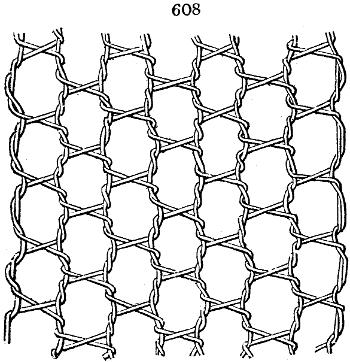
The threads in bobbin-net lace form, by their intertwisting and decussation, regular hexagonal holes or meshes, of which the two opposite sides, the upper and under, are directed along the breadth of the piece, or at right angles to the selvage or border. Fig. 608. shows how, by the crossing and twisting of the threads, the regular six-sided mesh is produced, and that the texture results from the union of three separate sets of threads, of which one set proceed downwards in serpentine lines, a second set proceeds from the left to the right, and a third from the right to the left, both in slanting directions. These oblique threads twist themselves round the vertical ones, and also cross each other betwixt them, in a peculiar manner, which may be readily understood by examining the representation. In comparing bobbin-net with a common web, the perpendicular threads in the figure, which are parallel to the border, may be regarded as the warp, and the two sets of slanting threads, as the weft.
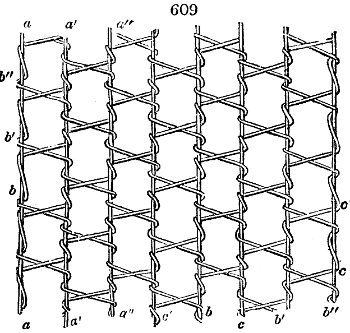
These warp threads are extended up and down, in the original mounting of the piece between a top and bottom horizontal roller or beam, of which one is called the warp beam, and the other the lace beam, because the warp and finished lace are wound upon them respectively. These straight warp threads receive their contortion from the tension of the weft threads twisted obliquely round them alternately to the right and the left hand. Were the warp threads so tightly drawn that they became inflexible, like fiddle-strings, then the lace would assume the appearance shown in fig. 609.; and although this condition does not really exist, it may serve to illustrate the structure of the web. The warp threads stand in the positions a a, a′ a′, and a′′ a′′; the one half of the weft proceeds in the direction b b, b′ b′ and b′′ b′′; and the second crosses the first by running in the direction c c, or c′ c′, towards the opposite side of the fabric. If we pursue the path of a weft thread, we find it goes on till it reaches the outermost or last warp thread, which it twists about; not once, as with the others, but twice; and then returning towards the other border, proceeds in a reverse direction. It is by this double twist, and by the return of the weft threads, that the selvage is made.
The ordinary material of bobbin-net is two cotton yarns, of from No. 180. to No. 250., twisted into one thread; but sometimes strongly twisted single yarn has been used. The beauty of the fabric depends upon the quality of the material, as well as the regularity and smallness of the meshes. The number of warp threads in a yard in breadth is from 600 to 900; which is equivalent to from 20 to 30 in an inch. The size of the holes cannot be exactly inferred from that circumstance, as it depends partly upon the oblique traction of the threads. The breadth of the pieces of bobbin-net varies from edgings of a quarter of an inch, to webs 12, or even 20 quarters, that is, 5 yards wide.
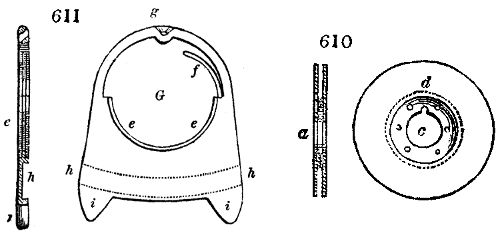
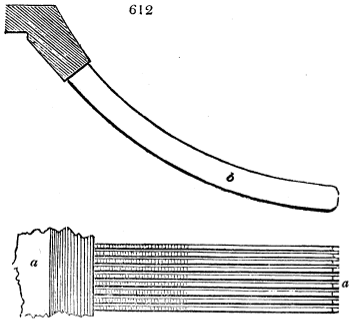
Bobbin-net lace is manufactured by means of very costly and complicated machines, called frames. The limits of this Dictionary will admit of an explanation of no more than the general principles of the manufacture. The threads for crossing and twisting round the warp, being previously gassed, that is, freed from loose fibres by singeing with gas, are wound round small pulleys, called bobbins, which are, with this view, deeply grooved in their periphery. Figs. 610, 611. exhibit the bobbin alone, and with its carriage. In the section of the bobbin a, fig. 610., the deep groove is shown in which the thread is wound. The bobbin consists of two thin discs of brass, cut out in a stamp-press, in the middle of each of which there is a hollow space c. These discs are riveted together, leaving an interval between their edge all round, in which the thread is coiled. The round hole in the centre, with the little notch at top, serves for spitting them upon a feathered rod, in order to be filled with thread by the rotation of that rod in a species of reel, called the bobbin-filling machine. Each of these bobbins (about double the size of the figure), is inserted into the vacant space G of the carriage, fig. 611. This is a small iron frame (also double the size of the figure), which, at e e, embraces the grooved border of the bobbin, and by the pressure of the spring at f, prevents it from falling out. This spring serves likewise to apply sufficient friction to the bobbin, so as to prevent it from giving off its thread at g by its rotation, unless a certain small force of traction be employed upon the thread. The curvilinear groove h h, sunk in each face or side of the carriage, has the depth shown in the section at h. This groove corresponds to the interval between the teeth of the comb, or bars of the bolt, in which each carriage is placed, and has its movement. A portion of that bolt or comb is shown at a, fig. 612. in plan, and one bar of a circular bolt machine at b, in section. If we suppose two such combs or bolts placed with the ends of the teeth opposite each other, but a little apart, to let the warp threads be stretched, in one vertical plane, between their ends or tips, we shall have an idea of the skeleton of a bobbin-net machine. One of these two combs, in the double bolt machine, has an occasional lateral movement called shogging, equal to the interval of one tooth or bolt, by which, after it has received the bobbins, with their carriages, into its teeth, it can shift that interval to the one side, and thereby get into a position to return the bobbins, with their carriages, into the next series of interstices or gates, in the other bolt. By this means the whole series of carriages receives successive side steps to the right in one bolt, and to the left in the other, so as to perform a species of countermarch, in the course of which they are made to cross and twist round about the vertical warp threads, and thus to form the meshes of the net.
The number of movements required to form a row of meshes in the double tier machine, that is, in a frame with two combs or bars, and 2 rows of bobbins, is six; that is, the whole of the carriages (with their bobbins) pass from one bar or comb to the other six times, during which passages the different divisions of bobbin and warp threads change their relative positions 12 times.
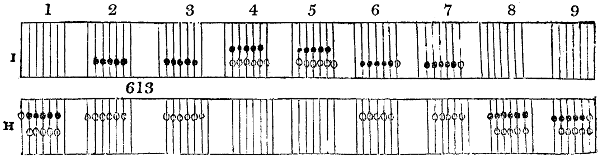
This interchange or traversing of the carriages with their bobbins, which is the most difficult thing to explain, but at the same time the most essential principle of the lace-machine, may be tolerably well understood by a careful study of fig. 613., in which the simple line represents the bolts or teeth, the sign the back line of carriages, and the sign the front line of carriages. H is the front comb or bolt bar, and I the back bolt bar. The former remain is always fixed or stationary, to receive the carriages as they may be presented to it by the shogging of the latter. There must be always one odd carriage at the end; the rest being in pairs.


No. 1. represents the carriages in the front comb or bar, the odd carriage being at the left end. The back line of carriages is first moved on to the back bar I, the odd carriage, as seen in No. 1., having been left behind, there being no carriage opposite to drive it over to the other comb or bar. The carriages then stand as in No. 2. The bar I now shifts to the left, as shown in No. 3.; the front carriages then go over into the back bar or comb, as is represented by No. 4. The bar I now shifts to the right, and gives the position No. 5. The front carriages are then driven over to the front bar, and leave the odd carriage on the back bar at the right end, for the same reason as before described, and the carriages stand as shown in No. 6. The bar I next shifts to the left, and the carriages stand as in No. 7. (the odd carriage being thereby on the back bar to the left.) The back carriages now come over to the front bar, and stand as in No. 8. The back bar or comb I shifts to the right as seen in No. 9., which completes the traverse. The whole carriages with their bobbins have now changed their position, as will be seen by comparing No. 9. with No. 1. The odd carriage, No. 1. has advanced one step to the right, and has become one of the front tier; one of the back tier or line has advanced one step to the left, and has become the odd carriage; and one of the front ones has gone over to the back line. The bobbins and carriages throughout the whole width of the machine have thus crossed each other’s course, and completed the mesh of net.
The carriages with their bobbins are driven a certain way from the one comb to the other, by the pressure of two long bars (one for each) placed above the level of the comb, until they come into such a position that their projecting heels or catches i i, fig. 611., are moved off by two other long flat bars below, called the locker plates, and thereby carried completely over the interval between the two combs.
There are six different systems of bobbin-net machines. 1. Heathcoate’s patent machine. 2. Brown’s traverse warp. 3. Morley’s straight bolt. 4. Clarke’s pusher principle, single tier. 5. Leaver’s machine, single tier. 6. Morley’s circular bolt. All the others are mere variations in the construction of some of their parts. It is a remarkable fact, highly honourable to the mechanical judgment of Mr. Morley of Derby, that no machines except those upon his circular bolt principle, have been found capable of working successfully by mechanical power.
The circular bolt machine (comb with curved teeth) was used by Mr. Morley, for making narrow breadths or edgings of lace immediately after its first invention, and it has been regularly used by the trade for that purpose ever since, in consequence of the inventor having declined to secure the monopoly of it to himself by patent. At that time the locker bars for driving across the carriages had only one plate or blade. A machine so mounted is now called “the single locker circular bolt.” In the year 1824, Mr. Morley added another plate to each of the locker bars, which was a great improvement on the machines for making plain net, but an obstruction to the making of narrow breadths upon them. This machine is now distinguished from the former by the term “double locker.”[31]
A rack of lace, is a certain length of work counted perpendicularly, and contains 240 meshes or holes. Well-made lace has the meshes a little elongated in the direction of the selvage.
The term gauge, in the lace manufacture, means the number of gates, slits, or interstices, in one inch of the bolt-bar or comb; and corresponds therefore to the number of bobbins in an inch length of the double tier. Thus, when we say “gauge nine points,” we mean that there are nine gates with nine bobbins in one inch of the comb or bolt-bar. Each of such bobbins with its carriage is therefore no more than one ninth of an inch thick. The common proportion or gauge up and down the machine is 16 holes in the inch for ten bobbins transversely. Circular bolt double tier machines can turn off by steam power fully 360 racks each day of 18 hours, with a relay of superintendents.
The number of new mechanical contrivances to which this branch of manufacture has given rise, is altogether unparalleled in any other department of the arts. Since Mr. Heathcoate’s first successful patent, in 1809, a great many other patents have been granted for making lace. In the year 1811, Mr. Morley, then of Nottingham, invented his straight bolt frame, more simple in construction, better combined, and more easy in its movements, than the preceding machines; but the modest inventor did not secure it, as he might have done, by patent. The pusher machine was invented in the same year, by Samuel Mart and James Clark, also of Nottingham. The following year is remarkable in the history of the lace trade, for the invention of the circular bolt machine, by Mr. Morley—a mechanism possessing all the advantages of his straight bolt machine, without its disadvantages.
Nearly at the same time Mr. John Leaver brought forward the lever machine, conjointly with one Turton, both of New Radford, near Nottingham. About the year 1817, or 1818, Mr. Heathcoate applied the rotatory movement to the circular bolt machine, and mounted a manufactory on that plan, by mechanical power, at Tiverton, after he and his partner, Mr. Boden, had been driven from Loughborough, in 1816, by the atrocious violence of the frame-destroying Luddites.
Such has been the progress of improvement and economy in this manufacture, that the cost of labour in making a rack, which was, twenty years ago, 3s. 6d., or 42 pence, is now not more than one penny. The prices of this beautiful fabric have fallen in an equally remarkable manner. At the former period, a 24 rack piece, five quarters broad, fetched 17l. sterling, in the wholesale market; the same is now sold for 7s.! The consequence is, that in lace decoration, the maid servant may now be more sumptuously arrayed than her mistress could afford to be twenty years ago.
LACQUER, is a varnish, consisting chiefly of a solution of pale shell-lac in alcohol, tinged with saffron, annotto, or other colouring matters. See Varnish.
LACTIC ACID. (Acide Lactique, Fr.; Milchsäure, Germ.) This acid was discovered by Scheele in buttermilk, where it exists most abundantly; but it is present also in fresh milk in small quantity, and communicates to it the property of reddening litmus. Lactic acid may be detected in all the fluids of the animal body; either free or saturated with alkaline matter.
Scheele obtained this acid by evaporating the sour whey of clotted milk to an eighth part of its bulk, saturating this remainder with slaked lime, in order to throw down the subphosphate of lime held in solution, filtering the liquor, diluting it with thrice its weight of water, and precipitating the lime circumspectly, by the gradual addition of oxalic acid. He next filtered, evaporated to dryness on a water bath, and digested the residuum in strong alcohol, which dissolved the lactic acid, and left the sugar of milk. On evaporating off the alcohol, the acid was obtained. As thus procured, it requires to be purified by saturation with carbonate of lead (pure white lead), and precipitating the solution of this lactate with sulphate of zinc, not added in excess. Sulphate of lead falls, and the supernatant lactate of zinc being evaporated affords crystals, at first brown, but which become colourless on being dissolved and re-crystallized twice or thrice. If the sulphuric acid of the dissolved salt be thrown down by water of baryta, the liquid when filtered and evaporated yields a pure lactic acid, of a syrupy consistence, colourless and void of smell. It has a pungent acid taste, which it loses almost entirely when moderately diluted with water. It does not crystallize. Its salts, with the exception of those of magnesia and zinc, have a gummy appearance, and are very soluble in alcohol, unless they hold an excess of base. Lactic acid consists of 44·92 carbon; 6·55 hydrogen; 48·53 oxygen. It contains 9·92 per cent. of water. It has not hitherto been applied to any use in the arts, except by the Dutch in their old process of bleaching linen with sour milk.
LACTOMETER is the name of an instrument for estimating the quality of milk, called also a Galactometer, which see. The most convenient form of apparatus would be a series of glass tubes each about 1 inch in diameter, and 12 inches long, graduated through a space of 10 inches, to tenths of an inch, having a stop-cock at the bottom, and suspended upright in a frame. The average milk of the cow being poured in to the height of 10 inches, as soon as the cream has all separated at top, the thickness of its body may be measured by the scale; and then the skim-milk may be run off below into a hydrometer glass, in order to determine its density, or relative richness in caseous matter.
LAKES. Under this title are comprised all those colours which consist of a vegetable dye, combined by precipitation with a white earthy basis, which is usually alumina. The general method of preparation is to add to the coloured infusion a solution of common alum, or rather a solution of alum saturated with potash, especially when the infusion has been made with the aid of acids. At first only a slight precipitate falls, consisting of alumina and the colouring matter; but on adding potash, a copious precipitation ensues, of the alumina associated with the dye. When the dyes are not injured, but are rather brightened by alkalis, the above process is reversed; a decoction of the dye-stuff is made with an alkaline liquor, and when it is filtered, a solution of alum is poured into it. The third method is practicable only with substances having a great affinity for subsulphate of alumina; it consists in agitating recently precipitated alumina with the decoction of the dye.
Yellow lakes are made with a decoction of Persian or French berries, to which some potash or soda is added; into the mixture a solution of alum is to be poured as long as any precipitate falls. The precipitate must be filtered, washed, and formed into cakes, and dried. A lake may be made in the same way with quercitron, taking the precaution to purify the decoction of the dye-stuff with buttermilk or glue. After filtering the lake it may be brightened with a solution of tin. Annotto lake is formed by dissolving the dye-stuff in a weak alkaline lye, and adding alum water to the solution. Solution of tin gives this lake a lemon yellow cast; acids a reddish tint.
Red lakes.—The finest of these is carmine.
This beautiful pigment was accidentally discovered by a Franciscan monk at Pisa. He formed an extract of cochineal with salt of tartar, in order to employ it as a medicine, and obtained, on the addition of an acid to it, a fine red precipitate. Homberg published a process for preparing it, in 1656. Carmine is the colouring matter of cochineal, prepared by precipitation from a decoction of the drug. Its composition varies according to the mode of making it. The ordinary carmine is prepared with alum, and consists of carminium (see Cochineal), a little animal matter, alumina, and sulphuric acid. See Carmine.
Carminated lake, called lake of Florence, Paris, or Vienna. For making this pigment, the liquor is usually employed which is decanted from the carmine process. Into this, newly precipitated alumina is put; the mixture is stirred, and heated a little, but not too much. Whenever the alumina has absorbed the colour, the mixture is allowed to settle, and the liquor is drawn off.
Sometimes alum is dissolved in the decoction of cochineal, and potash is then added, to throw down the alumina in combination with the colouring matter; but in this way an indifferent pigment is obtained. Occasionally, solution of tin is added, to brighten the dye.
A lake may be obtained from kermes, in the same way as from cochineal; but now it is seldom had recourse to.
Brazil-wood lakes.—Brazil wood is to be boiled in a proper quantity of water for 15 minutes; then, alum and solution of tin being added, the liquor is to be filtered, and a solution of potash poured in as long as it occasions a precipitate. This is separated by the filter, washed in pure water, mixed with a little gum water, and made into cakes. Or, the Brazil wood may be boiled along with a little vinegar, the decoction filtered, alum and salt of tin added, and then potash-lye poured in to precipitate the lake. For 1 pound of Brazil wood, 30 to 40 pounds of water, and from 11⁄2 to 2 pounds of alum, may be taken, in producing a deep red lake; or, the same proportions with half a pound of solution of tin. If the potash be added in excess, the tint will become violet. Cream of tartar occasions a brownish cast.
Madder lake.—A fine lake may be obtained from madder, by washing it in cold water as long as it gives out colour; then sprinkling some solution of tin over it, and setting it aside for some days. A gentle heat may also be applied. The red liquor must be then separated by the filter, and decomposed by the addition of carbonate of soda, when a fine red precipitate will be obtained. Or, the reddish brown colouring matter of a decoction of madder may be first separated by acetate of lead, and then the rose-red colour with alum. Or, madder tied up in a bag is boiled in water; to the decoction, alum is added, and then potash. The precipitate should be washed with boiling water, till it ceases to tinge it yellow; and it is then to be dried.
The following process merits a preference.
Diffuse 2 pounds of ground madder in 4 quarts of water, and after a maceration of 10 minutes, strain and squeeze the grounds in a press. Repeat this maceration, &c. twice upon the same portion of madder. It will now have a fine rose colour. It must then be mixed with 5 or 6 pounds of water and half a pound of bruised alum, and heated upon a water bath for 3 or 4 hours, with the addition of water, as it evaporates, after which the whole must be thrown upon a filter cloth. The liquor which passes is to be filtered through paper, and then precipitated by carbonate of potash. If the potash be added in three successive doses, three different lakes will be obtained, of successively diminishing beauty. The precipitates must be washed till the water comes off colourless.
Blue lakes are hardly ever prepared, as indigo, prussian blue, cobalt blue, and ultramarine, answer every purpose of blue pigments.
Green lakes are made by a mixture of yellow lakes with blue pigments; but chrome yellows mixed with blues produce almost all the requisite shades of green.
LAMINABLE is said of a metal which may be extended by passing between steel or hardened (chilled) cast-iron rollers.
For a description of metal rolling presses, see Iron and Mint; and
For a table of the relative laminability of metals, see Ductility.
LAMIUM ALBUM, or the dead nettle, is said by Leuchs to afford in its leaves a greenish-yellow dye. The L. purpureum dyes a reddish-grey with salt of tin, and a greenish tint with iron liquor.
LAMPS differ so much in principle, form, and construction, as to render their description impossible, as a general subject of manufacture. In fact, the operations of the lampist, like those of the blacksmith, cabinet-maker, cooper, coppersmith, tinman, turner, &c., belong to a treatise upon handicraft trades. I shall here, however, introduce a tabular view of the relative light and economy of the lamps most generally known.
Kind of Lamps. Intensity of light during Mean of 7 hours. Consump- tion per hour in grammes. Light from 100 parts of oil.
1 hour 2 hours 3 hours 4 hours 5 hours 6 hours
1. Mechanical lamp of Carcel - 100 42 238
2. Fountain lamp, and a chimney with flat wick - 100 98 98 97 96 96 125 11 113
3. Dome argand 103 90 72 61 42 34 31 26 ·714 116
4. Sinumbra lamp 102 95 83 81 78 66 56 37 ·145 150
5. Do. with fountain above - 100 90 70 52 41 32 85 43 197
6. Do. with another beak - 100 97 95 92 89 86 41 18 227
7. Girard’s hydrostatic lamp - 101 96 84 81 76 70 63 ·66 34 ·714 182
8. Thilorier’s or Parker’s do. lamp - 106 103 100 94 92 90 107 ·66 51 ·143 215
In the above table, for the purpose of comparing the successive degrees of intensity, 100 represents the mean intensity of light during the first hour. The quantity of oil consumed per hour is given in grammes, of 151⁄2 grains each. The last column expresses the quantity of light produced with a like consumption of oil, which was in all cases 100 grammes. See Candles.
The following table of M. Peclet is perhaps more instructive:—
Nature of the light. Inten- sity. Consump- tion per hour in grammes. Cost Fat pro- ducing the same light. Cost per hour.
per kilogr. of light per hour.
francs. cents. gram- mes. cents.
1. Mechanical lamp 100 42 1 ·40 5 ·8 42 5 ·8
2. Flat-wick mechan. do. 12 ·05 11 1 ·40 1 ·5 88 12 ·3
3. Hemispherical dome lamp 31 ·0 26 ·714 1 ·40 3 ·7 86 ·16 12 ·0
4. Sinumbra lamp 85 43 1 ·40 6 ·0 50 ·58 7 ·0
5. Do. with a lateral fountain or vase 41 18 1 ·40 2 ·5 43 ·90 6 ·1
6. Do. with a fountain above 90 43 1 ·40 6 ·0 47 ·77 6 ·6
7. Girard’s hydrostatic lamp 63 ·66 34 ·71 1 ·40 4 ·8 54 ·52 7 ·6
8. Thilorier’s or Parker’s do. 107 ·66 51 ·143 1 ·40 7 ·1 47 ·5 6 ·6
9. Candle, 6 in lb. 10 ·66 8 ·51 1 ·40 1 ·2 70 ·35 9 ·8
10. Do. 8 in do. 8 ·74 7 ·51 1 ·40 1 ·0 85 ·92 12 ·0
11. Do. 6 with smaller wick 7 ·50 7 ·42 2 ·40 1 ·7 98 ·93 23 ·7
12. Wax candle, 5 in lb. 13 ·61 8 ·71 7 ·60 5 ·7 64 ·04 48 ·6
13. Sperm candle, do. 14 ·40 8 ·92 7 ·60 5 ·8 61 ·94 47 ·8
14. Stearine candle, do. 14 ·30 9 ·35 6 ·00 5 ·5 65 ·24 37 ·1
15. Coal gas 127 136 litres 5 ·0 107 litres 3 ·9
16. Oil gas 127 136 do. 5 ·0 30 3 ·9
The light of the mechanical lamp is greatly over-rated relatively to that of gas. The cost of the former is at least 5 times greater than of the latter, in London.
LAMP OF DAVY consists of a common oil lamp, surmounted with a covered cylinder of wire gauze, for transmitting light to the miner without endangering the kindling of the atmosphere of fire-damp which may surround him; because carburetted hydrogen, in passing through the meshes of the cylindric cover, gets cooled by the conducting power of the metallic gauze, below the point of its accension.
The apertures in the gauze should not be more than 1-20th of an inch square. Since the fire-damp is not inflamed by ignited wire, the thickness of the wire is not of importance, but wire from 1-40th to 1-60th of an inch in diameter is the most convenient.
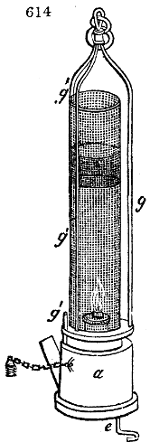
The cage or cylinder should be made by double joinings, the gauze being folded over in such a manner as to leave no apertures. When it is cylindrical, it should not be more than two inches in diameter; because in larger cylinders, the combustion of the fire-damp renders the top inconveniently hot; a double top is always a proper precaution, fixed 1⁄2 or 3⁄4 of an inch above the first top. See fig. 614.
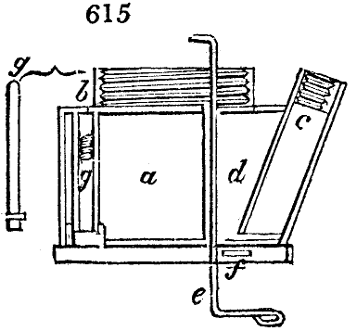
The gauze cylinder should be fastened to the lamp by a screw b, fig. 615., of four or five turns, and fitted to the screw by a tight ring. All joinings in the lamp should be made with hard solder; as the security depends upon the circumstance, that no aperture exists in the apparatus, larger than in the wire-gauze.
The parts of the lamp are,
1. The brass cistern a, d, fig. 615., which contains the oil. It is pierced at one side of the centre with a vertical narrow tube, nearly filled with a wire which is recurved above, at the level of the burner, to trim the wick, by acting on the lower end of the wire e with the fingers. It is called the safety-trimmer.
2. The rim b is the screw neck for fixing on the gauze cylinder, in which the wire-gauze cover is fixed, and which is fastened to the cistern by a screw fitted to b.
3. An aperture c for supplying oil. It is fitted with a screw or a cork, and communicates with the bottom of the cistern by a tube at f. A central aperture for the wick.
4. The wire-gauze cylinder, fig. 614., which should not have less than 625 apertures to the square inch.
5. The second top, 3⁄4 of an inch above the first, surmounted by a brass or copper plate, to which the ring of suspension may be fixed. It is covered with a wire cap in the figure.
6. Four or six thick vertical wires, g′ g′ g′ g′, joining the cistern below with the top plate, and serving as protecting pillars round the cage. g is a screw-pin to fix the cover, so that it shall not become loosened by accident or carelessness. The oil-cistern fig. 615. is drawn upon a larger scale than fig. 614., to show its minuter parts.
When the wire-gauze safe-lamp is lighted and introduced into an atmosphere gradually mixed with fire-damp, the first effect of the fire-damp is to increase the length and size of the flame. When the inflammable gas forms so much as 1-12th of the volume of the air, the cylinder becomes filled with a feeble blue flame, while the flame of the wick appears burning brightly within the blue flame. The light of the wick augments till the fire-damp increases to 1-6th or 1-5th, when it is lost in the flame of the fire-damp, which in this case fills the cylinder with a pretty strong light. As long as any explosive mixture of gas exists in contact with the lamp, so long it will give light; and when it is extinguished, which happens whenever the foul air constitutes so much as 1-3d of the volume of the atmosphere, the air is no longer proper for respiration; for though animal life will continue where flame is extinguished, yet it is always with suffering. By fixing a coil of platinum wire above the wick, ignition may be maintained in the metal when the lamp itself is extinguished; and from this ignited wire the wick may be again rekindled, on carrying it into a less inflammable atmosphere.
“We have frequently used the lamps where the explosive mixture was so high as to heat the wire-gauze red-hot; but on examining a lamp which has been in constant use for three months, and occasionally subjected to this degree of heat, I cannot perceive that the gauze cylinder of iron wire is at all impaired. I have not, however, thought it prudent, in our present state of experience, to persist in using the lamps under such circumstances, because I have observed, that in such situations the particles of coal dust floating in the air, fire at the gas burning within the cylinder, and fly off in small luminous sparks. This appearance, I must confess, alarmed me in the first instance, but experience soon proved that it was not dangerous.
“Besides the facilities afforded by this invention to the working of coal-mines abounding in fire-damp, it has enabled the directors and superintendents to ascertain, with the utmost precision and expedition, both the presence, the quantity, and correct situation of the gas. Instead of creeping inch by inch with a candle, as is usual, along the galleries of a mine suspected to contain fire-damp, in order to ascertain its presence, we walk firmly on with the safe-lamps, and, with the utmost confidence, prove the actual state of the mine. By observing attentively the several appearances upon the flame of the lamp, in an examination of this kind, the cause of accidents which happened to the most experienced and cautious miners is completely developed; and this has hitherto been in a great measure matter of mere conjecture.
“It is not necessary that I should enlarge upon the national advantages which must necessarily result from an invention calculated to prolong our supply of mineral coal, because I think them obvious to every reflecting mind; but I cannot conclude without expressing my highest sentiments of admiration for those talents which have developed the properties, and controlled the power, of one of the most dangerous elements which human enterprise has hitherto had to encounter.”—See Letter to Sir H. Davy, in Journal of Science, vol. i. p. 302., by John Buddle, Esq., generally and justly esteemed one of the most scientific coal-miners in the kingdom.
Mr. Buddle, in a letter dated 21st August, 1835, which is published in Dr. Davy’s life of his brother Sir Humphrey, says;—
“In the evidence given in my last examination before a committee of the House of Commons, I stated that after nearly twenty years’ experience of ‘the Davy’ with from 1000 to 1500 lamps in daily use, in all the variety of circumstances incidental to coal mining, without a single accident having happened which could be attributed to a defect in its principle, or even in the rules for its practical application, as laid down by Sir Humphrey—I maintained that ‘the Davy’ approximated perfection, as nearly as any instrument of human invention could be expected to do. We have ascertained distinctly that the late explosion did not happen in that part of the mine where the Davys were used. They were all found in a perfect state after the accident—many of them in the hands of the dead bodies of the sufferers.”
LAMP-BLACK. See Black.
LAMPATES and LAMPIC ACID. When a spirit of wine lamp has its cotton wick surmounted with a spiral coil of platinum wire, after lighting it for a little, it may be blown out, without ceasing to burn the alcohol; for the coil continues ignited, and a current of hot vapour continues to rise, as long as the spirit lasts. This vapour was first condensed and examined by Professor Daniell, who called it lampic acid. It has a peculiar, strongly acid, burning taste, and a spec. grav. of 1·015. It possesses in an eminent degree the property of reducing certain metallic solutions; such as those of platinum, gold, and silver. The lampates may be prepared by saturating the above acid with the alkaline and earthy carbonates.
LAPIDARY, Art of. The art of the lapidary, or that of cutting, polishing, and engraving gems, was known to the ancients, many of whom have left admirable specimens of their skill. The Greeks were passionate lovers of rings and engraved stones; and the most parsimonious among the higher classes of the Cyrenians are said to have worn rings of the value of ten minæ (about 30l. of our money.) By far the greater part of the antique gems that have reached modern times, may be considered as so many models for forming the taste of the student of the fine arts, and for inspiring his mind with correct ideas of what is truly beautiful. With the cutting of the diamond, however, the ancients were unacquainted, and hence they wore it in its natural state. Even in the middle ages, this art was still unknown; for the four large diamonds which enrich the clasp of the imperial mantle of Charlemagne, as now preserved in Paris, are uncut, octahedral crystals. But the art of working diamonds was probably known in Hindostan and China, in very remote periods. After Louis de Berghen’s discovery, in 1476, of polishing two diamonds by their mutual attrition, all the finest diamonds were sent to Holland to be cut and polished by the Dutch artists, who long retained a superiority, now no longer admitted by the lapidaries of London and Paris.
The operation of gem cutting is abridged by two methods; 1. by cleavage; 2. by cutting off slices with a fine wire, coated with diamond powder, and fixed in the stock of a hand-saw. Diamond is the only precious stone which is cut and polished with diamond powder, soaked with olive oil, upon a mill plate of very soft steel.
Oriental rubies, sapphires, and topazes, are cut with diamond powder soaked with olive oil, on a copper wheel. The facets thus formed are afterwards polished on another copper wheel, with tripoli, tempered with water.
Emeralds, hyacinths, amethysts, garnets, agates, and other softer stones, are cut at a lead wheel, with emery and water; and are polished on a tin wheel with tripoli and water, or, still better, on a zinc wheel, with putty of tin and water.
The more tender precious stones, and even the pastes, are cut on a mill-wheel of hard wood, with emery and water; and are polished with tripoli and water, on another wheel of hard wood.
Since the lapidary employs always the same tools, whatever be the stone which he cuts or polishes, and since the wheel discs alone vary, as also the substance he uses with them, we shall describe, first of all, his apparatus, and then the manipulations for diamond-cutting, which are applicable to every species of stone.
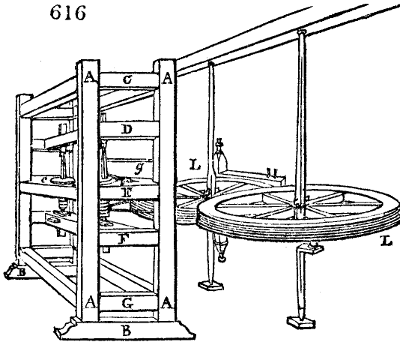
The lapidary’s mill, or wheel, is shewn in perspective in fig. 616. It consists of a strong frame made of oak carpentry, with tenon and mortised joints, bound together with strong bolts and screw nuts. Its form is a parallelopiped of from 8 to 9 feet long, by from 6 to 7 high; and about 2 feet broad. These dimensions are large enough to contain two cutting wheels alongside of each other, as represented in the figure.
Besides the two sole bars B B, we perceive in the breadth, 5 cross bars, C, D, E, F, G. The two extreme bars C and G, are a part of the frame-work, and serve to bind it. The two cross-bars D and F, carry each in the middle of their length, a piece of wood as thick as themselves, but only 41⁄2 inches long (see fig. 617.), joined solidly by mortises and tenons with that cross bar, as well as with the one placed opposite on the other parallel face. These two pieces are called summers (lintels); the one placed at D is the upper; the one at F, the lower.
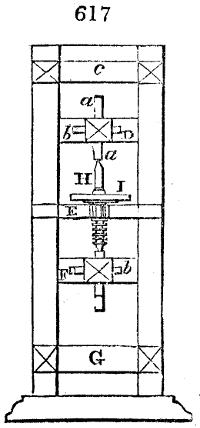
In fig. 617. this face is shewn inside, in order to explain how the mill wheel is placed and supported. The same letters point out the same objects, both in the preceding and the following figures.
In each of these summers a square hole is cut out, exactly opposite to the other; in which are adjusted by friction, a square piece of oak a a, fig. 617., whose extremities are perforated with a conical hole, which receives the two ends of the arbor H of the wheel I, and forms its socket. This square bar is adjusted at a convenient height, by a double wooden wedge b b.
The cross bar in the middle E supports the table c c, a strong plank of oak. It is pierced with two large holes whose centres coincide with the centre of the conical holes hollowed out at the end of the square pins. These holes, of about 6 inches diameter each, are intended to let the arbor pass freely through, bearing its respective wheel. (See one of these holes at I, in fig. 621. below.)
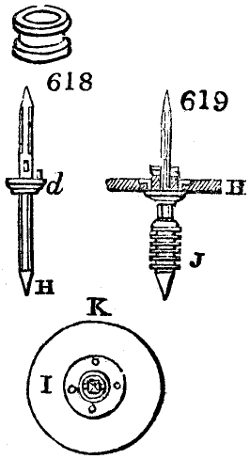
Each wheel is composed of an iron arbor H, fig. 618., of a grinding-wheel I, which differs in substance according to circumstances, as already stated, and of the pulley J, furnished with several grooves (see fig. 619.), which has a square fit upon the arbor. The arbor carries a collet d, on which are 4 iron pegs or pins that enter into the wheel to fasten it.
The wheel plate, of which the ground plan is shown at K, is hollowed out towards its centre to half its thickness; when it is in its position on the arbor, as indicated in fig. 619., a washer or ferrule of wrought iron is put over it, and secured in its place by a double wedge. In fig. 619. the wheel-plate is represented in section, that the connection of the whole parts may be seen.
A board g (see fig. 616. and fig. 624.), about 71⁄2 inches high, is fixed to the part of the frame opposite to the side at which the lapidary works, and it prevents the substances made use of in the cutting and polishing, from being thrown to a distance by the centrifugal force of the wheel-plate.
Behind this apparatus is mounted for each grinding-plate, a large wheel L (see fig. 616.), similar to a cutler’s, but placed horizontally. This wheel is grooved round its circumference to receive an endless cord or band, which passes round one of the grooves of the pulley J, fixed below the wheel-plate. Hence, on turning the fly-wheel L, the plate revolves with a velocity relative to the velocity communicated to the wheel L, and to the difference of diameter of the wheel L and the pulley J. Each wheel L, is mounted on an iron arbor, with a crank (see M, fig. 620.)
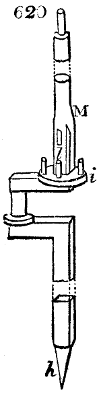
The lower pivot of that arbor h is conical, and turns in a socket fixed in the floor. The great wheel L rests on the collet i, furnished with its 4 iron pins, for securing the connection. Above the wheel an iron washer is laid, and the whole is fixed by a double wedge, which enters into the mortise l, fig. 620.
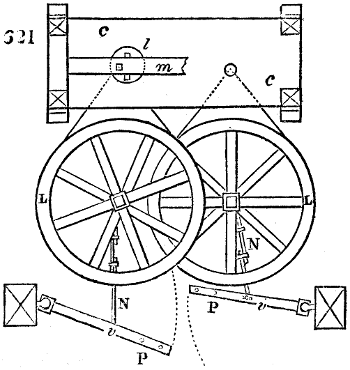
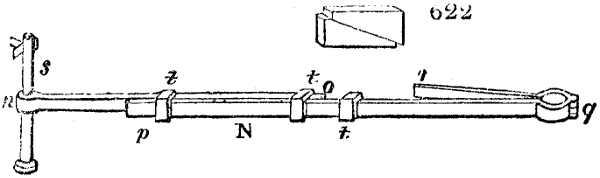
Fig. 621. exhibits a ground-plan view of all this assemblage of parts, to explain the structure of the machine. Every thing that stands above the upper summer-bar has been suppressed in this representation. Here we see the table c c; the upper summer m; the one wheel-plate l, the other having been removed to shew that the endless cord does not cross; the two large wheels L L, present in each machine, the crank bar N, seen separate in fig. 622, which serves for turning the wheel L. This bar is formed of 3 iron plates n, o; p, q; and q, r; (fig. 622.) The first is bent round at the point n, to embrace the stud s; the second p q, is of the same breadth and thickness as the first; and the third, is adjusted to the latter with a hinge joint, at the point q, where they are both turned into a circular form, to embrace the crank M. When all these pieces are connected, they are fixed at the proper lengths by the buckles or square rings t t t, which embrace these pieces, as is shown in fig. 622.
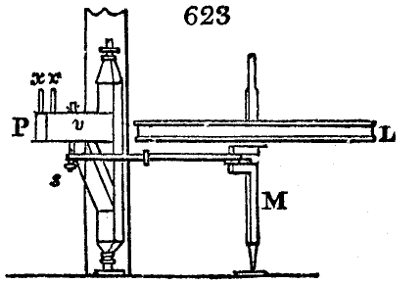
The stud s, seen in fig. 622., is fixed to the point v by a wedge-key upon the arm P, represented separately, and in perspective, in fig. 623. The labourer seizing the two upright pegs or handles x x; by the alternate forward and backward motion of his arm, he communicates the same motion to the crank rod, which transmits it to the crank of the arbor M, and impresses on that arbor, and the wheel which it bears, a rotatory movement.
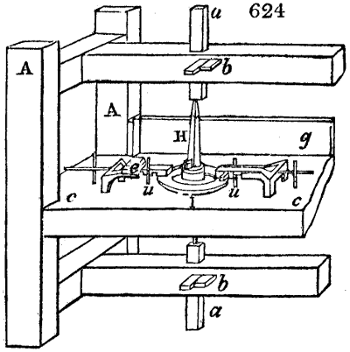
Fig. 624. shows piece-meal and in perspective, a part of the lapidary’s wheel-mill. There we see the table c c, the grind-plate I, whose axis is kept in a vertical position by the two square plugs a a, fixed into the two summers by the wedges b b. On the two sides of the wheel-plate we perceive an important instrument called a dial, which serves to hold the stone during the cutting and polishing. This instrument has received lately important ameliorations, to be described in fig. 625. The lapidary holds this instrument in his hand, he rests it upon the iron pins u u fixed in the table, lest he should be affected by the velocity of the revolving wheel-plate. He loads it sometimes with weights e, e, to make it take better hold of the grinding plate.
One of the most expert lapidaries of Geneva works by means of the following improved mechanism, of his own invention, whereby he cuts and polishes the facets with extreme regularity, converting it into a true dial.
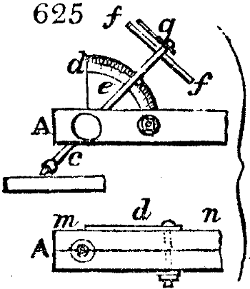
Fig. 625. shows this improvement. Each of the two jaws bears a large conchoidal cavity, into which is fitted a brass ball, which carries on its upper part a tube e, to whose extremity is fixed a dial-plate f f, engraved with several concentric circles, divided into equal parts, like the toothed-wheel cutting engine-plate, according to the number of facets to be placed in each cutting range. The tube receives with moderate friction the handle of the cement rod, which is fixed at the proper point by a thumb-screw, not shown in the figure, being concealed by the vertical limb d, about to be described.
A needle or index g, placed with a square fit on the tail of the cement rod, marks by its point the divisions on the dial plate f f. On the side m n of the jaw A, there is fixed by two screws, a limb d, forming a quadrant whose centre is supposed to be at the centre of the ball. This quadrant is divided as usual into 90 degrees, whose highest point is marked 0, and the lowest would mark about 70; for the remainder of the arc down to 90 is concealed by the jaw. The two graduated plates are used as follows:—
When the cement rod conceals zero or 0 of the limb, it is then vertical, and serves to cut the table of the brilliant; or the point opposite to it, and parallel to the table. On making it slope a little, 5 degrees for example, all the facets will now lie in the same zone, provided that the inclination be not allowed to vary. On turning round the cement rod the index g marks the divisions, so that by operating on the circle with 16 divisions, stopping for some time at each, 16 facets will have been formed, of perfect equality, and at equal distances, as soon as the revolution is completed.
Diamonds are cut at the present day in only two modes; into a rose diamond, and a brilliant. We shall therefore confine our attention to these two forms.
The rose diamond is flat beneath, like all weak stones, while the upper face rises into a dome, and is cut into facets. Most usually six facets are put on the central region, which are in the form of triangles, and unite at their summits; their bases abut upon another range of triangles, which being set in an inverse position to the preceding, present their bases to them, while their summits terminate at the sharp margin of the stone. The latter triangles leave spaces between them which are likewise cut each into two facets. By this distribution the rose diamond is cut into 24 facets; the surface of the diamond being divided into two portions, of which the upper is called the crown, and that forming the contour, beneath the former, is called dentelle (lace) by the French artists.
According to Mr. Jefferies, in his Treatise on Diamonds, the regular rose diamond is formed by inscribing a regular octagon in the centre of the table side of the stone, and bordering it by eight right-angled triangles, the bases of which correspond with the sides of the octagon; beyond these is a chain of 8 trapeziums, and another of 16 triangles. The collet side also consists of a minute central octagon, from every angle of which proceeds a ray to the edge of the girdle, forming the whole surface into 8 trapeziums, each of which is again subdivided by a salient angle (whose apex touches the girdle) into one irregular pentagon and two triangles.
To fashion a rough diamond into a brilliant, the first step is to modify the faces of the original octahedron, so that the plane formed by the junction of the two pyramids shall be an exact square, and the axis of the crystal precisely twice the length of one of the sides of the square. The octahedron being thus rectified, a section is to be made parallel to the common base or girdle, so as to cut off 5 eighteenths of the whole height from the upper pyramid, and 1 eighteenth from the lower one. The superior and larger plane thus produced is called the table, and the inferior and smaller one is called the collet; in this state it is termed a complete square table diamond. To convert it into a brilliant, two triangular facets are placed on each side of the table, thus changing it from a square to an octagon; a lozenge-shaped facet is also placed at each of the four corners of the table, and another lozenge extending lengthwise along the whole of each side of the original square of the table, which with two triangular facets set on the base of each lozenge, completes the whole number of facets on the table side of the diamond; viz. 8 lozenges, and 24 triangles. On the collet side are formed 4 irregular pentagons, alternating with as many irregular lozenges radiating from the collet as a centre, and bordered by 16 triangular facets adjoining the girdle. The brilliant being thus completed, is set with the table side uppermost, and the collet side implanted in the cavity made to receive the diamond. The brilliant is always three times as thick as the rose diamond. In France, the thickness of the brilliant is set off into two unequal portions; one third is reserved for the upper part or table of the diamond, and the remaining two thirds for the lower part or collet (culasse). The table has eight planes, and its circumference is cut into facets, of which some are triangles, and others lozenges. The collet is also cut into facets called pavillons. It is of consequence that the pavillons lie in the same order as the upper facets, and that they correspond to each other, so that the symmetry be perfect, for otherwise the play of the light would be false.
Although the rose-diamond projects bright beams of light in more extensive proportion often than the brilliant, yet the latter shows an incomparably greater play, from the difference of its cutting. In executing this, there are formed 32 faces of different figures, and inclined at different angles all round the table, on the upper side of the stone. On the collet (culasse) 24 other faces are made round a small table, which converts the culasse into a truncated pyramid. These 24 facets, like the 32 above, are differently inclined and present different figures. It is essential that the faces of the top and the bottom correspond together in sufficiently exact proportions to multiply the reflections and refractions, so as to produce the colours of the prismatic spectrum.
The other precious stones, as well as their artificial imitations, called pastes, are cut in the same fashion as the brilliant; the only difference consists in the matter constituting the wheel plates, and the grinding and polishing powders, as already stated.
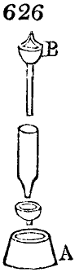
In cutting the stones, they are mounted on the cement-rod B, fig. 626., whose stem is set upright in a socket placed in the middle of a sole piece at A, which receives the stem of the cement-rod. The head of the rod fills the cup of A. A melted alloy of tin and lead is poured into the head of the cement-rod, into the middle of which the stone is immediately plunged; and whenever the solder has become solid, a portion of it is pared off from the top of the diamond, to give the pyramidal form shown in the figure at B.
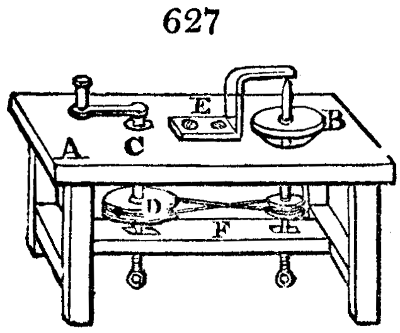
There is an instrument employed by the steel polishers for pieces of clock work, and by the manufacturers of watch-glasses for polishing their edges. It consists of a solid oaken table, fig. 627. The top is perforated with two holes, one for passing through the pulley and the arbor of the wheel-plate B, made either of lead or of hard wood, according to circumstances; and the other C for receiving the upper part of the arbor of the large pulley D. The upper pulley of the wheel-plate is supported by an iron prop E, fixed to the table by two wooden screws. The inferior pivots of the two pieces are supported by screw-sockets, working in an iron screw-nut sunk into the summer-bar F. The legs of the table are made longer or shorter, according as the workman chooses to stand or sit at his employment. Emery with oil is used for grinding down, and tin-putty or colcothar for polishing. The workman lays the piece on the flat of the wheel-plate with one hand, and presses it down with a lump of cork, while he turns round the handle with the other hand.
The Sapphire, Ruby, Oriental Amethyst, Oriental Emerald, and Oriental Topaz, are gems next in value and hardness to diamond; and they all consist of nearly pure alumina or clay, with a minute portion of iron as the colouring matter. The following analyses show the affinity in composition of the most precious bodies with others in little relative estimation.
Sapphire. Corundum Stone. Emery.
Alumina or clay 98 ·5 89 ·50 86 ·0
Silica 0 ·0 5 ·50 3 ·0
Oxide of iron 1 ·0 1 ·25 4 ·0
Lime 0 ·5 0 ·00 0 ·0
100 ·0 96 ·25 93 ·0
Salamstone is a variety which consists of small transparent crystals, generally six-sided prisms, of pale reddish and bluish colours. The corundum of Battagammana is frequently found in large six-sided prisms: it is commonly of a brown colour, whence it is called by the natives curundu gallé, cinnamon stone. The hair-brown and reddish-brown crystals are called adamantine spar. Sapphire and salamstone are chiefly met with in secondary repositories, as in the sand of rivers &c., accompanied by crystals and grains of octahedral iron-ore and of several species of gems. Corundum is found in imbedded crystals in a rock, consisting of indianite. Adamantine spar occurs in a sort of granite.
The finest varieties of sapphire come from Pegu, where they occur in the Capelan mountains near Syrian. Some have been found also at Hohenstein in Saxony, Bilin in Bohemia, Puy in France, and in several other countries. The red variety, the ruby, is most highly valued. Its colour is between a bright scarlet and crimson. A perfect ruby above 31⁄2 carats is more valuable than a diamond of the same weight. If it weigh one carat, it is worth 10 guineas; 2 carats, 40 guineas; 3 carats, 150 guineas; 6 carats, above 1000 guineas. A deep coloured ruby, exceeding 20 carats in weight, is generally called a carbuncle; of which 108 were said to be in the throne of the Great Mogul, weighing from 100 to 200 carats each; but this statement is probably incorrect. The largest oriental ruby known to be in the world, was brought from China to Prince Gargarin, governor of Siberia. It came afterwards into the possession of Prince Menzikoff, and constitutes now a jewel in the imperial crown of Russia.
A good blue sapphire of 10 carats is valued at 50 guineas. If it weighs 20 carats, its value is 200 guineas; but under 10 carats, the price may be estimated by multiplying the square of its weight in carats into half a guinea; thus, one of 4 carats would be worth 42 × 1⁄2 G. = 8 guineas. It has been said that the blue sapphire is superior in hardness to the red, but this is probably a mistake arising from confounding the corundum ruby with the spinelle ruby. A sapphire of a barbel blue colour, weighing 6 carats, was disposed of in Paris by public sale for 70l. sterling; and another of an indigo blue, weighing 6 carats and 3 grains, brought 60l.; both of which sums much exceed what the preceding rule assigns, from which we may perceive how far fancy may go in such matters. The sapphire of Brasil is merely a blue tourmaline, as its specific gravity and inferior hardness show. White sapphires are sometimes so pure, that when properly cut and polished they have been passed for diamonds.
The yellow and green sapphires are much prized under the names of Oriental topaz and emerald. The specimens which exhibit all these colours associated in one stone are highly valued, as they prove the mineralogical identity of these varieties.
Besides these shades of colour, sapphires often emit a beautiful play of colours, or chatoiement, when held in different positions relative to the eye or incident light; and some likewise present star-like radiations, whence they are called star-stones or asterias; sending forth 6 or even 12 rays, that change their place with the position of the stone. This property so remarkable in certain blue sapphires, is not however peculiar to these gems. It seems to belong to transparent minerals which have a rhomboid for their nucleus, and arises from the combination of certain circumstances in their cutting and structure. Lapidaries often expose the light-blue variety of sapphire to the action of fire, in order to render it white and more brilliant; but with regard to those found at Expailly in France, fire deepens their colour.
3. Chrysoberyl, called by Haüy Cymophane, and by others Prismatic corundum, ranks next in hardness to sapphire, being 8·5 on the same scale of estimation. Its specific gravity is 3·754. It usually occurs in rounded pieces about the size of a pea, but it is also found crystallised in many forms, of which 8-sided prisms with 8-sided summits are perhaps the most frequent. Lustre vitreous; colour asparagus green, passing into greenish-white and olive-green. It shows a bluish opalescence, a light undulating as it were in the stone, when viewed in certain directions; which property constitutes its chief attraction to the jeweller. When polished, it has been sometimes mistaken for a yellow diamond; and from its hardness and lustre is considerably valued. Good specimens of it are very rare. It has been found only in the alluvial deposits of rivers, along with other species of gems. Thus it occurs in Brasil, along with diamonds and prismatic topaz; also in Ceylon. Its constituents are, alumina 68·66; glucina 16·00; silica 6·00; protoxide of iron 4·7; oxide of titanium 2·66; moisture 0·66, according to Seybert’s analysis of a specimen from Brasil. It is difficultly but perfectly fusible before the blowpipe, with borax and salt of phosphorus. In composition it differs entirely from sapphire, or the rhombohedral corundum.
4. Spinelle Ruby, called Dodecahedral corundum by some mineralogists, and Balas ruby by lapidaries. Its hardness is 8. Specific gravity 3·523. Its fundamental form is the hexahedron, but it occurs crystallized in many secondary forms: octahedrons, tetrahedrons and rhombohedrons. Fracture conchoidal; lustre vitreous; colour red, passing into blue and green, yellow, brown and black; and sometimes it is nearly white. Red spinelle consists of, alumina 74·5; silica 15·5; magnesia 8·25; oxide of iron 1·5; lime 0·75. Vauquelin discovered 6·18 per cent. of chromic acid in the red spinelle. The red varieties exposed to heat, become black and opaque; on cooling they appear first green, then almost colourless, but at last resume their red colour. Pleonaste is a variety which yields a deep green globule with borax.
Crystals of spinelle from Ceylon have been observed imbedded in limestone, mixed with mica, or in rocks containing adularia, which seem to have belonged to a primitive district. Other varieties like the pleonaste occur in the drusy cavities of rocks ejected by Vesuvius. Crystals of it are often found in diluvial and alluvial sand and gravel, along with true sapphires, pyramidal zircon, and other gems, as also with octahedral iron ore, in Ceylon. Blue and pearl-gray varieties occur in Südermannland in Sweden, imbedded in granular limestone. Pleonaste is met with also in the diluvial sands of Ceylon. Clear and finely coloured specimens of spinelle are highly prized as ornamental stones. When the weight of a good spinelle exceeds 4 carats, it is said to be valued at half the price of a diamond of the same weight. M. Brard has seen one at Paris, which weighed 215 grains.
5. Zircon or Hyacinth. Its fundamental form is an isosceles 4-sided pyramid; and the secondary forms have all a pyramidal character. Fracture conchoidal, uneven; lustre more or less perfectly adamantine; colours, red, brown, yellow, gray, green, white; which with the exception of some red tints, are not bright. Hardness 7·5. Specific gravity 4·5. Zircon and hyacinth consist, according to Klaproth, of almost exactly the same constituents; namely, zirconia 70; silica 25; oxide of iron 5. In the white zirconia there is less iron and more silica. Before the blowpipe the hyacinth loses its colour, but does not melt. The brighter zircons are often worked up into a brilliant form, for ornamenting watch cases. As a gem, hyacinth has no high value. It has been often confounded with other stones, but its very great specific gravity makes it to be readily recognized.
6. Topaz. The fundamental form is a scalene 4-sided pyramid; but the secondary forms have a prismatic character; and are frequently observed in oblique 4-sided prisms, acuminated by 4 planes. The lateral planes of the prism are longitudinally striated. Fracture conchoidal, uneven; lustre vitreous; colours, white, yellow, green, blue, generally of pale shades. Hardness 8; specific gravity 3·5. Prismatic topaz consists, according to Berzelius, of alumina 57·45; silica 34·24; fluoric acid 7·75. In a strong heat the faces of crystallization, but not those of cleavage, are covered with small blisters, which however immediately crack. With borax, it melts slowly into a transparent glass. Its powder colours the tincture of violets green. Those crystals which possess different faces of crystallization on opposite ends, acquire the opposite electricities on being heated. By friction, it acquires positive electricity.
Most perfect crystals of topaz have been found in Siberia, of green, blue, and white colours, along with beryl, in the Uralian and Altai mountains, as also in Kamschatka; in Brazil, where they generally occur in loose crystals, and pebble forms of bright yellow colours; and in Mucla in Asia Minor, in pale straw-yellow regular crystals. They are also met with in the granitic detritus of Cairngorm in Aberdeenshire. The blue varieties are absurdly called oriental aquamarine by lapidaries. If exposed to heat, the Saxon topaz loses its colour and becomes white; the deep yellow Brazilian varieties assume a pale pink hue; and are then sometimes mistaken for spinelle, to which, however, they are somewhat inferior in hardness. Topaz is also distinguishable by its double refractive property. Tavernier mentions a topaz, in the possession of the Great Mogul, which weighed 157 carats, and cost 20,000l. sterling. There is a specimen in the museum of natural history at Paris which weighs 4 ounces 2 gros.
Topazes are not scarce enough to be much valued by the lapidary.
7. Emerald and Beryl, are described in their alphabetical places. Emerald loses its lustre by candle-light; but as it appears to most advantage when in the company of diamonds, it is frequently surrounded with brilliants, and occasionally with pearls. Beryl is the aqua-marine of the jewellers, and has very little estimation among lapidaries.
8. Garnet. See this stone in its alphabetical place.
9. Chrysolite, called Peridot by Haüy; probably the topaz of the ancients, as our topaz was their chrysolite. It is the softest of the precious stones, being scratched by quartz and the file. It refracts double.
10. Quartz, including, as sub-species, Amethyst, Rock-crystal, Rose-quartz, Prase or Chrysoprase, and several varieties of calcedony, as Cat’s eye, Plasma, Chrysoprase, Onyx, Sardonyx, &c. Lustre vitreous, inclining sometimes to resinous; colours, very various; fracture conchoidal; hardness, 7; specific gravity, 2·69.
11. Opal, or uncleavable quartz. Fracture, conchoidal; lustre, vitreous or resinous; colours, white, yellow, red, brown, green, gray. Lively play of light; hardness, 5·5 to 6·5; specific gravity, 2·091. It occurs in small kidney-shaped and stalactitic shapes, and large tuberose concretions. The phenomena of the play of colours in precious opal has not been satisfactorily explained. It seems to be connected with the regular structure of the mineral. Hydrophane, or oculis mundi, is a variety of opal without transparency, but acquiring it when immersed in water, or in any transparent fluid. Precious opal was found by Klaproth to consist of silica, 90; water, 10; which is a very curious combination. Hungary has been long the only locality of precious opal, where it occurs near Caschau, along with common and semi-opal, in a kind of porphyry. Fine varieties have, however, been lately discovered in the Faroe islands; and most beautiful ones, sometimes quite transparent, near Gracias a Dios, in the province of Honduras, America. The red and yellow bright coloured varieties of fire-opal are found near Zimapan, in Mexico. Precious opal, when fashioned for a gem, is generally cut with a convex surface; and if large, pure, and exhibiting a bright play of colours, is of considerable value. In modern times, fine opals of moderate bulk have been frequently sold at the price of diamonds of equal size; the Turks being particularly fond of them. The estimation in which opal was held by the ancients is hardly credible. They called it Paideros, or Child beautiful as love. Nonius, the Roman senator, preferred banishment to parting with his favourite opal, which was coveted by Mark Antony. Opal which appears quite red when held against the light, is called girasol by the French; a name also given to the sapphire or corundum asterias or star-stone.
12. Turquois, or Calaite. Mineral turquois, occurs massive; fine-grained impalpable; fracture conchoidal; colour, between a blue and a green, soft, and rather bright; opaque; hardness, 6; spec. grav. 2·83 to 3·0. Its constituents are, alumina, 73; oxide of copper, 4·5; oxide of iron, 4; water, 18; according to Dr. John. But by Berzelius, it consists of phosphate of alumina and lime, silica, oxides of copper and iron, with a little water. It has been found only in the neighbourhood of Nichabour in the Khorassan, in Persia; and is very highly prized as an ornamental stone in that country. There is a totally different kind of turquois, called bone turquois, which seems to be phosphate of lime coloured with oxide of copper. When the oriental stone is cut and polished, it forms a pleasing gem of inferior value. Malachite, or mountain green, a compact carbonate of copper, has been substituted sometimes for turquois, but their shades are different. Malachite yields a green streak, and turquois a white one.
13. Lapis lazuli, is of little value, on account of its softness.
LEAD. (Plomb, Fr.; Blei, Germ.) This is one of the metals most antiently known, being mentioned in the books of Moses. It has a gray blue colour, with a bright metallic lustre when newly cut, but it becomes soon tarnished and earthy looking in the air. Its texture is close, without perceptible cleavage or appearance of structure; the specific gravity of common lead is 11·352; but of the pure metal, from 11·38 to 11·44. It is very malleable and ductile, but soft and destitute of elasticity; fusible at 612° Fahr., by Crighton, at 634° by Kupfer, and crystallizable on cooling, into octahedrons implanted into each other so as to form an assemblage of four-sided pyramids.
There are four oxides of lead. 1. The suboxide of a grayish blue colour, which forms a kind of crust upon a plate of lead long exposed to the air. It is procured in a perfect state by calcining oxalate of lead in a retort; the dark gray powder which remains is the pure suboxide. 2. The protoxide is obtained by exposing melted lead to the atmosphere, or, more readily, by expelling the acid from the nitrate of lead by heat in a platinum crucible. It is yellow, and was at one time prepared as a pigment by calcining lead; but is now superseded by the chromate of this metal. Litharge is merely this oxide in the form of small spangles, from having undergone fusion; it is more or less contaminated with iron, copper, and sometimes a little silver. It contains likewise some carbonic acid. The above oxide consists of 104 of metal, and 8 of oxygen, its prime equivalent being 112, upon the hydrogen scale; and it is the base of all the salts of lead. 3. The plumbeous suroxide of Berzelius, the sesquioxide of some British chemists, is the well-known pigment called RED LEAD or minium. It consists of 100 parts of metal and 10 of oxygen. 4. The plumbic suroxide of Berzelius, or the peroxide of the British chemists, is obtained by putting red lead in chlorine water, or in dilute nitric acid. It is of a dark brown, almost black colour, which gives out oxygen when heated, and becomes yellow oxide. It kindles sulphur when triturated with it. This oxide is used by the analytical chemist to separate, by condensation, the sulphurous acid existing in a gaseous mixture.
Among the ores of lead some have a metallic aspect; are black in substance, as well as when pulverized; others have a stony appearance, and are variously coloured, with usually a vitreous or greasy lustre. The specific gravity of the latter ores is always less than 5. The whole of them, excepting the chloride, become more or less speedily black, with sulphuretted hydrogen or with hydrosulphurets; and are easily reduced to the metallic state upon charcoal, with a flux of carbonate of soda, after they have been properly roasted. They diffuse a whitish or yellowish powder over the charcoal, which, according to the manner in which the flame of the blowpipe is directed upon it, becomes yellow or red; thus indicating the two characteristic colours of the oxides of lead.
We shall not enter here into the controversy concerning the existence of native lead, which has been handled at length by M. Brongniart in the Dictionnaire des Sciences Naturelles, article Plomb, Mineralogie.
The lead ores most interesting to the arts are:—
1. Galena, sulphuret of lead. This ore has the metallic lustre of lead with a crystalline structure derivable from the cube. When heated cautiously at the blowpipe it is decomposed, the sulphur flies off, and the lead is left alone in fusion; but if the heat be continued, the coloured surface of the charcoal indicates the conversion of the lead into its oxides. Galena is a compound of lead and sulphur, in equivalent proportions, and therefore consists, in 100 parts, of 862⁄3 of metal, and 131⁄3 of sulphur, with which numbers the analysis of the galena of Clausthal by Westrumb exactly agrees. Its specific gravity, when pure, is 7·56. Its colour is blackish gray, without any shade of red, and its powder is black; characters which distinguish it from blende or sulphuret of zinc. Its structure in mass is lamellar, passing sometimes into the fibrous or granular, and even compact. It is brittle. The specular galena, so called from its brightly polished aspect, is remarkable for forming the slickensides of Derbyshire—thin seams, which explode with a loud noise when accidentally scratched in the mine.
The argentiferous galena has in general all the external characters of pure galena. The proportions of silver vary from one-fifth part of the whole, as at Tarnowitz, in Silesia, to three parts in ten thousand, as in the ore called by the German miners Weisgültigerz; but it must be observed, that whenever this lead ore contains above 5 per cent. of silver, several other metals are associated with it. The mean proportion of silver in galena, or that which makes it be considered practically as an argentiferous ore, because the silver may be profitably extracted, is about two parts in the thousand. See Silver. The above rich silver ores were first observed in the Freyberg mines, called Himmelsfürst and Beschertglück, combined with sulphuret of antimony; but they have been noticed since in the Hartz, in Mexico, and several other places.
The antimonial galena (Bournonite) exhales at the blowpipe the odour peculiar to antimony, and coats the charcoal with a powder partly white and partly red. It usually contains some arsenic.
2. The Seleniuret of lead, resembles galena, but its tint is bluer. Its chemical characters are the only ones which can be depended on for distinguishing it. At the blowpipe, it exhales a very perceptible smell of putrid radishes. Nitric acid liberates the selenium. When heated in a tube, oxide of selenium of a carmine red rises along with selenic acid, white and deliquescent. The specific gravity of this ore varies from 6·8 to 7·69.
3. Native minium or red lead, has an earthy aspect, of a lively and nearly pure red colour, but sometimes inclining to orange. It occurs pulverulent, and also compact, with a fracture somewhat lamellar. When heated at the blowpipe upon charcoal, it is readily reduced to metallic lead. Its specific gravity varies from 4·6 to 8·9. This ore is rare.
4. Plomb-gomme. This lead ore, as singular in appearance as in composition, is of a dirty brownish or orange-yellow, and occurs under the form of globular, or gum-like concretions. It has also the lustre and translucency of gum; with somewhat of a pearly aspect at times. It is harder than fluor spar. It consists of oxide of lead, 40; alumina, 37; water, 18·8; foreign matters and loss, 4·06; in 100. Hitherto it has been found only at Huelgoët, near Poullaouen, in Brittany, covering with its tears or small concretions the ores of white lead and galena which compose the veins of that lead mine.
5. White lead, carbonate of lead. This ore in its purest state, is colourless and transparent like glass, with an adamantine lustre. It may be recognized by the following characters:—
Its specific gravity is from 6 to 6·7; it dissolves with more or less ease, and with effervescence, in nitric acid; becomes immediately black by the action of sulphuretted hydrogen, and melts on charcoal before the blowpipe into a button of lead. According to Klaproth, the carbonate of Leadhills contains 82 parts of oxide of lead, and 16 of carbonic acid, in 98 parts. This mineral is tender, scarcely scratches calc-spar, and breaks easily with a waved conchoidal fracture. It possesses the double refracting property in a very high degree; the double image being very visible on looking through the flat faces of the prismatic crystals. Its crystalline forms are very numerous, and are referrible to the octahedron, and the pyramidal prism.
6. Vitreous lead, or sulphate of lead. This mineral closely resembles carbonate of lead; so that the external characters are inadequate to distinguish the two. But the following are sufficient. When pure, it has the same transparency and lustre. It does not effervesce with nitric acid; it is but feebly blackened by sulphuretted hydrogen; it first decrepitates and then melts before the blowpipe into a transparent glass, which becomes milky as it cools. By the combined action of heat and charcoal, it passes first into a red pulverulent oxide, and then into metallic lead. It consists, according to Klaproth, of 71 oxide of lead, 25 sulphuric acid, 2 water, and 1 iron. That specimen was from Anglesea; the Wanlockhead mineral is free from iron. The prevailing form of crystallization is the rectangular octahedron, whose angles and edges are variously modified. The sulphato-carbonate, and sulphato tri-carbonate of lead, now called Leadhillite, are rare minerals which belong to this head.
7. Phosphate of lead.—This, like all the combinations of lead with an acid, exhibits no metallic lustre, but a variety of colours. Before the blowpipe, upon charcoal, it melts into a globule externally crystalline, which, by a continuance of the heat, with the addition of iron and boracic acid, affords metallic lead. Its constituents are 80 oxide of lead, 18 phosphoric acid, and 1·6 muriatic acid, according to Klaproth’s analysis of the mineral from Wanlockhead. The constant presence of muriatic acid in the various specimens examined is a remarkable circumstance. The crystalline forms are derived from an obtuse rhomboid. Phosphate of lead is a little harder than white lead; it is easily scratched, and its powder is always gray. Its specific gravity is 6·9. It has a vitreous lustre, somewhat adamantine. Its lamellar texture is not very distinct; its fracture is wavy, and it is easily frangible. The phosphoric and arsenic acids being, according to M. Mitscherlich, isomorphous bodies, may replace each other in chemical combinations in every proportion, so that the phosphate of lead may include any proportion, from the smallest fraction of arsenic acid, to the smallest fraction of phosphoric acid, thus graduating indefinitely into arseniate of lead. The yellowish variety indicates, for the most part, the presence of arsenic acid.
8. Muriate of lead. Horn-lead, or murio-carbonate.—This ore has a pale yellow colour, is reducible to metallic lead by the agency of soda, and is not altered by the hydrosulphurets. At the blowpipe it melts first into a pale yellow transparent globule, with salt of phosphorus and oxide of copper; and it manifests the presence of muriatic acid by a bluish flame. It is fragile, tender, softer than carbonate of lead, and is sometimes almost colourless, with an adamantine lustre. Spec. grav. 606. Its constituents, according to Berzelius, are, lead, 25·84; oxide of lead, 57·07; carbonate of lead, 6·25; chlorine, 8·84; silica, 1·46; water, 0·54; in 100 parts. The carbonate is an accidental ingredient, not being in equivalent proportion. Klaproth found chlorine, 13·67; lead, 39·98; oxide of lead, 22·57; carbonate of lead, 23·78.
9. Arseniate of lead.—Its colour of a pretty pure yellow, bordering slightly on the greenish, and its property of exhaling by the joint action of fire and charcoal a very distinct arsenical odour, are the only characters which distinguish this ore from the phosphate of lead. The form of the arseniate of lead when it is crystallized, is a prism with six faces, of the same dimensions as that of phosphate of lead. When pure, it is reducible upon charcoal, before the blowpipe, into metallic lead, with the copious exhalation of arsenical fumes; but only in part, and leaving a crystalline globule, when it contains any phosphate of lead. The arseniate of lead is tender, friable, sometimes even pulverulent, and of specific gravity 5·04. That of Johann-Georgenstadt consists, according to Rose, of oxide of lead 77·5; arsenic acid 12·5; phosphoric acid 7·5, and muriatic acid 1·5.
10. Red lead, or Chromate of lead.—This mineral is too rare to require consideration in the present work.
11. Plomb vauquelinite. Chromate of lead and copper.
12. Yellow lead. Molybdate of lead.
13. Tungstate of lead.
Having thus enumerated the several species of lead ore, we may remark, that galena is the only one which occurs in sufficiently great masses to become the object of mining and metallurgy. This mineral is found in small quantity among the crystalline primitive rocks, as granite. It is however among the oldest talc-schists and clay slates, that it usually occurs. But galena is much more abundant among the transition rocks, being its principal locality, where it exists in interrupted beds, masses, and more rarely in veins. The blackish transition limestone is of all rocks that which contains most galena; as at Pierreville in Normandy; at Clausthal, Zellerfeldt, and most mines of the Harz; at Fahlun, in Sweden; in Derbyshire and Northumberland, &c. In the transition graywacke of the south of Scotland, the galena mines of Leadhills occur. The galena of the primitive formations contains more silver than that of the calcareous.
The principal lead mines at present worked in the world, are the following: 1. Poullaouen and Huelgoët near Carhaix in France, department of Finisterre, being veins of galena, which traverse a clay slate resting upon granite. They have been known for upwards of three centuries; the workings penetrate to a depth of upwards of 300 yards, and in 1816 furnished 500 tons of lead per annum, out of which 1034 pounds avoirdupois of silver were extracted. 2. At Villeforte and Viallaz, department of the Lozère, are galena mines said to produce 100 tons of lead per annum, with 400 kilogrammes of silver (880 libs. avoird.). 3. At Pezey and Macot, to the east of Moutiers in Savoy, a galena mine exists in talc-schist, which has produced annually 200 tons of lead, and about 600 kilogrammes of silver (1320 libs avoird.). 4. The mine of Vedrin, near Namur in the Low Countries, is opened upon a vein of galena, traversing compact limestone of a transition district; it has furnished 200 tons of lead, from which 385 pounds avoird. of silver were extracted. 5. In Saxony the galena mines are so rich in silver as to make the lead be almost overlooked. They are enumerated under silver ores. 6. The lead mines of the Harz, have been likewise considered as silver ores. 7. Those of Bleyberg in the Eifel are in the same predicament. 8. The galena mines of Bleyberg and Villach in Carinthia, in compact limestone. 9. In Bohemia, to the south-west of Prague. 10. The mines of Joachimsthal, and Bleystadt, on the southern slope of the Erzgebirge, produce argentiferous galena. 11. There are numerous lead mines in Spain, the most important being in the granite hills of Linarès, upon the southern slope of the Sierra Morena, and in the district of the small town of Canjagar. Sometimes enormous masses of galena are extracted from the mines of Linarès. There are also mines of galena in Catalonia, Grenada, Murcia, and Almeria, the ore of the last locality being generally poor in silver. 12. The lead mines of Sweden are very argentiferous, and worked chiefly with a view to the silver. 13. The lead mines of Daouria are numerous and rich, lying in a transition limestone, which rests on primitive rocks; their lead is neglected on account of the silver.