T. (continued 2)
Reading edition
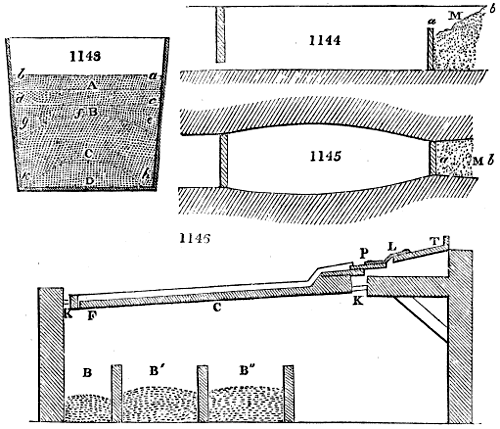
The openings in the front sides of the troughs are nearly 8 inches by 71⁄2: they are fitted with an iron frame, which is closed with sheet iron, pierced with about 160 holes in the square inch, bored conically, being narrower within. The ore, on issuing, deposits its rough in the first basin, and its slimes in the following basins. The rough is washed in buddles (see Lead, page 751), and in tossing tubs; the slimes in trunks, and upon a kind of twin tables, called racks. Into the tossing-tub, or dolly, fig. 1143., the stamped ore is thrown, along with a certain quantity of water, and a workman stirs it about with an iron shovel for three or four minutes. He then removes a little of the water with a handled pitcher, and strikes the sides of the tub for 8 or 10 minutes with a hammer, which hastens the subsidence of the denser parts. The water is next poured off by inclining the tub to one side. In one operation of this kind, four distinct strata of the ores may be procured, as indicated by the lines a b, c d, e f g, h i k, in the figure. The portion A is to be washed again in the trunking-box, figs. 1144, 1145.; B is to be washed upon the German chests or racks, fig. 1146.; C, the most considerable, is put aside, as schlich fit for the market; D, forming a nucleus the centre of the tub, is to be passed through sieves of copper wire, having 18 meshes in the square inch. This product thus affords a portion D′, which passes through the sieve, and D′′ which remains upon it; the latter is sometimes thrown away, and at others is subjected to the operation called the tie, viz., a washing upon the sloping bottom of a long trough.
The slimes are freed from the lighter mud in the trunking-box, figs. 1144, 1145.; which is from 7 to 8 feet long. Being accumulated at M, the workman pushes them back with a shovel from a towards b. The metallic portion is carried off, and deposited by the stream of water upon the table; but the earthy matters are floated along into a basin beyond it. The product collected in the chest is divided into two portions; the one of which is washed once, and the other twice, upon the rack, fig. 1146. This is composed of a frame C, which carries a sloping board or table, susceptible of turning round to the right or left upon two pivots, K, K. The head of the table is the inclined plane T. A small board P, which is attached by a band of leather L, forms the communication with the lower table C, whose slope is generally 5 inches in its whole length of 9 feet; but this may vary with the nature of the ore, being somewhat less when it is finely pulverized. The ore is thrown upon T, in small portions of 20 or 25 lbs. A woman spreads it with a rake, while a stream of water sweeps a part of it upon the table, where it gets washed. The fine mud falls through a cross slit near the lower end, into a basin B. After working for a few minutes, should the schlich seem tolerably rich, the operative turns the table round its axis K, K, so as to tumble it into the boxes below. The mud is in B; an impure schlich in B′, which must be washed again upon the rack; and a schlich fit for roasting in B′′.
The slope of the rack-table for washing the roasted tin ore, is 73⁄4 inches in the 9 feet.
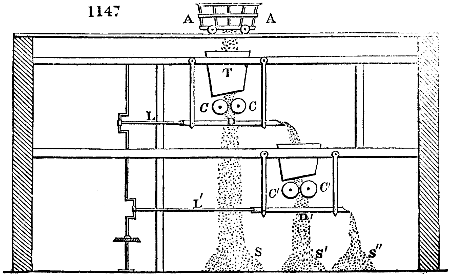
Crushing rolls at the Pembroke mines.—Waggons, moved on a railway by an endless rope, bring the ore to be crushed, immediately over the rolls, as shown in fig. 1147. A trap being opened in the side of the waggon, the ore falls into the hopper T, whence it passes directly between the twin cylinders C, C, and next upon the sieve D, which receives a seesaw motion horizontally, by means of the rod L, and the crank of the upright turning-shaft. The finer portion of ore, which passes through that sieve, forms the heap S. The coarser portion is tossed over the edge of the sieve, and falls between the cylinders C′ C′, upon a lower level, and forms the second heap S′ of sifted, and S′′ of unsifted, ore.
The holes of the sieves D, D′, being of the same size, the products S, S′, are of the same fineness. S′′ is ground again, being mixed, in the uppermost hopper T, along with the lumps from the waggons.
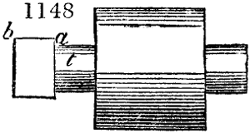
The diameter and length of the under rolls (see fig. 1148.) are each 16 inches. a b, is the square end of the gudgeon t, which prevents the shaft shifting laterally out of its place. The diameter of the upper rolls is 18 inches, but their length is the same. Both are made of white cast iron, chilled or case-hardened by being cast in iron moulds instead of sand; and they last a month, at least, when of good quality. They make from 10 to 15 turns in a minute, according to the hardness of the ores of tin or copper; and can grind about 50 tons of rich copper ore in 12 hours; but less of the poorer sort.
The next process is the calcination in the burning-house; which includes several reverberatory furnaces. At the mine of Poldice, they are 4 or 5 yards long, by from 21⁄2 to 3 yards wide. Their hearth is horizontal; the elevation, about 26 inches high near the fireplace, sinks slightly towards the chimney. There is but one opening, which is in the front; it is closed by a plate-iron door, turning on hinges. Above the door there is a chimney, to let the sulphureous and arsenical vapours fly off, which escape out of the hearth, without annoying the workmen. This chimney leads to horizontal flues, in which the arsenious acid is condensed.
Six hundred weight of ore are introduced; the calcination of which takes from 12 to 18 hours, according to the quantity of pyrites contained in the ore. At the beginning of the operation, a moderate heat is applied, after which it is pushed to a dull red, and kept so during several hours. The door is shut; the materials are stirred from time to time with an iron rake, to expose new surfaces, and prevent them from agglutinating or kerning, as the workmen say. The more pyrites is present, the more turning is necessary. Should the ore contain black oxide of iron, it becomes peroxidized, and is then easily removed by a subsequent washing.
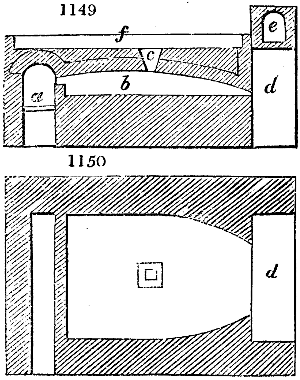
Figs. 1149, 1150. represent the furnace employed at Altenberg, in Saxony, for roasting tin ores. a is the grate; b, the sole of the roasting hearth; c, an opening in the arched roof for introducing the dried schlich (the ground and elutriated ore); d, is the smoke-mantle or chimney-hood, at the end of the furnace, under which the workmen turn over the spread schlich, with long iron rods bent at their ends; e, is the poison vent, which conducts the arsenical vapours to the poison chamber (gifthaus) of condensation.
When the ore is sufficiently calcined, as is shown by its ceasing to exhale vapours, it is taken out, and exposed for some days to the action of the air, which decomposes the sulphurets, or changes them into sulphates. The ore is next put into a tub filled with water, stirred up with a wooden rake, and left to settle; by which means the sulphate of copper that may have been formed, is dissolved out. After some time, this water is drawn off into a large tank, and its copper recovered by precipitation with pieces of old iron. In this way, almost all the copper contained in the tin ore is extracted.
The calcined ore is sifted, and treated again on the racks, as above described. The pure schlich, called black tin, is sold under this name to the smelters; and that which collects on the middle part of the inclined wash-tables, being much mixed with wolfram, is called mock lead. This is passed once more through the stamps, and washed; when it also is sold as black tin.
Stream tin is dressed by similar methods: 1. by washing in a trunking-box, of such dimensions that the workman stands upon it in thick boots, and makes a skilful use of the rake; 2. by separating the larger conglomerate pebbles from the smaller pure ones; picking, stamping, and washing, on a kind of sleeping-tables. See Metallurgy, figs. 677, 678.
The tin ores of Cornwall and Devonshire are all reduced within the counties where they are mined, as the laws prohibit their exportation out of them. Private interests suffer no injury from this prohibition; because the vessels which bring the fuel from Wales, for smelting these ores, return to Swansea and Neath loaded with copper ores.
The smelting-works belong in general to individuals who possess no tin mines, but who purchase at the cheapest rate the ores from the mining proprietors. The ores are appraised according to their contents in metal, and its fineness; conditions which they determine by the following mode of assay. When a certain number of bags of ore, of nearly the same quality, are brought to the works, a small sample is taken from each bag, and the whole are well blended. Two ounces of this average ore are mixed with about 4 per cent. of ground coal, put into an open earthen crucible, and heated in an air furnace (in area about 10 inches square) till reduction takes place. As the furnace is very hot when the crucible is introduced, the assay is finished in about a quarter of an hour. The metal thus revived, is poured into a mould, and what remains in the crucible is pounded in a mortar, that the grains of tin may be added to the ingot.
This method, though imperfect in a chemical point of view, serves the smelter’s purpose, as it affords him a similar result to what he would get on the great scale. A more exact assay would be obtained by fusing, in a crucible lined with hard-rammed charcoal, the ore mixed with 5 per cent. of ground glass of borax. To the crucible a gentle heat should be applied during the first hour, then a strong heat during the second hour, and, lastly, an intense heat for a quarter of an hour. This process brings out from 4 to 5 per cent. more tin than the other; but it has the inconvenience of reducing the iron, should any be present; which by subsequent solution in nitric acid will be readily shown. This assay would be too tedious for the smelter, who may have occasion to try a great many samples in one day.
The smelting of tin ores is effected by two different methods:—
In the first, a mixture of the ore with charcoal is exposed to heat on the hearth of a reverberatory furnace fired with coal.
In the second, the tin ore is fused in a blast furnace, called a blowing-house, supplied with wood charcoal. This method is practised in only a few works, in order to obtain a very pure quality of tin, called grain tin in England, and étain en larmes in France; a metal required for certain arts, as dyeing, &c. This method is applied merely to stream tin.
In the smelting-houses, where the tin is worked in reverberatories, two kinds of furnaces are employed; the reduction and the refining furnaces.
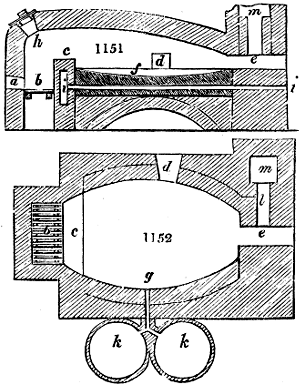
Figs. 1151, 1152. represent the furnaces for smelting tin at St. Austle, in Cornwall; the former being a longitudinal section, the latter a ground plan, a is the fire-door, through which pitcoal is laid upon the grate b; c is the fire-bridge; d, the door for introducing the ore; e, the door through which the ore is worked upon the hearth f; g, the stoke-hole; h, an aperture in the vault or roof, which is opened at the discharge of the waste schlich, to secure the free escape of the fumes up the chimney; i, i, air channels, for admitting cold air under the fire-bridge and the sole of the hearth, with the view of protecting them from injury by the intensity of the heat above. k, k, are basins into which the melted tin is drawn off; l, the flue; m, the chimney, from 35 to 50 feet high. The roasted and washed schlich is mixed with small coal or culm, along with a little slaked lime, or fluor spar, as a flux; each charge of ore amounts to from 15 to 24 cwt., and contains from 60 to 70 per cent. of metal.
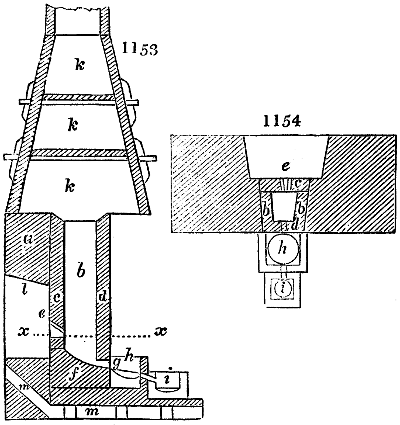
Fig. 1153. represents in a vertical section through the tuyère, and fig. 1154. in a horizontal section, in the dotted line x, x, of fig. 1153., the furnace employed for smelting tin at the Erzgebirge mines, in Saxony. a, are the furnace pillars, of gneiss; b, b, are shrouding or casing walls; c, the tuyère wall; d, front wall, both of granite; as also the tuyère e. f, the sole-stone, of granite, hewn out basin-shaped; g, the eye, through which the tin and slag are drawn off into the fore-hearth h; i, the stoke-hearth; k, k, the light ash chambers; l, the arch of the tuyère; m, m, the common flue, which is placed under the furnace and the hearths, and has its outlet under the vault of the tuyère.
In the smelting furnaces at Geyer the following dimensions are preferred:—Length of the tuyère wall, 11 inches; of the breast wall, 11 inches; depth of the furnace, 17 inches. High chimney-stalks are advantageous where a great quantity of ores is to be reduced, but not otherwise.
The refining furnaces are similar to those which serve for reducing the ore; only, instead of a basin of reception, they have a refining basin placed alongside, into which the tin is run. This basin is about 4 feet in diameter, and 32 inches deep; it consists of an iron pan, placed over a grate, in which a fire may be kindled. Above this pan there is a turning gib, by means of which a billet of wood may be thrust down into the bath of metal, and kept there by wheeling the gibbet over it, lowering a rod, and fixing it in that position.
The works in which the blast furnaces are employed, are called blowing-houses. The smelting furnaces are 6 feet high, from the bottom of the crucible (concave hearth) to the throat, which is placed at the origin of a long and narrow chimney, interrupted by a chamber, where the metallic dust, carried off by the blast, is deposited. This chamber is not placed vertically over the furnace; but the lower portion of the chimney has an oblique direction from it. The furnace is lined with an upright cylinder of cast iron, coated internally with loam, with an opening in it for the blast. This opening, which corresponds to the lateral face opposite to the charging side, receives a tuyère, in which the nozzles of two cylinder single bellows, driven by a water-wheel, are planted. The tuyère opens at a small height above the sole of the furnace. On a level with the sole, the iron cylinder presents a slope, below which is the hemispherical basin of reception, set partly beneath the interior space of the furnace, and partly without. Near the corner of the building there is a second basin of reception, larger than the first, which can discharge itself into the former by a sloping gutter. Near this basin there is another, for the refining operation. These are all made either of brick or cast iron.
The quality of the average ground-tin ore prepared for smelting is such, that 20 parts of it yield from 121⁄2 to 13 of metallic tin, (621⁄2 to 65 per cent.) The treatment consists of two operations, smelting and refining.
First operation; deoxidization of the ore, and fusion of the tin.—Before throwing the ore into the smelting furnace, it is mixed with from one-fifth to one-eighth of its weight of blind coal, in powder, called culm; and a little slaked lime is sometimes added, to render the ore more fusible. These matters are carefully blended, and damped with water, to render the charging easier, and to prevent the blast from sweeping any of it away at the commencement. From 12 to 16 cwt. are introduced at a charge; and the doors are immediately closed and luted, while the heat is progressively raised. Were the fire too strong at first, the tin oxide would unite with the quartz of the gangue, and form an enamel. The heat is applied for 6 or 8 hours, during which the doors are not opened; of course the materials are not stirred. By this time the reduction is, in general, finished; the door of the furnace is removed, and the melted mass is worked up to complete the separation of the tin from the scoriæ, and to ascertain if the operation be in sufficient forwardness. When the reduction seems to be finished, the scoriæ are taken out at the same door, with an iron rake, and divided into three sorts; those of the first class A, which constitute at least three-fourths of the whole, are as poor as possible, and may be thrown away; the scoriæ of the second class B, which contain some small grains of tin, are sent to the stamps; those of the third class C, which are last removed from the surface of the bath of tin, are set apart, and re-smelted, as containing a considerable quantity of metal in the form of grain tin. These scoriæ are in small quantity. The stamp slag contains fully 5 per cent. of metallic tin.
As soon as the scoriæ are cleared away, the channel is opened which leads to the basin of reception, into which the tin consequently flows out. Here it is left for some time, that the scoriæ which may be still mixed with the metal, may separate, in virtue of the difference of their specific gravities. When the tin has sufficiently settled, it is lifted out with ladles, and poured into cast-iron moulds, in each of which a bit of wood is fixed, to form a hole in the ingot, for the purpose of drawing it out when it becomes cold.
Refining of tin.—The object of this operation is to separate from the tin, as completely as possible, the metals reduced and alloyed along with it. These are, principally, iron, copper, arsenic, and tungsten; to which are joined, in small quantities, some sulphurets and arseniurets that have escaped decomposition, a little unreduced oxide of tin, and also some earthy matters which have not passed off with the scoriæ.
Liquation.—The refining of tin consists of two operations; the first being a liquation, which, in the interior, is effected in a reverberatory furnace, similar to that employed in smelting the ore. (figs. 1151, 1152.) The blocks being arranged on the hearth of the furnace, near the bridge, are moderately heated; the tin melts, and flows away into the refining-basin; but, after a certain time, the blocks cease to afford tin, and leave on the hearth a residuum, consisting of a very ferruginous alloy.
Fresh tin blocks are now arranged on the remains of the first; and thus the liquation is continued till the refining-basin be sufficiently full, when it contains about 5 tons. The residuums are set aside, to be treated as shall be presently pointed out.
Refining proper.—Now begins the second part of the process. Into the tin-bath, billets of green wood are plunged, by aid of the gibbet above described. The disengagement of gas from the green wood produces a constant ebullition in the tin; bringing up to its surface a species of froth, and causing the impurest and densest parts to fall to the bottom. That froth, composed almost wholly of the oxides of tin and foreign metals, is successively skimmed off, and thrown back into the furnace. When it is judged that the tin has boiled long enough, the green wood is lifted out, and the bath is allowed to settle. It separates into different zones, the upper being the purest; those of the middle are charged with a little of the foreign metals; and the lower are much contaminated with them. When the tin begins to cool, and when a more complete separation of its different qualities cannot be looked for, it is lifted out in ladles, and poured into cast-iron moulds. It is obvious, that the order in which the successive blocks are obtained, is that of their purity; those formed from the bottom of the basin being usually so impure, that they must be subjected anew to the refining process, as if they had been directly smelted from the ore.
The refining operation takes 5 or 6 hours; namely, an hour to fill the basin, three hours to boil the tin with the green wood, and from one to two hours for the subsidence.
Sometimes a simpler operation, called tossing, is substituted for the above artificial ebullition. To effect it, a workman lifts some tin in a ladle, and lets it fall back into the boiler, from a considerable height, so as to agitate the whole mass. He continues this manipulation for a certain time; after which, he skims with care the surface of the bath. The tin is afterwards poured into moulds, unless it be still impure. In this case, the separation of the metals is completed by keeping the tin in a fused state in the boiler for a certain period, without agitation; whereby the upper portion of the bath (at least one-half) is pure enough for the market.
The moulds into which the tin blocks are cast, are usually made of granite. Their capacity is such, that each block shall weigh a little more than three hundred weight. This metal is called block tin. The law requires them to be stamped or coined by public officers, before being exposed to sale. The purest block tin is called refined tin.
The treatment just detailed gives rise to two stanniferous residuums, which have to be smelted again. These are—
1. The scoriæ B and C, which contain some granulated particles of tin.
2. The dross found on the bottom of the reverberatory furnace, after re-melting the tin to refine it.
The scoriæ C, are smelted without any preparation; but those marked B, are stamped in the mill, and washed, to concentrate the tin grains; and from this rich mixture, called prillion, smelted by itself, a tin is procured of very inferior quality. This may be readily imagined, since the metal which forms these granulations is what, being less fusible than the pure tin, solidified quickly, and could not flow off into the metallic bath.
Whenever all the tin blocks have thoroughly undergone the process of liquation, the fire is increased, to melt the less fusible residuary alloy of tin with iron and some other metals, and this is run out into a small basin, totally distinct from the refining basin. After this alloy has reposed for some time, the upper portion is lifted out into block moulds, as impure tin, which needs to be refined anew. On the bottom and sides of the basin there is deposited a white, brittle alloy, with a crystalline fracture, which contains so great a proportion of foreign metals, that no use can be made of it. About 31⁄2 tons of coal are consumed in producing 2 of tin.
Smelting of tin by the blast furnace.—This mode of reduction employs only wood charcoal, and its object is to obtain tin of the maximum purity to which it can be brought by manufacturing processes. The better ores of the stream-works, and the finer tin sands, are selected for this operation. The washings being always well performed, the oxide of tin is exempt from every arsenical or sulphureous impurity, and is associated with nothing but a little hematite. It is therefore never calcined.
The smelting is effected without addition; only, in a few cases, some of the residuary matters of a former operation are added to the ore. About a ton and six-tenths of wood charcoal are burned for one ton of fine smelted tin. The only rule is, to keep the furnace always full of charcoal and ore. The revived tin is received immediately in the first basin; then run off into the second, where it is allowed to settle for some time. The scoriæ that run off into the first basin, are removed as soon as they fix. These scoriæ are divided into two classes; namely, such as still retain tin oxide, and such as hold none of the metal in that state, but only in granulations. The metallic bath is divided, by repose, into horizontal zones, of different degrees of purity; the more compound and denser matters falling naturally to the bottom of the basin. The tin which forms the superior zones, being judged to be pure enough, is transvased by ladles into the refining basin, previously heated, and under which, if it is of cast-iron, a moderate fire is applied. The tin near the bottom of the receiving basin is always laded out apart, to be again smelted; sometimes, indeed, when the furnace is turning out very impure tin, none of it is transvased into the second basin; but the whole is cast into moulds, to be again treated in the blast furnace.
In general they receive no other preparation, but the green wood ebullition, before passing into the market. Sometimes, however, the block of metal is heated till it becomes brittle, when it is lifted to a considerable height, and let fall, by which it is broken to pieces, and presents an agglomeration of elongated grains or tears; whence it is called grain tin.
On making a comparative estimate of the expense by the blowing-house process, and by the reverberatory furnace, it has been found that the former yields about 66 per cent. of tin, in smelting the stream or alluvial ore, whose absolute contents are from 75 to 78 parts of metal in the hundred. One ton of tin consumes a ton and six-tenths of wood charcoal, and suffers a loss of 15 per cent. In working with the reverberatory furnace, it is calculated that ore whose mean contents by an exact analysis are 70 per cent., yields 65 per cent. on the great scale. The average value of tin ore, as sold to the smelter, is 50 pounds sterling per ton; but it fluctuates, of course, with the market prices. In 1824, the ore of inferior quality cost 30l., while the purest sold for 60l. One ton of tin, obtained from the reverberatory furnace, cost—
11⁄2 tons of ore, worth £75 0 0
13⁄4 tons of coals, at 10s. per ton 0 17 6
Wages of labour, interest on capital, &c. 3 0 0
78 17 6
On comparing these results with the former, we perceive that in a blowing-house the loss of tin is 15 per cent., whereas it is only 5 in the reverberatory furnace. The expense in fuel is likewise much less relatively in the latter process; for only 13⁄4 tons of coals are consumed for one ton of tin; while a ton and six-tenths of wood charcoal are burned to obtain the same quantity of tin in the blowing-house; and it is admitted that one ton of wood charcoal is equivalent to two tons of coal, in calorific effect. Hence every thing conspires to turn the balance in favour of the reverberatory plan. The operation is also, in this way, much simpler, and may be carried on by itself. The scoriæ, besides, from the reverberatory hearth, contain less tin than those derived from the same ores treated with charcoal by the blast, as is done at Altenberg. It must be remembered, however, that the grain tin procured by the charcoal process is reckoned to be finer, and fetches a higher price; a superiority partly due to the purity of the ore reduced, and partly to the purity of the fuel.
To test the quality of tin, dissolve a certain weight of it with heat in muriatic acid; should it contain arsenic, brown-black flocks will be separated during the solution, and arseniuretted hydrogen gas will be disengaged, which, on being burned at a jet, will deposit the usual gray film of metallic arsenic upon a white saucer held a little way above the flame. Other metals present in the tin, are to be sought for, by treating the above solution with nitric acid of spec. grav. 1·16, first in the cold, and at last with heat and a small excess of acid. When the action is over, the supernatant liquid is to be decanted off the peroxidized tin, which is to be washed with very dilute nitric acid, and both liquors are to be evaporated to dissipate the acid excess. If, on the addition of water to the concentrated liquor, a white powder falls, it is a proof that the tin contains bismuth; if on adding sulphate of ammonia, a white precipitate appears, the tin contains lead; water of ammonia added to supersaturation, will occasion reddish-brown flocks, if iron is present; and on evaporating the supernatant liquid to dryness, the copper will be obtained.
The uses of tin are very numerous. Combined with copper, in different proportions, it forms bronze, and a series of other useful alloys; for an account of which see Copper. With iron, it forms tin-plate; with lead, it constitutes pewter, and solder of various kinds (see Lead). Tin-foil coated with quicksilver makes the reflecting surface of glass mirrors. (See Glass.) Nitrate of tin affords the basis of the scarlet dye on wool, and of many bright colours to the calico-printer and the cotton-dyer. (See Scarlet and Tin Mordants.) A compound of tin with gold, gives the fine crimson and purple colours to stained glass and artificial gems. (See Purple of Cassius.) Enamel is made by fusing oxide of tin with the materials of flint glass. This oxide is also an ingredient in the white and yellow glazes of pottery-ware.
An Account of Tin coined in Cornwall and Devon, from 1817 to 1829 inclusive:—
Years. Blocks. Tons.
1817 25,379 4,120
1818 23,048 3,745 1⁄3
1819 18,881 3,065
1820 17,084 2,773 1⁄2
1821 19,273 3,128
1822 18,732 3,137
1823 24,077 4,031
1824 28,602 4,819
1825 24,902 4,170
1826 26,299 4,406
1827 31,744 5,316
1828 28,179 4,696
1829 26,344 4,396
Tin imported. Duty, 50s. per cwt. Tin exported.
Cwts. Cwts.
1827 2,217 2,938
1828 3,386 3,258
1829 2,674 2,581
1830 15,539 10,426
1831 8,099 12,226
1832 29,203 21,720
1833 35,124 39,850
1834 46,769 46,685
1835 17,705 23,796
1836 23,236 17,231
The principal importations are from the East India Company’s territories and Ceylon:—they amounted in 1832 to 24,585 cwts.; in 1833 to 27,928; in 1834 to 33,611; in 1835 to 10,104; and in 1836 to 17,729. From Sumatra and Java 1961 cwts. were imported in 1832, and 1145 in 1834, but in the other years greatly less.
Declared value of tin and pewter wares and tin-plates exported in - 1827. 1829. 1831. 1833. 1835.
302,255l. 235,178l. 239,143l. 282,176l. 381,076l.
1828. 1830. 1832. 1834. 1836.
266,651l. 249,657l. 243,259l. 337,056l. 387,951l.
Of these goods, from two-fifths to three-fifths go to the United States of America.
Abstract of Tin coined in Cornwall and Devon, in the year ending June 30, 1835; from the Mining Review, vol. iii.
Smelters. Blocks of Grain Tin. Blocks of Common Tin. Totals.
1834. 1835. 1834. 1835. 1834. 1835.
Daubuz and Co. 728 875 6114 4494 6842 5369
Grenfell and Boase 344 196 3776 3097 4120 3293
Bolitho and Sons 229 153 3829 3099 4058 3252
R. and J. Michell 101 75 709 575 810 650
Wheal Vor Adventurers — — 3925 4069 3925 4069
Taylor, Sons and Co. — 112 — 1250 — 1362
John Batten and Son 28 49 2352 2351 2380 2400
Joseph Carne — — 896 851 896 851
William Cornish — — 622 574 622 574
Gill and Co. (at Morwelham) — — 758 — 758 —
Ditto (at Calstock) 60 — 605 — 665 —
Rundle, Paul and Co. — 12 — 1545 — 1557
Total 1490 1472 23586 21905 25076 23377
Total, in 1834, 4180 tons; in 1835, 3899 tons. (6 blocks = 1 ton.)
TINCAL, crude borax.
TINCTORIAL MATTER. One of the most curious and valuable facts ascertained upon this subject, is, that madder kept in casks, in a warm place, undergoes a species of fermentation, which, by ripening or rather deoxidizing the colouring-matter, increases its dyeing power by no less than from 20 to 50 per cent. See M. H. Schlumberger’s memoir read to the Société Industrielle de Mulhausen, 24 November, 1837.
TINCTURE is a title used by apothecaries to designate alcohol, in a somewhat dilute state, impregnated with the active principles of either vegetable or animal substances.
TIN-GLASS, is a name of bismuth.
TIN MORDANTS, for dyeing scarlet:—
Mordant A, as commonly made by the dyers, is composed of 8 parts of aquafortis, 1 part of common salt or sal ammoniac, and 1 of granulated tin. This preparation is very uncertain.
Mordant B.—Pour into a glass globe with a long neck, 3 parts of pure nitric acid at 30° B.; and 1 part of muriatic acid at 17°; shake the globe gently, avoiding the corrosive vapours, and put a loose stopper in its mouth. Throw into this nitro-muriatic acid, one-eighth of its weight of pure tin, in small bits at a time. When the solution is complete, and settled, decant it into bottles, and close them with ground stoppers. It should be diluted only when about to be used.
Mordant C, by Dambourney.—In two drams Fr. (144 grs.) of pure muriatic acid, dissolve 18 grains of Malacca tin. This is reckoned a good mordant for brightening or fixing the colour of peachwood.
Mordant D, by Hellot.—Take 8 ounces of nitric acid, diluted with as much water; dissolve in it half an ounce of sal ammoniac, and 2 drams of nitre. In this acid solution dissolve one ounce of granulated tin of Cornwall, observing not to put in a fresh piece till the preceding be dissolved.
Mordant E, by Scheffer.—Dissolve one part of tin in four of a nitro-muriatic acid, prepared with nitric acid diluted with its own weight of water, and one thirty-secondth of sal ammoniac.
Mordant F, by Poërner.—Mix one pound of nitric acid with one pound of water, and dissolve in it an ounce and a half of sal ammoniac. Stir it well, and add, by very slow degrees, two ounces of tin turned into thin ribbons upon the lathe.
Mordant G, by Berthollet.—Dissolve in nitric acid of 30° B., one-eighth of its weight of sal ammoniac, then add by degrees one-eighth of its weight of tin, and dilute the solution with one-fourth of its weight of water.
Mordant K, by Dambourney.—In one dram (72 grs.) of muriatic acid at 17°, one of nitric acid at 30°, and 18 grains of water, dissolve, slowly and with some heat, 18 grains of fine Malacca tin.
Mordant L, is the birch bark prescribed by Dambourney.—This bark, dried and ground, is said to be a very valuable substance for fixing the otherwise fugitive colours produced by woods, roots, archil, &c.
TIN-PLATE. The only alloy of iron interesting to the arts, is that with tin, in the formation of tin-plate, or white-iron.
The sheet iron intended for this manufacture is refined with charcoal instead of coke, subsequently rolled to various degrees of thinness, and cut into rectangles of different sizes, by means of a shearing-machine driven by a water-wheel, which will turn out 100 boxes a day, or four times the number cut by hand labour. The first step towards tinning, is to free the metallic surface from every particle of oxide or impurity, for any such would inevitably prevent the iron from alloying with the tin. The plates are next bent separately by hand into a saddle or Λ shape, and ranged in a reverberatory oven, so that the flame may play freely among them, and heat them to redness. They are then plunged into a bath, composed of four pounds of muriatic acid diluted with three gallons of water, for a few minutes, taken out and drained on the floor, and once more exposed to ignition in a furnace, whereby they are scaled, that is to say, cast their scales. The above bath will suffice for scaling 1800 plates. When taken out, they are beat level and smooth on a cast-iron block, after which they appear mottled blue and white, if the scaling has been thoroughly done. They are next passed through chilled rolls or cast-iron cylinders, rendered very hard by being cast in thick iron moulds, as has been long practised by the Scotch founders in casting bushes for cart-wheels. After this process of cold rolling, the plates are immersed, for ten or twelve hours, in an acidulous lye, made by fermenting bran-water, taking care to set them separately on edge, and to turn them at least once, so that each may receive a due share of the operation. From this lye-steep they are transferred into a leaden trough, divided by partitions, and charged with dilute sulphuric acid. Each compartment is called a hole by the workmen, and is calculated to receive about 225 plates, the number afterwards packed up together in a box. In this liquid they are agitated about an hour, till they become perfectly bright, and free from such black spots as might stain their surface at the time of immersion. This process, called pickling, is both delicate and disagreeable, requiring a good workman, at high wages. The temperature of the two last steeps should be at least 90° or 100° F., which is kept up by stoves in the apartments. The plates are finally scoured with hemp and sand in a body of water, and then put aside for use in a vessel of pure water, under which they remain bright and free from rust for many months, a very remarkable circumstance.
The tinning follows these preparatory steps. A range of rectangular cast-iron pots is set over a fire-flue in an apartment called the stow, the workmen stationing themselves opposite to the narrow ends. The first rectangle in the range is the tin-pot; the second is the wash-pot, with a partition in it; the third is the grease-pot; the fourth is the pan, grated at bottom; the fifth is the list-pot, and is greatly narrower than any of the rest: they are all of the same length.
The prepared plates, dried by rubbing bran upon them, are first immersed one by one in a pot filled with melted tallow alone, and are left there for nearly an hour. They are thence removed, with the adhering grease, into pot No. 1., filled with a melted mixture of block and grain tin, covered with about four inches of tallow, slightly carbonized. This pot is heated by a fire, playing under its bottom and round its sides, till the metal becomes so hot as nearly to inflame the grease. Here about 340 plates are exposed, upright, to the action of the tin for an hour and a half, or more, according to their thickness. They are next lifted out, and placed upon an iron grating, to let the superfluous metal drain off; but this is more completely removed in the next process, called washing.
Into the wash-pot, No. 2., filled with melted grain tin, the workman puts the above plates, where the heat detaches the ribs, and drops. There is a longitudinal partition in it, for keeping the drop of tin that rises in washing from entering the vessel where the last dip is given. Indeed, the metal in the wash-pot, after having acted on 60 or 70 boxes, becomes so foul, that the weight of a block (300 cwt.) of it, is transferred into the tin-pot, No. 1., and replaced by a fresh block of grain tin. The plates being lifted out of the wash-pot, with tongs held in the left hand of the workman, are scrubbed on each side with a peculiar hempen brush, held in his right hand, then dipped for a moment in the hot tin, and forthwith immersed in the adjoining grease-pot, No. 3. This requires manual dexterity; and though only three-pence be paid for brushing and tin-washing 225 plates, yet a good workman can earn six shillings and three-pence in twelve hours, by putting 5625 plates through his hands. The final tin-dip is useful to remove the marks of the brush, and to make the surface uniformly bright. To regulate the temperature of the tallow-pot, and time during which the plates are left in it, requires great skill and circumspection on the part of the workman. If kept in it too long, they would be deprived to a certain extent of their silvery lustre; and if too short, streaks of tin would disfigure their surface. As a thick plate retains more heat after being lifted out of the washing-pot, it requires a proportionally cooler grease-pot. This pot has pins fixed within it, to keep the plates asunder; and whenever the workman has transferred five plates to it, a boy lifts the first out into the cold adjoining pan, No. 4.; as soon as the workman transfers a sixth plate, the boy removes the second; and so on. The manufacture is completed by removing the wire of tin left on the under edge of the plates, in consequence of their vertical position in the preceding operations. This is the business of the list-boy, who seizes the plates when they are cool enough to handle, and puts the lower edge of each, one by one, into the list-pot, No. 5., which contains a very little melted tin, not exceeding a quarter of an inch in depth. When he observes the wire-edge to be melted, he takes out the plate, and, striking it smartly with a thin stick, detaches the superfluous metal, which leaves merely a faint stripe where it lay. This mark may be perceived on every tin-plate in the market.
The plates are finally prepared for packing up in their boxes, by being well cleansed from the tallow, by friction with bran.
Mr. Thomas Morgan obtained a patent, in September, 1829, for clearing the sheet-iron plates with dilute sulphuric acid in a hole, instead of scaling them in the usual way, previous to their being cold rolled, annealed, and tinned; whereby, he says, a better article is produced at a cheaper rate.
Crystallized tin-plate, see Moirée Metallique. It would seem that the acid merely lays bare the crystalline structure really present on every sheet, but masked by a film of redundant tin. Though this showy article has become of late years vulgarized by its cheapness, it is still interesting in the eyes of the practical chemist. The English tin-plates marked F, answer well for producing the Moirée, by the following process. Place the tin-plate, slightly heated, over a tub of water, and rub its surface with a sponge dipped in a liquor composed of four parts of aquafortis, and two of distilled water, holding one part of common salt or sal ammoniac in solution. Whenever the crystalline spangles seem to be thoroughly brought out, the plate must be immersed in water, washed either with a feather or a little cotton (taking care not to rub off the film of tin that forms the feathering), forthwith dried with a low heat, and coated with a lacquer varnish, otherwise it loses its lustre in the air. If the whole surface is not plunged at once in cold water, but if it be partially cooled by sprinkling water on it, the crystallization will be finely variegated with large and small figures. Similar results will be obtained by blowing cold air through a pipe on the tinned surface, while it is just passing from the fused to the solid state; or a variety of delineations may be traced, by playing over the surface of the plate with the pointed flame of a blowpipe.
The following Table shows the several sizes of tin-plates, the marks by which they are distinguished, and their current wholesale prices in London:—
Names. Sizes. No. in a box. Weight of each box. Marks on the boxes. Prices per box, in
1823. 1838.
Inches. cwt. qrs. lbs. s. s. d.
Common, No. 1. 13 3⁄4 by 10 225 1 0 0 CI. 47 35
Ditto 2. 13 1⁄4 — 9 1⁄4 0 3 21 CII. 45 33 6
Ditto 3. 12 3⁄4 — 9 1⁄2 0 3 16 CIII. 43 32 9
Cross, No. 1. 13 3⁄4 — 10 1 1 0 XI. 53 40 2
Two crosses, 1. 1 1 21 XXI. 58 43 2
Three crosses, 1. 1 2 14 XXX. I. 63 47
Four crosses, 1. 1 3 7 XXXX. I.
Common doubles 16 3⁄4 — 12 1⁄2 100 0 3 21 CD. 64 -6 - 150 sheets in each. 48 6
Cross doubles 1 0 14 XD. 73 -6 56
Two cross do. 1 1 7 XXD. 81 60 6
Three cross do. 1 2 0 XXXD. 88 -6 65
Four cross do. 1 2 21 XXXXD.
Com. small doubles 5 — 11 200 1 2 0 CSD. 69 51 6
Cross do. do. 1 2 21 XSD. 75 56 0
Two cross do. 1 3 14 XXSD. 80 59 6
Three do. do. 2 0 7 XXXSD.
Four do. do. 2 1 0 XXXXSD.
Waster’s com. No. 1. 3 3⁄4 — 10 225 1 0 0 WCI. 44 32 9
Ditto cross, 1. ditto 1 1 0 WXI. 50 47 3
These are the cash prices of one wholesale warehouse in Thames-street; an immediately adjoining warehouse charges fully 1s. more upon the standard CI, and proportionally upon the others.
TITANIUM, is a rare metal, discovered by Klaproth, in menachanite, in 1794. It has been detected since in the form of small cubes of a copper-red colour, in some of the blast furnaces in Yorkshire. According to Hassenfratz, its presence in small quantity does not impair the malleability of iron. It is very brittle, so hard as to scratch steel, and very light, having a specific gravity of only 5·3. It will not melt in the heat of any furnace, nor dissolve, when crystallized, even in nitro-muriatic acid; but only when in fine powder. By calcination with nitre, it becomes oxygenated, and forms titanate of potassa. Traces of this metal may be detected in many irons, both wrought and cast. The principal ores of titanium are sphene, common and foliated, rutile, iserine, menachanite, and octahedrite or pyramidal titanium ore. None of them has been hitherto applied to any use.
TOBACCO. It is said that the name tobacco was given by the Spaniards to the plant, because it was first observed by them at Tabasco, or Tabaco, a province of Yucatan in Mexico. In 1560, Nicot, the French ambassador to Portugal, having received some tobacco from a Flemish merchant, showed it, on his arrival in Lisbon, to the grand prior, and, on his return into France, to Catherine of Medicis, whence it has been called Nicotiana by the botanists. Admiral Sir Francis Drake having, on his way home from the Spanish Main, in 1586, touched at Virginia, and brought away some forlorn colonists, is reported to have first imported tobacco into England. But, according to Lobel, this plant was cultivated in Britain before the year 1570; and was consumed by smoking in pipes by Sir Walter Raleigh, and companions, so early as the year 1584.
The plants are hung up to dry during four or five weeks; taken down out of the sheds in damp weather, for in dry they would be apt to crumble into pieces; stratified in heaps, covered up, and left to sweat for a week or two, according to their quality and the state of the season; during which time they must be examined frequently, opened up, and turned over, lest they become too hot, take fire, or run into putrefactive fermentation. This process needs to be conducted by skilful and attentive operatives. An experienced negro can form a sufficiently accurate judgment of the temperature, by thrusting his hand down into the heap.
The tobacco thus prepared, or often without fermentation, is sent into the market; but, before being sold, it must undergo the inspection of officers, appointed by the state with very liberal salaries, who determine its quality, and brand an appropriate stamp upon its casks, if it be sound; but if it be bad, it is burned.
Our respectable tobacconists are very careful to separate all the damaged leaves, before they proceed to their preparation, which they do by spreading them in a heap upon a stone pavement, watering each layer in succession, with a solution of sea salt, of spec. grav. 1·107, called sauce, till a ton or more be laid; and leaving their principles to react on each other for three or four days, according to the temperature, and the nature of the tobacco. It is highly probable that ammonia is the volatilizing agent of many odours, and especially of those of tobacco and musk. If a fresh green leaf of tobacco be crushed between the fingers, it emits merely the herbaceous smell common to many plants; but if it be triturated in a mortar, along with a little quicklime or caustic potash, it will immediately exhale the peculiar odour of snuff. Now analysis shows the presence of muriate of ammonia in this plant, and fermentation serves further to generate free ammonia in it; whence, by means of this process, and lime, the odoriferous vehicle is abundantly developed. If, on the other hand, the excess of alkaline matter in the tobacco of the shops be saturated by a mild dry acid, as the tartaric, its peculiar aroma will entirely disappear.
Tobacco contains a great quantity of an azotized principle, which by fermentation produces abundance of ammonia; the first portions of which saturate the acid juices of the plant, and the rest serve to volatilize its odorous principles. The salt water is useful chiefly in moderating the fermentation, and preventing it from passing into the putrefactive stage; just as salt is sometimes added to saccharine worts in tropical countries, to temper the fermentative action. The sea salt, or concentrated sea water, which contains some muriate of lime, tends to keep the tobacco moist, and is therefore preferable to pure chloride of sodium for this purpose. Some tobacconists mix molasses with the salt sauce, and ascribe to this addition the violet colour of the macouba snuff of Martinique; and others add a solution of extract of liquorice. The following prescription is that used by a skilful manufacturer:—In a solution of the liquorice juice, a few figs are to be boiled for a couple of hours; to the decoction, while hot, a few bruised anise-seeds are to be added, and when cold, common salt to saturation. A little silent spirit of wine being poured in, the mixture is to be equably, but sparingly, sprinkled with the rose of a watering-pot, over the leaves of the tobacco, as they are successively stratified upon the preparation floor.
The fermented leaves, being next stripped of their middle ribs by the hands of children, are sorted anew, and the large ones are set apart for making cigars. Most of the tobaccos on sale in our shops are mixtures of different growths: one kind of smoking tobacco, for example, consists of 70 parts of Maryland, and 30 of meagre Virginia; and one kind of snuff consists of 80 parts of Virginia, and 30 parts of either Humesfort or Warwick. The Maryland is a very light tobacco, in thin yellow leaves; that of Virginia is in large brown leaves, unctuous or somewhat gluey on the surface, having a smell somewhat like the figs of Malaga; that of Havannah is in brownish, light leaves, of an agreeable and rather spicy smell; it forms the best cigars. The Carolina tobacco is less unctuous than the Virginian; but in the United States it ranks next to the Maryland.
The shag tobacco is dried to the proper point upon sheets of copper.
Tobacco is cut into what is called shag tobacco by knife-edged chopping stamps, a machine somewhat similar to that represented under Metallurgy, fig. 670. For grinding the tobacco leaves into snuff, conical mortars are employed, somewhat like that used by the Hindoos for grinding sugar-canes, fig. 1080.; but the sides of the snuff-mill have sharp ridges from the top to near the bottom.
Mr. L. W. Wright obtained a patent in August, 1827, for a tobacco-cutting machine, which bears a close resemblance to the well-known machines with revolving knives, for cutting straw into chaff. The tobacco, after being squeezed into cakes, is placed upon a smooth bed within a horizontal trough, and pressed by a follower and screws to keep it compact. These cakes are progressively advanced upon the bed, or fed in, to meet the revolving blades. The speed of the feeding-screw determines the degree of fineness of the sections or particles into which the tobacco is cut.
I was employed some years ago by the Excise, to analyze a quantity of snuff, seized on suspicion of having been adulterated by the manufacturer. I found it to be largely drugged with pearl-ashes, and to be thereby rendered very pungent, and absorbent of moisture; an economical method of rendering an effete article at the same time active and aqueous.
According to the recent analysis of Possett and Reimann, 10,000 parts of tobacco-leaves contain—6 of the peculiar chemical principle nicotine; 1 of nicotianine; 287 of slightly bitter extractive; 174 of gum, mixed with a little malic acid; 26·7 of a green resin; 26 of vegetable albumen; 104·8 of a substance analogous to gluten; 51 of malic acid; 12 of malate of ammonia; 4·8 of sulphate of potassa; 6·3 of chloride of potassium; 9·5 of potassa, which had been combined with malic and nitric acids; 16·6 of phosphate of lime; 24·2 of lime, which had been combined with malic acid; 8·8 of silica; 496·9 of fibrous or ligneous matter; traces of starch; and 88·28 of water.
Nicotine is a transparent colourless liquid, of an alkaline nature. It may be distilled in a retort plunged into a bath heated to 290° Fahrenheit. It has a pricking, burning taste, which is very durable; and a pungent disagreeable smell. It burns by means of a wick, with the diffusion of a vivid light, and much smoke. It may be mixed with water in all proportions. It is soluble also in acetic acid, oil of almonds, alcohol, and ether, but not in oil of turpentine. It acts upon the animal economy with extreme violence; and in the dose of one drop it kills a dog. It forms salts with the acids. About one part of it may be obtained by very skilful treatment from one thousand of good tobacco.
Tobacco imported into the United Kingdom, viz.—unmanufactured, in 1836, 52,232,907 lbs.; in 1837, 27,070,448 lbs.;—manufactured, and snuff, in 1836, 182,248 lbs.; in 1837, 642,287 lbs. Retained for home consumption, unmanufactured, in 1836, 22,309,021 lbs.; in 1837, 22,504,343 lbs.:—manufactured, and snuff, in 1836, 159,226 lbs.; in 1837, 145,045 lbs. Duty received,—on unmanufactured tobacco, in 1836, £3,344,703; in 1837, £3,375,125; on manufactured tobacco, and snuff, in 1836, £71,560; in 1837, £65,220.
TOBACCO-PIPES. The practice of smoking tobacco has become so general in many nations as to render the manufacture of tobacco-pipes a considerable branch of industry. Some seek in the inhalation of tobacco-smoke a pleasurable narcotism; others imagine it to be beneficial to their health; but, in general, smoking is merely a dreamy resource against ennui, which ere long becomes an indispensable stimulus. The filthiness of this habit, the offensive odour which persons under its influence emit from their mouths and clothes, the stupor it too often occasions, as well as the sallow complexion, black or carious teeth, and impaired digestion, all prove the great consumption of tobacco to be akin in evil influence upon mankind to the use of ardent spirits.
Tobacco-pipes are made of a fine-grained plastic white clay, to which they have given the name. It is worked with water into a thin paste, which is allowed to settle in pits, or it may be passed through a sieve, to separate the siliceous or other stony impurities; the water is afterwards evaporated till the clay becomes of a doughy consistence, when it must be well kneaded to make it uniform. Pipe-clay is found chiefly in the isle of Purbeck and Dorsetshire. It is distinguished by its perfectly white colour, and its great adhesion to the tongue after it is baked; owing to the large proportion of alumina which it contains.
A child fashions a ball of clay from the heap, rolls it out into a slender cylinder upon a plank, with the palms of his hands, in order to form the stem of the pipe. He sticks a small lump to the end of the cylinder for forming the bowl; which having done, he lays the pieces aside for a day or two, to get more consistence. In proportion as he makes these rough figures, he arranges them by dozens on a board, and hands them to the pipemaker.
The pipe is finished by means of a folding brass or iron mould, channelled inside of the shape of the stem and the bowl, and capable of being opened at the two ends. It is formed of two pieces, each hollowed out like a half-pipe, cut as it were lengthwise; and these two jaws, when brought together, constitute the exact space for making one pipe. There are small pins in one side of the mould, corresponding to holes in the other, which serve as guides for applying the two together with precision.
The workman takes a long iron wire, with its end oiled, and pushes it through the soft clay in the direction of the stem, to form the bore, and he directs the wire by feeling with his left hand the progress of its point. He lays the pipe in the groove of one of the jaws of the mould, with the wire sticking in it; applies the other jaw, brings them smartly together, and unites them by a clamp or vice, which produces the external form. A lever is now brought down, which presses an oiled stopper into the bowl of the pipe, while it is in the mould, forcing it sufficiently down to form the cavity; the wire being meanwhile thrust backwards and forwards so as to pierce the tube completely through. The wire must become visible at the bottom of the bowl, otherwise the pipe will be imperfect. The wire is now withdrawn, the jaws of the mould opened, the pipe taken out, and the redundant clay removed with a knife. After drying for a day or two, the pipes are scraped, polished with a piece of hard wood, and the stems being bent into the desired form, they are carried to the baking kiln, which is capable of firing fifty gross in from 8 to 12 hours. A workman and a child can easily make five gross of pipes in a day.
No tobacco-pipes are so highly prized as those made in Natolia, in Turkey, out of meerschaum, a somewhat plastic magnesian stone, of a soft greasy feel, which is formed into pipes after having been softened with water. It becomes white and hard in the kiln.
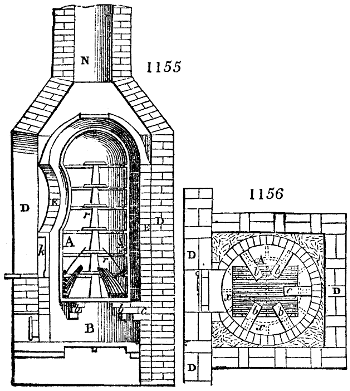
A tobacco-pipe kiln should diffuse an equal heat to every part of its interior, while it excludes the smoke of the fire. The crucible, or large sagger, A, A, figs. 1155. and 1156., is a cylinder, covered in with a dome. It is placed over the fireplace B, and enclosed within a furnace of ordinary brickwork D, D, lined with fire-bricks E, E. Between this lining and the cylinder, a space of about 4 inches all round is left for the circulation of the flame. There are 12 supports or ribs between the cylinder and the furnace lining, which form so many flues, indicated by the dotted lines x, in fig. 1156. (the dotted circle representing the cylinder). These ribs are perforated with occasional apertures, as shown in fig. 1155., for the purpose of connecting the adjoining flues; but the main bearing of the hollow cylinder is given by five piers, b, b, c, formed of bricks projecting over and beyond each other. One of these piers c, is placed at the back of the fireplace, and the other four at the sides b, b. These project nearly into the centre, in order to support and strengthen the bottom; while the flues pass up between them, unite at the top of the cylinder in the dome L, and discharge the smoke by the chimney N.
The lining F, E, E, of the chimney is open on one side to form the door, by which the cylinder is charged and discharged. The opening is permanently closed as high as k, fig. 1155., by an iron plate plastered over with fire-clay; above this it is left open, and shut merely with temporary brickwork while the furnace is going. When this is removed, the furnace can be filled or emptied through the opening, the cylindric crucible having a correspondent aperture in its side, which is closed in the following ingenious way, while the furnace is in action. The workman first spreads a layer of clay round the edge of the opening, he then sticks the stems of broken pipes across from one side to the other, and plasters up the interstices with clay, exactly like the lath-and-plaster work of a ceiling. The whole of the cylinder, indeed, is constructed in this manner, the bottom being composed of a great many fragments of pipe stems, radiating to the centre; these are coated at the circumference with a layer of clay. A number of bowls of broken pipes are inserted in the clay; in these other fragments are placed upright to form the sides of the cylinder. The ribs round the outside, which form the flues, are made in the same way, as well as the dome L; by which means the cylindric case may be made very strong, and yet so thin as to require little clay in the building, a moderate fire to heat it, while it is not apt to split asunder. The pipes are arranged within, as shown in the figure, with their bowls resting against the circumference and their ends supported on circular pieces of clay r, which are set up in the centre for that purpose. Six small ribs are made to project inwards all round the crucible, at the proper heights, to support the different ranges of pipes, without having so many resting on each other as to endanger their being crushed by the weight. By this mode of distribution, the furnace may contain 50 gross, or 7200 pipes, all baked within 8 or 9 hours; the fire being gradually raised, or damped if occasion be, by a plate partially slid over the chimney top.
TODDY, Sura, Mee-ra, sweet juice.—The proprietors of coco-nut plantations in the peninsula of India, and in the Island of Ceylon, instead of collecting a crop of nuts, frequently reap the produce of the trees by extracting sweet juice from the flower-stalk. When the flowering branch is half shot, the toddy-drawers bind the stock round with a young coco-nut leaf in several places, and beat the spadix with a short baton of ebony. This beating is repeated daily for ten or twelve days, and about the end of that period a portion of the flower-stalk is cut off. The stump then begins to bleed, and an earthen vessel (chatty) or a calabash is suspended under it, to receive the juice, which is by the Europeans called toddy.
A thin slice is taken from the stump daily, and the toddy is removed twice a day. A coco-nut frequently pushes out a new spadix once a month; and after each spadix begins to bleed, it continues to produce freely for a month, by which time another is ready to supply its place. The old spadix continues to give a little juice for another month, after which it withers; so that there are sometimes two pots attached to a tree at one time, but never more. Each of these spadices, if allowed to grow, would produce a bunch of nuts from two to twenty. Trees in a good soil produce twelve bunches in the year; but when less favourably situated, they often do not give more than six bunches. The quantity of six English pints of toddy is sometimes yielded by a tree daily.
Toddy is much in demand as a beverage in the neighbourhood of villages, especially where European troops are stationed. When it is drunk before sunrise, it is a cool, delicious, and particularly wholesome beverage; but by eight or nine o’clock fermentation has made some progress, and it is then highly intoxicating.[68]
TOLU, is a brownish-red balsam, extracted from the stem of the Myroxilon toluiferum, a tree which grows in South America. It is composed of resin, oil, and benzoic acid. Having an agreeable odour, it is sometimes used in perfumery. It has a place in the Materia Medica, but for what good reason I know not.
TOMBAC, is a white alloy of copper.
TONKA BEAN, the fruit of the Dipterix odorata, affords a concrete crystalline volatile oil (stearoptène), called coumarine by the French. It is extracted by digestion with alcohol, which dissolves the stearoptène, and leaves a fat oil. It has an agreeable smell, and a warm taste. It is fusible at 122° Fahrenheit, and volatile at higher heats.
TOPAZ. See Lapidary.
TORTOISE-SHELL, or rather scales, a horny substance, that covers the hard strong covering of a bony contexture, which encloses the Testudo imbricata, Linn. The lamellæ or plates of this tortoise are 13 in number, and may be readily separated from the bony part by placing fire beneath the shell, whereby they start asunder. They vary in thickness from one-eighth to one-quarter of an inch, according to the age and size of the animal, and weigh from 5 to 25 pounds. The larger the animal, the better is the shell. This substance may be softened by the heat of boiling water; and if compressed in this state by screws in iron or brass moulds, it may be bent into any shape. The moulds being then plunged in cold water, the shell becomes fixed in the form imparted by the mould. If the turnings or filings of tortoise-shell be subjected skilfully to gradually increased compression between moulds immersed in boiling water, compact objects of any desired ornamental figure or device may be produced. The soldering of two pieces of scale is easily effected, by placing their edges together, after they are nicely filed to one bevel, and then squeezing them strongly between the long flat jaws of hot iron pincers, made somewhat like a hairdresser’s curling-tongs. The pincers should be strong, thick, and just hot enough to brown paper slightly, without burning it. They may be soldered also by the heat of boiling water, applied along with skilful pressure. But in whatever way this process is attempted, the surfaces to be united should be made very smooth, level, and clean; the least foulness, even the touch of a finger, or breathing upon them, would prevent their coalescence. See Horn.
TOUCH-NEEDLES, and TOUCH-STONE, are means of ascertaining the quality of gold trinkets. See Assay.
TOW. See Flax.
TRAGACANTH, GUM. (Gomme adracante, Fr.; Traganth, Germ.) See Gum.
TRAVERTINO. See Tufa.
TREACLE, is the viscid brown uncrystallizable syrup which drains from the sugar-refining moulds. Its specific gravity is generally 1·4, and it contains upon an average 75 per cent. of solid matter, by my experiments.
TRIPOLI (Terre pourrie, Fr.; Tripel, Germ.); rotten-stone; is a mineral of an earthy fracture, a yellowish-gray or white colour, composition impalpably fine, meagre to the touch, does not adhere to the tongue, and burns white. Its analogue, the Polierschiefer, occurs in thin flat foliated pieces, of the above colours, occasionally striped; soft, absorbent of water; spec. grav. 1·9. to 2·2.
M. Ehrenberg has shown that both of these friable homogeneous rocks, which consist almost entirely of silica, are actually composed of the exuviæ or rather the skeletons of infusoria (animalcula) of the family of Barcillariæ, and the genera Cocconema, Gonphonema, &c. They are recognised with such distinctness in the microscope, that their analogies with living species may be readily traced; and in many cases there are no appreciable differences between the living and the petrified. The species are distinguished by the number of partitions or transverse lines upon their bodies. The length is about 1⁄288 of a line. M. Ehrenberg made his observations upon the tripolis of Billen in Bohemia of Santafiora in Tuscany, of the Isle of France, and of Francisbad, near Eger.
The meadow iron ore (Fer limoneux des marais) is composed almost wholly of the Gaellonella ferruginea. Most of these infusoria are lacustrine; but others are marine, particularly the tripolis of the Isle of France.
According to the chemical analysis of Bucholz, tripoli consists of—silica, 81; alumina, 1·5; oxide of iron, 8; sulphuric acid, 3·45; water, 4·55. This specimen was probably found in a coal-field. The tripoli of Corfu is reckoned the best for scouring or brightening brass and other metals. Mr. Phillips found in the Derbyshire rotten-stone (near Bakewell), 86 of alumina, 4 of silica, and 10 of carbon—being a remarkable difference in composition from the Bohemian.
TUFA, or TUF, is a gray deposit of calcareous carbonate, from springs and streams.
TULA METAL, is an alloy of silver, copper, and lead.
TUNGSTEN (Eng. and Fr.; Wolfram, Germ.); is a peculiar metal, which occurs in the state of an acid (the tungstic), combined with various bases, as with lime, the oxides of iron, manganese, and lead. The metal is obtained by reduction of the ore, or the deoxidizement of the acid, in the form of a dark steel-gray powder, which assumes under the burnisher a feeble metallic lustre. Its specific gravity is 17·22.
TURBITH MINERAL, is the yellow subsulphate of mercury.
TURF (Peat, Scotch; Tourbe, Fr.; Torf, Germ.); consists of vegetable matter, chiefly of the moss family, in a state of partial decomposition by the action of water. Cut, during summer, into brick-shaped pieces, and dried, it is extensively used as fuel by the peasantry in every region where it abounds. The dense black turf, which forms the lower stratum of a peat-moss, is much contaminated with iron, sulphur, sand, &c., while the lighter turf of the upper strata, though nearly pure vegetable matter, is too bulky for transportation, and too porous for factory fuel. These defects have been happily removed by Mr. Williams, managing director of the Dublin Steam Navigation Company, who has recently obtained a patent for a method of converting the lightest and purest beds of peat-moss, or bog, into the four following products: 1. A brown combustible solid, denser than oak; 2. A charcoal, twice as compact as that of hard wood; 3. A factitious coal; and 4. A factitious coke; each of which possesses very valuable properties.
Mr. D’Ernst, artificer of fire-works to Vauxhall, has proved, by the severe test of coloured fires, that the turf charcoal of Mr. Williams is 20 per cent. more combustible than that of oak. Mr. Oldham, engineer of the Bank of England, has applied it in softening his steel plates and dies, with remarkable success. But one of the most important results of Mr. Williams’s invention is, that with 10 cwts. of pitcoal, and 21⁄2 cwts. of his factitious coal, the same steam power is now obtained, in navigating the Company’s ships, as with 171⁄2 cwts. of pitcoal alone; thereby saving 30 per cent. in the stowage of fuel. What a prospect is thus opened up of turning to admirable account the unprofitable bogs of Ireland; and of producing, from their inexhaustible stores, a superior fuel for every purpose of arts and engineering.
The turf is treated as follows:—Immediately after being dug, it is triturated under revolving edge-wheels, faced with iron plates perforated all over their surface, and is forced by the pressure through these apertures, till it becomes a species of pap, which is freed from the greater part of its moisture by squeezing in a hydraulic press between layers of caya cloth, then dried, and coked in suitable ovens.—(See Charcoal, and Pitcoal, coking of.) Mr. Williams makes his factitious coal by incorporating with pitch or rosin, melted in a cauldron, as much of the above charcoal, ground to powder, as will form a doughy mass, which is moulded into bricks in its hot and plastic state. From the experiments of M. Le Sage, detailed in the 5th volume of “The Repertory of Arts,” charred ordinary turf seems to be capable of producing a far more intense heat than common charcoal. It has been found preferable to all other fuel for case-hardening iron, tempering steel, forging horseshoes, and welding gun-barrels. Since turf is partially carbonized in its native state, when it is condensed by the hydraulic press, and fully charred, it must evidently afford a charcoal very superior in calorific power to the porous substance generated from wood by fire.
TURKEY RED, is a brilliant dye produced on cotton goods by Madder.
TURMERIC, Curcuma, Terra merita, (Souchet, or Safran des Indes, Fr.; Gelbwurzel, Germ.); is the root of the Curcuma longa and rotunda, a plant which grows in the East Indies, where it is much employed in dyeing yellow, as also as a condiment in curry sauce or powder. The root is knotty, tubercular, oblong, and wrinkled; pale-yellow without, and brown-yellow within; of a peculiar smell, a taste bitterish and somewhat spicy. It contains a peculiar yellow principle, called curcumine, a brown, colouring-matter, a volatile oil, starch, &c. The yellow tint of turmeric is changed to brown-red by alkalis, alkaline earths, subacetate of lead, and several metallic oxides; for which reason, paper stained with it is employed as a chemical test.
Turmeric is employed by the wool-dyers for compound colours which require an admixture of yellow, as for cheap browns and olives. As a yellow dye, it is employed only upon silk. It is a very fugitive colour. A yellow lake may be made by boiling turmeric powder with a solution of alum, and pouring the filtered decoction upon pounded chalk.
TURNSOLE. See Archil and Litmus.
TURQUOIS. See Lapidary.
TURPENTINE (Térébinthine, Fr.; Terpenthin, Germ.); is a substance which flows out of incisions made in the stems of several species of pines. It has the consistence and gray-yellow colour of honey. It has a smell which is not disagreeable to many persons, a warm, sharp, bitterish taste; dries into a solid in the air, with the evaporation of its volatile oil. It becomes quite fluid at a moderate elevation of temperature, and burns at a higher heat, with a bright but very fuliginous flame. There are several varieties of turpentine.
1. Common turpentine, is extracted from incisions in the Pinus abies and Pinus silvestris. It has little smell; but a bitter burning taste. It consists of the volatile oil of turpentine to the amount of from 5 to 25 per cent.; and of rosin or colophony.
2. Venice turpentine, is extracted from the Pinus larix (larch), and the French turpentine from the Pinus maritima. The first comes from Styria, Hungary, the Tyrol, and Switzerland, and contains from 18 to 25 per cent. of oil; the second, from the south of France, and contains no more than 12 per cent. of oil. The oil of all the turpentines is extracted by distilling them along with water. They dissolve in all proportions in alcohol, without leaving any residuum. They also combine with alkaline lyes, and in general with the salifiable bases. Venice turpentine contains also succinic acid.
3. Turpentine of Strasbourg is extracted from the Pinus picea and Abies excelsa. It affords 33·5 per cent. of volatile oil, and some volatile or crystallizable resin, with extractive matter and succinic acid.
4. Turpentine of the Carpathian mountains, and of Hungary; the first of which comes from the Pinus cembra, and the second from the Pinus mugos. They resemble that of Strasbourg.
5. Turpentine of Canada, called Canada balsam, is extracted from the Pinus canadensis and balsamea. Its smell is much more agreeable than that of the preceding species.
6. Turpentine of Cyprus or Chio, is extracted from the Pistacea terebinthus. It has a yellow, greenish, or blue-green colour. Its smell is more agreeable, and taste less acrid, than those of the preceding sorts.
Common Turpentine imported into the United Kingdom, in 1836, 370,981 cwts. 1 qr. 26 lbs.; in 1837, 415,023 cwts. 1 qr. 10 lbs. Retained for home consumption, in 1836, 341,693 cwts. 18 lbs.; in 1837, 405,772 cwts. 2 qrs. 14 lbs. Duty received, in 1836, £74,052; in 1837, £87,918.
TURPENTINE, OIL OF, sometimes called essence of turpentine. As found in commerce, it contains more or less rosin, from which it may be freed by re-distillation along with water. It is colourless, limpid, very fluid, and possessed of a very peculiar smell. Its specific gravity, when pure, is 0·870; that of the oil commonly sold in London, is 0·875. It always reddens litmus paper, from containing a little succinic acid. According to Oppermann, the oil which has been repeatedly rectified over chloride of calcium, consists of 84·60 carbon, 11·735 hydrogen, and 3·67 oxygen. When oil of turpentine contains a little alcohol, it burns with a clear flame; but otherwise it affords a very smoky flame. Chlorine inflames this oil; and muriatic acid converts it into a crystalline substance, like camphor. It is employed extensively in varnishes, paints, &c., as also in medicine.
TUTENAG, is an alloy of copper and zinc.
TYPE, (Caractère, Fr.; Druckbuchstabe, Germ.) The first care of the letter-cutter is to prepare well-tempered steel punches, upon which he draws or marks the exact shape of the letter, with pen and ink if it be large, but with a smooth blunted point of a needle if it be small; and then, with a proper sized and shaped graver and sculpter, he digs or scoops out the metal between the strokes upon the face of the punch, leaving the marks untouched and prominent. He next works the outside with files till it be fit for the matrix. Punches are also made by hammering down the hollows, filing up the edges, and then hardening the soft steel. Before he proceeds to sink and justify the matrix, he provides a mould to justify them by, of which a good figure is shown in plate XV., Miscellany, figs. 2. 3. of Rees’s Cyclopædia.
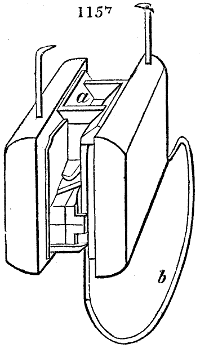
A matrix is a piece of brass or copper, about an inch and a half long, and thick in proportion to the size of the letter which it is to contain. In this metal the face of the letter intended to be cast is sunk, by striking it with the punch to a depth of about one eighth of an inch. The mould, fig. 1157., in which the types are cast, is composed of two parts. The outer part is made of wood, the inner of steel. At the top it has a hopper-mouth a, into which the fused type-metal is poured. The interior cavity is as uniform as if it had been hollowed out of a single piece of steel; because each half, which forms two of the four sides of the letter, is exactly fitted to the other. The matrix is placed at the bottom of the mould, directly under the centre of the orifice, and is held in its position by a spring b. Every letter that is cast can be loosened from the matrix only by removing the pressure on the spring.
A good type-foundry is always provided with several furnaces, each surmounted with an iron pot containing the melted alloy, of 3 parts of lead and 1 of antimony. Into this pot the founder dips the very small iron ladle, to lift merely as much metal as will cast a single letter at a time. Having poured in the metal with his right hand, and returned the ladle to the melting-pot, the founder throws up his left hand, which holds the mould, above his head, with a sudden jerk, supporting it with his right hand. It is this movement which forces the metal into all the interstices of the matrix; for without it, the metal, especially in the smaller moulds, would not be able to expel the air and reach the bottom. The pouring in the metal, the throwing up the mould, the unclosing it, removing the pressure of the spring, picking out the cast letter, closing the mould again, and re-applying the spring to be ready for a new operation, are all performed with such astonishing rapidity and precision, that a skilful workman will turn out 500 good letters in an hour, being at the rate of one every eighth part of a minute. A considerable piece of metal remains attached to the end of the type as it quits the mould. There are nicks upon the lower edge of the types, to enable the compositor to place them upright, without looking at them.
From the table of the caster, the heap of types turned out of his mould, is transferred from time to time to another table, by a boy, whose business it is to break off the superfluous metal, and that he does so rapidly as to clear from 2000 to 5000 types in an hour; a very remarkable dispatch, since he must seize them by their edges, and not by their feeble flat sides. From the breaking-off boy, the types are taken to the rubber, a man who sits in the centre of the workshop with a grit-stone slab on a table before him, and having on the fore and middle finger of his right hand a piece of tarred leather, passes each broad side of the type smartly over the stone, turning it in the movement, and that so dexterously, as to be able to rub 2000 types in an hour.
From the rubber, the types are conveyed to a boy, who, with equal rapidity sets them up in lines, in a long shallow frame, with their faces uppermost and nicks outwards. This frame, containing a full line, is put into the dresser’s hands, who polishes them on each side, and turning them with their faces downwards, cuts a groove or channel in their bottom, to make them stand steadily on end. It is essential that each letter be perfectly symmetrical and square; the least inequality of their length would prevent them from making a fair impression; and were there the least obliquity in their sides, it would be quite impossible, when 200,000 single letters are combined, as in one side of the Times newspaper, that they could hold together as they require to do, when wedged up in the chases, as securely as if that side of type form a solid plate of metal. Each letter is finally tied up in lines of convenient length, the proportionate numbers of each variety, small letters, points, large capitals, small capitals, and figures, being selected, when the fount of type is ready for delivery to the printer.
The sizes of types cast in this country vary, from the smallest, called diamond, of which 205 lines are contained in a foot length, to those letters employed in placards, of which a single letter may be 3 or 4 inches high. The names of the different letters and their dimensions, or the number of lines which each occupies in a foot, are stated in the following table:—
Double Pica 41 1⁄2
Paragon 44 1⁄2
Great Primer 51 1⁄4
English 64
Pica 71 1⁄2
Small Pica 83
Long Primer 89
Bourgeois 102 1⁄4
Brevier 112 1⁄2
Minion 128
Nonpareil 143
Pearl 178
Diamond 205
T. Aspinwall, Esq., the American consul, obtained, in May, 1828, a patent for an improved method of casting printing types by means of a mechanical process, being a communication from a foreigner residing abroad. The machine is described, with six explanatory figures, in the second series of Newton’s Journal, vol. v. page 212. The patentee does not claim, as his invention, any of the parts separately, but the general process and arrangement of machinery; more particularly the manner of suspending a swing table (upon which the working parts are mounted) out of the horizontal and perpendicular position; the mode of moving the table with the parts of the mould towards the melting-pot; the manner of bringing the parts of the mould together, and keeping them closed during the operation of casting the types. Several other mechanical schemes have been proposed for founding types, but I have been informed by very competent judges, Messrs. Clowes, that none of them can compete in practical utility with that dexterity and precision of handiwork, which I have often seen practised in their great printing establishment in Stamford-street.