C. (continued 6)
Reading edition
CLAY (Argile, Fr.; Thon, Germ.) is a mixture of the two simple earths, alumina and silica, generally tinged with iron. Lime, magnesia, with some other colouring metallic oxides, are occasionally present in small quantities in certain natural clays.
The different varieties of clay possess the following common characters:—
1. They are readily diffusible through water, and are capable of forming with it a plastic ductile mass, which may be kneaded by hand into any shape. This plasticity exists, however, in very different degrees in the different clays.
2. They concrete into a hard mass upon being dried, and assume, upon exposure to the heat of ignition, a degree of hardness sometimes so great as to give sparks by collision with hardened steel. In this state they are no longer plastic with water, even when pulverised. Tolerably pure clays, though infusible in the furnace, become readily so by the admixture of lime, iron, manganese, &c.
3. All clays, even when previously freed from moisture, shrink in the fire in virtue of the reciprocal affinity of their particles; they are very absorbent of water in their dry state, and adhere strongly to the tongue.
4. Ochrey, impure clays emit a disagreeable earthy smell when breathed upon.
Brongniart distributes the clays into:—
1. Fire-clays, (argiles apyres, Fr.; feuerfeste, Germ.)
2. Fusible, (schmelzbare, Germ.)
3. Effervescing (brausende, Germ.), from the presence of chalk.
4. Ochrey (ocreuses, Fr.; ockrige, Germ.)
Fire-clay is found in the greatest abundance and perfection for manufacturing purposes in,
1. Slate-clay. (Thon-schiefer, Germ.) Its colour is gray or grayish-yellow. Massive, dull, or glimmering from admixture of particles of mica. Fracture slaty, approaching sometimes to earthy. Fragments tabular. Soft, sectile, and easily broken. Sp. gr. = 2·6. Adheres to the tongue, and breaks down in water. It occurs along with pit coal; which see. Slate-clay is ground, and reduced into a paste with water, for making fire-bricks; for which purpose it should be as free as possible from lime and iron.
2. Common clay or loam.—This is an impure coarse pottery clay, mixed with iron ochre, and occasionally with mica. It has many of the external characters of plastic clay. It is soft to the touch, and forms, with water, a somewhat tenacious paste; but is in general less compact, more friable, than the plastic clays, which are more readily diffusible in water. It does not possess the property of acquiring in water that commencement of translucency which the purer clays exhibit. Although soft to the touch, the common clay wants unctuosity, properly so called. The best example of this argillaceous substance is afforded in the London clay formation, which consists chiefly of bluish or blackish clay, mostly very tough. Those of its strata which effervesce with acids partake of the nature of marl. This clay is fusible at a strong heat, in consequence of the iron and lime which it contains. It is employed in the manufacture of bricks, tiles, and coarse pottery ware.
3. Potter’s clay, or Plastic clay.—This species is compact, soft, or even unctuous to the touch, and polishes with the pressure of the finger; it forms, with water, a tenacious, very ductile, and somewhat translucent paste. It is infusible in a porcelain kiln, but assumes in it a great degree of hardness. Werner calls it pipe-clay. Good plastic clay remains white, or if gray before, becomes white in the porcelain kiln.
The geological position of the plastic clay is beneath the London clay, and above the sand which covers the chalk formation. The plastic clay of the Paris basin is described as consisting of two beds separated by a bed of sand. The lower bed is the proper plastic clay. The plastic clay of Abondant, near the forest of Dreux, analysed by Vauquelin, gave—
Silica, 43·5; alumina, 33·2; lime, 0·35; iron, 1; water, 18.
This clay is employed as a fire clay for making the bungs or seggars, or coarse earthenware cases, in which china ware is fired.
The plastic clay of Dorsetshire and Devonshire supplies the great Staffordshire potteries. It is gray coloured, less unctuous than that of Dreux, and consequently more friable. It becomes white in the pottery kiln, and is infusible at that heat. It causes no effervescence with nitric acid, but falls down quickly in it, and becomes higher coloured. Its refractoriness allows of a harder glaze being applied to the ware formed from it without risk of the heat requisite for making the glaze flow, affecting the biscuit either in shape or colour. “Most of the plastic clays of France,” says M. Brongniart, “employed for the same ware, have the disadvantage of reddening a little in a somewhat strong heat; and hence it becomes necessary to coat them with a soft glaze, fusible by means of excess of lead at a low heat, in order to preserve the white appearance of the biscuit. Such a glaze has a dull aspect, and cracks readily into innumerable fissures by alternations of hot and cold water.” Hence one reason of the vast inferiority of the French stone-ware to the English.
4. Porcelain clay or Kaolin earth.—The Kaolins possess very characteristic properties. They are friable in the hand, meagre to the touch, and difficultly form a paste with water. When freed from the coarse and evidently foreign particles interspersed through them, they are absolutely infusible in the porcelain kiln, and retain their white colour unaltered. They harden with heat like other clays, and perhaps in a greater degree; but they do not acquire an equal condensation or solidity, at least when they are perfectly pure. The Kaolins in general appear to consist of alumina and silica in nearly equal proportions. Most of the Kaolin clays contain some spangles of mica which betray their origin from disintegrated granite.
This origin may be regarded as one of their most distinctive features. Almost all the porcelain clays are evidently derived from the decomposition of the felspars, granites, and principally those rocks of felspar and quartz, called graphic granite. Hence, they are to be found only in primitive mountain districts, among banks or blocks of granite, forming thin seams or partings between them. In the same partings, quartz and mica occur, being relics of the granite; while some seams of Kaolin retain the external form of felspar.
The most valuable Kaolins have been found:—
In China and Japan. The specimens imported from these countries appear pretty white; but are more unctuous to the touch, and more micaceous than the porcelain clays of France.
In Saxony. The Kaolin employed in the porcelain manufactories of that country has a slight yellow or flesh colour, which disappears in the kiln, proving as Wallerius observed, that this tint is not owing to any metallic matter.
In France, at Saint-Yriex-la-Perche, about 10 leagues from Limoges. The Kaolin occurs there in a bed, or perhaps a vein of beds of granite, or rather of that felspar rock called Pe-tun-tse, which exists here in every stage of decomposition. This Kaolin is generally white, but sometimes a little yellowish with hardly any mica. It is meagre to the touch, and some beds include large grains of quartz, called pebbly by the China manufacturers. This variety, when ground, affords, without the addition of any fusible ingredient, a very transparent porcelain.
Near Bayonne. A Kaolin possessing the lamellated structure of felspar, in many places. The rock containing it is a graphic granite in every stage of decomposition.
In England, in the county of Cornwall. This Kaolin or China clay is very white, and more unctuous to the touch than those upon the continent of Europe mentioned above. Like them it results from the decomposition of the felspars and granites, occurring in the middle of these rocks. Mr. Wedgewood found it to contain 60 of alumina or pure clay, and 40 of silica, in 100 parts.
Pure clay, the alumina of the chemist, is absolutely infusible; but when subjected to the fire of a porcelain kiln, it contracts into about one half of its total bulk. It must, however, be heated very cautiously, otherwise it will decrepitate and fly in pieces, owing to the sudden expansion into steam of the water combined with its particles, which is retained with a considerable attractive force. It possesses little plasticity, and consequently affords a very short paste, which is apt to crack when kneaded into a cake.
It is not only infusible by itself, but it will not dissolve in the fusible glasses; making them merely opaque. If either lime or silica be added separately to pure clay, in any proportion, the mixture will not melt in the most violent furnace; but if alumina, lime, and silica be mixed together, the whole melts, and the more readily, the nearer the mixture approaches to the following proportions:—1 of alumina, 1 of lime, and 3 of sand. If the sand be increased to five parts, the compound becomes infusible. These interesting facts show the reciprocal action of those earths which are mixed most commonly in nature with alumina.
Iron in small quantity, but in a state not precisely determined, though probably of protoxide, does not colour the clays till they are subjected to a powerful heat. There are very white clays, such as those of Montereau, which do not become red till calcined in the porcelain kiln; the oxide of iron contained in them, which colours them in that case, was previously imperceptible. It appears from this circumstance, that the clays fit for making fine white stone ware, as also the Kaolins adapted to the manufacture of porcelain, are very rare.
Iron, in larger proportion, usually colours the clays green or slate-blue, before they have been heated. Such clays, exposed to the action of fire, become yellow or red according to the quantity of iron which they contain. When the iron is very abundant, it renders the clays fusible; but a little lime and silica must also be present for this effect. The earthenware made with these ferruginous clays, can bear but a moderate baking heat; it is thick, porous, and possesses the advantage merely of cheapness, and of bearing considerable alternations of temperature without breaking.
Alumina and the very aluminous natural clays which possess most plasticity, are apt to crack in drying, or to lose their shape. This very serious defect for the purposes of pottery is rectified, in some measure, by adding to that earth a certain quantity of sand or silica. Thus, a compound is formed which possesses less attraction for water, and dries more equably from the openness of its body. The principal causes of the distortion of earthenware vessels, are the unequal thickness of their parts, and quicker desiccation upon one side than another. Hard burnt stone-ware ground to powder, and incorporated with clay, answers still better than sand for counteracting the great and irregular contraction which natural pottery paste is apt to experience. Such ground biscuit is called cement; and its grains interspersed through the ware, may be regarded as so many solutions of continuity, which arrest the fissures.
The preceding observations point out the principles of those arts which employ clay for moulding by the wheel, and baking in a kiln. See Porcelain and Pottery.
CLOTH, MANUFACTURE OF. See Textile Fabrics, Weaving, Wool.
CLOTH-BINDING. Nothing places in so striking a point of view the superior taste, judgment, and resources of London tradesmen over those of the rest of the world, than the extensive substitution which they have recently made of embossed silks and calicoes for leather in the binding of books. In old libraries, cloth-covered boards indeed may occasionally be seen, but they have the meanest aspect, and are no more to be compared with our modern cloth-binding, than the jupon of a trull, with the ballet dress of Taglioni. The silk or calico may be dyed of any shade which use or fancy may require, impressed with gold or silver foil in every form, and variegated by ornaments in relief, copied from the most beautiful productions in nature. This new style of binding is distinguished not more for its durability, elegance, and variety, than for the economy and dispatch with which it ushers the offspring of intellect into the world. For example, should a house eminent in this line, such as that of Westleys, Friar-street, Doctors’-commons, receive 5000 volumes from Messrs. Longman & Co. upon Monday morning, they can have them all ready for publication, within the incredibly short period of two days; being far sooner than they could have rudely boarded them upon the former plan. The reduction of price is not the least advantage incident to the new method, amounting to fully 50 per cent. upon that with leather.
The dyed cloth being cut by a pattern to the size suited to the volume, is passed rapidly through a roller press, between engraved cylinders of hard steel, whereby it receives at once the impress characteristic of the back, and the sides, along with embossed designs over the surface in sharp relief. The cover thus rapidly fashioned, is as rapidly applied by paste to the stitched and pressed volume; no time being lost in mutual adjustments; since the steel rollers turn off the former, of a shape precisely adapted to the latter. Hard glazed and varnished calico is moreover much less an object of depredation to moths, and other insects, than ordinary leather has been found to be.
COBALT. This metal being difficult to reduce from its ores, is therefore very little known, and has not hitherto been employed in its simple state in any of the arts; but its oxide has been extensively used on account of the rich blue colour which it imparts to glass, and the glaze of porcelain and stone-ware. The principal ores of cobalt are those designated by mineralogists under the names of arsenical cobalt and gray cobalt. The first contains, in addition to cobalt, some arsenic, iron, nickel, and occasionally silver, &c. The other is a compound of cobalt with iron, arsenic, sulphur, and nickel. Among the gray cobalts, the ore most esteemed for its purity is that of Tunaberg in Sweden. It is often in regular crystals which possess the lustre and colour of polished steel. The specific gravity of cobalt pyrites is 6·36 to 4·66. The Tunaberg variety afforded to Klaproth, cobalt, 44; arsenic, 55·5; sulphur, 0·5: so that it is an arseniuret. Others, however, contain much sulphur as well as iron. It imparts at the blowpipe a blue colour to borax and other fluxes, and gives out arsenical fumes.
The ore being picked to separate its concomitant stony matters, is pounded fine and passed through a sieve; and is also occasionally washed. The powder is then spread on the sole of a reverberatory furnace, the flue of which leads into a long horizontal chimney. Here it is exposed to calcination for several hours, to expel the sulphur and arsenic that may be present; the former burning away in sulphurous acid gas, the latter being condensed into the white oxide or arsenious acid, whence chiefly the market is supplied with this article. This calcining process can never disengage the whole of these volatile ingredients, and there is therefore a point beyond which it is useless to push it; but the small quantities that remain are not injurious to the subsequent operations. The roasted ore is sifted anew; reduced to a very fine powder, and then mixed with 2 or 3 parts of very pure siliceous sand, to be converted into what is called zaffre. With this product glasses are generally coloured blue, as well as enamels and pottery glaze. In the works where cobalt ores are treated, a blue glass is prepared with the zaffre, which is well known under the name of smalt or azure blue. This azure is made by adding to the zaffre 2 or 3 parts of potash, according to its richness in cobalt, and melting the mixture in earthen crucibles. The fused mass is thrown out while hot into water; and is afterwards triturated and levigated in mills mounted for the purpose. There remains at the bottom of the earthen pot a metallic lump, which contains a little cobalt, much nickel, arsenic, iron, &c. This is called speiss.
As it is the oxide of cobalt which has the colouring quality, the calcination serves the purpose of oxidizement, as well as of expelling the foreign matters.
A finer cobalt-oxide is procured for painting upon hard porcelain, by boiling the cobalt ore in nitric acid, which converts the arsenic into an acid, and combines it with the different metals present in the mineral. These arseniates being unequally soluble in nitric acid, may be separated in succession by a cautious addition of carbonate of soda or potash; and the arseniate of cobalt as the most soluble remains unaffected. It has a rose colour; and is easily distinguishable, whence the precipitation may be stopped at the proper point. The above solution should be much diluted, and the alkali should be cautiously added with frequent agitation.
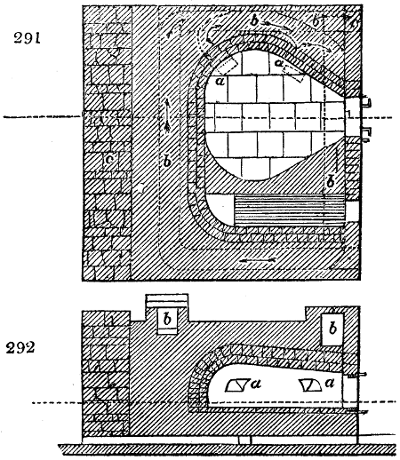
The cobalt ores, rich in nickel, are exposed to slow oxidizement in the air, whereby the iron, cobalt, arsenic, and sulphur get oxygenated by the atmospheric moisture, but the nickel continues in the metallic state. This action of the weather must not be extended beyond a year, otherwise the nickel becomes affected, and injures the cobalt blue. The ore hereby increases in weight, from 8 to 10 per cent. Fig. 291. is a longitudinal section of the furnace: fig. 292., a horizontal section upon a level with the sole of the hearth. It is constructed for wood fuel, and the hearth is composed of fire-bricks or tiles. The vapours and gases disengaged in the roasting, pass off through the flues a a, into the channels b b, and thence by c into the common vent, or poison chamber. See the representation of the poison tower of Altenberg, under the article Arsenic. The flues are cleared out by means of openings left at suitable situations in the brick-work of the chimneys.
The azure manufacture is carried on chiefly in winter, in order that the external cold may favour the more complete condensation of the acids of arsenic. From 3 to 5 cwt. of Schlich (pasty ore), are roasted at one operation, and its bed is laid from 5 to 6 inches thick. After two hours, it must be turned over; and the stirring must be repeated every half hour, till no more arsenic is observed to exhale. The process being then finished, the ore must be raked out of the furnace, and another charge introduced.
The duration of the roasting is regulated partly by the proportion of sulphur and arsenic present, and partly by the amount of nickel; which must not be suffered to become oxidized, lest it should spoil the colour of the smalt. The latter ores should be but slightly roasted, so as to convert the nickel into speiss. The roasted ore must be sifted in a safety apparatus. The loss of weight in the roasting amounts, upon the average, to 36 per cent. The roasted ore has a brownish gray hue, and is called safflor in German, and is distributed into different sorts. F F S is the finest safre; F S, fine; O S, ordinary; and M S, middling. These varieties proceed from various mixtures of the calcined ores. The roasted ore is ground up along with sand, elatriated, and, when dry, is called zaffre. It is then mixed with a sufficient quantity of potash for converting the mixture into a glass.
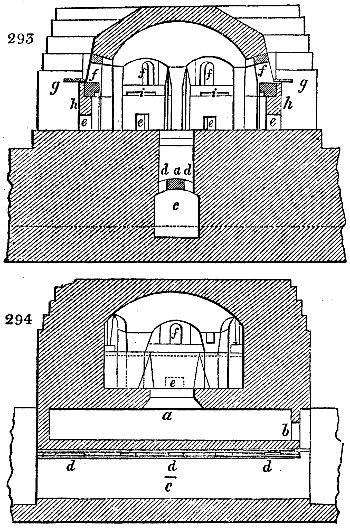
Figs. 293. and 294. represent a round smalt furnace, in two vertical sections, at right angles to each other. The fire-place is vaulted or arched; the flame orifice a, is in the middle of the furnace; b is the feed hole; c, a tunnel which serves as an ash-pit, and to supply air; d, openings through which the air arrives at the fuel, the wood being placed upon the vault; e, knee holes for taking out the scoriæ from the pot bottoms; f, working orifices, with cast-iron plates g, in front of them. Under these are the additional outlets h. The smoke and flame pass off through the orifices i, which terminate in expanded flues, where the sand may be calcined or the wood may be baked. Eight hours are sufficient for one vitrifying operation, during which the glass is stirred about several times in the earthen melting pots.
The preparation of the different shades of blue glass are considered as secrets in the smelting works; and marked with the following letters:—F F F C, the finest; F C, fine; M C, middling; O C, ordinary. A melting furnace, containing 8 pots of glass; produces in 24 hours, from 24 cwts. of the mixture, 19 cwts. of blue glass; and from 1⁄2 to 3⁄4 cwt. of scoriæ or speiss (speise). The composition speise, according to Berthier, is,—nickel, 49·0; arsenic, 37·8; sulphur, 7·8; copper, 1·6; cobalt, 3·2 in 100. Nickel, arsenic, and sulphur, are its essential constituents; the rest are accidental, and often absent. The freer the cobalt ore is from foreign metals, the finer is the colour, and the deeper is the shade; paler tints are easily obtained by dilution with more glass. The presence of nickel gives a violet tone.
The production of smalt in the Prussian states amounted, in 1830, to 74521⁄2 cwts.; and, in Saxony, to 9697 cwts.; in 1825, to 12,310 cwts.
One process for making fine smalt has been given under the title Azure; I shall introduce another somewhat different here.
The ore of cobalt is to be reduced to very fine powder, and then roasted with much care. One part, by weight, is next to be introduced, in successive small portions, into an iron vessel, in which three parts of acid sulphate of potassa has been previously fused, at a moderate temperature. The mixture, at first fluid, soon becomes thick and firm, when the fire is to be increased, until the mass is in perfect fusion, and all white vapours have ceased. It is then to be taken out of the crucible with an iron ladle, the crucible is to be recharged with acid sulphate of potash, and the operation continued as before, until the vessel is useless. The fused mass contains sulphate of cobalt, neutral sulphate of potassa, and arseniate of iron, with a little cobalt. It is to be pulverized, and boiled in an iron vessel, with water, as long as the powder continues rough to the touch. The white, or yellowish white residue, may be allowed to separate from the solution, either by deposition or filtration. Carbonate of potassa, free from silica, is then to be added to the solution, and the carbonate of cobalt thrown down is to be separated and well washed, if possible, with warm water; the same water may be used to wash other portions of the fused mass. The filtered liquid which first passes, is a saturated solution of sulphate of potassa: being evaporated to dryness in an iron vessel, it may be reconverted into acid sulphate by fusing it with one half its weight of sulphuric acid: this salt is then as useful as at first.
The oxide of cobalt thus obtained, contains no nickel; so little oxide of iron is present, that infusion of galls does not show its presence; it may contain a little copper, if that metal exists in the ore, but it is easily separated by the known methods. Sometimes sulphuretted hydrogen will produce a yellow brown precipitate in the solution of the fused mass; this, however, contains no arsenic, but is either sulphuret of antimony or bismuth, or a mixture of both.
It has been found advantageous to add to the fused mass, sulphate of iron, calcined to redness, and one tenth of nitre when the residue is arseniate of iron, and contains no arseniate of cobalt. There is then no occasion to act upon the residue a second time for the cobalt in it.
This process is founded on the circumstances that the sulphate of cobalt is not decomposed by a red heat, and that the arseniates of iron and cobalt are insoluble in all neutral liquids. It is quite evident that to obtain a perfect result, the excess of acid in the bisulphate of potassa must be completely driven off by the red heat applied.
110,646 lbs. of smalts were imported into the United Kingdom in 1835, and 96,949 were retained for home consumption. In 1834, only 16,223 lbs. were retained.
In 1835, 322,562 lbs. of zaffres were imported, and 336,824 are stated to have been retained, which is obviously an error. 284,000 lbs. were retained in 1834.
COCCULUS INDICUS, or Indian berry, is the fruit of the Menispermum Cocculus, a large tree, which grows upon the coasts of Malabar, Ceylon, &c. The fruit is blackish, and of the size of a large pea. It owes its narcotic and poisonous qualities to the vegeto-alkaline chemical principle called picrotoxia, of which it contains about one-fiftieth part of its weight. It is sometimes thrown into waters to intoxicate or kill fishes; and it is said to have been employed to increase the inebriating qualities of ale or beer. Its use for this purpose is prohibited by act of parliament, under a penalty of 200l. upon the brewer, and 500l. upon the seller of the drug.
COCHINEAL was taken in Europe at first for a seed, but was proved by the observations of Lewenhoeck to be an insect, being the female of that species of shield-louse, or coccus, discovered in Mexico, so long ago as 1518. It is brought to us from Mexico, where the animal lives upon the cactus opuntia or nopal. Two sorts of cochineal are gathered—the wild, from the woods, called by the Spanish name grana silvestra; and the cultivated, or the grana fina, termed also mesteque, from the name of a Mexican province. The first is smaller, and covered with a cottony down, which increases its bulk with a matter useless in dyeing; it yields, therefore, in equal weight, much less colour, and is of inferior price to that of the fine cochineal. But these disadvantages are compensated in some measure to the growers by its being reared more easily, and less expensively; partly by the effect of its down, which enables it better to resist rains and storms.
The wild cochineal, when it is bred upon the field nopal, loses in part the tenacity and quantity of its cotton, and acquires a size double of what it has on the wild opuntias. It may therefore be hoped, that it will be improved by persevering care in the rearing of it, when it will approach more and more to fine cochineal.
The fine cochineal, when well dried and well preserved, should have a gray colour, bordering on purple. The gray is owing to the powder, which naturally covers it, and of which a little adheres; as also to a waxy fat. The purple shade arises from the colour extracted by the water in which they were killed. It is wrinkled with parallel furrows across its back, which are intersected in the middle by a longitudinal one; hence, when viewed by a magnifier, or even a sharp naked eye, especially after being swollen by soaking for a little in water, it is easily distinguished from the factitious, smooth, glistening, black grains, of no value, called East India cochineal, with which it is often shamefully adulterated by certain London merchants. The genuine cochineal has the shape of an egg, bisected through its long axis, or of a tortoise, being rounded like a shield upon the back, flat upon the belly, and without wings.
These female insects are gathered off the leaves of the nopal plant, after it has ripened its fruit, a few only being left for brood, and are killed, either by a momentary immersion in boiling water, by drying upon heated plates, or in ovens: the last become of an ash-gray colour, constituting the silver cochineal, or jaspeada; the second are blackish, called negra, and are most esteemed, being probably driest; the first are reddish brown, and reckoned inferior to the other two. The dry cochineal being sifted, the dust, with the imperfect insects and fragments which pass through, are sold under the name of granillo.
Cochineal keeps for a long time in a dry place. Hellot says that he has tried some 130 years old, which produced the same effect as new cochineal.
We are indebted to MM. Pelletier and Caventou for a chemical investigation of cochineal, in which its colouring matter was skilfully eliminated.
Purified sulphuric ether acquired by digestion with it a golden yellow colour, amounting by Dr. John to one tenth of the weight of the insect. This infusion left, on evaporation, a fatty wax of the same colour.
Cochineal, exhausted by ether, was treated with alcohol at 40° B. After 30 infusions in the digester of M. Chevreul, the cochineal continued to retain colour, although the alcohol had ceased to have any effect on it. The first alcoholic liquors were of a red verging on yellow. On cooling, they let fall a granular matter. By spontaneous evaporation, this matter, of a fine red colour, separated, assuming more of the crystalline appearance. These species of crystals dissolved entirely in water, which they tinged of a yellowish-red.
This matter has a very brilliant purple-red colour; it adheres strongly to the sides of the vessels; it has a granular and somewhat crystalline aspect, very different, however, from those compound crystals alluded to above; it is not altered by the air, nor does it sensibly attract moisture. Exposed to the action of heat, it melts at about the fiftieth degree centigrade (122° Fahr.). At a higher temperature it swells up, and is decomposed with the production of carburetted hydrogen, much oil, and a small quantity of water, very slightly acidulous. No trace of ammonia was found in these products.
The colouring principle of cochineal is very soluble in water. By evaporation, the liquid assumes the appearance of syrup, but never yields crystals. It requires of this matter a portion almost imponderable to give a perceptible tinge of bright purplish red to a large body of water. Alcohol dissolves this colouring substance, but, as we have already stated, the more highly it is rectified the less of it does it dissolve. Sulphuric ether does not dissolve the colouring principle of cochineal; but weak acids do, possibly owing to their water of dilution. No acid precipitates it in its pure state. This colouring principle, however, appears to be precipitable by all the acids, when it is accompanied by the animal matter of the cochineal.
The affinity of alumina for the colouring matter is very remarkable. When that earth, newly precipitated, is put into a watery solution of the colouring principle, this is immediately seized by the alumina. The water becomes colourless, and a fine red lake is obtained, if we operate at the temperature of the atmosphere; but if the liquor has been hot, the colour passes to crimson, and the shade becomes more and more violet, according to the elevation of the temperature, and the continuance of the ebullition.
The salts of tin exercise upon the colouring matter of cochineal a remarkable action. The muriatic protoxide of tin forms a very abundant violet precipitate in the liquid. This precipitate verges on crimson, if the salt contains an excess of acid. The muriatic deutoxide of tin produces no precipitate, but changes the colour to scarlet-red. If gelatinous alumina be now added, we obtain a fine red precipitate, which does not pass to crimson by boiling.
To this colouring principle the name carminium has been given, because it forms the basis of the pigment called carmine.
The process followed in Germany for making carmine, which consists in pouring a certain quantity of solution of alum into a decoction of cochineal, is the most simple of all, and affords an explanation of the formation of carmine, which is merely the carminium and the animal matter precipitated by the excess of acid in the salt, which has taken down with it a small quantity of alumina; though it appears that alumina ought not to be regarded as essential to the formation of carmine. In fact, by another process, called by the name of Madame Cenette of Amsterdam, the carmine is thrown down, by pouring into the decoction of cochineal a certain quantity of the binoxalate of potash. When carbonate of soda is added, then carminated lake also falls down. That carmine is a triple compound of animal matter, carminium, and an acid appears from the circumstance, that liquors which have afforded their carmine, when a somewhat strong acid is poured into them, yield a new formation of carmine by the precipitation of the last portions of the animal matter. But whenever the whole animal matter is thrown down, the decoctions, although still much charged with the colouring principle, can afford no more carmine. Such decoctions may be usefully employed to make carminated lakes, saturating the acid with a slight excess of alkali, and adding gelatinous alumina. The precipitates obtained, on adding acids to the alkaline decoctions of cochineal, are therefore true carmines, since they do not contain alumina; but the small quantity of alumina which is thrown down by alum in the manufacture of carmine, augments its bulk and weight. It gives, besides, a greater lustre to the colour, even though diluting and weakening it a little.
The carmines found in the shops of Paris were analysed, and yielded the same products. They are decomposed by the action of heat, with the diffusion at first of a very strong smell of burning animal matter, and then of sulphur. A white powder remained, amounting to about one-tenth of the matter employed, and which was found to be alumina. Other quantities of carmine were treated with a solution of caustic potash, which completely dissolved them, with the exception of a beautiful red powder, not acted on by potash and concentrated acids, and which was recognized to be red sulphuret of mercury or vermillion. This matter, evidently foreign to the carmine, appears to have been added, in order to increase its weight.
The preceding observations and experiments seem calculated to throw some light on the art of dyeing scarlet and crimson. The former is effected by employing a cochineal bath, to which there have been added, in determinate proportions, acidulous tartrate of potash, and nitro-muriatic deutoxide of tin. The effect of these two salts is now well known. The former, in consequence of its excess of acid, tends to redden the colour, and to precipitate it along with the animal matter: the latter acts in the same manner, at first by its excess of acid, then by the oxide of tin which falls down also with the carmine and animal matter, and is fixed on the wool, with which it has of itself a strong tendency to combine. MM. Pelletier and Caventou remark, that “to obtain a beautiful shade, the muriate of tin ought to be entirely at the maximum of oxidizement; and it is in reality in this state that it must exist in the solution of tin prepared according to the proportions prescribed in M. Berthollet’s treatise on dyeing.”
We hence see why, in dyeing scarlet, the employment of alum is carefully avoided, as this salt tends to convert the shade to a crimson. The presence of an alkali would seem less to be feared. The alkali would occasion, no doubt, a crimson-coloured bath; but it would be easy in this case to restore the colour, by using a large quantity of tartar. We should, therefore, procure the advantage of having a bath better charged with colouring matter and animal substance. It is for experience on the large scale to determine this point. As to the earthy salts, they must be carefully avoided; and if the waters be selenitish, it would be a reason for adding a little alkali.
To obtain crimson, it is sufficient, as we know, to add alum to the cochineal bath, or to boil the scarlet cloth in alum water. It is also proper to diminish the dose of the salt of tin, since it is found to counteract the action of the alum.
The alkalies ought to be rejected as a means of changing scarlet to crimson. In fact, crimsons by this process cannot be permanent colours, as they pass into reds by the action of acids.
According to M. Von Grotthuss, carmine may be deprived of its golden shade by ammonia, and subsequent treatment with acetic acid and alcohol. Since this fact was made known, M. Herschel, colour maker at Halle, has prepared a most beautiful carmine.
The officers of Her Majesty’s Customs have lately detected a system of adulterating cochineal, which has been practised for many years upon a prodigious scale by a mercantile house in London. I have analyzed about 100 samples of such cochineal, from which it appears that the genuine article is moistened with gum-water, agitated in a box or leather bag, first, with sulphate of baryta in fine powder, afterwards with bone or ivory black, to give it the appearance of negra cochineal, and then dried. By this means about 12 per cent. of the worthless heavy spar is sold at the price of cochineal, to the enrichment of the sophisticators, and the disgrace and injury of British trade and manufactures.
The specific gravity of genuine cochineal is 1·25; that of the cochineal loaded with the barytic sulphate 1·35. It was taken in oil of turpentine and reduced to water as unity, because the waxy fat of the insects prevents the intimate contact of the latter liquid with them, and the ready expulsion of air from their wrinkled surface. They are not at all acted upon by the oil, but are rapidly altered by water, especially when they have been gummed and barytified.
The quantities of cochineal imported into the United Kingdom in the following years, were:—
1827. 1828. 1829. 1830. 1831. 1832. 1833. 1834. 1835.
Libs. 320,722 258,032 288,456 316,589 244,371 388,478 359,381 410,387 418,320
The quantities re-exported were:—
Libs. 145,756 158,109 153,738 100,059 168,329 138,270 130,732 265,490 352,023
Humboldt states that so long ago as the year 1736, there was imported into Europe from South America cochineal to the value of 15 millions of francs. Its high price had for a long time induced dyers to look out for cheaper substitutes in dyeing red, and since science has introduced so many improvements in tinctorial processes, both madder and lac have been made to supersede cochineal to a very great extent. Its price has, in consequence of this substitution, as well as from more successful modes of cultivation, fallen very greatly of late years. At present it is only 7s. per lib. in London. See Scarlet Dyeing.
COCOA, STEARINE, AND ELAINE. Mr. Soames obtained a patent in September 1829, for making these useful articles, by the following process:
He takes the substance called cocoa-nut oil, in the state of lard, in which it is imported into this country, and submits it to a strong hydraulic pressure, having made it up in small packages, 3 or 4 inches wide, 2 feet long, and 1 or 11⁄2 inches thick. These packages are formed by first wrapping up the said substance in a strong linen cloth, of close texture, and then in an outward wrapper of strong sail cloth. The packages are to be placed side by side, in single rows, between the plates of the press, allowing a small space between the packages for the escape of the elaine.
The temperature at which the pressure is begun, should be from about 50 to 55 degrees, or in summer as nearly at this pitch as can be obtained, and the packages of the said substance intended for pressure, should be exposed for several hours previously to about the same temperature. When the packages will no longer yield their oil or elaine freely at this temperature, it is to be gradually raised; but it must at no time exceed 65 degrees, and the lower the temperature at which the separation can be effected, the better will be the quality of the oil expressed.
When the packages are sufficiently pressed, that is, when they will give out no more oil, or yield it only in drops at long intervals, the residuum in them is to be taken out and cleansed and purified, which is done by melting it in a well-tinned copper vessel, which is fixed in an outer vessel, having a vacant space between, closed at the top, into which steam is admitted, and the heat is kept up moderately for a sufficient time to allow the impurities to subside; but if a still higher degree of purity is required, it is necessary to pass it through filters of thick flannel lined with blotting paper.
Having been thus cleansed or purified, it is fit for the manufacture of candles, which are made by the ordinary process used in making mould tallow candles. Having thus disposed of the stearine, or what is called the first product, he proceeds with the elaine or oil expressed from it, and which he calls the second product, as follows: that is to say, he purifies it by an admixture, according to the degree of its apparent foulness, of from 1 to 2 per cent. by weight of the sulphuric acid of commerce, of about 1·80 specific gravity, diluted with six times its weight of water. The whole is then to be violently agitated by mechanical means, and he prefers for this purpose the use of a vessel constructed on the principle of a common barrel churn. When sufficiently agitated, it will have a dirty whitish appearance, and is then to be drawn off into another vessel, in which it is to be allowed to settle, and any scum that rises is to be carefully taken off. In a day or two the impurities will be deposited at the bottom of the oil, which will then become clear, or nearly so, and it is to be filtered through a thick woollen cloth, after which it will be fit for burning in ordinary lamps and for other uses.
The process of separating the elaine from the stearine, by pressure, in manner aforesaid, had never before been applied to the substance called cocoa-nut oil, and consequently no product had heretofore been obtained thereby from that substance, fit for being manufactured into candles in the ordinary way, or for being refined by any of the usual modes, so as to burn in ordinary lamps, both which objects are obtained by this method of preparing or manufacturing the said substance.
Candles well made from the above material are a very superior article. The light produced is more brilliant than from the same sized candle made of tallow; the flame is perfectly colourless, and the wick remains free from cinder, or any degree of foulness during combustion.
COFFEE. The coffee is the seed of a tree of the family rubiaceæ, and belongs to the Pentandria monogynia of Linnæus. There are several species of the genus, but the only one cultivated is the Coffæa Arabica, a native of Upper Ethiopia and Arabia Felix. It rises to the height of 15 or 20 feet; its trunk sends forth opposite branches in pairs above and at right angles to each other; the leaves resemble those of the common laurel, although not so dry and thick. From the angle of the leaf-stalks small groups of white flowers issue, which are like those of the Spanish jasmine. These flowers fade very soon, and are replaced by a kind of fruit not unlike a cherry, which contains a yellow glairy fluid, enveloping two small seeds or berries convex upon one side, flat and furrowed upon the other in the direction of the long axis. These seeds are of a horny or cartilaginous nature; they are glued together, each being surrounded with a peculiar coriaceous membrane. They constitute the coffee of commerce.
It was not till towards the end of the 15th century that the coffee tree began to be cultivated in Arabia. Historians usually ascribe the discovery of the use of coffee as a beverage to the superior of a monastery there, who, desirous of preventing the monks from sleeping at their nocturnal services, made them drink the infusion of coffee upon the report of shepherds, who pretended that their flocks were more lively after browsing on the fruit of that plant. The use of coffee was soon rapidly spread, but it encountered much opposition on the part of the Turkish government, and became the occasion of public assemblies. Under the reign of Amurath III. the mufti procured a law to shut all the coffee-houses, and this act of suppression was renewed under the minority of Mahomet IV. It was not till 1554 under Solyman the Great that the drinking of coffee was accredited in Constantinople; and a century elapsed before it was known in London and Paris. Solyman Aga introduced its use into the latter city in 1669, and in 1672 an Armenian established the first café at the fair of Saint Germain.
When coffee became somewhat of a necessary of life from the influence of habit among the people, all the European powers who had colonies between the tropics, projected to form plantations of coffee trees in them. The Dutch were the first who transported the coffee plant from Moka to Batavia, and from Batavia to Amsterdam. In 1714 the magistrates of that city sent a root to Louis XIV. which he caused to be planted in the Jardin du Roi. This became the parent stock of all the French coffee plantations in Martinique.
The most extensive culture of coffee is still in Arabia Felix, and principally in the kingdom of Yemen, towards the cantons of Aden and Moka. Although these countries are very hot in the plains, they possess mountains where the air is mild. The coffee is generally grown halfway up on their slopes. When cultivated on the lower grounds it is always surrounded by large trees which shelter it from the torrid sun, and prevent its fruit from withering before their maturity. The harvest is gathered at three periods, the most considerable occurs in May, when the reapers begin by spreading cloths under the trees, then shaking the branches strongly, so as to make the fruit drop, which they collect, and expose upon mats to dry. They then pass over the dried berries a very heavy roller, to break the envelopes, which are afterwards winnowed away with a fan. The interior bean is again dried before being laid up in store.
In Demerara, Berbice, and some of our West India islands, where much good coffee is now raised, a different mode of treating the pulpy fruit and curing the beans is adopted. When the cherry-looking berry has assumed a deep-red colour it is gathered, and immediately subjected to the operations of a mill composed of two wooden rollers, furnished with iron plates, which revolve near a third fixed roller called the chops. The berries are fed into a hopper above the rollers, and falling down between them and the chops, they are stripped of their outer skins and pulp, while the twin beans are separated from each other. These beans then fall upon a sieve, which allows the skin and the pulp to pass through, while the hard beans accumulate and are progressively slid over the edge into baskets. They are next steeped for a night in water, thoroughly washed in the morning, and afterwards dried in the sun. They are now ready for the peeling mill, a wooden edge wheel turned vertically by a horse yoked to the extremity of its horizontal axis. In travelling over the coffee, it bursts and detaches the coriaceous or parchment-like skin which surrounds each hemispherical bean. It is then freed from the membranes by a winnowing machine, in which four pieces of tin made fast to an axle are caused to revolve with great velocity. Corn fanners would answer better than this rude instrument of negro invention. The coffee is finally spread upon mats or tables, picked clean, and packed up for shipment.
The most highly esteemed coffee is that of Moka. It has a smaller and a rounder bean; a more agreeable taste and smell than any other. Its colour is yellow. Next to it in European reputation is the Martinique and Bourbon coffees; the former is larger than the Arabian and more oblong; it is rounded at the ends; its colour is greenish, and it preserves almost always a silver gray pellicle, which comes off in the roasting. The Bourbon coffee approaches nearest to the Moka from which it originally sprung. The Saint Domingo coffee has its two extremities pointed, and is much less esteemed than the preceding.
The coffee tree flourishes in hilly districts where its root can be kept dry, while its leaves are refreshed with frequent showers. Rocky ground, with rich decomposed mould in the fissures, agrees best with it. Though it would grow, as we have said, to the height of 15 or 20 feet, yet it is usually kept down by pruning to that of five feet for increasing the production of the fruit, as well as for the convenience of cropping. It begins to yield fruit the third year, but is not in full bearing till the fifth, does not thrive beyond the twenty-fifth, and is useless in general at the thirtieth. In the coffee husbandry, the plants should be placed eight feet apart, as the trees throw out extensive horizontal branches, and in holes ten or twelve feet deep to secure a constant supply of moisture.
Coffee has been analysed by a great many chemists, with considerable diversity of results. The best analysis perhaps is that of Schrader. He found that the raw beans distilled with water in a retort communicated to it their flavour and rendered it turbid, whence they seem to contain some volatile oil. On reboiling the beans, filtering, and evaporating the liquor to a syrup, adding a little alcohol till no more matter was precipitated, and then evaporating to dryness, he obtained 17·58 per cent. of a yellowish-brown transparent extract, which constitutes the characteristic part of coffee, though it is not in that state the pure proximate principle, called cafeine. Its most remarkable reaction is its producing, with both the protoxide and the peroxide salts of iron, a fine grass green colour, while a dark green precipitate falls, which re-dissolves when an acid is poured into the liquor. It produces on the solution of the salts of copper scarcely any effect, till an alkali be added, when a very beautiful green colour is produced which may be employed in painting. Coffee beans contain also a resin, and a fatty substance somewhat like suet. According to Robiquet, ether extracts from coffee beans nearly 10 per cent. of resin and fat, but he probably exaggerates the amount. The peculiar substance cafeine contained in the above extract is crystallizable. It is remarkable in regard to composition, that after urea and the uric acid, it is among organic products the richest in azote. It was discovered and described in 1820 by Runge. It does not possess alkaline properties. Pfaff obtained only 90 grains of cafeine from six pounds of coffee beans. There is also an acid in raw coffee to which the name of cafeic acid has been given. When distilled to dryness and decomposed, it has the smell of roasted coffee.
Coffee undergoes important changes in the process of roasting. When it is roasted to a yellowish brown it loses, according to Cadet, 121⁄2 per cent. of its weight, and is in this state difficult to grind. When roasted to a chestnut brown it loses 18 per cent., and when it becomes entirely black, though not at all carbonised, it has lost 23 per cent. Schrader has analyzed roasted coffee comparatively with raw coffee, and he found in the first 121⁄2 per cent. of an extract of coffee, soluble in water and alcohol, which possesses nearly the properties of the extract of the raw coffee, although it has a deeper brown colour, and softens more readily in the air. He found also 10·4 of a blackish brown gum; 5·7 of an oxygenated extract or rather apothème soluble in alcohol, insoluble in water; 2 of a fatty substance and resin; 69 of burnt vegetable fibre, insoluble. On distilling roasted coffee with water, Schrader obtained a product which contained the aromatic principle of coffee; it reddened litmus paper, and exhaled a strong and agreeable odour of roasted coffee. If we roast coffee in a retort, the first portions of the aromatic principle of coffee condense into a yellow liquid in the receiver; and these may be added to the coffee roasted in the common way, from which this matter has been expelled and dissipated in the air.
Chenevix affirmed that by the roasting of coffee a certain quantity of tannin possessing the property of precipitating gelatine is generated. Cadet made the same observation, and found, moreover, that the tannin was most abundant in the lightly roasted coffee, and that there was nearly none of it in coffee highly roasted. Payssé and Schrader, on the contrary, state that solution of gelatine does not precipitate either the decoction of roasted coffee or the alcoholic extract of this coffee. Runge likewise asserts that he could obtain no precipitate with gelatine; but he says that albumen precipitates from the decoction of roasted coffee the same kind of tannin as is precipitated from raw coffee by the acetate of lead, and set free from the lead by sulphuretted hydrogen. With these results my own experiments agree. Gelatine certainly does not disturb clear infusion of roasted coffee, but the salts of iron blacken it.
Schrader endeavoured to roast separately the different principles of coffee, but none of them exhaled the aromatic odour of roasted coffee except the horny fibrous matter. He therefore concludes that this substance contributes mainly to the characteristic taste of roasted coffee, which cannot be imitated by any other vegetable matter, and which, as we have seen, should be ascribed chiefly to the altered cafeic acid. According to Garot we may extract the cafeine without alteration from roasted coffee by precipitating its decoction by subacetate of lead, treating the washed precipitate with sulphuretted hydrogen, and evaporating the liquid product to dryness.
Of late years, much ingenuity has been expended in contriving various forms of apparatus for making infusions of coffee for the table. I have tried most of them, and find, after all, none so good as a cafetière à la Belloy, the coffee biggin, with the perforated tin plate strainer, especially when the filtered liquor is kept simmering in a close vessel, set over a lamp or steam pan. The useful and agreeable matter in coffee is very soluble: it comes off with the first waters of infusion, and needs no boiling.
To roast coffee rightly we should keep in view the proper objects of this process, which are to develop its aroma, and destroy its toughness, so that it may be readily ground to powder. Too much heat destroys those principles which we should wish to preserve, and substitutes new ones which have nothing in common with the first, but add a disagreeable empyreumatic taste and smell. If, on the other hand, the rawness or greenness is not removed by an adequate heat, it masks the flavour of the bean, and injures the beverage made with it. When well roasted in the sheet iron cylinders set to revolve over a fire, it should have a uniform chocolate colour, a point readily hit by experienced roasters, who now manage the business very well for the principal coffee dealers both of London and Paris, so far as my judgment can determine. The development of the proper aroma is a criterion by which coffee roasters frequently regulate their operations. When it loses more than 20 per cent. of its weight, coffee is sure to be injured. It should never be ground till immediately before infusion.
COKE, is carbonized pitcoal. See Charcoal; and Pitcoal at the end.
COLCOTHAR OF VITRIOL, (Rouge d’Angleterre, Fr.; Rothes Eisenoxyd, Germ.) is the brown-red peroxide of iron, produced by calcining sulphate of iron with a strong heat, levigating the resulting mass, and elutriating it into an impalpable powder. A better way of making it so as to complete the separation of the acid, is to mix 100 parts of the green sulphate of iron with 42 of common salt, to calcine the mixture, wash away the resulting sulphate of soda, and levigate the residuum. The sulphuric acid in this case expels the chlorine of the salt in the form of muriatic acid gas, and saturates its alkaline base produced by the chemical reaction; whence an oxide will be obtained free from acid, much superior to what is commonly found in the shops. The best sort of polishing powder called jewellers’ red rouge or plate powder is the precipitated oxide of iron prepared by adding solution of soda to solution of copperas, washing, drying, and calcining the powder in shallow vessels with a gentle heat, till it assumes a deep brown red colour. See Iron.
COLOPHANY, black rosin, the solid residuum of the distillation of turpentine, when all the oil has been worked off.
COLOURING MATTER. (Matière colorante, Fr.; Farbstoff, Germ.) See Dyeing, the several dye-stuffs and pigments.
COLUMBIUM, a peculiar metal extracted from a rare mineral brought from Haddam in Connecticut. It is also called Tantalium from the mineral tantalite and yttrotantalite, found in Sweden. It has hitherto no application to the arts. It combines with two successive doses of oxygen; by the second it becomes an acid.
COLZA, is a variety of cabbage, the brassica oleracea, whose seeds afford, by pressure, an oil much employed in France and Belgium for burning in lamps, and for many other purposes. This plant requires a rich but light soil; it does not succeed upon either sandy or clayey lands. The ground for it must be deeply ploughed and well dunged. It should be sown in July, and be afterwards replanted in a richly manured field. In October it is to be planted out in beds, 15 or 18 inches apart. Colza may also be sowed in furrows 8 or 10 inches asunder.
Land which has been just cropped for wheat is that usually destined to colza; it may be fresh dunged with advantage. The harvest takes place in July, with the sickle, a little before the seeds are completely ripe, lest they should drop off. As the seed is productive of oil, however, only in proportion to its ripeness, the cut plants are allowed to complete their maturation, by laying them in heaps under airy sheds, or placing them in a stack, and thatching it with straw.
The cabbage stalks are thrashed with flails, the seeds are winnowed, sifted, spread out in the air to dry; then packed away in sacks, in order to be subjected to the oil mill at the beginning of winter. The oil-cake is a very agreeable food to cattle, and serves to fatten them. It is reckoned to defray the cost of the mill.
Colza impoverishes the soil very much, as do, indeed, all the plants cultivated for the sake of their oleaginous seeds. It must not, therefore, be come back upon again for six years, if fine crops be desired. The double ploughing which it requires, effectually cleans the ground. See Oils, Unctuous.
COMB, the name of an instrument made of a thin plate either plane or curved of wood, horn, tortoise-shell, ivory, bone, or metal, cut out upon one or both of its sides or edges, into a series of somewhat long teeth, not far apart; which is employed for disentangling, laying parallel and smooth the hairs of man, horses, or other animals.
A thin steel saw bow, mounted in an iron or wooden handle, is the implement used by the comb-maker to cut the bone, ivory, and wood into slices of from a twelfth to a quarter of an inch thick, and of a size suitable to that of the comb. The pieces of tortoise-shell as found in commerce are never flat, or, indeed, of any regular curvature, such as the comb must have. They are therefore steeped in boiling water sufficiently long to soften them, and set to cool in a press between iron or brass moulds, which impart to them the desired form which they preserve after cooling. After receiving their outline shape, and curvature, by proper flat files or fine rasps, the place of the teeth is marked with a triangular file, and then the teeth themselves are cut out with a double saw, composed of two thin slips of tempered steel, such as the main-spring of a watch, notched with very fine sharp teeth. These slips are mounted in a wooden or iron stock or handle, in which they may be placed at different distances to suit the width of the comb teeth. A comb-maker, however, well provided in tools, has an assortment of double saws set at every ordinary width. The two slips of this saw have their teeth in different planes, so that when it begins to cut, the most prominent slip alone acts, and when the teeth of this one have fairly entered into the comb, the other parallel blade begins to saw. The workman, meanwhile, has fixed the plate of tortoise-shell or ivory between the flat jaws of two pieces of wood, like a vice made fast to a bench, so that the comb intended to be cut is placed at an angle of 45° with the horizon. He now saws perpendicularly, forming two teeth at a time, proceeding truly in the direction of the first tracing.
A much better mode of making combs is to fix upon a shaft or arbour in a lathe a series of circular saws, with intervening brass washers or discs to keep them at suitable distances; to set in a frame like a vice, in front of these saws, the piece of ivory or horn to be cut; and to press it forward upon the saws at an angle of 45 degrees, by means of a regulated screw motion. When the teeth are thus cut, they are smoothed and polished with files, and by rubbing with pumice stone and tripoli.
Mr. Bundy, of Camden Town, obtained a patent so long ago as 1796, for an apparatus of that kind, which had an additional arbour fitted with a series of circular saws, or rather files, for sharpening the points of the comb teeth.
More recently, Mr. Lyne has invented a machine in which, by means of pressure, two combs are cut out at once with chisels from any tough material, such as horn or tortoise-shell, somewhat softened at the moment by the application of a heated iron to it. The piece of horn is made fast to a carriage, which is moved forwards by means of a screw until it comes under the action of a ratchet-wheel, toothed upon a part of its circumference. The teeth of this wheel bring a lever into action, furnished with a chisel or knife, which cuts out a double comb from the flat piece, the teeth of which combs are opposite to each other. By this means no part of the substance is lost, as in sawing out combs. The same carriage may be used, also, to bear a piece of ivory in the hard state towards a circular saw, on the principles above explained, with such precision, that from 80 to 100 teeth can be formed in the space of one inch by a proper disposition of the tool.
Bullocks’ horns, after the tips are sawed off, are roasted in the flame of a wood fire, till they are sufficiently softened; when they are slit up, pressed in a machine between two iron plates, and then plunged into a trough of cold water, whereby they are hardened. A paste of quicklime, litharge, and water is used to stain the horn to resemble tortoise-shell. See Horn.
COMBINATION (Combinaison, Fr.; Verbindung, Germ.); a chemical term which denotes the intimate union of dissimilar particles of matter, into a homogeneous looking compound, possessed of properties generally different from those of the separate constituents.
COMBUSTIBLE (Eng. and Fr.; Brennstoff, Germ.); any substance which exposed in the air to a certain temperature, consumes spontaneously with the emission of heat and light. All such combustibles as are cheap enough for common use go under the name of Fuel; which see. Every combustible requires a peculiar pitch of temperature to be kindled, called its accendible point. Thus phosphorus, sulphur, hydrogen, carburetted hydrogen, carbon, each takes fire at successively higher heats.
COMBUSTION (Eng. and Fr.; Verbrennung, Germ.) results in common cases from the mutual chemical reaction of the combustible, and the oxygen of the atmosphere, whereby a new compound is formed; the heat and light evolved being most probably produced by the rapid motions of the particles during the progress of this combination.
COMPOUND COLOURS. If the effects of the colouring particles did not vary according to the combinations which they form, and the actions exercised upon them by the different substances present in a dyeing bath, we might determine with precision the shade which ought to result from the mixture of any two colours, or of the ingredients affording these colours separately. Though the chemical action of the mordants, and of the liquor in the dye-bath often changes the results, yet theory may always predict them within a certain degree. It is not the colour appropriate to the dye-stuffs which is to be considered as the constituent part of compound colours, but that which they must assume with a certain mordant and dye-bath. Our attention ought therefore to be directed principally to the operation of the chemical agents employed.
1. The mixture of blue and yellow dyes produces green. D’Ambourney, indeed, says that he has extracted a fast green from the fermented juice of the berries of the buckthorn (rhamnus frangula), but no dyer would trust to such a colour.
2. The mixture of red and blue produces violet, purple, columbine (dove-colour), pansy, amaranth, lilac, mallow, and a great many other shades, determined by the nature and tone of the red and blue dye-stuffs, as well as their relative proportions in the bath.
3. The mixture of red and yellow produces orange, mordoré, cinnamon, coquelicot, brick, capuchin; with the addition of blue, olives of various shades; and with duns instead of yellows, chestnut, snuff, musk, and other tints.
4. Blacks of the lighter kinds constitute grays; and, mixed with other colours, produce marrone (marroons), coffees, damascenes. For further details upon this subject, see Calico Printing, Dyeing, as also the individual colours in their alphabetical places.
CONCRETE. The name given by architects to a compact mass of pebbles, sand and lime cemented together, in order to form the foundations of buildings. Semple says that the best proportions are 80 parts of pebbles, each about 7 or 8 ounces in weight, 40 parts sharp river sand, and 10 of good lime; the last is to be mixed with water to a thinnish consistence, and grouted in. It has been found that Thames ballast, as taken from the bed of the river, consists nearly of 2 parts of pebbles to 1 of sand, and therefore answers exceedingly well for making concrete; with from one-seventh to one-eighth part of lime. The best mode of making concrete, according to Mr. Godwin, is to mix the lime, previously ground, with the ballast in a dry state; sufficient water is now thrown over it to effect a perfect mixture, after which it should be turned over at least twice with shovels, or oftener; then put into barrows, and wheeled away for use instantly. It is generally found advisable to employ two sets of men to perform this operation, with three in each set; one man to fetch the water, &c., while the other two turn over the mixture to the second set, and they, repeating the process, turn over the concrete to the barrow-men. After being put into the barrows, it should at once be wheeled up planks, so raised as to give it a fall of some yards, and thrown into the foundation, by which means the particles are driven closer together, and greater solidity is given to the whole mass. Soon after being thrown in, the mixture is observed usually to be in commotion, and much heat is evolved with a copious emission of vapour. The barrow-load of concrete in the fall spreading over the ground, will form generally a stratum of from 7 to 9 inches thick, which should be allowed to set before throwing in a second.
Another method of making concrete, is first to cover the foundation with a certain quantity of water, and then to throw in the dry mixture of ballast and lime. It is next turned and levelled with shovels; after which more water is pumped in, and the operation is repeated. The former method is undoubtedly preferable.
In some cases it has been found necessary to mix the ingredients in a pug-mill, as in mixing clay, &c. for bricks. For the preparation of a concrete foundation, as the hardening should be rapid, no more water should be used than is absolutely necessary to effect a perfect mixture of the ingredients. Hot water accelerates the induration. There is about one-fifth of contraction in volume in the concrete, in reference to the bulk of its ingredients. To form a cubical yard of concrete, about 30 feet cube of ballast and 31⁄2 feet cube of ground lime must be employed, with a sufficient quantity of water.
CONGELATION (Eng. and Fr.; Gefrierung, Germ.); the act of freezing liquids. Many means are supplied by chemistry of effecting or promoting this process, but they do not constitute any peculiar art or manufacture. See Ice-House.
COOLING OF FLUIDS. In Mr. Derosnes’s method, the cooling agents employed are a current of atmospheric air, and warm water of the same or nearly the same temperature as that of the vapours which are to be operated upon.
Fig. 295. represents merely a diagram of the general features of an apparatus constructed upon the principles proposed to be employed, which will serve to explain the nature of this improvement.
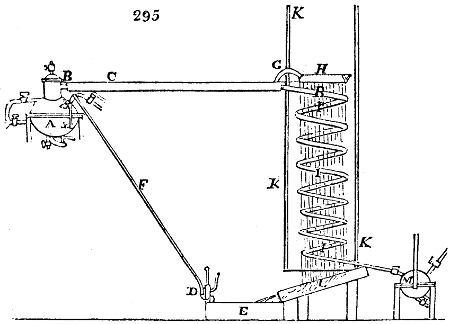
Let A be the source of the vapours, or the vessel, boiler, alembic, or closed pan that contains the liquid or syrup to be evaporated or concentrated. The pipe B, through which the vapour passes as it rises in the boiler, is surrounded by another tube C, of larger diameter, closed at both ends. A pump D, draws from the reservoir E, warm water, which water has been heated by its previous and continual passage through the apparatus in contact with the surface of the vapour pipes. This pump forces the water by the pipe F, into the annular space or chamber between the pipes B and C, in which chamber, by its immediate contact with the pipe B, it acquires the temperature of the vapours intended to be refrigerated. The pipe G conveys the water from the pipe C, into the annular colander or sieve H, which has a multitude of small holes pierced through its under part, and from whence the warm water descends in the form of a continued shower of rain. To the end of the pipe B, a distiller’s worm I I, is connected, which is placed beneath the colander H. The entire length of the worm-pipe should be bound round with linen or cotton cloth, as a conductor of the heat, which cloth will be continually moistened by the rain in its descent from the colander. As this water has been heated in passing along the tube C, the shower of rain descending from the colander will be at a higher temperature than that of the atmosphere, and, consequently, by heating the surrounding air as it descends, a considerable upward draft will be produced through the coils of the worm-pipe.
If the colander and the worm-pipe are enclosed within a chimney or upright tube, as K K, open at top and bottom, a current of ascending air will be produced within it by the descending shower of hot water, similar in effect to that which would be produced in a chimney communicating with a furnace, or to that of the burner of an argand lamp. Consequently, it will be perceived that in opposition to the descending rain, a strong upward current of air will blow through that part of the cylinder K K, which is beneath the colander. When the air first enters the lower aperture of the chimney or tube K, it is of the same temperature and moisture as the external atmosphere; but in its passage up the tube it meets with a warmer and damper atmosphere, caused by the heat given out from the hot fluid continually passing through the pipes, and by the hot shower of rain, and also by the steam evolved from the surfaces of the coils of the worm, which are continually wetted by the descending rain, the evaporation being considerably augmented by the cloth bound round the worm-pipe, retaining the water as it descends in drops from coil to coil.
The atmosphere within the tube being of a higher temperature than without, a current of air constantly ascends and escapes at the upper aperture K, and its place is supplied by fresh air from the surrounding atmosphere, entering the tube below. The fresh air thus admitted at the bottom of the tube being cold and dry, will be suited to take up the heat and moisture within, because the water within the tube being in a state of dispersion as rain, presents to the air many points, or a very extended surface, and also because it is of a higher temperature than the air; and, besides, cold dry air is continually renewed, and a source of warmth is furnished by the latent caloric to the steam, as fast as it is evolved. Thus a portion of the descending rain, or water, is evaporated, and the effect of this evaporation is to subtract caloric not only from the water held in contact with the coils of the worm-pipe by the cloth enveloping it, but also from the hot vapours which pass through the worm. This process of evaporation has, therefore, a cooling power, which is but slight in the lower part of the chimney or tube K; because the temperature of the water, or rain, and of the worm, at this part, are of a lower temperature; but its refrigerating power increases as it rises towards the colander, and there it acquires its maximum of intensity, so that at any point between the lower aperture of the cylinder and the colander, the current of air is always a little cooler than the atmosphere of the region through which it passes (that is, at its maximum); and in passing this region of higher temperature, it is not only put in equilibrium of temperature, but also made to take up an additional quantity of aqueous vapours, which equalises the new temperature it acquires with its capacity of saturation. The cooling caused by the evaporation acts in an incessant and progressive manner from the lower aperture of the cylinder to the under side of the colander; and this cooling not only acts as an agent of the evaporation which the current of air cools, but it refrigerates also, because it becomes warmed in abstracting caloric from the vapours or liquids passing through the worm; and this refrigeration acts also incessantly and progressively from the lower part of the tube or chimney to the colander.
The patentee states, in conclusion, that “the velocity or force of the current of air that passes through the chimney or tube K, can be accelerated by artificial means, either by conducting the air and vapour passing from the upper aperture of the cylinder into the chimney or flues of a furnace, or by means of a revolving, forcing, or exhausting fan, or ventilator, or any other contrivance which will produce an increased current of air, but which it is not necessary to be particularly described, as I only wish to explain the principles of a simple apparatus, constructed in any convenient form; and I would remark, that the area of the lower aperture through which the air is introduced into the chimney or tube K, and also the area of the upper aperture, or that through which it passes to the atmosphere, should be in accordance with the effect intended to be obtained.
“It is further to be remarked, that in order to obtain from this apparatus the best effect, the velocity of the current of air must be itself a maximum; and as the speed or velocity of the current of air is owing to and determined by the excess of the temperature of the descending water, or rain, and of the coils of the worm to that of the exterior atmosphere, it ensues that the temperature of the water, or rain, must be a maximum. But this excess of temperature is a maximum only when the source of the rain is at the same temperature as the vapours to be condensed: if less warm, it would attract less air; or, if warmer, it would augment the temperature of the vapours intended to be condensed. Consequently, the shower of water employed in the tube K, as the agent for cooling, bestows its maximum of effect when it is as warm as the vapours to be condensed; therefore, I may express this proposition, viz., ‘That in refrigerating with water, less of it may be expended when it is warm than when it is cold, and that the least quantity of water will be evaporated when it is as warm as the aqueous or spirituous vapours upon which it is to operate.’
“This proposition may appear strange, nevertheless it is conformable to the laws of nature; and appears only strange, because until now warm water has not been employed with currents of air for refrigerating.
“Hence it is necessary to raise the temperature of the water in the colander to the temperature of the vapours to be condensed: therefore, I cause the lukewarm water, pumped from the reservoir E, to circulate in the chamber C. In this circulation it also begins to act as a refrigerating medium, taking up a portion of heat from the vapours that pass through the pipe B, and afterwards it acts as a further condenser in the cylinder, in the way described. Finally, the portion of this water that is still in the fluid state, after having fallen down from coil to coil, arrives lukewarm to the inclined surface L, which conducts it into the reservoir E, from whence it is pumped up into the chamber C, as before described.
“The tube or chimney K, may have more or less altitude; the higher it is the greater is the current produced. The force or velocity of the current of air can be governed by the areas of the introduction and exit apertures. If the cylinder rises only to the height of the sieve, the effect is much less than when it is prolonged beyond this height. I would further remark, that if the cylinder was removed, a slight effect might be produced, provided that a current of air be preserved in the cylindrical space limited by the coils of the worm, and also if the current was produced between the coils; or a central passage might be formed in an apparatus of another shape than that above described.
“I have only shown the application of the worm, because intending only to explain the principles of this method of condensing and refrigerating.
“The small quantity of water wasted in this manner of condensation, (that is, that portion passed off to the atmosphere in the form of vapours, at the upper aperture of the cylinder K,) may be replaced by a small stream of cold water, which may be brought to the apparatus, and perhaps most conveniently introduced into the reservoir E, or into the chamber between the pipes B and C. When operating upon aqueous vapours, the waste of water is always less in weight than that of the vapours liquefied. When this apparatus is applied to the purposes of distillation, the end of the worm should terminate in a vessel M, which is to receive the produce of the condensation. It will be seen that this improved process is applicable to various purposes, where condensation or refrigeration is required; for instance, in the boiling or concentration of sugar; to condensing and refrigerating distilled vapours, or steam, or saline liquids, either in vacuum or not; to cooling brewers’ worts; and to the refrigeration of other liquors, or any other processes, when it may be required.”
I have inserted the specification of this patent verbatim. M. Derosne has busied himself during a long life with a prodigious number of ingenious little contrivances for clarifying and boiling syrups, distillation, &c., but he has in this invention taken a bolder flight, having secured the exclusive privilege of condensing vapours, and cooling liquors, with hot water, in preference to cold. No man at all versant in the scientific doctrines, or the practical applications of caloric, will ever seek to meddle with his monopoly of such a scheme. He may find, perhaps, some needy coppersmith ready to espouse that or any other equally foolish project, provided a productive job can be made of it, against credulous customers.
For some rational methods of cooling liquors, and condensing vapours, see Refrigeration, Still, and Sugar.
COPAL, a resin which exudes spontaneously from two trees, the Rhus copallinum, and the Elæocarpus copalifer, the first of which grows in America, and the second in the East Indies. A third species of copal tree grows on the coasts of Guinea, especially on the banks of some rivers, among whose sands the resin is found. It occurs in lumps of various sizes and of various shades of colour, from the palest greenish yellow to darkish brown. I found its specific gravity to vary in different specimens from 1·059 to 1·071, being intermediate in density between its two kindred resins, animé and amber. Some rate its specific gravity so high as 1·139, which I should think one of the errors with which chemical compilations teem. Copal is too hard to be scratched by the nail, whence the excellence of its varnish. It has a conchoidal fracture, and is without smell or taste. When exposed to heat in a glass retort over a spirit lamp it readily melts into a liquid, which being further heated boils with explosive jets. A viscid oily-looking matter then distils over. After continuing the process for some time, no succinic acid is found in the receiver, but the copal blackens in the retort. Anhydrous alcohol boiled upon it, causes it to swell, and transforms it by degrees into an elastic viscid substance. It is not soluble in alcohol of 0·825 at the boiling point, as I have ascertained. Copal dissolves in ether, and this ethereous solution may be mixed with alcohol without decomposition. Caoutchoucine acts very slightly upon it by my experiments, even at the boiling temperature of this very volatile fluid; but a mixture of it with alcohol of 0·825 in equal parts dissolves it very rapidly in the cold into a perfectly liquid varnish. Alcohol holding camphor in solution also dissolves it, but not nearly so well as the last solvent. According to Unverdorben, copal may be completely dissolved by digesting one part of it for 24 hours with one part and a half of alcohol (probably anhydrous), because that portion of copal which is insoluble in alcohol, dissolves in a very concentrated solution of the soluble portion. Oil of petroleum and turpentine dissolve only 1 or 2 per cent. of raw copal. By particular management, indeed, oil of turpentine may be combined with copal, as we shall describe under the article Varnish.
Fused copal possesses different properties from the substance in its solid state; for it then may be made to combine both with alcohol and oil of turpentine.
Unverdorben has extracted from the copal of Africa, five different kinds of resin, none of which has however been applied to any use in the arts.
The ultimate constituents of copal by my analysis are, carbon 79·87, hydrogen 9·00, oxygen 11·1; being of hydrogen 7·6 in excess above the quantity necessary to form water with the oxygen. Of copal and animé, 551,166 libs. were imported in 1835.
COPPER is one of the metals most anciently known. It was named from the island of Cyprus, where it was extensively mined and smelted by the Greeks. It has a reddish brown colour inclining to yellow; a faint but nauseous and rather disagreeable taste; and when rubbed between the fingers it imparts a smell somewhat analogous to its taste. Its specific gravity is from 8·8 to 8·9. It is much more malleable than it is ductile; so that far finer leaves may be obtained from it than wire. It melts at the 27th degree of Wedgewood’s pyrometer, and at a higher temperature it evaporates in fumes which tinge the fire of a bluish green. By exposure to heat with access of air, it is rapidly converted into black scales of peroxide. In tenacity it yields to iron; but surpasses gold, silver, and platinum, considerably in this respect.
In mineralogy, the genus copper includes about 13 different species, and each of these contains a great many varieties. These ores do not possess any one general exterior character by which they can be recognized; but they are readily distinguished by chemical re-agents. Water of ammonia digested upon any of the cupreous ores in a pulverized state, after they have been calcined either alone or with nitre, assumes an intense blue colour, indicative of copper. The richest of the ordinary ores appear under two aspects; the first class has a metallic lustre, a copper red, brass yellow, iron gray, or blackish gray colour, sometimes inclining to blue; the second is without metallic appearance, has a red colour, verging upon purple, blue, or green, the last tint being the most usual. Few copper ores are to be met with, indeed, which do not betray the presence of this metal by more or less of a greenish film.
1. Native copper, occurs in crystals, branches and filaments, its most common locality being in primitive rocks. It is found abundantly in Siberia, at the mines of Tourinski, in those of Hungary, of Fundo-Moldavi in Gallicia, of Fahlun in Sweden, of Cornwall, &c. The gangues of native copper are granite, gneiss, mica-slate, clay-slate, quartz, carbonate or fluate of lime, sulphate of barytes, &c. The most remarkable masses of native copper hitherto observed were; first, one in Brazil, 14 leagues from Basa, which weighed 2616 pounds; and secondly, another which Dr. Francis-le-Baron discovered in America to the south of Lake Superior. It was nearly 15 feet in circumference.
2. Sulphuret of Copper, the vitreous ore of Brochant. The texture of this ore is compact: its fracture, conchoidal, surface sometimes dull; colour, iron black or lead gray, often bluish, iridescent, or reddish from a mixture of protoxide. It is easily melted even by the heat of a candle; but more difficult of reduction than protoxide. This ore yields to the knife, assuming a metallic lustre when cut. Its density varies from 4·8 to 5·34. Its composition according to Klaproth is 78·5 copper, 18·5 sulphur, with a little iron and silica. Its equivalent constitution by theory is 80 copper + 20 sulphur = 100; whence 78·5 of metal should be associated with 19·6 of sulphur. This ore is therefore one of the richest ores, and forms very powerful veins, which likewise contain some orange protoxide. It is to be found in all considerable copper districts; in Siberia, Saxony, Sweden, and especially Cornwall, where the finest crystals occur.
3. Copper Pyrites, resembles in its metallic yellow hue, sulphuret of iron; but the latter is less pale, harder, and strikes fire more easily with steel. It presents the most lively rainbow colours. Its specific gravity is 4·3. It contains generally a good deal of iron; as the following analysis will show; copper 30, sulphur 37, iron 33, in 100 parts. According to Hisinger, the Swedish pyrites contains 63 of copper, 12 of iron, and 25 of sulphur. These ores occur in primitive and transition districts in vast masses and powerful veins; and are commonly accompanied with gray copper, sulphuret of iron, sparry iron, sulphurets of lead, and zinc.
4. Gray Copper, has a steel gray colour, more or less deep, either shining or dull; fracture uneven; a distinct metallic lustre; difficult of fusion at the blowpipe; it communicates to glass of borax a yellowish-red colour. Its density in crystals is 4·86. Its composition is very variable; consisting essentially of copper, iron, antimony, and sulphur. The exploration of this ore is profitable, in consequence of the silver which it frequently contains. It occurs in primitive mountains; and is often accompanied with red silver ore, copper pyrites, and crystallized quartz.
5. Protoxide of Copper, or red oxide of Copper: its colour is a deep red, sometimes very lively, especially when bruised. It is friable, difficult of fusion at the blowpipe, reducible on burning charcoal, soluble with effervescence in nitric acid, forming a green liquid. Its constitution when pure, is 88·9 copper + 11·1 oxygen = 100.
6. Black oxide of Copper, is of a velvet black, inclining sometimes to brown or blue; and it acquires the metallic lustre on being rubbed. It is infusible at the blowpipe. Its composition is, copper 80 + oxygen 20; being a true peroxide.
7. Hydrosilicate of Copper, consists essentially of oxide of copper, silica, and water. Its colour is green; and its fracture is conchoidal with a resinous lustre, like most minerals which contain water. Its specific gravity is 2·73. It is infusible at the blowpipe alone, but it melts easily with borax.
8. Dioptase Copper, or Emerald Malachite; a beautiful but rare cupreous mineral, consisting of oxide of copper, carbonate of lime, silica, and water in varying proportions.
9. Carbonate of Copper, Malachite; is of a blue or green colour. It occurs often in beautiful crystals.
10. Sulphate of Copper, Blue Vitriol, similar to the artificial salt of the laboratory. The blue water which flows from certain copper mines, is a solution of this salt. The copper is easily procured in the metallic state by plunging pieces of iron into it.
11. Phosphate of Copper, is of an emerald green, or verdigris colour with some spots of black. It presents fibrous or tuberculous masses with a silky lustre in the fracture. It dissolves in nitric acid without effervescence, forming a blue liquid; melts at the blowpipe, and is reducible upon charcoal, with the aid of a little grease, into a metallic globule. Its powder does not colour flame green, like the powder of muriate of copper.
12. Muriate of Copper, is green of various shades; its powder imparts to flame a remarkable blue and green colour. It dissolves in nitric acid without effervescence; and is easily reduced before the blowpipe. Its density is 3·5. By Klaproth’s analysis it consists of oxide of copper 73, muriatic acid 10, water 17.
13. Arseniate of Copper. It occurs in beautiful blue crystals. Before the blowpipe it melts exhaling fumes of a garlic odour, and it affords metallic globules when in contact with charcoal. See more upon the ores at the end of this article.
In the article Metallurgy, I have described the mode of working certain copper mines; and shall content myself here with giving a brief account of two cupreous formations, interesting in a geological point of view; that of the copper slate of Mansfeldt, and of the copper veins of Cornwall.
The curious strata of bituminous schist in the first of these localities, are among the most ancient of any which contain the exuviæ of organised bodies not testaceous. From among their tabular slabs the vast multitudes of fossil fish were extracted, which have rendered the cantons of Mansfeldt, Eisleben, Ilmenau, and other places in Thuringia and Voigtland so celebrated. Many of the fish are transformed into copper pyrites. Here, also, have been found the fossil remains of the lizard family, called Monitors.
Such is the influence of a wise administration upon the prosperity of mines, that the thin layer of slate in this formation, of which 100 pounds commonly contain but one pound and a half of copper, occasionally argentiferous, has been for several centuries the object of smelting works of the greatest importance to the territory of Mansfeldt and the adjoining country.
The frequent derangements which this metallic deposit experiences, led skilful directors of the under-ground operations at an early period to study the order of superposition of the accompanying rocks. From their observations, there resulted a system of facts which have served to guide miners, not only in the country of Mansfeldt, but over a great portion of Germany, and in several other countries where the same series of rocks, forming the immediate envelope of the cupreous schists, were found to occur in the same order of superposition.
Of the English copper works.—The deposits of copper in Cornwall occur always as veins in granite, or in the schistose rocks which surround and cover it; and hence, the Cornish miners work mostly in the granite or greenish clay slate; the former of which they call growan, the latter killas. But tin is sometimes disseminated in small veins in porphyry or elvan, which itself forms great veins in the above rocks. No stratification has been observed in Cornwall.
The copper veins are abundant in the killas and rare in the granite; but most numerous near the line of junction of the two rocks. The different kinds of mineral veins in Cornwall may be classed as follows:—
1. Veins of elvan; elvan courses, or elvan channels.
2. Tin veins, or tin lodes; the latter word being used by the Cornish miners to signify a vein rich in ore, and the word course, to signify a barren vein.
3. Copper veins running east and west; east and west copper lodes.
4. Second system of copper veins, or contra copper lodes.
5. Crossing veins; cross courses.
6. Modern copper veins; more recent copper lodes.
7. Clay veins; of which there are two sets, the more ancient, called Cross-Fluckans; and the more modern, called Slides.
There are therefore three systems of copper veins in Cornwall; of which the first is considered to be the most ancient, because it is always traversed by the two others, and because, on the contrary, it never cuts them off. The width of these veins does not exceed 6 feet, though occasional enlargements to the extent of 12 feet sometimes take place. Their length is unknown, but the one explored in the United Mines has been traced over an extent of seven miles. The gangue of these veins is generally quartz, either pure, or mixed with green particles analogous to chlorite. They contain iron pyrites, blende, sulphuret, and several other compounds of copper, such as the carbonate, phosphate, arseniate, muriate, &c. The most part of the copper veins are accompanied with small argillaceous veins, called by the miners fluckan of the lode. These are often found upon both sides of the vein, so as to form cheeks or salebandes.