G.
Reading edition
GABRONITE, is a yellowish stony substance, of a greasy lustre and spec. gr. = 2·74; affording no water by calcination; fusible at the blowpipe into an opaque glass; soluble in muriatic acid; solution affords hardly any precipitate by oxalate of ammonia. This mineral is distinguished by the large quantity of soda which it contains; its constituents being,—silica, 54; alumina, 24; soda, 17·25; magnesia, 1·5; oxide of iron, 1·25; water, 2. It belongs to the species Nepheline.
GADOLINITE; called also Yttrite and Ytterbite; is a mineral of a black, brownish, or yellowish colour, granular, or compactly vitreous, and conchoidal fracture; of spec. grav. 4·23? readily scratching glass; fusible at the blowpipe into an opaque glass, sometimes with intumescence. It affords, with acids, a solution that lets fall, with caustic soda, a precipitate partly re-soluble in carbonate of ammonia. It is remarkable for containing from 45 to 55 per cent. of the earth Yttria; its remaining constituents being silica, 25·8; oxide of cerium, 17·92; oxide of iron, 11·43. This mineral is very rare, having been hitherto found only in the neighbourhood of Fahlun and Ytterby, in Sweden; its peculiar constituent was discovered by Professor Gadolin.
GALACTOMETER, or LACTOMETER, is an instrument to ascertain the quality of milk; an article often sophisticated in various ways. Fresh milk, rich in cream, has a less specific gravity, than the same milk after it has been skimmed; and milk diluted with water becomes proportionably lighter. Hence, when our purpose is to determine the quantity of cream, the galactometer may consist merely of a long graduated glass tube standing upright upon a sole. Having filled 100 measures with the recent milk, we shall see, by the measures of cream thrown up, its value in this respect. A delicate long-ranged glass hydrometer, graduated from 1·000 up to 1·060, affords the most convenient means of detecting the degree of watery dilution, provided the absence of thickening materials has been previously ascertained by filtration. Good fresh milk indicates from 1·030 to 1·032; when the cream is removed, 1·035 to 1·037. When its density is less than 1·028, we may infer it has been thinned with water.
GALBANUM, is a gum-resin, which occurs sometimes in yellow, shining tears, easily agglutinated; of a strong durable smell; an acrid and bitter taste; at other times in lumps. It exudes either spontaneously or from incisions made into the stem of the bubon galbanum, a plant of the family of umbelliferæ, which grows in Africa, particularly in Ethiopia. It contains 67 of resin; 19·3 of gum; 6·4 of volatile oil and water; 7·5 of woody fibres and other impurities; with traces of acid malate of lime.
GALENA; (Plomb sulfuré, Fr.; Bleiglanz, Germ.;) is a metallic looking substance of a lead-gray colour, which crystallizes in the cubical system, and is susceptible of cleavages parallel to the faces of the cube; spec. gr. 7·7592; cannot be cut; fusible at the blowpipe with exhalation of sulphureous vapours; is easily reduced to metallic lead. Nitric acid first dissolves it, and then throws down sulphate of lead in a white precipitate; the solution affording with plates of zinc, brilliant laminæ of lead (arbor Saturni.) It consists of sulphur, 13; lead, 85; with a little iron, and sometimes a minute quantity of silver. This is the richest ore of lead, and it occurs in almost every geological formation, in veins, in masses, or in beds. It is almost always accompanied by sulphuret of zinc, different salts of lead, heavy spar, fluor spar, &c. Galena in powder, called Alquifoux, is employed as a glaze for coarse stoneware.
GALIPOT, is a name of a white semi-solid viscid rosin found on fir-trees; or an inferior sort of turpentine, poor in oil.
GALLATES; salts consisting of gallic acid combined with bases; the most important being that with oxide of iron, constituting a principal part of the black dye.
GALLIC ACID, is the peculiar acid extracted from gall-nuts; which see.
GALLIPOLI OIL, is a coarse olive oil, containing more or less mucilage; imported from a sea port so named, of the province of Otranto, in the kingdom of Naples.
GALL-NUTS, or GALLS; (Noix de Galle, Fr.; Galläpfel, Germ.;) are excrescences found upon the loaves and leaf-stalks of a species of oak, called Quercus infectoria, which grows in the Levant. They are produced in consequence of the puncture of the female of the gall wasp, (Cynips folii quercus), made in order to deposit her eggs; round which the juice of the tree exudes, and dries in concentric portions. When the insect gets fully formed, it eats through the nut, and flies off.
The Levant galls are of two different appearances and qualities; the first are heavy, compact, imperforated, the insect having not been sufficiently advanced to eat its way through the shell; prickly on the surface; of a blackish or bluish green hue; about the size of a musket ball. These are called black, blue, or Aleppo galls. The second are light, spongy, pierced with one or more holes; smooth upon the surface, of a pale grayish or reddish yellow colour, generally larger than the first, and are called white galls. Besides the galls of the Levant, others come from Dalmatia, Illyria, Calabria, &c.; but they are of inferior quality, being found upon the Quercus Cerris; they are smaller, of a brownish colour, and of inferior value. The further south the galls are grown, they are reckoned the better.
Galls consist principally of three substances; tannin or tannic acid; yellow extractive; and gallic acid. Their decoction has a very astringent and unpleasant bitter taste. The following are their habitudes with various reagents:—
Litmus paper is powerfully reddened.
Stannous chloride (protomuriate of tin), produces an isabel yellow precipitate.
Alum; a yellowish gray precipitate.
Acetate of lead; a thick yellowish white precipitate.
Acetate of copper; a chocolate brown precipitate.
Ferric sulphate (red sulphate of iron); a blue precipitate.
Sulphuric acid; a dirty yellowish precipitate.
Acetic acid brightens the muddy decoction.
The galls of the Quercus Cerris and common oak (Galles à l’épine, Fr.; Knoppern, Germ.) are of a dark-brown colour, prickly on the surface, and irregular in shape and size. They are used chiefly for tanning in Hungary, Dalmatia, and the southern provinces of the Austrian states, where they abound.
Tannin or tannic acid is prepared as follows: Into a long narrow glass adopter tube shut at its lower orifice with a cotton wick, a quantity of pounded galls are put, and slightly pressed down. The tapering end of the tube being inserted into a matrass or bottle, the vacant upper half of the tube is filled with sulphuric ether, and then closed with a ground-glass stopper. Next day there will be found in the bottle a liquid in two distinct strata; of which the more limpid occupies the upper part, and the other, of a syrupy consistence and amber colour, the lower. More ether must be filtered through the galls, till the thicker liquid ceases to augment. Both are now poured into a funnel, closed with the finger, and after the dense liquor is settled at the bottom, it is steadily run off into a capsule. This, after being washed repeatedly with ether, is to be transferred into a stove chamber, or placed under the receiver of an air pump to be evaporated. The residuary matter swells up in a spongy crystalline form of considerable brilliancy, sometimes colourless, but more frequently of a faintly yellowish hue.
This is pure tannin, which exists in galls to the amount of from 40 to 45 per cent. It is indispensable that the ether employed in the preceding process be previously agitated with water, or that it contain some water, because by using anhydrous ether, not a particle of tannin will be obtained.
Tannic acid is a white or yellowish solid, inodorous, extremely astringent, very soluble in water and alcohol, much less so in sulphuric ether, and uncrystallizable. Its watery solution, out of contact of air, undergoes no change; but if, in a very dilute state, it be left exposed to the atmosphere, it loses gradually its transparency, and lets fall a slightly grayish crystalline matter, consisting almost entirely of gallic acid. For procuring this acid in a perfectly pure state, it is merely necessary to treat that solution thus changed with animal charcoal, and to filter it in a boiling state, through paper previously washed with dilute muriatic acid. The gallic acid will fall down in crystals as the liquid cools.
If the preceding experiment be made in a graduated glass tube containing oxygen over mercury, this gas will be absorbed, and a corresponding volume of carbonic acid gas will be disengaged. In this case the liquor will appear in the course of a few weeks as if traversed with numerous crystalline colourless needles of gallic acid.
Tannin or tannic acid consists of carbon 51·56; hydrogen 4·20; oxygen 44·24.
From the above facts it is obvious that gallic acid does not exist ready formed in gall nuts, but that it is produced by the reaction of atmospheric oxygen upon the tannin of these concretions.
Gallic acid is a solid, feebly acidulous and styptic to the taste, inodorous, crystallizing in silky needles of the greatest whiteness; soluble in about 100 times its weight of cold, and in a much smaller quantity of boiling water; more soluble in alcohol than in water, but little so in sulphuric ether.
Gallic acid does not decompose the salts of protoxide of iron, but it forms, with the sulphate of the peroxide, a dark blue precipitate, much less insoluble than the tannate of iron. Gallic acid takes the oxide from the acetate and nitrate of lead, and throws down a white gallate unchangeable in the air, when it is mixed with that acetate and nitrate. It occasions no precipitate in solutions of gelatine (isinglass or glue), by which criterion its freedom from tannin is verified.
Gallic acid occurs but seldom in nature; and always united to brucine, veratrine, or lime. Its constituents are, carbon 49·89; hydrogen 3·49; oxygen 46·62. In the crystalline state it contains one atom of water, which it loses by drying.
Scheele obtained gallic acid by infusing pounded galls for 3 or 4 days in 8 times their weight of water, and exposing the infusion to the air, in a vessel covered loosely with paper. At the end of two months, the liquor had almost all evaporated, leaving some mouldiness mixed with a crystalline precipitate. The former being removed, the deposit was squeezed in a linen cloth, and then treated with boiling water. The solution being gradually evaporated, yielded crystals of gallic acid, granular or star-like, of a grayish colour. These crystals might be whitened by boiling their solution along with a little animal charcoal. About one fifth of gallic acid may be obtained by Scheele’s process from good gall-nuts.
From a decoction of 500 parts of galls, Sir H. Davy obtained 185 parts of solid extract; which consisted of 130 parts of tannin; 31 parts of gallic acid with extractive; 13 parts of mucilage; 12 parts of lime and salts. Hence gall-nuts would seem to contain, by this statement, more than two-thirds of their weight of tannin. This result is now seen, from the above experiments of Pelouze, to have been incorrect, in consequence of the admixture of yellow extractive in Davy’s tannin.
The uses of galls in many processes of dyeing, and in making black ink, are detailed under their respective heads.
GALL OF ANIMALS, or OX-GALL, purification of. Painters in water colours, scourers of clothes, and many others employ ox-gall or bile, but when it is not purified, it is apt to do harm from the greenness of its own tint. It becomes therefore an important object to clarify it, and to make it limpid and transparent like water. The following process has been given for that purpose. Take the gall of newly killed oxen, and after having allowed it to settle for 12 or 15 hours in a basin, pour the supernatant liquor off the sediment into an evaporating dish of stone ware, and expose it to a boiling heat in a water bath, till it is somewhat thick. Then spread it upon a dish, and place it before a fire till it becomes nearly dry. In this state it may be kept for years in jelly pots covered with paper, without undergoing any alteration. When it is to be used, a piece of it of the size of a pea is to be dissolved in a table spoonful of water.
Another and probably a better mode of purifying ox-gall is the following. To a pint of the gall boiled and skimmed, add one ounce of fine alum in powder, and leave the mixture on the fire till the alum be dissolved. When cooled, pour into a bottle, which is to be loosely corked. Now take a like quantity of gall also boiled and skimmed, add an ounce of common salt to it, and dissolve with heat; put it when cold into a bottle, which is likewise to be loosely corked. Either of these preparations may be kept for several years without their emitting a bad smell. After remaining three months, at a moderate temperature, they deposit a thick sediment, and become clearer, and fit for ordinary uses, but not for artists in water colours and miniatures, on account of their yellowish-green colour. To obviate this inconvenience, each of the above liquors is to be decanted apart, after they have become perfectly settled, and the clear portion of both mixed together in equal parts. The yellow colouring matter still retained by the mixture coagulates immediately and precipitates, leaving the ox-gall perfectly purified and colourless. If wished to be still finer, it may be passed through filtering paper; but it becomes clearer with age, and never acquires a disagreeable smell, nor loses any of its good qualities.
Clarified ox-gall combines readily with colouring matters or pigments, and gives them solidity either by being mixed with or passed over them upon paper. It increases the brilliancy and the durability of ultramarine, carmine, green, and in general of all delicate colours, whilst it contributes to make them spread more evenly upon the paper, ivory, &c. When mixed with gum Arabic, it thickens the colours without communicating to them a disagreeable glistering appearance; it prevents the gum from cracking, and fixes the colours so well that others may be applied over them without degradation. Along with lamp black and gum, it forms a good imitation of China ink. When a coat of ox-gall is put upon drawings made with black lead or crayons, the lines can no longer be effaced, but may be painted over safely with a variety of colours previously mixed up with the same ox-gall.
Miniature painters find a great advantage in employing it; by passing it over ivory, it removes completely the unctuous matter from its surface; and when ground with the colours, it makes them spread with the greatest ease, and renders them fast.
It serves also for transparencies. It is first passed over the varnished or oiled paper, and is allowed to dry. The colours mixed with the gall are then applied, and cannot afterwards be removed by any means.
It is adapted finally for taking out spots of grease and oil.
GALL OF GLASS, called also sandiver, is the neutral salt skimmed off the surface of melted crown glass; which, if allowed to remain too long, is apt to be reabsorbed in part, and to injure the quality of the metal, as the workmen call it.
GALVANIZED IRON, is the somewhat fantastic name newly given in France to iron tinned by a peculiar patent process, whereby it resists the rusting influence of damp air, and even moisture, much longer than ordinary tin plate. The following is the prescribed process. Clean the surface of the iron perfectly by the joint action of dilute acid and friction, plunge it into a bath of melted zinc, and stir it about till it be alloyed superficially with this metal; then take it out, and immerse it in a bath of tin, such as is used for making tin plate. The tin forms an exterior coat of alloy. When the metal thus prepared is exposed to humidity, the zinc is said to oxidize slowly by a galvanic action, and to protect the iron from rusting within it, whereby the outer tinned surface remains for a long period perfectly white, in circumstances under which iron tinned in the usual way would have been superficially browned and corroded with rust.
GAMBOGE; (Gomme Gutte, Fr.; Gutti, Germ.) is a gum resin, concreted in the air, from the milky juice which exudes from several trees. The gambogia gutta, a tree which grows wild upon the coasts of Ceylon and Malabar, produces the coarsest kind of gamboge; the guttaefera vera (Stalagmites cambogioides) of Ceylon and Siam affords the best. It comes to us in cylindrical lumps, which are outwardly brown yellow, but reddish yellow within, as also in cakes; it is opaque, easily reducible to powder, of specific gravity 1·207, scentless, and nearly devoid of taste, but leaves an acrid feeling in the throat. Its powder and watery emulsion are yellow. It consists of 80 parts of a hyacinth red resin, soluble in alcohol; and 20 parts of gum; but by another analysis, of 89 of resin, and 10·5 of gum. Gamboge is used as a pigment, and in miniature painting, to tinge gold varnish; in medicine as a powerful purge. It should never be employed by confectioners to colour their liqueurs, as they sometimes do.
GANGUE. A word derived from the German gang, a vein or channel. It signifies the mineral substance which either encloses or usually accompanies any metallic ore in the vein. Quartz, lamellar carbonate of lime, sulphate of baryta, sulphate and fluate of lime, generally form the gangues; but a great many other substances become such when they predominate in a vein. In metallurgic works the first thing is to break the mixed ore into small pieces, in order to separate the valuable from the useless parts, by processes called stamping, picking, sorting. See Metallurgy and Mines.
GARNET (Grenat, Fr.; Granat, Germ.); is a vitreous mineral of the cubic system, of which the predominating forms are the rhomboidal dodecahedron and the trapœzohedron; specific gravity varying from 3·35 to 4·24; fusible at the blowpipe. Its constituents are, silica, 42; alumina, 20·0; lime, 34·0; protoxide of iron, 4. Garnets are usually disseminated, and occur in all the primitive strata from gneiss to clay slate. The finer varieties, noble garnet or Almandine, and the reddish varieties of Grossulaire (Essonite), are employed in jewellery; the first are called the Syrian or oriental; the others, hyacinth. In some parts of Germany garnets are so abundant as to be used as fluxes to some iron ores; in others, the garnet gravel is washed, pounded, and employed as a substitute for emery. The garnets of Pegu are most highly valued. Factitious garnets may be made by the following composition:—Purest white glass, 2 ounces; glass of antimony, 1 ounce; powder of cassius, 1 grain; manganese, 1 grain.
GAS (Eng. and Fr.; Gaz, Germ.); is the generic name of all those elastic fluids which are permanent under a considerable pressure, and at the temperature of zero of Fahrenheit. In many of them, however, by the joint influence of excessive cold and pressure, the repulsive state of the particles may be balanced or subverted, so as to transform the elastic gas into a liquid or a solid. For this most interesting discovery, we are indebted to the fine genius of Mr. Faraday.
The following table exhibits the temperatures and pressures at which certain gases are liquefied.
Name of the gas. Becomes liquid Calculated boiling point; Barom. = 30 inches.
At Under a pressure of
Sulphurous acid 59 ° F. 3 atmospheres. - 4 ° Fahr.
Chlorine 60 4 - 22
Ammonia 50 6 ·5 - 64
Sulphuretted hydrogen 50 17 - 142
Carbonic acid 32 36 - 229
Hydrochloric or muriatic acid 50 50 - 249
Deutoxide of azote 45 50 - 254
Liquid carbonic acid becomes solidified, into a snowy-looking substance, by its own rapid evaporation. Oxygen, hydrogen, and azote, have hitherto resisted all attempts to divest them of their elastic form. For this purpose, it is probable that a condensing force equal to that of 650 atmospheres, will be required.
The volume of any gas is, generally speaking, inversely as the pressure to which it is exposed; thus, under a double pressure its bulk becomes one-half; under a triple pressure, one-third; and so on. For the change of volume in gaseous bodies by heat, see Expansion.
Ammonia, carbonic acid, carburetted hydrogen, chlorine, muriatic acid, sulphurous acid, sulphuretted hydrogen, are the gases of most direct interest in the arts and manufactures. Their detailed examination belongs to a work on chemistry.
GAS-HOLDER; a vessel for containing and preserving gas, of which various forms are described by chemical writers.
GASOMETER, means properly a measurer of gas, though it is employed often to denote a recipient of gas of any kind. See the article Gas-Light.
GAUZE WIRE CLOTH; is a textile fabric, either plane or tweelled, made of brass, iron, or copper wire, of very various degrees of fineness and openness of texture. Its chief uses are for sieves, and safety lamps.
GAY-LUSSITE, is a white mineral of a vitreous fracture, which crystallizes in oblique rhomboidal prisms; specific gravity from 1·93 to 1·95; scratches gypsum, but is scratched by calcspar; affords water by calcination; it consists of carbonic acid 28·66; soda, 20·44; lime, 17·70; water, 32·20; clay, 1·00. It is in fact, by my analysis, a hydrated soda-carbonate of lime in atomic proportions. This mineral occurs abundantly in insulated crystals, disseminated through the bed of clay which covers the urao, or native sesquicarbonate of soda, at Lagunilla in Colombia.
GELATINE; (Eng. and Fr.; Gallert, Leim, Germ.) is an animal product which is never found in the humours, but it may be obtained by boiling with water the soft and solid parts; as the muscles, the skin, the cartilages, bones, ligaments, tendons, and membranes. Isinglass consists almost entirely of gelatine. This substance is very soluble in boiling water; the solution forms a tremulous mass of jelly when it cools. Cold water has little action upon gelatine. Alcohol and tannin (tannic acid, see Gall-nuts) precipitate gelatine from its solution; the former by abstracting the water, the latter by combining with the substance itself into an insoluble compound; of the nature of leather. No other acid, except the tannic, and no alkali possesses the property of precipitating gelatine. But chlorine and certain salts render its solution more or less turbid; as the nitrate and bi-chloride of mercury, the proto-chloride of tin, and a few others. Sulphuric acid converts a solution of gelatine at a boiling heat into sugar. See Ligneous Fibre. Gelatine consists of carbon, 47·88; hydrogen, 7·91; oxygen, 27·21. See Glue and Isinglass.
GEMS, are precious stones, which, by their colour, limpidity, lustre, brilliant polish, purity, and rarity, are sought after as objects of dress and decoration. They form the principal part of the crown jewels of kings, not only from their beauty, but because they are supposed to comprize the greatest value in the smallest bulk; for a diamond, no larger than a nut or an acorn, may be the representative sign of the territorial value of a whole country, the equivalent in commercial exchange of a hundred fortunes, acquired by severe toils and privations.
Among these beautiful minerals mankind have agreed in forming a select class, to which the title of gems or jewels has been appropriated; while the term precious stone is more particularly given to substances which often occur under a more considerable volume than fine stones ever do.
Diamonds, sapphires, emeralds, rubies, topazes, hyacinths, and chrysoberyls, are reckoned the most valuable gems.
Crystalline quartz, pellucid opalescent or of various hues, amethyst, lapis lazuli, malachite, jasper, agate, &c., are ranked in the much more numerous and inferior class of ornamental stones. These distinctions are not founded upon any strict philosophical principle, but are regulated by a conventional agreement, not very well defined; for it is impossible to subject these creatures of fashion and taste to the rigid subdivisions of science. We have only to consider the value currently attached to them, and take care not to confound two stones of the same colour, but which may be very differently prized by the virtuoso.
Since it usually happens that the true gems are in a cut and polished state, or even set in gold or silver, we are thereby unable to apply to them the criteria of mineralogical and chemical science. The cutting of the stone has removed or masked its crystalline character, and circumstances rarely permit the phenomena of double or single refraction to be observed; while the test by the blowpipe is inadmissible. Hence the only scientific resources that remain are the trial by electricity, which is often inconclusive; the degree of hardness, a criterion requiring great experience in the person who employs it; and, lastly, the proof by specific gravity, unquestionably one of the surest means of distinguishing the really fine gems from ornamental stones of similar colour. This proof can be applied only to a stone that is not set; but the richer gems are usually dismounted, when offered for sale.
This character of specific gravity may be applied by any person of common intelligence, with the aid of a small hydrostatic balance. If, for example, a stone of a fine crimson-red colour, be offered for sale, as an oriental ruby; the purchaser must ascertain if it be not a Siberian tourmaline, or ruby spinel. Supposing its weight in air to be 100 grains, if he finds it reduced to 69 grains, when weighed in water, he concludes that its bulk is equal to that of 31 grains of water, which is its loss of weight. Now, a real sapphire which weighs 100 grains in air, would have weighed 76·6 in water; a spinel ruby of 100 grains would have weighed 72·2 in water, and a Siberian tourmaline of 100 grains would have weighed only 69 grains in water. The quality of the stone in question is, therefore, determined beyond all dispute, and the purchaser may be thus protected from fraud.
The sard of the English jewellers (Sardoine, French) is a stone of the nature of agate, having an orange colour more or less deep, and passing by insensible shades into yellow, reddish, and brown; whence it has been agreed to unite under this denomination all the agates whose colour verges upon brown. It should be remarked, however, that the sard presents, in its interior and in the middle of its ground, concentric zones, or small nebulosities, which are not to be seen in the red cornelian, properly so called. The ancients certainly knew our sard, since they have left us a great many of them engraved, but they seem to have associated under the title sarda both the sardoine of the French, and our cornelians and calcedonies. Pliny says that the sarda came from the neighbourhood of a city of that name in Lydia, and from the environs of Babylon. Among the engraved sards which exist in the collection of antiques in the Bibliothèque Royale of Paris, there is an Apollo remarkable for its fine colour and great size. When the stone forms a part of the agate-onyx, it is called sardonyx. For further details upon Gems, and the art of cutting and engraving them, see Lapidary.
GEOGNOSY, means a knowledge of the structure of the earth; Geology, a description of the same. The discussion of this subject does not come within the province of this Dictionary.
GERMAN SILVER. See the latter end of the article Copper.
GERMINATION; (Eng. and Fr.; Das Keimen, Germ.) is the first sprouting of a seed after it is sown, or when, after steeping, it is spread upon the malt floor. See Beer.
GIG MACHINES, are rotatory drums, mounted with thistles or wire teeth for teazling cloth. See Woollen Manufacture.
GILDING (Dorure, Fr.; Vergoldung, Germ.); is the art of coating surfaces with a thin film of gold. For a full discussion of this subject, see Gold. Mr. Elkington, gilt toy maker, obtained a patent, in June, 1836, for gilding copper, brass, &c., by means of potash or soda combined with carbonic acid, and with a solution of gold. Dissolve, says he, 5 oz. troy of fine gold in 52 oz. avoirdupois of nitro-muriatic acid of the following proportions: viz. 21 oz. of pure nitric acid, of spec. grav. 1·45, 17 oz. of pure muriatic acid, of spec. grav. 1·15; with 14 oz. of distilled water.
The gold being put into the mixture of acids and water, they are to be heated in a glass or other convenient vessel till the gold is dissolved; and it is usual to continue the application of heat after this is effected, until a reddish or yellowish vapour ceases to rise.
The clear liquid is to be carefully poured off from any sediment which generally appears and results from a small portion of silver, which is generally found in alloy with gold. The clear liquid is to be placed in a suitable vessel of stone, pottery ware is preferred. Add to the solution of gold 4 gallons of distilled water, and 20 pounds of bicarbonate of potash of the best quality; let the whole boil moderately for 2 hours, the mixture will then be ready for use.
The articles to be gilded having been first perfectly cleaned from scale or grease, they are to be suspended on wires, conveniently for a workman to dip them in the liquid, which is kept boiling. The time required for gilding any particular article will depend on circumstances, partly on the quantity of gold remaining in the liquid, and partly on the size and weight of the article; but a little practice will readily give sufficient guidance to the workman.
Supposing the articles desired to be gilded be brass or copper buttons, or small articles for gilt toys, or ornaments of dress, such as earrings or bracelets, a considerable number of which may be strung on a hoop, or bended piece of copper or brass wire, and dipped into the vessel containing the boiling liquid above described, and moved therein, the requisite gilding will be generally obtained in from a few seconds to a minute; this is when the liquid is in the condition above described, and depending on the quality of the gilding desired; but if the liquid has been used some time, the quantity of gold will be lessened, which will vary the time of operating to produce a given effect, or the colour required, all which will quickly be observed by the workman; and by noting the appearance of the articles from time to time, he will know when the desired object is obtained, though it is desirable to avoid as much as possible taking the articles out of the liquid.
When the operation is completed, the workman perfectly washes the articles so gilded with clean water; they may then be submitted to the usual process of colouring.
If the articles be cast figures of animals, or otherwise of considerable weight, compared with the articles above mentioned, the time required to perform the process will be greater.
In case it is desired to produce what is called a dead appearance, it may be performed by several processes: the one usually employed is to dead the articles in the process of cleaning, as practised by brass-founders and other trades; it is produced by an acid, prepared for that purpose, sold by the makers under the term “deading aquafortis,” which is well understood.
It may also be produced by a weak solution of nitrate of mercury, applied to the articles previous to the gilding process, as is practised in the process of gilding with mercury, previous to spreading the amalgam, but generally a much weaker solution; or the articles having been gilded may be dipped in a solution of nitrate of mercury, and submitted to heat to expel the same, as is practised in the usual process of gilding.
It is desirable to remark, that much of the beauty of the result depends on the well cleaning of the articles, and it is better to clean them by the ordinary processes, and at once pass them into the liquid to be gilded. See Gold, towards the end.
GIN, or Geneva, from Genievre (juniper), is a kind of ardent spirits manufactured in Holland, and hence called Hollands gin in this country, to distinguish it from British gin. The materials employed in the distilleries of Schiedam, are two parts of unmalted rye from Riga, weighing about 54 lbs. per bushel, and one part of malted bigg, weighing about 37 lbs. per bushel. The mash tun, which serves also as the fermenting tun, has a capacity of nearly 700 gallons, being about five feet in diameter at the mouth, rather narrower at the bottom, and 41⁄2 feet deep; the stirring apparatus is an oblong rectangular iron grid, made fast to the end of a wooden pole. About a barrel, = 36 gallons of water, at a temperature of from 162° to 168° (the former heat being best for the most highly dried rye), are put into the mash tun for every 11⁄2 cwt. of meal, after which the malt is introduced and stirred, and lastly the rye is added. Powerful agitation is given to the magma till it becomes quite uniform; a process which a vigorous workman piques himself upon executing in the course of a few minutes. The mouth of the tun is immediately covered over with canvas, and further secured by a close wooden lid, to confine the heat; it is left in this state for two hours. The contents being then stirred up once more, the transparent spent wash of a preceding mashing is first added, and next as much cold water as will reduce the temperature of the whole to about 85° F. The best Flanders yeast, which had been brought, for the sake of carriage, to a doughy consistence by pressure, is now introduced to the amount of one pound for every 100 gallons of the mashed materials.
The gravity of the fresh wort is usually from 33 to 38 lbs. per Dicas’ hydrometer; and the fermentation is carried on from 48 to 60 hours, at the end of which time the attenuation is from 7 to 4 lbs., that is, the specific gravity of the supernatant wash is from 1·007 to 1·004.
The distillers are induced by the scarcity of beer-barm in Holland, to skim off a quantity of the yeast from the fermenting tuns, and to sell it to the bakers, whereby they obstruct materially the production of spirit, though they probably improve its quality, by preventing its impregnation with yeasty particles; an unpleasant result which seldom fails to take place in the whiskey distilleries of the United Kingdom.
On the third day after the fermenting tun is set, the wash containing the grains is transferred to the still, and converted into low wines. To every 100 gallons of this liquor, two pounds of juniper berries, from 3 to 5 years old, being added along with about one quarter of a pound of salt, the whole are put into the low wine still, and the fine Hollands spirit is drawn off by a gentle and well-regulated heat, till the magma becomes exhausted; the first and the last products being mixed together; whereby a spirit, 2 to 3 per cent. above our hydrometer proof, is obtained, possessing the peculiar fine aroma of gin. The quantity of spirit varies from 18 to 21 gallons per quarter of grain; this large product being partly due to the employment of the spent wash of the preceding fermentation; an addition which contributes at the same time to improve the flavour.
For the above instructive details of the manufacture of genuine Hollands, I am indebted to Robert More, Esq., formerly of Underwood, distiller, who after studying the art at Schiedam, tried to introduce that spirit into general consumption in this country, but found the palates of our gin-drinkers too much corrupted to relish so pure a beverage.
GINNING, is the name of the operation by which the filaments of cotton are separated from the seeds. See Cotton Manufacture.
GLANCE COAL, or anthracite, of which there are two varieties, the slaty and the conchoidal. See Anthracite.
GLASS (Verre, Fr.; Glas, Germ.); is a transparent solid formed by the fusion of siliceous and alkaline matter. It was known to the Phenicians, and constituted for a long time an exclusive manufacture of that people, in consequence of its ingredients, natron, sand, and fuel, abounding upon their coasts. It is probable that the more ancient Egyptians were unacquainted with glass, for we find no mention of it in the writings of Moses. But according to Pliny and Strabo, the glass works of Sidon and Alexandria were famous in their times, and produced beautiful articles; which were cut, engraved, gilt, and stained of the most brilliant colours, in imitation of precious stones. The Romans employed glass for various purposes; and have left specimens in Herculaneum of window-glass, which must have been blown by methods analogous to the modern. The Phenician processes seem to have been learned by the Crusaders, and transferred to Venice in the 13th century, where they were long held secret, and formed a lucrative commercial monopoly. Soon after the middle of the 17th century, Colbert enriched France with the blown mirror glass manufacture.
Chance undoubtedly had a principal share in the invention of this curious fabrication, but there were circumstances in the most ancient arts likely to lead to it; such as the fusing and vitrifying heats required for the formation of pottery, and for the extraction of metals from their ores. Pliny ascribes the origin of glass to the following accident. A merchant-ship laden with natron being driven upon the coast at the mouth of the river Belus, in tempestuous weather, the crew were compelled to cook their victuals ashore, and having placed lumps of the natron upon the sand, as supports to the kettles, found to their surprise masses of transparent stone among the cinders. The sand of this small stream of Galilee, which runs from the foot of Mount Carmel, was in consequence supposed to possess a peculiar virtue for making glass, and continued for ages to be sought after and exported to distant countries for this purpose.
Agricola, the oldest author who has written technically upon glass, describes furnaces and processes closely resembling those employed at the present day. Neri, Kunckel, Henckel, Pott, Achard, and some other chemists, have since then composed treatises upon the subject; but Neri, Bosc, Antic, Loysel, and Allut, in the Encyclopédie Méthodique, are the best of the elder authorities.
The window-glass manufacture was first begun in England in 1557, in Crutched Friars, London; and fine articles of flint-glass were soon afterwards made in the Savoy House, Strand. In 1635 the art received a great improvement from Sir Robert Mansell, by the use of coal fuel instead of wood. The first sheets of blown glass for looking glasses and coach windows were made in 1673 at Lambeth, by Venetian artisans employed under the patronage of the Duke of Buckingham.
The casting of mirror-plates was commenced in France about the year 1688, by Abraham Thevart; an invention which gave rise soon afterwards to the establishment of the celebrated works of St. Gobin, which continued for nearly a century the sole place where this highly prized object of luxury was well made. In excellence and cheapness, the French mirror-plate has been, however, for some time rivalled by the English.
The analysis of modern chemists, which will be detailed in the course of this article, and the light thrown upon the manufacture of glass in general by the accurate means now possessed of purifying its several ingredients, would have brought the art to the highest state of perfection in this country, but for the vexatious interference and obstructions of our excise laws.
The researches of Berzelius having removed all doubts concerning the acid character of silica, the general composition of glass presents now no difficulty of conception. This substance consists of one or more salts; which are silicates with bases of potash, soda, lime, oxide of iron, alumina, or oxide of lead; in any of which compounds we can substitute one of these bases for another, provided that one alkaline base be left. Silica in its turn may be replaced by the boracic acid, without causing the glass to lose its principal characters.
Under the title glass are therefore comprehended various substances fusible at a high temperature, solid at ordinary temperatures, brilliant, generally more or less transparent, and always brittle. The following chemical distribution of glasses has been proposed.
1. Soluble glass; a simple silicate of potash or soda; or of both these alkalis.
2. Bohemian or crown glass; silicate of potash and lime.
3. Common window and mirror glass; silicate of soda and lime; sometimes also of potash.
4. Bottle glass; silicate of soda, lime, alumina and iron.
5. Ordinary crystal glass; silicate of potash and lead.
6. Flint glass; silicate of potash and lead; richer in lead than the preceding.
7. Strass; silicate of potash and lead; still richer in lead.
8. Enamel; silicate and stannate or antimoniate of potash or soda, and lead.
The glasses which contain several bases are liable to suffer different changes when they are melted or cooled slowly. The silica is divided among these bases, forming new compounds in definite proportions, which by crystallizing, separate from each other, so that the general mixture of the ingredients which constituted glass is destroyed. It becomes then very hard, fibrous, opaque, much less fusible, a better conductor of electricity and of heat; forming what Reaumur styled devitrified glass; and what is called after him, Reaumur’s porcelain.
This altered glass can always be produced in a more or less perfect state, by melting the glass and allowing it to cool very slowly; or merely by heating it to the softening pitch, and keeping it at this heat for some time. The process succeeds best with the most complex vitreous compounds, such as bottle glass; next with ordinary window glass; and lastly with glass of potash and lead.
This property ought to be kept constantly in view in manufacturing glass. It shows why in making bottles we should fashion them as quickly as possible with the aid of a mould, and reheat them as seldom as may be absolutely necessary. If it be often heated and cooled, the glass loses its ductility, becomes refractory, and exhibits a multitude of stony granulations throughout its substance. When coarse glass is worked at the enameller’s lamp, it is apt to change its nature in the same way, if the workman be not quick and expert at his business.
From these facts we perceive the importance of making a careful choice of the glass intended to be worked in considerable masses, such as the large object glasses of telescopes; as their annealing requires a very slow process of refrigeration, which is apt to cause devitrified specks and clouds. For such purposes, therefore, no other species of glass is well adapted except that with basis of potash and lead; or that with basis of potash and lime. These two form the best flint glass, and crown glass; and they should be exclusively employed for the construction of the object glasses of achromatic telescopes.
GLASS-MAKING, general principles of. Glass may be defined in technical phraseology, to be a transparent homogeneous compound formed by the fusion of silica with oxides of the alkaline, earthy, or common metals. It is usually colourless, and then resembles rock crystal, but is occasionally stained by accident or design with coloured metallic oxides. At common temperatures it is hard and brittle, in thick pieces; in thin plates or threads, flexible and elastic; sonorous when struck; fracture conchoidal, and of that peculiar lustre called vitreous; at a red heat, becoming soft, ductile and plastic. Besides glass properly so called, other bodies are capable of entering into vitreous fusion, as phosphoric acid, boracic acid, arsenic acid, as also certain metallic oxides, as of lead, and antimony, and several chlorides; some of which are denominated glasses. Impure and opaque vitriform masses are called slags; such are the productions of blast iron furnaces and many metallurgic operations.
Silica, formerly styled the earth of flints, which constitutes the basis of all commercial glass, is infusible by itself in the strongest fire of our furnaces; but its vitreous fusion is easily effected by a competent addition of potash or soda, either alone or mixed with lime or litharge. The silica, which may be regarded as belonging to the class of acids, combines at the heat of fusion with these bases, into saline compounds; and hence glass may be viewed as a silicate of certain oxides, in which the acid and the bases exist in equivalent proportions. Were these proportions, or the quantities of the bases which silica requires for its saturation at the melting point, exactly ascertained, we might readily determine beforehand the best proportions of materials for the glass manufacture. But as this is far from being the case, and as it is, moreover, not improbable that the capacity of saturation of the silica varies with the temperature, and that the properties of glass also vary with the bases, we must, in the present state of our knowledge, regulate the proportions rather by practice than by theory, though the latter may throw an indirect light upon the subject. For example, a good colourless glass has been found by analysis to consist of 72 parts of silica, 13 parts of potash, and 10 parts of lime, in 95 parts. If we reduce these numbers to the equivalent ratios, we shall have the following results; taking the atomic weights as given by Berzelius.
1 atom potash = 590 14·67
1 lime 356 8·84
3 silica 1722 42·79 - 71·49
2 silica 1155 28·70
3823 95·00
This glass would therefore have been probably better compounded with the just atomic proportions, to which it nearly approaches, viz. 71·49 silica, 14·67 potash, and 8·84 lime, instead of those given above as its actual constituents.
The proportions in which silica unites with the alkaline and other oxides are modified by the temperature as above stated; the lower the heat, the less silica will enter into the glass, and the more of the base will in general be required. If a glass which contains an excess of alkali be exposed to a much higher temperature than that of its formation, a portion of the base will be set free to act upon the materials of the earthen pot, or to be dissipated in fumes, until such a silicate remains as to constitute a permanent glass corresponding to that temperature. Hence the same mixture of vitrifiable materials will yield very different results, according to the heats in which it is fused and worked in the glass-house; and therefore the composition should always be referrible to the going of the furnace. When a species of glass which at a high temperature formed a transparent combination with a considerable quantity of lime, is kept for some time in fusion at a lower temperature, a portion of the lime unites with the silica into another combination of a semi-vitreous or even of a stony aspect, so as to spoil the transparency of the glass altogether. There is probably a supersilicate, and a subsilicate formed in such cases; the latter being much the more fusible of the two compounds. The Reaumur’s porcelain produced by exposing bottle glass to a red heat for 24 hours, is an example of this species of vitreous change in which new affinities are exercised at a lower temperature. An excess of silica, caused by the volatilization of alkaline matter with too strong firing, will bring on similar appearances.
The specific gravity of glass varies from 2·3 to 3·6. That of least specific gravity consists of merely silica and potash fused together; that with lime is somewhat denser, and with oxide of lead denser still. Plate glass made from silica, soda, and lime, has a specific gravity which varies from 2·50 to 2·6; crystal or flint glass from 3·0 to 3·6.
The power of glass to resist the action of water, alkalis, acids, air, and light, is in general the greater, the higher the temperature employed in its manufacture, the smaller the proportion of its fluxes, and the more exact the equivalent ratios of its constituents. When glass contains too much alkali, it is partially soluble in water. Most crystal glass is affected by having water boiled in it for a considerable time; but crown glass being poorer in alkali, and containing no lead, resists that action much longer, and is therefore better adapted to chemical operations. The affinity of glass for water, or its hygrometric attraction, is also proportional to the quantity of alkali which it contains. In general also potash glass is more apt to become damp than soda glass, agreeably to the respective hygrometric properties of these two alkalis, and also to the smaller proportion of soda than of potash requisite to form glass.
Air and light operate upon glass probably by their oxidizing property. Bluish or greenish coloured glasses become by exposure colourless, in consequence undoubtedly of the peroxidizement of the iron, to whose protoxide they owe their tint; other glasses become purple red from the peroxidizement of the manganese. The glasses which contain lead, suffer another kind of change in the air, if sulphuretted hydrogen be present; the oxide of lead is converted into a sulphuret, with the effect of rendering the surface of the glass opaque and iridescent. The more lead is in the glass, the quicker does this iridescence supervene. By boiling concentrated sulphuric acid in a glass vessel, or upon glass, we can ascertain its power of resisting ordinary menstrua. Good glass will remain smooth and transparent; bad glass will become rough and dim.
The brittleness of unannealed glass by change of temperature is sometimes very great. I have known a thick vessel to fly by vicissitudes of the atmosphere alone. This defect may be corrected by slowly heating the vessel in salt-water or oil to the highest pitch consistent with the nature of these liquids, and letting it cool very slowly. Within the limits of that range of heat, it will, in consequence of this treatment, bear alternations of temperature without cracking as before.
It has been said that glass made from silica and alkalis alone, will not resist the action of water, but that the addition of a little lime is necessary for this effect. In general 100 parts of quartzose sand require 33 parts of dry carbonate of soda for their vitrification, and 45 parts of dry carbonate of potash. But to make unchangeable alkaline glass, especially with potash, a smaller quantity of this than the above should be used, with a very violent heat. A small proportion of lime increases the density, hardness, and lustre of glass; and it aids in decomposing the alkaline sulphates and muriates always present in the pearl ash of commerce. From 7 to 20 parts of dry slaked lime have been added for 100 of silica, with advantage, it is said, in some German glass manufactories, where the alkaline matter is soda; for potass does not assimilate well with the calcareous earth.
In many glass works on the Continent, sulphate of soda is the form under which alkaline matter is introduced into glass. This salt requires the addition of 8 per cent. of charcoal to decompose and dissipate its acid; a result which takes place at a high heat, without the addition of any lime. 88 pounds of quartz-sand, 44 pounds of dry glauber salt, and 3 pounds of charcoal, properly mixed and fused, afford a limpid, fluent, and workable glass; with the addition of 17 pounds of lime, these materials fuse more readily into a plastic mass. If less carbon be added, the fusion becomes more tedious. The two following formulæ afford good glauber salt glass.
1. 2.
Sand 100 60·3
Calcined sulphate of soda 50 26·8
Lime 20 10·8
Charcoal 2·65 2·1
The first mixture has been proved in the looking-glass manufactory of Neuhaus near Vienna, and the second by the experiments of Kirn. The fusion of the first requires 18, of the second 21 hours. The bluish-green tinge which these otherwise beautiful and brilliant glasses possess, is not removable by the ordinary means, such as manganese or arsenic, which decolour alkaline glass. When the sulphate of soda and charcoal are used in smaller proportions, the glass becomes more colourless. The tinge is no doubt owing to the sulphur combining with the oxide of sodium, in some such way as in the pigment ultramarine.
By a proper addition of galena (the native sulphuret of lead), to glauber salt and quartz sand, without charcoal, it is said a tolerably good crystal glass may be formed. The sulphuric acid of the salt is probably converted by the reaction of the sulphuret of lead into sulphurous acid gas, which is disengaged.
One atom of sulphuret of lead = 1495·67, is requisite to decompose 3 atoms of sulphate of soda = 2676. It is stated, on good authority, that a good colourless glass may be obtained by using glauber salt without charcoal, as by the following formula.
Quartz-sand 100 pounds
Calcined glauber salt 24
Lime 20
Cullet of soda glass 12
The melting heat must be continued for 261⁄2 hours. A small quantity of the sand is reserved to be thrown in towards the conclusion of the process, in order to facilitate the expulsion of air bubbles. The above mixture will bear to be blanched by the addition of manganese and arsenic. The decomposition of the salt is in this case effected by the lime, with which the sulphuric acid first combines, is then converted into sulphurous acid, and dissipated. Glass made in this way was found by analysis to consist of 79 parts of silica, 12 lime, and 9·6 soda, without any trace of gypsum or sulphuric acid.
Glauber salt is partially volatilized by the heat of the furnace, and acts upon the arch of the oven and the tops of the pots. This is best prevented by introducing at first into the pots the whole of the salt mixed with the charcoal, the lime, and one fourth part of the sand; fusing this mixture at a moderate heat, and adding gradually afterwards the remainder of the sand, increasing the temperature at the same time. If we put in the whole ingredients together, as is done with potash glass, the sand and lime soon fall to the bottom, while the salt rises to the surface, and the combination becomes difficult and unequal.
Sulphate of potash acts in the same way as sulphate of soda.
Muriate of soda also, according to Kirn, may be used as a glass flux with advantage. The most suitable proportions are 4 parts of potash, 2 of common salt, and 3 of lime, agreeably to the following compositions:—
1. 2.
Quartz-sand 60·0 75·1
Calcined carbonate of potash 17·8 19·1
Common salt 8·9 9·5
Lime 13·3 14·3
For No. 1., the melting heat must be 10 hours, which turns out a very pure, solid, good glass; for No. 2., 23 hours of the furnace are required. Instead of the potash, glauber salt may be substituted; the proportions being then 19·1 glauber salt, 9·5 muriate of soda, 14·3 lime, 75·1 sand, and 1·3 charcoal.
The oxide of lead is an essential constituent of the denser glasses, and may be regarded as replacing the lime, so as to form with the quartz-sand a silicate of lead. It assimilates best with purified pearl ash, on account of the freedom of this alkali from iron, which is present in most sodas.
Its atomic constitution may be represented as follows:—
Computation. Analysis.
Silicic acid 5 atoms = 2877· 59·19 59·20
Oxide of lead 1 = 1394· 5 28·68 28·20
Potash 1 = 590· 0 12·13 9·00
Oxides of iron and manganese — — 1·40
4861· 5 100·00 100·00
The above analysis by Berthier relates to a specimen of the best English crystal glass, perfectly colourless and free from air-bubbles. This kind of glass may however take several different proportions of potash and silica to the oxide of lead.
The composition of mirror plate, as made on the Continent, is as follows:—
White quartz-sand 300 pounds
Dry carbonate of soda 100
Lime slaked in the air 43
Cullet, or old glass 300
The manganese should not exceed one half per cent. of the weight of the soda.
Optical glass requires to be made with very peculiar care. It is of two different kinds; namely, crown glass and flint glass. The latter contains a considerable proportion of lead, in order to give it an increased dispersive power upon the rays of light, in proportion to its mean refractive power.
Optical crown glass should be perfectly limpid, and have so little colour, that a pretty thick piece of it may give no appreciable tinge to the rays of light. It should be exempt from striæ or veins as well as air-bubbles, and have not the slightest degree of milkiness. It should moreover preserve these qualities when worked in considerable quantities. Potash is preferable to soda for making optical crown glass, because the latter alkali is apt to make a glass which devitrifies and becomes opalescent, by long exposure to heat in the annealing process. A simple potash silicate would be free from this defect, but it would be too attractive of moisture, and apt to decompose eventually by the humidity of the atmosphere. It should therefore contain a small quantity of lime, and as little potash as suffices for making a perfect glass at a pretty high temperature. It is probably owing to the high heats used in the English crown glass works, and the moderate quantity of alkali (soda) which is employed, that our crown glass has been found to answer so well for optical purposes.
Practical details of the Manufacture of Glass.
The Venetians were the first in modern times who attained to any degree of excellence in the art of working glass, but the French became eventually so zealous of rivalling them, particularly in the construction of mirrors, that a decree was issued by the court of France, declaring not only that the manufacture of glass should not derogate from the dignity of a nobleman, but that nobles alone should be masters of glass-works. Within the last 30 or 40 years, Great Britain has made rapid advances in this important art, and at the present day her pre-eminence in every department hardly admits of dispute.
There are five different species of glass, each requiring a peculiar mode of fabrication, and peculiar materials: 1. The coarsest and simplest form of this manufacture is bottle glass. 2. Next to it in cheapness of material maybe ranked broad or spread window glass. An improved article of this kind is now made near Birmingham, under the name of British or German plate. 3. Crown glass comes next, or window glass, formed in large circular plates or discs. This glass is peculiar to Great Britain. 4. Flint glass, crystal glass, or glass of lead. 5. Plate or fine mirror glass.
The materials of every kind of glass are vitrified in pots made of a pure refractory clay; the best kind of which is a species of shale or slate clay dug out of the coal-formation near Stourbridge. It contains hardly any lime or iron, and consists of silica and alumina in nearly equal proportions. The masses are carefully picked, brushed, and ground under edge iron wheels of considerable weight, and sifted through sieves having 20 meshes in the square inch. This powder is moistened with water (best hot), and kneaded by the feet or a loam-mill into an uniform smooth paste. A large body of this dough should be made up at a time, and laid by in a damp cellar to ripen. Previously to working it into shapes, it should be mixed with about a fourth of its weight of cement of old pots, ground to powder. This mixture is sufficiently plastic, and being less contractile by heat, forms more solid and durable vessels. Glass-house pots have the figure of a truncated cone, with the narrow end undermost; those for bottle and window-glass, being open at top, about 30 inches diameter at bottom, 40 inches at the mouth, and 40 inches deep; but the flint-glass pots are covered in at top with a dome-cap, having a mouth at the side, by which the materials are introduced, and the glass is extracted. Bottle and crown-house pots are from 3 to 4 inches thick; those for flint-houses are an inch thinner, and of proportionally smaller capacity.
The well-mixed and kneaded dough is first worked upon a board into a cake for the bottom; over this the sides are raised, by laying on its edges rolls of clay above each other with much manual labour, and careful condensation. The clay is made into lumps, is equalized, and slapped much in the same way as for making Pottery. The pots thus fashioned must be dried very prudently, first in the atmospheric temperature, and finally in a stove floor, which usually borrows its heat directly from the glass-house. Before setting the pots in the furnace, they are annealed during 4 or 5 days, at a red heat in a small reverberatory vault, made on purpose. When completely annealed, they are transferred with the utmost expedition into their seat in the fire, by means of powerful tongs supported on the axle of an iron-wheel carriage frame, and terminating in a long lever for raising them and swinging them round. The pot-setting is a desperate service, and when unskilfully conducted without due mechanical aids, is the forlorn hope of the glass-founder.—Quæque ipse miserrima vidi. The celebrated chemist, Dr. Irvine, caught his last illness by assisting imprudently at this formidable operation. The working breast of the hot furnace must be laid bare so as to open a breach for the extraction of the faulty pot, and the insertion of the fresh one, both in a state of bright incandescence. It is frightful to witness the eyes and fuming visages of the workmen, with the blackening and smoking of their scorched woollen clothes, exposed so long to the direct radiations of the flame. A light mask and sack dress coated with tinfoil, would protect both their faces and persons from any annoyance, at a very cheap rate.
The glass-houses are usually built in the form of a cone, from 60 to 100 feet high, and from 50 to 80 feet in diameter at the base. The furnace is constructed in the centre of the area, above an arched or groined gallery which extends across the whole space, and terminates without the walls, in large folding doors. This cavern must be sufficiently high to allow labourers to wheel out the cinders in their barrows. The middle of the vaulted top is left open in the building, and is covered over with the grate-bars of the furnace.
1. Bottle glass.—The bottle-house and its furnace resemble nearly fig. 505. The furnace is usually an oblong square chamber, built of large fire-bricks, and arched over with fire-stone, a siliceous grit of excellent quality extracted from the coal measures of Newcastle. This furnace stands in the middle of the area; and has its base divided into three compartments. The central space is occupied by the grate-bars; and on either side is the platform or fire-brick siege, (seat,) raised about 12 inches above the level of the ribs upon which the pots rest. Each siege is about 3 feet broad.
In the sides of the furnace, semi-circular holes of about a foot diameter are left opposite to, and a little above the top of, each pot, called working holes, by which the workmen shovel in the materials, and take out the plastic glass. At each angle of the furnace there is likewise a hole of about the same size, which communicates with the calcining furnace of a cylindrical form, dome-shaped at top. The flame that escapes from the founding or pot-furnace is thus economically brought to reverberate on the raw materials of the bottle glass, so as to dissipate their carbonaceous or volatile impurities, and convert them into a frit. A bottle-house has generally eight other furnaces or fire-arches; of which six are used for annealing the bottles after they are blown, and two for annealing the pots, before setting them in the furnace.
The laws of this country till lately prohibited the use for making common bottles of any fine materials. Nothing but the common river sand, and soap-boilers’ waste, was allowed. About 3 parts of waste, consisting of the insoluble residuum of kelp, mixed with lime and a little saline substance, were used for 1 part of sand. This waste was first of all calcined in two of the fire arches or reverberatories reserved for that purpose, called the coarse arches, where it was kept at a red heat, with occasional stirring, from 24 to 30 hours, being the period of a journey or journée, in which the materials could be melted and worked into bottles. The roasted soap-waste was then withdrawn, under the name of ashes, from its arch, coarsely ground, and mixed with its proper proportion of sand. This mixture was now put into the fine arch, and calcined during the working journey, which extended to 10 or 12 hours. Whenever the pots were worked out, that frit was immediately transferred into them in its ignited state, and the founding process proceeded with such despatch that this first charge of materials was completely melted down in 6 hours, so that the pots might admit to be filled up again with the second charge of frit, which was founded in 4 hours more. The heat was briskly continued, and in the course of from 12 to 18 hours, according to the size of the pots, the quality of the fuel, and the draught of the furnace, the vitrification was complete. Before blowing the bottles, however, the glass must be left to settle, and to cool down to the blowing consistency, by shutting the cave doors and feeding holes, so as to exclude the air from the fire-grate and the bottom of the hearth. The glass or metal becomes more dense, and by its subsidence throws up the foreign lighter earthy and saline matters in the form of a scum on the surface, which is removed with skimming irons. The furnace is now charged with coal, to enable it to afford a working heat for 4 or 5 hours, at the end of which time more fuel is cautiously added, to preserve adequate heat for finishing the journey.
It is hardly possible to convey in words alone a correct idea of the manipulations necessary to the formation of a wine bottle; but as the manufacturers make no mystery of this matter, any person may have an opportunity of inspecting the operation. Six people are employed at this task; one, called a gatherer, dips the end of an iron tube, about five feet long, previously made red-hot, into the pot of melted metal, turns the rod round so as to surround it with glass, lifts it out to cool a little, and then dips and turns it round again; and so in succession till a ball is formed on its end sufficient to make the required bottle. He then hands it to the blower, who rolls the plastic lump of glass on a smooth stone or cast-iron plate, till he brings it to the very end of the tube; he next introduces the pear-shaped ball into an open brass or cast-iron mould, shuts this together by pressing a pedal with his foot, and holding his tube vertically, blows through it, so as to expand the cooling glass into the form of the mould. Whenever he takes his foot from the pedal-lever, the mould spontaneously opens out into two halves, and falls asunder by its bottom hinge. He then lifts the bottle up at the end of the rod, and transfers it to the finisher, who, touching the glass-tube at the end of the pipe with a cold iron, cracks off the bottle smoothly at its mouth-ring. The finished bottles are immediately piled up in the hot annealing arch, where they are afterwards allowed to cool slowly for 24 hours at least. See Bottle Mould.
2. Broad or spread window glass.—This kind of glass is called inferior window glass, in this country, because coarse in texture, of a wavy wrinkled surface, and very cheap, but on the Continent spread window glass, being made with more care, is much better than ours, though still far inferior in transparency and polish to crown glass, which has, therefore, nearly superseded its use among us. But Messrs. Chance and Hartley, of West Bromwich near Birmingham, have of late years mounted a spread-glass work, where they make British sheet glass, upon the best principles, and turn out an article quite equal, if not superior to any thing of the kind made either in France or Belgium. Their materials are those used in the crown-glass manufacture. The vitrifying mixture is fritted for 20 or 30 hours in a reverberatory arch, with considerable stirring and puddling with long-handled shovels and rakes; and the frit is then transferred by shovels while red hot, to the melting pots to be founded. When the glass is rightly vitrified, settled, and brought to a working heat, it is lifted out by iron tubes, as will be described under the article Crown Glass, blown into pears, which being elongated into cylinders, are cracked up along one side, parallel to the axis, by touching them with a cold iron dipped in water, and are then opened out into sheets. Glass cylinders are spread in France, and at West Bromwich, on a bed of smooth stone Paris-plaster, or laid on the bottom of a reverberatory arch; the cylinder being placed on its side horizontally, with the cracked line uppermost, gradually opens out, and flattens on the hearth. At one time, thick plates were thus prepared for subsequent polishing into mirrors; but the glass was never of very good quality; and this mode of making mirror-plate has accordingly been generally abandoned.
The spreading furnace or oven is that in which cylinders are expanded into tables or plates. It ought to be maintained at a brisk red heat, to facilitate the softening of the glass. The oven is placed in immediate connection with the annealing arch, so that the tables may be readily and safely transferred from the former to the latter. Sometimes the cylinders are spread in a large muffle furnace, in order to protect them from being tarnished by sulphureous and carbonaceous fumes.
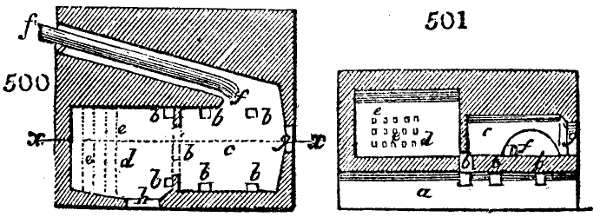
Fig. 500. represents a ground plan of both the spreading and annealing furnace; fig. 501. is an oblong profile in the direction of the dotted line X X, fig. 500.
a is the fire-place; b b the canals or flues through which the flame rises into both furnaces; c the spreading furnace, upon whose sole is the spreading slab. d is the cooling and annealing oven; e e iron bars which extend obliquely across the annealing arch, and serve for resting the glass tables against, during the cooling. f f the channel along which the previously cracked cylinders are slid, so as to be gradually warmed; g the opening in the spreading furnace, for enabling the workmen to regulate the process; h a door in the annealing arch, for introducing the tools requisite for raising up and removing the tables.
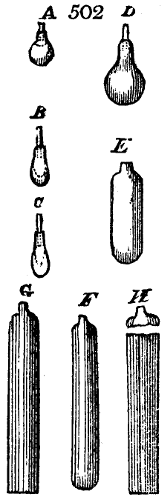
In forming glass-plates by the extension of a cylinder into a plane, the workman first blows the lump of glass into the shape of an oblong pear, the length of which must be nearly equal to the length of the intended plate, and its diameter such, that the circumference when developed, will be equal to the breadth of the plate. He now rests the blowing-iron on a stool or iron bar, while an assistant with a pointed iron, pierces a hole into the extreme end of the pear, in the line of the blowing-pipe. This opening is then enlarged, by introducing the blade of a pair of spring-tongs, while the glass is turned round; and by skilful management, the end of the pear is eventually opened out into a cylindrical mouth. The workman next mounts upon a stool, and holds the blowing-iron perpendicularly. The blown cylinder is now cracked off, a punto rod of iron having been previously stuck to its one end, to form a spindle for working the other by. This rod has a flat disc on its end, or three prongs, which being dipped in melted glass, are applied to the mouth of the cylinder. By this as a handle, the glass cone is carried to the fire, and the narrow end being heated, is next opened by spring tongs, and formed into a cylinder of the same size as the other end. The cylinder thus equalized, is next cracked or slit down in its side with a pair of shears, laid on a smooth copper plate, detached from the iron rod, spread out by heat into a plane surface, and finally annealed. This series of transformations, is represented in fig. 502., at A, B, C, D, E, F, G, H.
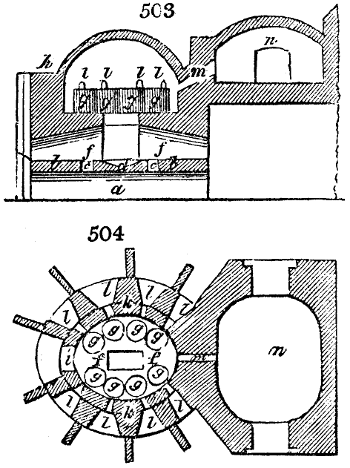
Fig. 503. and 504. represent a Bohemian furnace in which excellent white window glass is founded. Fig. 503. is a longitudinal section of the glass and annealing furnace. Fig. 504. is the ground plan. a is the ash pit vaulted under the sole of the furnace; the fireplace itself is divided into three compartments; with a middle slab at d, which is hollowed in the centre, for collecting any spilt glass, and two hearth tiles or slabs b b. c c are the draught or air holes; e e are arches upon which the bearing slabs f f partly rest. In the middle between these arches, the flame strikes upwards upon the pots g g, placed as closely together as possible, for economy of room. h is the breast wall of the furnace; i, fig. 504., the opening through which the pots are introduced; it is bricked up as soon as they are set. k k, is the base of the cone or dome of the furnace; l l l, the working orifices, which are made larger or smaller according to the size of the glass articles to be made. m is the flue which leads to the annealing stove n, with an arched door. Exterior to this, there is usually a drying kiln not shown in the figure; and there are adjoining stoves called arches, for drying and annealing the new pots before they are set.
The cooling or annealing arch, or leer, is often built independent of the glass-house furnace, is then heated by a separate fire-place, and constructed like a very long reverberatory furnace. See Copper.
The leer pans or trays of sheet iron, are laid upon its bottom in an oblong series, and hooked to each other.
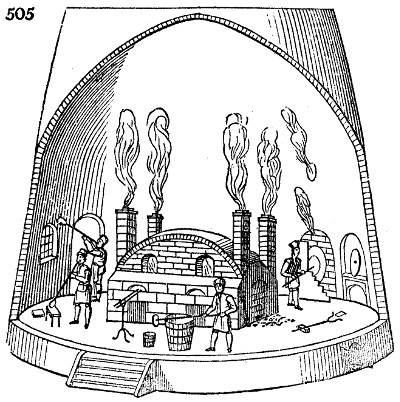
3. Crown-glass.—The crown-glass house with its furnace is represented in fig. 505., where the blowing operation is shewn on the one side of the figure, and the flashing on the other. The furnace is usually constructed to receive 4 or 6 pots, of such dimensions as to make about a ton of glass each at a time. There are, however, several subsidiary furnaces to a crown-house. 1. A reverberatory furnace or calcar, for calcining or fritting the materials; 2. a blowing furnace, for blowing the pear-shaped balls made at the pot-holes, into large globes; 3. a flashing furnace, and bottoming hole for communicating a softening heat, in expanding the globe into a circular plate; 4. the annealing arch for the finished tables; 5. the reverberatory oven for annealing the pots prior to their being set upon the founding siege.
The materials of crown glass used to be, fine sand, by measure 5 parts, or by weight 10; ground kelp by measure 11 parts, or by weight 161⁄2; but instead of kelp, soda ash is now generally employed. From 6 to 8 cwt. of sand, lime, and soda-ash, mixed together in wooden boxes with a shovel, are thrown on the sole of a large reverberatory, such as is represented in the article Copper. Here the mixture is well worked together, with iron paddles, flat shovels, and rakes with long handles; the area of this furnace being about 6 feet square, and the height 2 feet. The heat soon brings the materials to a pasty consistence, when they must be diligently turned over, to favour the dissipation of the carbon, sulphur, and other volatile matters of the kelp or soda ash, and to incorporate the fixed ingredients uniformly with the sand. Towards the end of 3 hours, the fire is considerably raised, and when the fourth hour has expired, the fritting operation is finished. The mass is now shovelled or raked out into shallow cast-iron square cases, smoothed down, and divided before it hardens by cooling, into square lumps, by cross sections with the spade. These frit-bricks are afterwards piled up in a large apartment for use; and have been supposed to improve with age, by the efflorescence of their saline constituents into carbonate of soda on their surface.
The founding-pots are filled up with these blocks of frit, and the furnace is powerfully urged by opening all the subterranean passages to its grate, and closing all the doors and windows of the glass-house itself. After 8 or 10 hours the vitrification has made such progress, and the blocks first introduced are so far melted down, that another charge of frit can be thrown in, and thus the pot is fed with frit till the proper quantity is used. In about 16 hours the vitrification of the frit has taken place, and a considerable quantity, amounting often to the cwt. of liquid saline matter floats over the glass. This salt is carefully skimmed off into iron pots with long ladles. It is called Sandiver or Glass-gall, and consists usually of muriate of soda, with a little sulphate. The pot is now ready for receiving the topping of cullet, which is broken pieces of window glass, to the amount of 3 or 4 cwt. This is shovelled in at short intervals; and as its pressure forces up the residuary saline matter, this is removed; for were it allowed to remain, the body of the glass would be materially deteriorated.
The heat is still continued for several hours till the glass is perfect, and the extrication of gas called the boil, which accompanies the fusion of crown glass, has nearly terminated, when the fire is abated, by shutting up the lower vault doors and every avenue to the grate, in order that the glass may settle fine. At the end of about 40 hours altogether, the fire being slightly raised by adding some coals, and opening the doors, the glass is carefully skimmed, and the working of the pots commences.
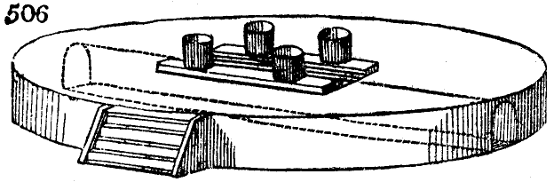
Before describing it, however, we may state that the marginal figure 506. shews the base of the crown-house cone, with the four open pots in two ranges on opposite sides of the furnace, sitting on their raised sieges, at each side of the grate. At one side of the base the door of the vault is shewn, and its course is marked by the dotted lines.
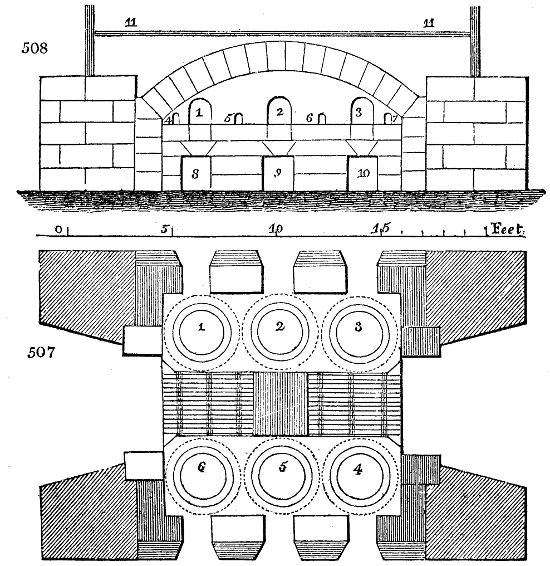
Detailed description of the crown-glass furnace, figs. 507. 508.—It is an oblong square, built in the centre of a brick cone, large enough to contain within it, two or three pots at each side of the grate room, which is either divided as shown in the plan, or runs the whole length of the furnace, as the manufacturer chooses. Fig. 507. is a ground plan, and fig. 508. a front elevation, of a six-pot furnace. 1, 2, 3, fig. 507., are the working holes for the purposes of ventilation, of putting in the materials, and of taking out the metal to be wrought. 4, 5, 6, 7, are pipe holes for warming the pipes before beginning to work with them. 8, 9, 10, are foot holes for mending the pots and sieges. 11 is a bar of iron for binding the furnace, and keeping it from swelling.
The arch is of an elliptic form; though a barrel arch, that is, an arch shaped like the half of a barrel cut longwise through the centre, is sometimes used. But this soon gives way when used in the manufacture of crown glass, although it does very well in the clay-furnace used for bottle houses.
The best stone for building furnaces is fire-stone, from Coxgreen in the neighbourhood of Newcastle. Its quality is a close grit, and it contains a greater quantity of talc than the common fire-stone, which seems to be the chief reason of its resisting the fire better. The great danger in building furnaces is, lest the cement at the top should give way with the excessive heat, and by dropping into the pots, spoil the metal. The top should therefore be built with stones only, as loose as they can hold together after the centres are removed, and without any cement whatever. The stones expand and come quite close together when annealing; an operation which takes from eight to fourteen days at most. There is thus less risk of any thing dropping from the roof of the furnace.
The inside of the square of the furnace is built either of Stourbridge fire-clay annealed, or the Newcastle fire-stone, to the thickness of sixteen inches. The outside is built of common brick about nine inches in thickness.
The furnace is thrown over an ash-pit, or cave as it is called, which admits the atmospheric air, and promotes the combustion of the furnace. This cave is built of stone until it comes beneath the grate room, when it is formed of fire-brick. The abutments are useful for binding and keeping the furnace together, and are built of masonry. The furnaces are stoutly clasped with iron all round, to keep them tight. In four-pot furnaces this is unnecessary, provided there be four good abutments.
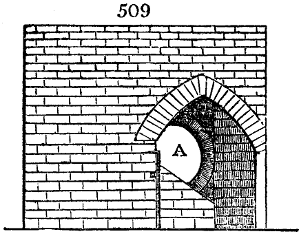
Fig. 509. is an elevation of the flashing furnace. The outside is built of common brick, the inside of fire-brick, and the mouth or nose of Stourbridge fire-clay.
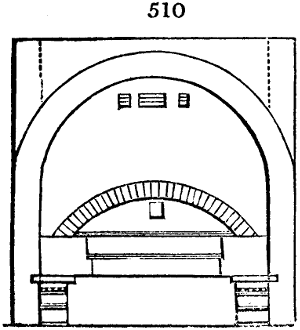
Fig. 510. is the annealing kiln. It is built of common brick, except round the grate room, where fire-brick is used.
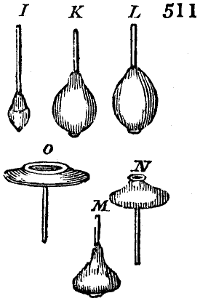
Few tools are needed for blowing and flashing crown-glass. The requisite ball of plastic glass is gathered, in successive layers as for bottles, on the end of an iron tube, and rolled into a pear-shape, on a cast-iron plate; the workman taking care that the air blown into its cavity is surrounded with an equal body of glass, and if he perceives any side to be thicker than another, he corrects the inequality by rolling it on the sloping iron table called marver, (marbre). He now heats the bulb in the fire, and rolls it so as to form the glass upon the end of the tube, and by a dexterous swing or two he lengthens it, as shewn in I, fig. 511. To extend the neck of that pear, he next rolls it over a smooth iron rod, turned round in a horizontal direction, into the shape K, fig. 511. By further expansion at the blowing-furnace, he now brings it to the shape L, represented in fig. 511.
This spheroid having become cool and somewhat stiff, is next carried to the bottoming hole (like fig. 509.), to be exposed to the action of flame. A slight wall erected before one half of this hole, screens the workman from the heat, but leaves room for the globe to pass between it and the posterior wall. The blowing-pipe is made to rest a little way from the neck of the globe, on a hook fixed in the front wall; and thus may be made easily to revolve on its axis, and by giving centrifugal force to the globe, while the bottom of it, or part opposite to the pipe, is softened by the heat, it soon assumes the form exhibited in M, fig. 511.
In this state the flattened globe is removed from the fire, and its rod being rested on the casher box covered with coal cinders, another workman now applies the end of a solid iron rod tipped with melted glass, called a punto, to the nipple or prominence in the middle; and thus attaches it to the centre of the globe, while the first workman cracks off the globe by touching its tubular neck with an iron chisel dipped in cold water. The workman having thereby taken possession of the globe by its bottom or knobbed pole attached to his punty rod, he now carries it to another circular opening, where he exposes it to the action of moderate flame with regular rotation, and thus slowly heats the thick projecting remains of the former neck, and opens it slightly out, as shewn at N, in fig. 511. He next hands it to the flasher, who resting the iron rod in a hook placed near the side of the orifice A, fig. 509., wheels it rapidly round opposite to a powerful flame, till it assumes first the figure O, and finally that of a flat circular table.
The flasher then walks off with the table, keeping up a slight rotation as he moves along, and when it is sufficiently cool, he turns down his rod into a vertical position, and lays the table flat on a dry block of fire-clay, or bed of sand, when an assistant nips it off from the punto with a pair of long iron shears, or cracks it off with a touch of cold iron. The loose table or plate is lastly lifted up horizontally on a double pronged iron fork, introduced into the annealing arch fig. 510. and raised on edge; an assistant with a long-kneed fork preventing it from falling too rapidly backwards. In this arch a great many tables of glass are piled up in iron frames, and slowly cooled from a heat of about 600° to 100° F., which takes about 24 hours; when they are removed. A circular plate or table of about 5 feet diameter weighs on an average 9 pounds.
4. Flint glass.—This kind of glass is so called because originally made with calcined flints, as the siliceous ingredient. The materials at present employed in this country for the finest flint glass or crystal, are first, Lynn sand, calcined, sifted, and washed; second, an oxide of lead, either red lead or litharge; and third, pearl ash. The pearl ash of commerce must however be purified by digesting it in a very little hot water, which dissolves the carbonate of potash, and leaves the foreign salts, chiefly sulphate of potash, muriate of potash, and muriate of soda. The solution of the carbonate being allowed to cool and become clear in lead pans, is then run off into a shallow iron boiler, and evaporated to dryness. Nitre is generally added as a fourth ingredient of the body of the glass; and it serves to correct any imperfections which might arise from accidental combustible particles, or from the lead being not duly oxidized. The above four substances constitute the main articles; to which we may add arsenic and manganese, introduced in very small quantities, to purify the colour and clear up the transparency of the glass. The black oxide of manganese, when used in such quantity only as to peroxidize the iron of the sand, simply removes the green tinge caused by the iron; but if more manganese be added than accomplishes that purpose, it will give a purple tinge to the glass; and in fact, most manufacturers prefer to have an excess rather than a defect of manganese, since cut glass has its brilliancy increased by a faint lilac hue. The arsenic is supposed to counteract the injury arising from excess of manganese, but is itself very apt on the other hand to communicate some degree of opalescence, or at least, to impair the lustre of the glass. When too much manganese has been added, the purple tinge may indeed be removed by any carbonaceous matter, as by thrusting a wooden rod down into the liquid glass; but this cannot be done with good effect in practice, since the final purple tinge is not decided till the glass is perfectly formed, and then the introduction of charcoal would destroy the uniformity of the whole contents of the pot.
The raw materials of flint glass, are always mixed with about a third or a fourth of their weight of broken crystal of like quality; this mixture is thrown into the pot with a shovel; and more is added whenever the preceding portions by melting subside; the object being to obtain a pot full of glass, to facilitate the skimming off the impurities, and sandiver. The mouth of the pot is now shut, by applying clay-lute round the stopper, with the exception of a small orifice below, for the escape of the liquid saline matter. Flint glass requires about 48 hours for its complete vitrification, though the materials be more fusible than those of crown glass; in consequence of the contents of the pot being partially screened by its cover from the action of the fire, as also from the lower intensity of the heat.
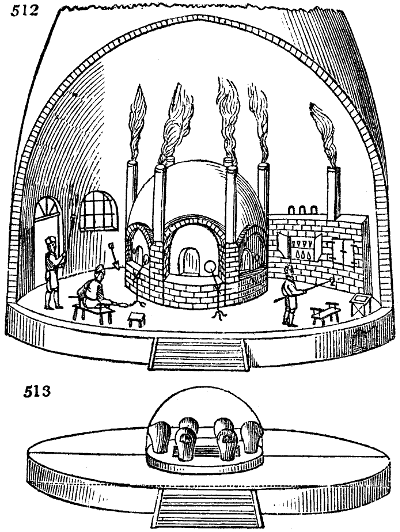
Fig. 512. represents a flint glass house for 6 pots, with the arch or leer on one side for annealing the crystal ware. In fig. 513., the base of the cone is seen, and the glass pots in situ on their platform ranged round the central fire grate. The dotted line denotes the contour of the furnace, fig. 512.
Whenever the glass appears fine, and is freed from its air bubbles, which it usually is in about 36 hours, the heat is suffered to fall a little by closing the bottom valves, &c., that the pot may settle; but prior to working the metal, the heat is somewhat raised again.
It would be useless to describe the manual operations of fashioning the various articles of the flint-glass manufacture, because they are indefinitely varied to suit the conveniences and caprices of human society.
Every different flint-house has a peculiar proportion of glass materials. The following have been offered as good practical mixtures.
1. Fine white sand 300 parts.
Red lead or litharge 200
Refined pearl ashes 80
Nitre 20
Arsenic and manganese, a minute quantity.
In my opinion, the proportion of lead is too great in the above recipe, which is given on the authority of Mr. James Geddes, of Leith. The glass made with it would be probably yellowish, and dull.
2. Fine sand 50·5
Litharge 27·2
Refined pearl ashes (carbonate of potash, with 5 per cent. of water) 17·5
Nitre 4·8
100·0
To these quantities from 30 to 50 parts of broken glass or cullet are added; with about a two-thousandth part of manganese, and a three-thousandth part of arsenic. But manganese varies so extremely in its purity, and contains often so much oxide of iron, that nothing can be predicated as to its quantity previously to trial.
M. Payen, an eminent manufacturing chemist in France, says that the composition of crystal does not deviate much from the following proportions:—
Wood fire. Coal fire.
Siliceous sand 3 3
Minium 2 2 1⁄4
Carbonate of potash 1 1⁄2 1 2⁄3
I conceive that this glass contains too much lead and potash. Such a mixture will produce a dull metal, very attractive of moisture: defects to which the French crown-glass also is subject.
The flint-glass leer for annealing glass, is an arched gallery or large flue, about 36 feet long, 3 feet high, 4 wide; having its floor raised above 2 feet above the ground of the glass-house. The hot air and smoke of a fire-place at one end pass along this gallery, and are discharged by a chimney 8 or 10 feet short of the other end. On the floor of the vault, large iron trays are laid and hooked to each other in a series, which are drawn from the fire end towards the other by a chain, wound about a cylinder by a winch-handle projecting through the side. The flint-glass articles are placed in their hot state into the tray next the fire, which is moved onwards to a cooler station whenever it is filled, and an empty tray is set in its place. Thus, in the course of about 20 hours, the glass advances to the cool end thoroughly annealed.
Besides colourless transparent glass, which forms the most important part of this manufacture, various coloured glasses are made to suit the taste of the public. The taste at Paris was lately for opaline crystal; which may be prepared by adding to the above composition (No. 2.) phosphate of lime, or well burnt bone-ash in fine powder, washed, and dried. The article must be as uniform in thickness as possible, and speedily worked into shape, with a moderate heat. Oxide of tin, putty, was formerly used for making opalescent glass, but the lustre of the body was always impaired by its means.
Crystal vessels have been made recently of which the inner surface is colourless, and all the external facets coloured. Such works are easily executed. The end of the blowing-rod must be dipped first in the pot containing colourless glass, to form a bulb of a certain size, which being cooled a little is then dipped for an instant into the pot of coloured glass. The two layers are associated without intermixture; and when the article is finished in its form, it is white within and coloured without. Fluted lines somewhat deeply cut, pass through the coloured coat, and enter the colourless one; so that when they cross, their ends alone are coloured.
For some time past, likewise, various crystal articles have been exhibited in the market with coloured enamel-figures on their surface, or with white incrustations of a silvery lustre in their interior. The former are prepared by placing the enamel object in the brass mould, at the place where it is sought to be attached. The bulb of glass being put into the mould, and blown while very hot, the small plate of enamel gets cemented to the surface. For making the white argentine incrustations, small figures are prepared with an impalpable powder of dry porcelain paste, cemented into a solid by means of a little gypsum plaster. When these pieces are thoroughly dried, they are laid on the glass while it is red hot, and a large patch of very liquid glass is placed above it, so as to encase it and form one body with the whole. In this way the incrustation is completely enclosed; and the polished surface of the crystal which scarcely touches it, gives a brilliant aspect, pleasing to the eye.
An uniform flint-glass, free from striæ, or wreath, is much in demand for the optician. It would appear that such an article was much more commonly made by the English manufacturers many years ago, than at present; and that in improving the brilliancy of crystal-glass they have injured its fitness for constructing optical lenses, which depends not so much on its whiteness and lustre as on the layers of different densities being parallel to each other. The oxide of lead existing in certain parts of a potful of glass in greater proportion than in other parts, increases the density unequally in the same mass, so that the adjoining strata are often very different in this respect. Even a potful of pretty uniform glass, when it stands some time liquid, becomes eventually unequable by the subsidence of the denser portions; so that striæ and gelatinous appearances begin to manifest themselves, and the glass becomes of little value. Glass allowed to cool slowly in mass in the pot is particularly full of wreath; and if quickly refrigerated, that is in two or three hours, it is apt to split into a multitude of minute splinters, of which no use can be made. For optical purposes, the glass must be taken out in its liquid state, being gathered on the end of the iron rod from the central portion of a recently skimmed pot, after the upper layers have been worked off in general articles.