C. (continued 2)
Reading edition
Before entering upon the different styles of work which constitute calico printing, I shall treat, in the first place, of what is common to them all, namely, the thickening of the mordants and colours. This is an operation of the greatest importance towards the successful practice of the art. Several circumstances may require the consistence of the thickening to be varied; such as the nature of the mordant, its density, and its acidity. A strong acid mordant cannot be easily thickened with starch; but it may be by roasted starch, vulgarly called British gum, and by gum arabic or senegal. Some mordants which seem sufficiently inspissated with starch, liquefy in the course of a few days; and being apt to run in the printing-on make blotted work. In France, this evil is readily obviated, by adding one ounce of spirits of wine to half a gallon of colour; a remedy which the English excise duties render too costly.
The very same mordant, when inspissated to different degrees, produces different tints in the dye-copper; a difference due to the increased bulk from the thickening substance; thus, the same mordant, thickened with starch, furnishes a darker shade than when thickened with gum. Yet there are circumstances in which the latter is preferred, because it communicates more transparency to the dyes, and because, in spite of the washing, more or less of the starch always sticks to the mordant. The gum has the inconvenience, however, of drying too speedily, and of also increasing too much the volume of the mordants; by both of which causes it obstructs their combination with the stuff, and the tints become thin or scratchy.
The substances generally employed as thickeners, are the following:—
Wheat starch.
Flour.
Roasted starch.
Gum senegal.
Gum tragacanth.
Salep.
Pipe-clay, mixed with gum senegal.
Sulphate of lead.
Sugar.
Molasses.
Glue.
After thickening with gum, we ought to avoid adding metallic solutions in the liquid state; such as nitrate of iron, of copper, solutions of tin, of subacetate of lead, &c.; as they possess the property of coagulating gum. I shall take care to specify the nature and proportion of thickening to be employed for each colour; a most important matter, hitherto neglected by English writers upon calico printing.
The atmosphere of the printing shops should never be allowed to cool under 65° or 70° F.; and it should be heated by proper stoves in cold weather, but not rendered too dry. The temperature and moisture should therefore both be regulated with the aid of thermometers and hygrometers, as they exercise a great influence upon all the printing processes, and especially upon the combination of the mordant with the cloth. In the course of the desiccation, a portion of the acetic acid evaporates with the water, and subacetates are formed, which combine with the stuff in proportion as the solvent principle escapes; the water as it evaporates carries off acetic acid with it, and thereby aids the fixation of bases. These remarks are peculiarly appropriate to delicate impressions by the cylinder machine, where the printing and drying are both rapidly effected. In the lapis lazuli style, the strong mordants are apt to produce patches, being thickened with pipe-clay and gum, which obstruct the evaporation of the acids. They are therefore apt to remain, and to dissolve a portion of the mordants at their immersion in the blue vat, or at any rate, in the dung bath. In such a case a hot and humid air is indispensable, after the application of the mordants; and sometimes the stuffs so impregnated, must be suspended in a damp chamber. To prevent the resist pastes becoming rapidly crusty, substances apparently useless are mixed with them, but which act beneficially by their hygrometric qualities, in retarding the desiccation. Oil also is sometimes added with that view.
It is often observed that goods printed upon the same day, and with the same mordant, exhibit inequalities in their tints. Sometimes the colour is strong and decided in one part of the piece, while it is dull and meagre in another. The latter has been printed in too dry an atmosphere. In such circumstances a neutral mordant answers best, especially if the goods be dried in a hot flue, through which humid vapours are in constant circulation.
In padding, where the whole surface of the calico is imbued with mordant, the drying apartment or flue, in which a great many pieces are exposed at once, should be so constructed as to afford a ready outlet to the aqueous and acid exhalations. The cloth ought to be introduced into it in a distended state; because the acetic acid may accumulate in the foldings, and dissolve out the earthy or metallic base of the mordant, causing white and gray spots in such parts of the printed goods. Fans may be employed with great advantage, combined with Hot Flues. (See this article.)
In the colour laboratory, all the decoctions requisite for the print work should be ready prepared. They are best made by a steam heat, by means of copper boilers of a cylindric form, rounded at the bottom, and encased within a cast-iron cylinder, the steam being supplied to the space between the two vessels, and the dye-stuff and water being introduced into the interior one, which for some delicate purposes may be made of tin, or copper tinned inside. A range of such steam apparatus should be placed either along one of the side walls, or in the middle line of the laboratory. Proper tables, drawers, phials, with chemical reagents, measures, balances, &c., should also be provided. The most useful dye-extracts are the following:—
Decoction of logwood, of Brazil wood, of Persian berries, of quercitron bark, of nut-galls, of old fustic, of archil or cutbear, of cochineal, of cochineal with ammonia, of catechu.
The following mordants should also be kept ready prepared:—
1. Aluminous mordant. 1. Take 50 gallons of boiling water. 1. Take 100 lbs. of alum. 1. Take 10 lbs. of soda crystals. 1. Take 75 lbs. of acetate of lead.
The soda should be added slowly to the solution of the alum in the water, and when the effervescence is finished, the pulverized acetate of lead is put in and well stirred about till it be all dissolved and decomposed. During the cooling, the mixture should be raked up a few times, and then allowed to settle. The supernatant liquor is the mordant; it has a density of 11° or 111⁄2° Baumé. It serves for reds and pinks, and enters into the composition of puce and lilac.
2. Aluminous mordant. 2. Take 50 gallons of water. 2. Take 100 lbs. of alum. 2. Take 10 lbs. of soda crystals. 2. Take 100 lbs. of acetate of lead;—operate as above directed.
The supernatant liquor here has a density of 12° Baumé; it is employed for lapis resists or reserves, and the cylinder printing of madder reds.
3. Aluminous mordant. 3. Take 50 gallons of water. 3. Take 100 lbs. of alum. 3. Take 6 lbs. of soda crystals. 3. Take 50 lbs. of acetate of lead;—operate as above directed.
This mordant is employed for uniform yellow grounds.
4. Aluminous mordant.
This is made by adding potash to a solution of alum, till its earth begins to be separated, then boiling the mixture to precipitate the subsulphate of alumina, which is to be strained upon a filter, and dissolved in acetic acid of moderate strength with the aid of heat. This mordant is very rich in alumina, and marks 20° B.
5. Aluminous mordant. 5. Take 121⁄2 gallons of water. 5. Take 100 lbs. of alum. 5. Take 150 lbs. of liquid pyrolignite of lime at 111⁄2° Baumé.
This mordant is made with heat like the first; after cooling, some alum crystallizes, and it marks only 121⁄2° B.
A mordant is made by solution of alum in potash, commonly called—
6. Aluminate of potash. The caustic lye is prepared by boiling together for an hour 100 gallons of water, 200 lbs. of potash, and 80 lbs. of quicklime; the mixture is then allowed to settle, the supernatant liquor is decanted, and evaporated till its density be 35° B. In 30 gallons of that lye at a boiling heat, 100 lbs. of ground alum are to be dissolved. On cooling, crystals of sulphate of potash separate. The clear liquor is to be decanted off, and the crystals being washed with a little water, this is to be added to the lye. About 33 gallons of mordant should be obtained.
Mordant for Black.
The pyrolignite of iron called iron liquor in this country, is the only mordant used in calico-printing for black, violet, puce, and brown colours. The acetate of alumina, prepared from pyrolignous acid, is much used by the calico-printers under the name of red or yellow liquor, being employed for these dyes.
We may observe that a strong mordant, like No. 2., does not keep so well as one of mean density, such as No 1. Too much mordant relatively to the demands of the works should therefore not be made at a time.
There are eight different styles of calico-printing, each requiring different methods of manipulation, and peculiar processes.
1. The madder style, to which the best chintzes belong, in which the mordants are applied to the white cloth with many precautions, and the colours are afterwards brought up in the dye-bath. These constitute permanent prints.
2. The padding or plaquage style, in which the whole surface of the calico is imbued with a mordant, upon which afterwards different coloured figures may be raised, by the topical application of other mordants joined to the action of the dye-bath.
3. The reserve style, where the white cloth is impressed with figures in resist paste, and is afterwards subjected first to a cold dye, as the indigo vat, and then to a hot dye-bath, with the effect of producing white or coloured spots upon a blue ground.
4. The discharge or rongeant style, in which thickened acidulous matter either pure or mixed with mordants, is imprinted in certain points upon the cloth, which is afterwards padded with a dark-coloured mordant, and then dyed, with the effect of showing bright figures on a darkish ground.
5. China blues; a style resembling blue stone-ware, which requires very peculiar treatment.
6. The decolouring or enlevage style; by the topical application of chlorine or chromic acid to dyed goods. This is sometimes called a discharge.
7. Steam colours; a style in which a mixture of dye extracts and mordants are topically applied to calico, while the chemical reaction which fixes the colours to the fibre is produced by steam.
8. Spirit colours; produced by a mixture of dye extracts, and solution of tin, vulgarly called spirit by dyers. These colours are brilliant but fugitive.
I. The madder style; called by some dip colours. The true chintz patterns belong to it; they have from 5 to 7 colours, several of which are grounded-in after the first dye has been given in the madder bath.
In dyeing with madder; sumach, fustic or quercitron, is sometimes added to the bath, in order to produce a variety of tints with the various mordants at one operation.
1. Suppose we wish to produce flowers or figures of any kind containing red, purple, and black colours, we may apply the three mordants at once, by the three-colour cylinder machine, putting into the first trough acetate of alumina thickened; into the second, acetate of iron; and into the third, a mixture of the two; then drying in the air for a few days to fix the iron, dunging, and dyeing up in a bath of madder and sumach. If we wish to procure the finest madder reds and pinks, besides the purple and black, we must apply at first only the acetate of alumina of two densities, by two cylinders, dry, dung, and dye up, in a madder bath. The mordants of iron liquor for the black, and of iron liquor mixed with the aluminous for purple, must be now grounded-in by blocks, taking care to insert these mordants into their precise spots: the goods being then dried with airing for several days, and next dunged, are dyed up in a bath of madder and sumach. They must be afterwards cleared by branning. See Bran, Dunging, and Madder.
2. Suppose we wish to produce yellow with red, pink, purple and black; in this case the second dye-bath should contain quercitron or fustic, and the spots intended to be yellow should receive the acetate of alumina mordant.
3. The mordant for a full red may be acetate of alumina, of spec. grav. 1·055 thickened with starch, and tinged with Brazil wood; that for a pale red or pink, the same at spec. gravity 1·014, thickened with gum; that for a middling red, the same at spec. gravity, 1·027, thickened with British gum; and for distinction’s sake, it may be tinged yellow with Persian berries. The mordant for black is a pyrolignous acetate of iron, of specific gravity 1·04; for purple the same, diluted with six times its volume of water; for chocolate, that iron liquor mixed with acetate of alumina, in various proportions according to the shade wanted. Sumach is mixed with the madder for all these colours except for the purple. The quantity of madder required varies according to the body of colour to be put upon the cloth, being from one pound per piece to three or even four. The goods must be entered when the copper is cool, be gradually heated during two or three hours, up to ebullition, and sometimes boiled for a quarter of an hour; the pieces being all the while turned with a wince from the one side of the copper to the other. (See Wince.) They are then washed and boiled in bran and water for ten or fifteen minutes. When there is much white ground in the chintz, they must be branned a second or even a third time, with alternate washing in the dash-wheel. To complete the purification of the white, they are spread upon the grass for a few days; or what is more expeditious, and equally good if delicately managed, they are winced for a few minutes in a weak solution of chloride of lime.
4. In the grounding-in for yellow, after madder reds, the aluminous mordant being applied, &c., the piece is dyed, for about an hour, with one pound of quercitron bark, the infusion being gradually heated to 150° or 160°, but not higher.
5. A yellow is sometimes applied in chintz work after the other colours are dyed, by means of a decoction of Persian berries mixed with the aluminous mordant, thickened with flour or gum, and printed-on with the block; the piece, when dry, is passed through a weak carbonated alkaline water, or lime water, then washed and dried for the market.
6. Black mordant.—Take half a gallon of acetate of iron, of spec. grav. 1·04, 4 ounces of starch, and 4 ounces of flour. The starch must first be moistened with the acetate, then the flour must be added, the rest of the acetate well mixed with both, and the whole made to boil over a brisk fire for five minutes, stirring meanwhile to prevent adhesion to the bottom of the pot. The colour must be poured into an earthen pipkin, and well mixed with half an ounce of gallipoli oil. In general, all the mordants, thickened with starch and flour, must be boiled, for a few minutes. With British gum or common gum, they must be heated to 160° F., or thereby, for the purpose merely of dissolving them. The latter should be passed through a sieve to separate the impurities often present in common gum.
7. Puce mordant.—Take a quart of acetate of alumina and acetate of iron, each of spec. grav. 1·04, mixed and thickened like the black, No. 6. To give the puce a reddish tinge, the acetate of alumina should have a specific gravity of 1·048, and the iron liquor only 1·007.
Red mordants are thickened with British gum, and are sufficiently coloured with the addition of any tingeing decoction.
8. Violet mordants.—These consist either of a very weak solution of acetate of iron, of spec. gravity 1·007, for example; or of a little of the stronger acetate of 1·04, mixed with acetate of alumina, and a little acetate of copper, thickened with starch or British gum. The shades may be indefinitely varied by varying the proportions of the acetates.
When black is one of the colours wanted, its mordant is very commonly printed-on first, and the goods are then hung upon poles in the drying-room, where they are aired for a few days, in order to fix the iron by its peroxidizement; the mordants for red, violet, &c., are then grounded in, and the pieces are dyed up, after dunging and washing, in the madder bath, into which, for certain shades, sumach, galls, or fustic, is added. The goods are brightened with a boil in soap water; occasionally also in a bath, containing a small quantity of solution of tin or common salt. The following mode of brightening is much extolled by the French, who are famous for their reds and roses.
1. A soap boil of forty minutes, at the rate of 1 pound for every 2 pieces. Rinse in clear water.
2. Pass through chloride of soda solution of such strength that two parts of it decolour one part of Gay Lussac’s test liquor. See Chloride of Lime and Indigo. Wince the pieces through it for 40 minutes. Rinse again.
3. Pass it again through the soap bath, No. 1.
4. Brighten it in a large bath of boiling water, containing 4 pounds of soap, and 1 pound of a cream-consistenced salt of tin, containing nearly half its weight of the muriate of tin, combined with as much nitric acid of spec. grav. 1·288. This strong nitro-muriate having been diluted with a little water, is to be slowly poured into the bath of soap water, and well mixed by stirring. The pieces are now put in, and winced through it for one half, or three quarters of an hour.
5. Repeat the soap boil, No. 1. Rinse and dry.
9. Grounding in of Indigo blue.
Take half a gallon of water of 120° F., 8 ounces of ground indigo, and 8 ounces of red sulphuret of arsenic (orpiment), 8 ounces of quicklime, mix together, and heat the mixture to the boiling point; withdraw from the fire, and add, when it is lukewarm, 6 ounces of carbonate of soda, stir and leave the whole at rest till the next day. Then decant the clear liquor, and thicken every quart of it with half a pound of gum. This colour ought to be green, and be preserved in a close vessel. When used it is put into a pot with a narrow orifice, the pencil is dipped into it, wiped on the edge of the pot, and immediately applied by hand. This plan is tedious, and is nearly superseded by the following grounding blue.
Take half a gallon of caustic soda lye of spec. grav. 1·15, heated to 120° F.
12 ounces of hydrate of protoxide of tin, obtained by precipitating it from the muriate of tin by solution of potash.
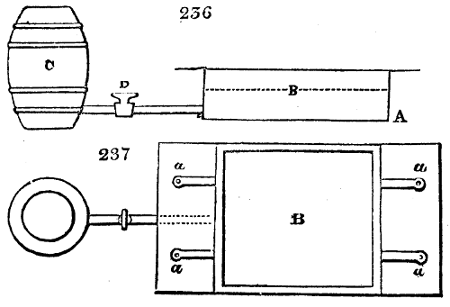
8 ounces of ground indigo; heat these mixed ingredients to the boiling point, then move the pot off and on the fire two or three times in succession, and finally thicken, with 3 pounds of raw sugar. In order to apply this by the block, the following apparatus is employed, called the canvass frame; figs. 236. 237. It is formed of a copper case or box A, in which is laid a frame B, filled with pretty stout canvass. The box communicates by a tube with the cistern C, mounted with a stop-cock D. Fig. 237. represents the apparatus in plan: A, the box; B, the canvass, with its edges a a a a, fixed by pin points to the sides. The colour is teared (tiré), or spread even, with a wooden scraper as broad as the canvass. In working with this apparatus, the colour being contained in the vessel C is drawn off into the case A, by opening the stop-cock D, till it rises to the level of the canvass. The instant before the printer daubs the block upon the canvass, the tearer (tireur), boy or girl, runs the scraper across it to renew its surface; and the printer immediately transfers the colour to the cloth. In this kind of printing great skill is required to give evenly impressions. As the blue is usually applied to somewhat large designs, it is very apt to run; an inconvenience counteracted by dusting fine dry sand upon the cloth as soon as it is blocked. The goods must be washed within 24 hours after being printed.
10. Topical grounding blue for the cylinder press.
Take 31⁄2 gallons of caustic soda lye of spec. grav. 1·15. Take 31⁄2 lbs. of ground indigo. Take 5 lbs. of precipitated protoxide of tin (as above).
Boil the mixed ingredients for ten minutes, take them from the fire, and add, first, 3 lbs. of Venice turpentine; then 11 lbs. of gum.
Put this mixture into the colour trough, print with it, and after two days wash in the dash-wheel; then pass it through a soap bath, along with a little soda, to brighten the blue, and to take off its greyish tint.
The use of the turpentine is easily explained; it serves to exclude the atmospherical oxygen, and prevent the regeneration of the indigo blue, before it is spread upon the cloth.
After the application to white calico of a similar blue, into which a little acid muriate of tin has been put, the goods are dipped for ten minutes in thin milk of lime, shaking the frame all the time. They are then washed, and cleared with a soap boil. The following colour remains long in the deoxidized state from its containing 8 ounces of indigo, 10 ounces of hydrated protoxide of tin, and 11⁄2 pounds of solution of muriate of tin, to 2 quarts of soda lye of 1·15, thickened with 21⁄2 pounds of gum. This blue may be applied by either the block or the cylinder.
11. Topical Prussian blue for grounding.
2 quarts of water with 8 ounces of starch, are to be mixed and boiled; add 21⁄4 ounces of a liquid Prussian blue colour, prepared by triturating three quarters of an ounce of that pigment with as much muriatic acid, leaving the ingredients to react upon each other for 24 hours, and then adding three quarters of an ounce of water.
Add 4 ounces of liquid perchloride of tin (oxymuriate).
Mix all together, and pass through a searce. This colour is not very fast; cloth printed with it will bear only rinsing.
12. Prussian blue figures are impressed as follows:—
Dissolve 8 ounces of sulphate of iron, and as much acetate of lead, separately in 2 quarts of boiling water; mix well, and settle. Take one quart of this clear liquor reduced to spec. grav. 1·02, one quart of mucilage containing 3 pounds of gum, coloured with a little prussiate of potash, mix into a mordant, and print it on with the cylinder. Two days afterwards wash in tepid water containing a little chalk, and then pass the cloth through a solution of prussiate of potash in water, sharpened with a little muriatic acid, till it takes the desired hue. Finally rinse.
II. The padding or plaquage style, called foulard also by the French. See Padding.
Any mordant whatever, such as the acetates of alumina, or of iron, or their mixture, may be applied to the piece by the padding machine, after which it is dried in the HOT-FLUE, washed, dunged, dyed, washed, and brightened.
Colours from metallic oxides are very elegantly applied by the padding process. Thus the iron buff, the manganese bronze, and the chrome yellows and greens are given.
1. Iron buff or chamois.
Take 50 gallons of boiling water; Take 150 pounds of sulphate of iron; dissolve along with Take 10 pounds of alum; which partly saturate by the gradual addition of Take 5 pounds of crystals of soda; and in this mixture dissolve Take 50 pounds of pyrolignous acetate of lead. Allow the whole to settle, and draw off the clear supernatant liquid.
For furniture prints this bath should have the spec. grav. 1·07.
The calico being padded in it, is to be dried in the hot-flue; and after 48 hours suspension is to be washed in water at 170° containing some chalk, by the wince apparatus. It is then washed, by the same apparatus, in hot water, containing a pailful of soda lye of spec. grav. 1·04.
For light tints the padding liquor should be reduced to the spec. grav. 1·01. The dye in either case may be brightened by wincing through a weak solution of chloride of lime.
Nitrate of iron diffused through a body of water may be also used for padding, with alternate washings in water, and a final wincing in a weak alkaline lye.
With a stronger solution, similar to the first, the boot-top colour is given.
2. The bronze or solitaire.
The goods are to be padded in a solution of the sulphate or muriate of manganese, of a strength proportional to the shade desired, dried in the hot-flue, and then raised by wincing them in a boiling-hot caustic lye, of spec. grav. 1·08, and next through a weak solution of chloride of lime, or soda. They are afterwards rinsed. Instead of passing them through the chloride, they may be merely exposed to the air till the manganese attracts oxygen, then rinsed, and dried.
When the manganese solution has the density of 1·027, it gives a light shade; at the density of 1·06, a shade of moderate depth, and at 1·12 a dark tint.
The texture of the stuff is apt to be injured during the oxidation of the manganese.
3. Carmelite is obtained by padding in a mixture of muriate or sulphate of manganese and acetate of iron, then proceeding as above.
4. Copper green is given by padding in a mixed solution of sulphate and acetate of copper with a little glue, drying in the hot-flue, and next day padding in a caustic lye of spec. grav. 1·05. The goods are then rinsed, and padded through a solution made with 8 ounces of arsenious acid combined with 4 ounces of potash diluted with 2 gallons of water. They are finally rinsed and dried.
5. Olive and cinnamon colours are given by padding through mixed solutions of the acetate of iron and sulphate of copper; drying, and padding in a caustic lye of spec. grav. 1·05.
6. Green and solitaire form a pleasing umber, or hellebore shade, which may be obtained by padding through a mixed solution of manganese and aceto-sulphate of copper and raising the shades, as above prescribed.
7. Chrome yellow.
Pad in a solution of bichromate of potash containing 8 ounces of it to the gallon of water; then dry with moderate heat, and pad in a solution of acetate or nitrate of lead, containing 6 or 8 ounces in the gallon of water; wash, and dry. Or we may pad first in a solution of acetate of lead containing a little glue; dry, and pad in solution of bichromate of potash. Then rinse. The last process is apt to occasion cloudiness. To obtain a light lemon tint, we must pad in a solution of acetate of lead of double the above strength, or 16 ounces to the gallon, then wince the pieces through weak milk of lime, rince, pad through bichromate of potash, rinse, and dry.
8. Chrome orange.
Pad through a mixed solution of the subacetate and acetate of lead, three times in succession, and dry in the hot-flue; then wince for ten minutes through weak milk of lime; rinse; wince for a quarter of an hour in a warm solution of bichromate of potash; and finally raise the colour by wincing the goods through hot lime water.
9. Prussian blue.
Pad in the preceding chamois liquor of the spec. grav. 1·007; dry in the hot-flue; wince well in chalky water at 160° F., and then dye by wincing in the following liquor:—
Dissolve 5 ounces of prussiate of potash, in 25 gallons of water heated to 90° or 100°, adding 2 ounces of sulphuric acid; afterwards rinse, and brighten in a very dilute sulphuric acid.
10. Green is given by padding goods, previously dyed in the indigo vat, in a solution of acetate of lead containing a little glue; and then padding them in a warm solution of bichromate of potash; finally rinsing and drying.
III. Resist pastes or reserves; these are subservient to the cold indigo vat, and they may be distributed under four heads; 1. fat reserves; 2. reserves with bases of metallic salts; 3. coloured reserves capable of assuming different tints in the dyeing; 4. reserves with mordants, for the cloth to be afterwards subjected to a dyeing bath, whereby variously coloured figures are brought up on a blue ground, so as to resemble the mineral called lazulite; whence the name lapis or lapis lazuli.
1. The fatty resists are employed in the printing of silk; which see infra.
2. With regard to reserves the following general observations may be made. After printing-on the paste, the goods must be hung up in a chamber, rather humid than too dry, and left there for a certain time, more or less, according to the nature of the reserve. In dipping them into the blue vat, if the reserve be too dry, it is apt to swell, scale off, and vitiate the pattern. This accident is liable to happen also when the vat is deficient in lime, especially with deep blues.
1. Simple white resist paste for a full body of blue.
Take 1 gallon of water, in which are to be dissolved,
1 pound of binacetate of copper (distilled verdigris), and 3 libs. of sulphate of copper. This solution is to be thickened with 2 libs. of gum senegal, 1 lib. of British gum, and 4 libs. of pipe-clay; adding afterwards, 2 ounces of nitrate of copper—as a deliquescent substance.
2. White reserve for light blues.
Take 1 gallon of water, in which dissolve
4 ounces of binacetate of copper, 1 lib. of sulphate of copper; and thicken this solution with 2 libs. of gum senegal, 1 lib. of British gum, and 4 libs. of pipe-clay.
3. White reserve for the cylinder machine.
Take 11⁄2 gallons of water; in which dissolve
21⁄2 libs. of binacetate of copper, 10 libs. of sulphate of copper; and add to the solution 6 libs. of acetate of lead; then thicken with 10 libs. of gum; adding afterwards 10 libs. of sulphate of lead.
After printing-on this reserve, the goods are to be hung up for two days, then dipped till the proper blue tint be obtained. Finally they must be winced through dilute sulphuric acid to clear up the white, by removing the cupreous tinge.
3. Coloured reserves.
1. Chamois reserve.
Take 1 gallon of the chamois bath (No. 1. page 226, at bottom); to which add
8 ounces of nitrate of copper, 24 ditto of muriate of zinc; thicken with 6 pounds of pipe clay, and 3 libs. of gum senegal.
After printing-on this paste, the goods must be hung up for five or six days in a somewhat damp room. Then after having dipped them in the vat, they are to be steeped in water for half an hour, and slightly washed. Next wince for half an hour, through water at 100° F. containing 2 pounds of soda crystals per 30 gallons. Rinse and dry.
2. Chrome yellow reserve.
Take 1 gallon of water; in which dissolve
3 libs. of nitrate of lead, 1 lib. of binacetate of copper; to the solution, add 1⁄2 lib. of subacetate of lead; and thicken the mixed solution with 3 libs. of gum. 6 libs. of pipe clay. Grind all the ingredients together, and pass through a searce.
After treating the goods as in No. 1., they must be winced for half an hour in a solution containing 5 ounces of bichromate of potash, per piece of calico, and also in a dilute muriatic bath, till the chrome yellow become sufficiently bright.
A chrome orange reserve may be made by introducing a larger proportion of subacetate of lead, and passing the reserve printed goods through weak milk of lime, as already prescribed for producing an orange by chrome.
The basis of the resist pastes used at Manchester is sometimes of more complex composition than the above; since, according to the private information I received from an extensive calico printer, they contain “china clay” (instead of pipe-clay which often contains iron) strong solution of sulphate of copper, oil, tallow, and soap; the whole incorporated by trituration with heat.
In the Lancashire print-works, a little tartaric acid is added to the nitrate of lead, which prevents the colour from taking a dingy cast.
4. Reserves with mordants, or the lazulite style.
1. Black upon a blue ground.
At Manchester the black pattern is printed-on with a mixture of iron liquor and extract of logwood, and the resist paste by the cylinder machine; in France the black is given by the following recipe:—
Take 1 gallon of decoction of galls of spec. grav. 1·04, mixed and boiled into a paste with
14 ounces of flour; into the paste, when nearly cold, there are added, 8 ounces of an acetated peroxide of iron, made by adding 1 lib. acetate of lead to 3 libs. of nitrate of iron, spec. grav. 1·56. 1⁄8 ounce of gallipoli oil.
This topical black forms a fast colour, and resists the fine blue vat, weak potash lye, bichromate of potash, boiling milk of lime, dunging and maddering.
The preceding answers best for the block; the following for the cylinder,—
2. Take 1 gallon decoction of galls of spec. grav. 1·056.
18 ounces of flour, mix, boil into a paste, to which, when cool, add 8 ounces of the aceto-nitrate of iron of the preceding formula, and 1 quart of iron liquor of spec. grav. 1·110.
In Lancashire a little prussiate of potash is sometimes added to nitrate of iron and decoction of logwood; and the goods are after washing, &c. finished by passing through a weak solution of bichromate of potash. The chromic acid gives depth and permanence to the black dye, being supposed to impart oxygen to the iron, while it does not affect any of the other colours that may happen to be impressed upon the cloth, as solution of chloride of lime would be apt to do. The solution of the bichromate deepens the spirit purples into blacks, and therefore with such delicate dyes becomes a very valuable application. This interesting fact was communicated to me by an eminent calico-printer in Lancashire.
Having premised the composition of the topical black dye, we are now prepared to apply it in the lazulite style.
1. Black resist.
Take 1 gallon of the above black without the flour,
2 ounces of sulphate of copper, 1 ounce of muriate of ammonia, dissolve and thicken with 4 pounds of pipe-clay and 2 pounds of gum.
Another good formula is the following:—
Take 1 gallon of iron liquor of 1·056 spec. grav. dissolve in it,
2 ounces of binacetate of copper, 8 ounces of sulphate of copper; and thicken as just described.
2. Puce reserve paste, contains acetate of alumina mixed with the iron liquor.
3. Full red reserve.
Take 1 gallon of acetate of alumina, (made with 50 gallons water, 100 libs. alum, 10 libs.
soda crystals, and 100 libs. acetate of lead; the supernatant liquid being of spec. grav. 1·085); dissolve in it 4 ounces of corrosive sublimate; thicken with 2 pounds of gum senegal, 4 pounds of pipe-clay, and mix in 8 ounces of gallipoli oil.
4. Reserve paste for a light red.
Take 1 gallon of the weaker sulpho-acetate of alumina formerly prescribed; dissolve in it
4 ounces of corrosive sublimate; and thicken with 4 pounds of pipe-clay, and 2 pounds of gum; adding to the mixture 8 ounces of oil.
5. Neutral resist paste.
Take 1 gallon of water; in which dissolve,
31⁄4 libs. of binarseniate of potash, and 12 ounces of corrosive sublimate; thicken with 3 libs. of gum, and 6 libs. of pipe-clay, adding to the paste 16 ounces of oil.
6. Carmelite reserve paste.
Take 1 half gallon of acetate of alumina spec. grav. 1·014; (see second aluminous mordant p. 223).
1 half gallon iron liquor of spec. grav. 1·027; dissolve in them 4 ounces of sulphate of copper, 4 ounces of verdigris, and 1 ounce of nitrate of copper; thicken with 2 libs. of gum, 4 libs. of pipe-clay.
7. Neutral reserve paste.
Take 1 gallon of water; dissolve in it,
44 ounces of binarseniate of potash, and 12 ounces of corrosive sublimate; thicken with 3 libs. of gum, 6 libs. of pipe-clay, 16 oz. of oil.
To explain fully the manipulation of the lazulite style, we shall suppose that the calicoes are printed with the following reserves, taken in their order:—
Black reserve, No. 1. above.
Full red reserve, No. 3.
Light red reserve, No. 4.
Neutral reserve, No. 7.
Four days after printing-on these reserves, the goods must be twice dipped in the blue vat, ten minutes in and ten minutes out each time; but more dips may be given according to the desired depth of shade. The cloth must be afterwards rinsed in running water for half an hour. The next process is to remove the paste; which is done by wincing the goods in a bran bath, lowered to 150°, during twenty minutes. They are then winced for five minutes in a bath of water slightly sharpened with vinegar. When well cleansed, they are ready for the madder bath. The lapis goods are finally cleared in a bran bath, by exposure on the grass, and a soap boil.
The lazulite style is susceptible of many modifications.
8. Deep blue ground, with light blue, carmelite, and white figures.
Print-on the white reserve, No. 1.
Dip in the strongest blue vat; rinse and dry.
Ground-in with the block, the carmelite reserve (containing the mixed acetates of iron and alumina.)
Ground-in the neutral reserve.
Dip for the light blue; rinse.
Dung, dye, and clear, as above.
By varying the proportions of the reserve mordants, and the dye stuffs, as madder, quercitron, &c. a great variety of effects may be produced.
9. Deep green ground, with buff and white figures.
Print-on the white reserve.
Dip in the blue vat; rinse and dry.
Pad in the buff liquor, as formerly prescribed.
Ground in upon the buff spots, the discharge, No. 2. presently to be described.
Wash away the paste in chalky water.
Wince through a boiling alkaline lye, to raise the buff iron colour.
IV. The Discharge style; first, of simple discharges.
1. Discharge for block printing.
Take 1 gallon of lemon or lime-juice, of spec. grav. 1·09, in which dissolve
1 pound of tartaric acid, 1 pound of oxalic acid, and thicken the solution with 4 pounds of pipe or china clay, and 2 pounds of pulverised gum; as soon as the gum is dissolved, the mixture must be put through a searce.
2. Another discharge is made of half the above acid strength.
3. A third with one half of the solid acids of the second.
4. Take 1 gallon of water, in which dissolve with heat
1 pound of cream of tartar adding, to facilitate the solution, 1 pound of warm sulphuric acid of spec. grav. 1·7674; after 24 hours mix 4 libs. of pipe or China clay, and three libs. of gum with the decanted clear liquor. In some cases British gum is used alone, as a thickener.
5. Discharge for the cylinder machine.
Take 1 gallon of lime juice, of spec. grav. 1·085; dissolve in it
3 pounds of tartaric acid, and one pound of oxalic acid; thicken with 6 pounds of gum senegal, or 5 pounds of British gum.
6., 7. A stronger and weaker discharge is made of the same materials; and one is made without the tartaric acid.
Second; combination of discharges with mordants.
1. Black, red, lilac, and white figures upon an olive ground.
The olive being given in a madder bath, and the ground well whitened (see Madder), the cloth is padded in a weak buff mordant; and upon the parts that are to remain white, the weakest simple discharge No. 3. is printed-on by the cylinder; (in some works the discharge paste is applied and made dry before padding through the iron liquor;) the goods are cleared of the paste in a tepid chalky water, then dyed in a quercitron bath, containing a little glue, and cleared in a bran bath.
Discharge mordants upon mordants may be regarded as a beautiful modification of the preceding style. Example.
A violet ground or impression, with red and white.
1. Pad with an acetate of iron of 1·004; or print-on with the cylinder, iron liquor of 1·027 thickened with British gum.
2. Print-on a red mordant, strongly acidulated with lime juice of 1·226.
3. Ground in the discharge No. 2.; dry.
4. Clear off the paste in chalky water.
5. Dung, madder, and brighten.
6. Ground-in the topical colours at pleasure.
V. China blues.
Take 16 pounds of coarsely ground indigo, and
4 pounds of sulphuret of arsenic; dissolve 22 pounds of sulphate of iron in 6 gallons of water; introduce these three matters into the indigo mill, and grind them for three days. If it be wished to have a thickened blue, this mixture must have pounded gum added to it, but if not, 5 gallons of water are added. This colour may be called blue No. 1.
The following table exhibits the different gradations of China blue:—
Course. Quantity by measure of No. 1. Quantity by measure of water or mucilage.
No. 1 1 0
2 11 1
3 10 2
4 8 4
5 6 6
6 4 8
7 2 10
8 2 12
9 2 14
10 2 16
11 2 18
12 2 20
I shall now give examples of working this style by the block and cylinder:— Impression of a single blue with small dots. For the block, blue No. 5. thickened with starch. For the cylinder, No. 4. thickened with gum.
Impression of two different blues with the block.
First blue, No. 4. with starch. Second blue, No. 9. with gum.
Impression of three blues with the block.
First blue, No. 5. with starch. Second blue, No. 7. with starch. Third blue, No. 10. with gum.
After printing-on the blues, the pieces are hung up for two days in a dry and airy place, but not too dry; then they are dipped as follows:—Three vats are mounted, which may be distinguished by the numbers, 1., 2., 3.—
No. 1. 300 pounds of lime to 1,800 gallons of water.
No. 2. Solution of sulphate of iron of spec. grav. 1·048.
No. 3. Solution of caustic soda of spec. grav. 1·055; made from soda crystals, quicklime, and water, as usual.
The pieces being suspended on the frames, are to be dipped in the first vat, and left in it ten minutes; then withdrawn, drained for five minutes; next plunged into the second vat for ten minutes, and drained also for five, &c. These operations will be most intelligible when put into the form of a table:—
Dip in the 1st vat. During 10 minutes. Drain during 5 minutes.
2 — —
1 — —
2 — —
3 — —
2 — —
1 — —
2 — —
1 — —
2 — —
3 — —
In the dipping of China blues, care should be taken to swing the frames during the operation; and when the last dip is given, the piece is to be plunged upon its frame into a fourth vat, containing dilute sulphuric acid of spec. grav. 1·027. This immersion is for the purpose of removing the oxide of iron, deposited upon the calico in the alternate passages through the sulphate of iron and lime vats. They are then rinsed an hour in running water, and finally brightened in the above dilute sulphuric acid, slightly tepid. Sometimes they are subjected to a soap bath, at the temperature of 120°. By the addition of nitrate of lead to the indigo vat, the blue becomes more lively. Some use the roller dyeing apparatus for running the pieces through the respective baths instead of the square frames. (See Wincing.) But the frame-dip gives the most evenly dyes, and preserves the vats in good condition for a much longer time.
The various phenomena which occur in the dipping of China blues, are not difficult of explanation with the lights of modern chemistry. We have, on the one hand, indigo and sulphate of iron alternately applied to the cloth; by dipping it into the lime, the blue is deoxidized, because a film of the sulphate of iron is decomposed, and protoxide of iron comes forth to seize the oxygen of the indigo, to make it yellow-green, and soluble, at the same time, in lime-water. Then, it penetrates into the heart of the fibres, and, on exposure to air, absorbs oxygen, so as to become insoluble and fixed within their pores. On dipping the calico into the second vat of sulphate of iron, a layer of oxide is formed upon its whole surface, which oxide exercises an action only upon those parts that are covered with indigo, and deoxidizes a portion of it; thus rendering a second dose soluble by the intervention of the second dip in the lime-bath. Hence we see that while these alternate transitions go on, the same series of deoxidizement, solution, and re-oxidizement recurs; causing a progressively increasing fixation of indigo within the fibres of the cotton. A deposit of sulphate of lime and oxide of iron necessarily falls upon the cloth, for which reason the frame should be shaken in the lime water vat, to detach the sulphate; but, on the contrary, it should be held motionless in the copperas bath, to favour the deposition of as much protoxide upon it as possible. These circumstances serve to account for the various accidents which sometimes befall the China blue process. Thus the blues sometimes scale off, which may proceed from one of two causes:—1. If the goods are too dry before being dipped, the colour swells, and comes off in the vats, carrying along with it more or less indigo. 2. If the quantity of sulphate of lime formed upon the cloth be considerable, the crust will fall off, and take with it more or less of the blue; whence arise inequalities in the impression. The influence of temperature is important; when it falls too low, the colours take a gray cast. In this case it should be raised with steam.
VI. The decolouring or enlevage style; not by the removal of the mordant, but the destruction of the dye. The acid, which is here mixed with the discharge paste, is intended to combine with the base of the chloride, and set the chlorine free to act upon the colour. Among the topical colours for this style are the following:—
1. Black.—Take one gallon of iron liquor of spec. grav. 1·086. 1. Black.—One pound of starch; boil together, and while the paste is hot, dissolve in it 1. Black.—One pound of tartaric acid in powder; and when cold, add 1. Black.—Two pounds of Prussian blue, prepared with muriatic acid, see p. 226. 1. Black.—Two ounces of lamp black, with four ounces of oil. 2. White discharge.—Take one gallon of water; in which dissolve 2. White discharge.—One pound and a half of oxalic acid, 2. White discharge.—Three pounds of tartaric acid; add 2. White discharge.—One gallon of lime juice of spec. grav. 1·22; and thicken with 2. White discharge.—Twelve pounds of pipe clay, and six pounds of gum. 3. Chrome-green discharge.— 3. Chrome-green disTake one gallon of water, thicken with 18 ounces of starch; boil 3. Chrome-green disand dissolve in the hot paste 3. Chrome-green disTwo pounds and a half of powdered nitrate of lead, 3. Chrome-green disOne pound and a half of tartaric acid, 3. Chrome-green disTwo pounds of Prussian blue, as above. 4. Blue discharge.—Take one gallon of water, thicken with 4. Blue discharge.18 ounces of gum; while the boiled paste is hot, dissolve in it 4. Blue discharge.Two pounds of tartaric acid, and mix one pound of Prussian blue. 5. Chrome-yellow discharge.—This is the same as the chrome-green given above, but without the Prussian blue. 6. A white discharge on a blue ground, requires the above white discharge to be strengthened with 8 ounces of strong sulphuric acid, per gallon. 7. White discharge for Turkey red needs to be very strong. 7. Take one gallon of lime juice of sp. grav. 1·086; dissolve in it 7. Five pounds of tartaric acid; thicken with 7. Eight pounds of pipe-clay, four pounds of gum; then dissolve in the mixture 7. Three pounds of muriate of tin in crystals; and add, finally, 7. Twenty-four ounces of sulphuric acid. 8. Yellow discharge for Turkey red.— 8. Yellow Take one gallon of lime juice of spec. grav. 1·086; in which dissolve 8. Yellow Four pounds of tartaric acid, 8. Yellow Four pounds of nitrate of lead; thicken the solution with 8. Yellow Six pounds of pipe-clay, and three pounds of gum. 9. For green discharge, add to the preceding 24 ounces of Prussian blue, as above.
The decolouring or chlorine bath is usually formed of wood lined with lead, and has an area of about 5 feet square, with a depth of 6 feet. A square frame, mounted with a horizontal series of rollers at top and bottom, may be let down by cords, at pleasure, into the cistern. The pieces are introduced and guided in a serpentine path, round the upper and lower rollers alternately, by a cord.
This bath is filled with a solution of chloride of lime, of the spec. grav. 1·045, whose decolouring strength is 65° by Gay Lussac’s indigo chlorometer. It ought to be made turbid by stirring before putting in the goods, which should occupy three minutes in their passage. The piece is drawn through by a pair of squeezer cylinders at the end of the trough, opposite to that at which the piece enters. With black, white, and blue impressions of all shades, the goods are floated in a stream of water for an hour; then rinsed and dried. When there is yellow or green, the pieces must be steeped in water, then merely washed by the wince, and passed through solution of bichromate of potash, containing from 3 to 5 ounces of the salt per piece. Here the pieces are winced during 15 or 20 minutes, rinsed, and next passed through dilute muriatic acid to clear the ground; then rinsed and dried.
Discharge by the intervention of the chromic acid.
After having dipped the pieces to the desired shade, they are padded in a solution of bichromate of potash; dried in the shade without heat; and then printed with the following mordant:—
Take 1 gallon of water; dissolve in it
2 pounds of oxalic and 1 pound of tartaric acid; thicken with
6 pounds of pipe clay, and 3 pounds of gum; lastly, add
8 ounces of muriatic acid.
After the impression, the pieces are winced in chalky water, at 120° F., then washed, and passed through a dilute sulphuric acid.
M. Daniel Kœchlin, of Mulhausen, the author of this very ingenious process, considers the action of the bichromate here as being analogous to that of the alkaline chlorides. At the moment that the block applies the preceding discharge to the bichromate dye, there is a sudden decoloration, and a production of a peculiar odour.
The pieces padded with the bichromate must be dried at a moderate temperature, and in the shade. Whenever watery solutions of chromate of potash and tartaric acid are mixed, an effervescence takes place, during which the mixture possesses the power of destroying vegetable colours. This property lasts no longer than the effervescence.
VII. Steam colours.—This style combines a degree of brilliancy with solidity of colour, which can hardly be obtained in any other way, except by the chintz dyes. The steam apparatus, employed for fixing colours upon goods, may be distributed under five heads:—1. the column; 2. the lantern; 3. the cask; 4. the steam-chest; and, 5. the chamber.
The column is what is most generally used in this country. It is a hollow cylinder of copper, from three to five inches in diameter, and about 44 inches long, perforated over its whole surface with holes of about one sixteenth of an inch, placed about a quarter of an inch asunder. A circular plate, about 9 inches diameter, is soldered to the lower end of the column, destined to prevent the coil of cloth from sliding down off the cylinder. The lower end of the column terminates in a pipe, mounted with a stop-cock for regulating the admission of steam from the main steam-boiler of the factory. In some cases, the pipe fixed to the lower surface of the disc is made tapering, and fits into a conical socket, in a strong iron or copper box, fixed to a solid pedestal; the steam pipe enters into one side of that box, and is provided, of course, with a stop-cock. The condensed water of the column falls down into that chest, and may be let off by a descending tube and a stop-cock. In other forms of the column, the conical junction pipe is at its top, and fits there into an inverted socket connected with a steam chest, while the bottom has a very small tubular outlet, so that the steam may be exposed to a certain pressure in the column, when it is encased with cloth.
The pieces, after being printed with the topical colours presently to be described, and dried, are lapped round this column, but not in immediate contact with it; for the copper cylinder is first enveloped in a few coils of blanket stuff; then with several coils of white calico; next with the several pieces of the printed goods, stitched endwise; and lastly, with an outward mantle of white calico. In the course of the lapping and unlapping of such a length of webs, the cylinder is laid in a horizontal frame, in which it is made to revolve. In the act of steaming, however, it is fixed upright, by one of the methods above described. The steaming lasts for 20 or 30 minutes, according to the nature of the dyes; those which contain much solution of tin admit of less steaming. Whenever the steam is shut off, the goods must be immediately uncoiled, to prevent the chance of any aqueous condensation. I was much surprised, at first, on finding the unrolled pieces to be free from damp, and requiring only to be exposed for a few minutes in the air, to appear perfectly dry. Were water condensed during the process, it would be apt to make the colours run.
Steam colours are all topical, though, for many of them, the pieces are previously padded with mordants of various kinds. Some manufacturers run the goods before printing them through a weak solution of the perchloride of tin, with the view of brightening all the colours subsequently applied or raised upon them. I shall now illustrate steam calico-printing by some examples, kindly furnished me by a practical printer near Manchester, who conducts a great business with remarkable success.
Steam blue.—Prussiate of potash, tartaric acid, and a little sulphuric acid, are dissolved in water, and thickened with starch; then applied by the cylinder, dried at a moderate heat, and steamed for 25 minutes. They are rinsed and dried after the steaming. The tartaric acid, at a high temperature, decomposes here a portion of the ferrocyanic acid, and fixes the remaining ferrocyanate of iron (Prussian blue) in the fibre of the cloth. The ground may have been previously padded and dyed; the acids will remove the mordant from the points to which the above paste has been applied, and bring out a bright blue upon them.
Steam purple.—This topical colour is made by digesting acetate of alumina upon ground logwood with heat; straining, thickening with gum senegal, and applying the paste by the cylinder machine.
Steam pink.—A decoction of Brazil-wood with a small quantity of the solution of muriate of tin, called, at Manchester, new tin crystals[15], and a little nitrate of copper to assist in fixing the colour; properly thickened, dried, and steamed for not more than 20 minutes, on account of the corrosive action of muriate of tin when the heat is too strong.
Cochineal pink.—Acetate of alumina is mixed with decoction of cochineal, a little tartaric acid and solution of tin; then thickened with starch, dried, and steamed.
Steam brown.—A mixed infusion of logwood, cochineal, and Persian berries, with cream of tartar, alum (or acetate of alumina), and a little tartaric acid, thickened, dried, and steamed.
Green, blue, chocolate, with white ground, by steam.—Prussiate of potash and tartaric acid, thickened, for the blue; the same mixture with berry-liquor and acetate of alumina, thickened, for the green; extract of logwood with acetate of alumina and cream of tartar, thickened, for the chocolate. These three topical colours are applied at once by the three-colour cylinder machine; dried and steamed. Though greens are fixed by the steam, their colour is much improved by passing the cloth through solution of bichromate of potash.
In France, solution of tin is much used for steam colours.
VIII. Spirit or Fancy colours.—These all owe their vivacity, as well as the moderate degree of permanency they possess, to their tin mordant. After printing-on the topical colour, the goods must be dried at a gentle heat, and passed merely through the rinsing machine. Purple, brown, or chocolate, red, green, yellow, blue, and white discharge; any five of these are printed on at once by the five-colour cylinder machine. See Rinsing Machine.
Chocolate, is given by extract of Brazil-wood, extract of logwood, nitromuriate of tin, with a little nitrate of copper; all mixed, thickened, and merely printed-on.
Red, by extract of Brazil-wood and tin, with a little nitrate of copper.
Green, by prussiate of potash, with muriate of tin and acetate of lead, dissolved, thickened, and printed-on.
The goods after rinsing must be passed through solution of bichromate of potash, to convert the Prussian blue colour into green, by the formation of chrome yellow upon it.
Blue.—Prussian blue ground up with solution (nitromuriate) of tin; thickened, &c.
Yellow.—Nitrate of lead dissolved in solution of tartaric acid, thickened, tenderly dried, passed through the bichromate vat or padding machine, washed and dried.
This yellow is pretty fast; though topical, it can hardly, therefore, be called a fancy colour.
When purple is to be inserted instead of the above blue, extract of logwood with tin is used in the place of the Prussian blue. Tartaric acid is a useful addition to tin in brightening fancy colours.
Chocolate.—A good topical chocolate is made by digesting logwood with liquid acetate of alumina, adding a little cream of tartar to the infusion; thickening, applying by the cylinder, drying, washing, then passing through solution of bichromate of potash, which serves to darken and fix the colour.
I shall conclude my account of the printing of cotton goods with some miscellaneous formulæ, which were given me by skilful calico-printers in Lancashire.
Prussian blue is prepared for topical printing by grinding it in a handmill, like that for grinding pepper or coffee, and triturating the powder with solution of muriate of tin.
Green.—The deoxidized indigo vat liquor is mixed with a little pearlash, and thickened with gum. This is applied by the cylinder or block to goods previously padded with nitrate of lead; the goods, after being dried, are passed through milky lime-water, rinsed, and then winced or padded through the bichromate of potash bath.
Another green.—Nitrate of lead, prussiate of potash, and tartaric acid, dissolved, and mixed with a little sulphate, nitrate, and muriate of iron; this mixture is either thickened for cylinder printing, or used in its liquid state in the padding trough. The goods subjected to one of these two processes are dried, padded in weak solution of carbonate of potash, which serves to precipitate the oxide of lead from the nitrate; they are finally padded with bichromate of potash, which induces a yellow upon the blue, constituting a green colour of any desired tint, according to the proportion of the materials.
Chocolate and black, with white discharge; a fast colour.—The cloth is padded with acetate of alumina, and dried in the hot flue; it is then passed through a two-colour machine, the one cylinder of which prints-on lime-juice discharge, thickened with gum senegal; the other a black topical dye (made with logwood extract and iron liquor). The cloths are now hung up to be aired during a week, after which they are dunged, and dyed up with madder, fustic, and quercitron bark, heated with steam in the bath.
Blue, white, and olive or chocolate.—1. Pad with the aluminous mordant; 2. Apply thickened lemon juice for discharge by the cylinder; 3. Dung the goods after they are thoroughly dried; 4. Pass them through the bath of madder, fustic, and quercitron, which dye a brown ground, and leave the discharge points white; then print-on a reserve paste of China clay and gum with sulphate of copper; dry, dip in the blue vat, which will communicate an olive tint to the brown ground; or a chocolate, if madder alone had been used.
When a black ground is desired, with white figures, the acid discharge paste should be printed-on by the cylinder, and dried before the piece is padded in the iron liquor. By following this plan the whites are much purer than when the iron is first applied.
Green, black, white.—The black is first printed-on by a mixture of iron liquor, and infusion (not decoction) of logwood; then resist or reserve paste is applied by the block, and dried; after which the goods are blued in the indigo vat, rinsed, dried, passed through solution of acetate of lead; next, through milky lime water; lastly, through a very strong solution of bichromate of potash.
Turkey red, black, yellow.—Upon Turkey red cloth, print with a strong solution of tartaric acid, mixed with solution of nitrate of lead, thickened with gum; dry. The cloth is now passed through the chloride of lime bath, washed, and chromed. Lastly, the black is printed-on by the block as above, with iron liquor and logwood.
Black ground dotted white, with red or pink and black figures.—1. Print-on the lime juice discharge-paste by the cylinder; dry; 2. Then pad with iron liquor, containing a little acetate of alumina, and hang up the goods for a few days to fix the iron; 3. Dye in a logwood bath to which a little madder has been added; clear with bran. The red or pink is now put in by the block, with a mixture of extract of Brazil-wood, nitromuriate of tin, and nitrate of copper, as prescribed in a preceding formula.
Orange or brown; black; white; pink.—The black is topical, as above; it is printed-on, as also the lemon-juice discharge and red mordant, with muriate of tin (both thickened), by the three-colour machine. Then, after drying the cloth, a single-cylinder machine is made to apply in diagonal lines to it a mixture of acetate of iron and alumina. The cloth, being dried and dunged, is next dyed in a bath of quercitron, madder, and fustic.
Here the orange is the result of the mordant of tin and alumina; the brown, of the alumina and iron; white, of the citric acid discharge. The tin mordant, wherever it has been applied, resists the weaker mordant impressed in the diagonal lines. The pink is blocked-on at the end.
Orange brown, or aventurine; black and white.—The topical black (as above), and discharge lemon juice, are printed-on by the two-colour machine; then the cloth is subjected to the diagonal line cylinder, supplied with the alumino-iron mordant. The cloth is dried, dunged, and dyed in a bath of bark, madder, and fustic.
The manganese or solitaire ground admits of a great variety of figures being easily brought upon it, because almost every acidulous mordant will dissolve the oxide of manganese from the spot to which it is applied, and insert its own base in its place; and of course, by dyeing such mordanted goods in various baths, any variety of coloured designs may be produced. Thus, if the paste of nitrate of lead and tartaric acid solution be applied, and the goods after drying be passed first through lime water, and then through a chrome bath, bright yellow spots will be made to appear upon the bronze ground.
Manganese bronze, buff and green; all metallic colours.—Pad-on the manganese solution, and dry; apply the aceto-sulphate of iron, of spec. grav. 1·02, and Scheele’s green (both properly thickened), by the two-colour machine. The goods are next to be dried, and padded through a cold caustic lye of spec. grav. 1·086. They are then rinsed, and passed through a weak solution of chloride of lime, to raise the bronze, again rinsed, and passed through a solution of arsenious acid to raise the green.
Scheele’s green for the calico-printer is made as follows:—
Take 1 gallon of water, in which dissolve with heat, 5 pounds of sulphate of copper, and 1 pound of verdigris. When the two salts are dissolved, remove the kettle from the fire, and put into it 1 quart of solution of nitrate of copper, and 5 pounds of acetate of lead. Stir the mixture to facilitate the decomposition, and allow the pigment to subside.
It must be thickened with 21⁄2 libs. of gum per gallon, for pencilling; or 12 oz. of starch for the block. The goods printed with this paste are to be winced through a caustic lye, till a fine sky-blue be produced; then washed well and rinsed. They are now to be passed through water, containing from half an ounce to an ounce of white arsenic per piece; 4 turns are sufficient; if it be too long immersed, it will take a yellow tint.
Catechu has been considerably employed by calico-printers of late years, as it affords a fine permanent substantive brown, of the shade called carmelite by the French. The following formula will exemplify its mode of application:—
Take 1 gallon of water; 1 pound of catechu in fine powder; reduce by boiling to half a gallon, pass the decoction through a fine sieve, and dissolve in it 4 ounces of verdigris; allow it then to cool, and thicken the solution with 5 ounces of starch; while the paste is hot, dissolve in it 5 ounces of pulverized muriate of ammonia.
Print-on this paste, dry, and wash. It is a fast colour.
I shall subjoin the prescriptions for two fancy cochineal printing colours.
Amaranth by cochineal.—Pad the pieces in the aluminous mordant of spec. grav. 1·027, page 224.
Dry in the hot flue; and after hanging up the goods during 3 days, wince well through chalky water, and then dye, as follows:—
For each piece of 28 or 30 yards, 8 ounces of cochineal are to be made into a decoction of 2 gallons in bulk, which is to be poured into a kettle with a decoction of 3 ounces of galls, and with 2 ounces of bran. The pieces are to be entered, and winced as in the madder bath, during two hours and a half; then washed in the dash wheel. On mixing with the amaranth bath a certain quantity of logwood, very beautiful lilacs and violets may be obtained.
Mixture of quercitron and cochineal.—Pad in the aluminous mordant, and dye with 2 libs. of quercitron, and 4 ounces of cochineal, when a capuchin colour will be obtained. If we pad with the following mordant; viz. 1 gallon of acetate of alumina of 1·056 spec. grav., and 1 of iron liquor of 1·02 spec. grav., and dye with 1 pound of quercitron, and 1 ounce of cochineal, we shall obtain a shade like boot-tops, of extreme vivacity.
Two ounces of cochineal will print a long piece of calico with rich pink figures, having acetate of alumina for a mordant. As the ground is hardly tinged by the dye, it neither needs nor admits of much clearing.
I have already mentioned that goods are sometimes padded with solution of perchloride of tin before printing-on them the steam colours, whereby they acquire both permanence and vivacity. I have also stated that the salts of tin at a high temperature are apt to corrode the fibre of the stuff, and therefore must be used with discretion. This danger is greatly lessened by adding to the perchloride of tin a sufficient quantity of caustic potash lye to form a stannate of potash. The goods are padded through this substance, diluted with water, dried with a moderate heat, and then immersed in very dilute sulphuric acid, which saturates the potash, and precipitates the tin oxide within the pores of the cloth. Calico thus prepared affords brilliant and permanent colours by the steam process, above described.
Printing of silks or woollen stuffs, such as merinoes and mousselin de laine, as also of mixed stuffs of silk and wool, such as chalys.—All these prints are applied, not by the cylinder but the block, and are fixed by the application of steam in one of four ways; 1. By the lanthorn; 2. By the cask; 3. By the chest; or 4. By the chamber.
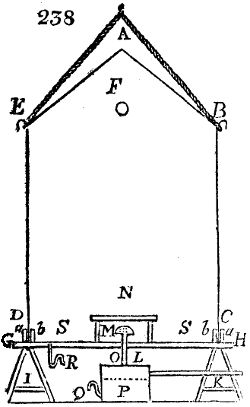
1. By the lanthorn.—In this mode of exposure to steam, the goods are stretched upon a frame; and therefore the apparatus may be described under two heads; the lanthorn and the frame. The former is made of copper, in the shape of a box A B C D E, fig. 238., open below, and with a sloping roof above, to facilitate the trickling down of the water condensed upon the walls. The sides B C D E are 41⁄2 feet high, 6 feet long, and 4 feet wide. The distance of the point A from the line E B is 2 feet. At F is a brass socket, which may be stopped with a cork; and there is a similar one at the other side. This kind of penthouse may be raised by means of a pully with cords fixed to the four angles of the roof E B; and it rests upon the table G H, a little larger than the area of the box, which stands upon the four feet I K. Round the borders of the table there is a triangular groove a b, for receiving the lower edges of the box, and it is stuffed steam-tight with lists of cloth. Through the centre of the table, the two-inch steam pipe M passes; it is surmounted with an hemispherical rose pierced with numerous holes for the equal distribution of the steam. Right above it, a disc N is placed upon four feet. The tube L communicates with a box P, which has a syphon Q to let off the condensed water. At the upper part of this box the tube L terminates which brings the steam. The little table G H slopes towards the part G, where the syphon R is placed for drawing off the water.
The frame has such dimensions, that it may stand in the four corners of the table at S S, as pointed out by the dotted lines. The second part embraces an open square frame, which is formed by spars of wood 2 inches square, mortised together; and is 3 feet 8 inches wide, 5 feet 8 inches long, and 4 feet 3 inches high; it is strengthened with cross bars. Upon the two sides of its breadth, two rows of round brass hooks are placed, about half an inch apart; they are soldered to a copper plate fixed to uprights by means of screws.
Before hanging up the goods, a piece of cloth 3 feet 8 inches long, and 4 feet wide, is placed upon the row of hooks; and 3 feet of it are left hanging out.
One foot within, the hooks pass through the cloth. A similar one is fitted to the other side. This cloth is intended to cover the goods hung upon the hooks; and it is kept straight by resting upon strings. The pieces are attached zig-zag from one hook to another. When the frame is filled, the bag is put within the cloths; it has the same rectangular shape as the frame. The pieces are in this way all encased in the cloth; a bit of it being also put beneath to prevent moisture affecting that part.
When shawls are framed, they are attached with pins; and if they be too large, they are doubled back to back, with the fringes at top.
These arrangements being made, the frame is set upon the table, the penthouse is placed over it, and the steam is admitted during from 35 to 45 minutes, according to circumstances. The orifice F is opened at first to let the air escape, and when it begins to discharge steam it is stopped. The frame is taken out at the proper time, the bag is removed, the cloths are lifted off, and the goods are spread out for airing. Three frames and six bags are required for a constant succession of work. The above apparatus is particularly suitable for silks.
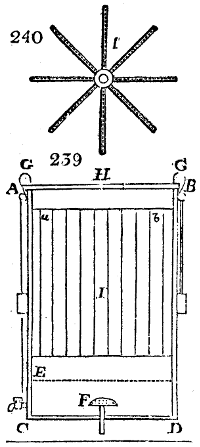
2. The drum.—This is the most simple mode of steaming. The apparatus is a drum of white wood, 2 inches thick, fig. 239.; the bottom is pierced with a hole which admits the steam-pipe F, terminating in a perforated rose. Four inches from the bottom there is a canvass partition E, intended to stop any drops of water projected from the tube F, and also to separate the condensed water from the body of the apparatus. The drum is covered in by a wooden head H, under which the goods are placed. It is made fast either by bolts, or by hooks, G G, thus , to which weighted cords are hung. The frame 1, fig. 240. rests upon a hoop, a a, a few inches from the edge. The goods are hung upon the frame in the ordinary way, and then wrapped round with flannel. The frame is studded with pin points, like that of the indigo vat, fixed about 5 inches asunder. From 20 to 30 minutes suffice for one steaming operation. The upper part of the frame must be covered also with flannels to prevent the deposition of moisture upon it. At the bottom of the drum there is a stopcock to let off the condensed water. According to the size of the figure, which is 3 feet 2 inches, 50 yards may be hung up single; but they may be doubled on occasion.

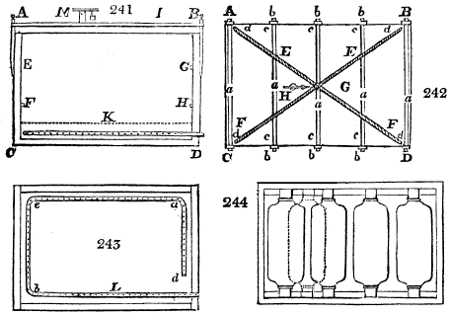
3. The box.—This steaming apparatus is convenient from the large quantity of goods admissible at a time: it answers best for woollen stuffs. From 12 to 16 pieces, of 36 yards each, may be operated upon at once; and from 240 to 260 shawls. It is formed of a deal box, A B C D, fig. 241., 4 feet wide, 6 long, and 3 high; the wood being 4 inches thick. It is closed by a cover of the same substance, I, which is made steam-tight at the edges by a list of felt. The lid is fastened down by 5 cross bars of iron, a a a a a, which are secured by screws, c c c c c, fig. 242. The ends of these cross bars are let into the notches, b b b b b, on the edge of the box. The safety valve M, fig. 241., is placed upon the lid. For taking off the lid, there are rings at the four corners, d d d d, bearing cords, F F F F. These join at the centre into one, which passes over a pulley. Eight inches from the bottom of the box there is a horizontal canvass partition, beneath which the steam is discharged from the pipe L, fig. 243. There are two ledges, E F G H, at the sides for receiving the bobbins. The tube L runs round the box, as shown by the letters d a e b: the end d is shut; but the side and top are perforated with many holes in the direction towards the centre of the box. Fig. 244. shows the arrangement of the lower set of bobbins: that of the upper set is shown by the dotted lines: it is seen to be in an alternate position, one lying between two others. They are formed of pieces of deal 4 inches broad, 1 inch thick, and of a length equal to the width of the box. They are first wrapped round with 5 or 6 turns of doubled flannel or calico: the piece of goods is laid over it upon a table, and then wrapped round. At the end of the piece, several folds of the covering must be put, as, also, a roll of flannel. The two ends must be slightly tied with packthread. When these flat bobbins are arranged in the box, the steam is let on them, and continued about 45 minutes: it is then shut off, the lid is removed, and the pieces are unrolled.
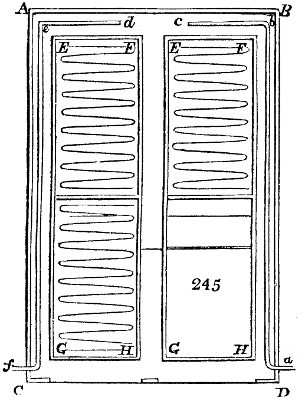
4. The chamber.—The interior height of the chamber, A B C D, fig. 245., is 9 feet, the length 12 feet, and the breadth 9 feet. The steam is introduced into it by two pipes, a b c, d e f. Their two ends, d c, are shut; but their sides are all along perforated with small holes. The frames E F G H, E F G H, are moveable, and run upon rollers: they are taken out by front doors, which are made of strong planks, shut by sliding in slots, and are secured by strong iron bars and pressure screws. The cross rods, E F G H, are provided with hooks for hanging up the pieces. There is a safety-valve in the top of this large chamber. The dimensions of the frame are 10 feet long, 3 feet wide, and 7 high. Three feet and a half from the upper part of the frame, a row of hooks is fixed for hanging on a double row of pieces, as shown in the figure. Over the frame, woollen blankets are laid to protect it from drops of water that might fall from the roof of the chamber. When the hooks are two thirds of an inch apart, 24 pieces, of 28 yards each, may be suspended at once. The period of steaming is from 45 to 60 minutes.
Muslins and silks do not require so high a temperature as woollen goods. When the stuffs are padded with colour, like merinos and chalys, they must not be folded together, for fear of stains, which are sometimes occasioned by the column in steam calico-printing, where the end which receives the first impression of the steam is seldom of the same shade as the rest of the roll of goods. The duration of the steaming depends upon the quantity of acid in the mordant, and of saline solution in the topical colour; the more of which are present, the shorter should be the steaming period. A dry vapour is requisite in all cases; for when it becomes moist, from a feeble supply or external condensation, the goods become streaky or stained by the spreading of the colours.
1. Black figures are given by decoction of logwood thickened with starch, to which a little oxalic acid is added while hot, and, after it is cold, neutralised solution of nitrate of iron.
2. Dark blue for a ground.—Decoction of logwood, and archil thickened with starch; to which, while the paste is hot, a little soluble Prussian blue is added; and, when it is cold, neutralised nitrate of iron; see supra.
3. Deep poppy or ponceau colour.—Cochineal boiled in starch water, with oxalic acid (or tartaric), and perchloride of tin.
4. Rose.—Cochineal infusion; oxalic acid; perchloride of tin; thickened with gum.
5. Dark amaranth.—Decoctions of archil and cochineal, thickened with starch: to the paste, alum and perchloride of tin are added.
6. Capuchin colour.—Quercitron and cochineal thickened with starch; to the paste add oxalic acid, and perchloride of tin.
7. Annotto orange.—Dissolve the annotto in soda lye, of spec. grav. 1·07, at a boiling heat; add aluminate of soda, and thicken with gum.
8. Golden yellow.—Decoction of Persian berries thickened with starch; to which some alum and muriate of tin are added, with a little perchloride of tin and oxalic acid.
9. Lemon yellow.—Persian berries; starch; alum.
10. An ammoniacal solution of cochineal is used for making many violet and mallow colours. It is prepared by infusing cochineal in water of ammonia for 24 hours; then diluting with water, heating to ebullition, and straining.
11. Fine violet is given by ammoniacal cochineal, with alum and oxalic acid; to which a little aceto-sulphate of indigo is added, and gum for thickening. The following blue may be used instead of the solution of indigo. The mallow tint is given by adding a little perchloride of tin to the above formula, and leaving out the blue.
12. Dark blue.—Soluble Prussian blue; tartaric acid; alum; thicken with gum.
13. Emerald green.—One quart of decoction, equivalent to 1 pound of Persian berries; 1 quart of infusion of quercitron, of spec. grav. 1·027; in which dissolve 12 ounces of alum in powder; and add 6 ounces of the following blue bath for greens; thicken with 20 ounces of gum.
14. Blue bath for greens. Half a gallon of water at 140° F., 1 pound of soluble Prussian blue, 3 ounces of tartaric acid, and 2 ounces of alum.
I. Printing of Silks.—1. Of the madder style. This is one of the most difficult to execute, requiring both much skill and experience. The first step is the removal of the gum. A copper being nearly filled with water, the pieces, tied up in a linen bag, are put into it, with a quarter of a pound of soap for every pound of silk, and are boiled for 3 hours. If the silk be Indian, half an ounce of soda crystals must be added. When the goods are taken out, they are rinsed in the river, then passed through water at 140° F., holding 8 ounces of crystallised soda in solution, as a scourer. They are next rinsed in cold water, and steeped in water very faintly acidulated with sulphuric acid, during 4 hours, then rinsed, and dried.
Preparation of Mordants.—1 gallon of boiling water; 2 pounds of alum; dissolve:
1 pound of acetate of lead; 4 ounces of sal-ammoniac; 1 of chalk; mix well together; after decomposition and subsidence, draw off clear.
1. Red.—1 gallon of the above mordant, thickened with 14 ounces of starch, and tinged with decoction of Brazil wood. If dark red be wanted, dissolve, in a gallon of the above red, 4 ounces of sulphate of copper.
2. Black.—1 gallon of iron liquor, of 1·056 spec. grav.; thicken with 14 ounces of starch; and dissolve in the hot paste 2 ounces of sulphate of copper.
3. Violet. Take 1 gallon of iron liquor of 1·04 spec. grav.; 3. Violet. 2 ounces of cream of tartar; 2 ounces of nitre; 2 ounces of copperas; 3. Violet. 1 ounce of alum: dissolve, and mix the solution with 3. Violet. 1 gallon of gum water, containing 6 libs. of gum.
4. Puce. Half a gallon of red mordant; half a gallon of iron liquor of 1·07; 4. Puce. 7 ounces of starch for thickening colour with logwood.
Manipulation of the above colours.—Print-on the black, then the puce, next the violet, and, lastly the red. Dry in the hot flue, and, 48 hours after the impression, wash away the paste. The copper employed for dyeing is of a square form: a boil is given with bran, at the rate of 4 libs. per piece of the foulards: cold water is added to lower the temperature to 130° F. The pieces must be entered with the printed surface undermost, and winced for half an hour, taking care to keep them expanded and well covered with the liquor: they are then taken out and rinsed. When grounds are to be made on the foulards, 2 ounces of sumach must be added per piece.
Maddering.—Suppose 48 pieces are to be grounded with madder. 12 pounds of madder must be put into the copper, 1 pound of sumach, and 6 pounds of bran; the bath must be tepid when the pieces are entered: it must be heated to 104° F. in 20 minutes, and to the boiling point in an hour and a half. The goods must be briskly winced all the time, and finally turned out into cold water.
When they come out of the madder bath they are much loaded with colour. They are cleared by a boil of half an hour in bran, then turned out into cold water, and rinsed. A copper must be now mounted with 3 pounds of soap, 1 ounce of solution of tin, and 2 pailsful of bran, in which the goods are to be boiled for half an hour, then rinsed, and passed through a very dilute sulphuric acid bath. Then rinse, and dry. By following this process a light salmon ground is obtained.
II. Steam colours upon silk.—The same plan of operations may be adopted here as is described for calico-printing; the main difference being in the method of mordanting the stuffs. After boiling in soap water, in the proportion of 4 ounces per pound of silk, the goods are washed in cold water, and then in hot water at 140°; they are next rinsed, passed through weak sulphuric acid, rinsed, squeezed between rollers, and afterwards steeped in a bath containing 8 ounces of alum per gallon, where they remain for four hours, with occasionally wincing. They are now rinsed, and dried. The subsequent treatment resembles that of steam-colour printed cottons.
Black.—Take a gallon of decoction, made with 4 libs. of logwood, with which Black.—14 ounces of starch are to be combined: mix in Black.—2 ounces of powdered nut-galls: boil, and pour the colour into a pipkin containing Black.—2 ounces of tartaric acid; 2 ounces of oxalic, both in powder, and Black.—2 ounces of olive oil. Stir the colour till it is cold, and add Black.—8 ounces of nitrate of iron, and 4 ounces of nitrate of copper.
The red, violet, lilac, yellow colours, &c. are the same as for steam colours upon cotton. Topical colours are also applied without mordanting the silk beforehand. In this case a little muriate of tin is introduced. Thus, for
Yellow.—Take 1 gallon of a decoction, made with 4 libs. of Persian berries: dissolve in it 8 ounces of salt of tin (muriate), and 4 ounces of the nitro-muriatic solution of tin. Thicken with 2 pounds of gum.
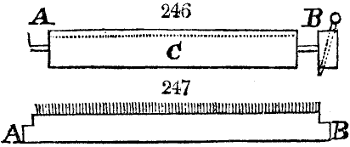
Printing of foulard pieces. The tables which serve for the impression of silk goods are so constructed as to receive them in their full breadth. Towards the part between the colour or sieve tub and the table, the roller is mounted upon which the piece is wound. This roller, A B, fig. 246., has a groove, C, cut out parallel to its axis. Into this a bar is pressed, which fixes the end of the piece. The head, B, of the roller is pierced with several holes, in which an iron pin passes for stopping its rotation at any point, as is shown at B. At the other end of the table there is placed a comb, fig. 247., which is supported by pivots A B at its ends. The teeth of the comb are on a level with the cloth.
The piece is arranged for printing as follows:—It is unwound, and its end is brought upon the teeth of the comb, and made to pass into them by slight taps with a brush. It is now stretched, by turning round the roller, and fixing it by the pin-handle. After tracing the outline, the printing blocks are applied. Care should be taken, in the course of printing, always to fix the teeth of the comb in the middle line between two handkerchiefs. The operation of grounding-in is much facilitated by this plan of extension.
The pieces are washed in running water, and must be rapidly dried. The subsequent dressing is given by gum tragacanth: they are dried upon a stretching frame, and then folded up for the market.
III. Mandarining of silk stuffs and chalys.—This style of printing depends upon the property which nitric acid possesses of giving to silk and woollen stuffs a yellow colour.
The first step is the scouring with a soap boil, as already described.
The designs are printed-on as also above described.
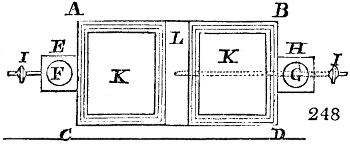
The swimming or colour-tub is usually double, and serves for two tables; instead of being placed, therefore, at the end of the table, it is put between two, and, consequently, behind the printer. It is formed of a copper chest, fig. 248., A B C D, in which steam may circulate, introduced by the pipe I; the excess being allowed to escape by the tube J, as also the water of condensation. The frame is placed in the hollow box K K. Between two such frames there is a plate of copper, L, which closes the box; it serves for laying the plates in order to keep them hot. At E and H are prolongations of the box, in which are set the vessels F G for holding the reserve paste.
Preparation of the reserve or resist paste.—Melt in a kettle 21⁄2 libs. of rosin; 1 lib. of suet: mix well, and put it into the basins F G. By means of steam the reserve is kept melted, as well as the false colour upon which the sieve floats. The piece of silk being laid upon the table, and the reserve spread upon the frame, the printer heats his block, which should be mounted with lead, if the pattern will permit, upon the little table L. He takes up the colour from the frame, and transfers it instantly to the piece. He must strike the block lightly, and then lift it, lest, by its cooling, it might stick to the silk. When the table pattern is completed, he dusts it over with sand, and proceeds to another portion of the silk. The piece must not be taken out of the stretch till it is quite dry, which requires usually 6 hours. Let us consider first the most common case, that of a white upon an orange ground. We shall afterwards describe the other styles, which may be obtained by this process. The piece, being printed and dry, must next be subjected to the mandarining operation.
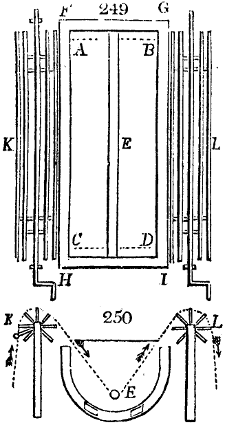
The apparatus here employed consists of a sandstone trough A B C D, fig. 249. Upon the two sides, A C, B D, of this trough are fixed two wooden planks, pierced with a hole an inch from the bottom to receive the roller E, under which the piece passes. In this trough the acid mixture is put. That trough is put into a wooden or copper trough, F G H I. Into the latter, water is put, which is heated by means of steam, or a convenient furnace. Before and behind are placed two winces, or reels, K L: one serves to guide the piece in entering into the trough, and the other in its leaving it. The piece falls immediately into a stream of cold water, or, failing that, into a large back, containing a mixture of chalk and water. The two winces are moved by handles: the velocity is proportioned to the action of the acid. The wince L ought to be higher than K, to allow the acid to drain off. Fig. 250. shows a section of the apparatus.
The temperature of the acid mixture ought to be maintained between 95° and 100° F.; for if it be raised higher, the resist would run the risk of melting, and the impression would become irregular and blotty.
The proportions of the acid mixture are the following:—1 gallon of water; and 1 gallon of nitric acid, of spec. grav. 1·288, which may be increased with the strength of the silk. It should be a little weaker for chalys. For the strong greens it may be 2 measures of acid of 1·288 to 1 measure of water. The duration of the passage through the acid should be 1 minute at most.
Mixture of orange colour, and clearing away of the resist.—The goods, on coming out of the mandarining apparatus, are rinsed in running water; then boiled in soap water, quickened with a little soda, at the rate of 2 libs. of the former and 4 oz. of the latter for a piece of 30 yards. They must be worked by the wince for half an hour. They are now rinsed in cold water, then passed through hot, again rinsed, and dried. I shall give some examples of the mode of manufacture, which is undoubtedly one of the most curious applications of chemical ingenuity.
1. Orange ground with white figures.
(1.) Print-on the fat reserve; (2.) mandarine; (3.) brighten the orange, and clear.
2. Orange ground, with blue figures.
(1.) Dip in the indigo vat as for calico; (2.) print-on the fat resist to preserve the blue; (3.) mandarine; 4. clear, and brighten the orange by the boil.
3. Orange ground, with blue and white figures.
(1.) Print-on the resist to preserve the white; (2.) dip in the vat, rinse, and dry; (3.) ground-in the fat resist to preserve the blue; (4.) mandarine; (5.) cleanse, and brighten.
4. Full green ground, and white figures.
(1.) Print-on the resist; (2.) mandarine, and rinse without drying; (3.) dip in the blue vat; (4.) cleanse, and brighten.
5. Full green ground, and blue figures.
(1.) Dip a pale blue, rinse, and dry; (2.) print-on the fat resist; (3.) mandarine, wash and dry; (4.) dip full blue; (5.) clean, and brighten.
6. Full green ground, with white and blue figures.
(1.) Print-on the resist; (2.) dip a pale blue, and dry; (3.) ground-in the fat resist; (4.) mandarine and rinse; (5.) dip a full blue; (6.) clean, and brighten.
7. Full green ground, with white, blue, and orange figures.
(1.) Print-on the fat reserve; (2.) dip a pale blue, and dry; (3.) ground-in the reserve; (4.) mandarine, rinse, and dry; (5.) ground-in the reserve; (6.) dip a full blue; (7.) clean, and brighten.
If blue grounds with white figures be wanted, the resist must be applied, and then the goods must be dipped in the blue vat: the resist is afterwards removed by a boil in soap-water.
The above processes are applicable to chalys.
The property which nitric acid possesses of staining animal matters yellow, such as the skin, wool, and silk, is here applied to a very elegant purpose.