B. (continued 6)
Reading edition
The following statement of the system of baking at Paris, I received in 1835 from a very competent judge of the business.
1,000 kilogrammes of wheat = 5 quarters English, cost 200 fr., and yield 800 kilos of flour of the best white quality, equivalent to 51⁄10 sacks French. Hence the sack of flour costs 40 francs at the mill, and including the carriage to Paris, it costs 45 or 46 francs.
The profit of the flour dealer is about 31⁄2 francs, and the sale price becomes from 43 to 50 francs.
Bread manufactured from the above.
£ s. d. £ s. d.
One day’s work of an ordinary baker, who makes four batches in a day, consists of 3 sacks at 50 francs, or 2l. sterling each 6 0 0
Salt 23⁄4 lbs. at 2d. per lb. 0 0 5 1⁄2
Yeast or leaven 3 lbs. at 5d. 0 1 3
Total cost of materials 6 1 8 1⁄2
Expenses of Baking.
Three workmen at different rates of wages, 15 francs 0 12 0
Fire-wood 0, as the charcoal produced pays for it
General expenses, such as rent, taxes, interest of capital, &c. 0 12 0
1 4 0 = 1 4 0
7 5 8 1⁄2
For this sum 315 loaves are made, being 105 for every sack of flour weighing 156·66 kilos, or 3442⁄3 lbs. avoird. One loaf contains therefore 344·65105 = 3·282 lbs., and as 100 lbs. of flour in Parisian baking are reckoned to produce 127 lbs. of bread, each loaf will weigh 4·168 lbs., avoird., and will cost 7l. 5s. 81⁄2d. divided by 315 = 51⁄2d. very nearly. The value of 315 loaves at the sale price of 6d. will be 7 17 6
Upon this day’s work the clear profit is therefore 0 11 9 1⁄2
A new baking establishment has been recently formed at the Royal Clarence Victualling Establishment at Weevil, near Portsmouth, upon a scale of magnitude nearly sufficient to supply the whole royal navy with biscuits, and that of a very superior description. The following account of it is taken from the United Service Journal. “It having been discovered that the flour supplied to government by contract, had in many instances been most shamefully adulterated, the corn is ground at mills comprised within the establishment, by which means the introduction of improper ingredients is prevented, and precisely the proportion of bran which is requisite in the composition of good sea-biscuit is retained, and no more. The flour-mill is furnished with 10 pairs of stones, by which 40 bushels of flour may be ground and dressed ready for baking, in an hour. The baking establishment consists of 9 ovens, each 13 feet long by 11 feet wide, and 171⁄2 inches in height. These are each heated by separate furnaces, so constructed that a blast of hot air and fire sweeps through them, and gives to the interior the requisite dose of heat in an incredible short space of time. The first operation in making the biscuits, consists in mixing the flour or rather meal and water; 13 gallons of water are first introduced into a trough, and then a sack of the meal, weighing 280 lbs. When the whole has been poured in by a channel communicating with an upper room, a bell rings, and the trough is closed. An apparatus consisting of two sets of what are called knives, each set ten in number, are then made to revolve amongst the flour and water by means of machinery. This mixing operation lasts one minute and a half, during which time the double set of knives or stirrers makes twenty-six revolutions. The next process is to cast the lumps of dough under what are called the breaking-rollers,—huge cylinders of iron, weighing 14 cwt. each, and moved horizontally by the machinery along stout tables. The dough is thus formed into large rude masses 6 feet long by 3 feet broad, and several inches thick. At this stage of the business, the kneading is still very imperfect, and traces of dry flour may still be detected. These great masses of dough are now drawn out, and cut into a number of smaller masses about a foot and a half long by a foot wide, and again thrust under the rollers, which is repeated until the mixture is so complete that not the slightest trace of any inequality is discoverable in any part of the mass. It should have been stated that two workmen stand one at each side of the rollers, and as the dough is flattened out, they fold it up, or double one part upon another, so that the roller at its next passage squeezes these parts together, and forces them to mix. The dough is next cut into small portions, and being placed upon large flat boards, is, by the agency of machinery, conveyed from the centre to the extremity of the baking-room. Here it is received by a workman, who places it under what is called the sheet roller, but which, for size, colour, and thickness, more nearly resembles a blanket. The kneading is thus complete, and the dough only requires to be cut into biscuits before it is committed to the oven. The cutting is effected by what is called the cutting-plate, consisting of a net-work of 52 sharp-edged hexagonal frames, each as large as a biscuit. This frame is moved slowly up and down by machinery, and the workman, watching his opportunity, slides under it the above-described blanket of dough, which is about the size of a leaf of a dining table; and the cutting-frame in its descent indents the sheet, but does not actually cut it through, but leaves sufficient substance to enable the workman at the mouth of the oven to jerk the whole mass of biscuits unbroken into it. The dough is prevented sticking to the cutting-frame by the following ingenious device: between each of the cutter-frames is a small flat open frame, movable up and down, and loaded with an iron ball, weighing several ounces. When the great frame comes down upon the dough, and cuts out 52 biscuits, each of these minor frames yields to the pressure, and is raised up; but as soon as the great frame rises, the weight of the balls acting upon the little frames, thrusts the whole blanket off, and allows the workmen to pull it out. One quarter of an hour is sufficient to bake the biscuit, which is afterwards placed for three days in a drying room, heated to 85° or 90°, which completes the process.” The following statement of the performance of the machinery is taken from actual experiment; in 116 days, during 68 of which, the work was continued for only 71⁄2 hours; and during 48, for only 53⁄4 hours each day, in all 769 working hours, equal to 77 days of 10 hours each; the following quantity of biscuit was baked in the 9 ovens; viz., 12,307 cwt. = 1,378,400 lbs. The wages of the men employed in baking this quantity amounted to 273l. 10s. 91⁄2d.; if it had been made by hand, the wages would have been 933l. 9s. 10d.; saving in the wages of labour, 659l. 7s. 01⁄2d. In this, is not included any part of the interest of the sum laid out upon the machine, or expended in keeping it in order. But in a very few years at such an immense rate of saving, the cost of the engine and other machinery will be repaid. This admirable apparatus is the invention of T. T. Grant, Esq. storekeeper of the Royal Clarence Victualling Establishment, who, we believe, has been properly rewarded, by a grant of 2,000l. from government.
The labour of incorporating the ingredients of bread, viz. flour, water and salt, or kneading dough, is so great as to have led to the contrivance of various mechanical modes of producing the same effect. One of the most ingenious is that for which a patent was obtained in August, 1830, by Mr. Edwin Clayton. It consists of a rotatory kneading trough, or rather barrel, mounted in bearings with a hollow axle, and of an interior frame of cast iron made to revolve by a solid axle which passes through the hollow one; in the frame there are cutters diagonally placed for kneading the dough. The revolving frame and its barrel are made to turn in contrary directions, so as greatly to save time and equalize the operation. This double action represents kneading by the two hands, in which the dough is inverted from time to time, torn asunder, and reunited in every different form. The mechanism will be readily understood from the following description.
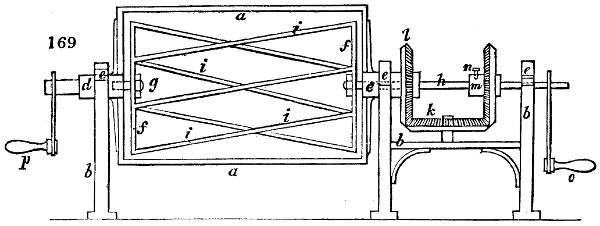
Fig. 169. exhibits a front elevation of a rotatory kneading trough, constructed according to improvements specified by the patentee, the barrel being shown in section: a is the barrel, into which the several ingredients, consisting of flour, water, and yeast, are put, which barrel is mounted in the frame-work b, with hollow axles c and d, which hollow axles turn in suitable bearings at e; f is the revolving frame which is mounted in the interior of the barrel a, by axles g and h. The ends of this revolving frame are fastened, or braced together by means of the oblique cutters or braces i, which act upon the dough when the machine is put in motion, and thus cause the operation of kneading.
Either the barrel may be made to revolve without the rotatory frame, or the rotatory frame without the barrel, or both may be made to revolve together, but in opposite ways. These several motions may be obtained by means of the geer-work, shown at k, l, and m, as will be presently described.
If it be desired to have the revolving motion of the barrel and rotatory frame together, but in contrary directions, that motion may be obtained by fastening the hollow axle of the wheel m, by means of a screw n, to the axle h, of the rotatory frame f, tight, so as they will revolve together, the other wheels k and l being used for the purpose of reversing the motion of the barrel. It will then be found that by turning the handle o, the two motions will be obtained.
If it be desired to put the rotatory frame f, only into motion, that action will be obtained by loosening the screw n, upon the axle of the wheel m, when it will be found that the axle h, will be made to revolve freely by means of the winch o, without giving motion to the wheels k, l, and m, and thus the barrel will remain stationary. If the rotatory action of the barrel be wanted, it will be obtained by turning the handle p, at the reverse end of the machine, which, although it puts the geer at the opposite end of the barrel into motion, yet as the hollow axle of the wheel m is not fastened to the axle h, by the screw n, these wheels will revolve without carrying round the frame f.
M. Kuhlmann, Professor of Chemistry at Lille, having been called upon several times by the courts of justice to examine by chemical processes bread suspected of containing substances injurious to health, collected some interesting facts upon the subject, which were published under the direction of the central council of salubrity of the department du Nord.
For some time public attention had been drawn to an odious fraud committed by a great many bakers in the north of France and in Belgium,—the introduction of a certain quantity of sulphate of copper into their bread. When the flour was made from bad grain this adulteration was very generally practised, as was proved by many convictions and confessions of the guilty persons. When the dough does not rise well in the fermentation (le pain pousse plat), this inconvenience was found to be obviated by the addition of blue vitriol, which was supposed also to cause the flour to retain more water. The quantity of blue water added is extremely small, and it is never done in presence of strangers, because it is reckoned a valuable secret. It occasions no economy of yeast, but rather the reverse. In a litre (about a quart) of water, an ounce of sulphate of copper is dissolved; and of this solution a wine-glass full is mixed with the water necessary for 50 quartern or 4 pound loaves.
M. Kuhlmann justly observes that there can be no safety whatever to the public when such a practice is permitted, because ignorance and avarice are always apt to increase the quantity of the poisonous water. In analyses made by him and his colleagues, portions of bread were several times found so impregnated with the above salt that they had acquired a blue colour, and presented occasionally even small crystals of the sulphate. By acting on the poisoned bread with distilled water and testing the water with ferro-cyanate (prussiate) of potash, the reddish brown precipitate or tint characteristic of copper will appear even with small quantities. Should the noxious impregnation be still more minute, the bread should be treated with a very dilute nitric-acid, either directly, or after incineration in a platinum capsule, and the solution, when concentrated by evaporation, should be tested by the ferro-cyanate of potash. In this way, a one seventy thousandth part of sulphate of copper may be detected.
M. Kuhlmann deduces, from a series of experiments on baking with various small quantities of sulphate of copper, that this salt exercises an extremely energetic action upon the fermentation and rising of the dough, even when not above one seventy thousandth part of the weight of the bread is employed; or one grain of sulphate for ten pounds of bread. The proportion of the salt which makes the bread rise best is one twenty thousandth, or one grain in three pounds of bread. If much more of the sulphate be added, the bread becomes moist, less white, and acquires a peculiar disagreeable smell like that of leaven. The increase of weight by increased moisture may amount to one sixteenth without the bread appearing softer, in consequence of the solidifying quality of the copper; for the acid does not seem to have any influence; as neither sulphate of soda, sulphate of iron, nor sulphuric acid have any analogous power. Alum operates like blue vitriol on bread, but larger quantities of it are required. It keeps water, and raises well, to use the bakers’ terms.
When alum is present in bread it may be detected by treating the bread with distilled water, filtering the water first through calico, and next through filtering paper, till it becomes clear; then dividing it into two portions, and into the one pouring a few drops of nitrate or muriate of barytes, and into the other a few drops of water of ammonia. In the former a heavy white precipitate indicating sulphuric acid will appear, and in the latter a light precipitate of alumina, redissoluble by a few drops of solution of caustic potash.
When chalk or Paris plaster is used to sophisticate flour, they may be best detected by incinerating the bread made of it, and examining the ashes with nitric acid which will dissolve the chalk with effervescence, and the Paris plaster without. In both cases the calcareous matter may be demonstrated in the solution, by oxalic acid, or better by oxalate of ammonia.
In baking puff-paste the dough is first kneaded along with a certain quantity of butter, then rolled out into a thin layer, which is coated over with butter, and folded face-wise many times together, the upper and under surfaces being made to correspond. This stratified mass is again rolled out into a thin layer, its surface is besmeared with butter, and then it is folded face-wise as before. When this process is repeated ten or a dozen times, the dough will consist of many hundred parallel laminæ, with butter interposed between each pair of plates. When a moderately thick mass of this is put into the oven, the elastic vapour disengaged from the water and the butter, diffuses itself between each of the thin laminæ, and causes them to swell into what is properly called puff-paste, being an assemblage of thin membranes, each dense in itself, but more or less distinct from the other, and therefore forming apparently but not really light bread.
One of the most curious branches of the baker’s craft is the manufacture of gingerbread, which contains such a proportion of molasses, that it cannot be fermented by means of yeast. Its ingredients are flour, molasses or treacle, butter, common potashes, and alum. After the butter is melted, and the potashes and alum are dissolved in a little hot water, these three ingredients, along with the treacle, are poured among the flour, which is to form the body of the bread. The whole is then incorporated by mixture and kneading into a stiff dough. Of these five constituents the alum is thought to be the least essential, although it makes the bread lighter and crisper, and renders the process more rapid; for gingerbread dough requires to stand over several days, sometimes 8 or 10, before it acquires that state of porosity which qualifies it for the oven. The action of the treacle and alum on the potashes in evolving carbonic acid, seems to be the gasefying principle of gingerbread; for if the carbonate of potash is withheld from the mixture, the bread, when baked, resembles in hardness a piece of wood.
Treacle is always acidulous. Carbonate of magnesia and soda may be used as substitutes for the potashes. Dr. Colquhoun has found that carbonate of magnesia and tartaric acid may replace the potashes and the alum with great advantage, affording a gingerbread fully more agreeable to the taste, and much more wholesome than the common kind, which contains a notable quantity of potashes. His proportions are one pound of flour, a quarter of an ounce of carbonate of magnesia, and one eighth of an ounce of tartaric acid; in addition to the treacle, butter, and aromatics as at present used. The acid and alkaline earth must be well diffused through the whole dough. The magnesia should, in fact, be first of all mixed with the flour. Pour the melted butter, the treacle, and the acid dissolved in a little water all at once among the flour, and knead into a consistent dough, which being set aside for half an hour or an hour will be ready for the oven, and should never be kept unbaked more than 2 or 3 hours. The following more complete recipe is given by Dr. Colquhoun, for making thin gingerbread cakes:—
Flour 1 lb.
Treacle 0 1⁄2
Raw sugar 0 1⁄4
Butter 2 oz.
Carbon. magnesia 0 1⁄4
Tartaric acid 0 1⁄8
Ginger 0 1⁄8
Cinnamon 0 1⁄8
Nutmeg 1
This compound has rather more butter than common thin gingerbread.
I shall here insert a passage from my Dictionary of Chemistry as published in 1821; as it may prove interesting to many of my present readers.
“Under Process of Baking, in the Supplement to the Encyclopedia Britannica, we have the following statement:—‘An ounce of alum is then dissolved over the fire in a tin pot, and the solution poured into a large tub, called by the bakers the seasoning-tub. Four pounds and a half of salt are likewise put into the tub, and a pailful of hot water.’—Foot note on this passage.—‘In London, where the goodness of bread is estimated entirely by its whiteness, it is usual with those bakers who employ flour of an inferior quality, to add as much alum as common salt to the dough; or, in other words, the quantity of salt added is diminished one half, and the deficiency supplied by an equal weight of alum. This improves the look of the bread very much, rendering it much whiter and firmer.’”
In a passage which we shall presently quote, our author represents the bakers of London in a conspiracy to supply the citizens with bad bread. We may hence infer that the full allowance he assigns of 21⁄4 pounds of alum for every 21⁄4 pounds of salt, will be adopted in converting the sack of flour into loaves. But as a sack of flour weighs 280 pounds, and furnishes on an average 80 quartern loaves, we have 21⁄4 pounds divided by 80, or 15750 grains80 = 197 grains, for the quantity present, by this writer, in a London quartern loaf. Yet in the very same page (39th of vol. ii.) we have the following passage: “Alum is not added by all bakers. The writer of this article has been assured by several bakers of respectability, both in Edinburgh and Glasgow, on whose testimony he relies, and who made excellent bread, that they never employed any alum. The reason for adding it given by the London bakers is, that it renders the bread whiter, and enables them to separate readily the loaves from each other. This addition has been alleged by medical men, and is considered by the community at large, as injurious to the health, by occasioning constipation. But if we consider the small quantity of this salt added by the baker, not quite 51⁄2 grains to a quartern loaf, we will not readily admit these allegations. Suppose an individual to eat the seventh part of a quartern loaf a day, he would only swallow eight-tenths of a grain of alum, or, in reality, not quite so much as half a grain; for one half of this salt consists of water. It seems absurd to suppose that half a grain of alum, swallowed at different times during the course of a day, should occasion constipation.” Is it not more absurd to state 21⁄4 pounds or 36 ounces, as the alum adulteration of a sack of flour by the London bakers, and within a few periods to reduce the adulteration to one ounce?
That this voluntary abstraction of 35⁄36 of the alum, and substitution of superior and more expensive flour is not expected by him from the London bakers, is sufficiently evident from the following story. It would appear that one of his friends had invented a new yeast for fermenting dough, by mixing a quart of beer barm with a paste made of ten pounds of flour and two gallons of boiling water, and keeping this mixture warm for six or eight hours.
“Yeast made in this way,” says he, “answers the purposes of the baker much better than brewers’ yeast, because it is clearer, and free from the hop mixture which sometimes injures the yeast of the brewer. Some years ago the bakers of London, sensible of the superiority of this artificial yeast, invited a company of manufacturers from Glasgow to establish a manufactory of it in London, and promised to use no other. About 5,000l. accordingly was laid out on buildings and materials, and the manufactory was begun on a considerable scale. The ale-brewers, finding their yeast, for which they had drawn a good price, lie heavy on their hands, invited all the journeymen bakers to their cellars, gave them their full of ale, and promised to regale them in that manner every day, provided they would force their masters to take all their yeast from the ale-brewers. The journeymen accordingly declared, in a body, that they would work no more for their masters unless they gave up taking any more yeast from the manufactory. The masters were obliged to comply; the new manufactory was stopped, and the inhabitants of London were obliged to continue to eat worse bread, because it was the interest of the ale-brewers to sell the yeast. Such is the influence of journeymen bakers in the metropolis of England!”
This doleful diatribe seems rather extravagant; for surely beer yeast can derive nothing noxious to a porter drinking people, from a slight impregnation of hops; while it must form probably a more energetic ferment than the fermented paste of the new company, which at any rate could be prepared in six or eight hours by any baker who found it to answer his purpose of making a pleasant-eating bread. But it is a very serious thing for a lady or gentleman of sedentary habits, or infirm constitution, to have their digestive process daily vitiated by damaged flour, whitened with 197 grains of alum per quartern loaf. Acidity of stomach, indigestion, flatulence, headaches, palpitation, costiveness, and urinary calculi may be the probable consequences of the habitual introduction of so much acidulous and acescent matter.
I have made many experiments upon bread, and have found the proportion of alum very variable. Its quantity seems to be proportional to the badness of the flour; and hence when the best flour is used, no alum need be introduced. That alum is not necessary for giving bread its utmost beauty, sponginess, and agreeableness of taste, is undoubted; since the bread baked at a very extensive establishment in Glasgow, in which about 20 tons of flour were regularly converted into loaves in the course of a week, united every quality of appearance with an absolute freedom from that acido-astringent drug. Six pounds of salt were used for every sack of flour; which, from its good quality, generally afforded 83 or 84 quartern loaves of the legal weight of four pounds five ounces and a half each. The loaves lost nine ounces in the oven.
Every baker ought to be able to analyse his flour. He may proceed as follows:—A ductile paste is to be made with a pound of the flour and a sufficient quantity of water, and left at rest for an hour; then having tied across a bowl a piece of silken sieve-stuff, a little below the surface of the water in the bowl, the paste is to be laid upon the sieve on a level with the water, and kneaded tenderly with the hand, so as merely to wash the starchy particles out of it. This portion of the flour gets immediately diffused through the water, some of the other constituents dissolve, and the gluten alone remains upon the filter. The water must be several times renewed till it ceases to become milky. The last washings of the gluten are made out of the sieve.
The whole of the turbid washings are to be put into a tall conical glass or stoneware vessel, and allowed to remain at rest, in a cool place, till they deposit the starch. The clear supernatant liquor is then decanted off. The deposit consists of starch, with a little gluten. It must be washed till the water settles over it quite clear, and then it is to be dried.
The filtered waters being evaporated, at a boiling heat, discover flocks floating through them, which have been supposed by some to be albumen, and by others gluten. At last, phosphate of lime precipitates. When the residuum has assumed a syrupy consistence in the cold, it is to be mixed with alcohol, in order to dissolve out its sugar. Cold water being added to what remains, effects a solution of the mucilage, and leaves the insoluble azotized matter with the phosphate of lime.
By this mode of analysis a minute portion of resin may remain in the gluten and in the washing water; the gluten retains also a small proportion of a fixed oil, and a volatile principle, which may be removed by alcohol. If we wish to procure the resin alone, we must first of all treat the flour, well dried, with alcohol.
When corn flour, poor in gluten, is to be analyzed, the dough must be inclosed in a linen bag, kneaded with water, and washed in that state.
In analyzing barley-meal by the above process, hordeine, mixed with common starch, is obtained: they may be separated by boiling water, which dissolves the starch, and leaves the hordeine under the aspect of saw-dust.
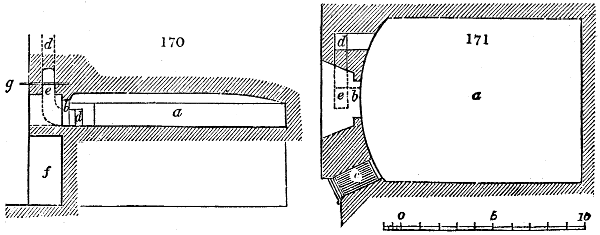
Fig. 171. is the plan of a London baker’s oven, fired with coal fuel.
Fig. 170. is the longitudinal section.
a, the body of the oven; b, the door; c, the fire-grate and furnace; d, the smoke flue; e, the flue above the door, to carry off the steam and hot air, when taking out the bread; f, recess below the door, for receiving the dust; g, damper plate to shut off the steam flue; h, damper plate to shut off smoke flue, after the oven has come to its proper heat; i, a small iron pan over the fire-place c, for heating water; k, ash-pit below the furnace.
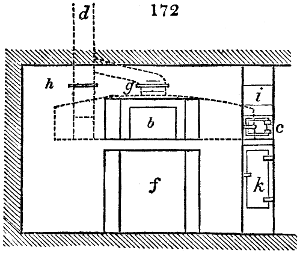
Fig. 172. is the front view; the same letters refer to the same objects in all the figures.
The flame and burnt air of the fire at c, sweep along the bottom of the oven by the right hand side, are reflected from the back to the left hand side, and thence escape by the flue d; (see plan fig. 171). Whenever the oven has acquired the proper degree of heat, the fire is withdrawn, the flues are closed by the damper plates, and the lumps of fermented dough are introduced.
BRECCIA, an Italian term, used by mineralogists and architects to designate such compound stony masses, natural or artificial, as consist of hard rocky fragments of considerable size, united by a common cement. When these masses are formed of small rounded pebbles, the conglomerate is called a pudding-stone, from a fancied resemblance to plum pudding.
Concrete, now so much used for the foundations of large buildings, is a factitious breccia, or pudding-stone. See Concrete.
BREWING. (Brasser, Fr.; Brauen, Germ.) The art of making beer, which see.
BRICK. (Brique, Fr.; Backsteine, ziegelsteine, Germ.) A solid, commonly rectangular, composed of clay, hardened by heat, and intended for building purposes. The natural mixture of clay and sand, called loam, as well as marl, which consists of lime and clay, with little or no sand, constitutes also a good material for making bricks. The poorer the marl is in lime, the worse adapted it is for agricultural purposes, and the better for the brick manufacturer, being less liable to fuse in his kiln. When a natural compound of silica and clay can be got nearly free from lime and magnesia, it forms a kind of bricks very refractory in the furnace, hence termed fire-bricks. Such a material is the slate-clay, schieferthon, of our coal measures, found abundantly, and of excellent quality, at Stourbridge, and in the neighbourhood of Newcastle and Glasgow. The London brickmakers add to the clay about one third of coal ashes obtained from the kitchen dust-holes; so that when the bricks are put into the kiln, the quantity of coaly matter attached to their surface, serves to economise fuel, and makes them less apt to shrink in the fire; though they are less compact, and probably less durable, than the bricks made in the coal districts of England.
The general process of brick-making consists in digging up the clay in autumn; exposing it, during the whole winter, to the frost, and the action of the air, turning it repeatedly, and working it with the spade; breaking down the clay lumps in spring, throwing them into shallow pits, to be watered and soaked for several days. The next step is to temper the clay, which is generally done by the treading of men or oxen. In the neighbourhood of London, however, this process is performed in a horse-mill. The kneading of the clay is, in fact, the most laborious but indispensable part of the whole business; and that on which, in a great measure, the quality of the bricks depends. All the stones, particularly the ferruginous, calcareous, and pyritous kinds, should be removed, and the clay worked into a homogeneous paste, with as little water as possible.
The earth, being sufficiently kneaded, is brought to the bench of the moulder, who works the clay into a mould made of wood or iron, and strikes off the superfluous matter. The bricks are next delivered from the mould, and ranged on the ground; and when they have acquired sufficient firmness to bear handling, they are dressed with a knife, and staked or built up in long dwarf walls, thatched over, and left to dry. An able workman will make, by hand, 5,000 bricks in a day.
The different kinds of bricks made in England are principally place bricks, gray and red stocks, marl facing bricks, and cutting bricks. The place bricks and stocks are used in common walling. The marls are made in the neighbourhood of London, and used in the outside of buildings; they are very beautiful bricks, of a fine yellow colour, hard, and well burnt, and, in every respect, superior to the stocks. The finest kind of marl and red bricks, called cutting bricks, are used in the arches over windows and doors, being rubbed to a centre, and gauged to a height.
In France attempts were long ago made to substitute animals and machines for the treading of men’s feet in the clay-kneading pit; but it was found that their schemes could not replace, with advantage, human labour, where it is so cheap, particularly for separating the stones and heterogeneous matters from the loam. The more it is worked, the denser, more uniform, and more durable, the bricks which are made of it. A good French workman, in a day’s labour of 12 or 13 hours, it has been said, is able to mould from 9,000 to 10,000 bricks, 9 inches long, 41⁄2 inches broad, and 21⁄4 thick; but he must have good assistants under him. In many brickworks near Paris, screw-presses are now used for consolidating the bricks and paving tiles in their moulds. M. Mollerat employed the hydraulic press for the purpose of condensing pulverized clay, which, after baking, formed beautiful bricks; but the process was too tedious and costly. An ingenious contrivance for moulding bricks mechanically, is said to be employed near Washington, in America. This machine moulds 30,000 in a day’s work of 12 hours, with the help of one horse, yoked to a gin wheel, and the bricks are so dry when discharged from their moulds, as to be ready for immediate burning. The machine is described, with figures, in the Bulletin de la Société d’Encouragement for 1819, p. 361. See further on, an account of our recent patents.
Bricks, in this country, are generally baked either in a clamp or in a kiln. The latter is the preferable method, as less waste arises, less fuel is consumed, and the bricks are sooner burnt. The kiln is usually 13 feet long, by 101⁄2 feet wide, and about 12 feet in height. The walls are one foot two inches thick, carried up a little out of the perpendicular, inclining towards each other at the top. The bricks are placed on flat arches, having holes left in them resembling lattice-work; the kiln is then covered with pieces of tiles and bricks, and some wood put in, to dry them with a gentle fire. This continues two or three days before they are ready for burning, which is known by the smoke turning from a darkish colour to transparent. The mouth or mouths of the kiln are now dammed up with a shinlog, which consists of pieces of bricks piled one upon another, and closed with wet brick earth, leaving above it just room sufficient to receive a faggot. The faggots are made of furze, heath, brake, fern, &c., and the kiln is supplied with these until its arches look white, and the fire appears at the top; upon which the fire is slackened for an hour, and the kiln allowed gradually to cool. This heating and cooling is repeated until the bricks be thoroughly burnt, which is generally done in 48 hours. One of these kilns will hold about 20,000 bricks.
Clamps are also in common use. They are made of the bricks themselves, and generally of an oblong form. The foundation is laid with place brick, or the driest of those just made, and then the bricks to be burnt are built up, tier upon tier, as high as the clamp is meant to be, with two or three inches of breeze or cinders strewed between each layer of bricks, and the whole covered with a thick stratum of breeze. The fireplace is perpendicular, about three feet high, and generally placed at the west end; and the flues are formed by gathering or arching the bricks over, so as to leave a space between each of nearly a brick wide. The flues run straight through the clamp, and are filled with wood, coals, and breeze, pressed closely together. If the bricks are to be burnt off quickly, which may be done in 20 or 30 days, according as the weather may suit, the flues should be only at about six feet distance; but if there be no immediate hurry, they may be placed nine feet asunder, and the clamp left to burn off slowly.
Floating bricks are a very ancient invention: they are so light as to swim in water; and Pliny tells us, that they were made at Marseilles; at Colento, in Spain; and at Pittane, in Asia. This invention, however, was completely lost, until M. Fabbroni published a discovery of a method to imitate the floating bricks of the ancients. According to Posidonius, these bricks are made of a kind of argillaceous earth, which was employed to clean silver plate. But as it could not be our tripoli, which is too heavy to float in water, M. Fabbroni tried several experiments with mineral agaric, guhr, lac-lunæ, and fossil meal, which last was found to be the very substance of which he was in search. This earth is abundant in Tuscany, and is found near Casteldelpiano, in the territories of Sienna. According to the analysis of M. Fabbroni, it consists of 55 parts of siliceous earth, 15 of magnesia, 14 of water, 12 of alumina, 3 of lime, and 1 of iron. It exhales an argillaceous odour, and, when sprinkled with water, throws out a light whitish smoke. It is infusible in the fire; and, though it loses about an eighth part of its weight, its bulk is scarcely diminished. Bricks composed of this substance, either baked or unbaked, float in water; and a twentieth part of clay may be added to their composition without taking away their property of swimming. These bricks resist water, unite perfectly with lime, are subject to no alteration from heat or cold, and the baked differ from the unbaked only in the sonorous quality which they have acquired from the fire. Their strength is little inferior to that of common bricks, but much greater in proportion to their weight; for M. Fabbroni found, that a floating brick, measuring 7 inches in length, 41⁄2 in breadth, and one inch eight lines in thickness, weighed only 141⁄4 ounces; whereas a common brick weighed 5 pounds, 63⁄4 ounces. The use of these bricks may be very important in the construction of powder magazines and reverberatory furnaces, as they are such bad conductors of heat, that one end may be made red hot while the other is held in the hand. They may also be employed for buildings that require to be light; such as cooking-places in ships, and floating batteries, the parapets of which would be proof against red-hot bullets.
The following plan of a furnace or kiln for burning tiles has been found very convenient:—
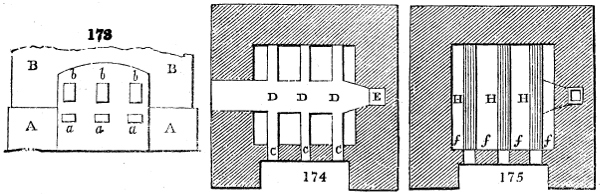
Fig. 173., front view, A A, B B, the solid walls of the furnace; a a a, openings to the ash-pit, and the draught hole; b b b, openings for the supply of fuel, furnished with a sheet-iron door. Fig. 174. Plan of the ash-pits and air channels c c c. The principal branch of the ash-pit D D D, is also the opening for taking out the tiles, after removing the grate; E the smoke flue. Fig. 175. Plan of the kiln seen from above. The grates H H H. The tiles to be fired are arranged upon the spaces f f f f.
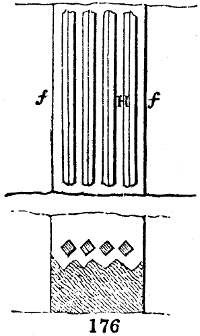
Fig. 176. is the plan and section of one of the grates upon a much larger scale than in the preceding figures.
Mechanical brick moulding.—Messrs. Lyne and Stainford obtained in August, 1825, a patent for a machine for making a considerable number of bricks at one operation. It consists, in the first place, of a cylindrical pug-mill of the kind usually employed for comminuting clay for bricks and tiles, furnished with rotatory knives, or cutters, for breaking the lumps and mixing the clay with the other materials of which bricks are commonly made. Secondly, of two movable moulds, in each of which fifteen bricks are made at once; these moulds being made to travel to and fro in the machine for the purpose of being alternately brought under the pug-mill to be fitted with the clay, and then removed to situations where plungers are enabled to act upon them. Thirdly, in a contrivance by which the plungers are made to descend, for the purpose of compressing the material and discharging it from the mould in the form of bricks. Fourthly, in the method of constructing and working trucks which carry the receiving boards, and conduct the bricks away as they are formed.
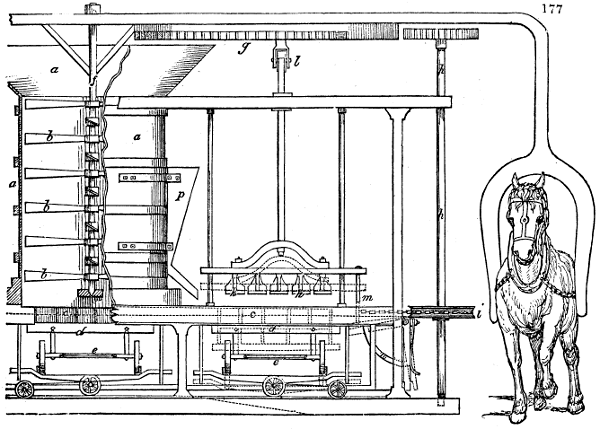
Fig. 177. exhibits the general construction of the apparatus; both ends of which being exactly similar, little more than half of the machine is represented. a is the cylindrical pug-mill, shown partly in section, which is supplied with the clay and other materials from a hopper above; b b, are the rotatory knives or cutters, which are attached to the vertical shaft, and being placed obliquely, press the clay down towards the bottom of the cylinder, in the act of breaking and mixing it as the shaft revolves. The lower part of the cylinder is open; and immediately under it the mould is placed in which the bricks are to be formed. These moulds run to and fro upon ledges in the side frames of the machine; one of the moulds only can be shown by dots in the figure, the side rail intervening: they are situated at c c and are formed of bars of iron crossing each other, and encompassed with a frame. The mould resembles an ordinary sash window in its form, being divided into rectangular compartments (fifteen are proposed in each) of the dimensions of the intended bricks, but sufficiently deep to allow the material, after being considerably pressed in the mould, to leave it, when discharged, of the usual thickness of a common brick.
The mould being open at top and bottom, the material is allowed to pass into it, when situated exactly under the cylinder; and the lower side of the mould, when so placed, is to be closed by a flat board d, supported by the truck e, which is raised by a lever and roller beneath, running upon a plane rail with inclined ends.
The central shaft f, is kept in continual rotatory motion by the revolution of the upper horizontal wheel g, of which it is the axis; and this wheel may be turned by a horse yoked to a radiating arm, or by any other means. A part of the circumference of the wheel g, has teeth which are intended at certain periods of its revolution to take into a toothed pinion, fixed upon the top of a vertical shaft h h. At the lower part of this vertical shaft, there is a pulley i, over which a chain is passed that is connected to the two moulds c, and to the frame in which the trucks are supported; by the rotation of the vertical shaft, the pulley winds a chain, and draws the moulds and truck frames along.
The clay and other material having been forced down from the cylinder into the mould, the teeth of the horizontal wheel g now come into geer with the pinion upon h, and turn it and the shaft and pulley i, by which the chain is wound, and the mould at the right hand of the machine brought into the situation shown in the figure; a scraper or edge-bar under the pug-mill having levelled the upper face of the clay in the mould, and the board d, supported by the truck e, formed the flat under side.
The mould being brought into this position, it is now necessary to compress the materials, which is done by the descent of the plungers k k. A friction-roller l, pendant from the under side of the horizontal wheel as that wheel revolves, comes in contact with an inclined plane, at the top of the shaft of the plungers; and, as the friction-roller passes over this inclined plane, the plungers are made to descend into the mould, and to compress the material; the resistance of the board beneath causing the clay to be squeezed into a compact state. When this has been effectually accomplished, the further descent of the plungers brings a pin m, against the upper end of a quadrant catch-lever n, and, by depressing this quadrant, causes the balance-lever upon which the truck is now supported to rise at that end, and to allow the truck with the board d to descend, as shown by dots; the plungers at the same time forcing out the bricks from the moulds, whereby they are deposited upon the board d; when, by drawing the truck forward out of the machine, the board with the bricks may be removed, and replaced by another board. The truck may then be again introduced into the machine, ready to receive the next parcel of bricks.
By the time that the discharge of the bricks from this mould has been effected, the other mould under the pug cylinder has become filled with the clay, when the teeth of the horizontal wheel coming round, take into a pinion upon the top of a vertical shaft exactly similar to that at h, but at the reverse end of the machine, and cause the moulds and the frame supporting the trucks to be slidden to the left end of the machine; the upper surface of the mould being scraped level in its progress, in the way already described. This movement brings the friction-wheel o, up the inclined plane, and thereby raises the truck with the board to the under side of the mould, ready to receive another supply of clay; and the mould at the left-hand side of the machine being now in its proper situation under the plungers, the clay becomes compressed, and the bricks discharged from the mould in the way described in the former instance; when this truck being drawn out, the bricks are removed to be dried and baked, and another board is placed in the same situation. There are boxes p, upon each side of the pug cylinder containing sand, at the lower parts of which small sliders are to be opened (by contrivances not shown in the figure) as the mould passes under them, for the purpose of scattering sand upon the clay in the mould to prevent its adhering to the plungers. There is also a rack and toothed sector, with a balance weight connected to the inclined plane at the top of the plunger-rods, for the purpose of raising the plunger after the friction-roller has passed over it. And there is a spring acting against the back of the quadrant-catch for the purpose of throwing it into its former situation, after the pin of the plunger has risen.
One of the latest, and apparently most effective machines for brick-making, is that patented by Mr. Edward Jones of Birmingham, in August 1835. His improvements are described under four heads; the first applies to a machine for moulding the earth into bricks in a circular frame-plate horizontally, containing a series of moulds or rectangular boxes, standing radially round the circumference of the circular frame, into which boxes successively the clay is expressed from a stationary hopper as the frame revolves, and after being so formed, the bricks are successively pushed out of their boxes, each by a piston, acted upon by an inclined plane below. The second head of the specification describes a rectangular horizontal frame, having a series of moulding boxes placed in a straight range, which are acted upon for pressing the clay by a corresponding range of pistons fixed in a horizontal frame, worked up and down by rods extending from a rotatory crank shaft, the moulding boxes being allowed to rise for the purpose of enabling the pistons to force out the bricks when moulded, and leave them upon the bed or board below. The third head applies particularly to the making of tiles, for the flooring of kilns in which malt or grain is to be dried. There is in this contrivance a rectangular mould, with pointed pieces standing up for the purpose of producing air-holes through the tiles as they are moulded, which is done by pressing the clay into the moulds upon the points, and scraping off the superfluous matter at top by hand. The fourth or last head applies to moulding chimney pots in double moulds, which take to pieces for the purpose of withdrawing the pot when the edges of the slabs or sides are sufficiently brought into contact.
“The drawing which accompanies the specification very imperfectly represents some parts of the apparatus, and the description is still more defective; but as we are acquainted with the machinery, we will endeavour to give it an intelligible form, and quote those parts of the specification which point the particular features of novelty proposed to be claimed by the patentee as his invention, under the several heads.”[13]
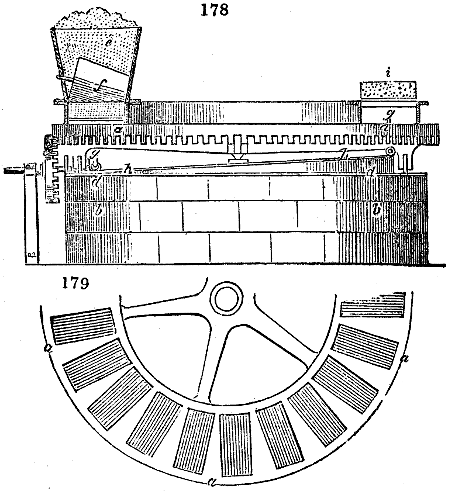
Fig. 178. represents, in elevation, the first-mentioned machine for moulding bricks. The moulds are formed in the face of a circular plate or wheel a a, a portion of the upper surface of which is represented in the horizontal view, fig. 179. Any convenient number of these moulds are set radially in the wheel, which is mounted upon a central pivot, supported by the masonry b b. There is a rim of teeth round the outer edge of the wheel a a, which take into a pinion c, on a shaft connected to the first mover; and by these means the wheel a, with the moulding boxes, is made to revolve horizontally, guided by arms with anti-friction rollers, which run round a horizontal plate a a, fixed upon the masonry.
A hopper e, filled with the brick earth shown with one of the moulding boxes in section, is fixed above the face of the wheel in such a way, that the earth may descend from the hopper into the several moulding boxes as the wheel passes round under it; the earth being pressed into the moulds, and its surface scraped off smooth by a conical roller f, in the bottom of the hopper.
Through the bottom of each moulding box there is a hole for the passage of a piston rod g, the upper end of which rod carries a piston with a wooden pallet upon it, acting within the moulding box; and the lower end of this rod has a small anti-friction roller which, as the wheel a revolves, runs round upon the face of an oblique ring or inclined way h h, fixed upon the masonry.
The clay is introduced into the moulding boxes from the hopper, fixed over the lowest part of the inclined way h, and it will be perceived that as the wheel revolves, the piston rods g, in passing up the inclined way, will cause the pistons to force the new-moulded bricks, with their pallet or board under them, severally up the mould, into the situation shown at i, in fig. 178., from whence they are to be removed by hand. Fresh pallets being then placed upon the several pistons, they, with the moulds, will be ready for moulding fresh bricks, when, by the rotation of the wheel a, they are severally brought under the hopper, the pistons having sunk to the bottoms of their boxes, as the piston rods passed down the other side of the inclined way h.
The patentee says, after having described the first head of his invention, he would have it understood that the same may be varied without departing from the main object of the invention; viz. that of arranging a series of moulds when worked by means of an inclined track, and in such manner that bricks, tiles, or other articles made of brick earth, may be capable of being formed in a mould with pallets or boards laid within the moulds, and constituting the bottoms thereof, the bricks being removed from out of the moulds, with the pallets or boards under them, as above described. “I do not, therefore, confine myself to the precise arrangement of the machine here shown, though it is the best with which I am acquainted for the purpose.”
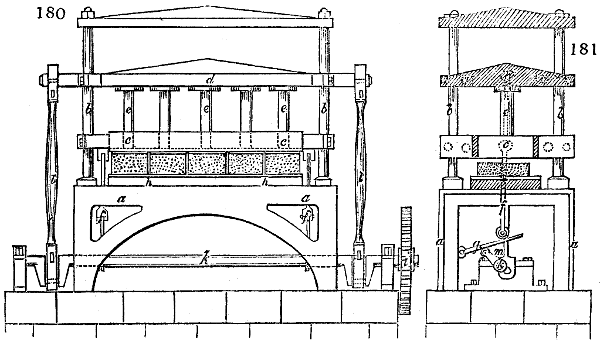
The second head of the invention is another construction of apparatus for moulding bricks, in this instance, in a rectangular frame. Fig. 180. is a front elevation of the machine; fig. 181., a section of the same taken transversely. a a is the standard frame-work and bed on which the bricks are to be moulded. Near the corners of this standard frame-work, four vertical pillars b b are erected, upon which pillars the frame of the moulding boxes c, slides up and down, and also the bar d, carrying the rods of the pistons e e e. These pistons are for the purpose of compressing the clay in the moulding box, and therefore must stand exactly over and correspond with the respective moulds in the frame c beneath.
The sliding frame c, constituting the sides and ends of the moulding boxes, is supported at each end by an upright sliding rod f, which rods pass through guides fixed to the sides of the standard frame a a, and at the lower end of each there is a roller, bearing upon the levers g, on each side of the machine, but seen only in fig. 181., which levers, when depressed, allow the moulding boxes to descend, and rest upon the bed or table of the machine h h.
In this position of the machine resting upon the bed or table, the brick-earth is to be placed upon, and spread over, the top of the frame c, by the hands of workmen, when the descent of the plunger or pistons e e e, will cause the earth to be forced into the moulds, and the bricks to be formed therein. To effect this, rotatory power is to be applied to the toothed wheel i, fixed on the end of the main driving crank shaft k k, which on revolving will, by means of the crank rods l l, bring down the bar a, with the pistons or plungers e e e, and compress the earth compactly into the moulds, and thereby form the bricks.
When this has been done, the bricks are to be released from the moulds by the moulding frame c rising up from the bed, as shown in fig. 180., the pistons still remaining depressed, and bearing upon the upper surfaces of the bricks. The moulding frame is raised by means of cams m, upon the crank shaft, which at this part of the operation are brought under the levers g, for the purpose of raising the cams and the sliding rods f, into the position shown in fig. 181.
The bricks having been thus formed and released from their moulds, they are to be removed from the bed of the machine by pushing forward, on the front side, fresh boards or pallets, which of course will drive the bricks out upon the other side, whence they are to be removed by hand.
There is to be a small hole in the centre of each pallet, and also in the bed, for the purpose of allowing any superfluous earth to be pressed through the moulding boxes when the pistons descend. And in order to cut off the projecting piece of clay which would be thus formed on the bottom of the brick, a knife-edge is in some way connected to the bed of the machine; and as the brick slides over it, the knife separates the protuberant lump: but the particular construction of this part of the apparatus is considered to be of little importance; and the manner of effecting the object is not clearly stated in the specification.
The patentee proposes a variation in this construction, which he describes in these words: “It will be evident that in place of having the moulds to rise, they may, by suitable arrangements, be made to descend below the bricks. In this case, in place of the boards, stationary blocks to receive the pallets must be fixed on the bed of the machine, and these blocks must be shaped in such a manner as to allow of the moulds passing over them; and then it will be desirable to use the first part of my improvements, that of having the pallets within the moulds at the time of moulding the bricks; or in case of working with exceedingly stiff brick-earth, the pallets may be dispensed with.” In 1835, 1,380,279,065 bricks paid duty in the United Kingdom; the revenue from which was 405,580l. 6s. 3d.
BRIMSTONE. (Soufre, Fr.; Schwefel, Germ.) Sulphur, which see.
BRITISH GUM. The trivial name given to starch, altered by a slight calcination in an oven, whereby it assumes the appearance and acquires the properties of gum, being soluble in cold water, and forming in that state a paste well adapted to thicken the colours of the calico printer. See Starch.
BROMINE, one of the archæal elements, which being developed from its combinations at the positive pole of the voltaic circuit, has been therefore deemed to be idio-electro-positive like oxygen and chlorine. It derives its name from its nauseous smell, Βρῶμος, fœtor. It occurs in various saline springs on the continent of Europe, in those of Ashby de la Zouche, and some others in England; in the lake Asphaltites, in sponges, in some marine plants, in an ore of zinc, and in the cadmium of Silesia. At ordinary temperatures it is liquid, of a dark brown colour in mass, but of a hyacinth-red in thin layers. Its smell is rank and disagreeable, somewhat like that of chlorine. It has a very caustic taste. Its specific gravity is 2·966. Applied to the skin it colours it deep yellow and corrodes it. One drop put within the bill of a bird suffices to kill it. It combines with oxygen with feeble affinity, forming bromic acid. Its attraction for hydrogen being far more energetic, it forms therewith a strong acid, the hydrobromic.
Bromine dissolves very sparingly in water, but it is very soluble in alcohol and ether. It combines with carbone, phosphorus, sulphur, and chlorine, as well as with most of the metals. From its scarcity it has not hitherto been applied to any purpose in the arts, but it is supposed to possess powerful discutient effects upon scrophulous and other glandular tumours, whence the waters containing it are prescribed as an internal and external remedy in such forms of disease.
BRONZE. A compound metal consisting of copper and tin, to which sometimes a little zinc and lead are added. This alloy is much harder than copper, and was employed by the ancients to make swords, hatchets, &c., before the method of working iron was generally understood. The art of casting bronze statues may be traced to the most remote antiquity, but it was first brought to a certain degree of refinement by Theodoros and Rœcus of Samos, about 700 years before the Christian era, to whom the invention of modelling is ascribed by Pliny. The ancients were well aware that by alloying copper with tin, a more fusible metal was obtained, that the process of casting was therefore rendered easier, and that the statue was harder and more durable; and yet they frequently made them of copper nearly pure, because they possessed no means of determining the proportions of their alloys, and because by their mode of managing the fire, the copper became refined in the course of melting, as has happened to many founders in our own days. It was during the reign of Alexander that bronze statuary received its greatest extension, when the celebrated artist Lysippus succeeded by new processes of moulding and melting to multiply groups of statues to such a degree that Pliny called them the mob of Alexander. Soon afterwards enormous bronze colossuses were made, to the height of towers, of which the isle of Rhodes possessed no less than one hundred. The Roman consul Mutianus found 3,000 bronze statues at Athens, 3,000 at Rhodes, as many at Olympia and at Delphi, although a great number had been previously carried off from the last town.
In forming such statues, the alloy should be capable of flowing readily into all the parts of the mould, however minute; it should be hard, in order to resist accidental blows, be proof against the influence of the weather, and be of such a nature as to acquire that greenish oxidized coat upon the surface which is so much admired in the antique bronzes, called patina antiqua. The chemical composition of the bronze alloy is a matter therefore of the first moment. The brothers Keller, celebrated founders in the time of Louis XIV., whose chefs d’œuvre are well known, directed their attention towards this point, to which too little importance is attached at the present day. The statue of Desaix in the Place Dauphine, and the column in the Place Vendôme are noted specimens of most defective workmanship from mismanagement of the alloys of which they are composed. On analyzing separately specimens taken from the bas-reliefs of the pedestal of this column, from the shaft, and from the capital, it was found that the first contained only six per cent. of alloy, and 94 of copper, the second much less, and the third only 0·21. It was therefore obvious that the founder, unskilful in the melting of bronze, had gone on progressively refining his alloy, by the oxidizement of the tin, till he had exhausted the copper, and that he had then worked up the refuse scoriæ in the upper part of the column. The cannons which the government furnished him for casting the monument consisted of—
Copper 89·360
Tin 10·040
Lead 0·102
Silver, zinc, iron, and loss 0·498
100·000
The moulding of the several bas-reliefs was so ill executed, that the chiselers employed to repair the faults removed no less than 70 tons of bronze, which was given them, besides 300,000 francs for their work. The statues made by the Kellers at Versailles were found on chemical analysis to consist of—
No. 1. No. 2. No. 3. The mean.
Copper 91·30 91·68 91·22 91·40
Tin 1·00 2·32 1·78 1·70
Zinc 6·09 4·93 5·57 5·53
Lead 1·61 1·07 1·43 1·37
100·00 100·00 100·00 100·00
The analysis of the bronze of the statue of Louis XV. was as follows:—
Copper 82·45 Its specific gravity was 8·482.
Zinc 10·30
Tin 4·10
Lead 3·15
100·00
The alloy most proper for bronze medals which are to be afterwards struck, is composed of from 8 to 12 parts of tin and from 92 to 88 of copper; to which if 2 or 3 parts in the hundred of zinc be added they will make it assume a finer bronze tint. The alloy of the Kellers is famous for this effect. The medal should be subjected to three or four successive stamps of the press, and be softened between each blow by being heated and plunged into cold water.
The bronze of bells or bell metal is composed in 100 parts of copper 78, tin 22. This alloy has a fine compact grain, is very fusible and sonorous. The other metals sometimes added are rather prejudicial, and merely increase the profit of the founders. Some of the English bells consist of 80 copper, 10·1 tin, 5·6 zinc, and 4·3 lead; the latter metal when in such large quantity is apt to cause insulated drops, hurtful to the uniformity of the alloy.
The tam-tams and cymbals of bronze.—The Chinese make use of bronze instruments forged by the hammer, which are very thin, and raised up in the middle; they are called gongs, from the word tshoung which signifies a bell. Klaproth has shown that they contain nothing but copper and tin; in the proportions of 78 of the former metal and 22 of the latter. Their specific gravity is 8·815. This alloy when newly cast is as brittle as glass, but by being plunged at a cherry-red heat into cold water and confined between two discs of iron to keep it in shape, it becomes tough and malleable. The cymbals consist of 80 parts copper and 20 tin.
Bronze vessels naturally brittle may be made tenacious by the same ingenious process, for which the world is indebted to M. Darcet. Bronze mortars for pounding have their lips tempered in the same way. Ancient warlike weapons of bronze were variously compounded; swords were formed of 871⁄2 copper, and 121⁄2 tin in 100 parts; the springs of balistæ consisted of 97 copper, and 3 tin.
Cannon metal consists of about 90 or 91 copper, and 10 or 9 of tin. From the experiments of Papacino-d’Antony, made at Turin, in 1770, it appears that the most proper alloy for great guns is from 12 to 14 parts of tin to 100 of copper; but the Comte Lamartilliere concluded from his experiments made at Douay, in 1786, that never less than 8 nor more than 11 of tin should be employed in 100 parts of bronze.
Gilt ornaments of bronze.—This kind of bronze should be easy of fusion, and take perfectly the impression of the mould. The alloy of copper and zinc is when fused of a pasty consistence, does not make a sharp cast, is apt to absorb too much amalgam, is liable to crack in cooling, and is too tough or too soft for the chaser or the turner. Were the quantity of zinc increased to make the metal harder, it would lose the yellow colour suitable to the gilder. A fourfold combination of copper, zinc, tin, and lead, is preferable for making such ornamental bronze articles; and the following proportions are probably the best, as they unite closeness of grain with the other good qualities. Copper 82, zinc 18, tin 3 or 1, lead 11⁄2 or 3. In the alloy which contains most lead, the tenacity is diminished and the density is increased, which is preferable for pieces of small dimensions. Another alloy which is said to require for its gilding only two thirds of the ordinary quantity of gold, has the following composition: copper, 82·257; zinc, 17·481; tin, 0·238; lead, 0·024.
The antique bronze colour is given to figures and other objects made from these alloys by the following process:—Two drams of sal-ammoniac, and half a dram of salt of sorrel, (binoxalate of potash,) are to be dissolved in fourteen ounce measures (English) of colourless vinegar. A hair pencil being dipped into this solution, and pressed gently between the fingers, is to be rubbed equally over the clean surface of the object slightly warmed in the sun or at a stove; and the operation is to be repeated till the wished for shade is obtained. (See Gilding.)
The bronze founder ought to melt his metals rapidly, in order to prevent the loss of tin, zinc, and lead, by their oxidizement. Reverberatory furnaces have been long used for this operation; the best being of an elliptical form. The furnaces with dome tops are employed by the bell founders, because their alloy being more fusible, they do not require so intense a heat; but they also would find their advantage in using the most rapid mode of fusion. The surface of the melting metals should be covered with small charcoal, or coke; and when the zinc is added, it should be dextrously thrust to the bottom of the melted copper. Immediately after stirring the melted mass so as to incorporate its ingredients, it should be poured out into the moulds. In general the metals most easily altered by the fire, as the tin, should be put in last. The cooling should be as quick as possible in the moulds to prevent the risk of the metals separating from each other in the order of their density, as they are very apt to do. The addition of a little iron, in the form of tin-plate, to bronze, is reckoned to be advantageous.
One part of tin, and two parts of copper, (nearly one atom of tin and four of copper, or more exactly 100 parts of tin, and 215 copper,) form the ordinary speculum metal of reflecting telescopes, which is of all the alloys the whitest, the most brilliant, the hardest, and the most brittle. The alloy of 1 part of tin, and 10 of copper, (or nearly one atom of the former to eighteen of the latter,) is the strongest of the whole series.
Ornamental objects of bronze, after being cast, are commonly laid upon red-hot coals till they take a dull red heat, and are then exposed for some time to the air. The surface is thereby freed from any greasy matter, some portion of the zinc is dissipated, the alloy assumes more of a coppery hue, which prepares for the subsequent gilding. The black tinge which it sometimes gets from the fire may be removed by washing it with a weak acid. It may be made very clean by acting upon it with nitric acid, of specific gravity 1·324, to which a little common salt and soot have been added, the latter being of doubtful utility; after which it must be well washed in water, and dried with rags or saw dust.
Bronzing, is the art of giving to objects of wood, plaster, &c. such a surface as makes them appear as if made of bronze. The term is sometimes extended to signify the production of a metallic appearance of any kind upon such objects. They ought first to be smeared over smoothly with a coat of size or oil varnish, and when nearly dry, the metallic powder made from Dutch foil, gold leaf, mosaic gold, or precipitated copper, is to be applied with a dusting bag, and then rubbed over the surface with a linen pad; or the metallic powders may be mixed with the drying oil beforehand, and then applied with a brush. Sometimes fine copper, or brass filings, or mosaic gold, are mixed previously with some pulverized bone ash, and then applied in either way. A mixture of these powders with mucilage of gum arabic is used to give paper or wood a bronze appearance. The surface must be afterwards burnished. Copper powder precipitated by clean plates of iron, from a solution of nitrate of copper, after being well washed and dried, has been employed in this way, either alone or mixed with pulverized bone-ash. A finish is given to works of this nature by a coat of spirit varnish.
A white metallic appearance is given to plaster figures by rubbing over them an amalgam of equal parts of mercury, bismuth, and tin, and applying a coat of varnish over it. The iron-coloured bronzing is given by black lead or plumbago, finely pulverized and washed. Busts and other objects made of cast iron acquire a bronze aspect by being well cleaned and plunged in solution of sulphate of copper, whereby a thin film of this metal is left upon the iron.
Copper acquires by a certain treatment a reddish or yellowish hue, in consequence of a little oxide being formed upon its surface. Coins and medals may be handsomely bronzed as follows: 2 parts of verdigris and 1 part of sal ammoniac are to be dissolved in vinegar; the solution is to be boiled, skimmed, and diluted with water till it has only a weak metallic taste, and upon further dilution lets fall no white precipitate. This solution is made to boil briskly, and is poured upon the objects to be bronzed, which are previously made quite clean, particularly free from grease, and set in another copper pan. This pan is to be put upon the fire, that the boiling may be renewed. The pieces under operation must be so laid that the solution has free access to every point of their surface. The copper hereby acquires an agreeable reddish brown hue, without losing its lustre. But if the process be too long continued, the coat of oxide becomes thick, and makes the objects appear scaly and dull. Hence they must be inspected every 5 minutes, and be taken out of the solution the moment their colour arrives at the desired shade. If the solution be too strong, the bronzing comes off with friction, or the copper gets covered with a white powder, which becomes green by exposure to air, and the labour is consequently lost. The bronzed pieces are to be washed with many repeated waters, and carefully dried, otherwise they would infallibly turn green. To give fresh-made bronze objects an antique appearance, three quarters of an ounce of sal ammoniac, and a dram and a half of binoxalate of potash (salt of sorrel) are to be dissolved in a quart of vinegar, and a soft rag or brush moistened with this solution is to be rubbed over the clean bright metal, till its surface becomes entirely dry by the friction. This process must be repeated several times to produce the full effect; and the object should be kept a little warm. Copper acquires very readily a brown colour by rubbing it with a solution of the common liver of sulphur, or sulphuret of potash.
The Chinese are said to bronze their copper vessels by taking 2 ounces of verdigris, 2 ounces of cinnabar, 5 ounces of sal ammoniac and 5 ounces of alum, all in powder, making them into a paste with vinegar, and spreading this pretty thick like a pigment on the surfaces previously brightened. The piece is then to be held a little while over a fire, till it becomes uniformly heated. It is next cooled, washed, and dried; after which it is treated in the same way once and again till the wished-for colour is obtained. An addition of sulphate of copper makes the colour incline more to chesnut brown, and of borax more to yellow. It is obvious that the cinnabar produces a thin coat of sulphuret of copper upon the surface of the vessel, and might probably be used with advantage by itself.
To give the appearance of antique bronze to modern articles, we should dissolve 1 part of sal ammoniac, 3 parts of cream of tartar, and 6 parts of common salt in 12 parts of hot water, and mix with the solution 8 parts of a solution of nitrate of copper of specific gravity 1·160. This compound, when applied repeatedly in a moderately damp place to bronze, gives it in a short time a durable green coat, which becomes by degrees very beautiful. More salt gives it a yellowish tinge, less salt a bluish cast. A large addition of sal ammoniac accelerates the operation of the mordant.
Browning of gun-barrels and other arms.—By this process, the surface of several articles of iron acquires a shining brown colour. This preparation, which protects the iron from rust, and also improves its appearance, is chiefly employed for the barrels of fowling-pieces and soldier’s rifles, to conceal the fire-arms from the game and the enemy. The finest kind of browning is the Damascus, in which dark and bright lines run through the brown ground.
This operation consists in producing a very thin uniform film of oxide or rust upon the iron, and giving a gloss to its surface by rubbing wax over it, or coating it with a shell-lac varnish.
Several means may be employed to produce this rust speedily and well. The effect may be obtained by inclosing the barrels in a space filled with the vapour of muriatic acid. Moistening their surface with dilute muriatic or nitric acid, will answer the same purpose. But the most common material used for browning, is the butter or chloride of antimony, which, on account of its being subservient to this purpose, has been called bronzing salt. It is mixed uniformly with olive oil, and rubbed upon the iron slightly heated; which is afterwards exposed to the air, till the wished-for degree of browning is produced. A little aquafortis is rubbed on after the antimony, to quicken its operation. The brown barrel must be then carefully cleaned, washed with water, dried, and finally polished, either by the steel burnisher, or rubbed with white wax, or varnished with a solution of 2 ounces of shell-lac, and 3 drams of dragon’s blood, in 2 quarts of spirit of wine.
The following process may also be recommended: Make a solution with half an ounce of aquafortis, half an ounce of sweet spirit of nitre, 1 ounce of spirit of wine, 2 ounces of sulphate of copper, and 1 ounce of tincture of iron, in so much water as will fill altogether a quart measure. The gun barrel to be browned must first of all be filed and polished bright, and then rubbed with unslaked lime and water to clear away all the grease. Its two ends must now be stopped with wooden rods, which may serve as handles, and the touch-hole must be filled with wax. The barrel is then to be rubbed with that solution, applied to linen rags or a sponge, till the whole surface be equally moistened; it is allowed to stand 24 hours, and is then scrubbed with a stiff brush. The application of the liquid and the brushing may be repeated twice or oftener, till the iron acquires a fine brown colour. After the last brushing, the barrel must be washed with plenty of boiling water, containing a little potash; then washed with clean water, dried, rubbed with polishing hard wood, and coated with shell-lac varnish, for which purpose the barrel must be heated to the boiling point of water. It is finally polished with a piece of hard wood.
Storch recommends to make a browning solution with 1 part of sulphate of copper, one third of a part of sulphuric ether, and 4 parts of distilled water.
To give the damask appearance, the barrel must be rubbed over first with very dilute aquafortis and vinegar, mixed with a solution of blue vitriol; washed and dried, and rubbed with a hard brush to remove any scales of copper which may be precipitated upon it from the sulphate.
Statues, vases, bas-reliefs, and other objects made of gypsum, may be durably bronzed, and bear exposure to the weather better than after the ordinary oil-varnish, by the following process:—Prepare a soap from linseed oil, boiled with caustic soda lye, to which add a solution of common salt, and concentrate it by boiling, till it becomes somewhat granular upon the surface. It is then thrown upon a piece of linen cloth, and strained with moderate pressure. What passes through is to be diluted with boiling water, and again filtered. On the other hand, 4 parts of blue vitriol and 1 part of copperas are to be dissolved separately in hot water. This solution is to be poured slowly into the solution of soap, as long as it occasions any precipitate. This flocculent matter is a mixture of cupreous soap and ferruginous soap, that is, a combination of the oxides of copper and iron with the margaric acid of the soda soap. The copper soap is green, the iron soap is reddish brown, and both together resemble that green rust which is characteristic of the antique bronzes. When the precipitate is completely separated, a fresh portion of the vitriol solution is to be poured upon it in a copper pan, and is made to boil, in order to wash it. After some time, the liquid part must be decanted, and replaced by warm water for the purpose of washing the metallic soaps. They are finally treated with cold water, pressed in a linen bag, drained and dried. In this state the compound is ready for use in the following way:—
Three pounds of pure linseed oil are to be boiled with twelve ounces of finely-powdered litharge, then strained through a coarse canvass cloth, and allowed to stand in a warm place till the soap turns clear. Fifteen ounces of this soap-varnish, mixed with 12 ounces of the above metallic soaps, and 5 ounces of fine white wax, are to be melted together at a gentle heat in a porcelain basin, by means of a water bath. The mixture must be kept for some time in a melted state, to expel any moisture which it may contain. It must be then applied, by means of a painter’s brush, to the surface of the gypsum previously heated to the temperature of about 200° F. By skilful management of the heat, the colour may be evenly and smoothly laid on without filling up the minute lineaments of the busts. When, after remaining in the cool air for a few days, the smell of the pigment has gone off, the surface is to be rubbed with cotton wool, or a fine linen rag, and variegated with a few streaks of metal powder or shell gold. Small objects may be dipped in the melted mixture, and then exposed to the heat of a fire till they are thoroughly penetrated and evenly coated with it.
BROWN DYE. Upon this subject some general views are given in the article Dyeing, explanatory of the nature of this colour, to which I may in the first place refer. This dye presents a vast variety of tints, from yellow and red to black brown, and is produced either by mixtures of red, yellow, and blue with each other, or of yellow or red with black, or by substantive colours, such as catechu or oxide of manganese, alone. We shall here notice only the principal shades; leaving their modifications to the caprice or skill of the dyer.
1. Brown from mixture of other colours.
Wool and woollen cloths must be boiled with one eighth their weight of alum and sulpho-tartrate of iron (see this article); afterwards washed, and winced through the madder bath, which dyes the portion of the stuff imbued with the alum red, and that with the salt of iron black; the tint depending upon the proportion of each, and the duration of the madder bath.
A similar brown is produced by boiling every pound of the stuff with two ounces of alum, and one ounce of common salt, and then dyeing it in a bath of logwood containing either sulphotartrate, acetate, or sulphate of iron. Or the stuff may be boiled with alum and tartar, dyed up in a madder bath, and then run through a black bath of iron mordant and galls or sumach. Here the black tint is added to the red till the proper hue be hit. The brown may be produced also by adding some iron liquor to the madder bath, after the stuff has been dyed up in it with alum and tartar. A better brown of this kind is obtained by boiling every pound of wool with 2 ounces of alum, dyeing it up in cochineal, then changing the crimson thus given into brown, by turning the stuff through the bath after acetate of iron has been added to it. Instead of the cochineal, archil or cutbear, with a little galls or sumach, may be used.
Wool or silk may also receive a light blue ground from the indigo vat, then be mordanted with alum, washed, and turned through a madder bath till the wished-for brown be brought out. For the deeper shades, galls or sumach may be added to the paler Brazil-wood, with more or less iron mordant. Instead of the indigo vat, Saxon blue may be employed to ground the stuff before dyeing it with madder, or 5 pounds of madder, with 1 pound of alum, a solution of one tenth of a pound of indigo in sulphuric acid, may be used with the proper quantity of water for 20 pounds of wool; for dark shades some iron mordant may be added. Or we may combine a bath of cochineal or cutbear, fustic, and galls, and add to it sulphate of iron and sulphate of indigo, blunted with a little potash.
If we boil woollen cloth with alum and tartar, then pass it through a madder bath, and afterwards through one of weld or fustic, containing more or less iron mordant, we obtain shades variable, according to the proportions of the materials, from mordoré and cinnamon to chesnut brown.
After the same manner, bronze colours may be obtained from the union of olive dyes with red. For 25 pounds of cloth, we take 4 pounds of fustic chips, boil them for 2 hours, turn the cloth in this bath for an hour, and drain it; then add to the bath from 4 to 6 ounces of sulphate of iron, and 1 pound of ordinary madder, or 2 pounds of sandal wood; put the cloth again in this compound bath, and turn it through, till the desired shade be obtained. By changing the proportions, and adding an iron mordant, other tints may be produced.
This mode of dyeing is suitable for silk, but with three different baths, one of logwood, one of Brazil-wood, and one of fustic. The silk, after being boiled with soap, is to be alumed, and then dyed up in a bath compounded of these three decoctions, mixed in the requisite proportions. By the addition of walnut peels, sulphate of copper, and a little sulphate of iron, or by passing the silk through a bath of annotto, a variety of brown shades may be had.
Or the silk may receive an annotto ground, and then be passed through a bath of logwood or Brazil-wood. For 10 pounds of silk, 6 ounces of annotto are to be taken, and dissolved with 18 ounces of potashes in boiling water. The silk must be winced through this solution for 2 hours, then wrung out, dried, next alumed, passed through a bath of Brazil-wood, and finally through a bath of logwood containing some sulphate of iron. It is to be wrung out and dried.
Brown of different shades is imparted to cotton and linen, by impregnating them with a mixed mordant of acetates of alumina and iron, and then dyeing them up, either with madder alone, or with madder and fustic. When the aluminous mordant predominates, the madder gives an amaranth tint. For horse-chesnut brown, the cotton must be galled, plunged into a black bath, then into a bath of sulphate of copper, next dyed up in a decoction of fustic, wrung out, passed through a strong madder bath, then through the sulphate of copper solution, and finished with a soap boil. Different shades of cinnamon are obtained, when cottons first dyed up with madder get an olive cast with iron liquor in a fustic bath.
These cinnamon and mordoré shades are also produced by dyeing them first in a bath of weld and verdigris, passing them through a solution of sulphate of iron, wringing and drying them; next putting them through a bath containing 1 pound of galls for 10 pounds of stuff, again drying, next aluming, and maddering. They must be brightened by a boil in soap water.
A superior brown is produced by like means upon cotton goods, which have undergone the oiling process of the Turkey red dye. Such stuffs must be galled, mordanted with alum (see Madder), sulphate of iron, and acetate of lead (equal to 2⁄3 of the alum); after washing and drying, dyed in a madder bath, and cleared with a soap boil. The tint of brown varies with the proportion of alum and sulphate of iron.
We perceive from these examples, in how many ways the browning of dyes may be modified, upon what principles they are founded, and how we have it in our power to turn the shade more or less towards red, black, yellow, blue, &c.
Brown may be produced by direct dyes. The decoction of oak bark dyes wool a fast brown of different shades, according to the concentration of the bath. The colour is more lively with the addition of alum.
The decoction of bastard marjoram (Origanum vulgare) dyes cotton and linen a reddish brown, with acetate of alumina. Wool takes from it a dark brown.
The bark of the mangrove tree (Rizophora mangle) affords to wool boiled with alum and tartar a fine red brown colour, which, with the addition of sulphate of iron, passes into a fast chocolate.
The Bablah, the pods of the East Indian Mimosa cineraria, and the African Mimosa nilotica, gives cotton a brown with acetate or sulphate of copper.
The root of the white sea rose (Nymphæa alba) gives to cotton and wool beautiful shades of brown. A mordant of sulphate of iron and zinc is first given, and then the wool is turned through the decoction of the root, till the wished-for shade is obtained. The cotton must be mordanted with a mixture of the acetates of iron and zinc.
Walnut peels (Juglans regia), when ripe, contain a dark brown dye stuff, which communicates a permanent colour to wool. The older the infusion or decoction of the peels, the better dye does it make. The stuff is dyed in the lukewarm bath, and needs no mordant, though it becomes brighter with alum. Or this dye may be combined with the madder or fustic bath, to give varieties of shade. For dyeing silk, this bath should be hardly lukewarm, for fear of causing inequality of colour.
The peelings of horse-chesnuts may be used for the same purpose. With muriate of tin they give a bronze colour, and with acetate of lead a reddish brown.
Catechu gives cotton a permanent brown dye, as also a bronze, and mordoré, when its solution in hot water is combined with acetate or sulphate of copper, or when the stuff is previously mordanted with the acetates of copper and alumina mixed, sometimes with a little iron liquor, rinsed, dried, and dyed up, the bath being at a boiling heat.
Ferrocyanate of copper gives a yellow brown or a bronze to cotton and silk.
The brown colour called carmelite by the French is produced by one pound of catechu to four ounces of verdigris, with five ounces of muriate of ammonia.—The bronze (solitaire) is given by passing the stuff through a solution of muriate or sulphate of manganese, with a little tartaric acid, drying, passing through a potash lye at 4° Baumé, brightening and fixing with solution of chloride of lime.
BRUSHES. (Brosses, Fr.; Bürsten, Germ.) Mr. T. Mason obtained a patent in October, 1830, for an improvement in the manufacture of this article. It consists in a firmer mode of fixing the knots or small bundles of hair into the stock or the handle of the brush. This is done by forming grooves in the stocks of the brushes, for the purpose of receiving the ends of the knots of hair, instead of the holes drilled into the wood, as in brushes of the common constructions. These grooves are to be formed like a dovetail, or wider at the bottom than the top; and when the ends of the knots of hair have been dipped into cement, they are to be placed in the grooves and compressed into an oval form, by which the ends of the hair will be pressed outwards into the recess or wider part of the dovetailed groove, or the grooves may be formed with threads or teeth on the sides, instead of being dovetailed; and the cement and hairs being pressed into the teeth or threads, will cause them to adhere firmly to the stock or handle of the brush.
A metal ferrule may be placed on the outside of the stock of the brush, if necessary, and secured by pins or rivets, or in any other convenient manner, which ferrule may also form one side of the outer groove. Fig. 182. is a plan view of the stock of a round brush; fig. 183. is a section of the same; a a are the dovetailed grooves, which are turned out of the wood; b is the metal ferrule; c c are knots or small bundles of hair, to form the brush. After a number of the knots of hair are prepared, the ends are to be dipped into proper cement, and then placed into the grooves, when their ends are to be squeezed by a pair of plyers, or other means, which will compress them into the oval shape, as shown in fig. 184., and cause the ends of the hairs to extend outward under the dovetailed part of the recess.
The knots of hair are to be successively placed in the grooves, and forced up by a tool against the last knot put in, and so on, until the grooves are filled; fig. 184. is a section taken through a brush with teeth or threads of a screw formed upon the sides of the groove; into these teeth or threads the cement and hairs will be forced by the compression, by which means they will be held firmly in the stock of the brush.
BUTTER. (Beurre, Fr.; Butter, Germ.) Milk contains a fatty matter of more or less consistency, modified very much according to the nature of the animals which afford it. This substance is butter, held suspended in the milk by means of the caseous matter and whey, with which it is intimately blended. Milk is a true emulsion resulting from the mixture of these three ingredients, owing its opacity and white colour to the diffusion through it of that butyraceous oil. When any circumstance dissolves this union, each component becomes insulated, and manifests its peculiar properties. Milk, even left to itself, at a temperature of from 50° to 60° F., separates spontaneously into several products. A layer of a fatter, more consistent, but lighter nature, floats upon its surface, while the subjacent liquid forms a white magma, which retains among its curdy flocks all the whey of the milk. The upper layer or cream contains nearly the whole of the butter; but a portion remains entangled with the curd and whey below.
It belongs to a work on husbandry or rural economy to treat fully of the operations of the dairy; one of the principal of which is the extraction of butter from milk.
The Tartars and French have been long in the habit of preserving butter, by melting it with a moderate heat, whereby are coagulated the albuminous and curdy matters remaining in it, which are very putrescible. This fusion should be made by a heat of a water bath, about 176° F., continued for some time, to effect the more complete purification of the butter. If in this settled liquified state it be carefully decanted, strained through a tammy cloth, and slightly salted, it may be kept for a long time nearly fresh, without becoming in any degree rancid, more especially if it be put up in small jars closely covered.