S. (continued 3)
Reading edition
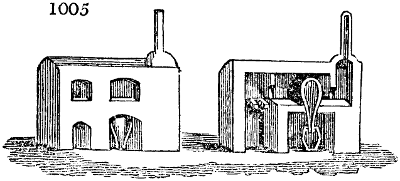
The amalgam is carried in bowls into the azogueria, where it is subjected to straining through the strong canvas bottom of a leather bag. The hard mass left in the bag is moulded into wedge-shaped masses of 30 lbs., which are arranged in the burning-house, (fig. 1005.), to the number of 11, upon a solid copper stand, called baso, having a round hole in its centre. Over this row of wedges several others are built; and the whole pile is called pina. Each circular range is firmly bound round with a rope. The base is placed over a pipe which leads to a small tank of water for condensing the quicksilver; a cylindrical space being left in the middle of the pina, to give free egress to the mercurial vapours.
A large bell-shaped cover, called capellina, is now hoisted up, and carefully lowered over the pina, by means of pulleys. A strong lute of ashes, saltierra, and lama is applied to its lower edge, and made to fit very closely to the plate on which the base stands. A wall of fire-bricks is then built loosely round the capellina, and this space is filled with burning charcoal, which is thrice replenished, to keep it burning all night. After the heat has been applied 20 hours, the bricks and ashes are removed, the luting broken, and the capellina hoisted up. The burned silver is then found in a hard mass, which is broken up, weighed, and carried to the casting-house, to be formed into bars of about 1080 ounces each. The loss of silver in burning, is about 5 ounces to each bar (barra), and the loss of quicksilver, from 21⁄2 upon the good metals, to 9 upon the coarse.
Molina told Mr. Miers, that the produce of the galena ores of Uspaltata did not average more than 2 marcs per caxon of 5000 lbs., which is an excessively poor ore. The argentiferous galena ores of Cumberland afford 11 marcs per caxon; while the average produce of the Potosi silver ores is only 5 or 6 marcs in the same quantity. These comparisons afford the clearest evidence that the English mode of smelting can never be brought into competition with the process of amalgamation as practised in America.
Humboldt, Gay Lussac, Boussingault, Karsten, and several other chemists of note, have offered solutions of the amalgamation enigma of Mexico and Peru. The following seems to be the most probable rationale of the successive steps of the process:—
The addition of the magistral (powder of the roasted copper pyrites), is not for the purpose of disengaging muriatic acid from the sea salt (saltierra), as has been supposed, since nothing of the kind actually takes place; but, by reciprocal or compound affinity, it serves to form chloride of copper, and chloride of iron, upon the one hand, and sulphate of soda, upon the other. Were sulphuric acid to be used instead of the magistral, as certain novices have prescribed, it would certainly prove injurious, by causing muriatic acid to exhale. Since the ores contain only at times oxide of silver, but always a great abundance of oxide of iron, the acid would carry off both partly, but leave the chloride of silver in a freer state. A magistral, such as sulphate of iron, which is not in a condition to generate the chlorides, will not suit the present purpose; only such metallic sulphates are useful as are ready to be transformed into chlorides by the saltierra. This is peculiarly the case with sulphate of copper. Its deuto-chloride gives up chlorine to the silver, becomes in consequence a protochloride, while the chloride of silver, thus formed, is revived, and amalgamated with the quicksilver present, by electro-chemical agency which is excited by the saline menstruum; just as the voltaic pile of copper and silver is rendered active by a solution of sea salt. A portion of chloride of mercury will be simultaneously formed, to be decomposed in its turn by the sulphate of silver resulting from the mutual action of the acidified pyrites, and the silver or its oxide in the ore. An addition of quicklime counteracts the injurious effect of too much magistral, by decomposing the resulting sulphate of copper. Quicksilver being an excellent conductor of heat, when introduced in too great quantities, is apt to cool the mass too much, and thereby enfeebles the operation of the deuto-chloride of copper upon the silver.
There is a method of extracting silver from its ores by what is called imbibition. This is exceedingly simple, consisting in depriving, as far as possible, the silver of its gangue, then melting it with about its own weight of lead. The alloy thus procured, contains from 30 to 35 per cent. of silver, which is separated by cupellation on the great scale, as described under ores of Lead. In this way the silver is obtained at Kongsberg in Norway.
The amalgamation works at Halsbrücke, near Freyberg, for the treatment of silver ores by mercury, have been justly admired as a model of arrangement, convenience, and regularity; and I shall conclude this subject with a sketch of their general distribution.
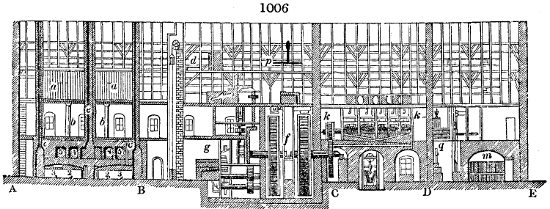
Fig. 1006 enlarged (241 kb)
Fig. 1006. presents a vertical section of this great usine or hüttenwerk, subdivided into four main departments. The first, A, B, is devoted to the preparation and roasting of the matters intended for amalgamation. The second, B, C, is occupied with two successive siftings and the milling. The third, C, D, includes the amalgamation apartment above, and the wash-house of the residuums below. And in the fourth, D, E, the distilling apparatus is placed, where the amalgam is finally delivered.
Thus, from one extremity of this building to the other, the workshops follow in the order of the processes; and the whole, over a length of 180 feet, seems to be a natural laboratory, through which the materials pass, as it were of themselves, from their crude to their refined condition; so skilfully economized and methodical are the labours of the workmen; such are the regularity, precision, concert, and facility, which pervade this long series of combinations, carriages, movements, and metamorphoses of matter.
Here we distinguish the following objects:—
1. In division A, B; a, a, is the magazine of salt; b, b, is the hall of preparation of the ores; on the floor of which they are sorted, interstratified, and mixed up with salt; c, c, are the roasting furnaces; in each of which we see, 1, the fireplace; 2, 3, the reverberatory hearth, divided into two portions, one a little higher than the other, and more distant from the fireplace, called the drier. The materials to be calcined fall into it, through a chimney 6. The other part 2, of the hearth is the calcining area. Above the furnace are chambers of sublimation 4, 5, for condensing some volatile matters which escape by the opening 7. e is the main chimney.
2. In the division B, C, we have d, the floor for the coarse sifting; beneath, that for the fine sieves; from which the matters fall into the hopper, whence they pass down to g, the mill-house, in which they are ground to flour, exactly as in a corn-mill, and are afterwards boulted through sieves, p, f, is the wheel machinery of the mill.
3. The compartment C, D, is the amalgamation work, properly speaking, where the casks are seen in their places. The washing of the residuums is effected in the shop l, below. k, k, is the compartment of revolving casks.
4. In the division D, E, the distillation process is carried on. There are four similar furnaces, represented in different states, for the sake of illustration. The wooden drawer is seen below, supporting the cast-iron basin, in which the tripod with its candelabra for bearing the amalgam saucers is placed. q is a store chamber.
At B, are placed the pulleys and windlass for raising the roasted ore, to be sifted and ground; as also for raising the milled flour, to be transported to the amalgamation casks. At D, the crane stands for raising the iron bells that cover the amalgamation candelabra.
Details of the Amalgamation Process, as practised at Halsbrücke.—All ores which contain more than 7 lbs. of lead, or 1 lb. of copper, per cent., are excluded from this reviving operation (anquickverfahren); because the lead would render the amalgam very impure, and the copper would be wasted. They are sorted for the amalgamation, in such a way that the mixture of the poorer and richer ores may contain 71⁄2, or, at most, 8 loths (of 1⁄2 oz. each) of silver per 100 lbs. The most usual constituents of the ores are, sulphur, silver, antimonial silver (speissglanzsilber), bismuth, sulphurets of arsenic, of copper, iron, lead (nickel, cobalt), zinc, with several earthy minerals. It is essential that the ores to be amalgamated shall contain a certain proportion of sulphur, in order that they may decompose enough of sea salt in the roasting to disengage as much chlorine as to convert all the silver present into a chloride. With this view, ores poor in sulphur are mixed with those that are richer, to make up a determinate average. The ore-post is laid upon the bed-floor, in a rectangular heap, about 17 ells long, and 41⁄2 ells broad (13 yards and 31⁄2); and upon that layer the requisite quantity of salt is let down from the floor above, through a wooden tunnel; 40 cwts. of salt being allotted to 400 cwts. of ore. The heap being made up with alternate strata to the desired magnitude, must be then well mixed, and formed into small bings, called roast-posts, weighing each from 31⁄2 to 41⁄2 cwts. The annual consumption of salt at Halsbrücke is 6000 cwts.; it is supplied by the Prussian salt-works.
Roasting of the Amalgamation Ores.—The furnaces appropriated to the roasting of the ore-posts are of the reverberatory class, provided with soot chambers. They are built up alongside of the bed-floor, and connected with it by a brick tunnel. The prepared ground ore (erzmehl) is spread out upon the hearth, and dried with incessant turning over; then the fire is raised so as to kindle the sulphur, and keep the ore redhot for one or two hours; during which time, dense white-gray vapours of arsenic, antimony, and water, are exhaled. The desulphuration next begins, with the appearance of a blue flame. This continues for three hours, during which the ignition is kept up; and the mass is diligently turned over, in order to present new surfaces, and to prevent any caking. Whenever sulphurous acid ceases to be formed, the finishing calcination is to be commenced with increased firing; the object being now to decompose the sea salt by means of the metallic sulphates that have been generated, to convert them into chlorides, with the simultaneous production of sulphate of soda. The stirring is to be continued till the proofs taken from the hearth no longer betray the smell of sulphurous, but only of muriatic acid gas. This roasting stage lasts commonly three quarters of an hour, 13 or 14 furnaces are worked at the same time at Halsbrücke; and each turns out in a week 5 tons upon an average. Out of the nicht chambers or soot vaults of the furnaces, from 96 to 100 cwts. of ore-dust are obtained, containing 32 marcs (16 lbs.) of silver. This dust is to be treated like unroasted ore. The fuel of the first fire is pitcoal; of the finishing one, fir-wood. Of the former 1151⁄2 cubic feet, and of the latter, 2941⁄4, are, upon an average, consumed for every 100 cwts. of ore.
During the last roasting, the ore increases in bulk by one fourth, becomes in consequence a lighter powder, and of a brown colour. When this process is completed, the ore is raked out upon the stone pavement, allowed to cool, then screened in close sieve-boxes, in order to separate the finer powder from the lumps. These are to be bruised, mixed with sea salt, and subjected to another calcination. The finer powder alone is taken to the millstones, of which there are 14 pairs in the establishment. The stones are of granite, and make from 100 to 120 revolutions per minute. The roasted ore, after it has passed through the boulter of the mill, must be as impalpable as the finest flour.
The Amalgamation.—This (the verquicken) is performed in 20 horizontal casks, arranged in 4 rows, each turning upon a shaft which passes through its axis; and all driven by the water-wheel shown in the middle of fig. 1006. The casks are 2 feet 10 inches long, 2 feet 8 inches wide, inside measure, and are provided with iron ends. The staves are 31⁄2 inches thick, and are bound together with iron hoops. They have a double bung-hole, one formed within the other, secured by an iron plug fastened with screws. They are filled by means of a wooden spout terminated by a canvas hose; through which 10 cwts. of the boulted ore-flour (erzmehl) are introduced after 3 cwts. of water have been poured in. To this mixture, from 3⁄4 to 7⁄8 of a cwt. of pieces of iron, 11⁄2 inch square, and 3⁄8 thick, are added. When these pieces get dissolved, they are replaced by others from time to time. The casks being two thirds full, are set to revolve for 11⁄2 or 2 hours, till the ore-powder and water become a uniform pap; when 5 cwts. of quicksilver are poured into each of them. The casks being again made tight, are put in geer with the driving machinery, and kept constantly revolving for 14 or 16 hours, at the rate of 20 or 22 turns in the minute. During this time they are twice stopped and opened, in order to see whether the pap be of the proper consistence; for if too thick, the globules of quicksilver do not readily combine with the particles of ore; and if too thin, they fall and rest at the bottom. In the first case, some water must be added; in the second, some ore. During the rotation, the temperature rises, so that even in winter it sometimes stands so high as 104° F.
The chemical changes which occur in the casks are the following:—The metallic chlorides present in the roasted ore are decomposed by the iron, whence results muriate of iron, whilst the deutochloride of copper is reduced partly to protochloride, and partly to metallic copper, which throw down metallic silver. The mercury dissolves the silver, copper, lead, antimony, into a complex amalgam. If the iron is not present in sufficient quantity, or if it has not been worked with the ore long enough to convert the copper deutochloride into a protochloride, previously to the addition of the mercury, more or less of the last metal will be wasted by its conversion into protochloride (calomel). The water holds in solution sulphate of soda, undecomposed sea salt, with chlorides of iron, manganese, &c.
As soon as the revivification is complete, the casks must be filled with water, set to revolve slowly (about 6 or 8 times in the minute), whereby in the course of an hour, or an hour and a half at most, a great part of the amalgam will have collected at the bottom; and in consequence of the dilution, the portion of horn silver held in solution by the sea salt will fall down and be decomposed. Into the small plug in the centre of the bung, a small tube with a stopcock is now to be inserted, to discharge the amalgam into its appropriate chamber. The cock must be stopped whenever the brown muddy residuum begins to flow. The main bung being then opened, the remaining contents of the casks are emptied into the wash-tun, while the pieces of iron are kept back. The residuary ore is found to be stripped of its silver within 5⁄32 or 7⁄40 of an ounce per cwt. The emptying of all the casks, and charging them again, takes 2 hours; and the whole process is finished within 18 or 20 hours; namely, 1 hour for charging, 14 to 16 hours for amalgamating; 11⁄2 hour for diluting; 1 hour for emptying. In 14 days, 3200 cwts. of ore are amalgamated. For working 100 cwts. of ore, 141⁄2 lbs. of iron, and 2 lbs. 121⁄2 ounces of mercury, are required; whence, for every pound of silver obtained, 0·95 of an ounce of mercury are consumed.
Trials have been made to conduct the amalgamation process in iron casks, heated to 150° or 160° Fahrenheit, over a fire; but though the de-silvering was more complete, the loss by mercury was so much greater as to more than counterbalance that advantage.
Treatment of the Amalgam.—It is first received in a moist canvas bag, through which the thin uncombined quicksilver spontaneously passes. The bag is then tied up and subjected to pressure. Out of 20 casks, from 3 to 31⁄2 cwts. of solid amalgam are thus procured, which usually consist of 1 part of an alloy, containing silver of 12 or 13 loths (in 16), and 6 parts of quicksilver. The foreign metals in that alloy are, copper, lead, gold, antimony, cobalt, nickel, bismuth, zinc, arsenic, and iron. The filtered quicksilver contains moreover 2 to 3 loths of silver in the cwt.
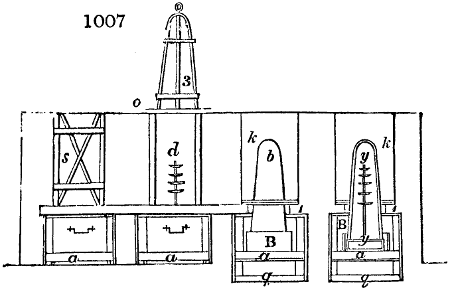
Fig. 1007. represents the apparatus for distilling the amalgam in the Halsbrücke works, marked m in fig. 1006. a is the wooden drawer, sliding in grooves upon the basis q; B is an open basin or box of cast iron, laid in the wooden drawer; y is a kind of iron candelabra, supported upon four feet, and set in the basin B; under d are five dishes or plates, of wrought iron, with a hole in the centre of each, whereby they are fitted upon the stem of the candelabra, 3 inches apart, each plate being successively smaller than the one below it. 3 indicates a cast-iron bell, furnished with a wrought-iron frame and hook, for raising it by means of a pulley and cord. s is a sheet-iron door for closing the stove, whenever the bell has been set in its place.
The box a, and the basin B, above it, are filled with water, which must be continually renewed, through a pipe in the side of the wooden box, so that the iron basin may be kept always submersed and cool. The drawer a, being properly placed, and the plates under d being charged with balls of amalgam (weighing altogether 3 cwts.), the bell 3 is to be let down into the water, as at y, and rested upon the lower part of the candelabra. Upon the ledge 1, which defines the bottom of the fireplace, a circular plate of iron is laid, having a hole in its middle for the bell to pass through. Upon this plate chips of fir-wood are kindled, then the door s, which is lined with clay, is closed and luted tight. The fuel is now placed in the vacant space k, round the upper part of the bell. The fire must be fed in most gradually, first with turf, then with charcoal; whenever the bell gets red, the mercury volatilizes, and condenses in globules into the bottom of the basin B. At the end of 8 hours, should no more drops of mercury be heard to fall into the water, the fire is stopped. When the bell has become cool, it is lifted off; the plates are removed from the candelabra d; and this being taken out, the drawer a is slid away from the furnace. The mercury is drained, dried, and sent again into the amalgamation works. The silver is fused and refined by cupellation.
The solid amalgam which is distilled in the above apparatus, would be distilled more profitably out of iron trays set in the mercurial retorts described and figured in pages 809, 810.
From 3 cwts. of amalgam, distilled under the bell, from 95 to 100 marcs (1⁄2 lbs.) of teller silver (dish silver) are procured, containing from 10 to 131⁄2 parts of fine silver out of 16; one-fifth part of the metal being copper. The teller silver is refined in quantities of 160 or 170 marcs, in black-lead crucibles filled within two inches of their brims, and submitted to brisk ignition. The molten mass exhales some vapours, and throws up a liquid slag, which being skimmed off, the surface is to be strewed over with charcoal powder, and covered with a lid. The heat having been briskly urged for a short time, the charcoal is then removed along with any fresh slag that may have risen, in order to observe whether the vapours have ceased. If not, fresh charcoal must be again applied, the crucible must be covered, and the heat increased, till fumes are no longer produced, and the surface of the silver becomes tranquil. Finally, the alloy, which contains a little gold, and much copper, being now from 11 to 13 löthig (that is, holding from 11 to 13 parts of fine silver in 16 parts), is cast into iron moulds, in ingots of 60 marcs. The loss of weight by evaporation and skimming of the slag amounts to 2 per cent.; the loss in silver is quite inconsiderable.
The dust from the furnace (tiegelöfen) is collected in a large condensation chamber of the chimney, and affords from 40 to 50 marcs of silver per cwt. The slags and old crucibles are ground and sent to the small amalgamation mill.
The earthy residuum of the amalgamation casks being submitted to a second amalgamation, affords out of 100 cwts. about 2 lbs. of coarse silver. This is first fused along with three or four per cent. of a mixture of potashes and calcined quicksalz, (impure sulphate of soda), and then refined. The supernatant liquor that is drawn out of the tanks in which the contents of the casks are allowed to settle, consists chiefly of sulphate of soda, along with some common salt, sulphates of iron and manganese, and a little phosphate, arseniate, and fluate of soda. The earthy deposit contains from 1⁄4 to 9⁄32 of a loth of silver per cwt., but no economical method of extracting this small quantity has yet been contrived.
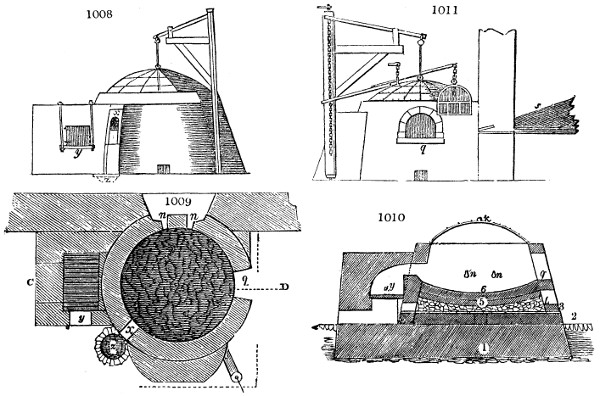
The argentiferous or rich lead is treated in Germany by the cupellation furnace represented in figs. 1008, 1009, 1010, and 1011. These figures exhibit the cupellation furnace of the principal smelting work in the Hartz, where the following parts must be distinguished; (fig. 1010.) 1, masonry of the foundation; 2, flues for the escape of moisture; 3, stone covers of the flues; 4, bed of hard rammed scoriæ; 5, bricks set on edge, to form the permanent area of the furnace; 6, the sole, formed of wood ashes, washed, dried, and beaten down; k, dome of iron plate, movable by a crane, and susceptible of being lined two inches thick with loam; n, n, tuyères for two bellows s; having valves suspended before their orifices to break and spread the blast; q, door for introducing into the furnace the charge of lead, equal to 84 quintals at a time; s, fig. 1011., two bellows, like those of a smith’s forge; y, door of the fireplace, through which billets of wood are thrown on the grate; x, small aperture or door, for giving issue to the frothy scum of the cupellation, and the litharge; z, basin of safety, usually covered with a stone slab, over which the litharge falls: in case of accident the basin is laid open to admit the rich lead.
The following is the mode of conducting the cupellation. Before putting the lead into the furnace, a floor is made in it of ashes beat carefully down (see 6, fig. 1010.); and there is left in the centre of this floor a circular space, somewhat lower than the rest of the hearth, where the silver ought to gather at the end of the operation. The cupel is fully six feet in diameter.
In forming the floor of a cupel, 35 cubic feet of washed wood ashes, usually got from the soap works, are employed. The preparation of the floor requires 21⁄2 hours’ work; and when it is completed, and the movable dome of iron plate has been lined with loam, 84 quintals (cwt.) of lead are laid on the floor, 42 quintals being placed in the part of the furnace farthest from the bellows, and 42 near to the fire-bridge; to these, scoriæ containing lead and silver are added, in order to lose nothing. The movable lid is now luted on the furnace, and heat is slowly applied in the fireplace, by burning fagots of fir-wood, which is gradually raised. Section 1010. is in the line C, D, of 1009.
At the end of three hours, the whole lead being melted, the instant is watched for when no more ebullition can be perceived on the surface of the bath or melted metal; then, but not sooner, the bellows are set a-playing on the surface at the rate of 4 or 5 strokes per minute, to favour the oxidizement.
In five hours, reckoned from the commencement of the process, the fire is smartly raised; when a grayish froth (abstrich) is made to issue from the small aperture x of the furnace. This is found to be a brittle mixture of oxidized metals and impurities. The workman now glides the rake over the surface of the bath, so as to draw the froth out of the furnace; and, as it issues, powdered charcoal is strewed upon it, at the aperture x, to cause its coagulation. The froth skimming lasts for about an hour and a half.
After this time, the litharge begins to form, and it is also let off by the small opening x; its issue being aided by a hook. In proportion as the floor of the furnace gets impregnated with litharge, the workman digs in it a gutter for the escape of the liquid litharge: it falls in front of the small aperture, and concretes in stalactitic forms.
By means of the two movable valves suspended before the tuyères n, n, (fig. 1010.) the workman can direct the blast as he will over the surface of the metal. The wind should be made to cause a slight curl on the liquid, so as to produce circular undulations, and gradually propel a portion of the litharge generated, towards the edges of the cupel, and allow this to retain its shape till the end of the operation. The stream of air should drive the greater part of the litharge towards the small opening x, where the workman deepens the outlet for it, in proportion as the level of the metal bath descends, and the bottom of the floor rises by the apposition of the litharge formed. Litharge is thus obtained during about 12 hours; after which period the cake of silver begins to take shape in the centre of the cupel.
Towards the end of the operation, when no more than four additional quintals of litharge can be looked for, and when it forms solely in the neighbourhood of the silver cake in the middle of the floor, great care must be taken to set apart the latter portions, because they contain silver. About this period, the fire is increased, and the workman places before the little opening x a brick, to serve as a mound to the efflux of litharge. The use of this brick is,—1, to hinder the escape of the silver in case of any accident; for example, should an explosion take place in the furnace; 2, to reserve a magazine of litharge, should that still circulating round the silver cake be suddenly absorbed by the cupel, for in this dilemma the litharge must be raked back on the silver; 3, to prevent the escape of the water that must be thrown on the silver at the end of the process.
When the argentiferous litharge, collected in the above small magazine, is to be removed, it is let out in the form of a jet, by the dexterous use of the iron hook.
Lastly, after 20 hours, the silver cake is seen to be well formed, and nearly circular. The moment for stopping the fire and the bellows is indicated by the sudden disappearance of the coloured particles of oxide of lead, which, in the latter moments of oxidation, undulate with extreme rapidity over the slightly convex surface of the silver bath, moving from the centre to the circumference. The phenomenon of their total disappearance is called the lightning, or fulguration. Whenever this occurs, the plate of silver being perfectly clean, there is introduced into the furnace, by the door q, a wooden spout, along which water, previously heated, is carefully poured on the silver.
The cupellation of 84 quintals of argentiferous lead takes in general 18 or 20 hours’ working. The promptitude of the operation depends on the degree of purity of the leads employed, and on the address of the operator, with whom also lies the economy of fuel. A good workman completes the cupellation of 84 quintals with 300 billets, each equivalent to a cubic foot and eight-tenths of wood (Hartz measure); others consume 400 billets, or more. In general, the cupellation of 100 quintals of lead, executed at the rate of 84 quintal charges, occasions a consumption of 790 cubic feet of resinous wood billets.
The products of the charge are as follow:—
1. Silver, holding in 100 marcs, 7 marcs and 3 loths of alloy 24 to 30 marcs.
2. Pure litharge, containing from 88 to 90 per cent. of lead 50 - 60 quintals.
3. Impure litharge, holding a little silver 2 - 6 —
4. Skimmings of the cupellation 4 - 8 —
5. Floor of the furnace impregnated with litharge 22 - 30 —
Note.—The marc is 7 oz. 2 dwts. 4 gr. English troy; and the loth is half an ounce. 16 loths make a marc. 100 pounds Cologne are equal to 103 pounds avoirdupois; and the above quintal contains 116 Cologne pounds.
The loss of lead inevitable by this operation, is estimated at 4 parts in 100. It has been diminished as much as possible in the Frankenscharn works of the Hartz, by leading the smoke into long flues, where the lead fumes are condensed into a metallic soot. The silver cake receives a final purification at the Mint, in a cupel on a smaller scale.
From numerous experiments in the great way, it has been found that not more than 100 quintals of lead can be profitably cupelled at one operation, however large the furnace, and however powerful and multiplied the bellows and tuyères may be; for the loss on either the lead or the silver, or on both, would be increased. In one attempt, no less than 500 quintals were acted on, in a furnace with two fireplaces, and four escapes for the litharge; but the silver remained disseminated through the lead, and the lightning could not be brought on. The chief object in view was economy of fuel.
Reduction of the Litharge.—This is executed in a slag-hearth, with the aid of wood charcoal.
Such is the train of operations by which the cupriferous galena schlich, or ground ore is reduced, in the district of Clausthal, into lead, copper, and silver. The works of Frankenscharn have a front fully 400 feet long.
Silver-smelting Works of Frankenscharn, near Clausthal.
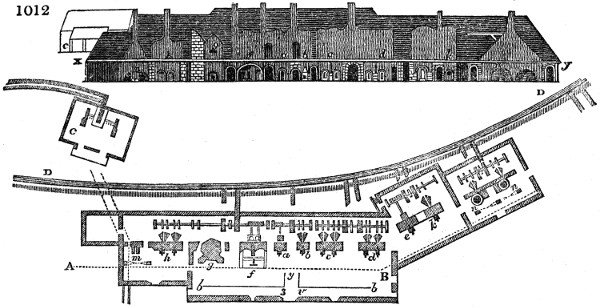
Fig. 1012 enlarged (291 kB)
Fig. 1012. exhibits the plan and elevation of these smelting-works, near Clausthal, in the Hartz, for lead ores containing copper and silver, where about 84,000 cwts. of schlich (each of 123 Cologne pounds) are treated every year. This quantity is the produce of 30 distinct mines, as also of nearly as many stamp and preparation works. All these different schlichs, which belong to so many different joint-stock companies, are confounded and worked up together in the same series of metallurgic operations; the resulting mixture being considered as one and the same ore belonging to a single undertaking; but in virtue of the order which prevails in this royal establishment, the rights of each of the companies, and consequently of each shareholder, are equitably regulated. A vigorous control is exercised between the mines and the stamps, as also between the stamps and the smelting-houses; while the cost of the metallurgic operations is placed under the officers of the crown, and distributed, upon just principles, among the several mines, according to the quantities of metal furnished by each.
From these arrangements, the following important advantages flow:—
1. The poor ores may be smelted with profit, without putting the companies to any risk or expense in the erection of new works; 2, by the mixture of many different ores, the smelting and metallic product become more easy and abundant; 3, the train of the operations is conducted with all the lights and resources of science; and 4, the amount of metal brought into the market is not subject to such fluctuations as might prove injurious to their sale.
The following is the series of operations:—
1, The fusion of the schlich (sludge); 2, the roasting of the mattes under a shed, and their treatment by four successive re-meltings; 3, the treatment of the resulting black copper; 4, the liquation; 5, the reliquation (ressuage); 6, the refining of the copper; 7, the cupellation of the silver; 8, the reduction of the litharge into lead. The 5th and 6th processes are carried on at the smelting works of Altenau.
The buildings are shown at A, B, C, and the impelling stream of water at D; the upper figure being the elevation; the lower, the plan of the works.
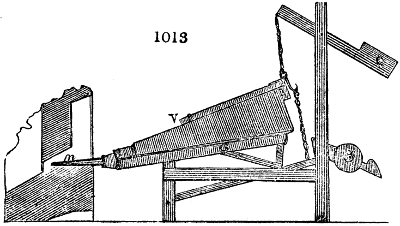
a, is the melting furnace, with a cylinder bellows behind it; b, c, d, furnaces similar to the preceding, with wooden bellows, such as fig. 1013; e, is a furnace for the same purpose, with three tuyères, and a cylinder bellows; f, the large furnace of fusion, also with three tuyères; g, a furnace with seven tuyères, now seldom used; h, low furnaces, like the English slag-hearths (krummofen), employed for working the last mattes; k, slag-hearths for reducing the litharge; m, the area of the liquation; n, p, cupellation furnaces.
x, y, a floor which separates the principal smelting-house into two stories; the materials destined for charging the furnaces being deposited in beds upon the upper floor, to which they are carried by means of two inclined planes, terraced in front of the range of buildings.
Here 89,600 quintals of schlich are annually smelted, which furnish—
Marketable lead 20,907 quintals.
Marketable litharge, containing 90 per cent. of lead 7,555
Silver, about 67
Copper (finally purified in the works of Altenau) 35
Total product 28,564
This weight amounts to one twenty-fifth of the weight of ore raised for the service of the establishment. Eight parts of ore furnish, on an average, about one of schlich. The bellows are constructed wholly of wood, without any leather; an improvement made by a bishop of Bamberg, about the year 1620. After receiving different modifications, they were adopted, towards 1730, in almost all the smelting-works of the continent, except in a few places, as Carniola, where local circumstances permitted a water blowing-machine to be erected. These pyramidal shaped bellows, composed of movable wooden boxes, have, however, many imperfections: their size must often be inconveniently large, in order to furnish an adequate stream of air; they do not drive into the furnace all the air which they contain; they require frequent repairs; and, working with great friction, they waste much mechanical power.
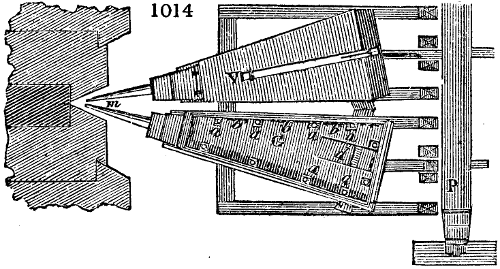
Fig. 1014. represents such wooden bellows, consisting of two chests or boxes, fitted into each other; the upper or moving one being called the fly, the lower or fixed one, the seat (gite). In the bottom of the gite, there is an orifice furnished with a clack-valve d, opening inwards when the fly is raised, and shutting when it falls. In order that the air included in the capacity of the two chests may have no other outlet than the nose-pipe m, the upper portion of the gite is provided at its four sides with small square slips of wood c, c, c, which are pressed against the sides of the fly by strong springs of iron wire b, b, b, while they are retained upon the gite by means of small square pieces of wood a, a, a, a. The latter a, a, are perforated in the centre, and adjusted upon rectangular stems, called buchettes; they are attached, at their lower ends, to the upright sides of the gite G. P is the driving-shaft of a water-wheel, which, by means of cams or tappets, depresses the fly, while the counterweight Q, fig. 1013., raises it again.
Figs. 1015, 1016, 1017, 1018. represent the moderately high (demihauts, or half-blast,) furnaces employed in the works of the lower Hartz, near Goslar, for smelting the silvery lead ores extracted from the mine of Rammelsberg. See its section, in fig. 737.
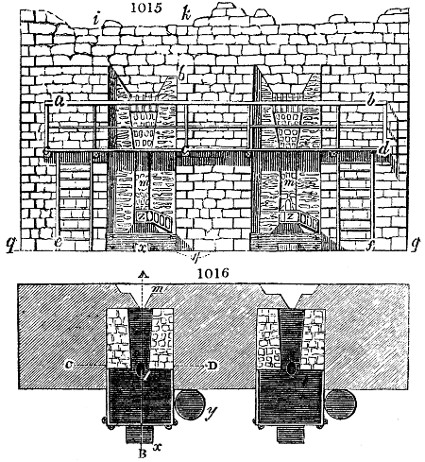
Fig. 1015. is the front elevation of the twin furnaces, built in one body of masonry; fig. 1016. is a plan taken at the level of the tuyères, in the line v, l, 6. of fig. 1017.; figs. 1017. and 1018. exhibit two vertical sections; the former in the line A, B, the latter in the line C, D, of fig. 1016. In these four figures the following objects may be distinguished.
a, b, c, d, a balcony or platform, which leads to the place of charging n; e, f, wooden stairs, by which the charging workmen mount from the ground p, q, of the works, to the platform; g, h, brickwork of the furnaces; i, k, wall of the smelting-works, against which they are supported; l, upper basin of reception, hollowed out of the brasque (or ground charcoal bed) 6; m, arch of the tuyère v, by which each furnace receives the blast of two bellows; n, place of charging, which takes place through the upper orifice n, o, of the basin n, o, v, t, of the furnace; t, a slab of clay, placed in such a way that, during the treatment of the lead, a little metallic zinc may run together in a sloping gutter, seen in fig. 1001., formed of slates cemented together with clay.
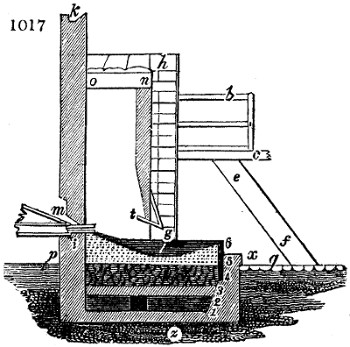
In figs. 1015 and 1017., l, z, is the brickwork of the foundations; m, conduits (called evaporatory), for the exhalation of the moisture; 4, a layer of slags, rammed above; 5, a bed of clay, rammed above the slags; 6, a brasque, composed of one part of clay, and two parts of ground charcoal, which forms the sole of the furnace.
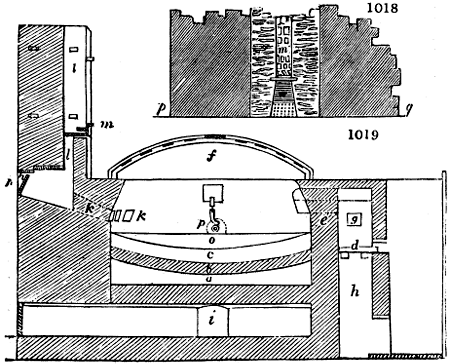
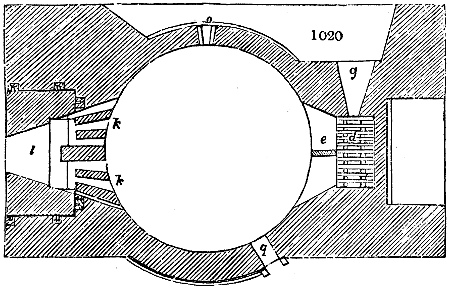
The excellent refinery furnace, or treibheerd, of Frederickshütte, near Tarnowitz, in Upper Silesia, is represented in figs. 1019. and 1020. a, is the bottom, made of slag or cinders; b, the foundation, of fire-bricks; c, the body of the hearth proper, composed of a mixture of 7 parts of dolomite, and 1 of fire-clay, in bulk; d, the grate of the air furnace; e, the fire-bridge; f, the dome or cap, made of iron plate strengthened with bars, and lined with clay-lute, to protect the metal from burning; g, the door of the fireplace; h, the ash-pit; i, the tap-hole; k, k, the flue, which is divided by partitions into several channels; l, the chimney; m, a damper-plate for regulating the draught; n, a back valve, for admitting air to cool the furnace, and brushes to sweep the flues; o, tuyère of copper, which by means of an iron wedge may be sloped more or less towards the hearth; p, the schnepper, a round piece of sheet iron, hung before the eye of the tuyère, to break and spread the blast; q, the outlet for the glassy litharge.
Lime-marl has been found to answer well for making the body of the hearth-sole, as it absorbs the vitrified litharge freely, without combining with it. A basin-shaped hollow is formed in the centre, for receiving the silver at the end of the process; and a gutter is made across the hearth for running off the glätte or fluid litharge.
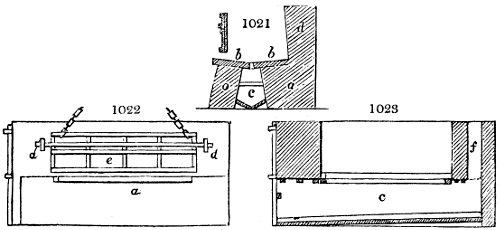
Figs. 1021, 1022. represent the eliquation hearth of Neustadt. Fig. 1021. is a cross section; fig. 1022. is a front view; and fig. 1023. a longitudinal section. It is formed by two walls a, a, 31⁄2 feet high, placed from 1⁄2 to 1 foot apart, sloped off at top with iron plates, 3 inches thick, and 18 inches broad, called saigerscharten, or refining plates, b, b, inclined 3 inches towards each other in the middle, so as to leave at the lowest point a slit 21⁄2 inches wide between them, through which the lead, as it sweats out by the heat, is allowed to fall into the space between the two walls c, called the saigergasse (sweating-gutter). The sole of this channel slopes down towards the front, so that the liquefied metal may run off into a crucible or pot. Upon one of the long sides, and each of the shorter ones, of the hearth, the walls d, d, are raised two feet high, and upon these the liquation lumps rest; upon the other long side, where there is no wall, there is an opening for admitting these lumps into the hearth. The openings are then shut with a sheet or cast iron plate e, which, by means of a chain, pulley, and counterweight, may be easily raised and lowered. f, is a passage for increasing the draught of air.
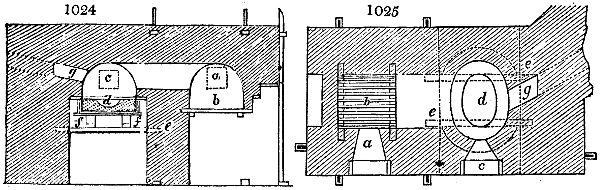
Figs. 1024. and 1025. represent the refining furnaces of Frederickshütte by Tarnowitz; a, is the fire-door; b, the grate; c, the door for introducing the silver; d, the movable test, resting upon a couple of iron rods e, e, which are let at their ends into the brickwork. They lie lower than would seem to be necessary; but this is done in order to be able to place the surface of the test at any desired level, by placing tiles f, f, under it; g, the flue, leading to a chimney 18 feet high. For the refining of 100 marks of blicksilber, of the fineness of 151⁄2 loths (half ounces) per cwt., 3 cubic feet of pitcoal are required. The test or cupel must be heated before the impure silver and soft lead are put into it.
At these smelting-houses from 150 to 160 cwt. of very pure workable lead (lead containing merely a little silver) are put into the furnace at once, and from 10 to 14 cwt. run off in vitrified oxide; the remainder is then refined with some pure lead, when an alloy containing from 141⁄2 to 151⁄2 loths of blicksilber per cwt. is obtained.
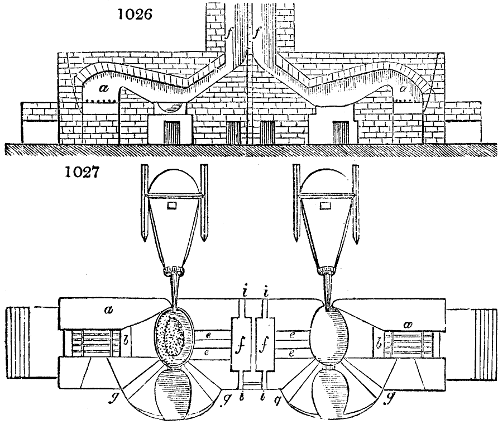
English refining furnaces.—The refining of lead is well performed in some works in the neighbourhood of Alston-moor, in reverberatory furnaces, figs. 1026. and 1027., whose fireplace is 22 inches square, and is separated from the sole by a fire-bridge, 14 inches in breadth. The flame, after having passed over the surface of the lead in the cupel, enters two flues e, e, on the opposite side of the furnace, which terminate in a chimney i, i, i, i, 40 feet high. At the bottom of the chimney are openings f, f, for taking out the metallic dust deposited within. These openings are shut during the process.
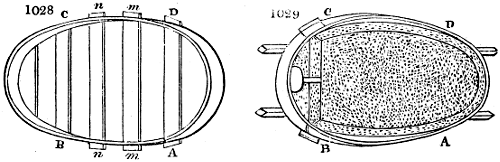
The cupel or test, which constitutes, in fact, the sole of the hearth in which the operation takes place, is movable. It consists of a vertical elliptical ring of iron, A, B, C, D, figs. 1028. and 1029., 33⁄4 inches high, the greatest diameter of the ellipse being 4 feet, and the smallest 21⁄2. Four iron bars (A D, m, m′, B C, n, n′,) are fixed across its bottom, which are also 33⁄4 inches broad, and an inch thick. The first of these bars is placed 9 inches from the end of the elliptic ring nearest the fireplace, and the three others are equally distributed between this bar and the back end.
In forming the cupel, several layers of a mixture of moistened bone ashes, and fern ashes, in very fine powder, are put into the test-frame. The bone ash constitutes from 1⁄8 to 1⁄16 of the bulk of the mixture, according to the purity of the fern ashes employed, estimated by the proportion of potash they contain, which has the property of semi-vitrifying the powder of burnt bones, of thus removing its friability, and rendering it more durable. The layers of ashes are strongly beat down, till the frame is entirely filled. The mass thus formed is then hollowed out by means of a little spade, made on purpose, till it is only three quarters of an inch thick above the iron bars near the centre of the bottom. A flange, 2 inches broad, is made at the upper part, and 21⁄2 inches at the lower part, except on the front or breast, which is 5 inches thick. In this anterior part, there is hollowed out an opening of an inch and a quarter broad, and 6 inches long, with which the outlet or gateway of the litharge communicates.
The cupel thus prepared is placed in the refining furnace. It rests in an iron ring built into the brickwork. The arched roof of the furnace is 12 inches above the cupel near the fire-bridge, and 9 inches near the flue at the other end.
The tuyère is placed in the back of the furnace, opposite to the side at which the litharge is allowed to overflow.
Openings g, g, are left at the sides of each cupel, either for running off or for introducing melted lead.
Refining of lead to extract its silver.—This operation, which the lead of Derbyshire cannot be submitted to with advantage, is performed in a certain number of the smelting-houses at Alston-moor, and always upon leads reduced in the Scotch furnace.
The cupel furnace above described, must be slowly heated, in order to dry the cupel without causing it to crack, which would infallibly be produced by sudden evaporation of the moisture in it. When it has been thus slowly brought to the verge of a red heat, it is almost completely filled with lead previously melted in an iron pot. The cupel may be charged with about 5 cwt. At the temperature at which the lead is introduced, it is immediately covered with a gray pellicle of oxide; but when the heat of the furnace has been progressively raised to the proper pitch, it becomes whitish-red, and has its surface covered over with litharge. Now is the time to set in action the blowing-machine, the blast of which, impelled in the direction of the great axis of the cupel, drives the litharge towards the breast of the cupel, and makes it flow out by the gateway prepared for it, through which it falls upon a cast-iron plate, on a level with the floor of the apartment, and is dispersed into tears. It is carried in this state to the furnace of reduction, and revived. As by the effect of the continual oxidization which it undergoes, the surface of the metal necessarily falls below the level of the gateway of the litharge, melted lead must be added anew by ladling it into the furnace from the iron boiler, as occasion may require. The operation is carried on in this manner till 84 cwt. or 4 Newcastle fodders of lead have been introduced, which takes from 16 to 18 hours, if the tuyère has been properly set. The whole quantity of silver which this mass of lead contains, is left in combination with about 1 cwt. of lead, which, under the name of rich lead, is taken out of the cupel.
When a sufficient number of these pieces of rich lead have been procured, so that by their respective quality, as determined by assaying, they contain in whole from 1000 to 2000 ounces of silver, they are re-melted to extract their silver, in the same furnace, but in a cupel which differs from the former in having at its bottom a depression capable of receiving at the end of the process the cake of silver. In this case a portion of the bottom remains uncovered, on which the scoriæ may be pushed aside with a little rake, from the edges of the silver.
The experiments of MM. Lucas and Gay Lussac have proved that fine silver, exposed to the air in a state of fusion, absorbs oxygen gas, and gives it out again in the act of consolidation. The quantity of oxygen thus absorbed may amount to twenty-two times the volume of the silver. The following phenomena are observed when the mass of metal is considerable; for example, from 40 to 50 pounds.
The solidification commences at the edges, and advances towards the centre. The liquid silver, at the moment of its passage to the solid state, experiences a slight agitation, and then becomes motionless. The surface, after remaining thus tranquil for a little, gets all at once irregularly perturbed, fissures appear in one or several lines, from which flow, in different directions, streams of very fluid silver, which increase the original agitation. The first stage does not yet clearly manifest the presence of gas, and seems to arise from some intestine motion of the particles in their tendency to group, on entering upon the process of crystallization, and thus causing the rupture of the envelop or external crust, and the ejection of some liquid portions.
After remaining some time tranquil, the metal presents a fresh appearance, precisely analogous to volcanic phenomena. As the crystallization continues, the oxygen gas is given out with violence at one or more points, carrying with it melted silver from the interior of the surface, producing a series of cones, generally surmounted by a small crater, vomiting out streams of the metal, which may be seen boiling violently within them.
These cones gradually increase in height by the accumulation of metal thrown up, and that which becomes consolidated on their sloping sides. The thin crust of metal on which they rest, consequently experiences violent impulses, being alternately raised and depressed by such violent agitation, that were it not for the tenacity and elasticity of the metal, there would evidently arise dislocation, fissures, and other analogous accidents. At length several of the craters permanently close, while others continue to allow the gas a passage. The more difficult this is, the more the craters become elevated, and the more their funnels contract by the adhesion or coagulation of a portion of the metal. The projection of globules of silver now becomes more violent; the latter being carried to great distances, even beyond the furnace, and accompanied by a series of explosions, repeated at short intervals. It is generally the last of these little volcanoes that attains the greatest altitude, and exhibits the foregoing phenomena with the greatest energy. It is, moreover, observable, that these cones do not all arise at the same time, some having spent their force, when others commence forming at other points. Some reach the height of an inch, forming bases of two or three inches in diameter. The time occupied by this exhibition is at least from half to three quarters of an hour.
During the formation of these cones, by the evolution of gas, portions of silver are shot forth, which assume, on induration, a form somewhat cylindrical, and often very fantastic, notwithstanding the incompatibility which appears to exist between the fluidity of the silver and these elongated figures. Their appearance is momentary, and without any symptoms of gas, although it is impossible to decide whether they may not arise from its influence; they seem, in fact, to resemble the phenomena of the first volcanic period.
Till very recently the only operations employed for separating silver from lead in the English smelting-works, were the following:—
1. Cupellation, in which the lead was converted into a vitreous oxide, which was floated off from the surface of the silver.
2. Reduction of that oxide, commonly called litharge.
3. Smelting the bottoms of the cupels, to extract the lead which had soaked into them, in a glassy state.
Cupellation and its two complementary operations were, in many respects, objectionable processes; from the injurious effects of the lead vapours upon the health of the workmen; from the very considerable loss of metallic lead, amounting to 7 per cent. at least; and, lastly, from the immense consumption of fuel, as well as from the vast amount of manual labour incurred in such complicated operations. Hence, unless the lead were tolerably rich in silver, it would not bear the expense of cupellation.
The patent process lately introduced by Mr. Pattinson, of Newcastle, is not at all prejudicial to the health of workmen; it does not occasion more than 2 per cent. of loss of lead, and in other respects it is so economical, that it is now profitably applied in Northumberland to alloys too poor in silver to be treated by cupellation. This process is founded upon the following phenomena.
After melting completely an alloy of lead and silver, if we allow it to cool very slowly, continually stirring it meanwhile with a rake, we shall observe at a certain period a continually increasing number of imperfect little crystals, which may be taken out with a drainer, exactly as we may remove the crystals of sea salt deposited during the concentration of brine, or those of sulphate of soda, as its agitated solution cools. On submitting to analysis the metallic crystals thus separated, and also the liquid metal deprived of them, we find the former to be lead almost alone, but the latter to be rich in silver, when compared with the original alloy. The more of the crystalline particles are drained from the metallic bath, the richer does the mother liquid become in silver. In practice, the poor lead is raised by this means to the standard of the ordinary lead of the litharge works; and the better lead is made ten times richer. This very valuable alloy is then submitted to cupellation; but as it contains only a tenth part of the quantity of lead subjected to crystallization, the loss in the cupel will be obviously reduced to one-tenth of what it was by the former process; that is, 7⁄10 of a per cent., instead of 7.
These nine-tenths of the lead separated by the drainer, are immediately sent into the market, without other loss than the trifling one, of about 1⁄2 per cent., involved in reviving a little dross skimmed off the surface of the melted metal at the beginning of the operation. Hence the total waste of lead in this method does not exceed 2 per cent. And as only a small quantity of lead requires to be cupelled, this may be done with the utmost slowness and circumspection; whereby loss of the precious metal, and injury to the health of the workpeople, are equally avoided.
The crystallization refinery of Mr. Pattinson is an extremely simple smelting-house. It contains 3 hemispherical cast-iron pans, 41 inches in diameter, and 1⁄4 of an inch thick. The three pans are built in one straight line, the broad flange at their edge being supported upon brickwork. Each pan has a discharge pipe, proceeding laterally from one side of its bottom, by which the melted metal may be run out when a plug is withdrawn, and each is heated by a small separate fire.
Three tons of the argentiferous lead constitute one charge of each pan; and as soon as it is melted, the fire is withdrawn; the flue, grate-door, and ash-pit, are immediately closed, and made air-tight with bricks and clay-lute. The agitation is now commenced, with a round bar of iron terminated with a chisel point, the workman being instructed merely to keep moving that simple rake constantly in the pan, but more especially towards the edges, where the solidification is apt to begin. He must be careful to take out the crystals, progressively as they appear, with an iron drainer, heated a little higher than the temperature of the metal bath. The liquid metal lifted in the drainer, flows readily back through its perforations, and may be at any rate effectually detached by giving the ladle two or three jogs. The solid portion remains in the form of a spongy, semi-crystalline, semi-pasty mass.
The proportion of crystals separated at each melting, depends upon the original quality of the alloy. If it be poor, it is usually divided in the proportion of two-thirds of poor crystals, and one-third of rich liquid metal; but this proportion is reversed if the alloy contain a good deal of silver.
Let us exemplify, by the common case of a lead containing 10 ounces of silver per ton. Operating upon three tons of this alloy, or 60 cwt., containing 30 oz. of silver, there will be obtained in the first operation—
(a) 40 cwt. at 4 1⁄4 ounces of silver per ton; in whole 9 oz. - 30 oz.
(b) 20 cwt. at 21 — — 21
Each of these alloys (a) and (b) will be joined to alloys of like quality obtained in the treatment of one or several other portions of three tons of the primitive alloy. Again, three tons of each of these rich alloys are subjected to the crystallization process, and thus in succession. Thus poorer and poorer lead is got on the one hand, and richer and richer alloys on the other. Sometimes the mother metal is parted from a great body of poor crystals, by opening the discharge-pipe, and running off the liquid, while the workman keeps stirring, to facilitate the separation of the two.
25 fodders, 15 cwts., 49 lbs. = 540 cwts., 49 lbs. of alloy, holding 5 oz. of silver per fodder, in the whole 130 oz., afforded, after three successive crystallizations—
oz.
440 cwts. of poor lead, holding 1⁄2 oz. of silver per fodder; in all 10 1⁄2
15 cwt. 49 — holding the original quantity, nearly 3 1⁄2
84 cwts. of lead for the cupel, holding 29 oz. 116
Total 130
1 cwt. of loss, principally in the reduction of dross.
The expenses of the new method altogether, including 3s. per fodder of patent dues are about one-third of the old; being 17l. 13s. and 54l. 16s. respectively, upon 84 cwts. of lead, at 29 oz. per fodder.
In the conditions above stated, the treatment of argentiferous lead occasions the following expenses:—
FOR ONE FODDER. £ s. d.
By the new process 0 13 7
old process 2 2 2
Admitting that the treatment of silver holding lead is economically possible only when the profit is equal to one-tenth of the gross expenses of the process, we may easily calculate, with the preceding data, that it is sufficient for the lead to have the following contents in silver:—
With the new process, 3 ounces per fodder; or, 0·000078
With the old process, 84⁄10 ounces per fodder; or, 0·000218
To conclude, the refining by crystallization reduces the cost of the parting of lead and silver, in the proportion of 3 to 1; and allows of extracting silver from a lead which contains only about 3 oz. per ton. In England, the new method produces at present very advantageous results, especially in reference to the great masses to which it may be applied. In 1828, the quantity of lead annually extracted from the mines in the United Kingdom had been progressively raised to 47,000 tons. Reduced almost to one-half of this amount in 1832, by the competition of the mines of la Sierra de Gador, the English production began again to increase in 1833. In 1835, 35,000 tons of lead were obtained, one-half of which only having a mean content of 81⁄2 oz. of silver per ton, was subjected to cupellation, and produced 14,000 oz. of that precious metal. The details of this production are—
Silver extracted from 17,500 tons of lead, holding upon the average 81⁄2 oz. per ton. 140,000 oz.
Silver extracted from silver ores, properly so called, in Cornwall 36,000
176,000
In 1837, the production of lead amounted probably to 40,000 tons; upon which the introduction of the new method would have the effect not only of reducing considerably the cost of parting the 20,000 tons of lead containing 8 oz. of silver per ton, but of permitting the extraction of 4 or 5 oz. of silver, which may be supposed to exist upon an average in the greater portion of the remaining 20,000 tons. Otherwise, this mass of the precious metal would have had no value, or have been unproductive.
There are two oxides of silver; called argentic oxide, and suroxide, by Berzelius. 1. The first is obtained by adding solution of caustic potassa, or lime-water, to a solution of nitrate of silver. The precipitate has a brownish-gray colour, which darkens when dried, and contains no combined water. Its specific gravity is 7·143. On exposure to the sun, it gives out a certain quantity of oxygen, and becomes a black powder. This oxide is an energetic base; being slightly soluble in pure water, reacting like the alkalis upon reddened litmus paper, and displacing, from their combinations with the alkalis, a portion of the acids, with which it forms insoluble compounds. It is insoluble in the caustic lyes of potassa or soda. By combination with caustic ammonia, it forms fulminating silver. This formidable substance may be prepared by precipitating the nitrate of silver with lime-water, washing the oxide upon a filter, and spreading it upon gray paper, to make it nearly dry. Upon the oxide, still moist, water of ammonia is to be poured, and allowed to remain for several hours. The powder which becomes black, is to be freed from the supernatant liquor by decantation, divided into small portions while moist, and set aside to dry upon bits of porous paper. Fulminating silver may be made more expeditiously by dissolving the nitrate in water of pure ammonia, and precipitating by the addition of caustic potassa lye in slight excess. If fulminating silver be pressed with a hard body in its moist state, it detonates with unparalleled violence; nay, when touched even with a feather, in its dry state, it frequently explodes. As many persons have been seriously wounded, and some have been killed, by these explosions, the utmost precautions should be taken, especially by young chemists, in its preparation. This violent phenomenon is caused by the sudden production of water and nitrogen, at the instant when the metallic oxide is reduced. The quiescent and divellent affinities seem to be so nicely balanced in this curious compound, that the slightest disturbance is sufficient to incite the hydrogen of the ammonia to snatch the oxygen from the silver. The oxide of silver dissolves in glassy fluxes, and renders them yellow. It consists, according to Berzelius, of 93·11 parts of silver, and 6·89 of oxygen. 2. The suroxide of silver is obtained by passing a voltaic current through a weak solution of the nitrate; it being deposited, of course, at the positive or oxygenating pole. It is said to crystallize in needles of a metallic lustre, interlacing one another, which are one-third of an inch long. When thrown into muriatic acid, it causes the disengagement of chlorine, and the formation of chloride of silver; into water of ammonia, it occasions such a rapid production of nitrogen gas, with a hissing sound, as to convert the whole liquid into froth. If a little of it, mixed with phosphorus, be struck with a hammer, a loud detonation ensues. With heat it decrepitates, and becomes metallic silver.
Sulphuret of silver, which exists native, may be readily prepared by fusing the constituents together; and it forms spontaneously upon the surface of silver exposed to the air of inhabited places, or plunged into eggs, especially rotten ones. The tarnish may be easily removed, by rubbing the metal with a solution of cameleon mineral, prepared by calcining peroxide of manganese with nitre. Sulphuret of silver is a powerful sulpho-base; since though it be heated to redness in close vessels, it retains the volatile sulphides, whose combinations with the alkalis are decomposed at that temperature. It consists of 87·04 of silver, and 12·96 of oxygen.
A small quantity of tin, alloyed with silver, destroys its ductility. The best method of separating these two metals, is to laminate the alloy into thin plates, and distil them along with corrosive sublimate. The bichloride of tin comes over in vapours, and condenses in the receiver. Silver and lead, when combined, are separated by heat alone in the process of cupellation, as described in the article Assay, and in the reduction of silver ores. See suprà.
An alloy, containing from one-twelfth to one-tenth of copper, constitutes the silver coin of most nations; being a harder and more durable metal under friction than pure silver. When this alloy is boiled with a solution of cream of tartar and sea-salt, or scrubbed with water of ammonia, the superficial particles of copper are removed, and a surface of fine silver is left.
Chloride of silver is obtained by adding muriatic acid, or any soluble muriate, to a solution of nitrate of silver. A curdy precipitate falls, quite insoluble in water, which being dried and heated to dull redness, fuses into a semi-transparent gray mass, called, from its appearance, horn-silver. Chloride of silver dissolves readily in water of ammonia, and crystallizes in proportion as the ammonia evaporates. It is not decomposed by a red heat, even when mixed with calcined charcoal; but when hydrogen or steam is passed over the fused chloride, muriatic acid exhales, and silver remains. When fused along with potassa (or its carbonate), the silver is also revived; while oxygen (or also carbonic acid) gas is liberated, and chloride of potassium is formed. Alkaline solutions do not decompose chloride of silver. When this compound is exposed to light, it suffers a partial decomposition, muriatic acid being disengaged. See Assay by the humid method.
The best way of reducing the chloride of silver, says Mohr, is to mix it with one-third of its weight of colophony (black rosin), and to heat the mixture moderately in a crucible till the flame ceases to have a greenish-blue colour; then suddenly to increase the fire, so as to melt the metal into an ingot.
The subchloride may be directly formed, by pouring a solution of deuto-chloride of copper or iron upon silver leaf. The metal is speedily changed into black spangles, which, being immediately washed and dried, constitute subchloride of silver. If the contact of the solutions be prolonged, chloride would be formed.
The bromide, cyanide, fluoride, and iodide of silver, have not been applied to any use in the arts. Sulphate of silver may be prepared by boiling sulphuric acid upon the metal. See Refining of Gold and Silver. It dissolves in 88 parts of boiling water, but the greater part of the salt crystallizes in small needles, as the solution cools. It consists of 118 parts of oxide, combined with 40 parts of dry acid. Solutions of the hyposulphite of potassa, soda, and lime, which are bitter salts, dissolve chloride of silver, a tasteless substance, into liquids possessed of the most palling sweetness, but not at all of any metallic taste.
The iodide of silver is remarkable, like some other metallic compounds, for changing its colour alternately with heat and cold. If a sheet of white paper be washed over with a solution of nitrate of silver, and afterwards with a somewhat dilute solution of hydriodate of potash, it will immediately assume the pale yellow tint of the cold silver iodide. On placing the paper before the fire, it will change colour from a pale primrose to a gaudy brilliant yellow, like the sun-flower; and on being cooled, it will again resume the primrose hue. These alternations may be repeated indefinitely, like those with the salts of cobalt, provided too great a heat be not applied. The pressure of a finger upon the hot yellow paper makes a white spot, by cooling it quickly.
Fulminate of silver is prepared in the same way as Fulminate of Mercury, which see.
On the 10th of February, 1798, the Lords of the Privy Council appointed the Hon. Charles Cavendish, F. R. S., and Charles Hatchett, Esq., F. R. S., to make investigations upon the wear of gold coin by friction. Their admirable experiments were begun in the latter end of 1798, and completed in April 1801, having been instituted and conducted with every mechanical aid, as devised by these most eminent chemical philosophers, and provided, at no small expense, by the government. The following are the important conclusions of their official report:—[54]
“Gold made standard by a mixture of equal parts of silver and copper, is not so soft as gold alloyed only with silver; neither is it so pale; for it appears to be less removed from the colour of fine gold, than either the former or the following metal.
“Gold, when alloyed with silver and copper, when annealed, does not become black, but brown; and this colour is more easily removed by the blanching liquor, or solution of alum, than when the whole of the alloy consists of copper. It may also be rolled and stamped with great facility; and, under many circumstances, it appears to suffer less by friction than gold alloyed by silver or copper alone.
“If copper alone forms the alloy, it must be dissolved and separated from the surface of each piece of coin, in the process of annealing and blanching.
“Upon a comparison of the different qualities of the three kinds of standard gold, it appears (strictly speaking) that gold made standard by silver and copper is rather to be preferred for coin.”
It will, undoubtedly, seem not a little strange to the uninitiated, that this report, and its important deductions, should have been of late years entirely set at nought, without any scientific reason or research, apparently for the purpose of giving a certain official in our Mint a good job, in sweating out all the silver from our sovereigns, and replacing it, in the new coinage, with copper, taking on an average 3d. worth of silver out of each ounce of our excellent gold coin, and charging the country 61⁄2d. for its extraction, besides the very considerable expense in providing fine copper to replace the silver. The pretence set up for this extraordinary degradation of the gold, was, that our coin might peradventure be exported, in order to be de-silvered abroad, a danger which could have been most readily averted, by leaving out as much gold in every sovereign as was equivalent to the silver introduced, and thus preserving its intrinsic value in precious metal. When the film of fine gold which covers each of our present pieces has been rubbed off from the prominent parts, these must appear of a very different and deeper colour than the flat part or ground of the coin. “The reason, therefore, is sufficiently apparent, says Mr. Hatchett, why gold which is alloyed with silver only, cannot be liable to this blemish;” and with one-half of silver alloy, it must be much less liable to it, than with copper alone. Why did the political economists in the recent Committee of the House of Commons on the Mint, blink this question, of public economy and expediency?
Gold, as imported from America, Asia, and Africa, contains on an average nearly the right proportion of silver for making the best coin; and were it alloyed to our national standard, of 22 parts of gold, 1 of silver, and 1 of copper, as defined by Messrs. Cavendish and Hatchett, then by simply adding the deficient quantities of one or two of these metals, by the rule of alligation, the very considerable expense would be saved to the nation, and sulphureous nuisance to the Tower Hamlets, now foolishly incurred in de-silvering and cuprifying sovereigns at the Royal Mint.
It was long imagined in Europe, that the average metallic contents of the silver ores of Mexico and Peru, were considerably greater than those of Saxony and Hungary. Much poorer ores, however, are worked among the Cordilleras than in any part of Europe. The mean product of the whole silver ores that are annually reduced in Mexico, amounts only to from 0·18 to 0·25 of a per cent.; that is, from 3 to 4 ounces in 100 lbs.; the true average being, perhaps, not more than 21⁄2. It is by their greater profusion of ores, not their superior richness, that the mines of South America surpass those of Europe.
Gold and Silver produced in Forty Years, from 1790 to 1830.
Gold. Silver.
Mexico £6,436,453 £139,818,032
Chile 2,768,488 1,822,924
Buenos Ayres 4,024,895 27,182,673
Russia 3,703,743 1,502,981
Returns of the Dollars coined at the different Mints in Mexico.
1829. 1830. 1831. 1834.
Mexico 1,280,000 1,090,000 1,386,000 952,000
Guanajuato 2,406,000 2,560,000 2,603,000 2,703,000
Zacatecas 4,505,000 5,190,000 4,965,000 5,527,000
Guadalaxara 596,000 592,000 590,000 715,000
Durango 659,000 453,000 358,000 1,215,000
San Luis 1,613,000 1,320,000 1,497,000 928,000
Ilalpan 728,000 90,000 323,000 —
Total 11,787,000 11,295,000 11,722,000 12,040,000
The returns for 1832 and 1833 are wanting.
Peru.—Returns of Gold and Silver coined at the Mints of Lima and Casco.
Gold. Silver. Total, in Dollars.
1830 180,000 2,015,000 2,195,000
1831 92,000 2,384,000 2,476,000
1832 94,000 3,210,000 3,284,000
1833 150,000 2,990,000 3,140,000
1834 110,000 3,150,000 3,260,000
Returns of Silver in Bars produced at the different Smelting-works in Peru.
Lima. Truxillo. Pasco. Aya- cucho. Puno. Are- quipa. Total, in Dollars.
1830 270,000 190,000 780,000 120,000 250,000 150,000 1,760,000
1831 270,000 60,000 1,110,000 70,000 310,000 110,000 1,930,000
1832 290,000 100,000 1,800,000 70,000 345,000 25,000 2,640,000
1833 222,000 70,000 2,130,000 50,000 25,000 65,000 2,562,000
Returns of Silver in Dollars exported from the Provinces of Chili.
Coquimbo. Huasco. Copiano.
1831 785,000 115,000 670,000
1832 316,000 — 36,000
1833 490,000 100,000 585,000
1,591,000 215,000 1,291,000
Santiago—Mint Coinage.
Gold. Silver. Total.
1832, 174,000; 1833, 392,500 1832, 42,000; 1833, 92,000 700,500
The production of Silver in the kingdom of Saxony, amounted to—
59,231 marcs and 8 loths, in the year 1825
55,023 — — 1826
60,034 — — 1827
61,361 — — 1828
65,176 — and 10 loths — 1830
65,886 — — 1832
The mine of Himmelsfürst alone produces annually 10,000 marcs.
The quantity of Silver produced in the Prussian states was—
22,135 marcs in 1825
20,071 — 1826
18,631 — 1827
21,731 — 1828
20,612 — 1829
20,887 — 1830
19,031 — 1831
22,083 — 1832
The whole annual production of Europe, and Asiatic Russia, has been rated by Humboldt at 292,000 marcs; by other authorities, at 310,000; while at the beginning of the present century, that of the Spanish colonies in America was 3,349,160 marcs, or nearly twelve times as much. The sum total is 3,704,160 marcs, of 3609 grains troy each; which is nearly 1,900,000 lbs. avoirdupois; that is, little less than 9000 tons.
The English Mint silver contains 222 pennyweights of fine silver, and 18 of copper, in the troy pound of 240 pennyweights; or 92·5 in 100 parts. 1 pound troy = 5760 grains, contains 65·8 shillings, each weighing 87·55 grains. The French silver coin contains one-tenth of copper, and a franc weighs 5 grammes = 77·222 grains troy. The Prussian dollar, (thaler), is the standard coin; 101⁄2 thaler weigh 1 marc; hence, 1 thaler weighs 343·7 grains troy, and contains 257·9 grains of fine silver; being 75 per cent. of silver, and 25 of alloy. The Austrian coin contains 13⁄288 of alloy, according to Wasserberg; which is only 41⁄2 per cent.
SILVER LEAF, is made in precisely the same way as Gold Leaf, to which article I must therefore refer the reader.
SILVERING, is the art of covering the surfaces of bodies with a thin film of silver. When silver leaf is to be applied, the methods prescribed for gold leaf are suitable. Among the metals, copper or brass are those on which the silverer most commonly operates. Iron is seldom silvered; but the processes for both metals are essentially the same.
The principal steps of this operation are the following:—
1. The smoothing down the sharp edges, and polishing the surface of the copper; called émorfiler by the French artists.
2. The annealing; or, making the piece to be silvered redhot, and then plunging it in very dilute nitric acid, till it be bright and clean.
3. Pumicing; or, clearing up the surface with pumice-stone and water.
4. The warming, to such a degree merely as, when it touches water, it may make a slight hissing sound; in which state it is dipped in the very weak aquafortis, whereby it acquires minute insensible asperities, sufficient to retain the silver leaves that are to be applied.
5. The hatching. When these small asperities are inadequate for giving due solidity to the silvering, the plane surfaces must be hatched all over with a graving tool; but the chased surfaces need not be touched.
6. The bluing, consists in heating the piece till its copper or brass colour changes to blue. In heating, they are placed in hot tools made of iron, called mandrins in France.
7. The charging, the workman’s term for silvering. This operation consists in placing the silver leaves on the heated piece, and fixing them to its surface by burnishers of steel, of various forms. The workman begins by applying the leaves double. Should any part darken in the heating, it must be cleared up by the scratch-brush.
The silverer always works two pieces at once; so that he may heat the one, while burnishing the other. After applying two silver leaves, he must heat up the piece to the same degree as at first, and he then fixes on with the burnisher four additional leaves of silver; and he goes on charging in the same way, 4 or 6 leaves at a time, till he has applied, one over another, 30, 40, 50, or 60 leaves, according to the desired solidity of the silvering. He then burnishes down with great pressure and address, till he has given the surface a uniform silvery aspect.
Silvering by the precipitated chloride of silver.—The white curd obtained by adding a solution of common salt to one of nitrate of silver, is to be well washed and dried. One part of this powder is to be mixed with 3 parts of good pearlash, one of washed whiting, and one and a half of sea salt. After clearing the surface of the brass, it is to be rubbed with a bit of soft leather, or cork moistened with water, and dipped in the above powder. After the silvering, it should be thoroughly washed with water, dried, and immediately varnished. Some use a mixture of 1 part of the silver precipitate, with 10 of cream of tartar, and this mixture also answers very well.
Others give a coating of silver by applying with friction, in the moistened state, a mixture of 1 part of silver-powder precipitated by copper, 2 parts of cream of tartar, and as much common salt. The piece must be immediately washed in tepid water very faintly alkalized, then in slightly warm pure water, and finally wiped dry before the fire. See Plated Manufacture.
The inferior kinds of plated buttons get their silver coating in the following way:—
2 ounces of chloride of silver are mixed up with 1 ounce of corrosive sublimate, 3 pounds of common salt, and 3 pounds of sulphate of zinc, with water, into a paste. The buttons being cleaned, are smeared over with that mixture, and exposed to a moderate degree of heat, which is eventually raised nearly to redness, so as to expel the mercury from the amalgam, formed by the reaction of the horn silver and the corrosive sublimate. The copper button thus acquires a silvery surface, which is brightened by clearing and burnishing.
Leather is silvered by applying a coat of parchment size, or spirit varnish, to the surface, and then the silver leaf, with pressure.
SIMILOR, is a golden-coloured variety of brass.
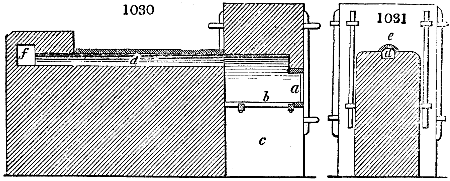
SINGEING OF WEBS. The old furnace for singeing cotton goods is represented in longitudinal section, fig. 1030., and in a transverse one in fig. 1031. a is the fire-door; b, the grate; c, the ash-pit; d, a flue, 6 inches broad, and 21⁄2 high, over which a hollow semi-cylindrical mass of cast iron e, is laid, one inch thick at the sides, and 21⁄2 thick at the top curvature. The flame passes along the fire-flue d, into a side opening f, in the chimney. The goods are swept swiftly over this ignited piece of iron, with considerable friction, by means of a wooden roller, and a swing frame for raising them at any moment out of contact.
In some shops, semi-cylinders of copper, three quarters of an inch thick, have been substituted for those of iron, in singeing goods prior to bleaching them. The former last three months, and do 1500 pieces with one ton of coal; while the latter, which are an inch and a half thick, wear out in a week, and do no more than from 500 to 600 pieces with the same weight of fuel.
In the early part of the year 1818, Mr. Samuel Hall enrolled the specification of a patent for removing the downy fibres of the cotton thread from the interstices of bobbin-net lace, or muslins, which he effected by singeing the lace with the flame of a gas-burner. The second patent granted to Mr. Hall, in April, 1823, is for an improvement in the above process; viz., causing a strong current of air to draw the flame of the gas through the interstices of the lace, as it passes over the burner, by means of an aperture in a tube placed immediately above the row of gas-jets, which tube communicates with an air-pump or exhauster.
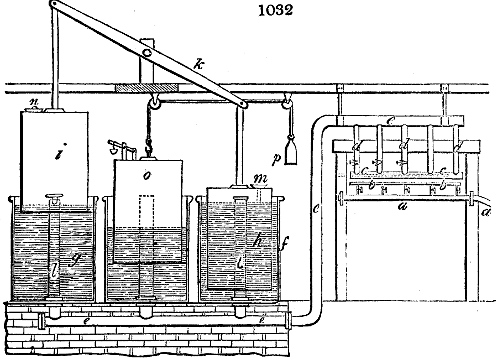
Fig. 1032. shows the construction of the apparatus complete, and manner in which it operates; a, a, is a gas-pipe, supplied by an ordinary gasometer; from this pipe, several small ones extend upwards to the long burner b, b. This burner is a horizontal tube, perforated with many small holes on the upper side, through which, as jets, the gas passes; and when it is ignited, the bobbin-net lace, or other material intended to be singed, is extended and drawn rapidly over the flame, by means of rollers, which are not shown in the figure.
The simple burning of the gas, even with a draught chimney, as in the former specification, is found not to be at all times efficacious; the patentee, therefore, now introduces a hollow tube c, c, with a slit or opening, immediately over the row of burners; and this tube, by means of the pipes d, d, d, communicates with the pipe e, e, e, which leads to the exhausting apparatus.
This exhausting apparatus consists of two tanks, f and g, nearly filled with water, and two inverted boxes or vessels, h and i, which are suspended by rods to the vibrating beam k; each of the boxes is furnished with a valve opening upwards; l, l, are pipes extending from the horizontal part of the pipe e, up into the boxes or vessels h and i, which pipes have valves at their tops, also opening upward. When the vessel h descends, the water in the tank forces out the air contained within the vessel at the valve m; but when that vessel rises again, the valve m being closed, the air is drawn from the pipe e, through the pipe l. The same takes place in the vessel i, from which the air in its descent is expelled through the valve n, and, in its ascent, draws the air through the pipe l, from the pipe e. By these means, a partial exhaustion is effected in the pipe e, e, and the tube c, c; to supply which, the air rushes with considerable force through the long opening of the tube c, c, and carries with it the flame of the gas-burners. The bobbin-net lace, or other goods, being now drawn over the flame between the burner b, b, and the exhausted tube c, c, by means of rollers, as above said, the flame of the gas is forced through the interstices of the fabric, and all the fine filaments and loose fibres of the thread are burnt off, without damaging the substance of the goods.
To adjust the draught from the gas-burners, there are stopcocks introduced into several of the pipes d; and to regulate the action of the exhausting apparatus, an air vessel o, is suspended by a cord or chain passing over pulleys, and balanced by a weight p. There is also a scraper introduced into the tube c, which is made, by any convenient contrivance, to revolve and slide backwards and forwards, for the purpose of removing any light matter that may arise from the goods singed, and which would otherwise obstruct the air passage. Two of these draught tubes c, may be adapted and united to the exhausting apparatus, when a double row of burners is employed, and the inclination of the flame may be directed upwards, downwards, or sideways, according to the position of the slit in the draft tube, by which means any description of goods may, if required, be singed on both sides at one operation.
The greater part of the bobbin-net lace made in England, is sent to Mr. Hall’s works, at Basford, near Nottingham, to be singed; and at a reduction of price truly wonderful. He receives now only one farthing for what he originally was paid one shilling.
SKIN (Peau, Fr.; Haut, Germ.); the external membrane of animal bodies, consists of three layers: 1. the epidermis, scarf-skin, (Oberhaut, Germ.); 2. the vascular organ, or papillary body, which performs the secretions; and 3. the true skin, (Lederhaut, Germ.), of which leather is made. The skin proper, or dermoid substance, is a tissue of innumerable very delicate fibres, crossing each other in every possible direction, with small orifices between them, which are larger on its internal than on its external surface. The conical channels thus produced, are not straight, but oblique, and filled with cellular membrane; they receive vessels and nerves which pass out through the skin (cutis vera), and are distributed upon the secretory organ. The fibrous texture of the skin is composed of the same animal matter as the serous membranes, the cartilages, and the cellular tissue; the whole possessing the property of dissolving in boiling water, and being, thereby, converted into glue. See Glue, Leather, and Tan.
SLAG (Laitier, Fr.; Schlacke, Germ.); is the vitreous mass which covers the fused metals in the smelting-hearths. In the iron-works it is commonly called cinder. Slags consist, in general, of bi-silicates of lime and magnesia, along with the oxides of iron and other metals; being analogous in composition, and having the same crystalline form as the mineral, pyroxene. See Copper and Iron.
SLATES (Ardoises, Fr.: Schiefern, Germ.) The substances belonging to this class may be distributed into the following species:—
1. Mica-slate, occasionally used for covering houses.
2. Clay-slate, the proper roofing-slate.
3. Whet-slate.
4. Polishing-slate.
5. Drawing-slate, or black chalk.
6. Adhesive slate.
7. Bituminous shale.
8. Slate-clay.
1. Mica-slate.—This is a mountain rock of vast continuity and extent, of a schistose texture, composed of the minerals mica and quartz, the mica being generally predominant.
2. Clay-slate.—This substance is closely connected with mica; so that uninterrupted transitions may be found between these two rocks in many mountain chains. It is a simple schistose mass, of a bluish-gray or grayish-black colour, of various shades, and a shining, somewhat pearly internal lustre on the faces, but of a dead colour in the cross fracture.
Clay-slate is extensively distributed in Great Britain. It skirts the Highlands of Scotland, from Lochlomond by Callender, Comrie, and Dunkeld; resting on, and gradually passing into mica-slate throughout the whole of that territory. Roofing-slate occurs, on the western side of England, in the counties of Cornwall and Devon; in various parts of North Wales and Anglesea; in the north-east parts of Yorkshire, near Ingleton, and in Swaledale; as also in the counties of Cumberland and Westmorland. It is likewise met with in the county of Wicklow and other mountainous districts of Ireland.
All the best beds of roofing-slate improve in quality as they lie deeper under the surface; near to which, indeed, they have little value.
A good roofing-slate should split readily into thin even laminæ; it should not be absorbent of water either on its face or endwise, a property evinced by its not increasing perceptibly in weight after immersion in water; and it should be sound, compact, and not apt to disintegrate in the air. The slate raised at Eisdale, on the west coast of Argyllshire, is very durable.
Cleaving and dressing of the slates.—The splitter begins by dividing the block, cut lengthwise, to a proper size, which he rests on end, and steadies between his knees. He uses a mallet and a chisel, which he introduces into the stone in a direction parallel to the folia. By this means he reduces it into several manageable pieces, and he gives to each the requisite length, by cutting cross grooves on the flat face, and then striking the slab with the chisel. It is afterwards split into thinner sections, by finer chisels dexterously applied to the edges. The slate is then dressed to the proper shape, by being laid on a block of wood, and having its projecting parts at the ends and sides cut off with a species of hatchet or chopping-knife. It deserves to be noticed, that blocks of slate may lose their property of divisibility into thin laminæ. This happens from long exposure to the air, after they have been quarried. The workmen say, then, that they have lost their waters. For this reason, the number of splitters ought to be always proportioned to the number of block-hewers. Frost renders the blocks more fissile; but a supervening thaw renders them quite refractory. A new frost restores the faculty of splitting, though not to the same degree; and the workmen therefore avail themselves of it without delay. A succession of frosts and thaws renders the quarried blocks quite intractable.
3. Whet-slate, or Turkey hone, is a slaty rock, containing a great proportion of quartz, in which the component particles, the same as in clay-slate and mica-slate, but in different proportions, are so very small as to be indiscernible.
4. Polishing slate. Colour, cream-yellow, in alternate stripes; massive; composition impalpable; principal fracture, slaty, thin, and straight; cross fracture, fine earthy; feels fine, but meagre; adheres little, if at all, to the tongue; is very soft, passing into friable; specific gravity in the dry state, 0·6; when imbued with moisture, 1·9. It is supposed to have been formed from the ashes of burnt coal. It is found at Planitz, near Zwickau, and at Kutschlin near Bilin in Bohemia.
5. Drawing-slate, or black chalk; has a grayish-black colour; is very soft, sectile, easily broken, and adheres slightly to the tongue; spec. grav. 2·11. The streak is glistening. It occurs in beds in primitive and transition clay-slate; also in secondary formations, as in the coal-measures of most countries. It is used in crayon drawing. Its trace upon paper is regular and black. The best kinds are found in Spain, Italy, and France. Some good black chalk occurs also in Caernarvonshire and in the island of Islay.
6. Adhesive slate, has a light greenish-gray colour, is easily broken or exfoliated, has a shining streak, adheres strongly to the tongue, and absorbs water rapidly, with the emission of air-bubbles and a crackling sound.
7. Bituminous shale, is a species of soft, sectile slate-clay, much impregnated with bitumen, which occurs in the coal-measures.
8. Slate-clay, has a gray or grayish-yellow colour; is massive, with a dull glimmering lustre from spangles of mica interspersed. Its slaty fracture approaches at times to earthy; fragments, tabular; soft, sectile, and very frangible; specific gravity, 2·6. It adheres to the tongue, and crumbles down when immersed for some time in water. It is found as an alternating bed in the coal-measures. (See the sections of the strata under Pitcoal.) When breathed upon, it emits a strong argillaceous odour. When free from lime and iron, it forms an excellent material for making refractory fire-bricks, being an infusible compound of alumina and silica; one of the best examples of which is the schist known by the name of Stourbridge clay.
SMALL WARES, is the name given in this country to textile articles of the tape kind, narrow bindings of cotton, linen, silk, or woollen fabric; plaited sash cord, braid, &c. Tapes are woven upon a loom like that for weaving ribbons, which is now generally driven by mechanical power. Messrs. Worthington and Mulliner obtained a patent, in June, 1825, for improvements in such a loom, which have answered the purposes of their large factory in Manchester very well; and in May, 1831, Mr. Whitehead, of the same town, patented certain improvements in the manufacture of small wares. The objects of the latter patent are, the regular taking up of the tape or cloth, as it is woven, a greater facility of varying the vibration of the lay, together with the saving of room required for a range of looms to stand in.[55] See Braiding Machine.
SMALT, see Azure and Cobalt.
Imported for home consumption in 1834, 162,232 lbs.; in 1835, 96,649; in 1836, 79,531; duty, 4d. per lb.
SMELTING, is the operation by which the ores of iron, copper, lead, &c., are reduced to the metallic state. See Metallurgy, Ores, and the respective metals.
SOAP (Savon, Fr.; Seife, Germ.); is a chemical compound, of saponified fats or oils with potash or soda, prepared for the purposes of washing linen, &c. Fatty matters, when subjected to the action of alkaline lyes, undergo a remarkable change, being converted into three different acids, called stearic, margaric, and oleic; and it is these acids, in fact, which combine with the bases, in definite proportions, to form compounds analogous to the neutro-saline. Some chemical writers describe under the title soap, every compound which may result from the union of fats with the various earths and metallic oxides—a latitude of nomenclature which common language cannot recognise, and which would perplex the manufacturer.
Soaps are distinguished into two great classes, according to their consistence; the hard and the soft; the former being produced by the action of soda upon fats, the latter by that of potash. The nature of the fats contributes also somewhat to the consistence of soaps; thus tallow, which contains much stearine and margarine, forms with potash a more consistent soap than liquid oils will do, which consist chiefly of oleine. The drying oils, such as those of linseed and poppy, produce the softest soaps.
1. Of the manufacture of hard soap.—The fat of this soap, in the northern countries of Europe, is usually tallow, and in the southern, coarse olive oil. Different species of grease are saponified by soda, with different degrees of facility; among oils, the olive, sweet almond, rapeseed, and castor oil; and among solid fats, tallow, bone grease, and butter, are most easily saponified. According to the practice of the United Kingdom, six or seven days are required to complete the formation of a pan of hard soap, and a day or two more for settling the impurities, if it contains rosin. From 12 to 13 cwt. of tallow are estimated to produce one ton of good soap. Some years ago, in many manufactories the tallow used to be saponified with potash lyes, and the resulting soft soap was converted, in the course of the process, into hard soap, by the introduction of muriate of soda, or weak kelp lyes, in sufficient quantity to furnish the proper quantity of soda by the reaction of the potash upon the neutral salts. But the high price of potash, and the diminished price as well improved quality of the crude sodas, have led to their general adoption in soap-works. The soda-ash used by the soap-boiler, contains in general about 36 per cent. of real soda, in the state of dry carbonate, mixed with muriate of soda, and more or less undecomposed sulphate. I have met lately with soda-ash, made from sulphate of soda, in which the materials had been so ill worked, and so imperfectly decomposed, as to contain 16 per cent. of sulphate, a circumstance equally disgraceful, as it was ruinous to the soda manufacturer. The barillas from Spain and Teneriffe contain from 18 to 24 per cent. of real soda. The alkali in both states is employed in England; barilla being supposed by many to yield a finer white or curd soap, on account of its freedom from sulphur.