A. (continued 4)
Reading edition
19 1·1428 45 1·4206 71 1·8765 29 0·8848 55 0·7643
20 1·1515 46 1·4339 72 1·9000 30 0·8795 56 0·7604
21 1·1603 47 1·4476 73 1·9241 31 0·8742 57 0·7656
22 1·1692 48 1·4615 74 1·9487 32 0·8690 58 0·7526
23 1·1783 49 1·4758 75 1·9740 33 0·8639 59 0·7487
24 1·1875 50 1·4902 76 2·0000 34 0·8588 60 0·7449
25 1·1968 51 1·4951 35 0·8538 61 0·7411
ARGILLACEOUS EARTH. The earth of clay, called in chemistry alumina, because it is obtained in greatest purity from alum.
ARGOL. Crude tartar; which see.
ARMS. Weapons of war. See Fire-Arms for an account of this manufacture.
ARRACK. A kind of intoxicating beverage made in India, by distilling the fermented juice of the cocoa-nut, the palmyra tree, and rice in the husk.
ARROW ROOT. The root of the maranta arundinacea, a plant which grows in the West Indies, furnishes, by pounding in mortars and elutriation through sieves, a peculiar species of starch, commonly but improperly called arrow root. It is reckoned more nourishing than the starch of wheat or potatoes, and is generally also freer from peculiar taste or flavour. The fresh root consists, according to Benzon, of 0·07 of volatile oil; 26 of starch (23 of which are obtained in the form of powder, while the other 3 must be extracted from the parenchyma in a paste by boiling water); 1·58 of vegetable albumen; 0·6 of a gummy extract; 0·25 of chloride of calcium; 6 of insoluble fibrine; and 65·6 of water.
The import duty upon arrow root from our own colonies, is 1s. per cwt.; from foreign parts, 2d. per lib. In 1835, 987,966 lbs. were imported, of which only 6267 were exported; leaving 895,406 for home consumption. The total revenue derived that year from arrow root, was 518l. See Starch.
ARSENIC. This metal occurs native, in the state of oxide, and also combined with sulphur under the improper name of yellow and red arsenic, or orpiment and realgar. Arsenic is associated with a great many metallic ores; but it is chiefly extracted from those of cobalt, by roasting, in which case the white oxide of arsenic, or, more correctly, the arsenious acid is obtained. This acid is introduced occasionally in small quantities into the materials of flint glass, either before their fusion, or in the melting pot. It serves to peroxidize the iron oxide in the sand, and thereby to purify the body of the glass; but an excess of it makes the glass milky.
Scheele’s green is a combination of this arsenious acid with oxide of copper, or an arsenite of copper, and is described under this metal.
Arseniate of potash is prepared, in the small way, by exposing to a moderate heat in a crucible, a mixture of equal parts of white arsenic and nitre in powder. After fusion, the crucible is to be cooled; the contents being dissolved in hot water, and the solution filtered, will afford regular crystals on cooling. According to M. Berzelius, they are composed of arsenic acid, 63·87; potash, 26·16; and water, 9·97. It is an acidulous salt, and is hence usually called the binarseniate, to denote that its composition is 2 atoms of arsenic acid, and 1 of potash. This article is prepared upon the great scale, in Saxony, by melting nitre and arsenious acid together in a cylinder of cast-iron. A neutral arseniate also is readily formed, by saturating the excess of acid in the above salt with potash; it does not crystallize. The acid arseniate is occasionally used in calico printing, for preventing certain points of the cotton cloth from taking on the mordant; with which view it is mixed up with gum water and pipe clay into a paste, which is applied to such places with a block.
The extraction of arsenic from the cobalt ores, is performed at Altenberg and Reichenstein, in Silesia, with an apparatus, excellently contrived to protect the health of the smelters from the vapours of this most noxious metallic sublimate.
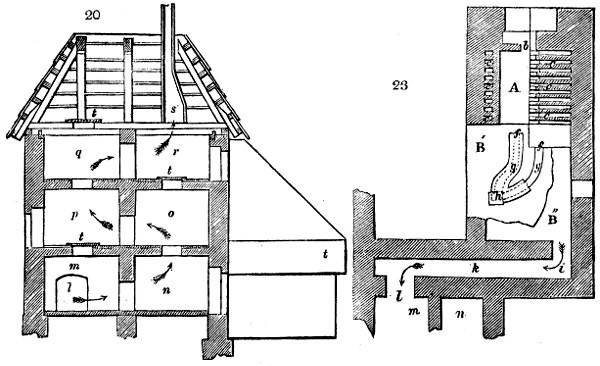
Figs. 20. to 23. represent the arsenical furnaces at Altenberg. Fig. 20. is a vertical section of the poison tower; fig. 21., a longitudinal section of the subliming furnace A, with the adjoining vault B, and the poison tower in part at n; fig. 22., the transverse section of the furnace A, of fig. 21.; fig. 23., ground plan of the furnace A, where the left half shows the part above, and the right the part below the muffle or oblong retort; B′ is the upper view, B′′ the ground plan of the vault B, of fig. 21.; m, n, the base of the poison tower. In the several figures the same letters denote the same objects: a is the muffle; b is its mouth for turning over the arsenical schlich, or ground ore; c c c, fire draughts or flues; d, an aperture for charging the muffle with fresh schlich; e, the smoke chimney; f, two channels or flues for the ascent of the arsenious fumes, which proceed to other two flues g, and then terminate both in h, which conducts the fumes into the vault B. They issue by the door i, into the conduit k, thence by l into the spaces m, n, o, p, q, r, of the tower. The incondensable gases escape by the chimney, s. The cover t, is removed after completion of the process, in order to push down the precipitate into the lower compartments.
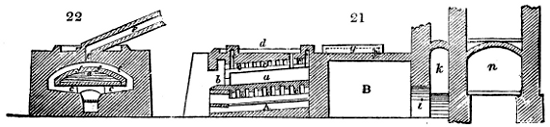
Figs. 21 and 22 enlarged (93 kB)
The arsenious schlichs, to the amount of 9 or 10 cwt. for one operation (1 roast-post, or roasting round), are spread 2 or 3 inches thick upon the bottom of the muffle, heated with a brisk fire to redness, then with a gentler heat, in order to oxidize completely, before subliming, the arsenical ore. With this view the air must have free entrance, and the front aperture of the muffle must be left quite open. After 11 or 12 hours, the calcined materials are raked out by the mouth of the muffle, and fresh ones are introduced by the openings indicated above, which are closed during the sublimation.
The arsenious acid found in these passages, is not marketable till it be re-sublimed in large iron pots, surmounted with a series of sheet iron drums or cast-iron cylinders, upon the sides of which the arsenic is condensed in its compact glassy form. The top cylinder is furnished with a pipe, which terminates in a condensing chamber.
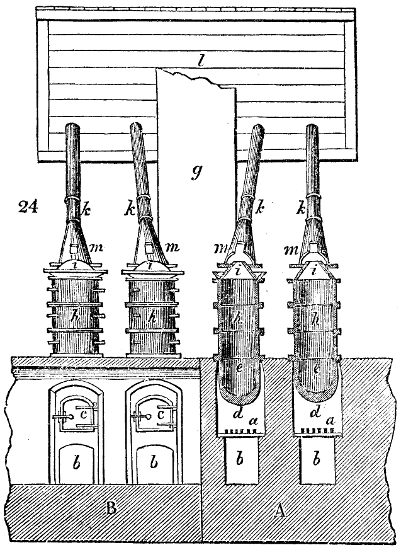
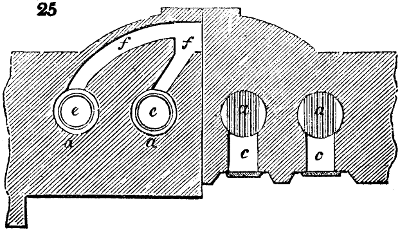
Figs. 24, 25. represent the arsenic refining furnaces at Reichenstein. Fig. 24. shows at A, a vertical section of the furnace, the kettle, and the surmounting drums or cylinders; over B it is seen in elevation; fig. 25. is a ground plan of the four fireplaces. a is the grate; b, the ash pit; c, the openings for firing; d, the fire-place; e, iron pots or kettles which are charged with the arsenious powder; f, the fire flues proceeding to the common chimney g; h, iron cylinders; i, caps; k, pipes leading to the poison vent l; m, openings in the pipes for introducing the probing wires.
The conduct of the process is as follows:—The pot is filled nearly to its brim with 31⁄2 cwt. of the arsenic meal, the cylinders are fitted on by means of their handles, and luted together with a mixture of loam, blood, and hair; then is applied first a gentle, and after half an hour, a strong fire, whereby the arsenic is raised partly in the form of a white dust, and partly in crystals; which, by the continuance of the heat, fuse together into a homogeneous mass. If the fire be too feeble, only a sublimate is obtained; but, if too violent, much of the arsenic is volatilized into the pipes. The workmen judge by the heat of the cylinders whether the operation be going on well or not. After 12 hours the furnace is allowed to cool, provided the probe wires show that the sublimation is over. The cylinders are then lifted off, and the arsenious glass is detached from their inner surface. According to the quality of the poison-flour, it yields from 3⁄4 to 7⁄8 of its weight of the glass or enamel. Should any dark particles of metallic arsenic be intermixed with the glass, a fresh sublimation must be had recourse to.
The following is the product in cwts. of arsenious acid, at Altenberg and Reichenstein, in Silesia, in the years
1825. 1826. 1827. 1828. 1829. 1830. 1831. 1832.
White arsenic in a glassy state 2632 1703 2686 1900 2070 2961 3337 2730
Sublimed arsenic in powder - 27 33 31 30 44 69 38
Yellow arsenical glass 112 11 56 - 86 313 60 219
Red arsenical glass 3 - - - 28
ARTESIAN WELLS. Under this name is designated a cylindrical perforation, bored vertically down through one or more of the geological strata of the earth, till it passes into a porous gravel bed containing water, placed under such incumbent pressure as to make it mount up through the perforation, either to the surface or to a height convenient for the operation of a pump. In the first case, these wells are called spouting or overflowing. This property is not directly proportional to the depth, as might at first sight be supposed, but to the subjacent pressure upon the water. We do not know exactly the period at which the borer or sound was applied to the investigation of subterranean fountains, but we believe the first overflowing wells were made in the ancient French province of Artois, whence the name of Artesian. These wells, of such importance to agriculture and manufactures, and which cost nothing to keep them in condition, have been in use, undoubtedly, for several centuries in the northern departments of France, and the north of Italy; but it is not more than 50 or 60 years since they became known in England and Germany. There are now a great many such wells in London and its neighbourhood, perforated through the immensely thick bed of the London clay, and even through some portions of the subjacent chalk. The boring of such wells has given much insight into the geological structure of many districts.
The formation of artesian wells depends on two things, essentially distinct from each other: 1. On an acquaintance with the physical constitution, or nature, of the mineral structure of each particular country; and, 2. On the skilful direction of the processes by which we can reach the water level, and of those by which we can promote its ascent in the tube. We shall first treat of the best method of making the well, and then offer some general remarks on the other subjects.
The operations employed for penetrating the soil are entirely similar to those daily practised by the miner, in boring to find metallic veins; but the well excavator must resort to peculiar expedients to prevent the purer water, which comes from deep strata, mingling with the cruder waters of the alluvial beds near the surface of the ground, as also to prevent the small perforation getting eventually filled with rubbish.
The cause of overflowing wells has been ascribed to a variety of circumstances. But, as it is now generally admitted that the numerous springs which issue from the ground proceed from the infiltration of the waters progressively condensed in rain, dew, snow, &c. upon the surface of our globe, the theory of these interior streamlets becomes by no means intricate; being analogous to that of syphons and water jets, as expounded in the treatises of physics. The waters are diffused, after condensation, upon the surface of the soil, and percolate downwards, through the various pores and fissures of the geological strata, to be again united subterraneously in veins, rills, streamlets, or expanded films, of greater or less magnitude, or regularity. The beds traversed by numerous disjunctions will give occasion to numerous interior currents in all directions, which cannot be recovered, and brought to the day; but when the ground is composed of strata of sand, or gravel very permeable to water, separated by other strata nearly impervious to it, reservoirs are formed to our hand, from which an abundant supply of water may be spontaneously raised. In this case, as soon as the upper stratum is perforated, the waters may rise, in consequence of the hydrostatic pressure upon the lower strata, and even overflow the surface in a constant stream, provided the level from which they proceed be proportionally higher.
The sheets of water occur principally at the separation of two contiguous formations; and, if the succession of the geological strata be considered, this distribution of the water will be seen to be its necessary consequence. In fact, the lower beds are frequently composed of compact sandstone or limestone, and the upper beds of clay. In level countries, the formations being almost always in horizontal-beds, the waters which feed the artesian wells must come from districts somewhat remote, where the strata are more elevated, as towards the secondary and transition rocks. The copious streams condensed upon the sides of these colder lands may be therefore regarded as the proper reservoirs of our wells.
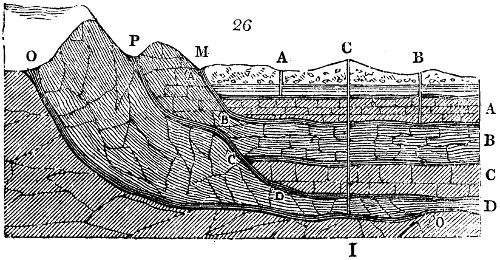
Fig. 26. represents the manner in which the condensed water of the heavens distributes itself under the surface of our globe. Here we have a geological section, showing the succession of the several formations, and the sheets or laminæ of water that exist at their boundaries, as well as in their sandy beds. The figure shows also very plainly that the height to which the water reascends in the bore of a well depends upon the height of the reservoir which supplies the sheet of water to which the well is perforated. Thus the well A, having gone down to the aqueous expanse A A, whose waters of supply are derived from the percolation M, will afford rising waters, which will come to the surface; whilst in the well B, supplied by the sheet P, the waters will spout above the surface, and in the well C they will remain short of it. The same figure shows that these wells often traverse sheets of water, which rise to different heights. Thus, in the well C there are five columns of ascending waters, which rise to heights proportional to the points whence they take their origin. Several of these will be spouting or overflowing, but some will remain beneath the surface.
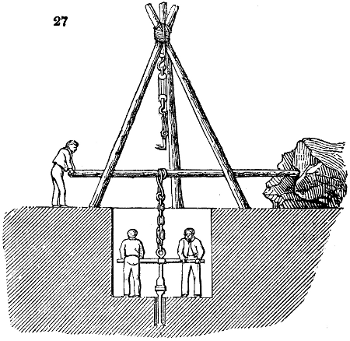
The situation of the intended well being determined upon, a circular hole is generally dug in the ground, about 6 or 8 feet deep, and 5 or 6 feet wide. In the centre of this hole the boring is carried on by two workmen below, assisted by a labourer above, as shown in fig. 27.
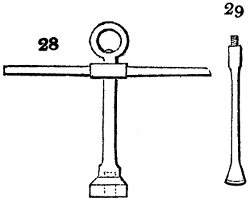
The handle (fig. 28.) having a female screw in the bottom of its iron shank, with a wooden bar or rail passing through the socket of the shank, and a ring at top, is the general agent to which all the boring implements are to be attached. A chisel (fig. 29.) is first employed, and connected to this handle by its screw at top. If the ground is tolerably soft, the weight of the two workmen bearing upon the cross bar, and occasionally forcing it round, will soon cause the chisel to penetrate; but if the ground is hard or strong, the workmen strike the chisel down with repeated blows, so as to peck their way, often changing their situation by walking round, which breaks the stones, or other hard substances, that may happen to obstruct its progress.
The labour is very considerably reduced, by means of an elastic wooden pole, placed horizontally over the well, from which a chain is brought down, and attached to the ring of the handle. This pole is usually made fast at one end, as a fulcrum, by being set into a heap of heavy loose stones; at the other end the labourer above gives it a slight up and down vibrating motion, corresponding to the beating motion of the workmen below, by which means the elasticity of the pole in rising lifts the handle and pecker, and thereby very considerably diminishes the labour of the workmen. See fig. 27.
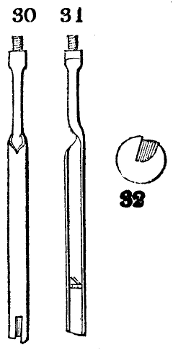
When the hole has been thus opened by a chisel, as far as its strength would permit, the chisel is withdrawn, and a sort of cylindrical auger (fig. 30.) attached to the handle (fig. 28.), for the purpose of drawing up the dirt or broken stones which have been disturbed by the chisel. A section of this auger is shown in fig. 31., by which the internal valve will be seen. The auger being introduced into the hole, and turned round by the workman, the dirt or broken stones will pass through the aperture at bottom (shown at fig. 32.), and fill the cylinder, which is then drawn up, and discharged at the top of the auger, the valve preventing its escape at bottom.
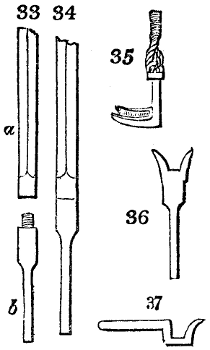
In order to penetrate deeper into the ground, an iron rod, as a, fig. 33., is now to be attached to the chisel, fig. 29., by screwing on to its upper end, and the rod is also fastened to the handle, fig. 28., by screwing into its socket. The chisel having thus become lengthened, by the addition of the rod, it is again introduced into the hole; and the operation of pecking or forcing it down, is carried on by the workmen as before. When the ground has been thus perforated, as far as the chisel and its rod will reach, they must be withdrawn, in order again to introduce the auger, fig. 30., to collect and bring up the rubbish; which is done by attaching it to the iron rod, in place of the chisel. Thus as the hole becomes deepened, other lengths of iron rods are added, by connecting them together, as a b are in fig. 34. The necessity of frequently withdrawing the rods from the holes, in order to collect the mud, stones, or rubbish, and the great friction produced by the rubbing of the tools against its sides, as well as the lengths of rods augmenting in the progress of the operation, sometimes to the extent of several hundred feet, render it extremely inconvenient, if not impossible, to raise them by hand. A tripedal standard is, therefore, generally constructed by three scaffolding poles tied together, over the hole, as shown fig. 27., from the centre of which a wheel and axle, or a pair of pully blocks is suspended, for the purpose of hauling up the rods, and from which hangs the fork, fig. 35. This fork is to be brought down under the shoulder, near the top of each rod, and made fast to it by passing a pin through two little holes in the claws. The rods are thus drawn up, about seven feet at a time, which is the usual distance between each joint, and at every haul a fork, fig. 36., is laid horizontally over the hole, with the shoulders of the lower rod resting between its claws, by which means the rods are prevented from sinking down into the hole again, while the upper length is unscrewed and removed. In attaching and detaching these lengths of rod, a wrench, fig. 37., is employed, by which they are turned round, and the screws forced up to their firm bearing.
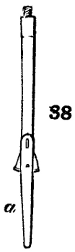
The boring is sometimes performed for the first sixty or a hundred feet, by a chisel of 21⁄2 inches wide, and cleared out by a gouge of 21⁄4 diameter, and then the hole is widened by a tool, such as is shown at fig. 38. This is merely a chisel, as fig. 29., four inches wide, but with a guide, a, put on at its lower part, for the purpose of keeping it in a perpendicular direction; the lower part is not intended to peck, but to pass down the hole previously made, while the sides of the chisel operate in enlarging the hole to four inches. The process, however, is generally performed at one operation, by a chisel of four inches wide, as fig. 29., and a gouge of three inches and three quarters, as fig. 30.
It is obvious, that placing and displacing the lengths of rod, which is done every time that the auger is required to be introduced or withdrawn, must, of itself, be extremely troublesome, independent of the labour of boring, but yet the operation proceeds, when no unpropitious circumstances attend it, with a facility almost incredible. Sometimes, however, rocks intercept the way, which require great labour to penetrate; but this is always effected by pecking, which slowly pulverises the stone. The most unpleasant circumstance attendant upon this business is the occasional breaking of a rod into the hole, which sometimes creates a delay of many days, and an incalculable labour in drawing up the lower portion.
When the water is obtained in such quantities and of such quality as may be required, the hole is dressed or finished by passing down it a diamond chisel, funnel mouthed, with a triangular bit in its centre; this makes the sides smooth previous to putting in the pipe. This chisel is attached to rods, and to the handle, as before described; and, in its descent, the workmen continually walk round, by which the hole is made smooth and cylindrical. In the progress of the boring, frequent veins of water are passed through; but, as these are small streams, and perhaps impregnated with mineral substances, the operation is carried on until an aperture is made into a main spring, which will flow up to the surface of the earth. This must, of course, depend upon the level of its source, which, if in a neighbouring hill, will frequently cause the water to rise up, and produce a continued fountain. But if the altitude of the distant spring happens to be below the level of the surface of the ground where the boring is effected, it sometimes happens that a well of considerable capacity is obliged to be dug down to that level, in order to form a reservoir, into which the water may flow, and whence it must be raised by a pump; while, in the former instance, a perpetual fountain may be obtained. Hence, it will always be a matter of doubt, in level countries, whether water can be procured, which would flow near to or over the surface; if this cannot be effected, the process of boring will be of little or no advantage, except as an experiment to ascertain the fact.
In order to keep the strata pure, and uncontaminated with mineral springs, the hole is cased, for a considerable depth, with a metallic pipe, about a quarter of an inch smaller than the bore. This is generally made of tin (though sometimes of copper or lead) in convenient lengths; and, as each length is let down, it is held by a shoulder resting in a fork, while another length is soldered to it; by which means a continuous pipe is carried through the bore, as far as may be found necessary, to exclude land springs, and to prevent loose earth or sand from falling in, and choking the aperture.
Mr. John Good, of Tottenham, who had been extensively employed in boring the earth for water, obtained a patent, in Aug. 1823, for certain improved implements contrived by him to facilitate his useful labours; a description of which cannot fail to be interesting.
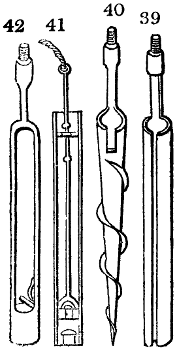
The figures annexed exhibit these ingenious tools; fig. 39. is an auger, to be connected by the screw-head to the length of rods by which the boring is carried on. This auger is for boring in soft clay or sand; it is cylindrical, and has a slit or opening from end to end, and a bit, or cutting-piece at bottom. When the earth is loose or wet, an auger of the same form is to be employed, but the slit or opening reduced in width, or even without a slit or opening. A similar auger is used for cutting through chalk; but the point or bit at bottom should then project lower, and, for that purpose, some of these cylindrical augers are made with moveable bits, to be attached by screws, which is extremely desirable in grinding them to cutting edges. Fig. 40. is a hollow conical auger, for boring loose sandy soils; it has a spiral cutting edge coiled round it, which, as it turns, causes the loose soil to ascend up the inclined plane, and deposit itself in the hollow within. Fig. 41. is a hollow cylinder or tube, shown in section, with a foot-valve, and a bucket to be raised by a rod and cord attached at the top; this is a pumping tool, for the purpose of getting up water and sand that would not rise by the auger. When this cylinder is lowered to the bottom of the bore, the bucket is lifted up by the rod and cord, and descends again by its own gravity, having a valve in the bucket, opening upwards, like other lift pumps; which, at every stroke, raises a quantity of water and sand in the cylinder equal to the stroke; the ascent and descent of the bucket being limited by a guide-piece at the top of the cylinder, and two small knobs upon the rod, which stop against the cross-guide. Fig. 42. is a tool for getting up broken rods. It consists of a small cylindrical piece at bottom, which the broken rod slips through when it is lowered, and a small catch with a knife-edge, acted upon by a back-spring. In rising, the tool takes hold of the broken rod, and thereby enables the workmen at top to draw it up. Another tool for the same purpose, is shown at fig. 43., which is like a pair of tongs; it is intended to be slidden down the bore, and for the broken rod to pass between the two catches, which, pressed by back-springs, will, when drawn up, take fast hold of the broken rod.
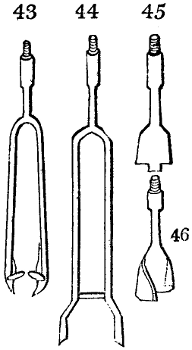
Fig. 44. is a tool for widening the hole, to be connected, like all the others, to the end of the length of rods passed down the bore; this tool has two cutting-pieces extending on the sides at bottom, by which, as the tool is turned round in the bore, the earth is peeled away. Fig. 45. is a chisel, or punch, with a projecting piece to be used for penetrating through stone; this chisel is, by rising and falling, made to peck the stone, and pulverize it; the small middle part breaking it away first, and afterwards the broad part coming into action. Fig. 46. is another chisel, or punching tool, twisted on its cutting edge, which breaks away a greater portion of the stone as it beats against it.
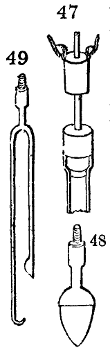
The manner of forcing down lengths of cast-iron pipe, after the bore is formed, is shown at fig. 47.; the pipe is seen below in the socket, at the end of which a block is inserted; and from this block a rod extends upwards, upon which a weight at top slides. To this weight cords are shown to be attached, reaching to the top of the bore; where the workmen alternately raise the weight and let it fall, which, by striking upon the block in its middle, beats down the pipe by a succession of strokes; and when one length of pipe has, by these means, been forced down, another length is introduced into the socket of the former. Another tool for the same purpose is shown at fig. 48., which is formed like an acorn; the raised part of the acorn strikes against the edge of the pipe, and by that means, it is forced down the bore. When it happens that an auger breaks in the hole, a tool similar to that shown at fig. 49. is introduced; on one side of this tool a curved piece is attached, for the purpose of a guide, to conduct it past the cylindrical auger; and at the end of the other side is a hook, which, taking hold of the bottom edge of the auger, enables it to be drawn up.
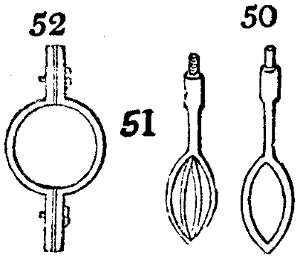
Wrought iron, copper, tin, and lead pipes, are occasionally used for lining the bore; and as these are subject to bends and bruises, it is necessary to introduce tools for the purpose of straightening their sides. One of these tools is shown at fig. 50., which is a bow, and is to be passed down the inside of the pipe, in order to press out any dents. Another tool, for the same purpose, is shown at fig. 51., which is a double bow, and may be turned round in the pipe for the purpose of straightening it all the way down; at fig. 52., is a pair of clams, for turning the pipe round in the hole while driving.
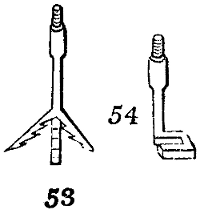
When loose stones lie at the bottom of the hole, which are too large to be brought up by the cylindrical auger, and cannot be conveniently broken, then it is proposed to introduce a triangular claw, as fig. 53., the internal notches of which take hold of the stone, and as the tool rises, bring it up. For raising broken rods, a tool like fig. 54. is sometimes employed, which has an angular claw that slips under the shoulder of the rod, and holds it fast while drawing up.
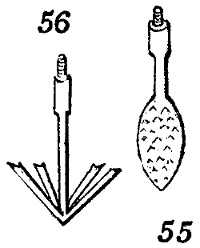
In raising pipes, it is necessary to introduce a tool into the inside of the pipe, by which it will be held fast. Fig. 55. is a pine-apple tool for this purpose; its surface is cut like a rasp, which passes easily down into the pipe, but catches as it is drawn up; and by that means brings the pipe with it. Fig. 56. is a spear for the same purpose, which easily enters the pipe by springing; at the ends of its prongs there are forks which stick into the metal as it is drawn up, and thereby raise it.
These are the new implements, for which the patent was granted. In the process of boring, there does not appear to be any thing new proposed; but that these several tools are to be employed for boring, packing, and otherwise penetrating, raising the earth, and extracting broken or injured tools. There are also suggestions for employing long buckets, with valves opening upward in their bottoms, for the purpose of drawing water from these wells when the water will not flow over the surface; also lift pumps, with a succession of buckets for the same purpose. But as these suggestions possess little if any novelty, it cannot be intended to claim them as parts of the patent.
ASPHALTUM. Native bitumen, so called from the lake Asphaltites.
ASSAY and ASSAYING. (Coupellation, Fr.; Abtreiben auf der capelle, Germ.) This is the process by which the quality of gold and silver bullion, coin, plate, or trinkets is ascertained with precision, or by which the quantity of either or both these precious metals is determined in any given alloy. It is, therefore, a case of chemical analysis, in which peculiar methods are employed to attain the object in view with accuracy and dispatch. Assaying has been also extended of late years, to determine the quantity of palladium and platina in certain bullion and gold dust brought from Brazil.
The art of assaying gold and silver by the cupel, is founded upon the feeble affinity which these metals have for oxygen, in comparison with copper, tin, and the other cheaper metals; and on the tendency which the latter metals have to oxidize rapidly in contact with lead at a high temperature, and sink with it into any porous earthy vessel in a thin glassy or vitriform state. The porous vessel may be made either of wood-ashes, freed from their soluble matter by washing with water; or, preferably, of burned bones reduced to a fine powder.
The lead added to the silver or gold to be assayed, serves chiefly to dissolve the oxidized copper, whence it appears that the quantity of lead requisite for silver assays, ought to be directly proportional to the quantity which the silver and copper would separately require. It has been found by experiment, that 16 parts of lead are quite sufficient to pass 1 of copper through the cupel; and that 3⁄10 of lead presents the most suitable proportion for passing one of silver. From these principles, however, if we should always regard the dose of lead to be employed for any alloy as being equal to (16 × C) + (3⁄30 × S) we should certainly commit an error. The phenomena of cupellation is of a more complex nature. Long practice and delicate trials alone can guide to the proper quantity of lead to be employed for every various state of the alloy. The following Table contains the results of M. D’Arcet’s elaborate experiments upon this subject:—
Alloy. Lead for 1 of Alloy. Ratio of the Copper to the Lead.
Silver. Copper.
1000 0 3⁄10 0
950 50 3 1 : 60
900 100 7 1 : 70
800 200 10 1 : 50
700 300 12 1 : 40
600 400 14 1 : 35
500 500 16 or 17 1 : 32
400 600 16 — 17 1 : 26·7
300 700 16 — 17 1 : 22·9
200 800 16 — 17 1 : 20
100 900 16 — 17 1 : 17·8
0 1000 16 — 17 1 : 16
Bismuth may be used as a substitute for lead in cupellation; two parts of it being nearly equivalent to three of lead. But its higher prices will prevent its general introduction among assay masters.
We begin this assay process by weighing, in a delicate balance, a certain weight of the metallic alloy; a gramme (= 15·444 gr.) is usually taken in France, and 12 grains in this country. This weight is wrapped up in a slip of lead foil or paper, should it consist of several fragments. This small parcel, thus enveloped, is then laid in a watch glass or a capsule of copper, and there is added to it the proportion of lead suited to the quality of alloy to be assayed; there being less lead, the finer the silver is presumed to be. Those who are much in the habit of cupellation can make good guesses in this way; though it is still guess work, and often leads to considerable error, for if too much lead be used for the proportion of baser metal present, a portion of the silver is wasted; but if too little, then the whole of the copper, &c. is not carried off, and the button of fine silver remains more or less impure. The most expert and experienced assayer by the cupel, produces merely a series of approximate conjectural results, which fall short of chemical demonstration and certainty in every instance. The lead must be, in all cases, entirely free from silver, being such as has been revived from pure litharge; otherwise errors of the most serious kind would be occasioned in the assays.
The best cupels weigh 121⁄2 grammes, or 193 grains. The cupels allow the fused oxides to flow through them as through a fine sieve, but are impermeable to the particles of metals; and thus the former pass readily down into their substance while the latter remain upon their surface; a phenomenon owing to the circumstance of the glassy oxides moistening, as it were, the bone-ash powder, whereas the metals can contract no adherence with it. Hence also the liquid metals preserve a hemispherical shape in the cupels, as quicksilver does in a cup of glass, while the fused oxide spreads over, and penetrates their substance, like water. A cupel may be regarded, in some measure, as a filter permeable only to certain liquids.
If we put into a cupel, therefore, two metals, of which the one is unalterable in the air, the other susceptible of oxidizement, and of producing a very fusible oxide, it is obvious that, by exposing both to a proper degree of heat, we shall succeed in separating them. We should also succeed, though the oxide were infusible, by placing it in contact with another one, which may render it fusible. In both cases, however, the metal from which we wish to part the oxides must not be volatile; it should also melt, and form a button at the heat of cupellation; for otherwise it would continue disseminated, attached to the portion of oxide spread over the cupel, and incapable of being collected.
The furnace and implements used for assaying in the Royal Mint and the Goldsmiths’ Hall, in the city of London, are the following:—
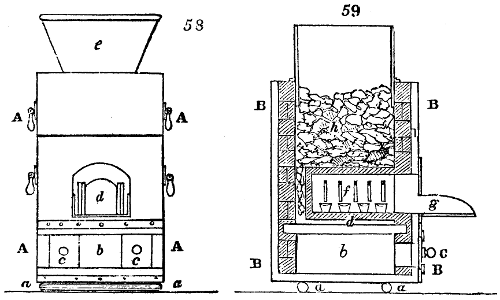
A A A A, fig. 58., is a front elevation of an assay furnace; a a, a view of one of the two iron rollers on which the furnace rests, and by means of which it is moved forward or backward; b, the ash-pit; c c are the ash-pit dampers, which are moved in a horizontal direction towards each other for regulating the draught of the furnace; d, the door, or opening, by which the cupels and assays are introduced into the muffle; e, a moveable funnel or chimney by which the draught of the furnace is increased. B B B B, fig. 59., is a perpendicular section of fig. 58.; a a, end view of the rollers; b the ash-pit; c one of the ash-pit dampers; d the grate, over which is the plate upon which the muffle rests, and which is covered with loam nearly one inch thick; f the muffle in section representing the situation of the cupels; g the mouth-plate, and upon it are laid pieces of charcoal, which during the process are ignited, and heat the air that is allowed to pass over the cupels, as will be more fully explained in the sequel; h the interior of the furnace, exhibiting the fuel.
The total height of the furnace is 2 feet 61⁄2 inches; from the bottom to the grate, 6 inches; the grate, muffle, plate, and bed of loam, with which it is covered, 3 inches; from the upper surface of the grate to the commencement of the funnel e, fig. 58., 211⁄2 inches; the funnel e, 6 inches. The square of the furnace which receives the muffle and fuel is 113⁄4 inches by 15 inches. The external sides of the furnace are made of plates of wrought iron, and are lined with a 2-inch fire-brick.
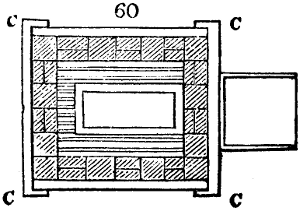
C C C C, fig. 60., is a horizontal section of the furnace over the grate, showing the width of the mouth-piece, or plate of wrought iron, which is 6 inches, and the opening which receives the muffle-plate.
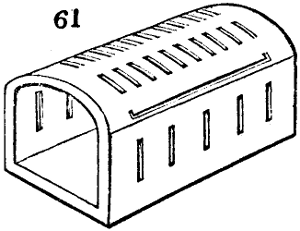
Fig. 61. represents the muffle or pot, which is 12 inches long, 6 inches broad inside; in the clear 63⁄4: in height 41⁄2 inside measure, and nearly 51⁄2 in the clear.
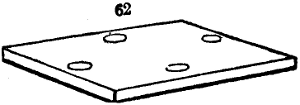
Fig. 62., the muffle-plate, which is of the same size as the bottom of the muffle.
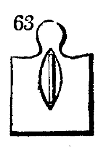
Fig. 63. is a representation of the sliding-door of the mouth-plate, as shewn at d, in fig. 58.
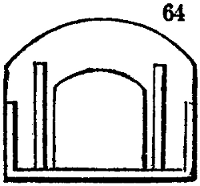
Fig. 64., a front view of the mouth-plate or piece, d, fig. 58.
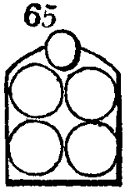
Fig. 65., a representation of the mode of making, or shutting up with pieces of charcoal, the mouth of the furnace.
Fig. 66., the teaser for cleaning the grate.
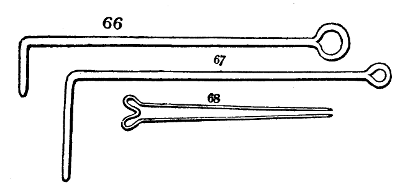
Fig. 67., a larger teaser, which is introduced at the top of the furnace, for keeping a complete supply of charcoal around the muffle.
Fig. 68., the tongs used for charging the assays into the cups.
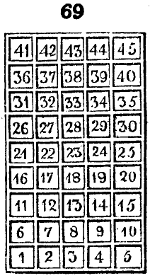
Fig. 69. represents a board of wood used as a register, and is divided into 45 equal compartments, upon which the assays are placed previously to their being introduced into the furnace. When the operation is performed, the cupels are placed in the furnace in situations corresponding to these assays on the board. By these means all confusion is avoided, and without this regularity it would be impossible to preserve the accuracy which the delicate operations of the assayer require.
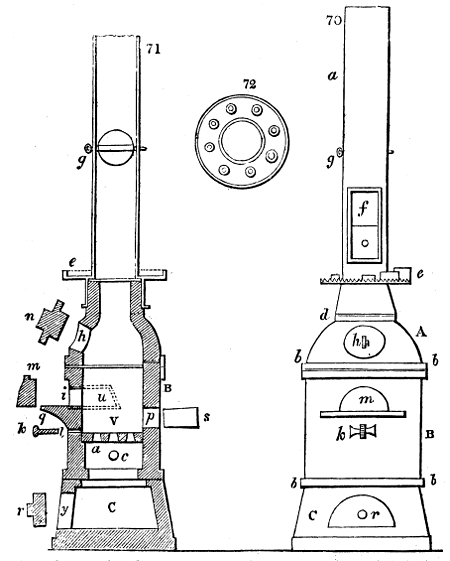
I shall now proceed to a description of a small assay furnace, invented by Messrs. Anfrye and d’Arcet, of Paris. They term it, Le Petit Fourneau à Coupelle. Fig. 70. represents this furnace, and it is composed of a chimney or pipe of wrought iron a, and of the furnace B. It is 171⁄2 inches high, and 71⁄4 inches wide. The furnace is formed of three pieces; of a dome A; the body of the furnace B; and the ash-pit C, which is used as the base of the furnace, fig. 70. and 71. The principal piece, or body of the furnace, B, has the form of a hollow tower, or of a hollow cylinder, flattened equally at the two opposite sides parallel to the axis, in such a manner that the horizontal section is elliptical. The foot which supports it is a hollow truncated cone, flattened in like manner upon the two opposite sides, and having consequently for its basis two ellipses of different diameters; the smallest ought to be equal to that of the furnace, so that the bottom of the latter may exactly fit it. The dome, which forms an arch above the furnace, has also its base elliptical, whilst that of the superior orifice by which the smoke goes out preserves the cylindrical form. The tube of wrought iron is 18 inches long and 21⁄2 inches diameter, having one of its ends a little enlarged, and slightly conical, that it may be exactly fitted or jointed upon the upper part of the furnace dome d, fig. 70. At the union of the conical and cylindrical parts of the tube, there is placed a small gallery of iron, e, fig. 70, 71. See also a plan of it, fig. 72. This gallery is both ingenious and useful. Upon it are placed the cupels, which are thus annealed during the ordinary work of the furnace, that they may be introduced into the muffle, when it is brought into its proper degree of heat. A little above this gallery is a door f, by which, if thought proper, the charcoal could be introduced into the furnace; above that there is placed at g a throttle valve, which is used for regulating the draught of the furnace at pleasure. Messrs. Anfrye and d’Arcet say, that, to give the furnace the necessary degree of heat so as to work the assays of gold, the tube must be about 18 inches above the gallery, for annealing or heating the cupels. The circular opening h, in the dome, fig. 70., and as seen in the section, fig. 71., is used to introduce the charcoal into the furnace: it is also used to inspect the interior of the furnace, and to arrange the charcoal round the muffle. This opening is kept shut during the working of the furnace, with the mouth-piece, of which the face is seen at n, fig. 71.
The section of the furnace, fig. 71., presents several openings, the principal of which is that of the muffle; it is placed at i; it is shut with the semicircular door m, fig. 70., and seen in the section m, fig. 71. In front of this opening, is the table or shelf, upon which the door of the muffle is made to advance or recede; the letter q, fig. 71., shows the face, side, and cross section of the shelf, which makes part of the furnace. Immediately under the shelf, is a horizontal slit, l, which is pierced at the level of the upper part of the grate, and used for the introduction of a slender rod of iron, that the grate may be easily kept clean. This opening is shut at pleasure, by the wedge represented at k, fig. 70. and 71.
Upon the back of the furnace is a horizontal slit p, fig. 71, which supports the fire-brick, s, and upon which the end of the muffle, if necessary, may rest; u, fig. 71., is the opening in the furnace where the muffle is placed.
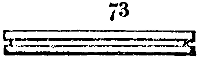
The plan of the grate of the furnace is an ellipse: fig. 73. is a horizontal view of it. The dimensions of that ellipsis determine the general form of the furnace, and thickness of the grate. To give strength and solidity to the grate, it is encircled by a bar or hoop of iron. There is a groove in which the hoop of iron is fixed. The holes of the grate are truncated cones, having the greater base below, that the ashes may more easily fall into the ash-pit. The letter v, fig. 71., shows the form of these holes. The grate is supported by a small bank or shelf, making part of the furnace, as seen at a, fig. 71.
The ash-pit, C, has an opening y in front, fig. 71.; and is shut when necessary by the mouth-piece r, fig. 70. and 71.
To give strength and solidity to the furnace, it is bound with hoops of iron, at b, b, b, b, fig. 70.
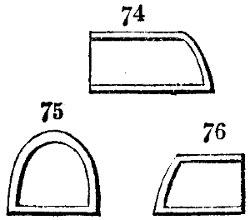
Figs. 74. 75. 76. are views of the muffle.
Fig. 77. is a view of a crucible for annealing gold.
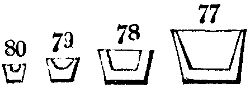
Figs. 78. 79. 80. are cupels of various sizes, to be used in the furnace. They are the same as those used by assayers in their ordinary furnaces.
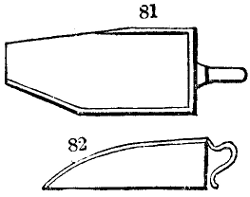
Figs. 81. and 82. are views of the hand-shovels, used for filling the furnace with charcoal; they should be made of such size and form as to fit the opening h, in figs. 70. and 71.
The smaller pincers or tongs, by which the assays are charged into the cupels, and by which the latter are withdrawn from the furnace, as well as the teaser for cleaning the grate of the furnace, are similar to those used in the British Mint.
In the furnace of the Mint above described, the number of assays that can be made at one time, is 45. The same number of cupels are put into the muffle. The furnace is then filled with charcoal to the top, and upon this are laid a few pieces already ignited. In the course of three hours, a little more or less, according to circumstances, the whole is ignited; during which period, the muffle, which is made of fire-clay, is gradually heated to redness, and is prevented from cracking; which a less regular or more sudden increase of temperature would not fail to do: the cupels, also, become properly annealed. All moisture being dispelled, they are in a fit state to receive the piece of silver or gold to be assayed.
The greater care that is exercised in this operation, the less liable is the assayer to accidents from the breaking of the muffle; which it is both expensive and troublesome to fit properly into the furnace.
The cupels used in the assay process, are made of the ashes of burnt bones (phosphate of lime). In the Royal Mint, the cores of ox-horn are selected for this purpose; and the ashes produced are about four times the expense of the bone-ash, used in the process of cupellation upon the large scale. So much depends upon the accuracy of an assay of gold or silver, where a mass of 15lbs. troy in the first, and 60lbs. troy in the second instance, is determined by the analysis of a portion not exceeding 20 troy grains, that every precaution which the longest experience has suggested, is used to obtain an accurate result. Hence the attention paid to the selection of the most proper materials for making the cupels.
The cupels are formed in a circular mould made of cast steel, very nicely turned, by which means they are easily freed from the mould when struck. The bone-ash is used moistened with a quantity of water, sufficient to make the particles adhere firmly together. The circular mould is filled, and pressed level with its surface; after which, a pestle or rammer, having its end nicely turned, of a globular or convex shape, and of a size equal to the degree of concavity wished to be made in the cupel for the reception of the assay, is placed upon the ashes in the mould, and struck with a hammer until the cupel is properly formed. These cupels are allowed to dry in the air for some time before they are used. If the weather is fine, a fortnight will be sufficient.
An assay may prove defective for several reasons. Sometimes the button or bead sends forth crystalline vegetations on its surface with such force, as to make one suppose a portion of the silver may be thrown out of the cupel. When the surface of the bead is dull and flat, the assay is considered to have been too hot, and it indicates a loss of silver in fumes. When the tint of the bead is not uniform, when its inferior surface is bubbly, when yellow scales of oxide of lead remain on the bottom of the cupel, and the bead adheres strongly to it, by these signs it is judged that the assay has been too cold, and that the silver retains some lead.
Lastly, the assay is thought to be good if the bead is of a round form, if its upper surface is brilliant, if its lower surface is granular and of a dead white, and if it separates readily from the cupel.
After the lead is put into the cupel, it gets immediately covered with a coat of oxide, which resists the admission of the silver to be assayed into the melted metal; so that the alloy cannot form. When a bit of silver is laid on a lead bath in this predicament, we see it swim about for a long time without dissolving. In order to avoid this result, the silver is wrapped up in a bit of paper; and the carburetted hydrogen generated by its combustion, reduces the film of the lead oxide, gives the bath immediately a bright metallic lustre, and enables the two metals readily to combine.
As the heat rises, the oxide of lead flows round about over the surface, till it is absorbed by the cupel. When the lead is wasted to a certain degree, a very thin film of it only remains on the silver, which causes the iridescent appearance, like the colours of soap-bubbles; a phenomenon, called by the old chemists, fulguration.
When the cupel cools in the progress of the assay, the oxygenation of the lead ceases; and, instead of a very liquid vitreous oxide, an imperfectly melted oxide is formed, which the cupel cannot absorb. To correct a cold assay, the temperature of the furnace ought to be raised, and pieces of paper ought to be put into the cupel, till the oxide of lead which adheres to it, be reduced. On keeping up the heat, the assay will resume its ordinary train.
Pure silver almost always vegetates. Some traces of copper destroy this property, which is obviously due to the oxygen which the silver can absorb while it is in fusion, and which is disengaged the moment it solidifies. An excess of lead, by removing all the copper at an early stage, tends to cause the vegetation.
The brightening is caused by the heat evolved, when the button passes from the liquid to the solid state. Many other substances present the same phenomenon.
In the above operation it is necessary to employ lead which is very pure, or at least free from silver. That kind is called poor lead.
It has been observed at all times, that the oxide of lead carries off with it, into the cupel, a little silver in the state of an oxide. This effect becomes less, or even disappears, when there is some copper remaining; and the more copper, the less chance there is of any silver being lost. The loss of silver increases, on the other hand, with the dose of lead. Hence the reason why it is so important to proportion the lead with a precision which, at first sight, would appear to be superfluous. Hence, also, the reason of the attempts which have, of late years, been made to change the whole system of silver assays, and to have recourse to a method exempt from the above causes of error.
M. d’Arcet, charged by the Commission of the Mint in Paris, to examine into the justice of the reclamations made by the French silversmiths against the public assays, ascertained that they were well founded; and that the results of cupellation gave for the alloys between 897 and 903 thousandths (the limits of their standard coin) an inferior standard, by from 4 to 5 thousandth parts, from the standard or title which should result from the absolute or actual alloy.
The mode of assay shows, in fact, that an ingot, experimentally composed of 900 thousandths of fine silver, and 100 thousandths of copper, appears, by cupellation, to be only, at the utmost, 896 or 897 thousandths; whereas fine silver, of 1000 thousandths, comes out nearly of its real standard. Consequently a director of the Mint, who should compound his alloy with fine silver, would be obliged to employ 903 or 904 thousandths, in order that, by the assay in the laboratory of the Mint, it should appear to have the standard of 900 thousandths. These 3 or 4 thousandths would be lost to him, since they would be disguised by the mode of assay, the definitive criterion of the quantity of silver, of which the government keeps count from the coiner of the money.
From experiments subsequently made by M. d’Arcet, it appears that silver assays always suffer a loss of the precious metal, which varies, however, with the standard of the alloy. It is 1 thousandth for fine silver,
4·3 thousandths for silver of 900 thousandths,
4·9 — for — of 800 —
4·2 — for — of 500 —
and diminishes thereafter, progressively, till the alloy contains only 100 thousandths of silver, at which point the loss is only 0·4.
Assays requested by the Commission of the Paris Mint, from the assayers of the principal Royal Mints in Europe, to which the same alloys, synthetically compounded, were sent, afforded the results inscribed in the following table.
Names of the Assayers. Cities where they reside. Standards found for the Mathematical Alloys.
950 mill. 900 mill. 800 mill.
F. de Castenhole, Mint Assayer Vienna 946 ·20 898 ·40 795 ·10
A. R. Vervaëz, Ditto Madrid 944 ·40 893 ·70 789 ·20
D. M. Cabrera, Assayer in Spain Ditto 944 ·40 893 ·70 788 ·60
Assayer Amsterdam 947 ·00 895 ·00 795 ·00
Mr. Bingley, Assay Master London 946 ·25 896 ·25 794 ·25
Mr. Johnson, Assayer Ditto 933 ·33 883 ·50 783 ·33
Inspector of the Mint Utrecht 945 ·00 896 ·50 799 ·00
Assayer of the Mint Naples 945 ·00 891 ·00 787 ·00
Assayer of Trade Ditto 945 ·00 891 ·00 787 ·00
Assayer of the Mint Hamburgh 946 ·13⁄72 897 ·41⁄72 798 ·44⁄72
Ditto Altona 942 ·1⁄4 894 ·00 790
These results, as well as those in still greater numbers, obtained from the ablest Parisian assayers, upon identical alloys of silver and copper, prove that the mode of assay applied to them brings out the standard too low; and further, that the quantity of silver masked or disguised, is not uniform for these different eminent assay masters. An alloy, for example, at the standard of 900 thousandths is judged at
M.
the Mint of Paris to have a standard of 895·6
At that of Vienna — 898·4
— Madrid — 893·7
— Naples — 891·0
The fact thus so clearly made out of a loss in the standard of silver bullion and coin, merits the most serious attention; and it will appear astonishing, perhaps, that a thing recurring every day, should have remained for so long a time in the dark. In reality, however, the fact is not new; as the very numerous and well-made experiments of Tillet from 1760 to 1763, which are related in the memoirs of the Academy of Sciences, show, in the silver assays, a loss still greater than that which was experienced lately in the laboratory of the Commission of the French Mint. But he thought that, as the error was common to the nations in general, it was not worth while or prudent to introduce any innovation.
A mode of assaying, to give, with certainty, the standard of silver bullion, should be entirely independent of the variable circumstances of temperature, and the unknown proportions of copper, so difficult to regulate by the mere judgment of the senses. The process by the humid way, recommended by me to the Royal Mint in 1829, and exhibited as to its principles before the Right Honourable John Herries, then Master, in 1830, has all the precision and certainty we could wish. It is founded on the well-known property which silver has, when dissolved in nitric acid, to be precipitated in a chloride of silver quite insoluble, by a solution of sea salt, or by muriatic acid; but, instead of determining the weight of the chloride of silver, which would be somewhat uncertain and rather tedious, on account of the difficulty of drying it, we take the quantity of the solution of sea salt which has been necessary for the precipitation of the silver. To put the process in execution, a liquor is prepared, composed of water and sea salt in such proportions that 1000 measures of this liquor may precipitate, completely, 12 grains of silver, perfectly pure, or of the standard 1000, previously dissolved in nitric acid. The liquor thus prepared, gives, immediately, the true standard of any alloy whatever, of silver and copper, by the weight of it which may be necessary to precipitate 12 grains of this alloy. If, for example 905 measures have been required to precipitate the 12 grains of alloy, its standard would be 905 thousandths.
The process by the humid way is, so to speak, independent of the operator. The manipulations are so easy; and the term of the operation is very distinctly announced by the absence of any sensible nebulosities on the affusion of sea salt into the silver solution, while there remains in it 1⁄2 thousandth of metal. The process is not tedious, and in experienced hands it may rival the cupel in rapidity; it has the advantage over the cupel of being more within the reach of ordinary operators, and of not requiring a long apprenticeship. It is particularly useful to such assayers as have only a few assays to make daily, as it will cost them very little time and expense.
By agitating briskly during two minutes, or thereby, the liquid rendered milky by the precipitation of the chloride of silver, it may be sufficiently clarified to enable us to appreciate, after a few moments of repose, the disturbance that can be produced in it by the addition of 1000 of a grain of silver. Filtration is more efficacious than agitation, especially when it is employed afterwards; it may be sometimes used; but agitation, which is much more prompt, is generally sufficient. The presence of lead and copper, or any other metal, except mercury, has no perceptible influence on the quantity of sea salt necessary to precipitate the silver; that is to say, the same quantity of silver, pure or alloyed, requires for its precipitation a constant quantity of the solution of sea salt.
Supposing that we operate upon a gramme of pure silver, the solution of sea salt ought to be such that 100 centimetres cube may precipitate exactly the whole silver. The standard of an alloy is given by the number of thousandths of solution of sea salt necessary to precipitate the silver contained in a gramme of the alloy.
When any mercury is accidentally present, which is, however, a rare occurrence, it is made obvious by the precipitated chloride remaining white when exposed to daylight, whereas when there is no mercury present, it becomes speedily first grey and then purple. Silver so contaminated must be strongly ignited in fusion before being assayed, and its loss of weight noted. In this case, a cupel assay must be had recourse to.
Preparation of the Normal Solution of Sea Salt, when it is measured by Weight.—Supposing the sea salt pure as well as the water, we have only to take these two bodies in the proportion of 0·5427 k. of salt to 99·4573 k. of water, to have 100 k. of solution, of which 100 grammes will precipitate exactly one gramme of silver. But instead of pure salt, which is to be procured with difficulty, and which besides may be altered readily by absorbing the humidity of the air, a concentrated solution of the sea salt of commerce is to be preferred, of which a large quantity may be prepared at a time, to be kept in reserve for use, as it is wanted. Instruction de Gay Lussac.
Preparation of the Normal Solution of Sea Salt, when measured by Volume.—The measure by weight has the advantage of being independent of temperature, of having the same degree of precision as the balance, and of standing in need of no correction. The measure by volume has not all these advantages; but, by giving it sufficient precision, it is more rapid, and is quite sufficient for the numerous daily assays of the mint. This normal solution is so made, that a volume equal to that of 100 grammes of water, or 100 centimetres cube, at a determinate temperature, may precipitate exactly one gramme of silver. The solution may be kept at a constant temperature, and in this case the assay stands in want of no correction; or if its temperature be variable, the assay must be corrected according to its influence. These two circumstances make no change in the principle of the process, but they are sufficiently important to occasion some modifications in the apparatus. Experience has decided the preference in favour of applying a correction to a variable temperature.
We readily obtain a volume of 100 cubic centimetres by means of a pipette, fig. 83., so gauged that when filled with water up to the mark a, b, and well dried at its point, it will run out, at a continuous efflux, 100 grammes of water at the temperature of 15 C. (59 Fah.). We say purposely at one efflux, because after the cessation of the jet, the pipette may still furnish two or three drops of liquid, which must not be counted or reckoned upon. The weight of the volume of the normal solution, taken in this manner with suitable precautions, will be uniform from one extreme to another, upon two centimetres and a half, at most, or to a quarter of a thousandth, and the difference from the mean will be obviously twice less, or one half. Let us indicate the most simple manner of taking a measure of the normal solution of sea salt.
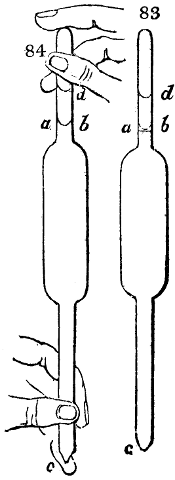
After having immersed the beak c of the pipette in the solution, we apply suction by the mouth, to the upper orifice, and thereby raise the liquid to d above the circular line a b. We next apply neatly the forefinger of one hand to this orifice, remove the pipette from the liquid, and seize it as represented in fig. 84. The mark a b being placed at the level of the eye, we make the surface of the solution become exactly a tangent to the plane a b. At the instant it becomes a tangent, we leave the beak c of the pipette open, by taking away the finger that had been applied to it, and without changing any thing else in the position of the hands, we empty it into the bottle which should receive the solution, taking care to remove it whenever the efflux has run out.
If after filling the pipette by suction, any one should find a difficulty in applying the forefinger fast enough to the upper orifice, without letting the liquid run down below the mark a b, he should remove the pipette from the solution with its top still closed with his tongue, then apply the middle finger of one of his hands to the lower orifice; after which he may withdraw his tongue, and apply the forefinger of the other hand to the orifice previously wiped. This mode of obtaining a measure of normal solution of sea salt is very simple, and requires no complex apparatus; but we shall indicate another manipulation still easier, and also more exact.
In this new process the pipette is filled from the top like a bottle, instead of being filled by suction, and it is moreover fixed. Fig. 85. represents the apparatus. D and D′ are two sockets separated by a stop cock R. The upper one, tapped interiorly, receives, by means of a cork stopper L, the tube T, which admits the solution of sea salt. The lower socket is cemented on to the pipette; it bears a small air-cock R′, and a screw plug V, which regulates a minute opening intended to let the air enter very slowly into the pipette. Below the stop-cock R′, a silver tube N, of narrow diameter, soldered to the socket, leads the solution into the pipette, by allowing the air, which it displaces, to escape by the stop-cock R′. The screw plug, with the milled head V′, replaces the ordinary screw by which the key of the stop-cock may be made to press, with more or less force, upon its conical seat.
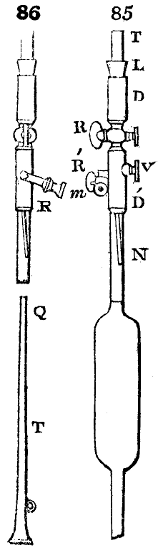
Fig. 86. represents, in a side view, the apparatus just described. We here remark an air-cock R, and an opening m. At the extremity Q of the same figure, the conical pipe T enters, with friction. It is by this pipe that the air is sucked into the pipette, when it is to be filled from its beak.
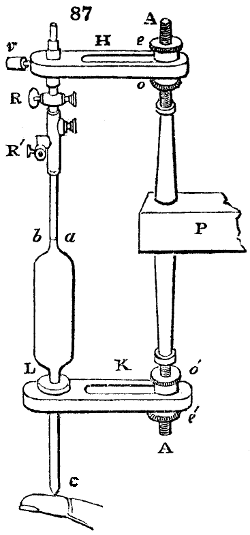
The pipette is supported by two horizontal arms H K (fig. 87.) moveable about a common axis A A, and capable of being drawn out or shortened by the aid of two longitudinal slits. They are fixed steadily by two screw nuts e e′, and their distance may be varied by means of round bits of wood or cork interposed, or even by opposite screw nuts o o′. The upper arm H is pierced with a hole, in which is fixed, by the pressure of a wooden screw v, the socket of the pipette. The corresponding hole of the lower arm is larger; and the beak of the pipette is supported in it by a cork stopper L. The apparatus is fixed by its tail-piece P, by means of a screw to the corner of a wall, or any other prop.
The manner of filling the pipette is very simple. We begin by applying the fore-finger of the left hand to the lower aperture c; we then open the two stop-cocks R and R′. Whenever the liquor approaches the neck of the pipette, we must temper its influx, and when it has arrived at some millimetres above the mark a b, we close the two stop-cocks, and remove our forefinger. We have now nothing more to do than to regulate the pipette; for which purpose the liquid must touch the line a b, and must simply adhere externally to the beak of the pipette.
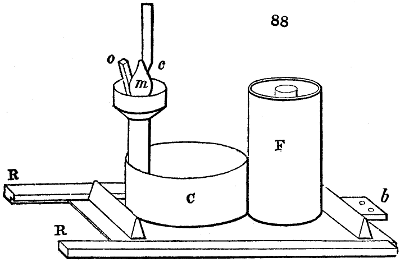
This last circumstance is easily adjusted. After taking away the finger which closed the aperture c of the pipette, we apply to this orifice a moist sponge m, fig. 88., wrapped up in a linen rag, to absorb the superfluous liquor as it drops out. This sponge is called the handkerchief (mouchoir), by M. Gay Lussac. The pipette is said to be wiped when there is no liquor adhering to its point exteriorly.
For the convenience of operating, the handkerchief is fixed by friction in a tube of tin plate, terminated by a cup, open at bottom to let the droppings flow off into the cistern C, to which the tube is soldered. It may be easily removed for the purpose of washing it; and, if necessary, a little wedge of wood, o, can raise it towards the pipette.
To complete the adjustment of the pipette, the liquid must be made merely to descend to the mark a, b. With this view, and whilst the handkerchief is applied to the beak of the pipette, the air must be allowed to enter very slowly by unscrewing the plug V, fig. 85.; and at the moment of the contact the handkerchief must be removed, and the bottle F, destined to receive the solution, must be placed below the orifice of the pipette, fig. 88. As the motion must be made rapidly, and without hesitation, the bottle is placed in a cylinder of tin-plate, of a diameter somewhat greater, and forming one body with the cistern and the handkerchief. The whole of this apparatus has for a basis a plate of tinned iron, moveable between two wooden rulers R R, one of which bears a groove, under which the edge of the plate slips. Its traverses are fixed by two abutments b b, placed so that when it is stopped by one of them, the beak of the pipette corresponds to the centre of the neck of the bottle, or is a tangent to the handkerchief. This arrangement, very convenient for wiping the pipette and emptying it, gives the apparatus sufficient solidity, and allows of its being taken away, and replaced without deranging any thing. It is obvious that it is of advantage, when once the entry of the air into the pipette has been regulated by the screw V, to leave it constantly open, because the motion from the handkerchief to the bottle is performed with sufficient rapidity to prevent a drop of the solution from collecting and falling down.

Temperature of the Solution.—After having described the manner of measuring by volume the normal solution of the sea salt, we shall indicate the most convenient means of taking the temperature. The thermometer is placed in a tube of glass T, fig. 89., which the solution traverses to arrive at the pipette. It is suspended in it by a piece of cork, grooved on the four sides to afford passage to the liquid. The scale is engraved upon the tube itself, and is repeated at the opposite side, to fix the eye by the coincidence of this double division at the level of the thermometric column. The tube is joined below to another narrower one, through which it is attached by means of a cork stopper B, in the socket of the stop-cock of the pipette. At its upper part it is cemented into a brass socket, screw-tapped in the inside, which is connected in its turn by a cock, with the extremity, also tapped, of the tube above T, belonging to the reservoir of the normal solution. The corks employed here as connecting links between the parts of the apparatus, give them a certain flexibility, and allow of their being dismounted and remounted in a very short time; but it is indispensable to make them be traversed by a hollow tube of glass or metal, which will hinder them from being crushed by the pressure they are exposed to. If the precaution be taken to grease them with a little suet and to fill their pores, they will suffer no leakage.
Preservation of the Normal Solution of Sea Salt in metallic Vessels.—M. Gay Lussac uses for this purpose a cylindrical vessel or drum of copper, of a capacity of about 110 litres, having its inside covered with a rosin and wax cement.
Preparation of the Normal Solution of Sea Salt, measuring it by Volume.—If the drum contains 110 litres, we should put only 105 into it, in order that sufficient space may be left for agitating the liquor without throwing it out. According to the principle that 100 centimetres cube, or 1⁄10 of a litre of the solution should contain enough of sea salt to precipitate a gramme of pure silver; and, admitting moreover, 13·516 for the prime equivalent of silver, and 7·335 for that of sea salt, we shall find the quantity of pure salt that should be dissolved in the 105 litres of water, and which corresponds to 105 × 10 = 1050 grammes of silver, to be by the following proportion:—
13·516 : 7·335 ∷ 1050 gramm. : x = 569·83 gr.
And as the solution of the sea salt of commerce, formerly mentioned, contains approximately 250 grammes per kilogramme, we must take 2279·3 grammes of this solution to have 569·83 gram. of salt. The mixture being perfectly made, the tubes and the pipette must be several times washed by running the solution through them, and putting it into the drum. The standard of the solution must be determined after it has been well agitated, supposing the temperature to remain uniform.
To arrive more conveniently at this result, we begin by preparing two decimes solutions; one of silver, and another of sea salt.
The decime solution of silver is obtained by dissolving 1 gramme of silver in nitric acid, and diluting the solution with water till its volume become a litre.
The decime solution of sea salt may be obtained by dissolving 0·543 grammes of pure sea salt in water, so that the solution shall occupy a litre; but we shall prepare it even with the normal solution which we wish to test, by mixing a measure of it with 9 measures of water; it being understood that this solution is not rigorously equivalent to that of silver, and that it will become so, only when the normal solution employed for its preparation shall be finally of the true standard. Lastly, we prepare beforehand several stoppered phials, in each of which we dissolve 1 gramme of silver in 8 or 10 grammes of nitric acid. For brevity’s sake we shall call these tests.
Now to investigate the standard of the normal solution, we must transfer a pipette of it into one of these test phials; and we must agitate the liquors briskly to clarify them. After some instants of repose, we must pour in 2 thousandths of the decime solution of sea salt, which, we suppose, will produce a precipitate. The normal liquor is consequently too feeble; and we should expect this, since the sea salt employed was not perfectly pure. We agitate and add 2 fresh thousandths, which will also produce a precipitate. We continue thus by successive additions of 2 thousandths, till the last produces no precipitation. Suppose that we have added 16 thousandths: the last two should not be reckoned, as they produced no precipitate; the preceding two were necessary, but only in part; that is to say, the useful thousandths added are above 12 and below 14, or otherwise they are on an average equal to 13.
Thus, in the condition of the normal solution, we require 1013 parts of it to precipitate one gramme of silver, while we should require only 1000. We shall find the quantity of concentrated solution of sea salt that we should add, by noting that the quantity of solution of sea salt, at first employed, viz. 2279·3 grammes, produced a standard of only 987 thousandths = 1000 - 13; and by using the following proportion:
987 : 2279·3 ∷ 13 : x = 30·02 grammes.
This quantity of the strong solution of salt, mixed with the normal solution in the drum, will correct its standard, and we shall now see by how much.
After having washed the tubes and the pipette, with the new solution, we must repeat the experiment upon a fresh gramme of silver. We shall find, for example, in proceeding only by a thousandth at a time, that the first causes a precipitate, but not the second. The standard of the solution is still too weak, and is comprised between 1000 and 1001; that is to say, it may be equal to 10001⁄2, but we must make a closer approximation.
We pour into the test bottle 2 thousandths of the decime solution of silver, which will destroy, perceptibly, two thousandths of sea salt, and the operation will have retrograded by two thousandths; that is to say, it will be brought back to the point at which it was first of all. If, after having cleared up the liquor, we add half a thousandth of the decime solution, there will necessarily be a precipitate, as we knew beforehand, but a second will cause no turbidity. The standard of the normal liquor will be consequently comprehended between 1000 and 10001⁄2, or equal to 10001⁄4.
We should rest content with this standard, but if we wish to correct it, we may remark that the two quantities of solution of salt added, viz. 2279·3 gr. + 30·02 gr. = 2309·32 gr. have produced only 999·75 thousandths, and that we must add a new quantity of it corresponding to 1⁄4 of a thousandth. We make, therefore, the proportion
999·75 : 2309·32 ∷ 0·25 : x.
But since the first term differs very little from 1000, we may content ourselves to have x by taking the 0·25⁄1000 of 2309·32, and we shall find 0·577 gr. for the quantity of solution of sea salt to be added to the normal solution.
It is not convenient to take exactly so small a quantity of solution of sea salt by the balance, but we shall succeed easily by the following process. We weigh 50 grammes of this solution, and we dilute it with water; so that it occupies exactly half a litre, or 500 centimetres cube. A pipette of this solution, one centimetre cube in volume, will give a decigramme of the primitive solution, and as such a small pipette is divided into twenty drops, each drop, for example, will represent 5 milligrammes of the solution. We should arrive at quantities smaller still by diluting the solution with a proper quantity of water; but greater precision would be entirely needless.
The testing of the normal liquor just described, is, in reality, less tedious than might be supposed. It deserves also to be remarked, that liquor has been prepared for more than 1000 assays; and that, in preparing a fresh quantity, we shall obtain directly its true standard, or nearly so, if we bear in mind the quantities of water and solution of salt which had been employed.
Correction of the Standard of the Normal Solution of Sea Salt, when the Temperature changes.—We have supposed, in determining the standard of the normal solution of sea salt, that the temperature remained uniform. The assays made in such circumstances, have no need of correction; but if the temperature should change, the same measure of the solution will not contain the same quantity of sea salt. Supposing that we have tested the solution of the salt at the temperature of 15° C.; if, at the time of making the experiment, the temperature is 18° C., for example, the solution will be too weak on account of its expansion, and the pipette will contain less of it by weight; if, on the contrary, the temperature has fallen to 12°, the solution will be thereby concentrated and will prove too strong. It is therefore proper to determine the correction necessary to be made, for any variation of temperature.
To ascertain this point, the temperature of the solution of sea salt was made successively to be 0°, 5°, 10°, 15°, 20°, 25°, and 30° C.; and three pipettes of the solution were weighed exactly at each of these temperatures. The third of these weighings gave the mean weight of a pipette. The corresponding weights of a pipette of the solution, were afterwards graphically interpolated from degree to degree. These weights form the second column of the following table, intitled, Table of Correction for the Variations in the Temperature of the Normal Solution of the Sea Salt. They enable us to correct any temperature between 0 and 30 degrees centigrade (32° and 86° Fahr.) when the solution of sea salt has been prepared in the same limits.
Let us suppose, for example, that the solution has been made standard at 15°, and that at the time of using it, the temperature has become 18°. We see by the second column of the table, that the weight of a measure of the solution is 100·099 gr. at 15°, and 100·065 at 18°; the difference 0·034 gr., is the quantity of solution less which has been really taken; and of course we must add it to the normal measure, in order to make it equal to one thousand millièmes. If the temperature of the solution had fallen to 10 degrees, the difference of the weight of a measure from 10 to 15 degrees would be 0·019 gr. which we must on the contrary deduct from the measure, since it had been taken too large. These differences of weight of a measure of solution at 15°, from that of a measure at any other temperature, form the column 15° of the table, where they are expressed in thousandths; they are inscribed on the same horizontal lines as the temperatures to which each of them relates with the sign + plus, when they must be added, and with the sign - minus, when they must be subtracted. The columns 5°, 10°, 20°, 25°, 35°, have been calculated in the same manner for the cases in which the normal solution may have been graduated to each of these temperatures. Thus, to calculate the column 10, the number 100·118 has been taken of the column of weights for a term of departure, and its difference from all the numbers of the same column has been sought.
Table of Correction for the Variations in the Temperature of the Normal Solution of the Sea Salt.
Tem- pera- ture. Weight. 5° 10° 15° 20° 25° 30°
gram. mill. mill. mill. mill. mill. mill.
4 100,109 0·0 - 0·1 + 0·1 + 0·7 + 1·7 + 2·7
5 100,113 0·0 - 0·1 + 0·1 + 0·7 + 1·7 + 2·8
6 100,115 0·0 0·0 + 0·2 + 0·8 + 1·7 + 2·8
7 110,118 + 0·1 0·0 + 0·2 + 0·8 + 1·7 + 2·8
8 100,120 + 0·1 0·0 + 0·2 + 0·8 + 1·8 + 2·8
9 100,120 + 0·1 0·0 + 0·2 + 0·8 + 1·8 + 2·8
10 100,118 + 0·1 0·0 + 0·2 + 0·8 + 1·7 + 2·8
11 100,116 0·0 0·0 + 0·2 + 0·8 + 1·7 + 2·8
12 100,114 0·0 0·0 + 0·2 + 0·8 + 1·7 + 2·8
13 100,110 0·0 - 0·1 + 0·1 + 0·7 + 1·7 + 2·7
14 100,106 - 0·1 - 0·1 + 0·1 + 0·7 + 1·6 + 2·7
15 100,099 - 0·1 - 0·2 - 0·0 + 0·6 + 1·6 + 2·6
16 100,090 - 0·2 - 0·3 - 0·1 + 0·5 + 1·5 + 2·5
17 100,078 - 0·4 - 0·4 - 0·2 + 0·4 + 1·3 + 2·4
18 100,065 - 0·5 - 0·5 - 0·3 + 0·3 + 1·2 + 2·3
19 100,053 - 0·6 - 0·7 - 0·5 + 0·1 + 1·1 + 2·2
20 100,039 - 0·7 - 0·8 - 0·6 0·0 + 1·0 + 2·0
21 100,021 - 0·9 - 1·0 - 0·8 - 0·2 + 0·8 + 1·9
22 100,001 - 1·1 - 1·2 - 1·0 - 0·4 + 0·6 + 1·7
23 99,983 - 1·3 - 1·4 - 1·2 - 0·6 + 0·4 + 1·5
24 99,964 - 1·5 - 1·5 - 1·4 - 0·8 + 0·2 + 1·3
25 99,944 - 1·7 - 1·7 - 1·6 - 1·0 0·0 + 1·1
26 99,924 - 1·9 - 1·9 - 1·8 - 1·2 - 0·2 + 0·9
27 99,902 - 2·1 - 2·2 - 2·0 - 1·4 - 0·4 + 0·7
28 99,879 - 2·3 - 2·4 - 2·2 - 1·6 - 0·7 + 0·4
29 99,858 - 2·6 - 2·6 - 2·4 - 1·8 - 0·9 + 0·2
30 99,836 - 2·8 - 2·8 - 2·6 - 2·0 - 1·1 0·0
Several expedients have been employed to facilitate and abridge the manipulations. In the first place, the phials for testing or assaying the specimens of silver should all be of the same height and of the same diameter. They should be numbered at their top, as well as on their stoppers, in the order 1, 2, 3, &c. They may be ranged successively in tens; the stoppers of the same series being placed on a support in their proper order. Each two phials should, in their turn, be placed in a japanned tin case (fig. 90.) with ten compartments duly numbered. These compartments are cut out anteriorly to about half their height, to allow the bottoms of the bottles to be seen. When each phial has received its portion of alloy, through a wide-beaked funnel, there must be poured into it about 10 grammes of nitric acid, of specific gravity 1·28, with a pipette, containing that quantity; it is then exposed to the heat of a water bath, in order to facilitate the solution of the alloy. The water bath is an oblong vessel made of tin plate, intended to receive the phials. It has a moveable double bottom, pierced with small holes, for the purpose of preventing the phials being broken, as it insulates them from the bottom to which the heat is applied. The solution is rapid; and, since it emits nitrous vapours in abundance, it ought to be carried on under a chimney.
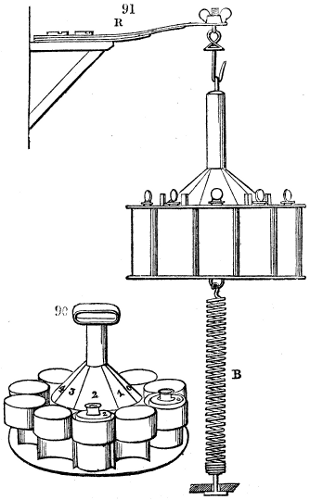
The agitator.—Fig. 91. gives a sufficiently exact idea of it, and may dispense with a lengthened description. It has ten cylindrical compartments, numbered from 1 to 10. The phials, after the solution of the alloy, are arranged in it in the order of their numbers. The agitator is then placed within reach of the pipette, intended to measure out the normal solution of sea salt, and a pipette full of this solution is put into each phial. Each is then closed with its glass stopper, previously dipped in pure water. They are fixed in the cells of the agitator by wooden wedges. The agitator is then suspended to a spring R, and, seizing it with the two hands, the operator gives an alternating rapid movement, which agitates the solution, and makes it, in less than a minute, as limpid as water. This movement is promoted by a spiral spring, B, fixed to the agitator and the ground; but this is seldom made use of, because it is convenient to be able to transport the agitator from one place to another. When the agitation is finished, the wedges are to be taken out, and the phials are placed in order upon a table furnished with round cells destined to receive them, and to screen them from too free a light.
When we place the phials upon this table, we must give them a brisk circular motion, to collect the chloride of silver scattered round their sides; we must lift out their stoppers, and suspend them in wire rings, or pincers. We next pour a thousandth of the decime solution into each phial; and before this operation is terminated, there is formed in the first phials, when there should be a precipitate, a nebulous stratum, very well marked, of about a centimetre in thickness.
At the back of the table there is a black board divided into compartments numbered from 1 to 10, upon each of which we mark, with chalk, the thousandths of the decime liquor put into the correspondent phial. The thousandths of sea salt, which indicate an augmentation of standard, are preceded by the sign +, and the thousandths of nitrate of silver by the sign -.
When the assays are finished, the liquor of each phial is to be poured into a large vessel, in which a slight excess of sea salt is kept; and when it is full, the supernatant clear liquid must be run off with a syphon.
The chloride of silver may be reduced without any perceptible loss. After having washed it well, we immerse pieces of iron or zinc into it, and add sulphuric acid in sufficient quantity to keep up a feeble disengagement of hydrogen gas. The mass must not be touched. In a few days the silver is completely reduced. This is easily recognised by the colour and nature of the product; or by treating a small quantity of it with water of ammonia, we shall see whether there be any chloride unreduced; for it will be dissolved by the ammonia, and will afterwards appear upon saturating the ammonia with an acid. The chlorine remains associated with the iron or the zinc in a state of solution. The first washings of the reduced silver must be made with an acidulous water, to dissolve the oxide of iron which may have been formed, and the other washings with common water. After decanting the water of the last washing, we dry the mass, and add a little powdered borax to it. It must be now fused. The silver being in a bulky powder is to be put in successive portions into a crucible as it sinks down. The heat should be at first moderate; but towards the end of the operation it must be pretty strong to bring into complete fusion the silver and the scoriæ, and to effect their complete separation. In case it should be supposed that the whole of the silver had not been reduced by the iron or zinc, a little carbonate of potash should be added to the borax. The silver may also be reduced by exposing the chloride to a strong heat, in contact with chalk and charcoal.
The following remarks by M. Gay Lussac, the author of the above method, upon the effect of a little mercury in the humid assay, are important:—
It is well known that chloride of silver blackens the more readily as it is exposed to an intense light, and that even in the diffused light of a room, it becomes soon sensibly coloured. If it contains four to five thousandths of mercury, it does not blacken; it remains of a dead white: with three thousandths of mercury, there is no marked discolouring in diffused light; with two thousandths it is slight; with one it is much more marked, but still it is much less intense than with pure chloride. With half a thousandth of mercury the difference of colour is not remarkable, and is perceived only in a very moderate light.
But when the quantity of mercury is so small that it cannot be detected by the difference of colour in the chloride of silver, it may be rendered quite evident by a very simple process of concentration. Dissolve one gramme of the silver supposed to contain 1⁄4 of a thousandth of mercury, and let only 1⁄4 of it be precipitated, by adding only 1⁄4 of the common salt necessary to precipitate it entirely. In thus operating, the 1⁄4 thousandth of mercury is concentrated in a quantity of chloride of silver four times smaller: it is as if the silver having been entirely precipitated, four times as much mercury, equal to two thousandths, had been precipitated with it.
In taking two grammes of silver, and precipitating only 1⁄4 by common salt, the precipitate would be, with respect to the chloride of silver, as if it amounted to four thousandths. By this process, which occupies only five minutes, because exact weighing is not necessary, 1⁄10 of a thousandth of mercury may be detected in silver.
It is not useless to observe, that in making those experiments the most exact manner of introducing small quantities of mercury into a solution of silver, is to weigh a minute globule of mercury, and to dissolve it in nitric acid, diluting the solution so that it may contain as many cubic centimetres as the globule weighs of centigrammes. Each cubic centimetre, taken by means of a pipette, will contain one milligramme of mercury.
If the ingot of silver to be assayed is found to contain a greater quantity of mercury, one thousandth for example, the humid process ought either to be given up in this case, or to be compared with cupellation.
When the silver contains mercury, the solution from which the mixed chlorides are precipitated, does not readily become clear.
Silver containing mercury, put into a small crucible and mixed with lamp black, to prevent the volatilization of the silver, was heated for three quarters of an hour in a muffle, but the silver increased sensibly in weight. This process for separating the mercury, therefore, failed. It is to be observed, that mercury is the only metal which has thus the power of disturbing the analysis by the humid way.
Assaying of Gold.—In estimating or expressing the fineness of gold, the whole mass spoken of is supposed to weigh 24 carats of 12 grains each, either real, or merely proportional, like the assayer’s weights; and the pure gold is called fine. Thus, if gold be said to be 23 carats fine, it is to be understood, that in a mass, weighing 24 carats, the quantity of pure gold amounts to 23 carats.
In such small work as cannot be assayed by scraping off a part and cupelling it, the assayers endeavour to ascertain its fineness or quality by the touch. This is a method of comparing the colour and other properties, of a minute portion of the metal, with those of small bars, the composition of which is known. These bars are called touch needles, and they are rubbed upon a smooth piece of black basaltes or pottery, which, for this reason, is called the touchstone. Black flint slate will serve the same purpose. Sets of gold needles may consist of pure gold; of pure gold, 231⁄2 carats with 1⁄2 carat of silver; 23 carats of gold with one carat of silver; 221⁄2 carats of gold with 11⁄2 carat of silver; and so on, till the silver amounts to four carats; after which the additions may proceed by whole carats. Other needles may be made in the same manner, with copper instead of silver; and other sets may have the addition, consisting either of equal parts of silver and copper, or of such proportions as the occasions of business require. The examination by the touch may be advantageously employed previous to quartation, to indicate the quantity of silver necessary to be added.
In foreign countries, where trinkets and small work are required to be submitted to the assay of the touch, a variety of needles is necessary; but they are not much used in England. They afford, however, a degree of information which is more considerable than might at first be expected. The attentive assayer compares not only the colour of the stroke made upon the touchstone by the metal under examination, with that produced by his needle, but will likewise attend to the sensation of roughness, dryness, smoothness, or greasiness, which the texture of the rubbed metal excites, when abraded by the stone. When two strokes perfectly alike in colour are made upon the stone, he may then wet them with aquafortis, which will affect them very differently, if they be not similar compositions; or the stone itself may be made red-hot by the fire, or by the blowpipe, if thin black pottery be used; in which case the phenomena of oxidation will differ, according to the nature and quantity of the alloy. Six principal circumstances appear to affect the operation of parting; namely, the quantity of acid used in parting, or in the first boiling; the concentration of this acid; the time employed in its application; the quantity of acid made use of in the reprise, or second operation; its concentration; and the time during which it is applied. From experiment it has been shown, that each of these unfavourable circumstances might easily occasion a loss of from the half of a thirty-second part of a carat, to two thirty-second parts. The assayers explain their technical language by observing, that in the whole mass consisting of twenty-four carats, this thirty-second part denotes 1-768th part of the mass. It may easily be conceived, therefore, that if the whole six circumstances were to exist, and be productive of errors, falling the same way, the loss would be very considerable.