M. (continued 3)
Reading edition
Figs. 689, 690, 691. represent the reverberatory furnace generally employed in the Hartz, in the district of Mansfeldt, Saxony, Hungary, &c., for the treatment of black copper, and for refining rose copper upon the great scale. An analogous furnace is used at Andreasberg for the liquefaction or purification of the mattes, and for workable lead when it is much loaded with arsenic.
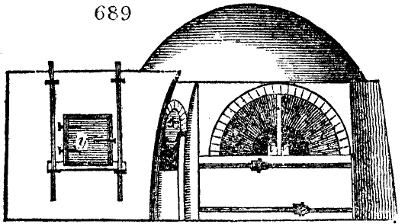
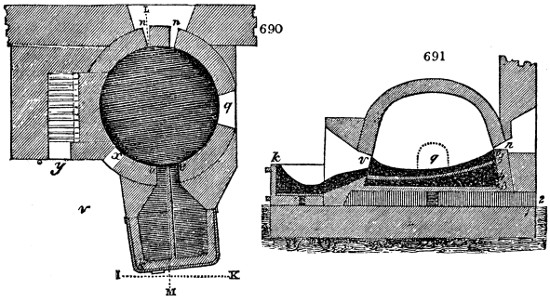
Fig. 689. presents the elevation of the furnace parallel to the line I K, of the plan fig. 690.; which plan is taken at the level of the tuyère n, of fig. 691.; fig. 691. is a vertical section in the line L M, fig. 690. k represents one of two basins of reception, brasqued with clay and charcoal; n, n, two tuyères, through which enters the blast of two pairs of bellows, like those shown at Cupellation of Silver; q, door by which the matter to be melted is laid upon the sole of the furnace; v, v, two points where the sole is perforated, when necessary to run off the melted matter into either of the basins h; x, door through which the slags or cinders floating upon the surface of the melted metal are raked out; y, door of the fire-place. The fuel is laid upon a grate above an ash-pit, and below the arch of a reverberatory which is contiguous to the dome or cap of the furnace properly so called. In the section, fig. 691., the following parts may be noted: 1, 2, 3, mason-work of the foundation; 4, vapour channels or conduits, for the escape of the humidity; 5, bed of clay; 6, brasque composed of clay and charcoal, which forms the concavity of the hearth.
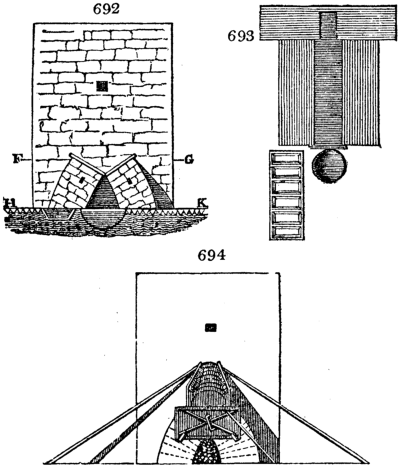
Figs. 692, 693, 694., show the furnace employed for liquation in one of the principal smelting works of the Hartz. Fig. 694. exhibits the working area charged with the liquation cakes and charcoal, supported by sheets of wrought iron; being an image of the process in action. Fig. 693. is the plan, in the line F, G, of fig. 692.
A liquation cake is composed of—
Black copper holding at least 5 or 6 loths (21⁄2 or 3 oz.) of silver per cwt., and weighing 90 to 96 lbs.
Lead obtained from litharge, 2 cwts. Litharge, 1⁄2 cwt.
From 30 to 32 cakes are successively worked in one operation, which lasts about 5 hours; the furnace is brought into action, as usual, with the aid of slags; then a little litharge is added; when the lead begins to flow, the copper is introduced, and when the copper flows, lead is added, so that the mixture of the metals may be effected in the best way possible.
From 8 to 16 of these cakes (pains) are usually placed in the liquation furnace, figs. 692, 693, 694. The operation lasts 3 or 4 hours, in which time about 11⁄2 quintals of charcoal are consumed. The cakes are covered with burning charcoal, supported, as I have said, by the iron plates. The workable lead obtained flows off towards the basin in front of the furnace; whence it is laded out into moulds set alongside. See fig. 693. If the lead thus obtained be not sufficiently rich in silver to be worth cupellation, it is employed to form new liquation cakes. When it contains from 5 to 6 loths of silver per cwt., it is submitted to cupellation in the said smelting works. See Silver.
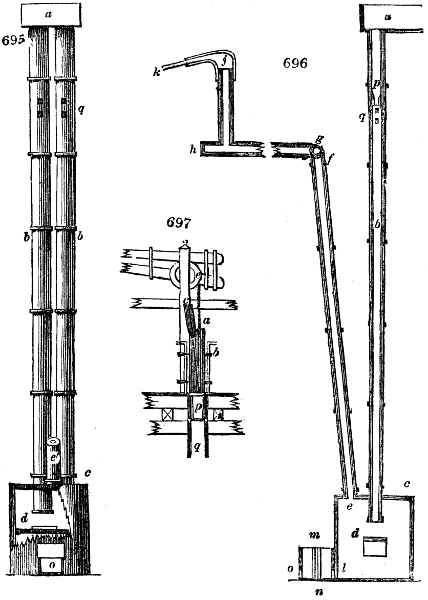
The trompe, or water-blowing engine, figs. 695, 696, 697. Fig. 695. is the elevation; fig. 696. is a vertical section, made at right angles to the elevation. The machine is formed of two cylindrical pipes, the bodies of the trompe b b, set upright, called the funnels, which terminate above in a water cistern a, and below in a close basin under c, called the tub or drum. The conical part p, of the funnel has been called etranguillon, being strangled, as it were, in order that the water discharged into the body of the trompe shall not fill the pipe in falling, but be divided into many streamlets. Below this narrow part, eight holes, q q, are perforated obliquely through the substance of the trompe, called the vent-holes or nostrils, for admitting the air, which the water carries with it in its descent. The air afterwards parts from the water, by dashing upon a cast-iron slab, placed in the drum upon the pedestal d. An aperture l, at the bottom of the drum, allows the water to flow away after its fall; but, to prevent the air from escaping along with it, the water as it issues is received in a chest l m o n, divided into two parts by a vertical slide-plate between m n. By raising or lowering this plate, the water may be maintained at any desired level within the drum, so as to give the included air any determinate degree of pressure. The superfluous water then flows off by the hole o.
The air-pipe e f, fig. 696., is fitted to the upper part of the drum; it is divided, at the point f, into three tubes, of which the principal one is destined for the furnace of cupellation, whilst the other two g g, serve for different melting furnaces. Each of these tubes ends in a leather pocket, and an iron nose-pipe k, adjusted in the tuyère of the furnace. At Pesey, and in the whole of Savoy, a floodgate is fitted into the upper cistern a, to regulate the admission of water into the trome; but in Carniola, the funnel p is closed with a wooden plug, suspended to a cord, which goes round a pulley mounted upon a horizontal axis, as shewn in fig. 697. By the plug a being raised more or less, merely the quantity of water required for the operation is admitted. The plug is pierced lengthwise with an oblique hole c c, in which the small tube c is inserted, with its top some way above the water level, through which air may be admitted into the heart of the column descending into the trompe p q.
The ordinary height of the trompe apparatus is about 26 or 27 feet to the upper level of the water cistern; its total length is 11 mètres (36 feet 6 inches), and its width 2 feet, to give room for the drums. It is situated 10 mètres (331⁄3 feet) from the melting furnace. This is the case at the smelting works of Jauerberg, in Upper Carniola.
OF THE ASSAY OF ORES.
Assays ought to occupy an important place in metallurgic instructions, and there is reason to believe that the knowledge of assaying is not sufficiently diffused, since its practice is so often neglected in smelting houses. Not only ought the assays of the ores under treatment, to be frequently repeated, because their nature is subject to vary; but the different products of the furnaces should be subjected to reiterated assays, at the several periods of the operations. When silver or gold ores are in question, the docimastic operations, then indispensable, exercise a salutary controul over the metallurgic processes, and afford a clear indication of the quantities of precious metal which they ought to produce.
By the title Assays, in a metallurgic point of view, is meant the method of ascertaining for any substance whatever, not only the presence and the nature of a metal, but its proportional quantity. Hence the operations which do not lead to a precise determination of the metal in question, are not to be arranged among the assays now under consideration. Experiments made with the blow-pipe, although capable of yielding most useful indications, are like the touchstone in regard to gold, and do not constitute genuine assays.
Three kinds of assays may be practised in different circumstances, and with more or less advantage upon different ores. 1. The mechanical assay; 2. the assay by the dry way; 3. the assay by the humid way.
1. Of mechanical assays.—These kinds of assays consist in the separation of the substances mechanically mixed in the ores, and are performed by a hand-washing, in a small trough of an oblong shape, called a sebilla. After pulverizing with more or less pains the matters to be assayed by this process, a determinate weight of them is put into this wooden bowl with a little water; and by means of certain movements and some precautions, to be learned only by practice, the lightest substances may be pretty exactly separated, namely, the earthy gangues from the denser matter or metallic particles, without losing any sensible portion of them. Thus a schlich of greater or less purity will be obtained, which may afford the means of judging by its quality of the richness of the assayed ores, and which may thereafter be subjected to assays of another kind, whereby the whole metal may be insulated.
Washing, as an assay, is practised on auriferous sands; on all ores from the stamps, and even on schlichs already washed upon the great scale, to appreciate more nicely the degree of purity they have acquired. The ores of tin in which the oxide is often disseminated in much earthy gangue, are well adapted to this species of assay, because the tin oxide is very dense. The mechanical assay may also be employed in reference to the ores whose metallic portion presents an uniform composition, provided it also possesses considerable specific gravity. Thus the ores of sulphuret of lead (galena) being susceptible of becoming almost pure sulphurets (within 1 or 2 per cent.) by mere washing skilfully conducted, the richness of that ore in pure galena, and consequently in lead, may be at once concluded; since 120 of galena contain 104 of lead, and 16 of sulphur. The sulphuret of antimony mingled with its gangue may be subjected to the same mode of assay, and the result will be still more direct, since the crude antimony is brought into the market after being freed from its gangue by a simple fusion.
The assay by washing is also had recourse to for ascertaining if the scoriæ or other products of the furnaces contain some metallic grains which might be extracted from them by stamping and washing on the great scale; a process employed considerably with the scoriæ of tin and copper works.
Of assays by the dry way.—The assay by the dry way has for its object, to show the nature and proportion of the metals contained in a mineral substance. To make a good assay, however, it is indispensably necessary to know what is the metal associated with it, and even within certain limits, the quantity of the foreign bodies. Only one metal is commonly looked after; unless in the case of certain argentiferous ores. The mineralogical examination of the substances under treatment, is most commonly sufficient to afford data in these respects; but the assays may always be varied with different views, before stopping at a definite result; and in every instance, only such assays can be confided in, as have been verified by a double operation.
This mode of assaying requires only a little experience, with a simple apparatus; and is of such a nature as to be practised currently in the smelting works. The air furnace and crucibles employed are described in all good elementary chemical books. These assays are usually performed with the addition of a flux to the ore, or some agent for separating the earthy from the metallic substances; and they possess a peculiar advantage relative to the smelting operations, because they offer many analogies between results on the great scale and experiments on the small. This may even enable us often to deduce, from the manner in which the assay has succeeded with a certain flux, and at a certain degree of heat, valuable indications as to the treatment of the ore in the great way. See Furnace.
In the smelting houses which purchase the ore, as in Germany, it is necessary to bestow much attention upon the assays, because they serve to regulate the quality and the price of the schlichs to be delivered. These assays are not by any means free from difficulties, especially when ores containing several useful metals are treated, and which are to be dosed or proportioned; ores, for example, including a notable quantity of lead, copper, and silver, mixed together.
In the central works of the Hartz, as well as in those of Saxony, the schlichs as delivered are subjected to docimastic assays, which are verified three times, and by three different persons, one of whom is engaged for the interests of the mining partners, another for that of the smelting house, and a third as arbiter in case of a difference. If the first two results of assaying differ by 1⁄2 loth (or 1⁄4 ounce) of silver per cwt. of schlich, the operations must be resumed; but this rarely happens. When out of the three assays, the one differs from the two others by no more than 1⁄4 loth of silver per cwt., but by more in one, and by less in another, the mean result is adopted. As to the contents of the schlich in lead, the mean results of the assays must be taken. The differences allowed, are three pounds for the schlich, when it contains from 12 to 30 per cent. of lead, increasing to six pounds for schlich, when it contains less than 55 per cent. of that metal.
Assaying forms in great establishments, an important object in reference to time and expense. Thus, in the single work of Franckenscharn, in the Hartz, no less than 300 assays have to be made in a threefold way, every Monday, without taking into account the several assays of the smelting products which take place every Thursday. Formerly fluxes more or less compound were employed for these purposes, and every assay cost about fifteen pence. At present all these assays are made more simply, by much cheaper methods, and cost a penny farthing each upon an average.
Of the assays by the humid way.—The assays by the humid way, not reducible to very simple processes, are true chemical analyses, which may in fact be applied with much advantage, either to ores, or to the products of the furnace; but which cannot be expected to be practised in smelting-houses, on account of the complication of apparatus and reagents they require. Moreover, an expert chemist is necessary to obtain results that can be depended on. The directors of smelting-houses, however, should never neglect any opportunities that may occur of submitting the materials operated upon, as well as their products, to a more thorough examination than the dry way alone can effect. One of the great advantages of similar researches is, to discover and appreciate the minute quantities of injurious substances which impair the malleability of the metals, which give them several bad qualities, about whose nature and cause, more or less error and uncertainty prevail. Chemical analysis, rightly applied to metallurgy, cannot fail to introduce remarkable improvements into the processes.—See the different metals, in their alphabetical places.
For assays in the dry way, both of stony and metallic minerals, the process of Dr. Abich deserves recommendation. In consists in mixing the pulverized mineral with 4 or 6 times its weight of carbonate of baryta in powder, fusing the mixture at a white heat, and then dissolving it after it cools, in dilute muriatic acid. The most refractory minerals, even corundum, cyanite, staurolite, zircon, and felspar, yield readily to this treatment. This process may be employed with advantage upon poor refractory ores. The platinum crucible, into which the mixed materials are put for fusion, should be placed in a Hessian crucible, and surrounded with good coak.
The following tabular view of the metallic produce of the British mines, is given by two very skilful observers, in a work published in 1827, entitled Voyage Metallurgique en Angleterre, par MM. Dufrénoy et Elie de Beaumont:—
Tons. Tons.
Tin Cornwall alone 3,160
Copper - Cornwall 9,331 - 11,469
Devonshire 537
Staffordshire 38
Anglesey 738
Wales 55
Cumberland 21
Ireland 738
Scotland 11
Lead - Wales 7,500 - 31,900
Scotland 2,800
Cornwall and Devonshire 800
Shropshire 800
Derbyshire 1,000
Cumberland 19,000
Cast Iron about 600,000 [32]
The manganese raised in England exceeds 2000 tons.
M. Heron de Villefosse inserted in the last number of the Annales des Mines for 1827, the following statistical view of the metallic products of France:—
Tons.
Lead in pigs (saumons) 103
Litharge 513
Sulphuret of lead, ground galena (alquifoux) 112
Black copper 164
Antimony 91
Manganese 765
Crude cast iron 25,606
Bar iron 127,643
Steel 3,500
Silver in ingots 1 1⁄6
The total value of which is estimated at 80 millions of francs; or about 3,400,000 pounds sterling.
METALS; (Metaux, Fr.; Metalle, Germ.) are by far the most numerous class of undecompounded bodies in chemical arrangements. They amount to 41; of which 7 form, with oxygen, bodies possessed of alkaline properties; these are, 1. potassium; 2. sodium; 3. lithium; 4. barytium, or barium; 5. strontium; 6. calcium; 7. magnesium; for even magnesia, the last and feeblest base, tinges turmeric brown, and red cabbage green. The next 5 metals form, with oxygen, the earths proper; they are, 8. yttrium; 9. glucinum; 10. alumium; 11. zirconium; 12. thorinum. The remaining 29 may be enumerated in alphabetical order, as they hardly admit of being grouped into subdivisions with any advantage. They are as follows: 13. antimony; 14. arsenic; 15. bismuth; 16. cadmium; 17. cerium; 18. chromium; 19. cobalt; 20. copper; 21. gold; 22. iridium; 23. iron; 24. lead; 25. manganese; 26. mercury; 27. molybdenum; 28. nickel; 29. osmium; 30. palladium; 31. platinum; 32. rhodium; 33. silver; 34. tantalum; 35. tellurium; 36. tin; 37. titanium; 38. tungstenium; 39. vanadium; 40. uranium; 41. zinc.
1. They are all, more or less, remarkable for a peculiar lustre, called the metallic. This property of strongly reflecting light, is connected with a certain state of aggregation of their particles, but is possessed, superficially at least, by mica, animal charcoal, selenium, polished indigo;—bodies not at all metallic.
2. The metals are excellent conductors of caloric, and most of them also of electricity, though probably not all. According to Despretz, they possess the power of conducting heat according to the following numbers:—Gold, 1000; platinum, 981; silver, 973; copper, 898; iron, 374; zinc, 363; tin, 304; lead, 179·6.
Becquerel gives the following table of metals, as to electrical conduction:—
Copper, 100; gold, 93·6; silver, 73·6; zinc, 28·5; platina, 16·4; iron, 15·8; tin, 15·5; lead, 8·3; mercury, 3·5; potassium, 1·33.
The metals which hardly, if at all, conduct electricity, are, zirconium; alumium; tantalum, in powder; and tellurium.
3. Metals are probably opaque; yet gold leaf, as observed by Newton, seems to transmit the green rays, for objects placed behind it in the sunbeam appear green. This phenomena has, however, been ascribed to the rays of light passing through an infinite number of minute fissures in the thinly hammered gold.
4. All metals are capable of combining with oxygen, but with affinities and in quantities extremely different. Potassium and sodium have the strongest affinity for it; arsenic and chromium, the feeblest. Many metals become acids by a sufficient dose of oxygen, while, with a smaller dose, they constitute salifiable bases.
5. Metals combine with each other, forming a class of bodies called alloys, except when one of them is mercury, in which case the compound is styled an amalgam.
6. They combine with hydrogen into hydrurets; with carbon, into carburets; with sulphur, into sulphurets; with phosphorus, into phosphurets; with selenium, into seleniurets; with boron, into borurets (borides?); with chlorine, into chlorides; with iodine, into iodides; with cyanogen, into cyanides; with silicon, into silicides; and with fluorine, into fluorides.
7. Metallic salts are definite compounds, mostly crystalline, of the metallic oxides with the acids. See Haloid.
METEORITES, (Aerolithes, Fr.), are stones of a peculiar aspect and composition, which have fallen from the air.
METHYLÈNE, a peculiar liquid compound of carbon and hydrogen, extracted from pyroxilic spirit, which is reckoned to be a bi-hydrate of methylène.
MICA, is a finely foliated mineral, of a pearly metallic lustre. It is harder than gypsum, but not so hard as calc-spar; flexible and elastic; spec. grav. 2·65. It is an ingredient of granite and gneiss. The large sheets of mica exposed for sale in London, are mostly brought from Siberia. They are used, instead of glass, to enclose the fire, without concealing the flame, in certain stoves.
The mica of Fahlun, analyzed by Rose, afforded, silica, 46·22; alumina, 34·52; peroxide? of iron, 6·04; potash, 8·22; magnesia, with oxide of manganese, 2·11; fluoric acid, 1·09; water, 0·98.
MICROCOSMIC SALT; a term given to a salt extracted from human urine, because man was regarded by the alchemists as a miniature of the world, or the microcosm. It is a phosphate of soda and ammonia; and is now prepared by mixing, equivalent proportions of phosphate of soda and phosphate of ammonia, each in solution, evaporating and crystallizing the mixture. A small excess of ammonia aids the crystallization.
MILK; (Lait, Fr.; Milche, Germ.) owes its whiteness and opacity to an emulsion composed of the caseous matter and butter, with sugar of milk, extractive matters, salts, and free lactic acid; the latter of which causes fresh milk to redden litmus paper. Milk, in general, contains from 10 to 12 per cent. of solid matter, on being evaporated to dryness by a steam heat. The mean specific gravity of cows’ milk is 1·030, but it is less if the milk be rich in cream. The specific gravity of the skimmed milk is 1·035; and of the cream is 1·0244. 100 parts of creamed milk, contain—
Caseous matter, containing some butter, 2 ·600
Sugar of milk 3 ·500
Alcoholic extract, lactic acid, and lactates 0 ·600
Salts; muriate and phosphate of potash, and phosphate of lime 0 ·420
Water 92 ·875
Cream consists of,—Butter separated by churning 4 ·5
Caseous matter precipitated by the coagulation of the milk of the butter 3 ·5
Butter-milk 92 ·0
100 ·0
When milk contained in wire-corked bottles, is heated to the boiling point in a water bath, the oxygen of the included small portion of air under the cork seems to be carbonated, and the milk will afterwards keep fresh, it is said, for a year or two; as green gooseberries and peas do by the same treatment.
MILL-STONE, or Buhr-Stone. This interesting form of silica, which occurs in great masses, has a texture essentially cellular, the cells being irregular in number, shape, and size, and are often crossed by thin plates, or coarse fibres of silex. The Buhr-stone has a straight fracture, but it is not so brittle as flint, though its hardness is nearly the same. It is feebly translucent; its colours are pale and dead, of a whitish, grayish, or yellowish cast, sometimes with a tinge of blue.
The Buhr-stones usually occur in beds, which are sometimes continuous, and at others interrupted. These beds are placed amid deposits of sand, or argillaceous and ferruginous marls, which penetrate between them, filling their fissures and honeycomb cavities. Buhr-stones constitute a very rare geological formation, being found in abundance only in the mineral basin of Paris, and a few adjoining districts. Its place of superposition is well ascertained: it forms a part of the lacustrine, or fresh-water formation, which, in the locality alluded to, lies above the fossil-bone gypsum, and the stratum of sand and marine sandstone which cover it. Buhr-stone constitutes, therefore, the uppermost solid stratum of the crust of the globe; for above it there is nothing but alluvial soil, or diluvial gravel, sand, and loam.
Buhr-stones sometimes contain no organic forms, at others they seem as if stuffed full of fresh-water shells, or land shells and vegetables of inland growth. There is no exception known to this arrangement; but the shells have assumed a siliceous nature, and their cavities are often bedecked with crystals of quartz. The best Buhr-stones for grinding corn, have about an equal proportion of solid matter, and of vacant space. The finest quarry of them is upon the high ground, near La Ferté-sous-Jouarre. The stones are quarried in the open air, and are cut out in cylinders, from one to two yards in diameter, by a series of iron and wooden wedges, gradually but equally inserted. The pieces of buhr-stones are afterwards cut into parallelopipeds, called panes, which are bound with iron hoops into large millstones. These pieces are exported chiefly to England and America. Good millstones of a bluish white colour, with a regular proportion of cells, when six feet and a half in diameter, fetch 1200 francs a-piece, or 48l. sterling. A coarse conglomerate sandstone or breccia is, in some cases, used as a substitute for buhr-stones; but it is a poor one.
MINERAL WATERS. See Soda Water, and Waters, Mineral.
MINES; (Bergwerke, Germ.) Amidst the variety of bodies apparently infinite, which compose the crust of the globe, geologists have demonstrated the prevalence of a few general systems of rocks, to which they have given the name of formations or deposits. A large proportion of these mineral systems consists of parallel planes, whose length and breadth greatly exceed their thickness; on which account they are called stratified rocks; others occur in very thick blocks, without any parallel stratification, or horizontal seams of considerable extent.
The stratiform deposits are subdivided into two great classes; the primary and the secondary. The former seem to have been called into existence before the creation of organic matter, because they contain no exuviæ of vegetable or animal beings; while the latter are more or less interspersed, and sometimes replete with organic remains. The primary strata are characterized, moreover, by the nearly vertical or highly inclined position of their planes; the secondary lie for the most part in a nearly horizontal position.
Where the primitive mountains graduate down into the plains, rocks of an intermediate character appear, which, though possessing a nearly vertical position, contain a few vestiges of animal beings, especially shells. These have been called transition, to indicate their being the passing links between the first and second systems of ancient deposits; they are distinguished by the fractured and cemented texture of their planes, for which reason they are sometimes called conglomerate.
Between these and the truly secondary rocks, another very valuable series is interposed in certain districts of the globe; namely, the coal-measures, the paramount formation of Great Britain. The coal strata are disposed in a basin-form, and alternate with parallel beds of sandstone, slate-clay, iron-stone, and occasionally limestone. Some geologists have called the coal-measures the medial formation.
In every mineral plane, the inclination and direction are to be noted; the former being the angle which it forms with the horizon, the latter the point of the azimuth or horizon, towards which it dips, as west, north-east, south, &c. The direction of the bed is that of a horizontal line drawn in its plane; and which is also denoted by the point of the compass. Since the lines of direction and inclination are at right angles to each other, the first may always be inferred from the second; for when a stratum is said to dip to the east or west, this implies that its direction is north and south.
The smaller sinuosities of the bed are not taken into account, just as the windings of a river are neglected in stating the line of its course.
Masses are mineral deposits, not extensively spread in parallel planes, but irregular heaps, rounded or oval, enveloped in whole or in a great measure by rocks of a different kind. Lenticular masses being frequently placed between two horizontal or inclined strata, have been sometimes supposed to be stratiform themselves, and have been accordingly denominated by the Germans liegende stocke, lying heaps or blocks.
The orbicular masses often occur in the interior of unstratified mountains, or in the bosom of one bed.
Nests, concretions, nodules, are small masses found in the middle of strata; the first being commonly in a friable state; the second often kidney-shaped, or tuberous; the third nearly round, and encrusted, like the kernel of an almond.
Lodes, or large veins, are flattened masses, with their opposite surfaces not parallel, which consequently terminate like a wedge, at a greater or less distance, and do not run parallel with the rocky strata in which they lie, but cross them in a direction not far from the perpendicular; often traversing several different mineral planes. The lodes are sometimes deranged in their course, so as to pursue for a little way the space between two contiguous strata; at other times they divide into several branches. The matter which fills the lodes is for the most part entirely different from the rocks they pass through, or at least it possesses peculiar features.
This mode of existence, exhibited by several mineral substances, but which has been long known with regard to metallic ores, suggests the idea of clefts or rents having been made in the stratum posterior to its consolidation, and of the vacuities having been filled with foreign matter, either immediately or after a certain interval. There can be no doubt as to the justness of the first part of the proposition, for there may be observed round many lodes undeniable proofs of the movement or dislocation of the rock; for example, upon each side of the rent, the same strata are no longer situated in the same plane as before, but make greater or smaller angles with it; or the stratum upon one side of the lode is raised considerably above, or depressed considerably below, its counterpart upon the other side. With regard to the manner in which the rent has been filled, different opinions may be entertained. In the lodes which are widest near the surface of the ground, and graduate into a thin wedge below, the foreign matter would seem to have been introduced as into a funnel at the top, and to have carried along with it in its fluid state portions of rounded gravel and organic remains. In other cases, other conceptions seem to be more probable; since many lodes are largest at their under part, and become progressively narrower as they approach the surface; from which circumstance, it has been inferred that the rent has been caused by an expansive force acting from within the earth, and that the foreign matter, having been injected in a fluid state, has afterwards slowly crystallized. This hypothesis accounts much better than the other for most of the phenomena observable in mineral veins, for the alterations of the rock at their sides, for the crystallization of the different substances interspersed in them, for the cavities bestudded with little crystals, and for many minute peculiarities. Thus, the large crystals of certain substances which line the walls of hollow veins, have sometimes their under surfaces besprinkled with small crystals of sulphurets, arseniurets, &c., while their upper surfaces are quite smooth; suggesting the idea of a slow sublimation of these volatile matters from below, by the residual heat, and their condensation upon the under faces of the crystalline bodies, already cooled. This phenomenon affords a strong indication of the igneous origin of metalliferous veins.
In the lodes, the principal matters which fill them are to be distinguished from the accessory substances; the latter being distributed irregularly, amidst the mass of the first, in crystals, nodules, grains, seams, &c. The non-metalliferous exterior portion, which is often the largest, is called gangue, from the German gang, vein. The position of a vein is denoted, like that of the strata, by the angle of inclination, and the point of the horizon towards which they dip, whence the direction is deduced.
Veins, are merely small lodes, which sometimes traverse the great ones, ramifying in various directions, and in different degrees of tenuity.
A metalliferous substance is said to be disseminated, when it is dispersed in crystals, spangles, scales, globules, &c., through a large mineral mass.
Certain ores which contain the metals most indispensable to human necessities, have been treasured up by the Creator in very bountiful deposits; constituting either great masses in rocks of different kinds, or distributed in lodes, veins, nests, concretions, or beds with stony and earthy admixtures; the whole of which become the objects of mineral exploration. These precious stores occur in different stages of the geological formations; but their main portion, after having existed abundantly in the several orders of the primary strata, suddenly cease to be found towards the middle of the secondary. Iron ores are the only ones which continue among the more modern deposits, even so high as the beds immediately beneath the chalk, when they also disappear, or exist merely as colouring matters of the tertiary earthy beds.
The strata of gneiss and mica-slate constitute in Europe the grand metallic domain. There is hardly any kind of ore which does not occur there in sufficient abundance to become the object of mining operations, and many are found no where else. The transition rocks and the lower part of the secondary ones, are not so rich, neither do they contain the same variety of ores. But this order of things, which is presented by Great Britain, Germany, France, Sweden, and Norway, is far from forming a general law; since in equinoxial America the gneiss is but little metalliferous; while the superior strata, such as the clay-schists, the sienitic porphyries, the limestones, which complete the transition series, as also several secondary deposits, include the greater portion of the immense mineral wealth of that region of the globe.
All the substances of which the ordinary metals form the basis, are not equally abundant in nature; a great proportion of the numerous mineral species which figure in our classifications, are mere varieties scattered up and down in the cavities of the great masses or lodes. The workable ores are few in number, being mostly sulphurets, some oxides, and carbonates. These occasionally form of themselves very large masses, but more frequently they are blended with lumps of quartz felspar, and carbonate of lime, which form the main body of the deposit; as happens always in proper lodes. The ores in that case are arranged in small layers parallel to the strata of the formation, or in small veins which traverse the rock in all directions, or in nests or concretions stationed irregularly, or finally disseminated in hardly visible particles. These deposits sometimes contain apparently only one species of ore, sometimes several, which must be mined together, as they seem to be of contemporaneous formation; whilst, in other cases, they are separable, having been probably formed at different epochs. In treating of the several metals in their alphabetical order, I have taken care to describe their peculiar geological positions, and the rocks which accompany or mineralize them.
In mining, as in architecture, the best method of imparting instruction is to display the master-pieces of the respective arts, which speak clearly to the mind through the medium of the eye. It is not so easy, however, to represent at once the general effect of a mine, as it is of an edifice; because there is no point of sight from which the former can be sketched at once, like the latter. The subterraneous structures certainly afford some of the finest examples of the useful labours of man, continued for ages, under the guidance of science and ingenuity; but, however curious, beautiful, and grand in themselves, they cannot become objects of a panoramic view. It is only by the lights of geometry and geology that mines can be contemplated and surveyed, either as a whole or in their details; and, therefore, these marvellous subterranean regions, in which roads are cut many hundred miles long, are altogether unknown or disregarded by men of the world. Should any of them, perchance, from curiosity or interest, descend into these dark recesses of the earth, they are prepared to discover only a few insulated objects, which they may think strange or possibly hideous; but they cannot recognize either the symmetrical disposition of mineral bodies, or the laws which govern geological phenomena, and serve as sure guides to the skilful miner in his adventurous search. It is by exact plans and sections of subterraneous workings, that a knowledge of the nature, extent, and distribution of mineral wealth, can be acquired.
698. A general view of mining operations.
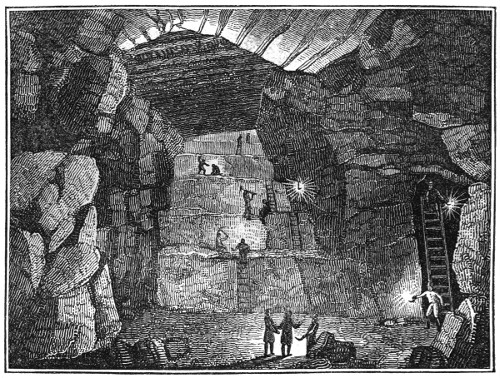
As there is no country in the world so truly rich and powerful, by virtue of its mineral stores, as Great Britain, so there are no people who ought to take a deeper interest in their scientific illustration. I have endeavoured in the present article to collect from the most authentic sources the most interesting and instructive examples of mining operations.
To the magnificent work of Ville-Fosse, Sur la Richesse Minerale, no longer on sale, I have to acknowledge weighty obligations; many of the figures being copied from his great Atlas.
Lodes or mineral veins are usually distinguished by English miners into at least four species. 1. The rake vein. 2. The pipe vein. 3. The flat or dilated vein; and 4. The interlaced mass (stock-werke), indicating the union of a multitude of small veins mixed in every possible direction with each other, and with the rock.
1. The rake vein is a perpendicular mineral fissure; and is the form best known among practical miners. It commonly runs in a straight line, beginning at the superficies of the strata, and cutting them downwards, generally further than can be reached. This vein sometimes stands quite perpendicular; but it more usually inclines or hangs over at a greater or smaller angle, or slope, which is called by the miners the hade or hading of the vein. The line of direction in which the fissure runs, is called the bearing of the vein.
2. The pipe vein resembles in many respects a huge irregular cavern, pushing forward into the body of the earth in a sloping direction, under various inclinations, from an angle of a few degrees to the horizon, to a dip of 45°, or more. The pipe does not in general cut the strata across like the rake vein, but insinuates itself between them; so that if the plane of the strata be nearly horizontal, the bearing of the pipe vein will be conformable; but if the strata stand up at a high angle, the pipe shoots down nearly headlong like a shaft. Some pipes are very wide and high, others are very low and narrow, sometimes not larger than a common mine or drift.
3. The flat or dilated vein, is a space or opening between two strata or beds of stone, the one of which lies above, and the other below this vein, like a stratum of coal between its roof and pavement; so that the vein and the strata are placed in the same plane of inclination. These veins are subject, like coal, to be interrupted, broken, and thrown up or down by slips, dykes, or other interruptions of the regular strata. In the case of a metallic vein, a slip often increases the chance of finding more treasure. Such veins do not preserve the parallelism of their beds, characteristic of coal seams; but vary excessively in thickness within a moderate space. Flat veins occur frequently in limestone, either in a horizontal or declining direction. The flat or strata veins open and close, as the rake veins also do.
4. The interlaced mass has been already defined.
To these may be added the accumulated vein, or irregular mass (butzenwerke), a great deposit placed without any order in the bosom of the rocks, apparently filling up cavernous spaces.
The interlaced masses are more frequent in primitive formations, than in the others; and tin is the ore which most commonly affects this locality. See figure of Tin mine.
The study of the mineral substances, called gangues or vein-stones, which usually accompany the different ores, is indispensable in the investigation and working of mines. These gangues, such as quartz, calcareous spar, fluor spar, heavy spar, &c., and a great number of other substances, although of little or no value in themselves, become of great consequence to the miner, either by pointing out by their presence that of certain useful minerals, or by characterising in their several associations, different deposits of ores of which it may be possible to follow the traces, and to discriminate the relations, often of a complicated kind, provided we observe assiduously the accompanying gangues.
Mineral veins are subject to derangements in their course, which are called shifts or faults. Thus, when a transverse vein throws out, or intercepts, a longitudinal one, we must commonly look for the rejected vein on the side of the obtuse angle which the direction of the latter makes with that of the former. When a bed of ore is deranged by a fault, we must observe whether the slip of the strata be upwards or downwards; for in either circumstance, it is only by pursuing the direction of the fault that we can recover the ore; in the former case by mounting, in the latter by descending beyond the dislocation.
When two veins intersect each other, the direction of the offcast is a subject of interest, both to the miner and the geologist. In Saxony it is considered as a general fact that the portion thrown out is always upon the side of the obtuse angle, a circumstance which holds also in Cornwall; and the more obtuse the angle, the out-throw is the more considerable. A vein may be thrown out on meeting another vein, in a line which approaches either towards its inclination or its direction. The Cornish miners use two different terms to denote these two modes of rejection; for the first case, they say the vein is heaved; for the second, it is started.
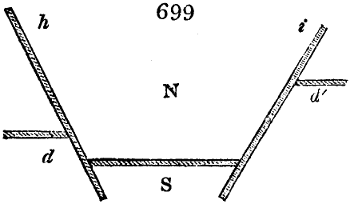
The great copper lode of Carharack, d, fig. 699. in the parish of Gwenap, is one of the most instructive examples of intersection. The power or thickness of this vein is 8 feet; its direction is nearly due east and west, and it dips towards the north at an inclination of two feet per fathom; its upper part being in the killas (a greenish clay-slate); its lower part in the granite. The lode has suffered two intersections; the first produced by meeting the vein h, called Steven’s fluckan, which runs from north-east to south-west, and which throws the lode several fathoms out; the second is produced by another vein i, almost at right angles with the first, and which occasions another out-throw of 20 fathoms to the right side. The fall of the vein occurs therefore in the one case to the right, and in the other to the left; but in both it is towards the side of the obtuse angle. This distribution is very singular; for one part of the vein appears to have mounted while the other has descended. N, S denotes North and South. d is the copper lode running east and west. h, i, are systems of clay-slate veins called fluckans; the line over S, represents the down-shift, and d′ the up-shift.
General observations on the localities of ores, and on the indications of metallic mines.
1. Tin, exists principally in primitive rocks, appearing either in interlaced masses, in beds, or as a constituent part of the rock itself, and more rarely in distinct veins. Tin ore is found indeed sometimes in alluvial land, filling up low situations between lofty mountains.
2. Gold, occurs either in beds, or in veins, frequently in primitive rocks; though in other formations, and particularly in alluvial earth, it is also found. When this metal exists in the bosom of primitive rocks, it is particularly in schists; it is not found in serpentine, but it is met with in greywacke in Transylvania. The gold of alluvial districts, called gold of washing or transport, occurs, as well as alluvial tin, among the debris of the more ancient rocks.
3. Silver, is found particularly in veins and beds, in primitive and transition formations; though some veins of this metal occur in secondary strata. The rocks richest in it are, gneiss, mica-slate, clay-slate, greywacke, and old alpine limestone. Localities of silver-ore itself are not numerous, at least in Europe, among secondary formations; but it occurs in combination with the ores of copper or of lead.
4. Copper, exists in the three mineral epochas; 1. in primitive rocks, principally in the state of pyritous copper, in beds, in masses, or in veins; 2. in transition districts, sometimes in masses, sometimes in veins of copper pyrites; 3. in secondary strata, especially in beds of cupreous schist.
5. Lead, occurs also in each of the three mineral epochas; abounding particularly in primitive and transition grounds, where it usually constitutes veins, and occasionally beds of sulphuretted lead (galena). The same ore is found in strata or in veins among secondary rocks, associated now and then with ochreous iron-oxide and calamine (carbonate of zinc); and it is sometimes disseminated in grains through more recent strata.
6. Iron, is met with in four different mineral eras, but in different ores. Among primitive rocks, magnetic iron ore and specular iron ore occur chiefly in beds, sometimes of enormous size; the ores of red or brown oxide of iron (hæmatite) are found generally in veins, or occasionally in masses with sparry iron, both in primitive and transition rocks; as also sometimes in secondary strata; but more frequently in the coal-measure strata, as beds of clay-ironstone, of globular iron oxide, and carbonate of iron. In alluvial districts we find ores of clay-ironstone, granular iron-ore, bog-ore, swamp-ore, and meadow-ore. The iron ores which belong to the primitive period have almost always the metallic aspect, with a richness amounting even to 80 per cent. of iron, while the ores in the posterior formations become in general more and more earthy, down to those in alluvial soils, some of which present the appearance of a common stone, and afford not more than 20 per cent. of metal, though its quality is often excellent.
7. Mercury, occurs principally among secondary strata, in disseminated masses, along with combustible substances; though the metal is met with occasionally in primitive countries.
8. Cobalt, belongs to the three mineral epochas; its most abundant deposits are veins in primitive rocks; small veins containing this metal are found, however, in secondary strata.
9. Antimony, occurs in veins or beds among primitive and transition rocks.
10, 11. Bismuth and nickel do not appear to constitute the predominating substance of any mineral deposits; but they often accompany cobalt.
12. Zinc, occurs in the three several formations: namely, as sulphuret or blende, particularly in primitive and transition rocks; as calamine, in secondary strata, usually along with oxide of iron, and sometimes with sulphuret of lead.
An acquaintance with the general results collected and classified by geology must be our first guide in the investigation of mines. This enables the observer to judge whether any particular district, should from the nature and arrangement of its rocks, be susceptible of including within its bosom, beds of workable ores; it indicates also, to a certain degree, what substances may probably be met with in a given series of rocks, and what locality these substances will preferably affect. For want of a knowledge of these facts, many persons have gone blindly into researches equally absurd and ruinous.
Formerly indications of mines were taken from very unimportant circumstances; from thermal waters, the heat of which was gratuitously referred to the decomposition of pyrites; from mineral waters, whose course is however often from a far distant source; from vapours incumbent over particular mountain groups; from the snows melting faster in one mineral district than another; from the different species of forest trees, and from the greater or less vigour of vegetation, &c. In general, all such indications are equally fallacious with the divining rod, and the compass made of a lump of pyrites suspended by a thread.
Geognostic observation has substituted more rational characters of metallic deposits, some of which may be called negative and others positive.
The negative indications are derived from that peculiar geological constitution, which from experience or general principles excludes certain metallic matters; for example, granite, and in general every primitive formation, forbids the hope of finding within them combustible fossils (pit-coal), unless it be beds of anthracite; there also it would be vain to seek for sal gem. It is very seldom that granite rocks include silver; or limestones, ores of tin. Volcanic territories never afford any metallic ores worth the working; nor do extensive veins usually run into secondary and alluvial formations. The richer ores of iron do not occur in secondary strata; and the ores of this metal peculiar to these localities, do not exist among primary rocks.
Among positive indications, some are proximate and others remote. The proximate are, an efflorescence, so to speak, of the subjacent metallic masses; magnetic attraction for iron ores; bituminous stone, or inflammable gas for pit-coal; the frequent occurrence of fragments of particular ores, &c. The remote indications consist in the geological epocha, and nature of the rocks. From the examples previously adduced, marks of this kind acquire new importance when in a district susceptible of including deposits of workable ores, the gangues or vein-stones are met with which usually accompany any particular metal. The general aspect of mountains whose flanks present gentle and continuous slopes, the frequency of sterile veins, the presence of metalliferous sands, the neighbourhood of some known locality of an ore, for instance that of iron-stone in reference to coal, lastly the existence of salt springs and mineral waters, may furnish some indications; but when ferruginous or cupreous waters issue from sands or clays, such characters merit in general little attention, because the waters may flow from a great distance. No greater importance can be attached to metalliferous sands and saline springs.
In speaking of remote indications, we may remark that in several places, and particularly near Clausthal in the Hartz, a certain ore of red oxide of iron occurs above the most abundant deposits of the ores of lead and silver; whence it has been named by the Germans the iron-hat. It appears that the iron ore rich in silver, which is worked in America under the name of pacos, has some analogy with this substance; but iron ore is in general so plentifully diffused on the surface of the soil, that its presence can be regarded as only a remote indication, relative to other mineral substances, except in the case of clay ironstone with coal.
Of the instruments and operations of subterranean operations.—It is by the aid of geometry in the first place that the miner studies the situation of the mineral deposits, on the surface and in the interior of the ground; determines the several relations of the veins and the rocks; and becomes capable of directing the perforations towards a suitable end.
The instruments are, 1. the magnetic compass, which is employed to measure the direction of a metallic ore, wherever the neighbourhood of iron does not interfere with its functions; 2. the graduated semicircle which serves to measure the inclination, which is also called the clinometer.
3. The chain or cord for measuring the distance of one point from another.
4. When the neighbourhood of iron renders the use of the magnet uncertain, a plate or plane table is employed.
The dials of the compasses generally used in the most celebrated mines, are graduated into hours; most commonly into twice 12 hours. Thus the whole limb is divided into 24 spaces, each of which contains 15° = 1 hour. Each hour is subdivided into 8 parts.
Means of penetrating into the interior of the earth.—In order to penetrate into the interior of the earth, and to extract from it the objects of his toils, the miner has at his disposal several means, which may be divided into three classes: 1. manual tools, 2. gunpowder, and 3. fire.
The tools used by the miners of Cornwall and Devonshire are the following:
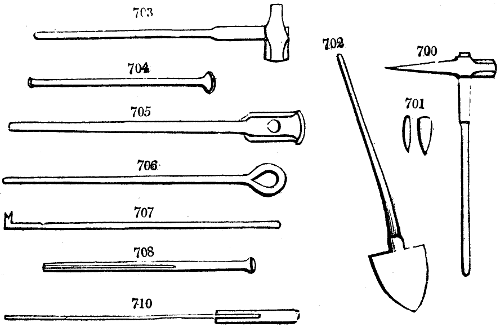
Fig. 700. The pick. It is a light tool, and somewhat varied in shape according to circumstances. One side used as a hammer is called the poll, and is employed to drive in the gads, or to loosen and detach prominences. The point is of steel, carefully tempered, and drawn under the hammer to the proper form. The French call it pointerolle.
Fig. 701. The gad. It is a wedge of steel, driven into crevices of rocks, or into small openings made with the point of the pick.
Fig. 702. The miner’s shovel. It has a pointed form, to enable it to penetrate among the coarse and hard fragments of the mine rubbish. Its handle being somewhat bent, a man’s power may be conveniently applied without bending his body.
The blasting or shooting tools are:—
A sledge or mallet fig. 703.
Borer — 704.
Claying bar — 705.
Needle or nail — 706.
Scraper — 707.
Tamping bar — 708.
Besides these tools the miner requires a powder-horn, rushes to be filled with gunpowder, tin cartridges for occasional use in wet ground, and paper rubbed over with gunpowder or grease, for the smifts or fuses.
The borer, fig. 704., is an iron bar tipped with steel, formed like a thick chisel, and is used by one man holding it straight in the hole with constant rotation on its axis, while another strikes the head of it with the iron sledge or mallet, fig. 703. The hole is cleared out from time to time by the scraper, fig. 707., which is a flat iron rod turned up at one end. If the ground be very wet, and the hole gets full of mud, it is cleaned out by a stick bent at the end into a fibrous brush, called a swab-stick.
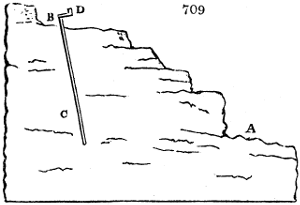
Fig. 709. represents the plan of blasting the rock, and a section of a hole ready for firing. The hole must be rendered as dry as possible, which is effected very simply by filling it partly with tenacious clay, and then driving into it a tapering iron rod, which nearly fills its calibre, called the claying bar. This being forced in with great violence, condenses the clay into all the crevices of the rock, and secures the dryness of the hole. Should this plan fail, recourse is had to tin cartridges furnished with a stem or tube (see fig. 710.,) through which the powder may be inflamed. When the hole is dry, and the charge of powder introduced, the nail, a small taper rod of copper, is inserted so as to reach the bottom of the hole, which is now ready for tamping. By this difficult and dangerous process, the gunpowder is confined, and the disruptive effect produced. Different substances are employed for tamping, or cramming the hole, the most usual one being any soft species of rock free from siliceous or flinty particles. Small quantities of it only are introduced at a time, and rammed very hard by the tamping-bar, which is held steadily by one man, and struck with a sledge by another. The hole being thus filled, the nail is withdrawn by putting a bar through its eye, and striking it upwards. Thus a small perforation or vent is left for the rush which communicates the fire.
Besides the improved tamping-bar faced with hard copper, other contrivances have been resorted to for diminishing the risk of those dreadful accidents that frequently occur in this operation. Dry sand is sometimes used as a tamping material, but there are many rocks for the blasting of which it is ineffective. Tough clay will answer better in several situations.
For conveying the fire, the large and long green rushes which grow in marshy ground are selected. A slit is made in one side of the rush, along which the sharp end of a bit of stick is drawn, so as to extract the pith, when the skin of the rush closes again by its own elasticity. This tube is filled up with gunpowder, dropped into the vent-hole, and made steady with a bit of clay. A paper smift, adjusted to burn a proper time, is then fixed to the top of the rush-tube, and kindled, when the men of the mine retire to a safe distance.
In fig. 709. the portion of the rock which would be dislodged by the explosion, is that included between A and B. The charge of powder is represented by the white part which fills the hole up to C; from which point to the top, the hole is filled with tamping. The smift is shewn at D.
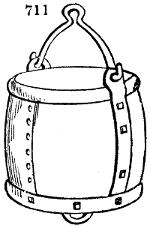
Fig. 711. is an iron bucket, or as it is called in Cornwall, a kibble, in which the ore is raised in the shafts, by machines called whims, worked by horses. The best kibbles are made of sheet-iron, and hold each about three hundred weight of ore: 120 kibbles are supposed to clear a cubic fathom of rock.
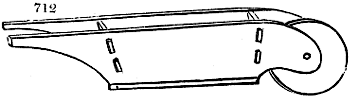
Fig. 712. represents the wheelbarrow used under ground for conveying ore and waste to the foot of the shafts. It is made of light deal, except the wheel, which has a narrow rim of iron.
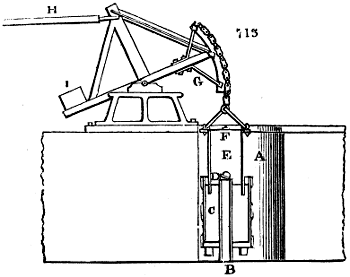
Fig. 713. represents Mr. Taylor’s ingenious ventilator, or machine for renewing fresh air in mines. It is so simple in construction, so complete in its operation, requires so little power to work it, and is so little liable to injury from wear, that nothing further of the kind can be desired in ordinary metallic mines. The shaft of the mine is represented at A; at either the top or bottom of which the machine may be placed, as is found most convenient, but the foul air must be discharged into a floor, furnished with a valve-door to prevent its return into the mine. B is the air-pipe from the mine, passing through the bottom of the fixed vessel or cylinder C, which is formed of timber, and bound with iron hoops. It is filled with water nearly to the top of the pipe B, on which is fixed a valve opening upwards at D. E, the air, or exhausting cylinder of cast-iron, open at bottom, and suspended over the air-pipe, but immersed some way in the water. It is furnished with a wooden top, having an aperture fitted with a valve likewise opening upwards at F. This exhausting cylinder is moved up and down by the bob G, brought into connexion with any engine by the horizontal rod H; the weight of the cylinder being balanced, if necessary, by the counterpoise I. The action is as follows:—When the cylinder rises, the air from the mine rushes up through the pipe and valve D; and when it descends, this valve shuts, and prevents the return of the air, which is expelled through the valve F. With a cylinder two feet in diameter and six feet long, working from two to three strokes per minute, 200 gallons of air may be discharged in the same time.
Gunpowder is the most valuable agent of excavation; possessing a power which has no limit, and which can act every where, even under water. Its introduction, in 1615, caused a great revolution in the mining art.
It is employed in mines in different manners, and in different quantities, according to circumstances. In all cases, however, the process resolves itself into boring a hole, and enclosing a cartridge in it, which is afterwards made to explode. The hole is always cylindrical, and is usually made by means of the borer, fig. 704., a stem of iron, terminated by a blunt-edged chisel. It sometimes ends in a cross, formed by two chisels set transversely. The workman holds the stem in his left hand, and strikes it with an iron mallet held in his right. He is careful to turn the punch a very little round at every stroke. Several punches are employed in succession, to bore one hole; the first shorter, the latter ones longer, and somewhat thinner. The rubbish is withdrawn as it accumulates, at the bottom of the hole, by means of a picker, which is a small spoon or disc of iron fixed at the end of a slender iron rod. When holes of a large size are to be made, several men must be employed; one to hold the punch, and one or more to wield the iron mallet. The perforations are seldom less than an inch in diameter, and 18 inches deep; but they are sometimes 2 inches wide, with a depth of 50 inches.
The gunpowder, when used, is most commonly put up in paper cartridges. Into the side of the cartridge, a small cylindrical spindle or piercer is pushed. In this state the cartridge is forced down to the bottom of the hole, which is then stuffed, by means of the tamping bar, fig. 708., with bits of dry clay, or friable stones coarsely pounded.[33] The piercer is now withdrawn, which leaves in its place, a channel through which fire may be conveyed to the charge. This is executed either by pouring gunpowder into that passage, or by inserting into it, reeds, straw stems, quills, or tubes of paper filled with gunpowder. This is exploded by a long match, which the workmen kindle, and then retire to a place of safety.
As the piercer must not only be slender, but stiff, so as to be easily withdrawn when the hole is tamped, iron spindles are usually employed, though they occasionally give rise to sparks, and consequently to dangerous accidents, by their friction against the sides of the hole. Brass piercers have been sometimes tried; but they twist and break too readily.
Each hole bored in a mine, should be so placed in reference to the schistose structure of the rock, and to its natural fissures, as to attack and blow up the least resisting masses. Sometimes the rock is prepared beforehand for splitting in a certain direction, by means of a narrow channel excavated with the small hammer.
The quantity of gunpowder should be proportional to the depth of the hole, and the resistance of the rock; and merely sufficient to split it. Anything additional would serve no other purpose than to throw the fragments about the mine, without increasing the useful effect. Into the holes of about an inch and a quarter diameter, and 18 inches deep, only two ounces of gunpowder are put.
It appears that the effect of the gunpowder may be augmented by leaving an empty space above, in the middle of, or beneath the cartridge. In the mines of Silesia, the consumption of gunpowder has been eventually reduced, without diminishing the product of the blasts, by mixing sawdust with it in certain proportions. The hole has also been filled up with sand in some cases, according to Mr. Jessop’s plan, instead of being packed with stones, which has removed the danger of the tamping operation. The experiments made in this way have given results very advantageous in quarry blasts with great charges of gunpowder; but less favourable in the small charges employed in mines.
Water does not oppose an insurmountable obstacle to the employment of gunpowder; but when the hole cannot be made dry, a cartridge bag impermeable to water must be had recourse to, provided with a tube also impermeable, in which the piercer is placed.
After the explosion of each mining charge, wedges and levers are employed, to drag away and break down what has been shattered.
Wherever the rock is tolerably hard, the use of gunpowder is more economical and more rapid than any tool-work, and is therefore always preferred. A gallery, for example, a yard and a half high, and a yard wide, the piercing of which by the hammer formerly cost from five to ten pounds sterling, the running yard, in Germany, is executed at the present day by gunpowder at from two to three pounds. When, however, a precious mass of ore is to be detached, when the rock is cavernous, which nearly nullifies the action of gunpowder, or when there is reason to apprehend that the shock caused by the explosion may produce an injurious fall of rubbish, hand-tools alone must be employed.
In certain rocks and ores of extreme hardness, the use both of tools and gunpowder becomes very tedious and costly. Examples to this effect are seen, in the mass of quartz mingled with copper pyrites, worked at Rammelsberg, in the Hartz, in the masses of stanniferous granite of Geyer and Altenberg in the Erzgebirge of Saxony, &c. In these circumstances, fortunately very rare, the action of fire is used with advantage to diminish the cohesion of the rocks and the ores. The employment of this agent is not necessarily restricted to these difficult cases. It was formerly applied very often to the working of hard substances; but the introduction of gunpowder into the mining art, and the increase in the price of wood, occasion fire to be little used as an ordinary means of excavation, except in places where the scantiness of the population has left a great extent of forest timber, as happens at Kongsberg in Norway, at Dannemora in Sweden, at Felsobanya in Transylvania, &c.
The action of fire may be applied to the piercing of a gallery, or to the advancement of a horizontal cut, or to the crumbling down of a mass of ore, by the successive upraising of the roof of a gallery already pierced. In any of these cases, the process consists in forming bonfires, the flame of which is made to play upon the parts to be attacked. All the workmen must be removed from the mine during, and even for some time after, the combustion. When the excavations have become sufficiently cool to allow them to enter, they break down with levers and wedges, or even by means of gunpowder, the masses which have been rent and altered by the fire.
To complete our account of the manner in which man may penetrate into the interior of the earth, we must point out the form of the excavations that he should make in it.
In mines, three principal species of excavations may be distinguished; viz. shafts, galleries, and the cavities of greater or less magnitude which remain in the room of the old workings.
A shaft or pit is a prismatic or cylindrical hollow space, the axis of which is either vertical or much inclined to the horizon. The dimension of the pit, which is never less than 32 inches in its narrowest diameter, amounts sometimes to several yards. Its depth may extend to 1000 feet, and more. Whenever a shaft is opened, means must be provided to extract the rubbish which continually tends to accumulate at its bottom, as well as the waters which may percolate down into it; as also to facilitate the descent and ascent of the workmen. For some time a wheel and axle erected over the mouth of the opening, which serve to elevate one or two buckets of proper dimensions, may be sufficient for most of these purposes. But such a machine becomes ere long inadequate. Horse-whims, or powerful steam-engines, must then be had recourse to; and effectual methods of support must be employed to prevent the sides of the shaft from crumbling and falling down.
A Gallery is a prismatic space, the straight or winding axis of which does not usually deviate much from the horizontal line. Two principal species are distinguished; the galleries of elongation, which follow the direction of a bed or a vein; and the transverse galleries, which intersect this direction under an angle not much different from 90°. The most ordinary dimensions of galleries are a yard wide, and two yards high; but many still larger may be seen traversing thick deposits of ore. There are few whose width is less than 24 inches, and height less than 40; such small drifts serve merely as temporary expedients in workings. Some galleries are several leagues in length. We shall describe in the sequel the means which are for the most part necessary to support the roof and the walls. The rubbish is removed by waggons or wheelbarrows of various kinds. See fig. 712.
It is impossible to advance the boring of a shaft or gallery beyond a certain rate, because only a limited set of workmen can be made to bear upon it. There are some galleries which have taken more than 30 years to perforate. The only expedient for accelerating the advance of a gallery, is to commence, at several points of the line to be pursued, portions of galleries which may be joined together on their completion.
Whether tools or gunpowder be used in making the excavations, they should be so applied as to render the labour as easy and quick as possible, by disengaging the mass out of the rock at two or three of its faces. The effect of gunpowder, wedges, or picks, is then much more powerful. The greater the excavation, the more important is it to observe this rule. With this intent, the working is disposed in the form of steps (gradins), placed like those of a stair; each step being removed in successive portions, the whole of which, except the last, are disengaged on three sides, at the instant of their being attacked.
The substances to be mined occur in the bosom of the earth, under the form of alluvial deposits, beds, pipe-veins, or masses, threads or small veins, and rake-veins.
When the existence of a deposit of ore is merely suspected, without positive proofs, recourse must be had to labours of research, in order to ascertain the richness, nature, and disposition of a supposed mine. These are divided into three kinds; open workings, subterranean workings, and boring operations.
1. The working by an open trench, has for its object to discover the outcropping or basset edges of strata or veins. It consists in opening a fosse of greater or less width, which, after removing the vegetable mould, the alluvial deposits, and the matters disintegrated by the atmosphere, discloses the native rocks, and enables us to distinguish the beds which are interposed, as well as the veins that traverse them. The trench ought always to be opened in a direction perpendicular to the line of the supposed deposit. This mode of investigation costs little, but it seldom gives much insight. It is chiefly employed for verifying the existence of a supposed bed or vein.
The subterranean workings afford much more satisfactory knowledge. They are executed by different kinds of perforations; viz. by longitudinal galleries hollowed out of the mass of the beds or veins themselves, in following their course; by transverse galleries, pushed at right angles to the direction of the veins; by inclined shafts, which pursue the slope of the deposits, and are excavated in their mass; or, lastly, by perpendicular pits.
If a vein or bed unveils itself on the flank of a mountain, it may be explored, according to the greater or less slope of its inclination, either by a longitudinal gallery opened in its mass, from the outcropping surface, or by a transverse gallery falling upon it in a certain point, from which either an oblong gallery or a sloping shaft may be opened.
If our object be to reconnoitre a highly inclined stratum, or a vein in a level country, we shall obtain it with sufficient precision, by means of shafts, 8 or 10 yards deep, dug at 30 yards distance from one another; excavated in the mass of ore, in the direction of its deposit. If the bed is not very much inclined, only 45°, for example, vertical shafts must be opened in the direction of its roof, or of the superjacent rocky stratum, and galleries must be driven from the points in which they meet the ore, in the line of its direction.
When the rocks which cover valuable minerals are not of very great hardness, as happens generally with the coal formation, with pyritous and aluminous slates, sal gem, and some other minerals of the secondary strata, the borer is employed with advantage to ascertain their nature. This mode of investigation is economical, and gives, in such cases, a tolerably exact insight into the riches of the interior. The method of using the borer, has been described under Artesian Wells.
OF MINING IN PARTICULAR.
The mode of working mines is two-fold; by open excavations, and subterranean.
Workings in the open air present few difficulties, and occasion little expense, unless when pushed to a great depth. They are always preferred for working deposits little distant from the surface; where, in fact, other methods cannot be resorted to, if the substance to be raised be covered with incoherent matters. The only rules to be observed are, to arrange the workings in terraces, so as to facilitate the cutting down of the earth; to transport the ores and the rubbish to their destination at the least possible expense; and to guard against the crumbling down of the sides. With the latter view, they ought to have a suitable slope, or to be propped by timbers whenever they are not quite solid.
Open workings, are employed for valuable clays, sands, as also for the alluvial soils of diamonds, gold, and oxide of tin, bog iron ores, &c., limestones, gypsums, building stones, roofing slates, masses of rock salt in some situations, and certain deposits of ores, particularly the specular iron of the island of Elba; the masses of stanniferous granite of Geyer, Altenberg, and Seyffen, in the Erzgebirge, a chain of mountains between Saxony and Bohemia; the thick veins or masses of black oxide of iron of Nordmarch, Dannemora, &c., in Sweden; the mass of cupreous pyrites of Ræraas, near Drontheim, in Norway; several mines of iron, copper, and gold in the Ural mountains, &c.
Subterranean workings may be conveniently divided into five classes, viz.:—
1. Veins, or beds, much inclined to the horizon, having a thickness of at least two yards.
2. Beds of slight inclination, or nearly horizontal, the power or thickness of which does not exceed two yards.
3. Beds of great thickness, but slightly inclined.
4. Veins, or beds highly inclined, of great thickness.
5. Masses of considerable magnitude in all their dimensions.
Subterranean mining requires two very distinct classes of workings; the preparatory, and those for extraction.
The preparatory consist in galleries, or in pits and galleries destined to conduct the miner to the point most proper for attacking the deposit of ore, for tracing it all round this point, for preparing chambers of excavation, and for concerting measures with a view to the circulation of air, the discharge of waters, and the transport of the extracted minerals.
If the vein or bed in question be placed in a mountain, and if its direction forms a very obtuse angle with the line of the slope, the miner begins by opening in its side, at the lowest possible level, a gallery of elongation, which serves at once to give issue to the waters, to explore the deposit through a considerable extent, and then to follow it in another direction; but to commence the real mining operations, he pierces either shafts or galleries, according to the slope of the deposit, across the first gallery.
For a stratum little inclined to the horizon, placed beneath a plain, the first thing is to pierce two vertical shafts, which are usually made to arrive at two points in the same line of slope, and a gallery is driven to unite them. It is, in the first place, for the sake of circulation of air that these two pits are sunk; one of them, which is also destined for the drainage of the waters, should reach the lowest point of the intended workings. If a vein is intersected by transverse ones, the shafts are placed so as to follow, or, at least, to cut through the intersections. When the mineral ores lie in nearly vertical masses, it is right to avoid, as far as possible, sinking pits into their interior. These should rather be perforated at one side of their floor, even at some considerable distance, to avoid all risk of crumbling the ores into a heap of rubbish, and overwhelming the workmen.
With a vein of less than two yards thick, as soon as the preparatory labours have brought the miners to the point of the vein from which the ulterior workings are to ramify, whenever a circulation of air has been secured, and an outlet to the water and the matters mined, the first object is to divide the mass of ore into large parallelopipeds, by means of oblong galleries, pierced 20 or 25 yards below one another, with pits of communication opened up, 30, 40, or 50 yards asunder, which follow the slope of the vein. These galleries and shafts are usually of the same breadth as the vein, unless when it is very narrow, in which case it is requisite to cut out a portion of the roof or the floor. Such workings serve at once the purposes of mining, by affording a portion of ore, and the complete investigation of the nature and riches of the vein, a certain extent of which is thus prepared before removing the cubical masses. It is proper to advance first of all, in this manner, to the greatest distance from the central point which can be mined with economy, and afterwards to remove the parallelopiped blocks, in working back to that point.
This latter operation may be carried on in two different ways; of which one consists in attacking the ore from above; and another from below. In either case, the excavations are disposed in steps similar to a stair upon their upper or under side. The first is styled a working in direct or descending steps; and the second a working in reverse, or ascending steps.
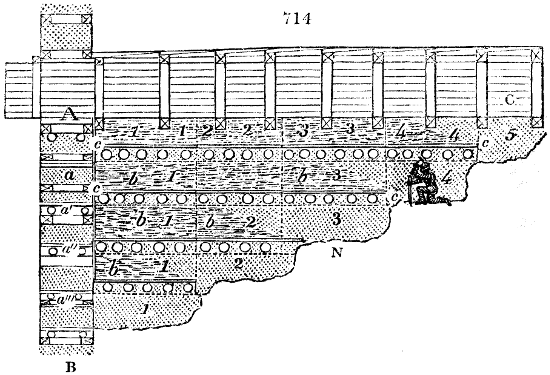
1. Suppose, for example, that the post N, fig. 714., included between the horizontal gallery A C, and the shaft A B, is to be excavated by direct steps, a workman stationed upon a scaffold at the point a, which forms the angle between the shaft and the elongated drift, attacks the rock in front of him and beneath his feet. Whenever he has cut out a parallelopiped (a rectangular mass), of from four to six yards broad, and two yards high, a second miner is set to work upon a scaffold at a′, two yards beneath the first, who, in like manner, excavates the rock under his feet and before him. As soon as the second miner has removed a post of four or six yards in width, by two in height, a third begins upon a scaffold at a′′ to work out a third step. Thus, as many workmen are employed as there are steps to be made between the two oblong horizontal galleries which extend above and below the mass to be excavated; and since they all proceed simultaneously, they continue working in similar positions, in floors, over each other, as upon a stair with very long wide steps. As they advance, the miners construct before them wooden floors c c c c, for the purpose of supporting the rubbish which each workman extracts from his own step. This floor, which should be very solid, serves also for wheeling out his barrow filled with ore. The round billets which support the planks sustain the roof or the wall of the mineral vein or bed under operation. If the rubbish be very considerable, as is commonly the case, the floor planks are lost. However strongly they may be made, as they cannot be repaired, they sooner or later give way under the enormous pressure of the rubbish; and as all the weight is borne by the roof of the oblong gallery underneath, this must be sufficiently timbered. By this ingenious plan, a great many miners may go to work together upon a vein without mutual interference; as the portions which they detach have always two faces at least free, they are consequently more easily separable, either with gunpowder or with the pick. Should the vein be more than a yard thick, or if its substance be very refractory, two miners are set upon each step. b b b b indicate the quadrangular masses that are cut out successively downwards; and 1 1, 2 2, 3 3, forwards; the lines of small circles are the sections of the ends of the billets which support the floors.
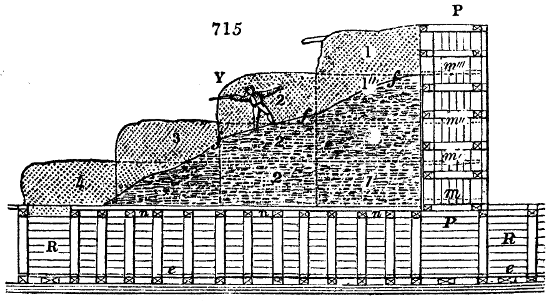
2. To attack a mass Y, fig. 715., a scaffold m, is erected in one of its terminal pits P P, at the level of the ceiling of the gallery R R′, where it terminates below. A miner placed on this scaffold, cuts off at the angle of this mass a parallelopiped 1, from one to two yards high, by six or eight long. When he has advanced thus far, there is placed in the same pit, upon another scaffold m′, a second miner, who attacks the vein above the roof of the first cutting, and hews down, above the parallelopiped 1, a parallelopiped of the same dimensions 1′, while the first is taking out another 2, in advance of 1. When the second miner has gone forward 6 or 8 yards, a third is placed also in the same pit. He commences the third step, while the first two miners are pushing forwards theirs, and so in succession.
In this mode of working, as well as in the preceding, it is requisite to support the rubbish and the walls of the vein. For the first object, a single floor n n n, may be sufficient, constructed above the lower gallery, substantial enough to bear all the rubbish, as well as the miners. In certain cases, an arched roof may be substituted; and in others, several floors are laid at different heights. The sides of the vein are supported by means of pieces of wood fixed between them perpendicularly to their planes. Sometimes, in the middle of the rubbish, small pits are left at regular distances apart, through which the workmen throw the ore coarsely picked, down into the lower gallery. The rubbish occasionally forms a slope f f f, so high that miners placed upon it can work conveniently. When the rich portions are so abundant as to leave too little rubbish to make such a sloping platform, the miners plant themselves upon movable floors, which they carry forward along with the excavations.
These two modes of working in the step-form, have peculiar advantages and disadvantages; and each is preferred to the other according to circumstances.
In the descending workings or in direct steps, fig. 714., the miner is placed on the very mass or substance of the vein; he works commodiously before him; he is not exposed to the splinters which may fly off from the roof; but by this plan he is obliged to employ a great deal of timber to sustain the rubbish; and the wood is fixed for ever.
In the ascending workings, or in reversed steps, fig. 715., the miner is compelled to work in the re-entering angle formed between the roof and the front wall of his excavation, a posture sometimes oppressive; but the weight of the ore conspires with his efforts to make it fall. He employs less timber than in the workings with direct steps. The sorting of the ore is more difficult than in the descending working, because the rich ore is sometimes confounded with the heap of rubbish on which it falls.
When seams of diluvium or gravel-mud, occur on one of the sides of the vein, or on both, they render the quarrying of the ore more easy, by affording the means of uncovering the mass to be cut down, upon an additional face.
Should the vein be very narrow, it is necessary to remove a portion of the sterile rock which encloses it, in order to give the work a sufficient width to enable the miner to advance. If, in this case, the vein be quite distinct from the rock, the labour may be facilitated, as well as the separation of the ore, by disengaging the vein, on one of its faces through a certain extent, the rock being attacked separately. This operation is called stripping the vein. When it is thus uncovered, a shot of gunpowder is sufficient to detach a great mass of it, unmixed with sterile stones.
By the methods now described, only those parallelopipeds are cut out, either in whole or in part, which present indications of richness adequate to yield a prospect of benefit. In other cases, it is enough to follow out the threads of ore which occur, by workings made in their direction.
The miner, in searching within the crust of the earth for the riches which it conceals, is exposed to many dangers. The rocks amidst which he digs are seldom or never entire, but are almost always traversed by clefts in various directions, so that impending fragments threaten to fall and crush him at every instant. He is even obliged at times to cut through rotten friable rocks or alluvial loams. Fresh atmospheric air follows him with difficulty in the narrow channels which he lays open before him; and the waters which circulate in the subterranean seams and fissures filter incessantly into his excavation, and tend to fill it. Let us now take a view of the means he employs to escape from these three classes of dangers.
1. Of the timbering of excavations.—The excavations of mines, are divisible into three principal species; shafts, galleries, and chambers. When the width of these excavations is inconsiderable, as is commonly the case with shafts and galleries, their sides can sometimes stand upright of themselves; but more frequently they require to be propped or stayed by billets of wood, or by walls built with bricks or stones; or even by stuffing the space with rubbish. These three kinds of support are called timbering, walling, and filling up.
Timbering is most used. It varies in form for the three species of excavations, according to the solidity of the walls which it is destined to sustain.
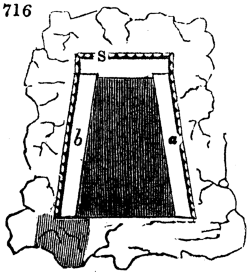
In a gallery, for example, it may be sufficient to support merely the roof, by means of joists placed across, bearing at their two ends in the rock; or the roof and the two walls by means of an upper joist S, fig. 716., which is then called a cap or cornice beam, resting on two lateral upright posts or stanchions, a, b, to which a slight inclination towards each other is given, so that they approach a little at the top, and rest entirely upon the floor. At times, only one of the walls and the roof need support. This case is of frequent occurrence in pipe veins. Pillars are then set up only on one side, and on the other the joists rest in holes of the rock. It may happen that the floor of the gallery shall not be sufficiently firm to afford a sure foundation to the standards; and it may be necessary to make them rest on a horizontal piece called the sole. This is timbering with complete frames. The upright posts are usually set directly on the sole; but the extremities of the cap or ceiling, and the upper ends of the standards, are mortised in such a manner that these cannot come nearer, whereby the cap shall possess its whole force of resistance. In friable and shivery rocks there is put behind these beams, both upon the ceiling and the sides, facing boards, which are planks placed horizontally, or spars of cleft wood, set so close together as to leave no interval. They are called fascines in French. In ordinary ground, the miner puts up these planks in proportion as he goes forwards; but in a loose soil, such as sand or gravel, he must mount them a little in advance. He then drives into the mass behind the wooden frame-work, thick but sharp-pointed planks or stakes, and which, in fact, form the sides of the cavity, which he proceeds to excavate. Their one extremity is thus supported by the earth in which it is thrust, and their other end by the last framing. Whenever the miner gets sufficiently on, he sustains the walls by a new frame. The size of the timber, as well as the distance between the frames or stanchions, depends on the degree of pressure to be resisted.
When a gallery is to serve at once for several distinct purposes, a greater height is given to it; and a flooring is laid on it at a certain level. If, for example, a gallery is to be employed, both for the transport of the ores and the discharge of the waters, a floor e e, fig. 715., is constructed above the bottom, over which the carriages are wheeled, and under which the waters are discharged.
The timbering of shafts varies in form, as well as that of galleries, according to the nature and the locality of the ground which they traverse, and the purposes which they are meant to serve. The shafts intended to be stayed with timber are usually square or rectangular, because this form, in itself more convenient for the miner, renders the execution of the timbering more easy. The wood-work consists generally of rectangular frames, the spars of which are about eight inches in diameter, and placed at a distance asunder of from a yard to a yard and a half. The spars are never placed in contact, except when the pressure of the earth and the waters is very great. The pieces composing the frames are commonly united by a half-check, and the longer of the two pieces extends often beyond the angles, to be rested in the rock. Whether the shaft is vertical or inclined, the frame-work is always placed so that its plane may be perpendicular to the axis of the pit. It happens sometimes in inclined shafts that there are only two sides, or even a single one, which needs to be propped. These are stayed by means of cross beams, which rest at their two ends in the rock. When the frames do not touch one another, strong planks or stakes are fastened behind them to sustain the ground. To these planks the frames are firmly connected, so that they cannot slide. In this case the whole timbering will be supported, when the lower frame is solidly fixed, or when the pieces from above pass by its angles to be abutted upon the ground.
In the large rectangular shafts, which serve at once for extracting the ores, for the discharge of the waters, and the descent of the workmen, the spaces destined for these several purposes are in general separated by partitions, which also serve to increase the strength of the timberings, by acting as buttresses to the planks in the long sides of the frame-work. Occasionally a partition separates the ascending from the descending basket, to prevent their jostling.—Lastly, particular passages are left for ventilation.
As it is desirable that the wood shall retain its whole force, only those pieces are squared which absolutely require it. The spars of the frames in shafts and galleries are deprived merely of their bark, which by holding moisture, would accelerate the decomposition of the wood. The alburnum of oak is also removed.
Resinous woods, like the pine, last much shorter than the oak, the beech, and the cherry-tree; though the larch is used with advantage. The oak has been known to last upwards of 40 years; while the resinous woods decay frequently in 10. The fresher the air in mines, the more durable is the timbering.
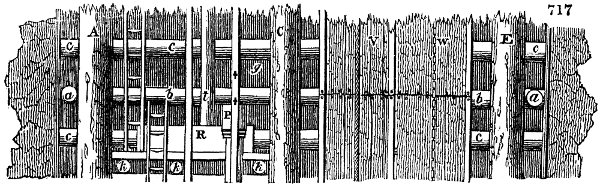
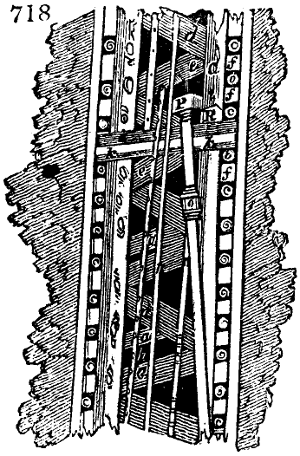
The marginal figs. 717, 718. represent two vertical sections of a shaft, the one at right angles to the other, with the view of showing the mode of sustaining the walls of the excavation by timbering. It is copied from an actual mine in the Hartz. There we may observe the spaces allotted to the descent of the miners by ladders, to the drainage of the waters by pumps P, and rods t, and to the extraction of the mineral substances by the baskets B. a, b, c, f, h, k, various cross timbers; A, C, E, upright do.; R, pump cistern; V, W, corve-ways. The shafts here shown, are excavated in the line of the vein itself,—the rock enclosing it being seen in the second figure.
In a great many mines it is found advantageous to support the excavations by brick or stone buildings, constructed either with or without mortar. These constructions are often more costly than wooden ones, but they last much longer, and need fewer repairs. They are employed instead of timberings, to support the walls and roof of galleries, to line the sides of shafts, and to bear up the roofs of excavations.
Sometimes the two sides of a gallery are lined with vertical walls, and its roof is supported by an ogee vault, or an arch. If the sides of the mine are solid, a simple arch is sufficient to sustain the roof and at other times the whole surface of a gallery is formed of a single elliptic vault, the great axis of which is vertical; and the bottom is surmounted by a wooden plank, under which the waters run off; see fig. 719.
Walled shafts also are sometimes constructed in a circular or elliptic form, which is better adapted to resist the pressure of the earth and waters. Rectangular shafts of all dimensions, however, are frequently walled.
The sides of an excavation may also be supported by filling it completely with rubbish. Wherever the sides need to be supported for some time without the necessity of passing along them, it is often more economical to stuff them up with rubbish, than to keep up their supports. In the territory of Liege, for example, there have been shafts thus filled up for several centuries; and which are found to be quite entire when they are emptied. The rubbish is also useful for forming roads among steep strata, for closing air-holes, and forming canals of ventilation.
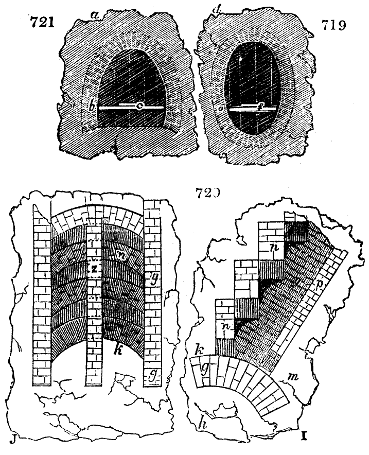
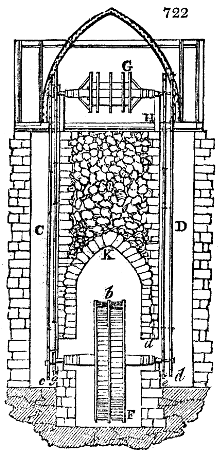
Figs. 719. 720. 721. represent the principal kinds of mason-work employed in the galleries and shafts of mines. Fig. 722. exhibits the walling in of the cage of an overshot water-wheel, as mounted within a mine. Before beginning to build, an excavation large enough must be made in the gallery to leave a space three feet and a half high for the workmen to stand in, after the brick-work is completed. Between the two opposite sides, cross beams of wood must be fixed at certain distances, as chords of the vault, over which the rock must be hollowed out to receive the arch-stones, and the centring must then be placed, covered with deals to receive the voussoirs, beginning at the flanks and ending with the key-stone. When the vault is finished through a certain extent, the interval between the arch and the rock must be rammed full of rubbish, leaving passages if necessary through it and the arch, for currents of water.
In walling galleries, attention must be paid to the direction of the pressure, and to build vertically or with a slope accordingly. Should the pressure be equal in all directions, a closed vault, like fig. 719., should be formed. For walls not far from the vertical, salient or buttressed arches are employed, as shown in fig. 720., called in German überspringende bogen; for other cases, twin-arches are preferred, with an upright wall between.