A. (continued 2)
Reading edition
Alco- hol per cent. Temperature. Alco- hol per cent. Temperature.
30° F. 35° F. 40° F. 45° F. 50° F. 55° F. 60° F. 65° F. 70° F. 75° F. 80° F. 85° F.
0 9994 9997 9997 9998 9997 9994 0 9991 9987 9991 9976 9970 9962
5 9924 9926 9926 9926 9925 9922 5 9919 9915 9909 9903 9897 9889
10 9868 9869 9868 9867 9865 9861 10 9857 9852 9845 9839 9831 9823
15 9823 9822 9820 9817 9813 9807 15 9802 9796 9788 9779 9771 9761
20 9786 9782 9777 9772 9766 9759 20 9751 9743 9733 9722 9711 9700
25 9753 9746 9738 9729 9720 9709 25 9700 9690 9678 9665 9652 9638
30 9717 9707 9695 9684 9672 9659 30 9646 9632 9618 9603 9588 9572
35 9671 9658 9644 9629 9614 9599 35 9583 9566 9549 9532 9514 9495
40 9615 9598 9581 9563 9546 9528 40 9510 9491 9472 9452 9433 9412
45 9544 9525 9506 9486 9467 9447 45 9427 9406 9385 9364 9342 9320
50 9460 9440 9420 9399 9378 9356 50 9335 9313 9290 9267 9244 9221
55 9368 9347 9325 9302 9279 9256 55 9234 9211 9187 9163 9139 9114
60 9267 9245 9222 9198 9174 9150 60 9126 9102 9076 9051 9026 9000
65 9162 9138 9113 9088 9063 9038 65 9013 8988 8962 8936 8909 8882
70 9046 9021 8996 8970 8944 8917 70 8892 8866 8839 8812 8784 8756
75 8925 8899 8873 8847 8820 8792 75 8765 8738 8710 8681 8652 8622
80 8798 8771 8744 8716 8688 8659 80 8631 8602 8573 8544 8514 8483
85 8663 8635 8606 8577 8547 8517 85 8488 8458 8427 8396 8365 8333
90 8517 8486 8455 8425 8395 8363 90 8322 8300 8268 8236 8204 8171
Alco- hol per cent. Temperature.
30° F. 35° F. 40° F. 45° F. 50° F. 55° F. 60° F. 65° F. 70° F. 75° F. 80° F. 85° F.
0 9994 9997 9997 9998 9997 9994 9991 9987 9991 9976 9970 9962
5 9924 9926 9926 9926 9925 9922 9919 9915 9909 9903 9897 9889
10 9868 9869 9868 9867 9865 9861 9857 9852 9845 9839 9831 9823
15 9823 9822 9820 9817 9813 9807 9802 9796 9788 9779 9771 9761
20 9786 9782 9777 9772 9766 9759 9751 9743 9733 9722 9711 9700
25 9753 9746 9738 9729 9720 9709 9700 9690 9678 9665 9652 9638
30 9717 9707 9695 9684 9672 9659 9646 9632 9618 9603 9588 9572
35 9671 9658 9644 9629 9614 9599 9583 9566 9549 9532 9514 9495
40 9615 9598 9581 9563 9546 9528 9510 9491 9472 9452 9433 9412
45 9544 9525 9506 9486 9467 9447 9427 9406 9385 9364 9342 9320
50 9460 9440 9420 9399 9378 9356 9335 9313 9290 9267 9244 9221
55 9368 9347 9325 9302 9279 9256 9234 9211 9187 9163 9139 9114
60 9267 9245 9222 9198 9174 9150 9126 9102 9076 9051 9026 9000
65 9162 9138 9113 9088 9063 9038 9013 8988 8962 8936 8909 8882
70 9046 9021 8996 8970 8944 8917 8892 8866 8839 8812 8784 8756
75 8925 8899 8873 8847 8820 8792 8765 8738 8710 8681 8652 8622
80 8798 8771 8744 8716 8688 8659 8631 8602 8573 8544 8514 8483
85 8663 8635 8606 8577 8547 8517 8488 8458 8427 8396 8365 8333
90 8517 8486 8455 8425 8395 8363 8322 8300 8268 8236 8204 8171
The importance of extreme accuracy in determining the density of alcoholic mixtures in the United Kingdom, on account of the great revenue derived from them to the State, and their consequent high price in commerce, induced the Lords of the Treasury a few years ago to request the Royal Society to examine the construction and mode of applying the instrument now in use for ascertaining and charging the duty on spirits. This instrument, which is known and described in the law as Sikes’s hydrometer, possesses, in many respects, decided advantages over those formerly in use. The committee of the Royal Society state, that a definite mixture of alcohol and water is as invariable in its value as absolute alcohol can be; and can be more readily, and with equal accuracy, identified by that only quality or condition to which recourse can be had in practice, namely, specific gravity. The committee further proposed, that the standard spirit be that which, consisting of alcohol and water alone, shall have a specific gravity of 0·92 at the temperature of 62° Fahr., water being unity at the same temperature; or, in other words, that it shall at 62° weigh 92⁄100 or 23⁄25 of an equal bulk of water at the same temperature.
This standard is rather weaker than the old proof, which was 12⁄13, or 0·923; or in the proportion of nearly 1·1 gallon of the present proof spirit per cent. The proposed standard will contain nearly one half by weight of absolute alcohol. The hydrometer ought to be so graduated as to give the indication of strength; not upon an arbitrary scale, but in terms of specific gravity at the temperature of 62°.
The committee recommend the construction of an equation table, which shall indicate the same strength of spirit at every temperature. Thus in standard spirit at 62° the hydrometer would indicate 920, which in this table would give proof spirit. If that same spirit were cooled to 40°, the hydrometer would indicate some higher number; but which, being combined in the table with the temperature as indicated by the thermometer, should still give proof or standard spirit as the result.
It is considered advisable, in this and the other tables, not to express the quality of the spirit by any number over or under proof, but to indicate at once the number of gallons of standard spirit contained in, or equivalent to, 100 gallons of the spirit under examination. Thus, instead of saying 23 over proof, it is proposed to insert 123; and in place of 35·4 under proof, to insert its difference to 100, or 64·6.
It has been considered expedient to recommend a second table to be constructed, so as to show the bulk of spirit of any strength at any temperature, relative to a standard bulk of 100 gallons at 62°. In this table a spirit which had diminished in volume, at any given temperature, 0·7 per cent., for example, would be expressed by 99·3; and a spirit which had increased at any given temperature 0·7 per cent., by 100·7.
When a sample of spirit, therefore, has been examined by the hydrometer and thermometer, these tables will give first the proportion of standard spirit at the observed temperature, and next the change of bulk of such spirit from what it would be at the standard temperature. Thus, at the temperature of 51°, and with an indication (sp. gr.) of 8240, 100 gallons of the spirit under examination would be shown by the first table to be equal to 164·8 gallons of standard spirit of that temperature; and by the second table it would appear that 99·3 gallons of the same spirit would become 100 at 62°, or in reality contain the 164·8 gallons of spirit in that state only in which it is to be taxed.
But as it is considered that neither of these tables can alone be used for charging the duty (for neither can express the actual quantity of spirit of a specific gravity of 0·92 at 62° in 100 gallons of stronger or weaker spirit at temperatures above or below 62°), it is considered essential to have a third table, combining the two former, and expressing this relation directly, so that upon mere inspection it shall indicate the proportion of standard spirit in 100 gallons of that under examination in its then present state. In this table the quantities should be set down in the actual number of gallons of standard spirit at 62°, equivalent to 100 of the spirit under examination; and the column of quantities may be expressed by the term value, as it in reality expresses the proportion of the only valuable substance present. As this will be the only table absolutely necessary to be used with the instrument for the purposes of the excise, it may, perhaps, be thought unnecessary to print the former two.
The following specimen table has been given by the committee:—
Temperature 45°. Temperature 75°.
Indica- tion.[3] Strength. Value. Indica- tion. Strength. Value.
9074 114·5 8941 114·5
7 114·3 4 114·3
9 114·2 5 114·2
81 114·0 8 114·0
3 113·9 9 113·9
5 113·7 52 113·7
6 113·6 3 113·6
9 113·4 6 113·4
90 113·3 7 113·3
3 113·1 9 113·1
The mixture of alcohol and water, taken as spirit in Mr. Gilpin’s tables, is that of which the specific gravity is 0·825 at 60° Fahr., water being unity at the same temperature. The specific gravity of water at 60° being 1000, at 62° it is 99,981. Hence, in order to compare the specific gravities given by Mr. Gilpin with those which would result when the specific gravity of water at 62° is taken at unity, all the former numbers must be divided by 99,981.
Table of the Specific Gravities of different Mixtures, by Weight, of Alcohol and Water, at different Temperatures; constructed by Mr. Gilpin, for the use of the British Revenue on Spirits.
Tem- pera- ture, Fahr. Pure Alco- hol. 100 Alco- hol 100 Alco- hol 100 Alco- hol 100 Alco- hol 100 Alco- hol 100 Alco- hol 100 Alco- hol 100 Alco- hol 100 Alco- hol 100 Alco- hol 100 Alco- hol 100 Alco- hol 100 Alco- hol 100 Alco- hol 100 Alco- hol 100 Alco- hol 100 Alco- hol 100 Alco- hol 100 Alco- hol 100 Alco- hol
5 Water. 10 Water. 15 Water. 20 Water. 25 Water. 30 Water. 35 Water. 40 Water. 45 Water. 50 Water. 55 Water. 60 Water. 65 Water. 70 Water. 75 Water. 80 Water. 85 Water. 90 Water. 95 Water. 100 Water.
Deg.
30 0 ·83896 0 ·84995 0 ·85957 0 ·86825 0 ·87585 0 ·88282 0 ·88921 0 ·89511 0 ·90054 0 ·90558 0 ·91023 0 ·91449 0 ·91847 0 ·92217 0 ·92563 0 ·92889 0 ·93191 0 ·93474 0 ·93741 0 ·93991 0 ·94222
35 ·83672 ·84769 ·85729 ·86587 ·87357 ·88059 ·88701 ·89294 ·89839 ·90345 ·90811 ·91241 ·91640 ·92009 ·92355 ·92680 ·92986 ·93274 ·93541 ·93790 ·94025
40 ·83445 ·84539 ·85507 ·86361 ·87184 ·87838 ·88481 ·89073 ·89617 ·90127 ·90596 ·91026 ·91428 ·91799 ·92151 ·92476 ·92783 ·93072 ·93341 ·93592 ·93827
45 ·83214 ·84310 ·85277 ·86131 ·86905 ·87613 ·88255 ·88849 ·89396 ·89909 ·90380 ·90812 ·91211 ·91584 ·91937 ·92264 ·92570 ·92859 ·93131 ·93382 ·93621
50 ·82977 ·84076 ·85042 ·85902 ·86676 ·87384 ·88030 ·88626 ·89174 ·89684 ·90160 ·90596 ·90997 ·91370 ·91723 ·92051 ·92358 ·92647 ·92919 ·93177 ·93419
55 ·82736 ·83834 ·84802 ·85664 ·86441 ·87150 ·87796 ·88393 ·88945 ·89458 ·89933 ·90367 ·90768 ·91144 ·91502 ·91837 ·92145 ·92436 ·92707 ·92963 ·93208
60 ·82500 ·83599 ·84568 ·85430 ·86208 ·86918 ·87569 ·88169 ·88720 ·89232 ·89707 ·90144 ·90549 ·90927 ·91287 ·91622 ·91933 ·92225 ·92499 ·92758 ·93002
65 ·82262 ·83362 ·84334 ·85193 ·85976 ·86686 ·87337 ·87938 ·88490 ·89006 ·89479 ·89920 ·90328 ·90707 ·91066 ·91400 ·91715 ·92010 ·92283 ·92546 ·92794
70 ·82023 ·83124 ·84092 ·84951 ·85736 ·86451 ·87105 ·87705 ·88254 ·88773 ·89252 ·89695 ·90104 ·90484 ·90847 ·91181 ·91493 ·91793 ·92069 ·92333 ·92580
75 ·81780 ·82878 ·83851 ·84710 ·85496 ·86212 ·86864 ·87466 ·88018 ·88538 ·89018 ·89464 ·89872 ·90252 ·90617 ·90952 ·91270 ·91569 ·91849 ·92111 ·92364
80 ·81530 ·82631 ·83603 ·84467 ·85248 ·85966 ·86622 ·87228 ·87776 ·88301 ·88781 ·89225 ·89639 ·90021 ·90385 ·90723 ·91046 ·91340 ·91622 ·91891 ·92142
85 ·81291 ·82396 ·83371 ·84243 ·85036 ·85757 ·86411 ·87021 ·87590 ·88120 ·88609 ·89043 ·89460 ·89843 ·90209 ·90558 ·90882 ·91186 ·91465 ·91729 ·91969
90 ·81044 ·82150 ·83126 ·84001 ·84797 ·85518 ·86172 ·86787 ·87360 ·87889 ·88376 ·88817 ·89230 ·89617 ·89988 ·90342 ·90688 ·90967 ·91248 ·91511 ·91751
95 ·80794 ·81900 ·82877 ·83753 ·84550 ·85272 ·85928 ·86542 ·87114 ·87654 ·88146 ·88588 ·89003 ·89390 ·89763 ·90119 ·90443 ·90747 ·91029 ·91290 ·91531
100 ·80548 ·81657 ·82630 ·83513 ·84038 ·85031 ·85688 ·86302 ·86879 ·87421 ·87915 ·883671 ·88769 ·89158 ·89536 ·89889 ·90215 ·90522 ·90805 ·91066 ·91310
Tem- pera- ture, Fahr. Pure Alco- hol. 100 Alco- hol 100 Alco- hol 100 Alco- hol 100 Alco- hol 100 Alco- hol 100 Alco- hol 100 Alco- hol 100 Alco- hol 100 Alco- hol 100 Alco- hol
5 Water. 10 Water. 15 Water. 20 Water. 25 Water. 30 Water. 35 Water. 40 Water. 45 Water. 50 Water.
Deg.
30 0 ·83896 0 ·84995 0 ·85957 0 ·86825 0 ·87585 0 ·88282 0 ·88921 0 ·89511 0 ·90054 0 ·90558 0 ·91023
35 ·83672 ·84769 ·85729 ·86587 ·87357 ·88059 ·88701 ·89294 ·89839 ·90345 ·90811
40 ·83445 ·84539 ·85507 ·86361 ·87184 ·87838 ·88481 ·89073 ·89617 ·90127 ·90596
45 ·83214 ·84310 ·85277 ·86131 ·86905 ·87613 ·88255 ·88849 ·89396 ·89909 ·90380
50 ·82977 ·84076 ·85042 ·85902 ·86676 ·87384 ·88030 ·88626 ·89174 ·89684 ·90160
55 ·82736 ·83834 ·84802 ·85664 ·86441 ·87150 ·87796 ·88393 ·88945 ·89458 ·89933
60 ·82500 ·83599 ·84568 ·85430 ·86208 ·86918 ·87569 ·88169 ·88720 ·89232 ·89707
65 ·82262 ·83362 ·84334 ·85193 ·85976 ·86686 ·87337 ·87938 ·88490 ·89006 ·89479
70 ·82023 ·83124 ·84092 ·84951 ·85736 ·86451 ·87105 ·87705 ·88254 ·88773 ·89252
75 ·81780 ·82878 ·83851 ·84710 ·85496 ·86212 ·86864 ·87466 ·88018 ·88538 ·89018
80 ·81530 ·82631 ·83603 ·84467 ·85248 ·85966 ·86622 ·87228 ·87776 ·88301 ·88781
85 ·81291 ·82396 ·83371 ·84243 ·85036 ·85757 ·86411 ·87021 ·87590 ·88120 ·88609
90 ·81044 ·82150 ·83126 ·84001 ·84797 ·85518 ·86172 ·86787 ·87360 ·87889 ·88376
95 ·80794 ·81900 ·82877 ·83753 ·84550 ·85272 ·85928 ·86542 ·87114 ·87654 ·88146
100 ·80548 ·81657 ·82630 ·83513 ·84038 ·85031 ·85688 ·86302 ·86879 ·87421 ·87915
Tem- pera- ture, Fahr. 100 Alco- hol 100 Alco- hol 100 Alco- hol 100 Alco- hol 100 Alco- hol 100 Alco- hol 100 Alco- hol 100 Alco- hol 100 Alco- hol 100 Alco- hol
55 Water. 60 Water. 65 Water. 70 Water. 75 Water. 80 Water. 85 Water. 90 Water. 95 Water. 100 Water.
Deg.
30 0 ·91449 0 ·91847 0 ·92217 0 ·92563 0 ·92889 0 ·93191 0 ·93474 0 ·93741 0 ·93991 0 ·94222
35 ·91241 ·91640 ·92009 ·92355 ·92680 ·92986 ·93274 ·93541 ·93790 ·94025
40 ·91026 ·91428 ·91799 ·92151 ·92476 ·92783 ·93072 ·93341 ·93592 ·93827
45 ·90812 ·91211 ·91584 ·91937 ·92264 ·92570 ·92859 ·93131 ·93382 ·93621
50 ·90596 ·90997 ·91370 ·91723 ·92051 ·92358 ·92647 ·92919 ·93177 ·93419
55 ·90367 ·90768 ·91144 ·91502 ·91837 ·92145 ·92436 ·92707 ·92963 ·93208
60 ·90144 ·90549 ·90927 ·91287 ·91622 ·91933 ·92225 ·92499 ·92758 ·93002
65 ·89920 ·90328 ·90707 ·91066 ·91400 ·91715 ·92010 ·92283 ·92546 ·92794
70 ·89695 ·90104 ·90484 ·90847 ·91181 ·91493 ·91793 ·92069 ·92333 ·92580
75 ·89464 ·89872 ·90252 ·90617 ·90952 ·91270 ·91569 ·91849 ·92111 ·92364
80 ·89225 ·89639 ·90021 ·90385 ·90723 ·91046 ·91340 ·91622 ·91891 ·92142
85 ·89043 ·89460 ·89843 ·90209 ·90558 ·90882 ·91186 ·91465 ·91729 ·91969
90 ·88817 ·89230 ·89617 ·89988 ·90342 ·90688 ·90967 ·91248 ·91511 ·91751
95 ·88588 ·89003 ·89390 ·89763 ·90119 ·90443 ·90747 ·91029 ·91290 ·91531
100 ·883671 ·88769 ·89158 ·89536 ·89889 ·90215 ·90522 ·90805 ·91066 ·91310
Tem- pera- ture, Fahr. 95 Alco- hol 90 Alco- hol 85 Alco- hol 80 Alco- hol 75 Alco- hol 70 Alco- hol 65 Alco- hol 60 Alco- hol 55 Alco- hol 50 Alco- hol 45 Alco- hol 40 Alco- hol 35 Alco- hol 30 Alco- hol 25 Alco- hol 20 Alco- hol 15 Alco- hol 10 Alco- hol 5 Alco- hol
100 Water. 100 Water. 100 Water. 100 Water. 100 Water. 100 Water. 100 Water. 100 Water. 100 Water. 100 Water. 100 Water. 100 Water. 100 Water. 100 Water. 100 Water. 100 Water. 100 Water. 100 Water. 100 Water.
Deg.
30 0 ·94447 0 ·94675 0 ·94920 0 ·95173 0 ·95429 0 ·95681 0 ·95944 0 ·96209 0 ·96470 0 ·96719 0 ·96967 0 ·97200 0 ·97418 0 ·97635 0 ·97860 0 ·98108 0 ·98412 0 ·98804 0 ·99334
35 ·94249 ·94484 ·94734 ·94988 ·95246 ·95502 ·95772 ·96048 ·96315 ·96579 ·96840 ·97086 ·97319 ·97556 ·97801 ·98076 ·98397 ·98804 ·99344
40 ·94058 ·94295 ·94547 ·94802 ·95060 ·95328 ·95602 ·95879 ·96159 ·96434 ·96706 ·96967 ·97220 ·97472 ·97737 ·98033 ·98373 ·98795 ·99345
45 ·93860 ·94096 ·94348 ·94605 ·94871 ·95143 ·95423 ·95703 ·95993 ·96280 ·96563 ·96840 ·97110 ·97384 ·97666 ·97980 ·98338 ·98774 ·99338
50 ·93658 ·93897 ·94149 ·94414 ·94683 ·94958 ·95243 ·95534 ·95831 ·96126 ·96420 ·96708 ·96995 ·97284 ·97589 ·97920 ·98293 ·98745 ·99316
55 ·93452 ·93696 ·93948 ·94213 ·94486 ·94767 ·95057 ·95357 ·95662 ·95966 ·96272 ·96575 ·96877 ·97181 ·97500 ·97847 ·98239 ·98702 ·99284
60 ·93247 ·93493 ·93749 ·94018 ·94296 ·94579 ·94876 ·95181 ·95493 ·95804 ·96122 ·96437 ·96752 ·97074 ·97410 ·97771 ·98176 ·98654 ·99244
65 ·93040 ·93285 ·93546 ·93822 ·94099 ·94388 ·94689 ·95000 ·95318 ·95635 ·95962 ·96288 ·96620 ·96959 ·97309 ·97688 ·98106 ·98594 ·99194
70 ·92828 ·93076 ·93337 ·93616 ·93898 ·94193 ·94500 ·94813 ·95139 ·95469 ·95802 ·96143 ·96484 ·96836 ·97203 ·97596 ·98028 ·98527 ·99134
75 ·92613 ·92865 ·93132 ·93413 ·93695 ·93989 ·94301 ·94623 ·94957 ·95292 ·95638 ·95987 ·96344 ·96708 ·97086 ·97495 ·97943 ·98454 ·99066
80 ·92393 ·92646 ·92917 ·93201 ·93488 ·93785 ·94102 ·94431 ·94768 ·95111 ·95467 ·95826 ·96192 ·96568 ·96963 ·97385 ·97845 ·98367 ·98991
Tem- pera- ture, Fahr. 95 Alco- hol 90 Alco- hol 85 Alco- hol 80 Alco- hol 75 Alco- hol 70 Alco- hol 65 Alco- hol 60 Alco- hol 55 Alco- hol 50 Alco- hol
100 Water. 100 Water. 100 Water. 100 Water. 100 Water. 100 Water. 100 Water. 100 Water. 100 Water. 100 Water.
Deg.
30 0 ·94447 0 ·94675 0 ·94920 0 ·95173 0 ·95429 0 ·95681 0 ·95944 0 ·96209 0 ·96470 0 ·96719
35 ·94249 ·94484 ·94734 ·94988 ·95246 ·95502 ·95772 ·96048 ·96315 ·96579
40 ·94058 ·94295 ·94547 ·94802 ·95060 ·95328 ·95602 ·95879 ·96159 ·96434
45 ·93860 ·94096 ·94348 ·94605 ·94871 ·95143 ·95423 ·95703 ·95993 ·96280
50 ·93658 ·93897 ·94149 ·94414 ·94683 ·94958 ·95243 ·95534 ·95831 ·96126
55 ·93452 ·93696 ·93948 ·94213 ·94486 ·94767 ·95057 ·95357 ·95662 ·95966
60 ·93247 ·93493 ·93749 ·94018 ·94296 ·94579 ·94876 ·95181 ·95493 ·95804
65 ·93040 ·93285 ·93546 ·93822 ·94099 ·94388 ·94689 ·95000 ·95318 ·95635
70 ·92828 ·93076 ·93337 ·93616 ·93898 ·94193 ·94500 ·94813 ·95139 ·95469
75 ·92613 ·92865 ·93132 ·93413 ·93695 ·93989 ·94301 ·94623 ·94957 ·95292
80 ·92393 ·92646 ·92917 ·93201 ·93488 ·93785 ·94102 ·94431 ·94768 ·95111
Tem- pera- ture, Fahr. 45 Alco- hol 40 Alco- hol 35 Alco- hol 30 Alco- hol 25 Alco- hol 20 Alco- hol 15 Alco- hol 10 Alco- hol 5 Alco- hol
100 Water. 100 Water. 100 Water. 100 Water. 100 Water. 100 Water. 100 Water. 100 Water. 100 Water.
Deg.
30 0 ·96967 0 ·97200 0 ·97418 0 ·97635 0 ·97860 0 ·98108 0 ·98412 0 ·98804 0 ·99334
35 ·96840 ·97086 ·97319 ·97556 ·97801 ·98076 ·98397 ·98804 ·99344
40 ·96706 ·96967 ·97220 ·97472 ·97737 ·98033 ·98373 ·98795 ·99345
45 ·96563 ·96840 ·97110 ·97384 ·97666 ·97980 ·98338 ·98774 ·99338
50 ·96420 ·96708 ·96995 ·97284 ·97589 ·97920 ·98293 ·98745 ·99316
55 ·96272 ·96575 ·96877 ·97181 ·97500 ·97847 ·98239 ·98702 ·99284
60 ·96122 ·96437 ·96752 ·97074 ·97410 ·97771 ·98176 ·98654 ·99244
65 ·95962 ·96288 ·96620 ·96959 ·97309 ·97688 ·98106 ·98594 ·99194
70 ·95802 ·96143 ·96484 ·96836 ·97203 ·97596 ·98028 ·98527 ·99134
75 ·95638 ·95987 ·96344 ·96708 ·97086 ·97495 ·97943 ·98454 ·99066
80 ·95467 ·95826 ·96192 ·96568 ·96963 ·97385 ·97845 ·98367 ·98991
Experiments were made, by direction of the committee, to verify Gilpin’s tables, which showed that the error introduced in ascertaining the strength of spirits by tables founded on Gilpin’s numbers must be quite insensible in the practice of the revenue. The discrepancies thus detected, on a mixture of a given strength, did not amount in any one instance to unity in the fourth place of decimals. From a careful inspection of such documents the committee are of opinion, that Gilpin’s tables possess a degree of accuracy far surpassing what could be expected, and sufficiently perfect for all practical or scientific purposes.
The following table is given by Mr. Lubbock, for converting the apparent specific gravity, or indication, into true specific gravity:—
Indi- ca- tion. -Temperature+ Indi- ca- tion.
30° 32° 37° 42° 47° 52° 57° 62° 67° 72° 77° 80°
·82 ·00083 ·00078 ·00065 ·00052 ·00039 ·00025 ·00012 ·00011 ·00024 ·00035 ·00042 ·82
·83 ·00084 ·00079 ·00066 ·00052 ·00039 ·00026 ·00012 ·00012 ·00024 ·00036 ·00042 ·83
·84 ·00085 ·00080 ·00066 ·00053 ·00039 ·00026 ·00013 ·00012 ·00024 ·00036 ·00043 ·84
·85 ·00086 ·00081 ·00067 ·00054 ·00040 ·00026 ·00013 ·00012 ·00025 ·00037 ·00043 ·85
·86 ·00087 ·00082 ·00068 ·00054 ·00040 ·00027 ·00013 ·00012 ·00025 ·00037 ·00044 ·86
·87 ·00088 ·00083 ·00069 ·00055 ·00041 ·00027 ·00013 ·00012 ·00025 ·00037 ·00044 ·87
·88 ·00089 ·00084 ·00070 ·00055 ·00041 ·00027 ·00013 ·00012 ·00026 ·00038 ·00045 ·88
·89 ·00090 ·00085 ·00070 ·00055 ·00042 ·00028 ·00013 ·00012 ·00026 ·00038 ·00045 ·89
·90 ·00091 ·00085 ·00071 ·00056 ·00042 ·00028 ·00014 ·00013 ·00026 ·00039 ·00046 ·90
·91 ·00092 ·00086 ·00072 ·00057 ·00043 ·00028 ·00014 ·00013 ·00026 ·00039 ·00046 ·91
·92 ·00093 ·00087 ·00073 ·00058 ·00043 ·00029 ·00014 ·00013 ·00027 ·00040 ·00047 ·92
·93 ·00094 ·00088 ·00073 ·00059 ·00044 ·00029 ·00014 ·00013 ·00027 ·00040 ·00047 ·93
·94 ·00095 ·00089 ·00074 ·00059 ·00044 ·00029 ·00014 ·00013 ·00027 ·00040 ·00048 ·94
·95 ·00096 ·00090 ·00075 ·00060 ·00045 ·00029 ·00014 ·00013 ·00028 ·00041 ·00048 ·95
·96 ·00097 ·00091 ·00076 ·00060 ·00045 ·00030 ·00014 ·00013 ·00028 ·00041 ·00049 ·96
·97 ·00098 ·00092 ·00077 ·00061 ·00046 ·00030 ·00015 ·00014 ·00028 ·00042 ·00049 ·97
·98 ·00099 ·00093 ·00077 ·00062 ·00046 ·00030 ·00015 ·00014 ·00028 ·00042 ·00050 ·98
·99 ·00100 ·00094 ·00078 ·00062 ·00047 ·00031 ·00015 ·00014 ·00029 ·00043 ·00050 ·99
1·00 ·00101 ·00095 ·00079 ·00063 ·00047 ·00031 ·00015 1·00
Fig. 5.
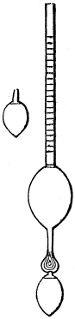
The hydrometer constructed, under the directions of the Commissioners of Excise, by Mr. Bate, has a scale of 4 inches in length divided into 100 parts, and 9 weights. It has thus a range of 900 divisions, and expresses specific gravities at the temperature of 62° Fahr. In order to render this instrument so accurate a measurer of the specific gravity, at the standard temperature, as to involve no error of an appreciable amount, Mr. Bate has constructed the weights (which in this instrument are immersed in the fluid of different specific gravities) so that each successive weight should have an increase of bulk over the preceding weight equal to that part of the stem occupied by the scale, and an increase of weight sufficient to take the whole of the scale, and no more, down to the liquid. This arrangement requires great accuracy of workmanship, and enhances the price of the instrument. But it allows of increased strength in the ball, where it is very much required, and it gives, upon inspection only, the indication (apparent specific gravity) by which the general table is to be examined and the result ascertained. Fig. 5. represents this instrument and two of its nine ballast weights. It comprehends all specific gravities between 820 and 1000. It indicates true specific gravity with almost perfect accuracy at the temperature of 62° Fahr.; but it does not exclude other instruments from being used in conjunction with tables. The latter are, in fact, independent of the instrument, and may be used with gravimeters, or any instrument affording indications by specific gravity at a given temperature.
The commercial value of spirituous liquors being much lower in France than in England, a less sensible instrument becomes sufficient for the wants of that country. Baumé’s and Cartier’s hydrometers, with short arbitrary scales, are very much employed, but they have been lately superseded by an ingenious and ready instrument contrived by M. Gay Lussac, and called by him an alcoomètre. He takes for the term of comparison pure alcohol by volume, at the temperature of 15° Cent., and represents the strength of it by 100 centimes, or by unity. Consequently, the strength of a spirituous liquid is the number of centimes in volume of pure alcohol which that liquid contains at the temperature of 15° Cent. The instrument is formed like a common hydrometer, and is graduated for the temperature of 15° Cent. Its scale is divided into 100 parts or degrees, each of which denotes a centime of alcohol; the division 0 at the bottom of the stem corresponds to pure water, and the division 100 at its top, to pure alcohol. When immersed in a spirituous liquor at 15° Cent. (59° Fahr.) it announces its strength directly. For example: if in spirits supposed at the temperature of 15° Cent. it sinks to the division 50, it indicates that the strength of this liquor is 50 per cent., or that it contains 50 centimes of pure alcohol. In our new British proof spirit, it would sink to nearly 57, indicating 57 by volume of pure alcohol, allowing for condensation, or 50 by weight. A table of correction is given for temperature, which he calls “Table of real strength of spirituous liquors.” The first vertical column of this table contains the temperatures, from 0° to 30° Cent., and the first horizontal line the indications of the alcoomètre. In the same table we have most ingeniously inserted a correction for the volume of the spirits when the temperature differs from 15° Cent. If we take 1000 litres or gallons, measured at the temperature of 2°, of a spirituous liquor whose apparent strength is 44c; its real strength at 15° will from the preceding mode of correction be 49c. On heating this liquid to 15°, in order to find its real specific gravity or strength, its bulk will become greater; and, instead of 1000 litres or gallons, which it measured at 2°, we shall have 1009 at 15° C. This number is inscribed in smaller characters in the same square cell with the real force, precisely under 49c. All the numbers in small characters, printed under each real strength, indicate the volume which 1000 litres of a spirituous liquor would have, when measured at the temperature at which its apparent strength is taken. In the above example, the quantity in litres or gallons of pure alcohol contained in 1000 litres or gallons of the spirits, measured at the temperature of 2°, will be, therefore,—1009 lit. × 0·49 = 494 lit. 41.
This quantity of pure alcohol, thus estimated, is called richness of spirit in alcohol, or simply richness.
Let us take an example similar to the preceding, but at a higher temperature than 15° Cent. Suppose we have 1000 litres measured, at the temperature of 25°, of spirits whose apparent strength is 53c, what is the real quantity of pure alcohol which this spirit contains at the temperature of 15°? We shall find in the table, first of all, that the real strength of the spirits is 49c·3. As to its bulk or volume, it is very clear that the 1000 litres in cooling from 25° to 15°, will occupy a smaller space. This volume will be 993 litres; it is inscribed directly below 49c·3, the real strength. We shall therefore have of pure alcohol, contained in the 1000 litres of spirits, measured at the temperature of 25°, or their richness, 993 lit. × 0·493 = 489 lit. 55.
Alcometrical Table of real Strength, by M. Gay Lussac.
Tem- pera- ture C. 31c 32c 33c 34c 35c 36c 37c 38c 39c 40c 41c 42c 43c 44c 45c 46c 47c 48c 49c 50c 51c 52c 53c 54c 55c 56c 57c 58c 59c 60c 61c 62c 63c 64c 65c 66c 67c 68c 69c 70c 71c 72c 73c 74c 75c 76c 77c 78c 79c 80c 81c 82c 83c 84c 85c 86c 87c 88c 89c 90c
Deg.
10 33·0 34 35 36 37 38 39 40 41 42 43 44 45 46 46·9 47·9 48·9 49·9 50·9 51·8 52·8 53·8 54·8 55·8 56·8 57·8 58·8 59·7 60·7 61·7 62·7 63·7 64·7 65·7 66·7 67·6 68·6 69·6 70·6 71·6 72·6 73·5 74·5 75·5 76·5 77·5 78·5 79·5 80·5 81·5 82·4 83·4 84·4 85·4 86·4 87·4 88·3 89·3 90·2 91·2
1002 1002 1003 1003 1003 1003 1003 1003 1003 1003 1003 1004 1004 1004 1004 1004 1004 1004 1004 1004 1004 1004 1004 1004 1004 1004 1004 1004 1004 1004 1004 1004 1004 1004 1004 1004 1004 1004 1004 1004 1004 1004 1005 1005 1005 1005 1005 1005 1005 1005 1005 1005 1005 1005 1005 1005 1005 1005 1005 1005
11 32·6 33·6 34·6 35·6 36·6 37·6 38·6 39·6 40·6 41·6 42·6 43·6 44·6 45·6 46·6 47·6 48·6 49·5 50·5 51·5 52·5 53·5 54·4 55·4 56·4 57·4 58·4 59·4 60·4 61·4 62·4 63·4 64·4 65·4 66·4 67·3 68·3 69·3 70·3 71·3 72·3 73·2 74·2 75·2 76·2 77·2 78·2 79·2 80·2 81·2 82·2 83·1 84·1 85·1 86·1 87·1 88 89 90 91
1002 1002 1002 1002 1002 1002 1002 1002 1003 1003 1003 1003 1003 1003 1003 1003 1003 1003 1003 1003 1003 1003 1003 1003 1003 1003 1003 1003 1003 1003 1003 1003 1003 1003 1003 1003 1003 1004 1004 1004 1004 1004 1004 1004 1004 1004 1004 1004 1004 1004 1004 1004 1004 1004 1004 1004 1004 1004 1004 1004
12 32·2 33·2 34·2 35·2 36·2 37·2 38·2 39·2 40·2 41·2 42·2 43·2 44·2 45·2 46·2 47·2 48·2 49·2 50·2 51·1 52·1 53·1 54·1 55 56 57 58 59 60 61 62 63 64 65 66 67 68 69 70 71 72 72·9 73·9 74·9 75·9 76·9 77·9 78·9 79·9 80·9 81·9 82·9 83·9 84·8 85·8 86·8 87·8 88·7 89·7 90·7
1001 1001 1002 1002 1002 1002 1002 1002 1002 1002 1002 1002 1002 1002 1002 1002 1002 1002 1002 1002 1002 1002 1002 1002 1002 1002 1002 1002 1002 1002 1002 1002 1002 1002 1002 1002 1003 1003 1003 1003 1003 1003 1003 1003 1003 1003 1003 1003 1003 1003 1003 1003 1003 1003 1003 1003 1003 1003 1003 1003
13 31·8 32·8 33·8 34·8 35·8 36·8 37·8 38·8 39·8 40·8 41·8 42·8 43·8 44·8 45·8 46·8 47·8 48·8 49·8 50·8 51·8 52·7 53·7 54·7 55·7 56·7 57·7 58·7 59·7 60·7 61·7 62·7 63·7 64·7 65·7 66·7 67·7 68·7 69·6 70·6 71·6 72·6 73·6 74·6 75·6 76·6 77·6 78·6 79·6 80·6 81·6 82·6 83·6 84·6 85·5 86·5 87·5 88·5 89·5 90·5
1001 1001 1001 1001 1001 1001 1001 1001 1001 1001 1001 1001 1001 1002 1002 1002 1002 1002 1002 1002 1002 1002 1002 1002 1002 1002 1002 1002 1002 1002 1002 1002 1002 1002 1002 1002 1002 1002 1002 1002 1002 1002 1002 1002 1092 1002 1002 1002 1002 1002 1002 1002 1002 1002 1002 1002 1002 1002 1002 1002
14 31·4 32·4 33·4 34·4 35·4 36·4 37·4 38·4 39·4 40·4 41·4 42·4 43·4 44·4 45·4 46·4 47·4 48·4 49·4 50·4 51·4 52·3 53·3 54·3 55·3 56·3 57·3 58·3 59·3 60·3 61·3 62·3 63·3 64·3 65·3 66·3 67·3 68·3 69·3 70·3 71·3 72·3 73·3 74·3 75·3 76·3 77·3 78·3 79·3 80·3 81·3 82·3 83·3 84·3 85·3 86·3 87·3 88·2 89·2 90·2
1001 1001 1001 1001 1001 1001 1001 1001 1001 1001 1001 1001 1001 1001 1001 1001 1001 1001 1001 1000 1001 1001 1001 1001 1001 1001 1001 1001 1001 1001 1001 1001 1001 1001 1001 1001 1001 1001 1001 1001 1001 1001 1001 1001 1001 1001 1001 1001 1001 1001 1001 1001 1001 1001 1001 1001 1001 1001 1001 1001
15 31 32 33 34 35 36 37 38 39 40 41 42 43 44 45 46 47 48 49 50 51 52 53 54 55 56 57 58 59 60 61 62 63 64 65 66 67 68 69 70 71 72 73 74 75 76 77 78 79 80 81 82 83 84 85 86 87 88 89 90
1000 1000 1000 1000 1000 1000 1000 1000 1000 1000 1000 1000 1000 1000 1000 1000 1000 1000 1000 1000 1000 1000 1000 1000 1000 1000 1000 1000 1000 1000 1000 1000 1000 1000 1000 1000 1000 1000 1000 1000 1000 1000 1000 1000 1000 1000 1000 1000 1000 1000 1000 1000 1000 1000 1000 1000 1000 1000 1000 1000
16 30·6 31·6 32·5 33·5 34·5 35·5 36·5 37·5 38·5 39·5 40·6 41·6 42·6 43·6 44·6 45·6 46·6 47·6 48·6 49·6 50·6 51·6 52·6 53·6 54·6 55·6 56·6 57·6 58·6 59·6 60·6 61·7 62·7 63·7 64·7 65·7 66·7 67·7 68·7 69·7 70·7 71·7 72·7 73·7 74·7 75·7 76·7 77·7 78·7 79·7 80·7 81·7 82·7 83·7 84·7 85·7 86·7 87·7 88·7 89·7
1000 1000 999 999 999 999 999 999 999 999 999 999 999 999 999 999 999 999 999 999 999 999 999 999 999 999 999 999 999 999 999 999 999 999 999 999 999 999 999 999 999 999 999 999 999 999 999 999 999 999 999 999 999 999 999 999 999 999 999 999
17 30·2 31·2 32·1 33·1 34·1 35·1 36·1 37·1 38·1 39·1 40·2 41·2 42·2 43·2 44·9 45·2 46·2 47·2 48·2 49·2 50·3 51·3 52·3 53·3 54·3 55·3 56·3 57·3 58·3 59·3 60·3 61·3 62·3 63·3 64·3 65·3 66·3 67·3 68·3 69·3 70·3 71·3 72·3 73·3 74·3 75·4 76·4 77·4 78·4 79·4 80·4 81·4 82·4 83·4 84·4 85·4 86·4 87·4 88·4 89·5
999 999 999 999 999 999 999 999 999 999 999 999 999 998 998 998 998 998 998 998 998 998 998 998 998 998 998 998 998 998 998 998 998 998 998 998 998 998 998 998 998 998 998 998 998 998 998 998 998 998 998 998 998 998 998 998 998 998 998 998
18 29·8 30·8 31·7 32·7 33·7 34·7 35·7 36·7 37·7 38·7 39·8 40·8 41·8 42·8 43·8 44·9 45·9 46·9 47·9 48·9 49·9 50·9 51·9 52·9 53·9 54·9 55·9 56·9 57·9 58·9 59·9 61 62 63 64 65 66 67 68 69 70 71 72 73 74 75·1 76·1 77·1 78·1 79·1 80·1 81·1 82·1 83·1 84·1 85·2 86·2 87·2 88·2 89·2
999 999 998 998 998 998 998 998 998 998 998 998 998 998 998 998 998 998 998 998 998 998 998 998 998 998 998 997 997 997 997 997 997 997 997 997 997 997 997 997 997 997 997 997 997 997 997 997 997 997 997 997 997 997 997 997 997 997 997 997
19 29·4 30·4 31·3 32·3 33·3 34·3 35·3 36·3 37·3 38·3 39·4 40·4 41·4 42·5 43·5 44·5 45·5 46·5 47·5 48·5 49·5 50·6 51·6 52·6 53·6 54·6 55·6 56·6 57·6 58·6 59·6 60·6 61·6 62·7 63·7 64·7 65·7 66·7 67·7 68·7 69·7 70·7 71·7 72·7 73·7 74·7 75·8 76·8 77·8 78·8 79·8 80·8 81·9 82·9 83·9 84·9 85·9 86·9 87·9 88·9
998 998 998 998 998 998 998 998 997 997 997 997 997 997 997 997 997 997 997 997 997 997 997 997 997 997 997 997 997 997 997 997 997 997 997 997 997 997 996 996 996 996 996 996 996 996 996 996 996 996 996 996 996 996 996 996 996 996 996 996
20 29 30 30·9 31·9 32·9 33·9 34·9 35·9 36·9 37·9 39 40 41 42·1 43·1 44·1 45·1 46·1 47·2 48·2 49·2 50·2 51·2 52·2 53·2 54·2 55·2 56·2 57·2 58·2 59·2 60·3 61·3 62·3 63·3 64·3 65·4 66·4 67·4 68·4 69·4 70·4 71·4 72·4 73·4 74·4 75·5 76·5 77·5 78·5 79·5 80·5 81·6 82·6 83·6 84·6 85·6 86·6 87·7 88·7
998 998 997 997 997 997 997 997 997 997 997 997 997 997 996 996 996 996 996 996 996 996 996 996 996 996 996 996 996 996 996 996 996 996 996 996 996 996 996 996 996 996 995 995 995 995 995 995 995 995 995 995 995 995 995 995 995 995 995 995
21 28·6 29·6 30·5 31·5 32·5 33·5 34·5 35·5 36·5 37·5 38·6 39·6 40·6 41·7 42·7 43·7 44·8 45·8 46·8 47·8 48·8 49·8 50·8 51·8 52·9 53·9 54·9 55·9 56·9 57·9 58·9 59·9 61 62 63 64 65 66 67 68·1 69·1 70·1 71·1 72·1 73·1 74·1 75·2 76·2 77·2 78·2 79·2 80·2 81·3 82·3 83·3 84·3 85·3 86·4 87·4 88·4
997 997 997 997 997 997 997 996 996 996 996 996 996 996 996 996 996 996 995 995 995 995 995 995 995 995 995 995 995 995 995 995 995 995 995 995 995 995 995 995 995 995 995 994 994 994 994 994 994 994 994 994 994 994 994 994 994 994 994 994
22 28·2 29·2 30·1 31·1 32·1 33·1 34·1 35·1 36·1 37·1 38·2 39·2 40·2 41·3 42·3 43·3 44·3 45·3 46·4 47·4 48·4 49·4 50·4 51·4 52·5 53·5 54·5 55·5 56·5 57·5 58·5 59·5 60·6 61·6 62·7 63·7 64·7 65·7 66·7 67·7 68·8 69·8 70·8 71·8 72·8 73·8 74·8 75·9 76·9 77·9 78·9 79·9 81 82 83 84 85 86·1 87·1 88·2
997 997 996 996 996 996 996 996 996 996 996 995 995 995 995 995 995 995 995 995 995 995 995 994 994 994 994 994 994 994 994 994 994 994 994 994 994 994 994 994 994 994 994 994 993 993 993 993 993 993 993 993 993 993 993 993 993 993 993 993
23 27·8 28·8 29·7 30·7 31·7 32·7 33·7 34·7 35·7 36·7 37·8 38·8 39·8 40·9 41·9 42·9 43·9 44·9 46 47 48 49·1 50·1 51·1 52·1 53·1 54·1 55·1 56·1 57·1 58·1 59·2 60·2 61·3 62·3 63·3 64·3 65·4 66·4 67·4 68·4 69·4 70·5 71·5 72·5 73·5 74·5 75·5 76·6 77·6 78·6 79·6 80·7 81·7 82·7 83·8 84·8 85·8 86·8 87·9
996 996 996 996 996 996 996 995 995 995 995 995 995 994 994 994 994 994 994 994 994 994 994 994 994 994 994 993 993 993 993 993 993 993 993 993 993 993 993 993 993 993 993 993 992 992 992 992 992 992 992 992 992 992 992 992 992 992 992 992
24 27·4 28·4 29·3 30·3 31·3 32·3 33·3 34·3 35·3 36·3 37·4 38·4 39·4 40·5 41·5 42·5 43·6 44·6 45·6 46·6 47·6 48·7 49·7 50·7 51·8 52·8 53·8 54·8 55·8 56·8 57·8 58·9 59·9 61 62 63 64 65 66 67·1 68·1 69·1 70·1 71·2 72·2 73·2 74·2 75·2 76·3 77·3 78·3 79·3 80·4 81·4 82·4 83·5 84·5 85·5 86·5 87·6
996 996 995 995 995 995 995 995 995 994 994 994 994 994 994 994 994 994 993 993 993 993 993 693 993 993 993 993 993 992 992 992 992 992 992 992 992 992 992 992 992 992 992 992 992 992 992 991 991 991 991 991 991 991 991 991 991 991 991 991
25 27 28 28·9 29·9 30·9 31·9 32·9 33·9 34·9 35·9 37 38 39 40·1 42·1 42·2 43·2 44·2 45·2 46·3 47·3 48·3 49·3 50·3 51·4 52·4 53·4 54·4 55·5 56·5 57·5 58·5 59·5 60·6 61·6 62·6 63·7 64·7 65·7 66·7 67·8 68·8 69·8 70·8 71·8 72·8 73·9 74·9 76 77 78 79 80·1 81·1 82·1 83·2 84·2 85·2 86·3 87·4
995 995 995 995 995 994 994 994 994 994 994 994 993 993 993 993 993 993 993 993 993 993 993 992 992 992 992 992 992 992 992 992 992 991 991 991 991 991 991 991 991 991 991 991 991 991 991 991 991 991 991 991 990 990 990 990 990 990 990 990
Tem- pera- ture C. 31c 32c 33c 34c 35c 36c 37c 38c 39c 40c 41c 42c
Deg.
10 33·0 34 35 36 37 38 39 40 41 42 43 44
1002 1002 1003 1003 1003 1003 1003 1003 1003 1003 1003 1004
11 32·6 33·6 34·6 35·6 36·6 37·6 38·6 39·6 40·6 41·6 42·6 43·6
1002 1002 1002 1002 1002 1002 1002 1002 1003 1003 1003 1003
12 32·2 33·2 34·2 35·2 36·2 37·2 38·2 39·2 40·2 41·2 42·2 43·2
1001 1001 1002 1002 1002 1002 1002 1002 1002 1002 1002 1002
13 31·8 32·8 33·8 34·8 35·8 36·8 37·8 38·8 39·8 40·8 41·8 42·8
1001 1001 1001 1001 1001 1001 1001 1001 1001 1001 1001 1001
14 31·4 32·4 33·4 34·4 35·4 36·4 37·4 38·4 39·4 40·4 41·4 42·4
1001 1001 1001 1001 1001 1001 1001 1001 1001 1001 1001 1001
15 31 32 33 34 35 36 37 38 39 40 41 42
1000 1000 1000 1000 1000 1000 1000 1000 1000 1000 1000 1000
16 30·6 31·6 32·5 33·5 34·5 35·5 36·5 37·5 38·5 39·5 40·6 41·6
1000 1000 999 999 999 999 999 999 999 999 999 999
17 30·2 31·2 32·1 33·1 34·1 35·1 36·1 37·1 38·1 39·1 40·2 41·2
999 999 999 999 999 999 999 999 999 999 999 999
18 29·8 30·8 31·7 32·7 33·7 34·7 35·7 36·7 37·7 38·7 39·8 40·8
999 999 998 998 998 998 998 998 998 998 998 998
19 29·4 30·4 31·3 32·3 33·3 34·3 35·3 36·3 37·3 38·3 39·4 40·4
998 998 998 998 998 998 998 998 997 997 997 997
20 29 30 30·9 31·9 32·9 33·9 34·9 35·9 36·9 37·9 39 40
998 998 997 997 997 997 997 997 997 997 997 997
21 28·6 29·6 30·5 31·5 32·5 33·5 34·5 35·5 36·5 37·5 38·6 39·6
997 997 997 997 997 997 997 996 996 996 996 996
22 28·2 29·2 30·1 31·1 32·1 33·1 34·1 35·1 36·1 37·1 38·2 39·2
997 997 996 996 996 996 996 996 996 996 996 995
23 27·8 28·8 29·7 30·7 31·7 32·7 33·7 34·7 35·7 36·7 37·8 38·8
996 996 996 996 996 996 996 995 995 995 995 995
24 27·4 28·4 29·3 30·3 31·3 32·3 33·3 34·3 35·3 36·3 37·4 38·4
996 996 995 995 995 995 995 995 995 994 994 994
25 27 28 28·9 29·9 30·9 31·9 32·9 33·9 34·9 35·9 37 38
995 995 995 995 995 994 994 994 994 994 994 994
Tem- pera- ture C. 43c 44c 45c 46c 47c 48c 49c 50c 51c 52c 53c 54c
Deg.
10 45 46 46·9 47·9 48·9 49·9 50·9 51·8 52·8 53·8 54·8 55·8
1004 1004 1004 1004 1004 1004 1004 1004 1004 1004 1004 1004
11 44·6 45·6 46·6 47·6 48·6 49·5 50·5 51·5 52·5 53·5 54·4 55·4
1003 1003 1003 1003 1003 1003 1003 1003 1003 1003 1003 1003
12 44·2 45·2 46·2 47·2 48·2 49·2 50·2 51·1 52·1 53·1 54·1 55
1002 1002 1002 1002 1002 1002 1002 1002 1002 1002 1002 1002
13 43·8 44·8 45·8 46·8 47·8 48·8 49·8 50·8 51·8 52·7 53·7 54·7
1001 1002 1002 1002 1002 1002 1002 1002 1002 1002 1002 1002
14 43·4 44·4 45·4 46·4 47·4 48·4 49·4 50·4 51·4 52·3 53·3 54·3
1001 1001 1001 1001 1001 1001 1001 1000 1001 1001 1001 1001
15 43 44 45 46 47 48 49 50 51 52 53 54
1000 1000 1000 1000 1000 1000 1000 1000 1000 1000 1000 1000
16 42·6 43·6 44·6 45·6 46·6 47·6 48·6 49·6 50·6 51·6 52·6 53·6
999 999 999 999 999 999 999 999 999 999 999 999
17 42·2 43·2 44·9 45·2 46·2 47·2 48·2 49·2 50·3 51·3 52·3 53·3
999 998 998 998 998 998 998 998 998 998 998 998
18 41·8 42·8 43·8 44·9 45·9 46·9 47·9 48·9 49·9 50·9 51·9 52·9
998 998 998 998 998 998 998 998 998 998 998 998
19 41·4 42·5 43·5 44·5 45·5 46·5 47·5 48·5 49·5 50·6 51·6 52·6
997 997 997 997 997 997 997 997 997 997 997 997
20 41 42·1 43·1 44·1 45·1 46·1 47·2 48·2 49·2 50·2 51·2 52·2
997 997 996 996 996 996 996 996 996 996 996 996
21 40·6 41·7 42·7 43·7 44·8 45·8 46·8 47·8 48·8 49·8 50·8 51·8
996 996 996 996 996 996 995 995 995 995 995 995
22 40·2 41·3 42·3 43·3 44·3 45·3 46·4 47·4 48·4 49·4 50·4 51·4
995 995 995 995 995 995 995 995 995 995 995 994
23 39·8 40·9 41·9 42·9 43·9 44·9 46 47 48 49·1 50·1 51·1
995 994 994 994 994 994 994 994 994 994 994 994
24 39·4 40·5 41·5 42·5 43·6 44·6 45·6 46·6 47·6 48·7 49·7 50·7
994 994 994 994 994 994 993 993 993 993 993 693
25 39 40·1 42·1 42·2 43·2 44·2 45·2 46·3 47·3 48·3 49·3 50·3
993 993 993 993 993 993 993 993 993 993 993 992
Tem- pera- ture C. 55c 56c 57c 58c 59c 60c 61c 62c 63c 64c 65c 66c
Deg.
10 56·8 57·8 58·8 59·7 60·7 61·7 62·7 63·7 64·7 65·7 66·7 67·6
1004 1004 1004 1004 1004 1004 1004 1004 1004 1004 1004 1004
11 56·4 57·4 58·4 59·4 60·4 61·4 62·4 63·4 64·4 65·4 66·4 67·3
1003 1003 1003 1003 1003 1003 1003 1003 1003 1003 1003 1003
12 56 57 58 59 60 61 62 63 64 65 66 67
1002 1002 1002 1002 1002 1002 1002 1002 1002 1002 1002 1002
13 55·7 56·7 57·7 58·7 59·7 60·7 61·7 62·7 63·7 64·7 65·7 66·7
1002 1002 1002 1002 1002 1002 1002 1002 1002 1002 1002 1002
14 55·3 56·3 57·3 58·3 59·3 60·3 61·3 62·3 63·3 64·3 65·3 66·3
1001 1001 1001 1001 1001 1001 1001 1001 1001 1001 1001 1001
15 55 56 57 58 59 60 61 62 63 64 65 66
1000 1000 1000 1000 1000 1000 1000 1000 1000 1000 1000 1000
16 54·6 55·6 56·6 57·6 58·6 59·6 60·6 61·7 62·7 63·7 64·7 65·7
999 999 999 999 999 999 999 999 999 999 999 999
17 54·3 55·3 56·3 57·3 58·3 59·3 60·3 61·3 62·3 63·3 64·3 65·3
998 998 998 998 998 998 998 998 998 998 998 998
18 53·9 54·9 55·9 56·9 57·9 58·9 59·9 61 62 63 64 65
998 998 998 997 997 997 997 997 997 997 997 997
19 53·6 54·6 55·6 56·6 57·6 58·6 59·6 60·6 61·6 62·7 63·7 64·7
997 997 997 997 997 997 997 997 997 997 997 997
20 53·2 54·2 55·2 56·2 57·2 58·2 59·2 60·3 61·3 62·3 63·3 64·3
996 996 996 996 996 996 996 996 996 996 996 996
21 52·9 53·9 54·9 55·9 56·9 57·9 58·9 59·9 61 62 63 64
995 995 995 995 995 995 995 995 995 995 995 995
22 52·5 53·5 54·5 55·5 56·5 57·5 58·5 59·5 60·6 61·6 62·7 63·7
994 994 994 994 994 994 994 994 994 994 994 994
23 52·1 53·1 54·1 55·1 56·1 57·1 58·1 59·2 60·2 61·3 62·3 63·3
994 994 994 993 993 993 993 993 993 993 993 993
24 51·8 52·8 53·8 54·8 55·8 56·8 57·8 58·9 59·9 61 62 63
993 993 993 993 993 992 992 992 992 992 992 992
25 51·4 52·4 53·4 54·4 55·5 56·5 57·5 58·5 59·5 60·6 61·6 62·6
992 992 992 992 992 992 992 992 992 991 991 991
Tem- pera- ture C. 67c 68c 69c 70c 71c 72c 73c 74c 75c 76c 77c 78c
Deg.
10 68·6 69·6 70·6 71·6 72·6 73·5 74·5 75·5 76·5 77·5 78·5 79·5
1004 1004 1004 1004 1004 1004 1005 1005 1005 1005 1005 1005
11 68·3 69·3 70·3 71·3 72·3 73·2 74·2 75·2 76·2 77·2 78·2 79·2
1003 1004 1004 1004 1004 1004 1004 1004 1004 1004 1004 1004
12 68 69 70 71 72 72·9 73·9 74·9 75·9 76·9 77·9 78·9
1003 1003 1003 1003 1003 1003 1003 1003 1003 1003 1003 1003
13 67·7 68·7 69·6 70·6 71·6 72·6 73·6 74·6 75·6 76·6 77·6 78·6
1002 1002 1002 1002 1002 1002 1002 1002 1092 1002 1002 1002
14 67·3 68·3 69·3 70·3 71·3 72·3 73·3 74·3 75·3 76·3 77·3 78·3
1001 1001 1001 1001 1001 1001 1001 1001 1001 1001 1001 1001
15 67 68 69 70 71 72 73 74 75 76 77 78
1000 1000 1000 1000 1000 1000 1000 1000 1000 1000 1000 1000
16 66·7 67·7 68·7 69·7 70·7 71·7 72·7 73·7 74·7 75·7 76·7 77·7
999 999 999 999 999 999 999 999 999 999 999 999
17 66·3 67·3 68·3 69·3 70·3 71·3 72·3 73·3 74·3 75·4 76·4 77·4
998 998 998 998 998 998 998 998 998 998 998 998
18 66 67 68 69 70 71 72 73 74 75·1 76·1 77·1
997 997 997 997 997 997 997 997 997 997 997 997
19 65·7 66·7 67·7 68·7 69·7 70·7 71·7 72·7 73·7 74·7 75·8 76·8
997 997 996 996 996 996 996 996 996 996 996 996
20 65·4 66·4 67·4 68·4 69·4 70·4 71·4 72·4 73·4 74·4 75·5 76·5
996 996 996 996 996 996 995 995 995 995 995 995
21 65 66 67 68·1 69·1 70·1 71·1 72·1 73·1 74·1 75·2 76·2
995 995 995 995 995 995 995 994 994 994 994 994
22 64·7 65·7 66·7 67·7 68·8 69·8 70·8 71·8 72·8 73·8 74·8 75·9
994 994 994 994 994 994 994 994 993 993 993 993
23 64·3 65·4 66·4 67·4 68·4 69·4 70·5 71·5 72·5 73·5 74·5 75·5
993 993 993 993 993 993 993 993 992 992 992 992
24 64 65 66 67·1 68·1 69·1 70·1 71·2 72·2 73·2 74·2 75·2
992 992 992 992 992 992 992 992 992 992 992 991
25 63·7 64·7 65·7 66·7 67·8 68·8 69·8 70·8 71·8 72·8 73·9 74·9
991 991 991 991 991 991 991 991 991 991 991 991
Tem- pera- ture C. 79c 80c 81c 82c 83c 84c 85c 86c 87c 88c 89c 90c
Deg.
10 80·5 81·5 82·4 83·4 84·4 85·4 86·4 87·4 88·3 89·3 90·2 91·2
1005 1005 1005 1005 1005 1005 1005 1005 1005 1005 1005 1005
11 80·2 81·2 82·2 83·1 84·1 85·1 86·1 87·1 88 89 90 91
1004 1004 1004 1004 1004 1004 1004 1004 1004 1004 1004 1004
12 79·9 80·9 81·9 82·9 83·9 84·8 85·8 86·8 87·8 88·7 89·7 90·7
1003 1003 1003 1003 1003 1003 1003 1003 1003 1003 1003 1003
13 79·6 80·6 81·6 82·6 83·6 84·6 85·5 86·5 87·5 88·5 89·5 90·5
1002 1002 1002 1002 1002 1002 1002 1002 1002 1002 1002 1002
14 79·3 80·3 81·3 82·3 83·3 84·3 85·3 86·3 87·3 88·2 89·2 90·2
1001 1001 1001 1001 1001 1001 1001 1001 1001 1001 1001 1001
15 79 80 81 82 83 84 85 86 87 88 89 90
1000 1000 1000 1000 1000 1000 1000 1000 1000 1000 1000 1000
16 78·7 79·7 80·7 81·7 82·7 83·7 84·7 85·7 86·7 87·7 88·7 89·7
999 999 999 999 999 999 999 999 999 999 999 999
17 78·4 79·4 80·4 81·4 82·4 83·4 84·4 85·4 86·4 87·4 88·4 89·5
998 998 998 998 998 998 998 998 998 998 998 998
18 78·1 79·1 80·1 81·1 82·1 83·1 84·1 85·2 86·2 87·2 88·2 89·2
997 997 997 997 997 997 997 997 997 997 997 997
19 77·8 78·8 79·8 80·8 81·9 82·9 83·9 84·9 85·9 86·9 87·9 88·9
996 996 996 996 996 996 996 996 996 996 996 996
20 77·5 78·5 79·5 80·5 81·6 82·6 83·6 84·6 85·6 86·6 87·7 88·7
995 995 995 995 995 995 995 995 995 995 995 995
21 77·2 78·2 79·2 80·2 81·3 82·3 83·3 84·3 85·3 86·4 87·4 88·4
994 994 994 994 994 994 994 994 994 994 994 994
22 76·9 77·9 78·9 79·9 81 82 83 84 85 86·1 87·1 88·2
993 993 993 993 993 993 993 993 993 993 993 993
23 76·6 77·6 78·6 79·6 80·7 81·7 82·7 83·8 84·8 85·8 86·8 87·9
992 992 992 992 992 992 992 992 992 992 992 992
24 76·3 77·3 78·3 79·3 80·4 81·4 82·4 83·5 84·5 85·5 86·5 87·6
991 991 991 991 991 991 991 991 991 991 991 991
25 76 77 78 79 80·1 81·1 82·1 83·2 84·2 85·2 86·3 87·4
991 991 991 991 990 990 990 990 990 990 990 990
I consider the preceding table, which I have extracted from the longer tables of M. Gay Lussac, as an important addition to the resources of British dealers and manufacturing chemists. With the aid of his little instrument, which may be got for a trifle from its ingenious maker, M. Collardeau, Rue Faubourg St. Martin, at Paris, or constructed by one of the London hydrometer artists, the per centage of real alcohol, and the real value of any spirituous liquor, may be determined to sufficient nicety for most purposes, in a far easier manner than by any instruments now used in this country. It has been adopted by the Swedish government, with M. Gay Lussac’s tables.
M. Gay Lussac’s table gives, by inspection, the true bulk of the spirits as corrected for temperature; that is, their volume, if of the normal temperature of 15° Cent. (59° Fahr.). Now this is important information; for, if a person buys 1000 gallons of spirits in hot weather, and pays for them exactly according to their strength corrected for temperature, he will not have 1000 gallons when the weather is in its mean state. He may lose, in this way, several gallons without being aware of it from his hydrometer.
Sometimes, after moist autumns, when damaged grain abounds, the alcohol distilled from its fermented wash contains a peculiar volatile body. When we apply our nose to this species of spirits in its hot state, the volatile substance dissolved in it irritates the eyes and nostrils: it has very nearly the same smell as an alcoholic solution of cyanogen, as any chemist may discover by standing near the discharge pipe of the refrigeratory worm of a raw-grain whisky still. Such spirits intoxicate more strongly than pure spirits of the same strength, and excite, in many persons, even temporary frenzy. It is a volatile fatty matter, of a very fetid odour, when obtained by itself, as I have procured it in cold weather at some of the great distilleries in Scotland. It does not combine with bases. At the end of a few months, it spontaneously decomposes in the spirits, and leaves them in a less nauseous and noxious state. By largely diluting the spirits with water, and distilling at a moderate temperature, the greater part of this oil may be separated. Part of it comes over with the strongest alcohol, and part with the latter runnings, which are called by the distillers strong and weak feints. The intermediate portion is purer spirit. The feints are always more or less opalescent, or become so on dilution with water, and then throw up an oily pellicle upon their surface. The charcoals of light wood, such as pine or willow, well calcined, and infused in sufficient quantity with the spirits prior to rectification, will deprive them of the greater part of that oily contamination. Animal charcoal, well calcined, has also been found useful; but it must be macerated for some time with the empyreumatic spirits, before distillation. Another mode of separating that offensive oil is, to agitate the impure spirits with a quantity of a fat oil, such as olive oil, or oil of almonds, to decant off the oil, and re-distil the spirits with a little water.
Some foreign chemists direct empyreumatic or rank spirits, to be rectified with the addition of chloride of lime. I have tried this method in every way, and on a considerable scale, but never found the spirits to be improved by it. They were rather deteriorated. See Brandy, Distillation, Fermentation, Gin, Rum, Whisky.
Anhydrous or absolute alcohol, when swallowed, acts as a mortal poison, not only by its peculiar stimulus on the nervous system, but by its abstracting the aqueous particles from the soft tissue of the stomach, with which it comes in contact, so as to destroy its organisation. Alcohol of 0·812 consists, by experiments, of 3 atoms of carbon, 6 of hydrogen, and 2 of oxygen; absolute alcohol consists, probably, of 2 of carbon, 3 of hydrogen, and 1 of oxygen.
ALE. The fermented infusion of pale malted barley, usually combined with infusion of hops. See Beer.
ALEMBIC, a Still; which see.
ALEMBROTH, salt of. The salt of wisdom, of the alchemists; a compound of bichloride of mercury and sal ammoniac, from which the old white precipitate of mercury is made.
ALGAROTH, powder of. A compound of oxide and chloride of antimony, being a precipitate obtained by pouring water into the acidulous chloride of that metal.
ALIZARINE. See Madder.
ALKALI. A class of chemical bodies, distinguished chiefly by their solubility in water, and their power of neutralising acids, so as to form saline compounds. The alkalis of manufacturing importance are, ammonia, potash, soda, and quinia. These alkalis change the purple colour of red cabbage and radishes to a green, the reddened tincture of litmus to a purple, and the colour of turmeric and many other yellow dyes to a brown. Even when combined with carbonic acid, the first three alkalis exercise this discolouring power, which the alkaline earths, lime and barytes, do not. The same three alkalis have an acrid, and somewhat urinous taste; the first two are energetic solvents of animal matter; and the three combine with oils, so as to form soaps. They unite with water in every proportion, and also with alcohol; and the first three combine with water after being carbonated.
ALKALIMETER. An instrument for measuring the alkaline force or purity of any of the alkalis of commerce. It is founded on the principle, that the quantity of real alkali present in any sample, is proportional to the quantity of acid which a given weight of it can neutralize. See the individual alkalis, Potash, and Soda.
ALKANA, is the name of the root and leaves of Lausania inermis, which have been long employed in the East, to dye the nails, teeth, hair, garments, &c. The leaves, ground and mixed with a little limewater, serve for dyeing the tails of horses in Persia and Turkey.
ALKANET, the root of. (Anchusa tinctoria.) A species of bugloss, cultivated chiefly in the neighbourhood of Montpellier. It affords a fine red colour to alcohol and oils; but a dirty red to water. Its principal use is for colouring ointments, cheeses, and pommades. The spirituous tincture gives to white marble a beautiful deep stain.
ALLIGATION. An arithmetical formula, useful, on many occasions, for ascertaining the proportion of constituents in a mixture, when they have undergone no change of volume by chemical action. When alcoholic liquors are mixed with water, there is a condensation of bulk, which renders that arithmetical rule inapplicable. The same thing holds, in some measure, in the union of metals by fusion. See Alloy.
ALLOY. (Alliage, Fr.; Legirung, Germ.) This term formerly signified a compound of gold and silver, with some metal of inferior value, but it now means any compound of any two or more metals whatever. Thus, bronze is an alloy of copper and tin; brass, an alloy of copper and zinc; and type metal, an alloy of lead and antimony. All the alloys possess metallic lustre, even when cut or broken to pieces; they are opaque; are excellent conductors of heat and electricity; are frequently susceptible of crystallising; are more or less ductile, malleable, elastic, and sonorous. An alloy which consists of metals differently fusible is usually malleable in the cold, and brittle when hot, as is exemplified with brass and gong metal.
Many alloys consist of definite or equivalent proportions of the simple component metals, though some alloys seem to form in any proportion, like combinations of salt or sugar with water. It is probable that peculiar properties belong to the equivalent or atomic ratio, as is exemplified in the superior quality of brass made in that proportion.
One metal does not alloy indifferently with every other metal, but it is governed in this respect by peculiar affinities; thus, silver will hardly unite with iron, but it combines readily with gold, copper, and lead. In comparing the alloys with their constituent metals, the following differences may be noted; in general, the ductility of the alloy is less than that of the separate metals, and sometimes in a very remarkable degree; on the contrary, the alloy is usually harder than the mean hardness of its constituents. The mercurial alloys or amalgams are, perhaps, exceptions to this rule.
The specific gravity is rarely the mean between that of each of its constituents, but is sometimes greater and sometimes less, indicating, in the former case, an approximation, and in the latter, a recedure, of the particles from each other in the act of their union. The following tables of binary alloys exhibit this circumstance in experimental detail:—
Alloys having a density greater than the mean of their constituents. Alloys having a density less than the mean of their constituents.
Gold and zinc Gold and silver
Gold and tin Gold and iron
Gold and bismuth Gold and lead
Gold and antimony Gold and copper
Gold and cobalt Gold and iridium
Silver and zinc Gold and nickel
Silver and lead Silver and copper
Silver and tin Silver and lead
Silver and bismuth Iron and bismuth
Silver and antimony Iron and antimony
Copper and zinc Iron and lead
Copper and tin Tin and lead
Copper and palladium Tin and palladium
Copper and bismuth Tin and antimony
Lead and antimony Nickel and arsenic
Platinum and molybdenum Zinc and antimony.
Palladium and bismuth.
It would be hardly possible to infer the melting point of an alloy from that of each of its constituent metals; but, in general, the fusibility is increased by mutual affinity in their state of combination. Of this, a remarkable instance is afforded in the fusible metal consisting of 8 parts of bismuth, 5 of lead, and 3 of tin, which melts at the heat of boiling water or 212° Fahr., though the melting point deduced from the mean of its components should be 514°. This alloy may be rendered still more fusible by adding a very little mercury to it, when it forms an excellent material for certain anatomical injections, and for filling the hollows of carious teeth. Nor do the colours of alloys depend, in any considerable degree, upon those of the separate metals; thus, the colour of copper, instead of being rendered paler by a large addition of zinc, is thereby converted into the rich-looking pinchbeck metal.
By means of alloys, we multiply, as it were, the numbers of useful metals, and sometimes give usefulness to such as are separately of little value. Since these compounds can be formed only by fusion, and since many metals are apt to oxidise readily at their melting temperature, proper precautions must be taken in making alloys to prevent this occurrence, which is incompatible with their formation. Thus, in combining tin and lead, rosin or grease is usually put on the surface of the melting metals, the carbon produced by the decomposition of which protects them, in most cases, sufficiently from oxidisement. When we wish to combine tin with iron, as in the tinning of cast-iron tea kettles, we rub sal ammoniac upon the surfaces of the hot metals in contact with each other, and thus exclude the atmospheric oxygen by means of its fumes. When there is a notable difference in the specific gravities of the metals which we wish to combine, we often find great difficulties in obtaining homogeneous alloys; for each metal may tend to assume the level due to its density, as is remarkably exemplified in alloys of gold and silver made without adequate stirring of the melting metals. If the mass be large, and slow of cooling after it is cast in an upright cylindrical form, the metals sometimes separate, to a certain degree, in the order of their densities. Thus, in casting large bells and cannons with copper alloys, the bottom of the casting is apt to contain too much copper and the top too much tin, unless very dexterous manipulation in mixing the fused materials have been employed immediately before the instant of pouring out the melted mass. When such inequalities are observed, the objects are broken and re-melted, after which they form a much more homogeneous alloy. This artifice of a double melting is often had recourse to, and especially in casting the alloys for the specula of telescopes.
When we wish to alloy three or more metals, we often experience difficulties, either because one of the metals is more oxidable, or denser, or more fusible, than the others, or because there is no direct affinity between two of the metals. In the latter predicament, we shall succeed better by combining the three metals, first in pairs, for example, and then melting the two pairs together. Thus, it is difficult to unite iron with bronze directly; but if, instead of iron, we use tin plate, we shall immediately succeed, and the bronze, in this manner, acquires valuable qualities from the iron. Thus, also, to render brass better adapted for certain purposes, a small quantity of lead ought to be added to it, but this cannot be done directly with advantage: it is better to melt the lead first along with the zinc, and then to add this alloy to the melting copper, or the copper to that alloy, and fuse them together.
We have said that the difference of fusibility was often an obstacle to metallic combination; but this circumstance may also be turned to advantage in decomposing certain alloys by the process called eliquation. By this means silver may be separated from copper, if a considerable quantity of lead be first alloyed with the said copper; this alloy is next exposed to a heat just sufficient to melt the lead, which then sweats out, so to speak, from the pores of the copper, and carries along with it the greater part of the silver, for which it has a strong affinity. The lead and the silver are afterwards separated from each other, in virtue of their very different oxidability, by the action of heat and air.
One of the alloys most useful to the arts is brass; it is more ductile and less easily oxidised than even its copper constituent, notwithstanding the opposite nature of the zinc. This alloy may exist in many different proportions, under which it has different names, as tombac, similor, pinchbeck, &c. Copper and tin form, also, a compound of remarkable utility, known under the names of hard brass, for the bushes, steps, and bearings of the axles, arbours, and spindles in machinery; and of bronze, bell-metal, &c. Gold and silver, in their pure state, are too soft and flexible to form either vessels or coins of sufficient strength and durability; but when alloyed with a little copper, they acquire the requisite hardness and stiffness for these and other purposes.
When we have occasion to unite several pieces of the same or of different metals, we employ the process called soldering, which consists in fixing together the surfaces by means of an interposed alloy, which must be necessarily more fusible than the metal or metals to be joined. That alloy must also consist of metals which possess a strong affinity for the substances to be soldered together. Hence each metal would seem to require a particular kind of solder, which is, to a certain extent, true. Thus, the solder for gold trinkets and plate is an alloy of gold and silver, or gold and copper; that of silver trinkets, is an alloy of silver and copper; that of copper is either fine tin, for pieces that must not be exposed to the fire, or a brassy alloy called hard solder, of which the zinc forms a considerable proportion. The solder of lead and tinplate is an alloy of lead and tin, and that of tin is the same alloy with a little bismuth. Tinning, gilding, and silvering may also be reckoned a species of alloys, since the tin, gold, and silver are superficially united in these cases to other metals.
Metallic alloys possess usually more tenacity than could be inferred from their constituents; thus, an alloy of twelve parts of lead with one of zinc has a tenacity double that of zinc. Metallic alloys are much more easily oxidised than the separate metals, a phenomenon which may be ascribed to the increase of affinity for oxygen which results from the tendency of the one of the oxides to combine with the other. An alloy of tin and lead heated to redness takes fire, and continues to burn for some time like a piece of bad turf.
Every alloy is, in reference to the arts and manufactures, a new metal, on account of its chemical and physical properties. A vast field here remains to be explored. Not above sixty alloys have been studied by the chemists out of many hundred which may be made; and of these very few have yet been practically employed. Very slight modifications often constitute very valuable improvements upon metallic bodies. Thus, the brass most esteemed by turners at the lathe contains from two to three per cent. of lead; but such brass does not work well under the hammer; and, reciprocally, the brass which is best under the hammer is too tough for turning.
That metallic alloys tend to be formed in definite proportions of their constituents is clear from the circumstance that the native gold of the auriferous sands is an alloy with silver, in the ratios of 1 atom of silver united to 4, 5, 6, 12 atoms of gold, but never with a fractional part of an atom. Also, in making an amalgam of 1 part of silver with 12 or 15 of mercury, and afterwards squeezing the mixture through chamois leather, the amalgam separates into 2 parts: one, containing a small proportion of silver and much mercury, passes through the skin; and the other, formed of 1 of silver and 8 of mercury, is a compound in definite proportions, which crystallises readily, and remains in the knot of the bag. An analogous separation takes place in the tinning of mirrors; for on loading them with the weights, a liquid amalgam of tin is squeezed out, while another amalgam remains in a solid form composed of tin and mercury in uniform atomic proportions. But, as alloys are generally soluble, so to speak, in each other, this definiteness of combination is masked and disappears in most cases.
M. Chaudet has made some experiments on the means of detecting the metals of alloys by the cupelling furnace, and they promise useful applications. The testing depends upon the appearances exhibited by the metals and their alloys when heated on a cupel. Pure tin, when heated this way, fuses, becomes of a greyish black colour, fumes a little, exhibits incandescent points on its surface, and leaves an oxide, which, when withdrawn from the fire, is at first lemon-yellow, but when cold, white. Antimony melts, preserves its brilliancy, fumes, and leaves the vessel coloured lemon-yellow when hot, but colourless when cold, except a few spots of a rose tint. Zinc burns brilliantly, forming a cone of oxide; and the oxide, much increased in volume, is, when hot, greenish, but when cold, perfectly white. Bismuth fumes, becomes covered with a coat of melted oxide, part of which sublimes, and the rest enters the pores of the cupel; when cold, the cupel is of a fine yellow colour, with spots of a greenish hue. Lead resembles bismuth very much; the cold cupel is of a lemon-yellow colour. Copper melts, and becomes covered with a coat of black oxide; sometimes spots of a rose tint remain on the cupel.
Alloys.—Tin 75, antimony 25, melt, become covered with a coat of black oxide, have very few incandescent points; when cold, the oxide is nearly black, in consequence of the action of the antimony: a 1⁄400 part of antimony may be ascertained in this way in the alloy. An alloy of antimony, containing tin, leaves oxide of tin in the cupel: a 1⁄100 part of tin may be detected in this way. An alloy of tin and zinc gives an oxide which, whilst hot, is of a green tint, and resembles philosophic wool in appearance. An alloy containing 99 tin, 1 zinc, did not present the incandescent points of pure tin, and gave an oxide of greenish tint when cold. Tin 95, bismuth 5 parts, gave an oxide of a grey colour. Tin and lead give an oxide of a rusty brown colour. An alloy of lead and tin, containing only 1 per cent. of the latter metal, when heated, does not expose a clean surface, like lead, but is covered at times with oxide of tin. Tin 75, and copper 25, did not melt, gave a black oxide: if the heat be much elevated, the under part of the oxide is white, and is oxide of tin; the upper is black, and comes from the copper. The cupel becomes of a rose colour. If the tin be impure from iron, the oxide produced by it is marked with spots of a rust colour.
The degree of affinity between metals may be in some measure estimated by the greater or less facility with which, when of different degrees of fusibility or volatility, they unite, or with which they can, after union, be separated by heat. The greater or less tendency to separate into differently proportioned alloys, by long-continued fusion, may also give some information upon this subject. Mr. Hatchett remarked, in his elaborate researches on metallic alloys, that gold made standard with the usual precautions, by silver, copper, lead, antimony, &c., and then cast, after long fusion, into vertical bars, was by no means an uniform compound; but that the top of the bar, corresponding to the metal at the bottom of the crucible, contained the larger proportion of gold. Hence, for a more thorough combination, two red-hot crucibles should be employed, and the liquefied metals should be alternately poured from the one into the other. To prevent unnecessary oxidisement from the air, the crucibles should contain, besides the metal, a mixture of common salt and pounded charcoal. The metallic alloy should also be occasionally stirred up with a rod of pottery ware.
The most direct evidence of a chemical change having been effected in alloys is, when the compound melts at a lower temperature than the mean of its ingredients. Iron, which is nearly infusible, acquires almost the fusibility of gold when alloyed with this precious metal. The analogy is here strong with the increase of solubility which salts acquire by mixture, as is exemplified in the difficulty of crystallising residuums of saline solutions, or mother waters, as they are called.
In common cases the specific gravity affords a good criterion whereby to judge of the proportion of two metals in an alloy. But a very fallacious rule has been given in some respectable works for computing the specific gravity that should result from the alloying of given quantities of two metals of known densities, supposing no chemical condensation or expansion of volume to take place. Thus, it has been taught, that if gold and copper be united in equal weights, the computed specific gravity is merely the arithmetical mean between the numbers denoting the two specific gravities. Whereas, the specific gravity of any alloy must be computed by dividing the sum of the two weights by the sum of the two volumes, compared, for conveniency sake, to water reckoned unity. Or, in another form, the rule may be stated thus:—Multiply the sum of the weights into the products of the two specific-gravity numbers for a numerator; and multiply each specific gravity-number into the weight of the other body, and add the two products together for a denominator. The quotient obtained by dividing the said numerator by the denominator, is the truly computed mean specific gravity of the alloy. On comparing with that density, the density found by experiment, we shall see whether expansion or condensation of volume has attended the metallic combination. Gold having a specific gravity of 19·36, and copper of 8·87, when they are alloyed in equal weights, give, by the fallacious rule of the arithmetical mean of the densities 19·36 + 8·872 = 14·11; whereas the rightly computed mean density is only 12·16. It is evident that, on comparing the first result with experiment, we should be led to infer that there had been a prodigious condensation of volume, though expansion has actually taken place. Let W, w be the two weights; P, p the two specific gravities, then M, the mean specific gravity, is given by the formula—
(W + w)PpPw + pW ∴ 2Δ = - (P - p)2P + p =
twice the error of the arithmetical mean; which is therefore always in excess.
ALMOND. (Amande, Fr.; Mandel, Germ.) There are two kinds of almond which do not differ in chemical composition, only that the bitter, by some mysterious reaction of its constituents, generates in the act of distillation a quantity of a volatile oil, which contains hydrocyanic acid. Vogel obtained from bitter almonds 8·5 per cent. of husks. After pounding the kernels, and heating them to coagulate the albumen, he procured, by expression, 28 parts of an unctuous oil, which did not contain the smallest particle of hydrocyanic acid. The whole of the oil could not be extracted in this way. The expressed mass, treated with boiling water, afforded sugar and gum, and, in consequence of the heat, some of that acid. The sugar constitutes 6·5 per cent. and the gum 3. The vegetable albumen extracted, by means of caustic potash, amounted to 30 parts: the vegetable fibre to only 5. The poisonous aromatic oil, according to Robiquet and Boutron-Charlard, does not exist ready-formed in the bitter almond, but seems to be produced under the influence of ebullition with water. These chemists have shown that bitter almonds deprived of their unctuous oil by the press, when treated first by alcohol, and then by water, afford to neither of these liquids any volatile oil. But alcohol dissolves out a peculiar white crystalline body, without smell, of a sweetish taste at first, and afterwards bitter, to which they gave the name of amygdaline. This substance does not seem convertible into volatile oil.
Sweet almonds by the analysis of Boullay, consist of 54 parts of the bland almond oil, 6 of uncrystallisable sugar, 3 of gum, 24 of vegetable albumen, 24 of woody fibre, 5 of husks, 3·5 of water, 0·5 of acetic acid, including loss. We thus see that sweet almonds contain nearly twice as much oil as bitter almonds do.
ALMOND OIL. A bland fixed oil, obtained usually from bitter almonds by the action of a hydraulic press, either in the cold, or aided by hot iron plates. See Oil.
ALOE. A series of trials has been made within a few years at Paris to ascertain the comparative strength of cables made of hemp and of the aloe from Algiers; and they are said to have all turned to the advantage of the aloe. Of cables of equal size, that made of aloe raised a weight of 2,000 kilogrammes (2 tons nearly); that made of hemp, a weight of only 400 kilogrammes. At the exposition of objects of national industry, two years ago, in Brussels, I saw aloe cordage placarded, as being far preferable to hempen. See Rope.
ALUDEL. A pear-shaped vessel open at either end, of which a series are joined for distilling mercury in Spain. See Mercury.
ALUM. (Alun, Fr.; Alaum, Germ.) A saline body, consisting of the earth of clay, called alumina by the chemists, combined with sulphuric acid and potash, or sulphuric acid and ammonia, into a triple compound. It occurs in the crystallised form of octahedrons, has an acerb subacid taste, and reddens the blue colour of litmus or red cabbage.
Alum works existed many centuries ago at Roccha, formerly called Edessa, in Syria, whence the ancient name of Roch alum given to this salt. It was afterwards made at Foya Nova, near Smyrna, and in the neighbourhood of Constantinople. The Genoese, and other trading people of Italy, imported alum from these places into western Europe, for the use of the dyers of red cloth. About the middle of the fifteenth century, alum began to be manufactured at La Tolfa, Viterbo, and Volaterra, in Italy; after which time the importation of oriental alum was prohibited by the pope, as detrimental to the interests of his dominions. The manufacture of this salt was extended to Germany at the beginning of the sixteenth century, and to England at a somewhat later period, by Sir Thomas Chaloner, in the reign of Elizabeth. In its pure state, it does not seem to have been known to the ancients; for Pliny, in speaking of something like plumose alum, says, that it struck a black colour with pomegranate juice, which shows that the green vitriol was not separated from it. The stypteria of Dioscorides, and the alumen of Pliny, comprehended, apparently, a variety of saline substances, of which sulphate of iron, as well as alumina, was probably a constituent part. Pliny, indeed, says, that a substance called in Greek Ὑγρα, or watery, probably from its very soluble nature, which was milk-white, was used for dyeing wool of bright colours. This may have been the mountain butter of the German mineralogists, which is a native sulphate of alumina, of a soft texture, waxy lustre, and unctuous to the touch.
The only alum manufactories now worked in Great Britain, are those of Whitby, in England, and of Hurlett and Campsie, near Glasgow, in Scotland; and these derive the acid and earthy constituents of the salt from a mineral called alum slate. This mineral has a bluish or greenish-black colour, emits sulphurous fumes when heated, and acquires thereby an aluminous taste. The alum manufactured in Great Britain contains potash as its alkaline constituent; that made in France contains, commonly, ammonia, either alone, or with variable quantities of potash. Alum may in general be examined by water of ammonia, which separates from its watery solutions its earthy basis, in the form of a light flocculent precipitate. If the solution be dilute, this precipitate will float long as an opalescent cloud.
If we dissolve alum in 20 parts of water, and drop this solution slowly into water or caustic ammonia till this be nearly, but not entirely, saturated, a bulky white precipitate will fall down, which, when properly washed with water, is pure aluminous earth or clay, and dried forms 10·82 per cent. of the weight of the alum. If this earth, while still moist, be dissolved in dilute sulphuric acid, it will constitute, when as neutral as possible, the sulphate of alumina, which requires only two parts of cold water for its solution. If we now decompose this solution, by pouring into it water of ammonia, there appears an insoluble white powder, which is subsulphate of alumina, or basic alum; and contains three times as much earth as exists in the neutral sulphate. If, however, we pour into the solution of the neutral sulphate of alumina a solution of sulphate of potash, a white powder will fall if the solutions be concentrated, which is true alum; but if the solutions be dilute, by evaporating their mixture, and cooling it, crystals of alum will be obtained.
When newly precipitated alumina is boiled in a solution of alum, a portion of the earth enters into combination with the salt, constituting an insoluble compound, which falls in the form of a white powder. The same combination takes place, if we decompose a boiling hot solution of alum with a solution of potash, till the mixture appears nearly neutral by litmus paper. This insoluble or basic alum exists native in the alum-stone of Tolfa, near Civita Vecchia, and it consists in 100 parts of 19·72 parts of sulphate of potash, 61·99 basic sulphate of alumina, and 18·29 water. When this mineral is treated with a due quantity of sulphuric acid, it dissolves, and is converted into the crystallisable alum of commerce.
These experimental facts develope the principles of the manufacture of alum, which is prosecuted under various modifications, for its important uses in the arts. Alum seldom occurs ready-formed in nature; occasionally, as an efflorescence on stones, and in certain mineral waters in the East Indies. The alum of European commerce is fabricated artificially, either from the alum schists or stones, or from clay. The mode of manufacture differs according to the nature of these earthy compounds. Some of them, such as the alum stone, contain all the elements of the salt, but mixed with other matters, from which it must be freed. The schists contain only the elements of two of the constituents, namely, clay and sulphur, which are convertible into sulphate of alumina, and this may be then made into alum by adding the alkaline ingredient. To this class belong the alum slates, and other analogous schists, containing brown coal.
1. Manufacture of Alum from the Alum Stone.—The alum-stone is a rare mineral, being found in moderate quantity at Tolfa, and in larger in Hungary, at Bereghszasz, and Muszag, where it forms entire beds in a hard substance, partly characterised by numerous cavities, containing drusy crystallisations of alum-stone or basic alum. The larger lumps contain more or fewer flints disseminated through them, and are, according to their quality, either picked out to make alum, or are thrown away. The sorted pieces are roasted or calcined, by which operation apparently the hydrate of alumina, associated with the sulphate of alumina, loses its water, and, as burnt clay, loses its affinity for alum. It becomes, therefore, free; and during the subsequent exposure to the weather the stone gets disintegrated, and the alum becomes soluble in water.
The calcination is performed in common lime-kilns in the ordinary way. In the regulation of the fire it is requisite, here, as with gypsum, to prevent any fusion or running together of the stones, or even any disengagement of sulphuric or sulphurous acids, which would cause a corresponding defalcation in the product of alum. For this reason the contact of the ignited stones with carbonaceous matter ought to be avoided.
The calcined alum-stones, piled in heaps from 2 to 3 feet high, are to be exposed to the weather, and meanwhile they must be continually kept moist by sprinkling them with water. As the water combines with the alum the stones crumble down, and fall, eventually, into a pasty mass, which must be lixiviated with warm water, and allowed to settle in a large cistern. The clear supernatant liquor, being drawn off, must be evaporated, and then crystallised. A second crystallisation finishes the process, and furnishes a marketable alum. Thus the Roman alum is made, which is covered with a fine red film of peroxide of iron.
2. Alum Manufacture from Alum Schist.—The greater portion of the alum found in British commerce is made from alum-slate and analogous minerals. This slate contains more or less iron pyrites, mixed with coaly or bituminous matter, which is occasionally so abundant as to render them somewhat combustible. In the strata of brown coal and bituminous wood, where the upper layers lie immediately under clay beds, they consist of the coaly substance rendered impure with clay and pyrites. This triple mixture constitutes the essence of all good alum schists, and it operates spontaneously towards the production of sulphate of alumina. The coal serves to make the texture open, and to allow the air and moisture to penetrate freely, and to change the sulphur and iron present into acid and oxide. When these schists are exposed to a high temperature in contact with air, the pyrites loses one half of its sulphur, in the form of sublimed sulphur or sulphurous acid, and becomes a black sulphuret of iron, which speedily attracts oxygen, and changes to sulphate of iron, or green vitriol. The brown coal schists contain, commonly, some green vitriol crystals spontaneously formed in them. The sulphate of iron transfers its acid to the clay, progressively, as the iron, by the action of the air with a little elevation of temperature, becomes peroxidised; whereby sulphate of alumina is produced. A portion of the green vitriol remains, however, undecomposed, and so much the more as there may happen to be less of other salifiable bases present in the clay slate. Should a little magnesia or lime be present, the vitriol gets more completely decomposed, and a portion of Epsom salt and gypsum is produced.
The manufacture of alum from alum schists may be distributed under the six following heads:—1. The preparation of the alum slate. 2. The lixiviation of the slate. 3. The evaporation of the lixivium. 4. The addition of the saline ingredients, or the precipitation of the alum. 5. The washing of the aluminous salts; and 6. The crystallisation.
1. Preparation of the Alum Slate.—Some alum slates are of such a nature that, being piled in heaps in the open air, and moistened from time to time, they get spontaneously hot, and by degrees fall into a pulverulent mass, ready to be lixiviated. The greater part, however, require the process of ustulation, from which they derive many advantages. The cohesion of the dense slates is thereby so much impaired that their decomposition becomes more rapid; the decomposition of the pyrites is quickened by the expulsion of a portion of the sulphur; and the ready-formed green vitriol is partly decomposed by the heat, with a transference of its sulphuric acid to the clay, and the production of sulphate of alumina.
Such alum-slates as contain too little bitumen or coal for the roasting process must be interstratified with layers of small coal or brushwood over an extensive surface. At Whitby the alum rock, broken into small pieces, is laid upon a horizontal bed of fuel, composed of brushwood; but at Hurlett small coal is chiefly used for the lower bed. When about four feet of the rock is piled on, fire is set to the bottom in various parts; and whenever the mass is fairly kindled, more rock is placed over the top. At Whitby this piling process is continued till the calcining heap is raised to the height of 90 or 100 feet. The horizontal area is also augmented at the same time till it forms a great bed nearly 200 feet square, having therefore about 100,000 yards of solid measurement. The rapidity of the combustion is tempered by plastering up the crevices with small schist moistened. When such an immense mass is inflamed, the heat is sure to rise too high, and an immense waste of sulphur and sulphuric acid must ensue. This evil has been noticed at the Whitby works. At Hurlett the height to which the heap is piled is only a few feet, while the horizontal area is expanded; which is a much more judicious arrangement. At Whitby 130 tons of calcined schist produce on an average 1 ton of alum. In this humid climate it would be advisable to pile up on the top of the horizontal strata of brushwood or coal, and schist, a pyramidal mass of schist, which having its surface plastered smooth, with only a few air-holes, will protect the mass from the rains, and at the same time prevent the combustion from becoming too vehement. Should heavy rains supervene, a gutter must be scooped out round the pile for receiving the aluminous lixivium, and conducting it into the reservoir.
It may be observed, that certain alum schists contain abundance of combustible matter, to keep up a suitable calcining heat after the fire is once kindled; and therefore nothing is needed but the first layer of brushwood, which, in this case, may be laid over the first bed of the bituminous schist.
A continual, but very slow, heat, with a smothered fire, is most beneficial for the ustulation of alum slate. When the fire is too brisk, the sulphuret of iron may run with the earthy matters into a species of slag, or the sulphur will be dissipated in vapour, by both of which accidents the product of alum will be impaired. Those bituminous alum schists which have been used as fuel under steam boilers have suffered such a violent combustion that their ashes yield almost no alum. Even the best regulated calcining piles are apt to burn too briskly in high winds, and should have their draught-holes carefully stopped under such circumstances. It may be laid down as a general rule, that the slower the combustion the richer the roasted ore will be in sulphate of alumina. When the calcination is complete, the heap diminishes to one half its original bulk; it is covered with a light reddish ash, and is open and porous in the interior, so that the air can circulate freely throughout the mass. To favour this access of air, the masses should not be too lofty; and in dry weather a little water should be occasionally sprinkled on them, which, by dissolving away some of the saline matter, will make the interior more open to the atmosphere.
When the calcined mineral becomes thoroughly cold, we may proceed to the lixiviation. But as, from the first construction of the piles or beds till their complete calcination, many weeks, or even months, may elapse, care ought to be taken to provide a sufficient number or extent of them, so as to have an adequate supply of material for carrying on the lixiviating and crystallising processes during the course of the year, or at least during the severity of the winter season, when the calcination may be suspended, and the lixiviation becomes unsatisfactory. The beds are known to be sufficiently decomposed by the efflorescence of the salt which appears upon the stones, from the strong aluminous taste of the ashes, and from the appropriate chemical test of lixiviating an aliquot average portion of the mass, and seeing how much alum it will yield to solution of muriate or sulphate of potash.
2. The Lixiviation.—The lixiviation is best performed in stone-built cisterns; those of wood, however strong at first, are soon decomposed, and need repairs. They ought to be erected in the neighbourhood of the calcining heaps, to save the labour of transport, and so arranged that the solutions from the higher cisterns may spontaneously flow into the lower. In this point of view, a sloping terrace is the best situation for an alum work. In the lowest part of this terrace, and in the neighbourhood of the boiling-house, there ought to be two or more large deep tanks, for holding the crude lixivium, and they should be protected from the rain by a proper shed. Upon a somewhat higher level the cisterns of the clear lixivium may be placed. Into the highest range of cisterns the calcined mineral is to be put, taking care to lay the largest lumps at the bottom, and to cover them with lighter ashes. A sufficient quantity of water is now to be run over it, and allowed to rest for some time. The lixivium may then be drawn off, by a stopcock connected with a pipe at the bottom of the cistern, and run into another cistern at a somewhat lower level. Fresh water must now be poured on the partly exhausted schist, and allowed to remain for a sufficient time. This lixivium, being weak, should be run off into a separate tank. In some cases a third addition of fresh water may be requisite, and the weak lixivium which is drawn off may be reserved for a fresh portion of calcined mineral. In order to save evaporation, it is always requisite to strengthen weak leys by employing them instead of water for fresh portions of calcined schist. Upon the ingenious disposition and form of these lixiviating cisterns much of the economy and success of an alum work depend. The hydrometer should be always used to determine the degree of concentration which the solutions acquire.
The lixiviated stone being thus exhausted of its soluble ingredients, is to be removed from the cisterns, and piled up in a heap in any convenient place, where it may be left either spontaneously to decompose, or, after drying, may be subjected to another calcination.
The density of the solution may be brought, upon an average, up to the sp. gr. of from 1·09 to 1·15. The latter density may always be obtained by pumping up the weaker solutions upon fresh calcined mine. This strong liquor is then drawn off, when the sulphate of lime, the oxide of iron, and the earths are deposited. It is of advantage to leave the liquor exposed for some time, whereby the green vitriol may pass into a persulphate of iron with the deposition of some oxide, while the liberated acid may combine with some of the clay present, so as to increase the quantity of sulphate of alumina. The manufacture of alum is the more imperfect, as the quantity of sulphate of iron left undecomposed is greater, and therefore every expedient ought to be tried to convert the sulphate of iron into sulphate of alumina.