WITHOUT THE GLAMOUR
Reading edition
A Lieutenant of the Royal Irish Fusiliers That Stormed Ginchy Paints War’s Horrors in Vivid Language
It is well, once in a while, to take a square look at the grim, the ghastly, the repellent aspects of war, the reality stripped of the glamour, and realize that heroism is not always manifest in valiant deeds, but is often expressed in endurance, in patient suffering, in the play or poise of the inner forces in terrible circumstances.
The experiences at the storming of Ginchy through which Lieut. Arthur C. Young of the Seventh Battalion, Royal Irish Fusiliers, passed and which he embodied in a letter to a relative some days afterward, were not perhaps exceptional,—but his description of them is. It is very doubtful if a more literal, faithful yet graphically vivid picture of war in its actuality has come from the battle front. In simple direct language we get the horror, the awfulness of it—but we also get reflectively the quality of manhood that produces heroes.
Lieut. Young was, at the outbreak of the war, a resident of Kobe, Japan, and he promptly volunteered, returned to England and joined the Fusiliers. He had had his share of fighting, knew right well what it meant to go over the top, before the day at Ginchy which was the subject of his letter.
The storming of Ginchy described by Lieut. Young occurred Sept. 9, 1916. He says:
“It had been taken once or twice before, I believe (some say four times), but even out here it is so difficult to get authentic news about things which are happening quite close to us that you will have to make allowances for my possible inaccuracies. Each time, however, it was recaptured by the Germans, for to them it was a most important stronghold, particularly from their artillery’s point of view. A gunner officer told me why this was. You must remember that artillery fire is not very effective unless there is good observation, for atmospheric conditions affect shooting considerably. Now, the best sort of observation is that obtained from high ground in a forward position—it is better even than airplane or balloon observation, so I am told. Well, Ginchy was the last bit of high ground which the Germans held, and now that they have lost it, they are dependent on their less certain aerial observations, or, failing that, they must shoot by the map, which is no better than guesswork. Hence the vital importance to the Germans of Ginchy.
“On the night previous to the taking of Ginchy, my battalion had to take up a position on the further slope of the valley. We were some distance in rear at the time where the shells did not fall so plentifully. We had had nearly a week of it already, and a more horrible five days I have never passed in my life. We had been over the top from Falfemont Farm on the Tuesday, and had been thanked for our services in a special divisional order, but the price we had to pay for that feat was a big one, as the casualty list printed by this time only too well shows.
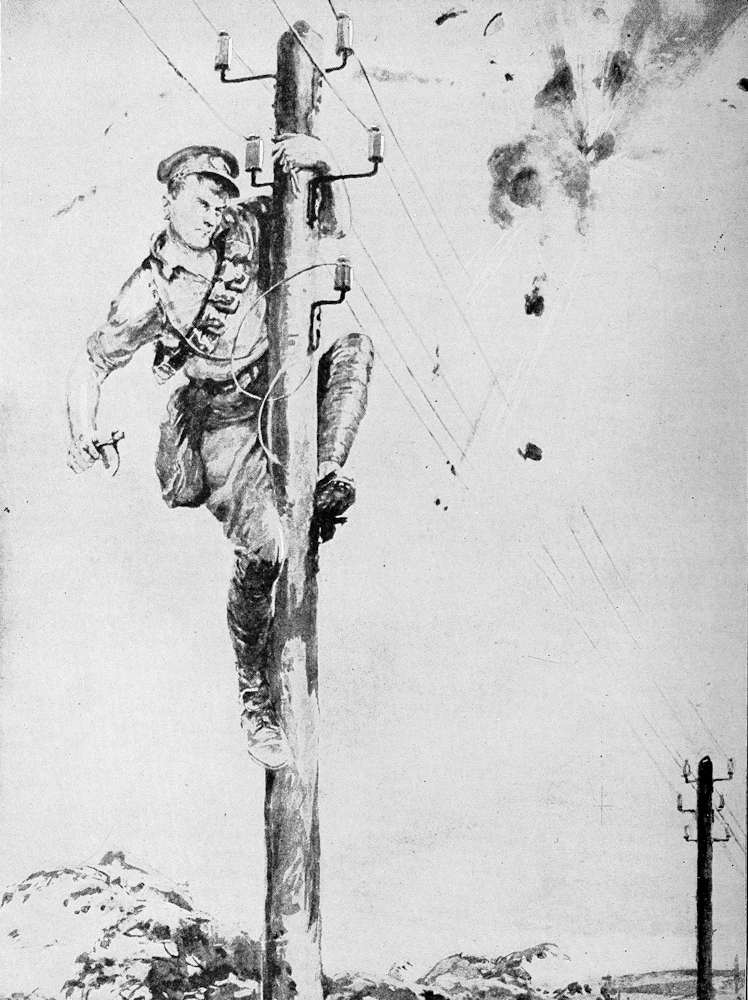
© New York Herald.
Treeing a Linesman Behind the Western Front
“I was sent out to find a habitable trench for my company. We moved in there at dusk. We faced half-right, as it were, looking up the slope toward Ginchy. It was like being near the foot of Parliament Hill, with the village on top. Our right flank was down near the bottom of the valley; our left extended up to the higher ground toward the ruins of Waterlot Farm. The trench was very shallow in places, where it had been knocked in by shell-fire. I had chosen it as the only one suitable in the neighborhood, but it was a horrible place. British dead were lying about everywhere. Our men had to give up digging in some places, because they came down to bodies which were buried there when the parapet blew in. The smell turned us sick. At last in desperation I went out to look for another trench, for I felt sure the Germans must have the range of the trench we were in, and that they would give us hell when dawn broke. To my joy I found that a very deep trench some distance back had just been vacated by another regiment, so we went in there.
“The night was bitterly cold. I have felt hunger and thirst and fatigue out here to a degree I have never experienced them before, but those torments I can endure far better than I thought I could. But the cold—my word! It is dreadful. I suppose life in the Far East does not harden one’s constitution against that torture. Many a night have I slept out in the open, in narrow, wet trenches, with the rain pouring down, and almost groaned with the agony of cold. If two can huddle together, you can get some warmth, but the trenches are frequently too narrow for that. I think I feel the cold more than any one.
“However, dawn broke at last. It was very misty. All night we had been trying to get into touch with the unit on our left, but without success. So the Captain sent me out with an orderly to see whether I could manage it. We two stumbled along, but the mist was so dense we could see nothing. We came to one trench after another, but not a living thing could we see—nothing but dead, British and German, some of them mangled beyond recognition. Bombs and rifles and equipment were lying all over the place, with here and there a great-coat, khaki or gray according to the nationality of their one-time owners, but of living beings we could see no sign whatsoever. There was a horrible stench in places which nearly turned our stomachs.
A DANGEROUS RECONNAISSANCE
“To make matters more wretched, we could not make sure of our direction, and were afraid of running into a German patrol, or even a German trench, for such accidents are by no means uncommon in this region. However, we managed to find our way back and report that up to such and such a point on the map (approximately) there was no one on our left. The Captain was not content with this, so I went out again, this time with another officer. Having a compass on this second occasion, I felt far more self-confidence, and to our mutual satisfaction we discovered that the unit on our left was the right flank of an English division. Captain —— was very bucked when we brought back this information. As the mist continued for some time afterward, we were able to light fires and make breakfast.
“Now, I have forgotten to tell you that we were in reserve. The front line was some five or six hundred yards higher up the slope nearer Ginchy. We knew that a big attack was coming off that day, but did not think we should be called upon to take part. Accordingly, we settled down for the day, and most of the men slept. I felt quite at home, as I sat in the bottom of the deep trench, reading the papers I had received the previous day from England.
“OVER THE TOP”
“It was about 4 o’clock in the afternoon when we first learned that we should have to take part in the attack on Ginchy. Now, you probably expect me to say at this point in my narrative that my heart leaped with joy at the news and that the men gave three rousing cheers, for that’s the sort of thing you read in the papers. Well, I had been over the top once already that week, and knew what it was to see men dropping dead all around me, to see men blown to bits, to see men writhing in pain, to see men running round and round, gibbering, raving mad. Can you wonder, therefore, that I felt a sort of sickening dread of the horrors which I knew we should all have to go through? How the others felt I don’t exactly know, but I don’t think I am far wrong when I say that their emotions were not far different from mine.
“You read no end of twaddle in the papers at home about the spirit in which men go into action. You might almost think they reveled in the horror and the agony of it all. I saw one account of the battle of Ginchy in which the correspondent spoke of the men of a certain regiment in reserve as ‘almost crying with rage’ because they couldn’t take part in the show. All I can say is that I should like to see such superhuman beings. It is rubbish like this which makes thousands of people in England think that war is great sport. As a famous Yankee General said, ‘War is hell,’ and you have only got to be in the Somme one single day to know it. The man who says he loves being in a charge is a liar, and an adjective liar at that.
“But to get on with the story. We were ordered to move up into the front line to reinforce the Royal Irish Rifles. None of us knew for a certainty whether we were going over the top or not, but everything seemed to point that way. Guides were sent down by the Rifles to lead us up. We wended our way up slowly, keeping as much as possible to the trenches, which were so shallow that the deepest part of them did not conceal more than our waists, but they were something to duck into if we heard a shell coming. The bombardment was now intense. Our shells bursting in the village of Ginchy made it belch forth smoke like a volcano. The German shells were bursting on the slope in front of us. The noise was deafening. I turned to my servant O’Brien, who has always been a cheery, optimistic soul, and said, ‘Well, O’Brien, how do you think we’ll fare?’ and his answer was for once not encouraging. ‘We’ll never come out alive, Sir!’ was his reply. Happily, we both came out alive, but I never thought we should at the time.
A CHARGE BY THE IRISH
“It was at this moment, just as we were debouching on to the scragged front line of trench, that we beheld a scene which stirred and thrilled us to the bottommost depths of our souls. The great charge of the Irish division had begun, and we had come up in the nick of time. Mere words must fail to convey anything like a true picture of the scene, but it is burned into the memory of all those who were there and saw it. Let me employ the simile of Parliament Hill. You are more than half way up it now. The flat top, where the village lies a heap of ruins, surrounded by a fence of shattered trees, is about 400 yards away. Between the outer fringe of Ginchy and the front line of our own trenches is No Man’s Land—a wilderness of pits, so close together that you could ride astraddle the partitions between any two of them. As you look half-right, obliquely along No Man’s Land, you behold a great host of yellow-coated men rise out of the earth and surge forward and upward in a torrent—not in extended order, as you might expect, but in one mass—I almost said a compact mass. The only way I can describe the scene is to ask you to picture five or six columns of men marching up hill in fours, with about a hundred yards between each column. Now, conceive those columns being gradually disorganized, some men going off to the right and others to the left to avoid shell holes. There seems to be no end to them. Just when you think the flood is subsiding, another wave comes surging up the beach toward Ginchy.
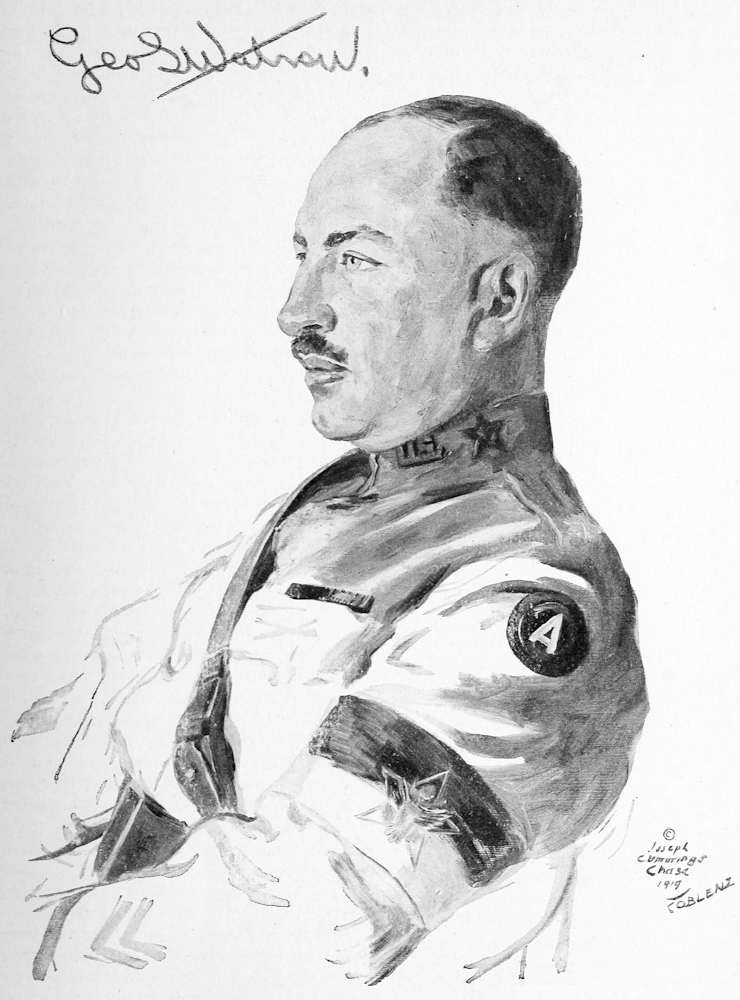
Drawn by Joseph Cummings Chase.
Lieutenant-Colonel George L. Watson
Wounded three times and mentioned in orders five times, he was awarded many decorations, French, English, Belgium, Portuguese and American. He carried out the first American gas-projector attack.
“We joined in on the left. There was no time for us any more than the others to get into extended order. We formed another stream converging on the others at the summit. By this time we were all wildly excited. Our shouts and yells alone must have struck terror into the Germans, who were firing their machine guns down the slope. But there was no wavering in the Irish host. We couldn’t run. We advanced at a steady walking pace, stumbling here and there, but going ever onward and upward. That numbing dread had now left me completely. Like the others, I was intoxicated with the glory of it all. I can remember shouting and bawling to the men of my platoon, who were only too eager to go on. The German barrage had now been opened in earnest, and shells were falling here, there, and everywhere in No Man’s Land. They were mostly dropping on our right, but they were coming nearer and nearer, as if a screen were being drawn across our front. I knew that it was a case of ‘now or never’ and stumbled on feverishly. We managed to get through the barrage in the nick of time, for it closed behind us, and after that we had no shells to fear in front of us.
THE MENTAL SIDE OF FIGHTING
“I mention, merely as an interesting fact in psychology, how in a crisis of this sort one’s mental faculties are sharpened. Instinct told us when the shells were coming gradually closer to crouch down in the holes until they had passed. Acquired knowledge, on the other hand—the knowledge instilled into one by lectures and books (of which I have only read one, namely, Haking’s ‘Company Training’)—told us that it was safer in the long run to push ahead before the enemy got the range, and it was acquired knowledge that won. And here’s another observation I should like to make by the way: I remember reading somewhere, I think it was in a book by Winston Churchill, that of the battle of Omdurman the writer could recollect nothing in the way of noise; he had an acute visual recollection of all that went on about him, but his aural recollection was nil; he could only recall the scene as if it were a cinematograph picture. Curiously, this was my own experience at Ginchy. The din must have been deafening (I learned afterward that it could be heard miles away), yet I have only a confused remembrance of it. Shells, which at any other time would have scared me out of my wits, I never so much as heard—not even when they were bursting quite close to me. One landed in the midst of a bunch of men about seventy yards away on my right; I have a most vivid recollection of seeing a tremendous burst of clay and earth go shooting up into the air—yes, and even parts of human bodies—and that when the smoke cleared away there was nothing left. I shall never forget that horrifying spectacle as long as I live, but I shall remember it as a sight only, for I can associate no sound with it.
“IT WAS HELL LET LOOSE”
“How long we were in crossing No Man’s Land I don’t know. It could not have been more than five minutes, yet it seemed much longer. We were now well up to the Boche. We had to clamber over all manner of obstacles—fallen trees, beams, great mounds of brick and rubble—in fact, over the ruins of Ginchy. It seems like a nightmare to me now. I remember seeing comrades falling round me. My sense of hearing returned, for I became conscious of a new sound, namely, the pop, pop, pop of machine guns and the continuous crackling of rifle fire. I remember men lying in shell holes holding out their arms and beseeching water. I remember men crawling about and coughing up blood, as they searched round for some place in which they could shelter until help could reach them. By this time all units were mixed up. But they were all Irishmen. They were cheering and cheering and cheering like mad. It was hell let loose. There was a machine gun playing on us near by, and we all made for it.
“At this moment we caught our first sight of the Germans. They were in a trench of sorts, which ran in and out among the ruins. Some of them had their hands up. Others were kneeling and holding their arms out to us. Still others were running up and down the trench distractedly as if they didn’t know which way to go, but as we got close they went down on their knees, too. To the everlasting good name of the Irish soldiery, not one of these Germans, some of whom had been engaged in slaughtering our men up to the very last moment, was killed. I did not see a single instance of a prisoner being shot or bayoneted. When you remember that our men were now worked up to a frenzy of excitement, this crowning act of mercy to their foes is surely to their eternal credit. They could feel pity even in their rage.
ONLY TWO OFFICERS LEFT
“By this time we had penetrated the German front line, and were on the flat ground where the village once stood, surrounded by a wood of fairly high trees. There was no holding the men back. They rushed through Ginchy, driving the Germans before them. The German dead were lying everywhere, some of them having been frightfully mangled by our shell-fire. As I was clambering out of the front trench, I felt a sudden stab in my right thigh. I thought I had got a ‘blighty’ [a wound serious enough to send him back to Britain], but found it was only a graze from a bullet, and so went on.
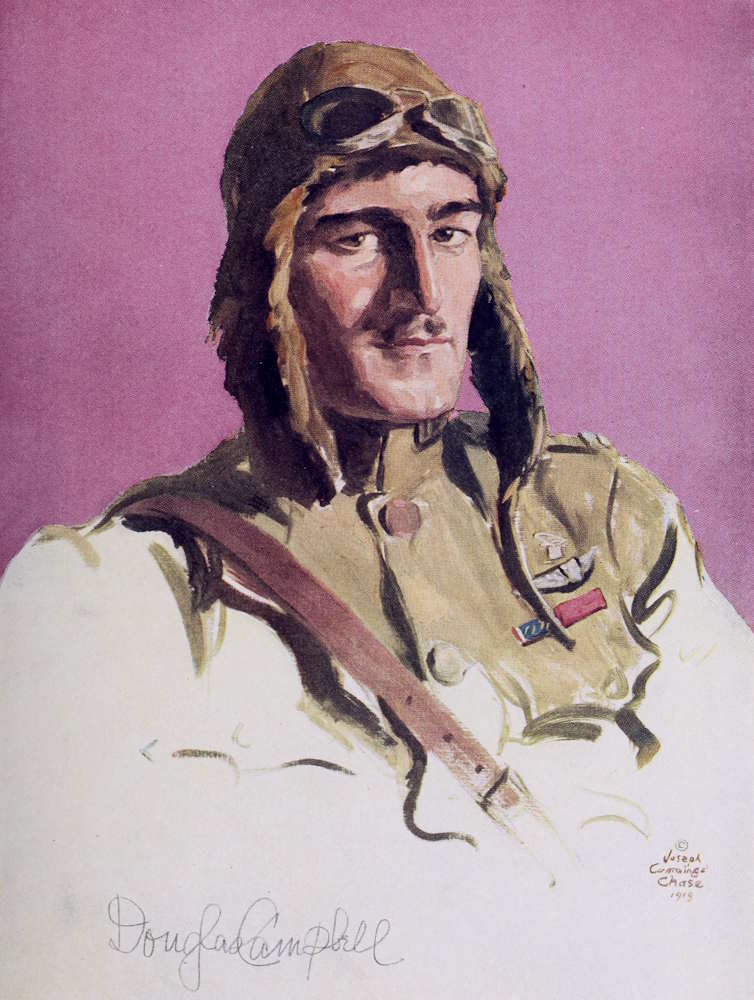
Drawn by Joseph Cummings Chase.
Captain Douglass Campbell
Pilot, Air Service
On May 19, 1918, Captain Campbell shot down an enemy biplane east of Flirey. On May 27th, at Montsec, he shot down one German machine and drove two others behind their lines. On May 28th he brought down a German Albatros and drove five others back. On May 31st, over Lironville, he shot down an enemy plane and routed another. On June 5th, though shot through the back, he destroyed another German machine over Eply.
“I managed to find my men without difficulty. They had rushed through the ruins of the village and were almost a hundred yards beyond the wood, where the ground dips down slightly into a shallow valley and mounts up gradually to a ridge about half a mile away. We were facing south here, having Delville Wood away to our left and Leuze Wood on our right. —— and I were the only two officers left in the company, so it was up to us to take charge. There were not more than half a dozen officers in this part of the line, and so we had a great deal of work to do. We could see the Germans hopping over the distant ridge like rabbits, and we had some difficulty in preventing our men from chasing them, for we had orders not to go too far.
“We got them—Irish Fusiliers, Inniskillings, and Dublins—to dig in by linking up the shell craters, and though the men were tired (some wanted to smoke and others to make tea), they worked with a will, and before long we had got a pretty decent trench outlined.
SCENES AMONG PRISONERS
“While we were at work a number of Germans who had stopped behind, and were hiding in shell holes, commenced a bombing attack on our right. But they did not keep it up long, for they hoisted a white flag (a handkerchief tied to a rifle), as a sign of surrender. I should think we must have made about twenty prisoners. They were very frightened. Some of them bunked into a sunken road or cutting which ran straight out from the wood in a southerly direction, and huddled together, with hands upraised. They began to empty their pockets and hand out souvenirs—watches, compasses, cigars, pen-knives—to their captors, and even wanted to shake hands with us! There was no other officer about at the moment, so I had to find an escort to take the prisoners down. Among the prisoners was a tall, distinguished-looking man, and I asked him in my broken German whether he was an officer. ‘Ja! mein Herr!’ was the answer I got. ‘Sprechen sie English?’ ‘Jah!’ ‘Good,’ I said, thankful that I didn’t have to rack my brains for any more German words; ‘please tell your men that no harm will come to them if they follow you quietly.’ He turned round and addressed his men, who seemed to be very grateful that we were not going to kill them! I must say the officer behaved with real soldierly dignity, and, not to be outdone in politeness, I treated him with the same respect that he showed me. I gave him an escort for himself and told off three or four men for the remainder. I could not but rather admire his bearing, for he did not show anything like the terror that his men did.
“I heard afterward that when Captain ——’s company rushed a trench more to our right, round the corner of the wood, a German officer surrendered in great style. He stood to attention, gave a clinking salute, and said in perfect English, ‘Sir, myself, this other officer and ten men are your prisoners.’ Captain —— said, ‘Right you are, old chap!’ and they shook hands, the prisoners being led away immediately. So you see there are certain amenities which are observed even on the bloodiest of battlefields. I believe our prisoners were all Bavarians, who are better mannered from all accounts than the Prussians. They could thank their stars they had Irish chivalry to deal with.
“There were a great many German dead and wounded in the sunken road. One of them was an officer. He was lying at the entrance to a dugout. He was waving his arms about. I went over and spoke to him. He could talk a little English. All he could say was, ‘Comrade, I die, I die.’ I asked him where he was hit and he said in the stomach. It was impossible to move him, for our stretcher bearers had not yet come up, so I got my servant to look for an overcoat to throw over him, as he was suffering terribly from the cold. Whether or not he survived the night I do not know.
“Our line was now extended across the sunken road and beyond the corner of the wood to our right. Darkness was coming on. Airplanes were hovering overhead, and shortly afterward our shells began to form a barrage in front. The Germans had evidently rallied, for we could see a long line of them coming up on our right, evidently from the direction of Leuze Wood. Our machine guns opened fire. The counter-attack was hung up, but the Germans must have dug themselves in for the night, for in the morning they gave us a good deal of trouble.
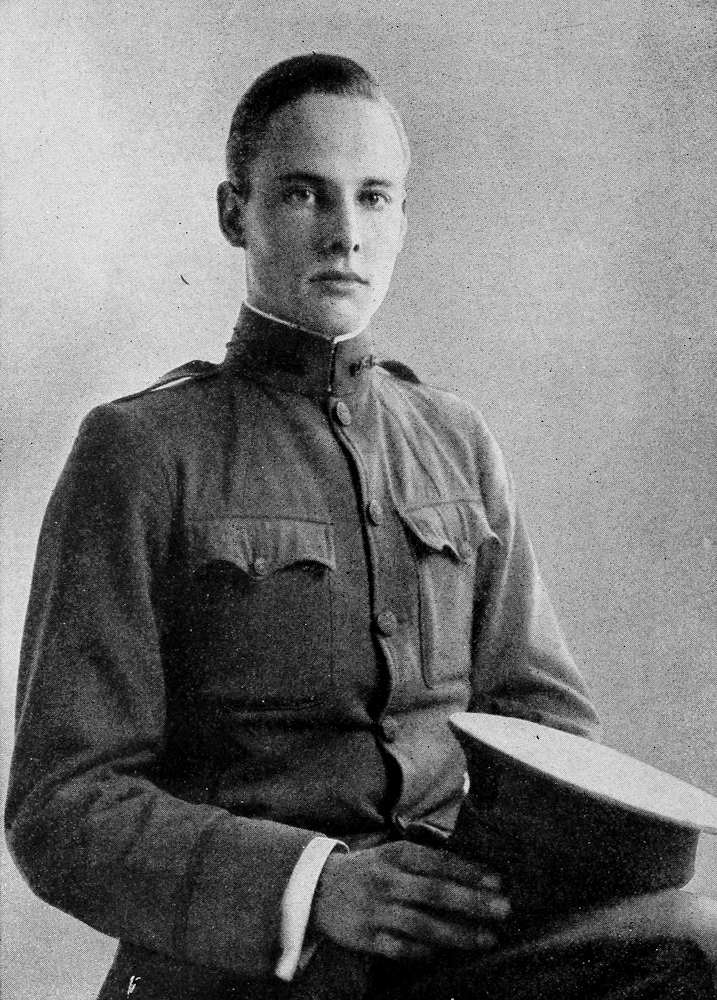
Photo by Fairchild, New York.
Lieutenant George H. Pendleton
With two other officers and twenty men he was sent by the Belgian command to get information about the enemy. In a fight with a German patrol he was wounded, but returned to headquarters with the desired information. He is a great-grandson of Francis Scott Key.
After the counter-attack had subsided, I was ordered to take my men and join up with the rest of the battalion on our right. There we spent the night in a trench. We must have been facing south. It was a miserable night we passed, for we were all very cold and thirsty. We had to keep digging. When morning broke it was very misty. We expected to be relieved at two in the morning, but the relief did not come till noon. Never shall I forget those hours of suspense. We were all hungry. The only food we could get was German black bread, which we picked up all over the place; also German tinned sausages and bully-beef. We had to lift up some of the dead to get at these things. Some of them had water bottles full of cold coffee, which we drank.
“We all craved a smoke. Fortunately, the German haversacks were pretty well stocked with cigarettes and cigars. I got a handful of cigars off a dead German, and smoked them all morning. Also a tin of cigarettes. His chocolates also came in handy. Poor devil, he must have been a cheery soul when living, for he had a photograph of himself in his pocket, in a group with his wife and two children, and the picture made him look a jolly old sport. And here he was dead, with both legs missing! The trench (between ours and the wood) was stacked with dead. It was full of débris—bombs, shovels, and what not—and torn books, magazines, and newspapers. I came across a copy of Schiller’s ‘Wallenstein.’
FORGETTING ENMITY
“Hearing moans as I went along the trench, I looked into a shelter or hole dug in the side and found a young German. He could not move, as his legs were broken. He begged me to get him some water, so I hunted round and found a flask of cold coffee, which I held to his lips. He kept saying ‘Danke, Kamerad, danke, danke.’ However much you may hate the Germans when you are fighting them, you can only feel pity for them when you see them lying helpless and wounded on the ground. I saw this man afterward on his way to the dressing station. About ten yards further on was another German, minus a leg. He, too, craved water, but I could get him none, though I looked everywhere. Our men were very good to the German wounded. In fact, kindness and compassion for the wounded, our own and the enemy’s, is about the only decent thing I have seen in war. It is not at all uncommon to see a British and German soldier side by side in the same shell hole nursing each other as best they can and placidly smoking cigarettes. A poor wounded German who hobbled into our trench in the morning, his face badly mutilated by a bullet—he whimpered and moaned as piteously as a child—was bound up by one of our officers, who took off his coat and set to work in earnest. Another German, whose legs were hit, was carried in by our men and put into a shell hole for safety, where he lay awaiting the stretcher bearers when we left. It is with a sense of pride that I can write this of our soldiers.
“There was a counter-attack on our left in the morning, and for a few minutes the machine guns were very active, but the Germans were beaten off. At last we were relieved, and made our way back, behind Guillemont, to be taken out of the line. We spent one night in a camp and next day came on here. I am writing this in a picturesque French village. You can see green fields and trees and stacks of corn and cattle when you look through the window. Here, at all events, ‘grim-visaged war hath smoothed his wrinkled front’. I am not alone in hoping that we shall not have to go back to that hellish place.
“Well, now, that’s the story of the great Irish charge at Ginchy, so far as I can tell it. I suppose by this time the great event has been forgotten by the English public. But it will never be forgotten by those who took part in it, for it is an event we shall remember with pride to the end of our days.
“Need I tell you how proud we officers and men are of the Royal Irish Fusiliers who played as big a part as any in the storming of that stronghold, and who went into action shouting their old battle cry of ‘Faugh-a-Ballagh’—‘Clear the way!’”
The estimated total war bill of the United States is 30 billions, which is equal to approximately $330 apiece for every man, woman and child in this country. The sum includes the 10 billions loaned to the Allies, and is estimated on the appropriations made by the first and second sessions of the 65th Congress, including the appropriations that were authorized, but were not expected to be expended before the fiscal year 1919.