WHERE DENOMINATIONS END
Reading edition
A Christian Priest Who Was a Hero too Found They Vanished at the Front
Though we did not see much about them in the dispatches, those soldiers of the Most High, the army chaplains who went to the front, were often as heroic and self-sacrificing in attending to their duties as were the doughboys themselves. Among the many was Father John J. Brady of New York, the young Catholic chaplain of the 5th Regiment, U. S. Marines, who was awarded the Distinguished Service Cross for things he did in the Château-Thierry region in the deadly period of June, 1918. Some of the zealous folk who wish to put a ban on tobacco in all of its forms will hardly understand the quality of heroism that prompted Father Brady to risk his life on several occasions to carry cigarettes to men of the fighting line who could not otherwise have had the “soldier’s solace” after the perils and fatigues of long hours of trench service. Nevertheless, that generous and courageous act was among the valiant things for which his country officially honored him. In the big fight that turned back the Germans, this free-souled chaplain made two complete tours of the front line under severe fire, ministering in unusually trying circumstances to the wounded and dying men of his regiment. Right well the men of that regiment loved him—not because he was their chaplain but because he was the chaplain who understood. A wonderful thing is understanding. We recall that the wise Solomon rated it above all things else.
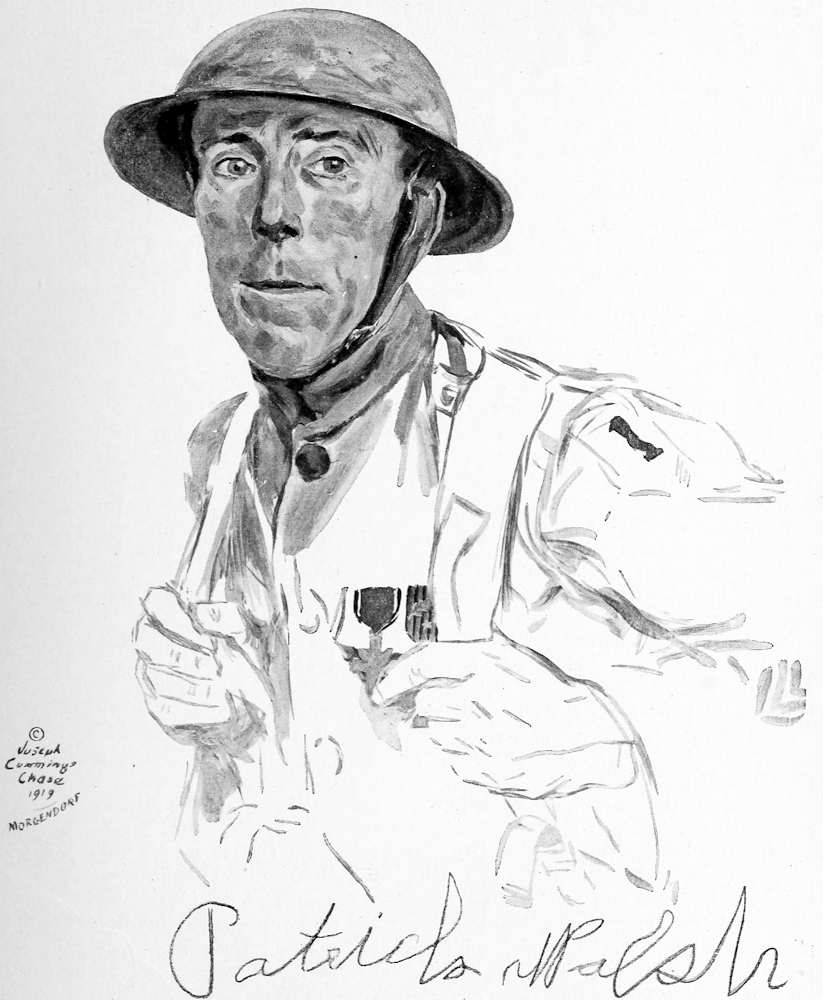
Drawn by Joseph Cummings Chase.
Sergeant Patrick Walsh
1st Division, 18th Infantry
He captured a nest of enemy machine gunners who were doing particular damage to his unit and as a result he was decorated with the Croix de Guerre and the Distinguished Service Cross. He is said to be the first American soldier to receive the former decoration.
The Stars and Stripes in an article about Chaplain Brady has the key to the man in the opening paragraph, which quotes him as saying:
“’Tis all one great church, the front line is. In all Christendom, in all the rest of the world you will not find so much unselfishness, so much Christian charity, so much loving kindness, as you find at the front. There, if anywhere, the men are brothers. We feel it. Denominations or sects are pretty much forgotten. Faith, war makes strange bunkies, and ’tis me and my pal, the Presbyterian minister, have been shelled out of the same quarters together.”
The article continues:
“Father Brady ought to know, for he penetrated the farthermost American position and has crawled beyond the front lines to hear confessions of Marines in the outpost. He was decorated for extraordinary heroism at the battle of Château-Thierry where his unfailing ministrations were a big factor in conserving the morale of the men.
“The true spirit of the Marines is Father Brady’s. He laughs at obstacles and perils, and his indomitable will carries him through the most difficult tasks. Often he has accomplished the seemingly impossible and he is honored by Protestant and Jew as he is by those of his own faith. Regardless of creed, the Devil Dogs of the 5th Regiment are proud of their chaplain.”
HIS LEATHERNECKS
“There was to be an attack the next morning in the gray hours before the sun was up, when Father Brady reached the wooded country between Soissons and Château-Thierry where his Leathernecks crouched under the Hun bombardments. He crawled and stumbled along the lines to hear confessions from his warriors. Hard-bitten old-timers who had not seen the interior of a church in years bared their souls and went light-hearted into the hell that followed the opening barrage.
“Reaching the final outpost, the young priest spied a shallow trench from which a sentry peeped. In spite of warnings he slipped out among the shadows and wormed his way forward and rolled into the ditch. He heard the confession as he and the outpost lay side by side looking up at the stars, and as he crept back to cover he knew that he had never granted absolution in stranger places. He has said mass for the faithful with his altar cloth on the shattered stump of a tree during the last lull before the attack.
“Friend and foe alike received the sacrament from the young Catholic priest. His enmity for the Germans ceased when he went among the young wounded Bavarians left on the field and gave them the last consolation of the church. Often he bent over young Germans, scarcely able to speak as they groped for their rosaries, and left them facing death more bravely.
“One of his most dangerous tasks was the burial of the dead, which must be done at night, and frequently under shell fire. It is work that must be done in the open, for digging is almost impossible where the woods fill the soil with interlacing roots. It was on such a mission that personal tragedy touched him. Making his way to the crest of a hill, where he had been told a man lay dead, he found the face of one of his closest friends turned up to the moonlight.
“In spite of the horrors he has witnessed and the sorrows he has shared, those who have met Father Brady recently say he is unchanged. Many men would have shrunk from his work, much of which was done alone with no comrade to speak a steadying word. Yet his spirit is still buoyant and his mind is unoppressed.”
A BIT OF A MISTAKE
“Many of his stories deal with the changes in spirit and practice that have followed the sharing of hardships. All the Marines were ‘his boys.’
“‘What a pother they’d have made in the old days of peace back home if they had caught me at a mistake I made the other night,’ he said. ‘In the confusion just before the attack I heard the confession of one old sinner of a sergeant. He got half-way through before I discovered that he was not a Catholic.’
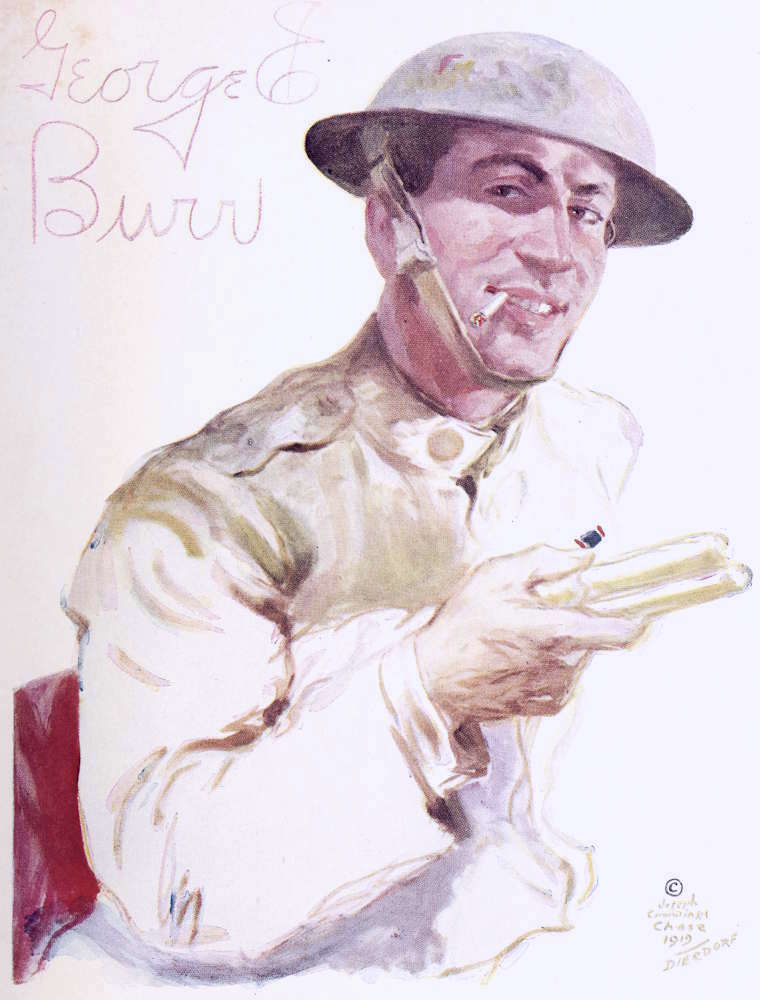
Drawn by Joseph Cummings Chase.
First-Class Sergeant George Burr
32nd Division, 107th Field Signal Battalion, Company C
Sergeant Burr, in charge of a detachment near Cierges, France, August 2, 1918, strung wire far in advance of the front lines, working through heavy artillery fire to the point where the regimental post of command was to be situated. When ordered to leave one man at the instrument, he himself remained.
“‘Why, you’re no Catholic!’ I told him.
“‘No, Padre, I’m a Presbyterian,’ said he, ‘but they say confession is good for the soul. Believe me, mine feels none the worse now.’
“Once Father Brady received $2,000 from America to buy himself an automobile. He spent it on a club for the boys in his regiment. Later they found that the young priest could box and wrestle, and that he was the best referee that could be got for their fights. He built up trust and affection for himself during the weary months at the front.
“He has been day and night with his regiment during the long period when they were in the midst of things. For a month at a time he has snatched what sleep he could wherever he might throw himself down, under hedges, in roadside barns and even in shell holes. But he has always had a word of cheer for the men, and in the most terrible days he has made both living and dying more bearable for the 5th Marines.”