COULDN’T STOP THEM
Reading edition
Thro’ Turkish Shells and Barbed-Wired Sea They Landed at Gallipoli
Twenty transports of Australians under General Birdwood, arriving at Gallipoli. In any circumstances, landing through rough seas and narrow beaches, under defiant cliffs and then climbing those cliffs is not nerve soothing for either impatient commanders or restless soldiers. But in war time with cannon belching at you—well, it costs.
It was planned to surprise the Turks—those surprisingly straight-shooting Turks, with their infernal German guns and German officers. The men tried to hope, but it was really absurd to think the enemy would be surprised. In January the Allied troops had tried to force the Dardanelles. That had been sufficient warning. The enemy would not be caught napping only a few months later. Even the most hopeful of the men set about writing the letters which might contain their very last wishes, fears, bequests, expressions of love. Then the gloom passed and jokes and laughter came.
At about two o’clock in the morning they dropped anchor. Each man stood at parade on the decks, and each was ordered to look to his supplies—a rifle, a bayonet, 150 rounds of ammunition, three days’ rations, a first-aid kit. It was weird contemplating this stretch of the Ægean and that bit of coast so soon to be washed by blood.
Captain David Fanlon in his story of The Big Fight says: “The long procession of transports and their grim battleship escorts had stolen up in the night, a widely spread yet organized, concrete group of slowly-moving, black, gloomy monsters. Every light aboard each ship had been ordered out. Not even the pin-head flame of a cigarette might show on any deck.
“The only light we had was the faint green gleam that filtered over the smooth waters from a moon that had begun to wane and had, indeed, at this hour of three in the morning, nearly fallen behind the ragged jaw of the black cliffs.”
That moon may have been very picturesque, but the men on those boats hated it, feared it, wished it in—any place but in the heaven above them. Its beam might act as a spotlight on the surprise attack. It looked like the evil eye of the enemy.
“I wonder,” said some one, “what that old green eye of a moon is looking at back of those dark, old cliffs? I wonder if he sees the big guns drowsing and the garrisons asleep or——”
“What he’s seeing,” came a grumbling answer, “is the heathen blighters getting ready to bang hell out of us!”
THE GREAT ADVENTURE BEGINS
“And now the men had assembled on the decks as soft-footedly as they might. They had gathered in the darkness into orderly rows like big companies of phantoms. The ship’s crews worked as spectrally and nearly as silently as the lowering of ladders and the launching of the boats would permit. Small steamboats, each with a swerving tail made up of barges and small boats, panted alongside the transports and battleships. With wonderful precision and swiftness the great ships spawned hundreds on hundreds of smaller craft, thousands on thousands of men, crowding the waters with them for as far as you could make out whichever way you looked in the faint moonlight.”
© New York Herald.
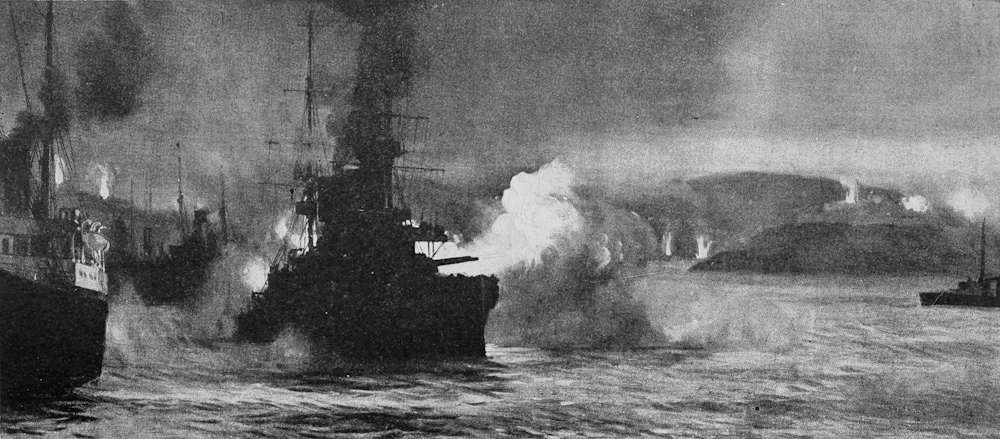
A Night Attack on the Dardanelles
British warships bombarding Turkish forts to protect the Allied landing parties. The fire that was returned was both accurate and deadly.
Of a sudden, the moon dipped and blinked out behind the cliffs. There was a sigh of relief. “God bless that damned old moon.” A moment before there had been just enough light to see the battleships coming on slowly in the rear with the obvious purpose of covering the attack. “Then you couldn’t see a blessed thing. The green waters had turned to ink. You only knew your comrades were with you in the same boat by the press of their swaying bodies against your shoulders and your ribs.”
They were within two hundred yards of the shore.
“Shouldn’t wonder,” whispered some one, “if we’re to surprise them after all.”
“Then suddenly out of that weird darkness, that curious silence that had been disturbed only by the rapid, half-choked panting of the steam tugs, the surge of the water against the sides of the barges, the whispers, the occasional smothered laughs—all soft sounds—there came hell—veritable hell if ever hell comes to men on earth! And it came with a tremendous roar!”
Captain Dave Fanlon was not an observer at the time. He was a participant. He gives a most thrilling account of the ghastly landing:
“There was a swift, sharp lightening of the sky back of the gaunt, black cliffs, and our boats seemed thrown out of the water, thrown up into the air by the rocking thunder of the heavy guns of the Turkish batteries behind those cliffs. The water that had been so smooth an instant before, that was, in fact, so treacherously smooth, as had been the silence, was stabbed and chopped and sent into wild spume by a great rain of shells. Blinding blasts flared as suddenly, as here and there a boat with its living load was struck and shattered. Screams and hoarse, impulsive cries began to mingle with the explosions.”
The Turks had the range as surely as if they were only ten feet away from the Australians. The English battleships began an angry, heavy retort. Whether they found their mark among the Turks or not, it seemed to make no difference. The enemy fire became more and more intense. Boat after boat was being smashed. Scores and scores of men, unable to swim, or weak swimmers, died right there.
CAUGHT IN BARBED-WIRE NETS
Most of the men struggled. They tried to throw off their encumbrances. They helped one another to get rid of their knapsacks. They let go their ammunition belts—everything but their bayonets. They knew that even if they could make the shore there would be small hope for them without the bayonets. All the time came that devilish fire from the cliffs. The shore was not far off now. They swam. They were within fifty feet of it. Then they hit against a terrible snare.
“The enemy had constructed on stakes in eight feet of water a barbed-wire entanglement along more than two miles of the beach.” Men ran their faces full tilt against the barbed wire’s fangs. They cursed and moaned. They hung on to the wire, but ducked every instant, for a scream of bullets was all around. Hundreds drowned. Hundreds were held like netted fish in the entangling wires. Many were lost in trying to get through that wire. But the attack went on. There was some space between the wire and the sea bottom. They crawled through! The enemy’s own shells smashed some of the wire. Bombing parties in battleship launches tore more sections open.
Men did get through. They lay gasping on the beach. But bullets came thicker. They rose. Officers tried to organize the torn forces. The bombardment from the forts was ceaseless. The English ships roared back with thundering fire. Machine gun fire and rifle fire from Turks, concealed in mounds of sand and the clefts of the cliffs, were tearing down the brave Australians—ever dauntless.
“The landing party was grotesque and wavering under the frightful storm. Shouts, yells, screams of pain, cries of alarm merged into a great clamor. The most heartening thing, somehow, in the darkness had become the Australian cry of ‘Coo-ee!’—sharp and musical, in which men had called themselves together into groups.
“There was no living on the beach. The only way out of that immediate hell was to charge across the sands and get into the shelter of the dunes, to fight our way to the base of the cliffs and get away from the shells of the cliffs, and to fight a way into the enemy trenches in the table-lands.”
Amidst the horror and confusion that reigned impossible deeds were performed. How it was ever done no one can tell. It was terrible. But it had to be done. Many of the English hadn’t a thing to fight with but the cold steel of their bayonets. The warships, of course, helped tremendously. The hills of sand and the stony cliffs were rent by merciless fire. You could see “the bodies of the enemies, clusters of them, spouting from the places of their concealment. Legs, arms, heads were flying wildly in the air.”
GOT THERE ANY OLD WAY
Captain Fanlon says:
“We got up those sand ridges any old way—by digging in our bayonets like Alpine staffs, clawing with our free hands, scrambling with toe-holds and fighting up on all fours.
“We had just gained a knoll of sand and bush and taken protection behind it for a minute’s breathing when one of my men, one of those sturdy cattlemen who had made their way out of the wilderness to get into the war for civilization, went down with a bullet in his leg.
“‘Nothing much,’ he said, as I bent over him to examine the wound, ‘and don’t stop for me. Go on and come back for me later or maybe the Red Cross lads will find me. A little thing like this isn’t going to—’
“He was smiling as he talked, but suddenly his head fell back, his smile widening into a horrible grin. A bullet had taken him in the neck. He was done for.
“Of course, and luckily, there were only a few of our thousands that had been blown out of their boats and most of the lusty fighters of the landing force had their ammunition in hand. They were going after the Turks with the rifle volleys of deadly accuracy.
“Having come alive through the terrible ordeal of that shell and bullet strand of open beach, the Australians and New Zealanders were fired to the highest fighting pitch. Companies of them sang as they climbed and pushed and struggled along—sang or rather yelled snatches of all manner of songs though they didn’t sound much like songs. More like strange, sustained savage war cries.
“There was no staying the impetuosity of some of them.”
SOME WOULDN’T “DIG IN”
At last the Turks began to give way. They were on the run. But their forts two and three miles away were still pouring their fire. The men were ordered to dig in. Despite orders, however, “hundreds of our warriors refused to stop. They charged right on through the pathways and tunnels in the cliffs. We never saw them again. Those that were not killed were captured by the Turks. We used to say in speaking of them afterward that they had ‘gone on to Constantinople.’”
The Australians had proved their mettle in this terrible adventure. Everlasting glory was theirs—soldiers so recently recruited. The soldiers, though, were not the only ones to be elevated to higher sacrifice in these soul-straining demands. “There was the work done by the Australian Army Service Corps—landing a steady procession of boats with medical and food supplies as well as ammunition, fleets on fleets of these boats from the transports and battleships moving to shore with the coolest regularity, with the waters around every one of them constantly thrashed by tons of falling shells. Scores of the boats were blown up. But the others never stopped.”
“The stretcher-bearers and the doctors we could also see working calmly among the sand dunes, ignoring snipers’ bullets as though they had been harmless flakes of snow. Slow and painful files of the wounded—those who could walk or stagger along were being guided to protected places until the coming of night might enable their removal to the hospital ships.
“As for the dead whose countless prone bodies were strewn upon the beach with curious pitiful inertness, so different from that of sleep that you know instinctively it means death—there was no use then risking live men to give the dead the attention, to award them such decencies of care and burial as were their due. This also would be the work of the night. Yes, and many a man as he worked over the graves of his fallen comrades pitched into that grave, himself become a dead man—betrayed to a sniper by the moonlight’s gleam.
“Twilight veiled the sun and then very suddenly black night came.”
© New York Herald.
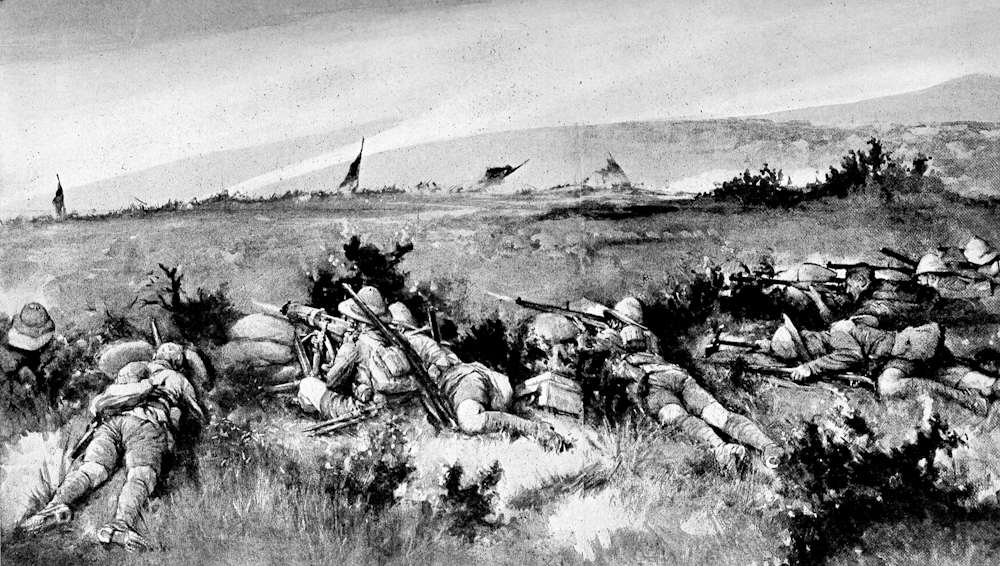
British Troops Meeting a Charge by the Turks
Their fighting equipment reduced to machine guns and rifles, a small British unit at Gallipoli met the onrushing Turks in the open and drove them back.
The Australians had done the thing men in authority had thought it impossible to do. Lord Kitchener later declared this one of the most brilliant feats of bravery and soldiering of the war.
There were 20,000 men who landed at Gallipoli. Perhaps 1,000 of them are alive to-day.
THE KIND OF MEN THEY WERE
And here is a tribute to the men who stormed the heights that may be found in the London Times’ account of the campaign:
“The most moving part in the Gallipoli story will ever be the splendid feelings it called forth in the breasts of young Australians. To them it was no ordinary adventure in warfare. These single-minded, loyal youths had different conceptions of God. But every conception fitted into the sublime conception that this work for their race and country was God’s work. Upon the tissue of their natures, the warm affections, the cleanliness and the liberty among which they had been brought up, this fighting call in Gallipoli precipitated something that seemed to them the highest thing possible. What they knew was that they wished to go to Anzac, that they were prepared to die there, that the Australian army had become for them a sacred institution. Their hearts were touched by the death of comrades, their eyes took fire at the sight of the distinctive Australian uniform. Gallipoli proved, if it did not in itself go far to produce, a warmth and generosity in the Australian character. The difficulty experienced by the commanders was not to get men to this shell-torn place of hardship, but to keep them from it. Half the members of the Light Horse Brigades and all the drivers of artillery and ambulances had been left behind in Cairo or Alexandria, to attend to the horses. But it was impossible to keep them there. They decided amongst themselves who could be spared. Everyone wished to go, those chosen were thought lucky. They boarded transports at Alexandria, stowed away until the ships were at sea, and then reported themselves to the officers commanding. One artillery brigade lost 39 of its men in this manner. General Hamilton could never find it in his heart to send back men who came with tears in their eyes and asked for nothing better than to be given privates’ work in Anzac. There were cases in which sergeants gladly forfeited stripes and pay for the chance. Men could not bear to go back to their homes and say they had not done their share at Anzac.”
UNORTHODOX BUT STANCH
“And of their discipline, which was attacked because it was sometimes unorthodox, what better can be said than what was told in the undying story of the Southland? The Southland was torpedoed by a German submarine in the Ægean Sea, when conveying the 21st Australian Infantry Battalion and part of the 23rd, 1,500 strong, from Alexandria to Mudros. They were Victorian country boys, recruited for the most part from the farms and stations of the Wimmera and the Goulburn Valley. Panic ensued among the ill-assorted crew of this converted German liner. Three of the four holds filled with water, the hatches of the hold first damaged were blown out and in the water there the Australians could see the dead bodies floating of their comrades killed by the explosion. No one thought that the ship could keep for long above water. But the soldiers stood at their stations. They waited for their turn. One went to the piano, and played favorite airs. Others, when volunteers were asked for, jumped into the water to right overturned boats. When at last all the men were off the stricken vessel, standing on half-submerged rafts, clinging to the edges of boats, swimming alongside improvised supports, volunteers were called for to stoke the ship into port, all the men within hearing offered for the hazardous task. Six officers and seventeen men climbed the rope ladders again, and with her bows under water and her stern low down, the ship was brought into Mudros and beached. It was a triumphant vindication of the discipline of Dominion troops. ‘The discipline was perfect,’ wrote Captain C. E. W. Bean, official reporter at Anzac. ‘The men turned out immediately. There had been boat drill on the voyage and the men ran straight to their proper places and lined up.’”
This praise of discipline which, though “unorthodox,” meets and never fails to meet the required end, reads quite as if it had been written of the boys of the United States’ expeditionary force.