THE RENDEZVOUS
Reading edition
One of America’s Young Poets Keeps a Tryst While Fighting for France
I have a rendezvous with Death At some disputed barricade, When Spring comes back with rustling shade And apple-blossoms fill the air— I have a rendezvous with Death When Spring brings back blue days and fair. And I to my pledged word am true— I shall not fail that rendezvous. —Alan Seeger.
The poem from which the above opening and closing lines are taken was read for the first time by the majority of those who knew it after the poet had kept the rendezvous—only a little late of the appointed time, like a traveler who has missed a train.
Alan Seeger loved France, and when he saw her in peril and his own America not likely to be brought into the conflict he went to France as a volunteer. Being an alien he was not eligible to the regular army, but the Foreign Legion welcomed him to fight for France under its flag. Among the men of the Legion was Rif Bear, a brilliant and traveled young Egyptian, and he became the close, the intimate friend of the poet with whom he found himself entirely in sympathy.
Seeger was under fire in a series of engagements without suffering hurt, but he seems to have foreboded the end that came in the Champagne campaign. He was a fatalist as well as a dreamer—and there are those who believe that we bring to ourselves the fruit of our thoughts.
After Seeger’s death Rif Bear wrote the facts and an appreciation in a personal letter to a lady in Boston. The letter was in French, but a translation of it has been published. There is a melancholy interest in the circumstances that a clerical error in the date of a temporary leave of absence cheated Seeger of one of the chief joys that could have come to him as a poet. The letter tells us that he ran one day to his friend in the triumph of happiness to show him a telegram which asked him to compose a poem to be read in public at a French-American demonstration—the memorial day ceremony. He was to have 48 hours leave in which to write the poem and attend the ceremony. But the promised leave did not come.
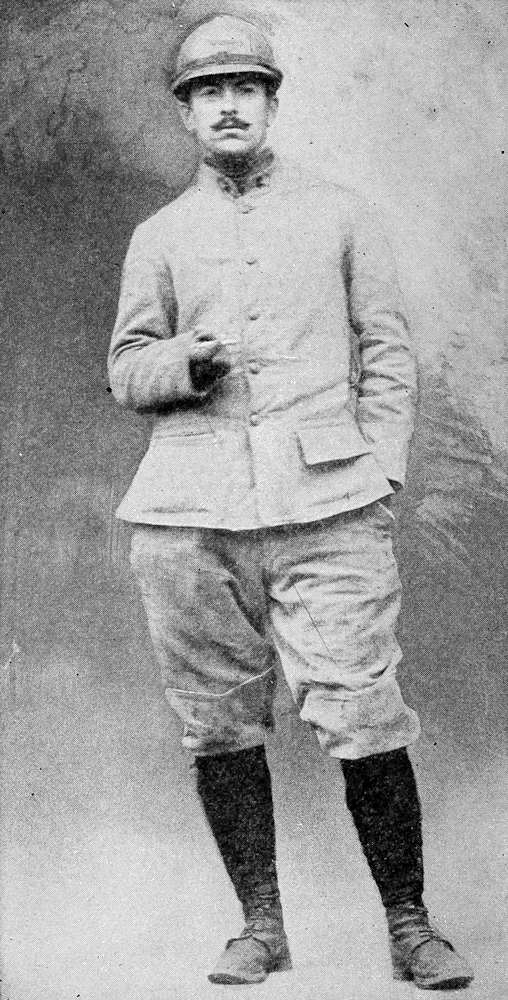
Courtesy of Century Company.
Alan Seeger
The young and gifted American poet who fought in the Foreign Legion. He was killed in action in the Champagne campaign.
“The eve of the ceremony arrived—I can not recall the date—but no leave came. We were in the trenches and chance had placed me near Seeger in petit poste (the small outlook-post, some yards in advance of the first line trench). He confessed that he had lost all hope of going, and I tried to find all sorts of arguments to encourage him, that his leave might come at dawn, and that by taking the train at Ressons at 7 a. m. he could still reach Paris by noon and would have plenty of time, as the ceremony was at two.
“The morning came, and instead of bringing the much-desired permission to leave, it brought a terrible downpour of rain, and the day passed sadly. He found consolation in the thought that it was only a postponement and that July 4 would soon arrive, when the Americans with the Foreign Legion might hope for forty-eight hours’ leave, as last year.”
The explanation came later. It was a clerical error that cheated him; the forty-eight hours’ leave granted for the event was made out for June 30, instead of for May 30. Continuing the letter:
A MARCHING ORDEAL
“On June 21, we left the sector of the Thiescourt Woods for an unknown destination, which proved to be the Somme. We took the train at Estrées St. Denis, and on June 22 about 10 a. m. reached Boves. Under a blazing sun, in heat that seemed to have escaped from the furnace of hell, we started for Bayonviller. We had undergone no such march since the war began.
“Weighed down by their sacks, prostrated by the heat, men fell by hundreds along the road. Hardly twenty of the two hundred forming the company arrived without having left the column. Seeger was one of these few. He told me afterward of the terrible effort that he had to make not to give up. At every halt he drank a drop of tafia (rum and coffee) to ‘give himself heart,’ and when he reached the end of the march he was worn out, but proud—he had not left the ranks.
“We passed the eight days of repose at Bayonviller, almost always together, seeking the greatest possible enjoyment in our life at the moment and making dreams for the future after the war. Alan confided to me that ‘after the war’ caused him fear—that he could not tell what destiny reserved for him, but that if the fates smiled on him it was toward the Orient that he would make. He loved the Orient—Constantinople, Cairo, Damascus, Beirut had a powerful fascination for him; their names would plunge him into profound reverie.
“‘It is in the mysterious frame of the Orient,’ he used to say, ‘in its dazzling light, in its blue, blue nights, among the perfumes of incense and hashish, that I would live, love, and die.’
“And then the talk would turn again on the war and he would say: ‘My only wish now is to make a bayonet charge. After that I shall see. Death may surprise me, but it shall not frighten me. It is my destiny. “Mektoub”’ (it is written). He was a real fatalist and drew courage and resignation from his fatalism.
“During the night of June 30-July 1 we left Bayonviller to move nearer the firing-line. We went to Proyart as reserves.
“At 8 o’clock on the morning of July 1 there was roll-call for the day’s orders and we were told that the general offensive would begin at nine without us, as we were in reserve, and that we would be notified of the day and hour that we were to go into action.
“When this report was finished we were ordered to shell fatigue, unloading 8-inch shells from automobile-trucks which brought them up to our position.
“All was hustle and bustle. The Colonial regiments had carried the first German lines and thousands and thousands of prisoners kept arriving and leaving. Ambulances filed along the roads continuously. As news began to arrive we left our work to seek more details, everything we could learn seemed to augur well.
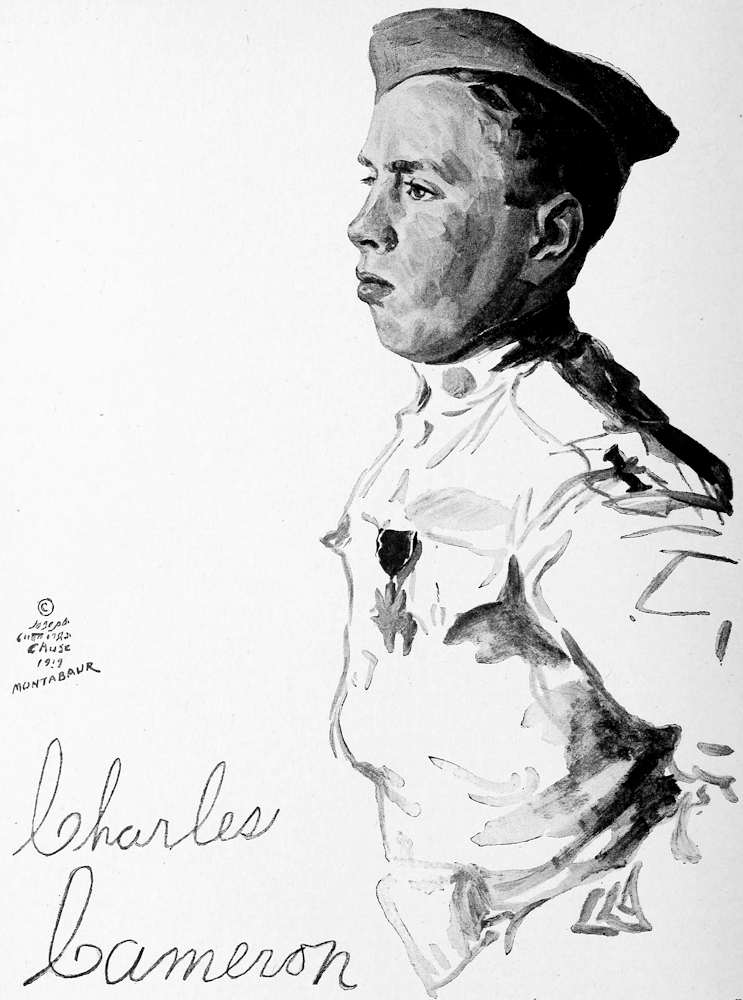
Drawn by Joseph Cummings Chase.
Private Charles Cameron
1st Division, 3rd Machine Gun Battalion, Company “B”
Decorated for extraordinary heroism in action near Soissons, France, July 19, 1918. When the infantry was held up by a trench occupied by Germans he voluntarily circled the trench and from the rear shot and killed one of the enemy and captured the others.
“About 4 p.m. we left Proyart for Fontaine-les-Capy and in the first line. Alan was beaming with joy and full of impatience for the order to join in the action. Everywhere delirious joy reigned at having driven the enemy back without loss for us. We believed that no further resistance would be met and that our shock attack would finish the Germans. After passing the night at Fontaine-les-Capy we moved in the morning toward what had been the German first lines. I passed almost all the day with Alan. He was perfectly happy.
“‘My dream is coming true,’ he said to me, ‘and perhaps this evening or to-morrow we shall attack. I am more than satisfied, but it’s too bad about our July 4 leave. I can not hope to see Paris again now before the 6th or 7th, but if this leave is not granted me “Mektoub! Mektoub”!’ he finished with a smile.
“The field of battle was relatively calm, a few shells fell, fired by the enemy in retreat, and our troops were advancing on all sides. The Colonials had taken Assevillers and the next day we were to take their place in first line.”
WHEN THE HOUR CAME
“On July 3, about noon, we moved toward Assevillers to relieve the Colonials at nightfall. Alan and I visited Assevillers, picking up souvenirs, post-cards, letters, soldiers’ notebooks, and chattering all the time, when suddenly a voice called out, ‘The company will fall in to go to the first line.’
“Before leaving one another we made each other the same promise as we had made before the Champagne battle (September 25, 1915), that if one of us fell so severely wounded that there was no hope of escape the other would finish him off with a bullet in the heart, rather than let him await death in lingering torture. He showed me his revolver, saying, ‘I have more luck than you. If I can still use one arm I shall have no need of any one,’ and then we rejoined our different sections.”
The order for attack came at 4 o’clock and the troops went forward, the flash and glitter of bayonets above the tall corn through which the men pressed making a curious spectacle against the going down of wave after wave of men under the terrific gun fire.
“The losses were heavy and the enemy made a desperate resistance. The company of reserves was ordered to advance with the second wave of assault. ‘Forward!’ cried the captain, and the company deployed ‘in files of squadron,’ advancing slowly but surely under the enemy’s intense and murderous fire.
“The first section (Alan’s section) formed the right and vanguard of the company, and mine formed the left wing. After the first bound forward, we lay flat on the ground, and I saw the first section advancing beyond us and making toward the extreme right of the village of Belloy-en-Santerre. I caught sight of Seeger and called to him, making a sign with my hand.
“He answered with a smile. How pale he was! His tall silhouette stood out on the green of the corn-field. He was the tallest man in his section. His head erect and pride in his eye, I saw him running forward, with bayonet fixed. Soon he disappeared and that was the last time I saw my friend.
“‘Forward!’ And we made a second bound, right to the wave of assault, which we left behind a little, and down we threw ourselves again. The fusillade became more and more intense, reaching a paroxysm. The mitrailleuses mow men down and the cannons thunder in desperation. Bodies are crushed and torn to fragments by the shells, and the wounded groan as they await death, for all hope of escaping alive from such a hell has fled.
“The air is saturated with the smell of powder and blood, everywhere the din is deafening; men are torn with impatience at having to remain without moving under such a fire. We struggle even for breath and cries resound from every side. Suddenly a word of command, an order of deliverance, passes from mouth to mouth. ‘Forward! With bayonets!’—the command that Seeger had awaited so long.
“In an irresistible sublime dash we hurl ourselves to the assault, offering our bodies as a target. It was at this moment that Alan Seeger fell heavily wounded in the stomach. His comrades saw him fall and crawl into the shelter of a shell-hole. Since that minute nobody saw him alive.
“I will spare you an account of the rest of the battle. As soon as the enemy was driven back and Belloy-en-Santerre won I searched for news of Seeger. I was told of his wound and was glad of it, for I thought he had been carried away and henceforth would be far from the dangers of bullets and shells.
“Thus ended this Fourth of July that Seeger had hoped to celebrate in Paris. On the next day we were relieved from the first lines and went into reserve lines. A fatigue party was left to identify the dead.
“Seeger was found dead. His body was naked, his shirt and tunic being beside him and his rifle planted in the ground with the butt in the air. He had tied a handkerchief to the butt to attract the attention of the stretcher-bearers. He was lying on his side with his legs bent.
“It was at night by the light of a pocket electric lamp that he was hastily recognized. Stretcher-bearers took the body and buried it next day in the one big grave made for the regiment, where lie 3 hundred bodies. This tomb is situated at the Hill 76 to the south of Belloy-en-Santerre.
“As I think of the circumstances of his death I am convinced that after undressing to bandage himself he must have risen and been struck by a second bullet.”