TANK-MAN TALKS
Reading edition
He Found the Little Fellows to His Taste But Didn’t Care for Heavies
The general impression of the war tank is that of a huge juggernaut going, solemn and irresistible, over any sort of obstacle; but there seem to have been tank crews who did not regard the lumbering monsters worshipfully. They pinned their faith and devotion to the lighter and nimbler type of machine that could jaunt along at eight miles an hour and revolve on its own axis. The Scientific American had a special correspondent in France who reports somewhat jerkily the talk of an American tank-man who had a working acquaintance with the small, and to him decidedly preferable, type of fighter. The tank-man is quoted:
“Yes, you read a lot in newspapers about tanks. But no American tanks saw any action in France. There were three battalions of American tank troops that saw action; one with heavy tanks, with the British, and two, with light tanks, operating in the Argonne and the St. Mihiel actions. Some troops, too, if I do say it who shouldn’t! No, you’ll have to get some one else to talk about the heavy tanks; don’t know anything about them and don’t want to. Light tanks for me, every time. Yes, I’ll tell you about them if you are interested.
“We used Renault tanks—light ones. Whiffet tanks some people call them. Weigh about seven tons and have two men for a crew. Fast? Too fast; faster than there’s any use of them to be, really. That was one of our troubles, running away from our infantry. No sense in having tanks that can get out of touch with the men they are supposed to precede and blaze a trail for! Those little Renaults can go eight miles an hour over good ground, and infantry is lucky if it goes two!
“Two men, one of them is the engineer and the other the pilot. Some of the tanks have machine guns and some one-pounders; only one gun to a tank you know—those little fellows aren’t battleships. We started in with 216 tanks. They cost about $10,000 each. Motor not unlike a good automobile motor; four-cylinder, about 40 horsepower. Indeed the tank has a lot of automobile mechanism about it. Those Renaults have four speeds forward and reverse.
GRENADES JUST EGGS
“You spin around in your own length. It’s astonishing how fast those little tanks can turn when they have to. Fast enough to cut a man in two if he’s in the way. Yes, it happened more than once. Some Boches had an idea they could do something to a Renault with a hand grenade and tried it at close quarters. Might just as well have thrown eggs at us, unless some splinters got in the slits. And if they were close enough and we whirled her round they were out of luck sure—broken legs, you know, or mashed ribs.
“No, the Boche anti-tank gun never hurt us to amount to anything. Ever see one? It weighs about 50 pounds and shoots a whale of a bullet, but unless it strikes sharp at right angles it doesn’t go through. Pretty hard steel, you know, that tank armor. What did stop us, when we were stopped, was the 77. Even that took a direct hit. A 77 could go off right beside us and we’d hardly know it. But if it made a direct hit—well, you don’t expect to run a war without any casualties, of course. I recall one case where a 77 made a hit and set off all the ammunition in the tank. The tank was scrap steel and the men—well, we found a hand, and a shoe. Just literally blown to nothing.
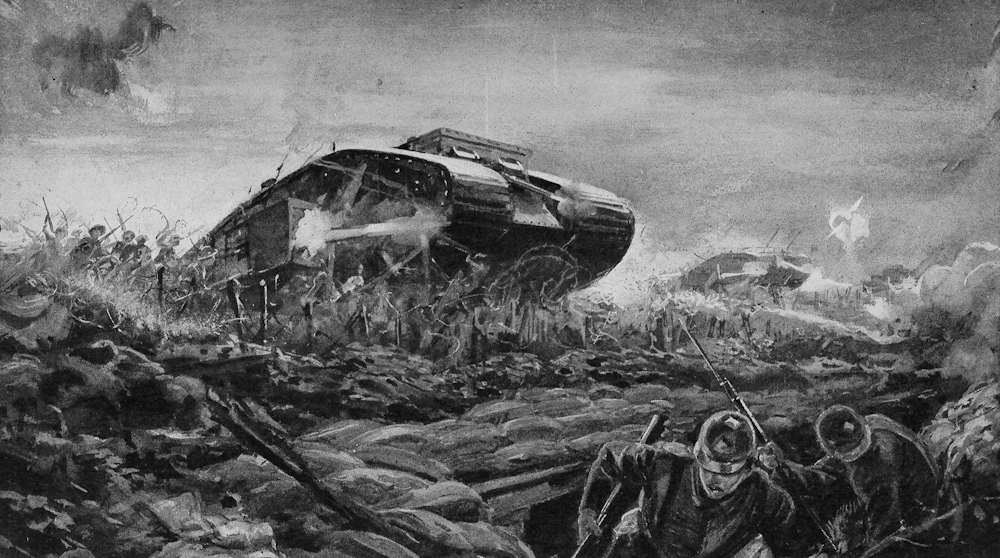
Courtesy of Leslie’s Weekly.
The British Juggernaut of the Battlefield
The Americans started in with 216 light tanks, a year after the British had used them in smashing the German defenses.
“Of course there are places a tank can’t go. You read a lot about how a tank loves mud. Don’t you believe it. A tank can slither around in mud just like an automobile. Of course it can go, but it can’t climb at the same angle on mud as on dry ground and somehow we always did fight in the mud. Mud didn’t stop us of course, but it made it more difficult. On dry ground we can climb 45 degrees, and 51 degrees in reverse.
“You hear a lot about the way a tank can crawl over trenches. But that’s the big heavy tank. The little fellow can’t run over a trench the way it can down and up a shell crater. The Renault is tail heavy, you see. It gets its nose across a trench all right, but if the trench is a little too wide the heavy tail drops back into it. Then you have to get out and dig or get another tank to come and pull you out. That’s why two tanks together are worth four separately. They can jam themselves up and still get along by doing the brother act with chains. Once that I know of a tank got stuck and the second tank couldn’t pull it out. So the officer outside signals another tank and it comes up—all this under fire, mind—and he hooks that on, too, and the two of them pull the helpless one up and over. He got the D. S. C. for it, that officer.
“It’s not nice when you’re stalled, you know. As long as you can move around, the 77 has a hard time getting you. But if you get stuck somewhere it doesn’t take a Boche gunner so very long to get your range. That’s why we were so anxious to have self-starters put on the American tanks, when we thought we were going to have American tanks. If there had been any self-starters on our Renaults we’d probably be shy about twenty casualties. Engine stalls, Boche gets busy, chap inside struggles with a crank, takes time, 77 lands, signal back for a reserve tank to come on into action. No, they didn’t put the self-starters on. Don’t ask me why; I don’t know.
TOO MUCH INGENUITY
“Sure, the American tanks were good tanks. We never used them in action that I know of. Those I saw got to France, or got where they might have been used, after the Armistice. But they were sure American all over—too much American, if you know what I mean. It’s a national failing, I guess, this business of being ingenious. There was so much ingenuity about those tanks there wasn’t always room for the crew. For instance, machine gun belts. When you use them, they are rolled up and in a carrier. Some wise tank builder decided all the ammunition in a machine gun tank ought to be in carriers, rolled up ready for use. When he got through, there wasn’t any room inside for the crew! No sense to it, of course; the same amount of ammunition stores flat, and leaves plenty of room, and it only takes a few seconds to roll up a belt and put it in a carrier.
“Then there was the compass. Some one must have read that British tanks carried compasses. So they did, until the tank crew could throw it away. So our American tanks came over with the handsomest compasses inside you ever saw; regular ship affairs, gimbals and all! Now, of course, that’s all foolishness. In the first place there wasn’t room for the compass and the crew. In the second place, when you start the engine, the compass does a fox trot, and keeps on whirling; it’s no good as a compass. And if it was, there wouldn’t be any sense in it; there’s a map stuck up right under your nose and that’s all you need, not to mention a few officers with flags telling you where to go, if they are not sitting on top going with you.
“Then there was the speedometer. Why any one should imagine a tank crew needed a speedometer I don’t know. But there it was, ready to tell us just how fast we were going. Maybe they thought, down in Washington, we were going to establish a tank speed record or something.
“And the hook—I mustn’t forget the hook. It’s so typically American—a device born of our national tendency to economise time. To put a hook in at the top of the tank meant at least two hours’ work. In 100 tanks that was 200 hours or 24 working days, slowing up production. The idea of the hook was that it would be so convenient when a crane had to lift the tank. Now the average tank gets lifted by a crane just four or six times; on a car at the factory, off the car, on the ship, off the ship, and maybe on and off a car again. So to save the six or twelve minutes it would take a crew to slip a chain around the tanks, they put a hook at the top, because it was efficient!
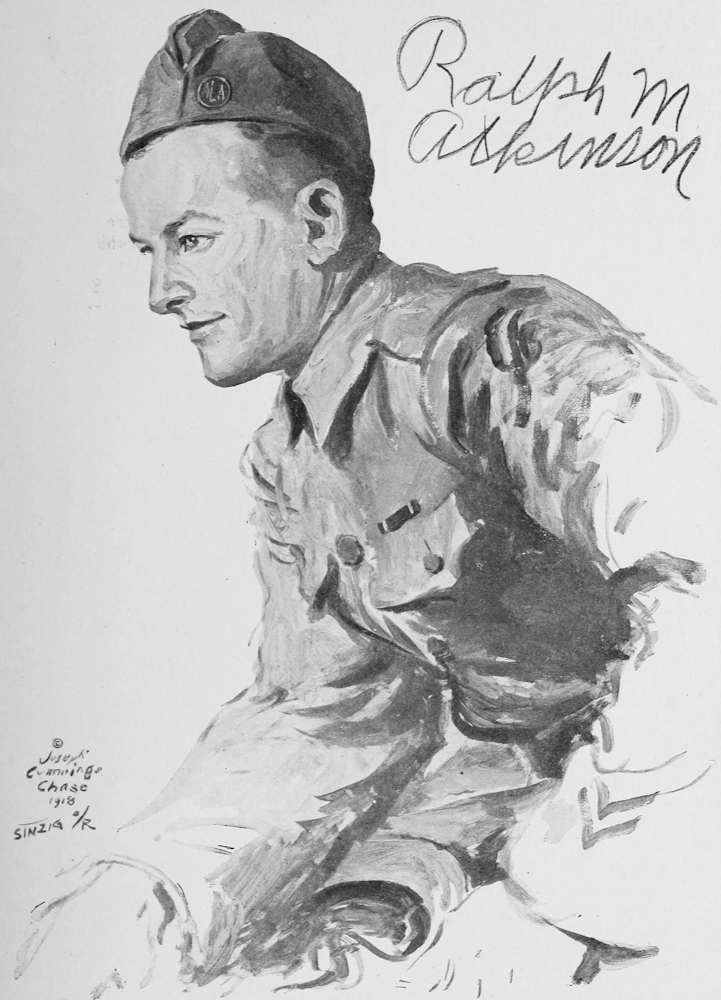
Drawn by Joseph Cummings Chase.
Sergeant Ralph M. Atkinson
42nd Division, 167th Infantry, Headquarters Company
While in command of a Stokes mortar platoon October 16, 1918, near Landres-et-St. Georges, Argonne, Sergeant Atkinson with three soldiers was advancing with the first wave of the assault, when on nearing the objective, he discovered about 250 of the enemy forming for a counter-attack. He advanced with the Stokes mortar under fire, and opened a murderous fire on the approaching enemy, dispersing them.
“Oh, well, I oughtn’t to grouch. We never used the tanks. And no one that I know minds much. Those Renault tanks were little dandies. You have no idea how easily they run. You can crawl over a telegraph pole and hardly feel it, so well worked out has been the spring suspension, the relation of rollers, chariots and treads. And they didn’t go in for any fancy touches, the Renaults. No armor for the guns nor fancy locks on the door to keep some one from crawling up and throwing a grenade inside, nor deflection armor at odd angles which never did anything but stop bullets and make splinters that otherwise would never have endangered any one’s eyes.
SNIFFS AT HUN TANKS
“German tanks? Punk. Too slow, mechanism too exposed, too many slits. Oh, very well made, but poor design. Nor do I think very much of German tank men.
“We had about 44 per cent. casualties, and that covers 22 actions. Ten per cent. of the casualties were deaths. But I don’t recall many men dying without doing something first.
“I recall that there was one tank got stuck in a trench and nothing handy to rescue it. Captured, of course. Well, we captured it back two days later. Every round of ammunition was fired. Every pistol cartridge had been fired. And both men had been wounded long before they were killed; there was plain evidence of it in blood where no blood would be if they had just been snuffed out right at first. They must have put up a beautiful scrap. Americans don’t like to surrender, somehow.”