EYE OF THE MORNING
Reading edition
The Popular Dutch Dancer Who Played the Rôle of German Spy to Her Cost
A story redolent of intrigue, adventure and a kind of romance is that of “Mata-Hari”—which is Japanese for “Eye-of-the Morning,” and is the name by which a Dutch dancer was known in the rendezvous of the light world of the European capitals before the war. Her real name is Marguerite Gertrude Zelle McLeod, and in 1917 her public and dashing career of art and adventure came to an abrupt stop by her arrest, trial, condemnation, and imprisonment, under sentence of death, in the prison of St. Lazare, Paris. She was condemned as a German spy, the specific offense being the betrayal to the Germans of the secret of the new, carefully guarded war weapon, the Tank. Reams have been written about this woman since her arrest, but nothing probably that would have anything like the interest for the public that will attach to the “memoirs,” the writing of which, reporters say, was her prison occupation.
Among the stories published at the time was one in the New York World in October, 1917, that presented what was known of her connection with the leak of the tank secret. The success of the tank depended largely on the element of surprise when it was put into the fighting front. Therefore the planning, construction and shipment of tanks to the Somme were conducted with the utmost possible secrecy. Necessarily, however, a certain number of persons in France and England were in a position to know; but, as it took a good many months to get the machines in readiness and habituate a crew to their rolling, pitching, sickening motion, the circle of those who knew more or less about it increased, and in some way not yet explained, Mata-Hari learned something of the secret. It is rumored that a member of the Chamber of Deputies inadvertently gave her her first information. The World said the rumor was strengthened by the fact that Mata-Hari had plenty of coal for her apartment during the fuel famine that winter. That in itself is proof enough to everybody of her intimacy with some high official, as few people, short of Deputies, had influence enough to obtain a hundredweight of coal during the bitter months of January, February, and March.
“In any event, Mata-Hari learned vaguely of tanks early in 1916, when the Krupp guns of the Crown Prince were daily booming nearer and nearer to Verdun in that terrific struggle which was to mark the turning-point of the war. Mata-Hari also learned that the tanks were being constructed in England, and would be shipped to France via certain ports—and she got the names of the ports, too.”
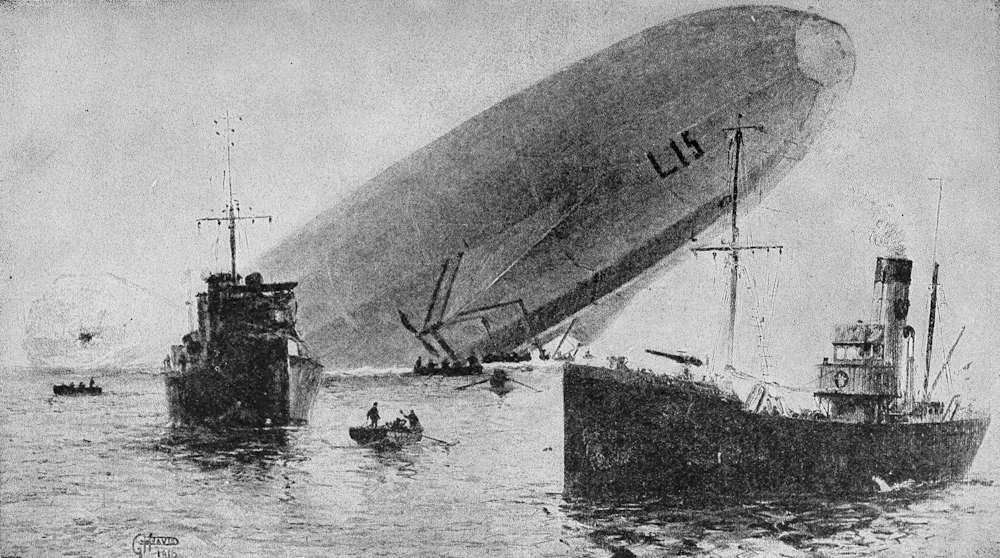
Zeppelin L-15 Sinking Off the Kentish Coast
The airship was brought down April 1, 1916, by British anti-aircraft guns.
Suddenly, Mata-Hari, then in Paris, decided to return to Holland, her native land, explaining to curious inquirers that she married a Dutch army officer with a Scotch name (McLeod) who had divorced her and that she was going to arrange a settlement.
SHE ACQUIRES A DRAGON
“The dancer proceeded to Rotterdam. Investigation there has since proved that she had no ‘communal rights property’ to settle with any one, and further that Captain MacLeod of the Dutch Army was known among his fellow officers as pronouncedly pro-German.
“Soon Mata-Hari returned to Paris. She was seen at the Café de Paris and at Maxim’s, and at Armenonville in the Bois with an English officer who wore on the lapel of his collar, as insignia denoting his branch of service, a little twisted brass dragon. Months later, when more of these badges were seen on British officers passing through Paris, it became known that the dragon was of the official insignia denoting service with the tanks.
“Mata-Hari sported a new bauble soon after taking up with the Englishman—a jeweled replica of his gold insignia—her dragon had real emeralds for eyes, and a carrot-shaped ruby for a tongue darting from its opened fangs.
“In May, 1916, a little more than a month before the Somme offensive opened and tanks were first used, Mata-Hari appeared before the police magistrate of her district and requested a safe conduct to visit a certain port in France. The reason she gave was that her fiancé, an English officer, was seriously wounded and in hospital there. He had sent for her to come to see him. Perhaps they would be married at his death-bed if he could not recover, she volunteered, dabbing at her eyes with a lace handkerchief. The safe conduct was made out, and Mata-Hari arrived at a certain French port almost simultaneously with the first consignment of tanks shipped over from England.”
She spent the greater part of her time for a week strolling about the town making frequent excursions by night, and then just a month before Foch and Haig began their drive along the Somme she appeared again in Paris.
“The first thing she did was to apply for a visé on her passport permitting her to go to Spain. San Sebastian was the place she mentioned, as she explained she wished to attend the horse-races there. Her papers were stamped and sealed and she left almost immediately for the fashionable winter resort in the south.
“Madrid, Spain, and Nauen, Germany, are in constant wireless communication. There are other radio stations, privately owned, in Spain which can flash messages to Germany, according to Allied intelligence officers who have investigated. And of course there are innumerable German agents, spies, and propaganda disseminators infesting the land of the Dons.
“Secret service reports disclose the fact that Mata-Hari was seen much in company at San Sebastian race-track with a man long looked upon with suspicion by the French government. He was a frequent caller upon her at the hotel where she stopped, and it was reported that he made many of the big bets she placed on horses that did not materialize as winners.
AGAIN THE DEPUTY
“Soon Mata-Hari came back to Paris and the apartment near the Bois de Boulogne. And once more the limousine owned by the individual whom rumor has branded a Deputy began rolling up to her door twice a week and sometimes oftener.
“Then came the simultaneous Franco-British offensive at the Somme. Tanks went into action for the first time, and according to General Haig’s official communiqué his ‘Land ships achieved satisfactory results.’”
But, notwithstanding the “satisfactory results,” several of the tanks were surprisingly put out of action and the investigation of the how and the wherefore revealed the fact that they had been disabled by a peculiar, small-caliber penetrating shell unlike anything known before. They were fired by guns of a special manufacture.
Instantly it became evident that the enemy had become aware of what was in store for him and had constructed an “anti-tank” gun. And when the booty in the captured German positions was examined, the British found they had several good specimens of Krupps’ newest weapon. Several German officers of higher rank taken prisoners confirmed suspicions by explaining they had received description of the tanks several weeks before, and had been instructed how to combat them.
Suspicion aroused, items of information, curious circumstances in accountable movements, bits of gossip were put together and military law took charge of Mata-Hari.
For some reason the finish of her memoirs is not yet; but the fictionist, attempting to forecast a sensation, has written this:
“So Mata-Hari writes feverishly, and all Paris waits eagerly!—except the one who waits apprehensively—to see if she will name the ami who gave her the first inkling of the tanks.
“Pinned to the corsage of the Empire-cut black silk dress which Mata-Hari wears in her narrow cell in St. Lazare prison is a curious gold brooch. It is shaped like a twisted dragon, and its eyes are emeralds!”