AS TO SPIES IN ENGLAND
Reading edition
A Dozen Were Shot, Hundreds Were Imprisoned, But “Cherished Spies” Were Allowed To Go Free Because Their Work Was So Bad.
There has never been a war since the one in which the daughter of Jupiter and Leda, the inconstant Helen, figured so conspicuously, that has not had its fact or fiction of “beautiful” women. Whether it be Homer or Timothy Tubbmutton who wields the recording pen, there is always the woman beautiful to flavor the narrative. And usually the “beautiful” is a clever spy who casts a seductive spell over diplomats, statesmen, generals or, if need be, corporals of the guard. Inevitably a war of a magnitude to take in every clime and nation offered alluring field for the play of the reportorial or literary imagination, and we have had—in novel, movie and magazine as well as in the columns of the press—stories unlimited about beautiful women spies.
It goes without saying that, with the rarest possible exception, beauty is not a feature of the type of person whose mentality delights in “treasons, stratagems and spoils.” But we seldom have an authoritative pronouncement on the subject, and for that reason it is particularly interesting to reproduce in part an interview Miss Gertrude Lynch had with an English secret service official in 1917 while the war was still very much on. Miss Lynch was one of the “Vigilantes,” an association of American writers whose object was to “help win the war” by the dissemination of educative information. The interview with the English official was to get some light on the German espionage system as applied to England. Though not named, the official is described as the spy expert of England. A great many spies, of one and another sort, were nabbed in England. The article says:
ONLY A DOZEN SHOT
“There have only been twelve spies shot since the beginning of the war, but hundreds are either in penal servitude for life or serving shorter sentences. The actual number was not known to the official who talked with me on this topic—with the distinct understanding that I should not mention his name or title. He is the acknowledged authority on the spy evil. Not far from where we sat, in a formidable cabinet which looked as if it held other interesting documents, the papers taken from von Papen were carefully locked.
Courtesy of Leslie’s Weekly.
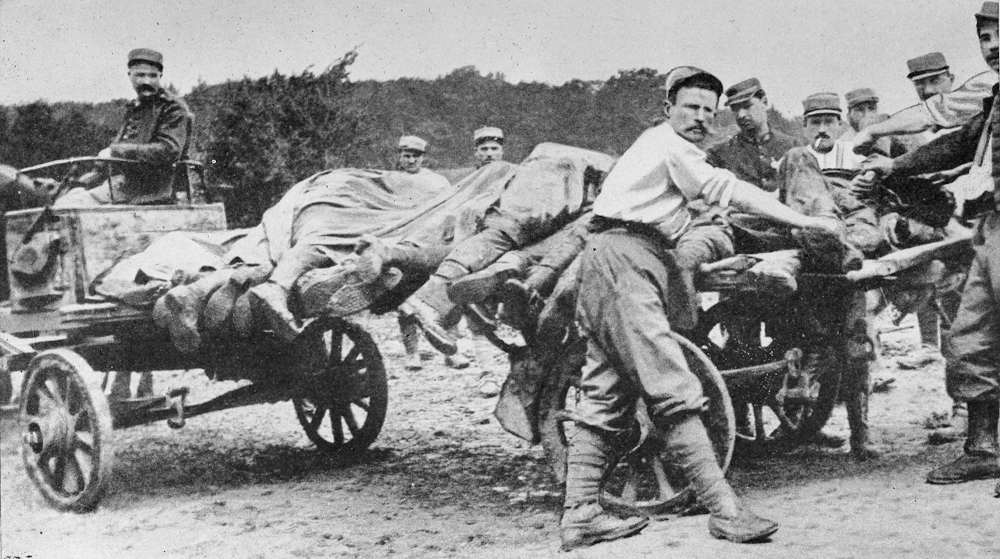
French and German Soldiers as Comrades in Death
Clearing a battlefield after the advance of the French armies in September, 1915. The fallen of both armies were loaded together on wagons and hauled to convenient places for interment. Their identity was learned from numbered metal tags on cords around the neck, or sewn into the clothing.
“‘No woman spies have been shot in England and only one among the feminine lot—a bad lot—who are serving sentence could possibly lay claim to being a “beautiful lady” spy. This woman had all the hall-marks of the fiction and cinema character, charming in manner, well gowned, having plenty of money, traveling about luxuriously, and was finally nabbed with the incriminating papers on her. But the popular conception of the feminine secret agent rarely exists outside of sensational stories because only women without moral sense can take up this profession, and when a woman is devoid of moral sense she is sure to be devoid of the other qualities that might make her work efficacious.
“‘There are, of course, numberless men and women who would be spies if they had not been interned, and, among the 30,000 Germans who are at this moment so confined, there are doubtless several who treasure the belief that they would have been of inestimable use to their country; but as they will never get a chance to prove themselves wrong that poor solace is permitted them.
“‘We have,’ continued my informant, ‘a great number of “cherished spies” with us. These are the spies who go about plying their profession and believing themselves the personification of that cleverness the Germans demand for this work. That is why we have dubbed them “Our Cherished Ones.” They are carefully watched. We let them go on doing bad work because it is much better to keep a bad spy doing bad work than it is to take him and perhaps have a spy who might do good work sent in his place.
“‘We would hate to lose our “cherished spies.” We don’t intend to!
“‘America has the job of the century. I wouldn’t know where to tell her to begin. Spies that were there and have left had plenty of time to lay their plans before the unrestricted submarine warfare began.
“‘With 8,000,000 Germans in America, what you have to find out is whether or not a German has been denationalized, a process that can only be gone through in Germany. It is not enough to know that he has been naturalized and that he claims to be a good citizen to your country. The fact that he has become a naturalized citizen does not free him from the call to fight for his own land. If he is denationalized as well as naturalized you are then safe, but not before. In England we had only a very small number who were found to be denationalized, a fairly negligible unit.
“‘I should say that the rush by foreigners immediately after the declaration of war in America was not because before they had been indifferent or hostile, but because they feared to be called upon to fight for their own countries. You will probably find that many of the Germans had been denationalized and were finishing up the process.’”
AMERICA’S HIGH-CLASS SPIES
America had a monopoly of the so-called high-class spies, according to this authority. The average German spy was described as a man who has one or more convictions hanging over his head—an unsentenced criminal—and these men were paid only about $250 a month. The statement continues:
“‘The last spy we caught was only a day or so ago. We had been after him for some time and he was traveling with a perfectly good American passport.
“‘The high-class spies with you are responsible for the sabotage, for the strikes on the docks and in the factories. They are pacifists, anticonscriptionists. It is a situation terribly serious for you. They are going to delay what they can not prevent. Don’t flatter yourselves that the important spies have been driven out. If I had been a spy in America and the warning had been given to me so long in advance, I would have laid my lines very well. Look out for those lines; you may trip.
“‘What should be done with a spy in America? He should be shot as soon as his espionage has been proved. No weakness should be permitted because he has many affiliations there.
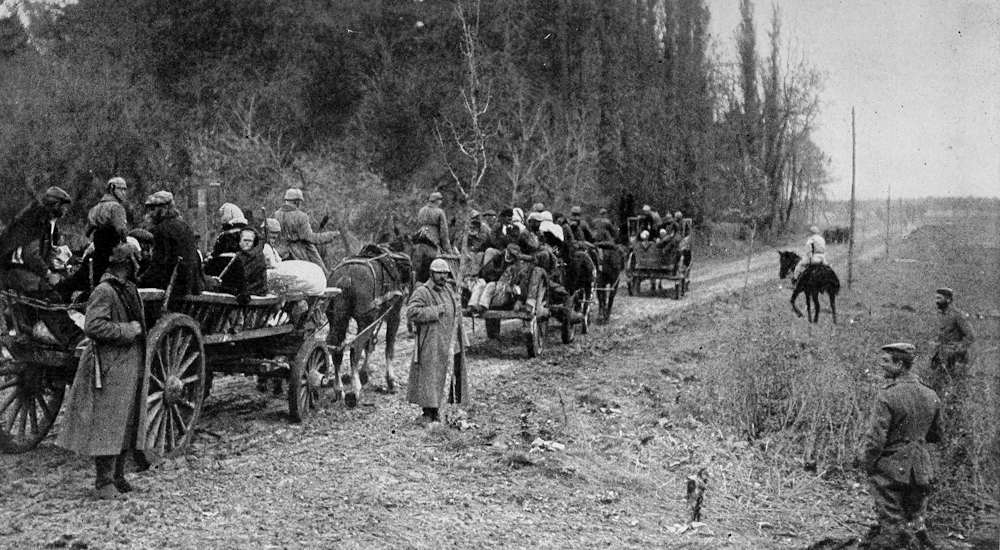
French Peasants Sent to the Front by Germans
In certain areas in France the German commanders feared that the inhabitants would give information to the French armies, and so moved all the population either into concentration camps near the front or to points a long way in the rear of the lines. Here is shown a wagon train filled with peasants who had been forced to leave their homes with only the few necessities these civilian heroes could carry.
“‘I was in Germany eight years ago. Everywhere I was asked, “Are you ready to fight America?” That was the pretty little German game. Even then they were dying to rub into us the fact that America was our enemy. In the beginning, when the commercial party—Herr Ballin and his clique—were in power, they pretended a great affection for you. It was contrary to their desire that the submarine warfare became so terrible—not because they hated its brutalities, don’t make any mistake about that, but because they thought it a diplomatic blunder. Then and now they have a press which harps on the unfriendly feeling that exists between you and us. That often reiterated phrase that “America is fighting Great Britain’s battles for her” was made in Germany.
“‘I’m not such a fool as to think that America loved us in the past, but that she ever hated us as the Germans have said and that we have hated her as they still say in subtle, indefinable ways in some of your papers, is unbelievable by either of the parties concerned. Nations have faults as do individuals. We’ve made mistakes. We may have talked a little too much about the Shannon and Chesapeake and you too much about Bunker Hill and that tea-party in Boston Harbor. Let’s have an end to it—it all helps Germany too much. Take away the text-books from your children which teach them to hate us. If you try it, the German school-teachers will try to keep them, see if they don’t.
“‘America ought to love us now if she has not in the past, if national love is founded on respect, as it should be. We can point to ourselves with pride. We have given up in this war the thing we most believed in—personal freedom. We have made untold sacrifices and we are ready to give up everything—everything. Anything in your press that makes you see these facts in a distorted way is false, spy-work of the subtle, underground, submarine mentality sort that the Germans excel in.
“‘Look out for it. It isn’t the work of the “lovely lady spy” or that of the man with a conviction suspended while he does their dirty work that you are in danger from. It is just where I have pointed out.
“‘You asked me a while ago what England would do in case Germany won. I will tell you and you can draw from it the lesson of spy—and other German effort.
“‘If Germany should win, there won’t be any one here when it happens to know anything about it.’”