SUBDUING THE TURK
Reading edition
When Captain Butt, the British Ace, Found Bakshish a Cure of Captivity
When the war broke out, Alan Bott was one of the younger set of newspaper men in London. Soon after England cast in her lot with France, Bott was training with the airmen. Right speedily he became a fighting flyer and anon an Ace, with seven German planes to his credit. He won the Victoria Cross, and the rank of Captain. Readers may remember having heard him lecture when he made a tour of this country early in 1919, and gave very impressive pictures of adventures in the air. Not many aviators had the varied experiences that fell to the fortune of Captain Bott, for though he was for a time with his fellows of the Royal British Air Force operating in France, he was transferred to the East later and many of his thrilling adventures were in the Holy Land. He gave an account of one of these soon after his arrival in this country. He said:
“It all began when I fell out of the clouds from a height of six thousand feet and bumped my nose after a fight with a Boche plane. It wasn’t exactly a fight with one plane, either. I was chasing a Boche who had a machine nearly as fast as mine, and by the time I caught up with him we were forty miles behind the enemy lines and above some rough, rocky, partly wooded hills.
“I was just beginning to pepper the Boche when two enemy scout planes I had not seen literally dropped from the clouds right above and shot me up, especially the petrol tank. I whirled and crashed down, and the next thing I knew it was moonlight and my leg was paining like the deuce, held down by part of my engine. It was a very lonely, desert spot, and I figured that hill would be my last resting-place. I figured they would name it after me.
“Whether fortunately or not a bunch of Arabs came along, sort of bandits, I suppose, and found me. As far as I could make out, after they lifted the engine off me they were tossing up whether they should kill me or turn me over to the Turks and get some bakshish, which is a popular pastime in that part of the country. They used to say that with £1,000 you could bribe the Grand Vizier himself.
“While they were drawing lots to see whether I would live or die, a party of Turkish soldiers came along and chased the Arabs off, but detained me. In fact, they were decent enough to take me to an Austrian hospital at Afion-Kara-Hisson, about seventy miles from our base at Jaffa. It was three weeks before I could get around much, and then I foolishly tried to escape. My leg was so bad that the attempt was a foozle, as the guards caught me up before I had gone very far.
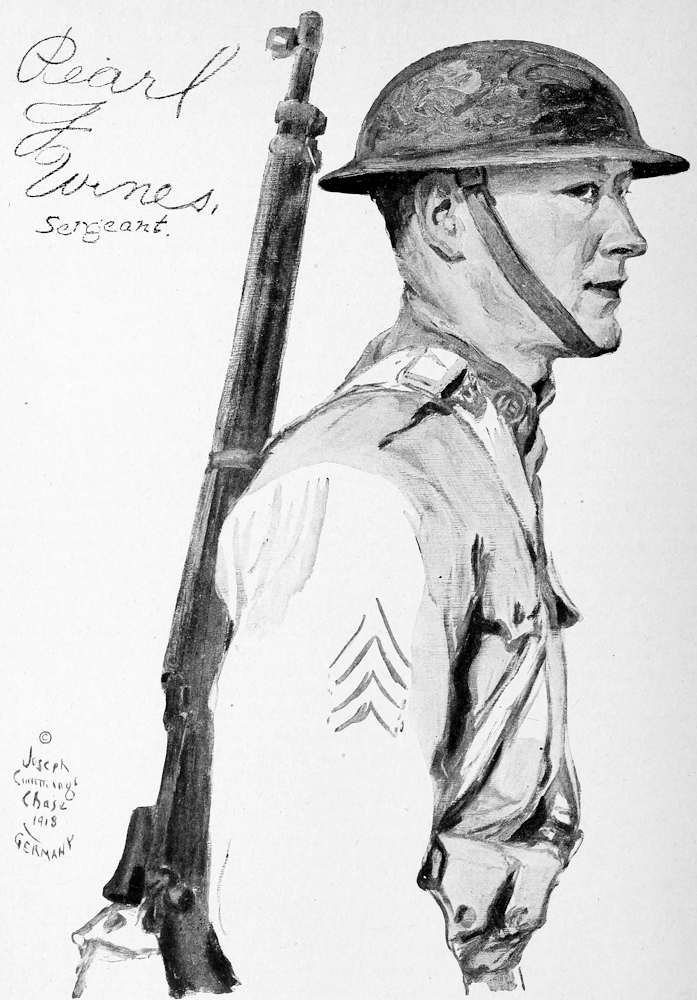
Drawn by Joseph Cummings Chase.
Sergeant Pearl J. Wines
90th Division, 358th Infantry, Company “E”
While fighting in the St. Mihiel sector on September 12, 1918, Wines was wounded in his side by a party of Germans. Becoming infuriated he engaged the entire party: killed three of them, and captured the other two without aid of any kind.
IN JAIL AT NAZARETH
“Finally, I was taken to Nazareth and put in a criminal jail with murderers and brigands, all filthy brutes. At first I was put in an underground dungeon, with one other man, an Arab, whose great penchant was chasing cooties. There were other English prisoners there, and we were all treated pretty badly. Our food consisted of a bowl of soup and a loaf of bread each day. It was some bread!
“Several of us planned to escape and tried several stunts, none of which appealed to the Turks, until I selfishly hit on the scheme of becoming temporarily insane. I was very crazy, for a few days, and then the highly ornate boss of the jail shook his head seriously and said he would have to send me to Constantinople.
“We finally began to rumble across the desert in a very slow train, and I decided to drop off at the first convenient way-station and cut across lots for Jaffa. We were quite near Constantinople before an opportunity came, and then, at the psychological moment, there was a very opportune train wreck, and I walked away and hid in among some rocks.
“When night came I met a Turkish officer dressed in a German uniform, and then worked the popular game of bakshish, which is really the national game of Turkey.
“I gave the officer a couple of Turkish pounds and he peeled the uniform. He put on mine and I have no doubt he was duly captured by the guards. I went to Constantinople and was saluted very regularly by Turkish and German soldiers. It took a lot of dodging to keep clear of the Germans in Constantinople, but I managed to get along, having a lot of fun sometimes in the cafés, listening to the gossip and plotting.
A STOWAWAY ON A “HELL SHIP”
“It appeared at that time that Turkey had been ready for quite a while to sign a separate peace, but the Allies couldn’t get the idea. My greatest desire was to get out of Constantinople, and I finally stowed away on a little rusty cargo-steamer bound for Odessa. We were rolling around the Black Sea one day when the crew were seized with Bolshevism and went on strike.
“It was great on that ship with the engines dead. We rolled and rolled for days on end. I had bought a Russian sailor’s uniform by that time and so could go about without fear of capture. The main thing was to get a crust of bread and cup of water. It was a hell ship and no mistake, with the sun beating down all day and the officers and crew in continual fights.
“Finally they patched up a truce and we made Odessa, the trip taking almost three weeks. It was bad in Odessa and when we heard that Bulgaria had made a separate peace I decided to make a try for the Bulgarian coast. I stowed away aboard another cargo steamship and finally reached Bulgaria and my British countrymen.”