EPIC OF THE FOREIGN LEGION
Reading edition
Its Wonderful Story Will Stand as One of the Vital Things of the War
The self-redeemed have always had the world’s sympathy—sometimes they have won the world’s acclaim. Visitors to that shrine of French honor and glory, the famous Hôtel des Invalides, may now see the battleflag of the Foreign Legion, draped between the flag of the Cuirassiers who fell at Reichshofen, and the standard borne by the Garibaldians in 1870-1871—not only draped in that honorable association, but wearing on its folds the cross of the Legion of Honor. And those who know will tell visitors that that flag was the flag of the redeemed.
It was said with shame and contempt at first that the Foreign Legion was composed of the riff-raff, scalawags and murderous upstarts of the nether world. So it was, but events proved that “there is a spirit in man” that can throw off degraded conditions and rise to the performance of nobly heroic deeds and sacrifices. This Legion, made up of renegades and social outcasts from all quarters of the globe, men beyond the pale of the law speaking a various language, tendered its services to France in 1915, was recognized by the President of the Republic, accepted by the Commander-in-Chief and admitted to the army on an equal footing with the regular regiments of the line. The pariahs became soldiers of France.
It was an extraordinarily nondescript assembly—all nationalities, all colors, from the black of the negro to the blonde of the Saxon, having but two things in common, their former outlawry and the “spirit that quickeneth,” and through the quality of that spirit they squared their debt to life,—for the Legion dissolved in the fire that met the “drive” in September, 1915, so soon after it entered the service. As one of the few survivors wrote: “War did its worst thoroughly with the Legion. We had the place of honor in the attack, and we paid for it.” Right good words.
There is all the material for an epic in the glory of the Foreign Legion. A great deal has been written about it, but the best is yet to be written—some time when the war is further away, and out of its horror the things that glow will rise into clearer view. Really, it is a great thing when the reject of the social order spring from their fugitive haunts and rush to death in defense of the higher civilization. In the meantime there is the moving story, graphically yet simply told, by Legionary Morlae, a survivor, published in the Atlantic Monthly for March, 1916.
The Legion was placed in the van, and Morlae’s company formed the front line of the extreme left flank.
Infinite care had been taken with the preparations, every detail provided for, even to the extent of arming twelve men from each company with long knives and hand grenades for use in their assigned duty as “trench-cleaners”; this duty was to enter the German trenches and caves and bomb-proofs and “dispose of such of the enemy as were still hidden therein after we had stormed the trench and passed on to the other side.”
JUST BEFORE GOING INTO ACTION
“One hour before the time set for the advance, we passed the final inspection and deposited our last letters with the regimental postmaster. Those letters meant a good deal to all of us, and they were in our minds during the long wait that followed. One man suddenly began to intone the Marseillaise. Soon every man joined in singing. It was a very Anthem of Victory. We were ready, eager, and confident: for us to-morrow held but one chance—Victory.
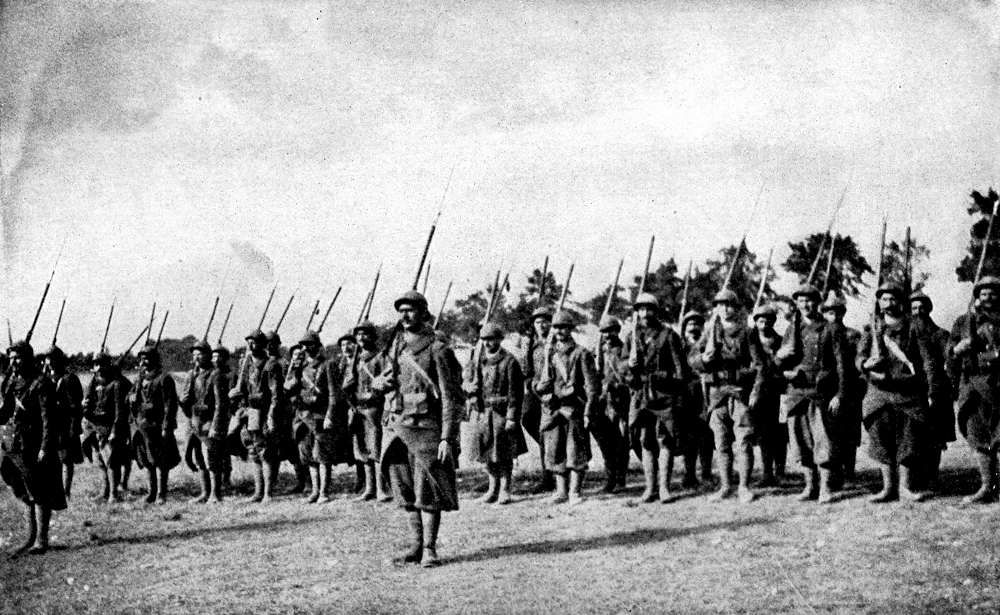
Courtesy of Scribners.
A Platoon of the Foreign Legion
The legion of adventurous spirits who fought for France, made up of renegades and social outcasts from all quarters of the globe. It had the right of honor in an attack and went through the bitterest fighting on the Western front.
“I had written to my friends at home. I had named the man in my company to whom I wished to leave my personal belongings. Sergeant Velte was to have my Parabellum pistol; Casey my prismatics; Birchler my money-belt and contents; while Sergeant Jovert was booked for my watch and compass. Yet, in the back of my mind, I smiled at my own forethought. I knew that I should come out alive.
“I recalled to myself the numerous times that I had been in imminent peril: in the Philippines, in Mexico, and during the thirteen months of this war: I could remember time and again when men were killed on each side of me and when I escaped unscratched. Take the affair of Papoin, Joly, and Bob Scanlon. We were standing together so near that we could have clasped hands. Papoin was killed, Joly was severely wounded, and Scanlon was hit in the ankle—all by the same shell. The fragments which killed and wounded the first two passed on one side of me, while the piece of iron that hit Bob went close by my other side. Yet I was untouched! Again, take the last patrol. When I was out of cover, the Germans shot at me from a range of 10 meters—and missed! I felt certain that my day was not to-morrow.
“Just the same, I was glad that my affairs were arranged, and it gave me a sense of conscious satisfaction to think that my comrades would have something to remember me by. There is always the chance of something unforeseen happening.
“The strain was beginning to wear off. From right and left there came a steady murmur of low talk. In our own column men were beginning to chaff each other. I could distinctly hear Subiron describing in picturesque detail to Capdevielle how he, Capdevielle, would look, gracefully draped over the German barbed wire; and I could hear Capdevielle’s heated response that he would live long enough to spit upon Subiron’s grave; and I smiled to myself. The moment of depression and self-communication had passed. The men had found themselves and were beginning their usual chaffing. And yet, in all their chatter there seemed to be an unusually sharp note. The jokes all had an edge to them. References to one another’s death were common, and good wishes for one another’s partial dismemberment excited only laughter. Just behind me I heard King express the hope that if he lost an arm or a leg he would at least get the médaille militaire in exchange. By way of comfort, his chum, Dowd, remarked that, whether he got the medal or not, he was very sure of getting a permit to beg on the street-corners.”
Here is a significant touch to be remembered. An hour before midnight as they passed down to the front trenches the men in the supporting trenches regarded them enviously in the darkness, demanding to know why these men should be going into battle ahead of themselves. And the answer came, “Nous sommes la Légion.” “A-a-a-a-h la Légion!” That was the satisfactory explanation. “Our right to the front rank seemed to be acknowledged. It did every man of us good.”
It was the recognition of the right to redemption!
OVER THE TOP AT DOUBLE-QUICK
There had been heavy artillery fire through the night, increasing in intensity as the hour of the morning appointed for the attack approached. The Germans, informed by their airmen of an unusual commotion in the enemy first line, began shelling that point, and the uproar was terrific when the signal was given for the Legion to go over the top. Says Morlae:
“I felt my jaws clenching, and the man next to me looked white. It was only for a second. Then every one of us rushed at the trench-wall, each and every man struggling to be the first out of the trench. In a moment we had clambered up and out. We slid over the parapet, wormed our way through gaps in the wire, formed in line, and, at the command, moved forward at march-step straight toward the German wire.”
As they moved forward at double-quick, men fell right and left under bursting shell, and the rain of bullets from the machine guns; but through all the appalling uproar Morlae could hear the clear, high voice of his captain shouting “En avant! Vive la France!”
STEADILY ON ACROSS A WALL OF FIRE
They went steadily on, supported by the fire of the rows of “75’s,” the fire-curtain in front outlining the whole length of the enemy’s line clearly, accurately. But above them was blackness, the low-flying clouds mingling with the smoke curtain; and out of that blackness “fell a trickling rain of pieces of metal, lumps of earth, knapsacks, rifles, cartridges and fragments of human flesh. The scene was horrible and terrifying. Across the wall of our own fire, poured shell after shell from the enemy, tearing through our ranks. From overhead the shrapnel seemed to come down in sheets, and from behind the stinking, blinding curtain came volleys of steel-jacketed bullets, their whine unheard and their effect almost unnoticed.... With me it was like a dream as we went on, ever on. Of a sudden our fire curtain lifted. In a moment it had ceased to bar our way and jumped like a living thing to the next line of the enemy. We could see the trenches in front of us now, quite clear of fire, but flattened almost beyond recognition. The defenders were either killed or demoralized. Calmly, almost stupidly, we parried or thrust with the bayonet at those who barred our way. Without a backward glance we leaped the ditch and went on straight forward toward the next trench, marked in glowing outline by our fire. I remember now how the men looked. Their eyes had a wild, unseeing look in them. Everybody was gazing ahead, trying to pierce the awful curtain which cut us off from all sight of the enemy. Always the black pall smoking and burning appeared ahead—just ahead of us—hiding everything we wanted to see.” And so on to the next trench ahead, what was left of it, where bayonet and gun-butt did their work speedily and then on, leaving the finishing touches to the “trench cleaners.”
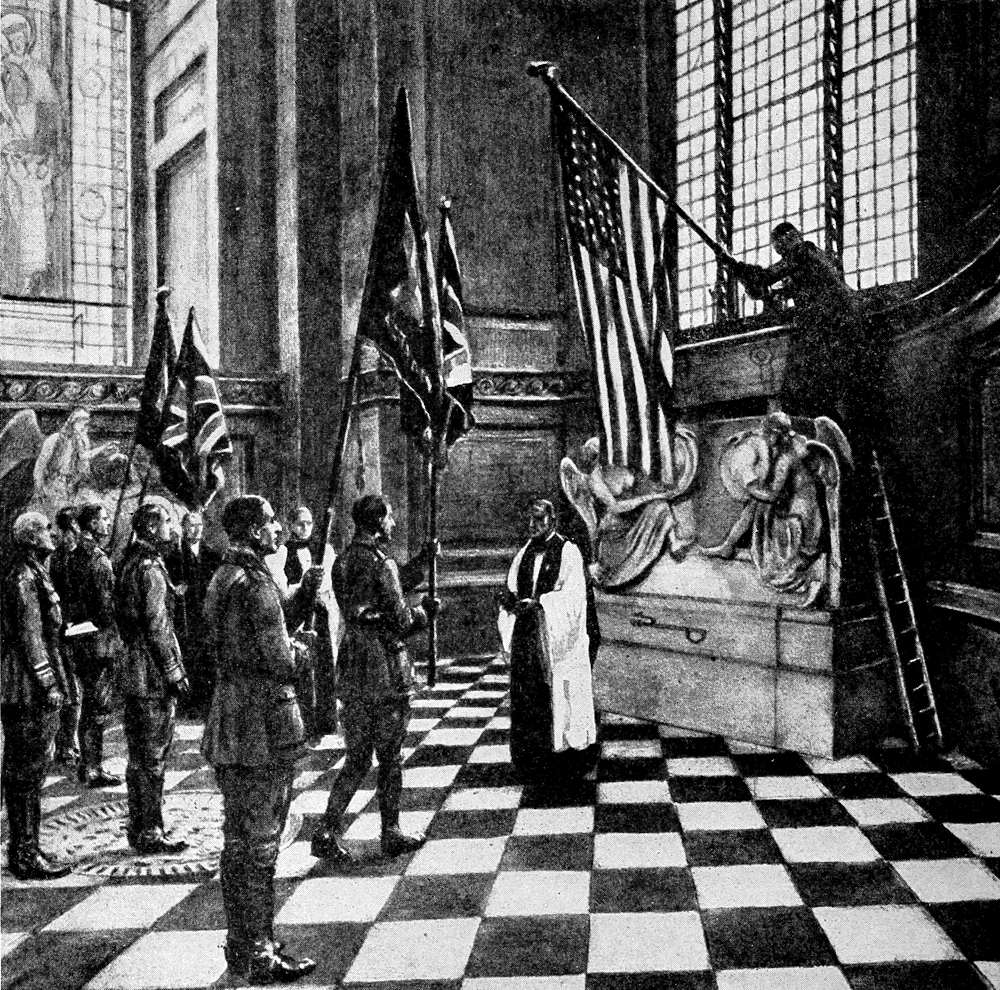
Placing the Stars and Stripes in St. Paul’s Cathedral, London
The American Legion—men who were serving in the Canadian Army—presented to the Cathedral the flag of the United States and the flag of Canada. They were first placed on the altar and after a short service were carried to the north transept.
Later of a sudden the German artillery in front ceased fire, and from the trench ahead the German troops “were pouring out in black masses and advancing toward us at a trot.” They thought it was a counter-attack and set themselves to meet it. But then the French artillery suddenly stopped firing and the supposed counter-attack was seen to be a surrender, the enemy coming forward in columns of four, officer leading, with hands up. As the prisoners were being escorted to the rear, the German artillery, aware of its mistake, resumed fire, viciously throwing shells among the masses of prisoners.
At last they gained the communication trench that led to their objective, the Navarin Farm. The trench was filled with dead or wounded Germans; and when they got to the final trench, it was wholly unoccupied. The French gunmen had done their work thoroughly. The men advanced into open position and dug in separately, smoked, chaffed each other, now and then made a dash to a neighbor’s hole, taking cheer in the fact that the charge was over and the object won.
But of the Legion such a pitiful few were left that it passed as a fact, surviving only as a memory; its war-sealed flag with the cross of the Legion of Honor, hanging in the Hôtel des Invalides, being the testimony of its service well done.
DARE-DEVIL FIGHTERS FROM THE PARIS SLUMS
As an addendum to this account of the final action of the Foreign Legion, brief reference to the Bataillon d’Afrique is quite appropriate. This battalion was organized by the French government in 1832 for the purpose of bringing under indefinite military discipline the city roughs, Apaches, sneak-thieves, pickpockets, swindlers, forgers and other offenders of the lower world. All the social refuse whom the authorities despaired of making useful to civil life were sent to join this battalion, which differed from the ordinary battalion consisting of 1,000 men, in having no numerical limit. It was maintained in Africa. These soldiers were young daredevils, keen, brave, daring, and veritable terrors in a fight. This was so characteristic of them that the best French officers were eager to have command of them, especially as they were devotedly obedient to their officers.
When France was forced to defend herself against Germany at the outbreak of the Great War, there were 5,000 of the Bataillon d’Afrique, 3,000 garrisoned in Tunis and 2,000 in Morocco. They were summoned to France, and the first detachment of several thousand landed at Marseilles early in August and were at once hurried north and into Belgium. One battalion was surrounded at Charleroi by a detachment of the Prussian Guards, and the situation looked very black and desperate. But that did not affect the fighting spirit of the battalion (the Joyeux) except to give it intensity. The Joyeux buried their flag that it might be in no danger of falling into the hands of the enemy and, with fixed bayonets, by sheer force and will-power cut their way through the encircling guardsmen. This battalion was part of the heroic rearguard in the retreat from Belgium. At the battle of the Marne it took terrible revenge for its discomfiture by the Guards at Charleroi, when the Joyeux in their turn surrounded a regiment of the Prussian Guards, which did not cut a way out.
They gave a fine account of themselves, that is, those who had survived the earlier campaigns in the final grand offensive of the Allies.
Captain Cecaldi, who led the Joyeux in many campaigns, said of them:
“The place of the Joyeux is where the powder talks, face to danger. They ever give proof of a calm energy, devilish courage, attentive obedience. They fight always with a good humor. In the midst of shells and bullets, in the hardest part of the struggle, they make droll and witty remarks. And when the end comes the Joyeux know how to die nobly.”