TORPEDOED!
Reading edition
A Nurse’s Graphic Personal Narrative of the Wanton Destruction of the Sussex
On a clear day with the sea a perfect mirror reflecting the blue sky, the French Channel Steamer Sussex left Folkstone harbor on its fateful trip for Dieppe, March 24, 1916. Among the passengers was an English nurse attached to a French hospital, who was returning to duty from a month’s leave of absence in England. The Sussex was a small but finely built, stout passenger boat, unarmed. She left harbor at 1.30 in the afternoon, and in a short time encountered in the Channel thousands of floating bags of a jettisoned cargo. A group of passengers, standing by the rail, began to discuss the possibilities of torpedoing. A British officer, who had braved dangers at Undros, laughed, saying that it was not submarine weather, the Germans being afraid to show themselves in a calm sea. Soon the others of the group strolled off leaving the nurse alone watching a Belgian officer exercising his dog on the deck. Presently they went away, and the nurse turned to look out at the sea and watch for a periscope.
What followed the nurse tells, as her personal experience, in an article published in Blackwood’s Magazine:
“It grew cold, and I was beginning to think of going back to my sheltered chair to roll myself up in my rug, when in a moment the whole earth and heaven seemed to explode in one head-splitting roar. In the thousandth part of a second my mind told me ‘Torpedoed—forward—on my right’—and then the sensation of falling, with my limbs spread-eagle, through space.
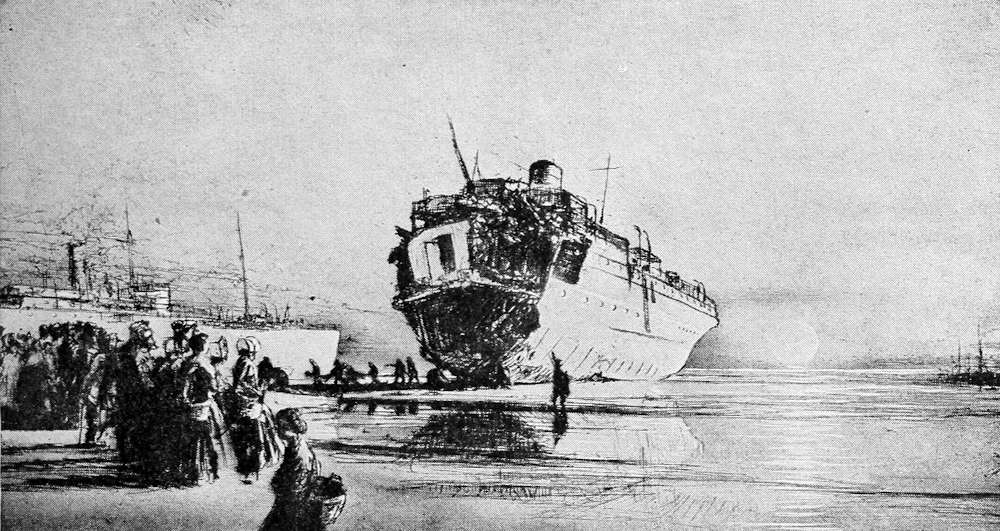
The Sussex Beached
This channel ferryboat was torpedoed at night while carrying a large number of distinguished passengers. The force of the explosion broke her amidships.
“When I came to myself again I was groping amid a tangle of broken wires with an agonizing pain in my back and the fiercest headache I had ever known. My hair was down, and plastered to my chin with blood that seemed to be coming from my mouth. There was more blood on my coat-sleeve. I was conscious that I was bleeding freely internally with every movement. My first definite thought was, ‘If only it is all a ghastly nightmare!’ But I remembered. My next thought was a passionately strong desire not to die by drowning—then. I crawled free of the wires that were coiled all about me and stood up.
DEAFENED AND UNABLE TO SPEAK
“In one unsteady glance I took in a number of things. Near me a horrible piece of something, and a dead woman. (Afterwards I wondered why I was so sure she was dead and never stooped to make sure.) Below me, on the quarterdeck and second-class promenade deck, numbers of people moving to and fro, many with lifebelts on. I never heard a sound from them, but it did not strike me as odd then. Now I know I was deafened. So I had been blown up on to the top deck, to the other end of the ship. I swayed to and fro, and looked for a stairway, but could find none, and began to be aware that I had only a few moments of consciousness left me.
“Something must be done if I was not to drown. I forced my will to concentrate on it, and came to the side, where I found three men looking down on a lowered boat. I also saw a lifebelt on the ground. I picked it up and, not having the strength to put it on, I tried to ask the men to tie it for me. Then I found I could not speak. So I held it up, and one, an American, understood, and hastily tied it. Then I saw one of them catch hold of a loose davit rope and swarm down it to the boat. There was my one chance, I decided. My arms were all right, but would my legs work? I took hold, and made a mighty effort to cross my knees round the rope: I succeeded. Then I slid down till I was just above the water.
INTO ONE LIFEBOAT
“I waited till the roll of the ship brought me near enough to the boat to catch, with my right hand, another rope that I saw hanging plumb above it, while I hung on with my left. It came within reach: I caught it, let go with my left, and lowered myself into the boat. Then I wanted to sink down in her bottom and forget everything, but I dared not, for men were pouring into her. I saw a man’s knee hooked over the side of the boat where I sat. I could not see his body, but it was in the water, between us and the side of the Sussex. As in a dream I held on to his knee with my left hand with all the grip I had left, and with my right held on to the seat on which I sat. I could do nothing to help him in, but on the other hand, so long as I remained conscious, his knee-hold should not be allowed to slip. No one took any notice of either of us. Gradually I began to hear again. The men in the boat were shouting that there was no more room, that the boat was full. One last man tumbled in and then the people in the boat pushed away, and men on the Sussex helped. Others continually threw gratings and planks overboard.
ALMOST SWAMPED
“Our boat was dangerously overcrowded. Already she was half swamped. I wondered when she would upset. A man on either side seized gratings and towed them alongside. One made a herculean effort and pulled the man whose knee I had been holding into our boat, and nearly upset her. No one said a word. He was an elderly man, and his fat face was white and piteous. His hands never ceased trembling. He had had a terrible fright. Some one suggested getting out the oars, and others said it was impossible, as they were underneath us all. However, it was managed, and several men stood up and changed places. Again we nearly upset. I joined with the others in commanding these wild folk to sit still. Three oars were produced. One was given to a young and sickly looking Frenchman opposite to me. He did not know how to use it. Everyone shouted to get away from the steamer. The water had now reached my knees, and I began to notice how cold it was.
“I saw three other women in the boat. They sat together, white and silent, in the stern, nor ever moved. They were French women. Some one noticed that the water was increasing and there was a wild hullabaloo of alarm. A Belgian—the man who had pulled into the boat the man whose knee I held—called for hats with which to bale, setting the example with his. But we were so tightly packed that no one could get at the water, whereupon the Belgian climbed overboard on to one of the gratings I have already mentioned, and a young Belgian soldier followed his example on the other side. They held on to our gunwale with their fingers. This somewhat relieved the congestion, enabling us to bail.
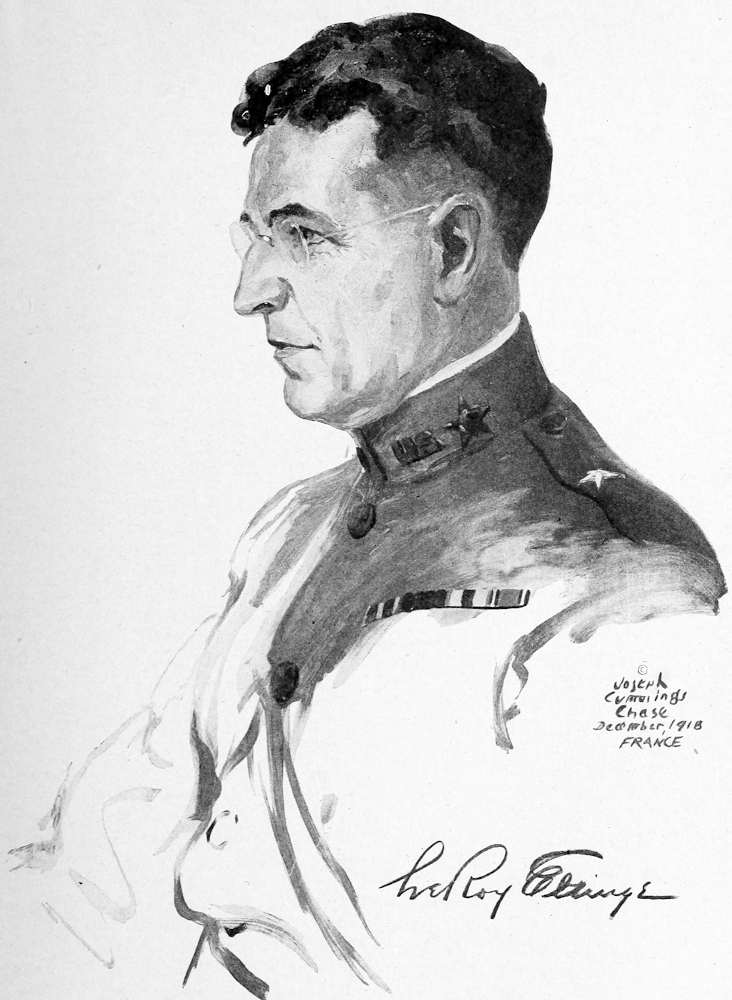
Drawn by Joseph Cummings Chase.
Brigadier-General Leroy Eltinge
Deputy Chief of Staff, G. H. Q., A. E. F.
“Sometimes the people in the boat bailed furiously, sometimes they stopped and stared stupidly about them. Some shouted ‘Ramez! Ramez!’ Others equally excited yelled ‘Mais non! Videz l’eau! Videz l’eau!’ I apologized to my immediate neighbors for that I had no hat to lend, and for that I was too hurt to stoop, but I put my hands on the erring oar the young Frenchman was feebly moving across my knees, and did my best to guide his efforts. As often as not he put it flat on the water, and sometimes he merely desisted altogether, and gazed vacantly in front of him. The Belgian asked for a handkerchief, and groping in the water at the bottom of the boat, found a hole and caulked it as best he could. Thereafter the bailers kept the water from increasing, but did little to reduce it.
THE SUSSEX STILL AFLOAT
“Looking around I saw our steamer riding quite happily on the water with her bows clean gone. Afterwards I learned that the torpedo had cut off her fore-part, to within an inch or two of where I had been standing, and that it had sunk. I saw another full boat being rowed away from the ship, and an overturned one with two people sitting on her keel. I saw a man seated on a grating. All were convinced that help would be forthcoming speedily. And still the Sussex floated. Four times I remarked—by way of a ballon d’essai—that it seemed as if she were not going to sink, and always there was an outcry to row, and get away from her. The Belgian and the Belgian soldier evidently thought as I did. They proposed that we should return before we were swamped ourselves. Once again a hysterical outburst. One man jumped to his feet and shrieked, and asked us if it were to hell that we intended returning? I began to be afraid that he and those who thought as he did would throw us others into the sea, but common-sense told me that to remain all night in that overcrowded half-swamped boat would be to court death.
“We saw at last that the other boat was returning. This was our chance. Example is a wonderful thing in dealing with mob hysteria. Tentatively the two Belgians and I proposed that we should go as close to the steamer as prudence permitted, and ask the Captain if she were going to sink. If his answer were favorable, those who desired should go on board, and any who liked could go off again in the boat. If his answer were unfavorable, we would stand off again. The maniac still shrieked his protests, but the rest of the boat was with us. But no one seemed to know how to turn the boat. As soon as we told one to backwater, the other two did likewise. It seemed hopeless. Finally, we let the other two oars pull, and I myself tried to induce my vis-à-vis to ‘ramez au sens contraire,’ which was the nearest approach I could get to ‘backwater’ in French. He was too dazed to understand, so I simply set my teeth and pulled against him, and in about fifteen minutes the boat gradually came round in a wide circle. How I longed to be whole again so that I could take his oar right away and cox that mad boat! With my injured back and inside I could only just compass what I did. The pain kept me from collapsing, and the exertion from freezing.
“It looked as though we were to be swamped, after all, within ten yards of the Sussex’s gaping bows, for our crew, in their excitement, had forgotten to bail for some minutes. As we floated in under her sides I made a final appeal, which a young Belgian put into more forcible French, for everybody to keep calm and not upset the boat at the last.
BACK TO THE SHIP
“The women now spoke for the first time—and it was to appeal to the excited boat’s load to let me be taken off first, since I was injured. I found I could not stand, so sat in the middle of the seat trying to trim the boat while the men scrambled out. I was left alone at last; and the water that came over the gunwale poured over my legs to my waist, some of it soaking through my thick great-coat and chilling me to the bone. The boat was floating away. Some one shouted to me to get up. I got on to my hands and knees on the seat and tried to crawl along the side, but the change of position nearly caused me to faint with pain. Then the Belgian managed to get hold of the boat and hold her, and some sailors leaned out of the hatchway in the Sussex’s side and grasped me by the arms and pulled me up and in as though I had been a sack. There were many far worse hurt than I, and they left me propped against a wall. The Belgian again came to the rescue, and half dragged me to the top of the second saloon stairway. I got down by levering myself on my hands on the rails, while he supported me under the arms.
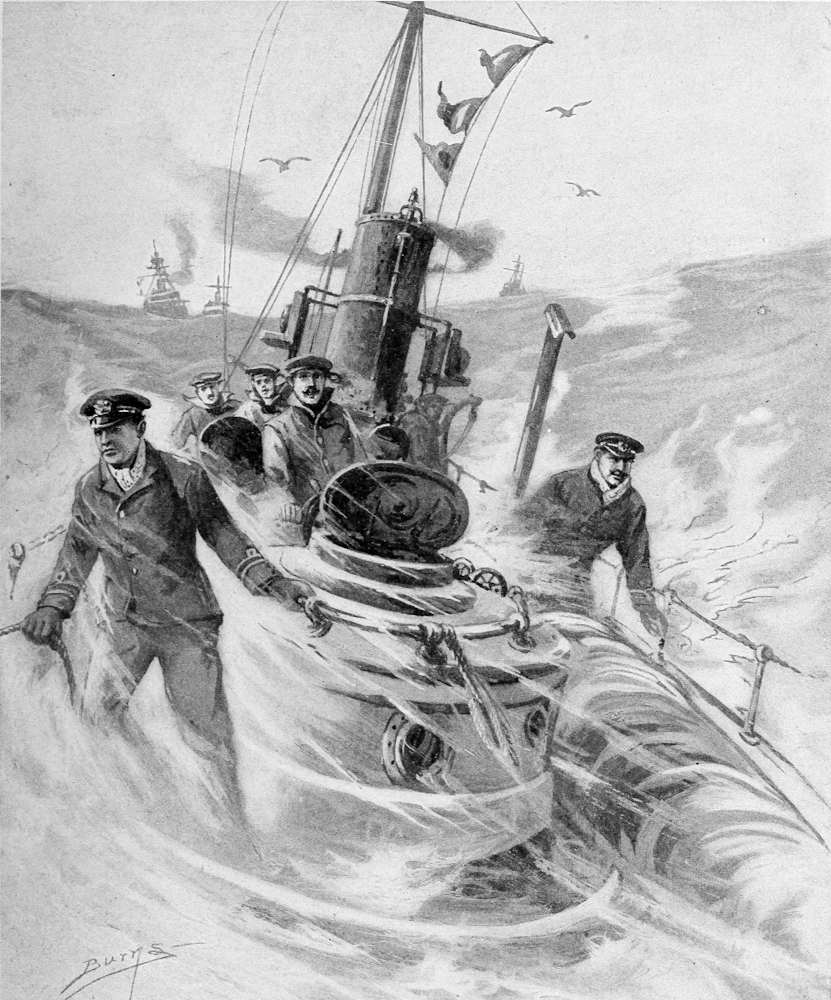
Courtesy of Leslies.
Searching for U-Boats in the North Sea
A fleet of torpedo boats combing the seas for German raiders. The Allied Fleets maintained their vigil until the German Navy was surrendered at Scapa Flow.
“Once in the saloon, he and the young Belgian soldier took off my loosely fixed lifebelt and laid me on a couch. One forced a glass of whisky down my throat, which burned and gave me back renewed consciousness, while the other ran for brandy. I was terribly cold, and the good Belgian took off my boots and puttees and stockings and chafed my feet till one was warm. The other had no sensation for over twelve hours, and five days later, when it was radiographed, proved to be sprained and fractured.
“WHAT IS IT TO DIE?”
“After that, long hours of waiting. A woman shrieked incessantly up on deck. A man with a wounded head came and sat patiently in a corner. A girl, complaining of a pain in her chest, came down the stairs and lay down on a corner couch. She never moved nor spoke again. By midnight she was dead. None of us guessed, none of us knew. She died bravely and silently, quite alone. Another woman showed signs of approaching hysteria. A young Belgian officer, who had been attending her, suddenly ceased his gallantry, and standing sternly before her, said brusquely, ‘After all, if the very worst comes, you can only die. What is it to die?’ The words acted on her like a douche of cold water. She became herself again and never murmured. We others, perhaps, benefited too. It is nerve-racking work lying helpless in a damaged vessel, wondering whether the rescue ship or another enemy submarine will appear first on the scene. And no ship came. At intervals the Belgian boy soldiers came down to reassure us: ‘The wireless had been repaired. Forty vessels were searching for us. There was a light to starboard. We were drifting towards Boulogne. The “Phares” of the coast were in sight.’ But no ship came. The light to starboard faded. Another appeared, and faded too.
“Then we heard the regular boom of a cannon or a rocket. We all knew that something must have blocked our wireless, but no one said so. The Belgian came down to sleep, fixing his lifebelt first. With him came a good French-woman, who was very kind to me and washed the blood from my face and rinsed out my bleeding mouth. She was very hungry, and all I could do to help her was to hold her jewels while she went on deck to search for her hand baggage, and, later, to give her some soaked food out of my pocket. There was no food left anywhere. She said some brave words, too, about death coming to all, only coming once, and being soon over. How much one person’s courage can help others at such a time! Then she tied on a lifebelt and went to sleep beside me. The ship was rolling now, and the seas slapped noisily against her somewhere, jarring her all through her frame. But the Captain had said she would not sink for eighteen hours, and we all believed his word implicitly. Still, it was an ugly noise, and seemed to betoken her helplessness.
“WOMEN AND CHILDREN FIRST”
“And then at last the news of rescue! A French fishing-boat was coming! ‘Women and children first,’ the young Belgians cried. My Belgian succorer roused himself and fetched my stockings and boots. My right boot would not go on. My puttees he could not manage, and so he tied them round me. He was always cool and practical and matter-of-fact. ‘I have been in the Belgian Congo,’ he explained, ‘and in shipwrecks before. I know what to do, and I am not alarmed. You can trust entirely to me.’ And I did. There was a great bump as the fishing-boat came alongside, and a rush upstairs. Once more I was left alone, for my Belgian friend had gone up to see about getting me helped on board. He came back to say that the crush was so great that he would wait till it was over and then take me. It seemed a long time, but he came back at last, only to find he could not lift me. Then he went away calling for an ‘homme de bonne volonté’ to help. A young Chinese responded, and together they staggered up the heaving stairway with me. When they reached the ship’s rail it was to hear that the boat had gone! A British torpedo boat was coming, we were told, and so the fisherman had gone off with as many as he could safely carry to Boulogne. With her went my hope of reaching my own hospital in France. I had been sure the destroyer would take her load to England.
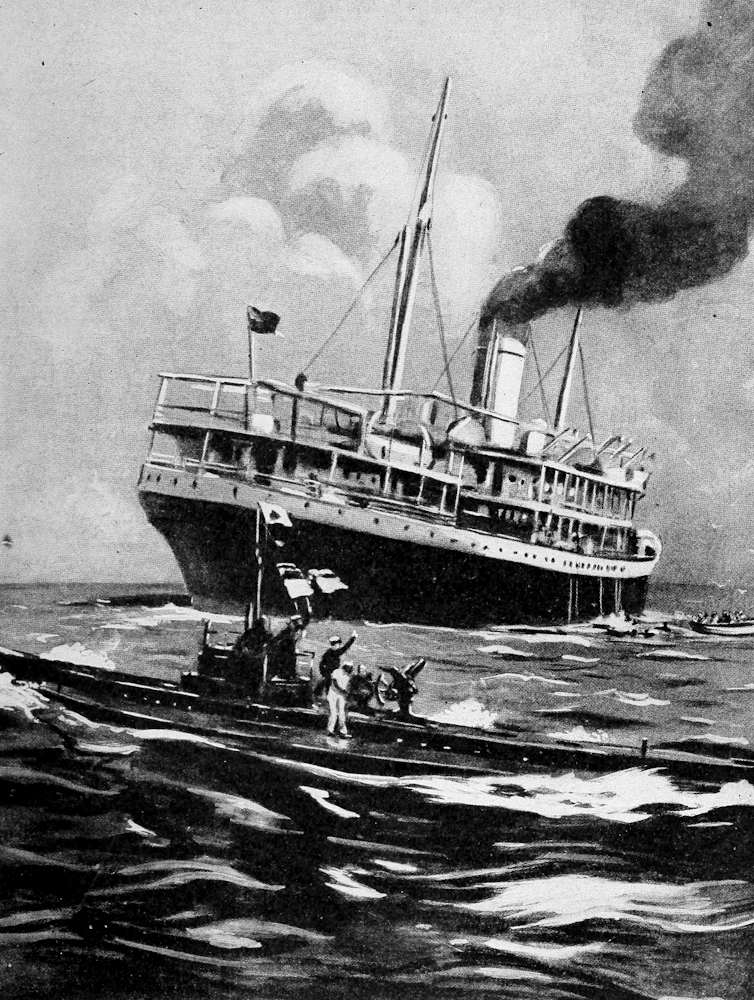
Courtesy of Leslies.
Sinking of the Falaba
After torpedoing the ship, the U-boat came to the surface and gave the command “Abandon ship.” Shortly afterward the Falaba broke into flames and was destroyed.
“Perhaps half an hour passed, and then the destroyer came. This time one of the French sailors helped him to carry me, and I was placed on my back, across the ship’s rail, and when the roll brought her near enough to the destroyer, British sailors grasped my arms and pulled me over. For one sickening second my legs dangled between the two ships, but the sailors hauled me in just before the impact came. They carried me to the chart-house and laid me on the couch, and before long the Belgian joined me, and, utterly exhausted, lay down on the floor. From that moment I felt entirely safe. We English are brought up to feel complete confidence in the British Navy, much as they teach us to trust in Providence. And the Navy deserves our confidence.
“It took a long time to transfer all the remaining passengers of the Sussex to H. M. S. ——, for the sea was becoming restless, and the two ships hammered and thumped at each other’s sides to such purpose that the rescuing destroyer had to go into dock for repairs when her labors were over and she had landed us all safely.”