WHEN THE “YANKS” WENT IN
Reading edition
The Story of the First American Soldiers to Go It Alone in Banging the Huns
Because they were recruited in the New England States, the boys of the 26th Division were known as “Yankees” or the “Yankee Division” and they set up pretty good claim to the distinction by acts of unit heroism not excelled for dash, daring and effective service by any troops opposed to the Huns. The “Yankee Division” was the first of the A.E.F. to take part in a great offensive in France. It was organized under the command of Maj. Gen. C. R. Edwards, Aug. 13, 1917; arrived in France in September, and in January, 1918, was undergoing special training on the Chemin des Dames front. It was assigned to the Toul sector and was in position by the end of March. Ten days later the enemy struck its first serious blow at the line, “a blow which turned out to be far more serious to the Germans than to the New Englanders.” It was the beginning of the five days fight known as the battle of Apremont, though it really was the battle of Bois Brulé, the worst of the fight being in the “burned wood” on the hill top where the 104th Regiment was stationed. In an article in the Boston Globe devoted to the 26th, Willard F. De Lue says:
“From the very first day there had been artillery-action; in fact, the Boche set up a row while the Yankees were coming into the line, before they got their packs off. Now, at five o’clock in the morning of April 10, the Germans sent over a body of seven hundred or eight hundred picked shock-troops against Colonel Shelton’s boys.
“But the Yankee artillery got the jump on them, and opened up with a barrage that couldn’t have been better. It smashed the Germans’ attack so badly that it broke down, and for the rest of that day, and for two more, the Boches were content to throw over a heavy artillery fire.
“On the 13th, however, they were at it again. This time they planned a little better. The center of the assault was directed against the French units on the left of the 104th, and it wasn’t long before they sent over a hurry call for a counter-attack by the Yanks. The 104th responded handsomely. They swept through Bois Brulé right on to the German flank, and relieved the pressure on the French line. But by that time their own flank was threatened. So the Yanks suddenly changed direction, and attacked by their own flank—a difficult maneuver, but beautifully executed.
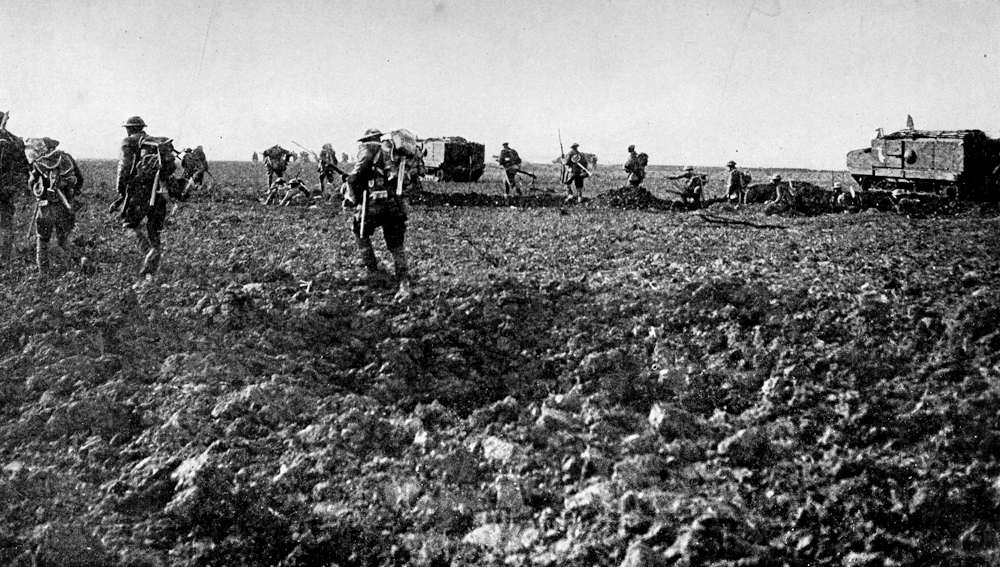
Courtesy World’s Work.
Cantigny—The First American Offensive
Here it was that our soldiers confirmed the confidence placed in them and won the admiration of the Allied High Command. Two days later Americans were ordered to hold the road to Paris and the crossing of the Marne at Château-Thierry.
“The fighting kept up stubbornly. By one o’clock in the afternoon the Germans had broken through and grabbed some of the advanced points held by the 104th, and were filtering in through communication trenches. It was apparent this was no mere raid. So the reserves were ordered up. But before they arrived the enemy had been hurled back again, and by six that night the heaviest of the fighting was over. On the 14th there was further action; but the Boche had been licked, and he knew it. His losses were tremendous; ours comparatively light.
“Many an act of heroism took place that day. The flags of the 104th Infantry were later decorated by the French for the gallantry displayed by its men. And the individual awards of American and French decorations are eloquent.
“That was the first battle fought by Americans—any Americans—in France in which they were not supported by French infantry.”
IN EVERY AFTER BATTLE
Having been inducted into the firing line, the 26th had no surcease, but took part in every subsequent battle up to the signing of the armistice, missing the promised rest, time after time, owing to the exigencies of the campaigns. And according to the complaint of a captured German lieutenant, they did not always play the game right. On one occasion the moment an enemy barrage was lifted, a body of Yankees darted ahead and actually nabbed some of the advancing Huns, the lieutenant included. He sputteringly said in reproach of these tactics, “They should not have been where they were. They were coming right through our own barrage, and might have been wiped out.”
That the Americans were so apt to be “where they shouldn’t have been” was greatly disconcerting to the Huns more than once. They did things in such an unconventional way, acting so much on individual initiative that they frequently spoiled the precise calculations of the German machine. The French had greater appreciation of the Yankee method. The commanding officer of the 32nd French said this of the 26th:
“I salute its colors and thank it for the splendid services it has rendered here to the common cause. Under the distinguished command of their chief, General Edwards, the high-spirited soldiers of the Yankee Division have taught the enemy some bitter lessons at Bois Brulé, at Seicheprey, at Xivray Marvoisin; they have taught him to realize the staunch vigor of the sons of the great republic fighting for the world’s freedom.”
The division was also in the Château-Thierry battle. Mr. Le Due writes:
“On the 9th the fighting on this new field began. The Boche, in the early morning, swept down into Vaux and established machine-gun posts.
“‘You’ve got to drive those (censored) out of there or we’ll be the laughing-stock of the division,’ was the word sent out by Colonel Logan. And so the driving began.
“That fight for Vaux will be long remembered—a picturesque fight, with groups of men rushing here and there, cleaning up snipers and machine-gunners, rushing hostile positions; overhead the roar of the American barrage, below the hum of countless machine guns. The clean-up was thorough.
“Three days later Foch’s famous counter-offensive began—on July 18, at 4:25 in the morning.
“The night before, at ten o’clock, a terrific thunder-storm had broken. Lightning flashed and rain fell in sheets. But in the morning there came a clearing, and when the fated hour approached there was a rosy flush on the morning sky. Commanders wore an anxious look. A surprise had been planned, and a clear day was not to their liking. But just before the time set a heavy mist began to descend. All was well.
“A gun spoke; then the roar from a hundred, a thousand iron-throated messengers of death. The creeping barrage had opened. The infantry was to attack simultaneously.
“The Yanks moved forward on the left, pivoting upon their own right, held by the 101st, in front of Vaux. The 102d came next; but it was the boys of the 103d and 104th, on the left, that did the early fighting.
“‘We are in Torcy,’ was the first message sent back. Then came a delay. A hitch had taken place; but by nine o’clock Bouresches, Belleau, and Givry were in the hands of the Yankees.
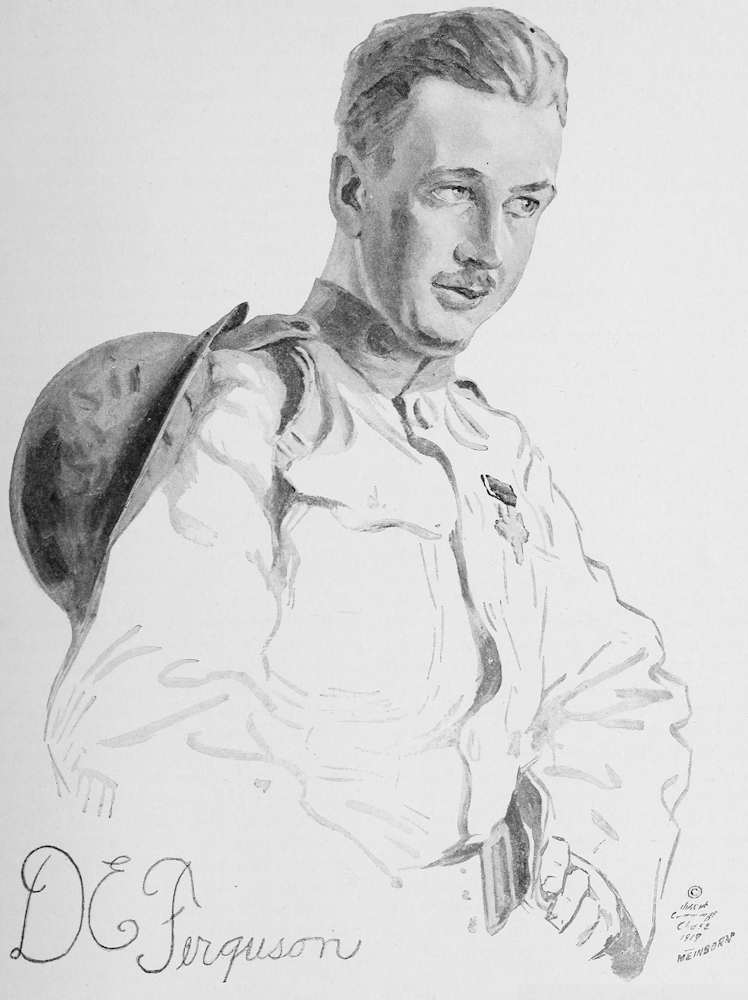
Drawn by Joseph Cummings Chase.
Sergeant Dugald E. Ferguson
32nd Division, 126th Infantry, Machine-Gun Company
When the infantry on his right was held up by fire from an enemy machine gun at Cierges, northeast of Château-Thierry, August 1, 1918, he seized a rifle, rushed around the flank of the enemy’s position, bayoneted two of the machine-gun crew and shot three of them, enabling the infantry to advance.
“The first objectives taken, preparations were at once made for a further advance. But the French, to the north, had been held up. On the 19th there was no forward movement until three in the afternoon. Hill 193, above Givry, where the French were held up, was passed on the flank, causing the Germans to fall back. Etrepilly and Etrepilly Woods were reached, taken, and passed. So, too, Genetrie Farm and the woods close by La Halmadière.
“In the night of the 19th there was another halt. Then forward again at daybreak, with the 101st and 102d Infantry getting into action late this day, and sweeping forward, through Vaux and the woods close to Bouresches, they crossed the Soissons-Château-Thierry road, and by the 22d found themselves in front of Epieds and Trugny.
WINNING MORE FRENCH PRAISE
“It was here that the severest fighting of the drive took place. In Epieds the Germans planted machine guns every seven yards. In Trugny and in the woods that lie on the hillsides to the east of both towns they had done likewise.
“The 101st tackled the Trugny proposition. Colonel Logan’s men were in and out of the town twice. But the German artillery had the range just right, and whenever the Yankees went in flooded the place with mustard-gas. On July 23 Colonel Logan borrowed a little ground on his right from the French, encircled Trugny on the south, and started up behind it, through Trugny Wood. It was a terrible fight, but that night the 101st broke through the German defenses and forced a retreat. Meantime, the three other infantry regiments were making constant frontal attacks. The 102d got into Trugny and captured the gun now on Boston Common.
“On the 23d the 103d and 104th Infantry Regiments were relieved; and on the 25th the 101st and 102d were relieved. But the artillery brigade kept on, supporting three other American divisions, until the Vesle River was reached, August 5. It was in this drive particularly that Sherburne’s outfit earned the name of the best field artillery in France. A regular Army officer, watching the guns in action, said: ‘I have been in the Army thirty years and never have seen field artillery until this day.’
“By August 7 the whole division, including the artillery, was back in villages along the Marne, between Château-Thierry and Paris.
“The people of the countryside hailed the men of the 26th as ‘saviors of Paris.’ Those who went into the French capital were greeted with enthusiasm. Men and women embraced them and kissed them.
“General Degoutte, famed commander of the French 6th Army, with which the Americans fought, wrote to General Edwards:
“‘The operations carried out by the 26th American Division from July 18 to July 24 demonstrated the fine soldierly qualities of this unit, and the worth of its fine leader, General Edwards. The 26th Division fought brilliantly ... advancing more than fifteen kilometers in depth in spite of the desperate resistance of the enemy.
“‘I take pleasure in communicating to General Edwards and his valiant division this expression of my esteem, together with my heartiest congratulations for the manner in which they have served the common cause.’”
THE LAST SHOT
And so on until, drawn from temporary reserve at Verdun, the 26th was ordered into the Argonne battle. The Globe chronicler continues:
“On October 15 the 104th was fighting in conjunction with the French and a squadron of fifteen French tanks. What the fighting was like may be judged from the fact that only one of those fifteen tanks came back.
“On the 16th other units went in, and by October 18 command passed to General Edwards. The new position in line was on the east side of the Meuse River, facing generally east. Ahead lay the scrubby woods of Haumont, Chenes, Ormont, Belleau, and the skirt of the Bois de Wavrille, and of Samogneux, the latter to the extreme left, nearer to Verdun.
“The attack on these positions began on the 23d and continued until the 27th. The woods, so far as trees went, consisted of a few dead, blasted stumps, standing out like skeletons, in the midst of thick, deadly underbrush. The whole ground had been fought over recently. Bodies of dead French and Germans lay there. And in one place was a valley full of skeletons of the Crown Prince’s men who had made the desperate attack on the forts of Verdun.
“These woods were taken and lost again, taken and lost, taken and lost. Four times did the 101st battle through Belleau, only to be blasted back by artillery. The enemy had sworn to stick it out, for an attack here threatened the lines of communication. And stick they did.
“Of those last days a volume might well be written: of the desperate charges, the hell of shell-fire, the deluges of gas, the hum of millions of machine-gun death-messengers—death-messengers that brought their messages home. And through it all, partly over ground they had won before, they plunged in the dull desperation of despair. In the previous days they had been robbed of the officers they knew and loved. Edwards had been relieved October 25. Others had preceded him, and others followed—Cole, Logan, Hume.
“Desperately these boys fought and paid the price. On the 9th the line was drawn back a little, the accompanying units couldn’t keep pace. And still the battle raged—a bloody, maddening, disheartening battle—raged despite reports that an armistice had been agreed upon. Even at ten in the morning of November 11, one hour before the fighting was to stop, the 26th was ordered forward again ‘to straighten out the line.’ In that hour hundreds were lost.
“The Yankee division fought up to the last shot. That shot fired, the division remained a wreck. Gen. Frank E. Bamford, the new commander, reported that the division was in no condition to go to the Rhine. That day, the 11th, 1,200 replacements were received, and more were on their way. When the last hour’s fight began one regiment, normally 3,000 strong, had only 240 rifles.”