SOME RED CROSS WEAKLINGS
Reading edition
Captain Bobo and His Buddies Weren’t Good Enough for the Doctors
There is a reminder of the stone which the builders rejected in the story breezily told by Frank Ward O’Malley in the Red Cross Magazine for July, 1919. It records the heroism of Bobo—Captain Stephen N. Bobo, whose ancestors long ago undoubtedly spelled their name Beaubeaux. Steve was born in Memphis, Tennessee, and began early to react against southern ease. Anyway, as soon as he was graduated from college he made straight for Honduras. “Thence,” says O’Malley, “Steve went to Chile, where he started for Sidney on a trading schooner, but liked the little ship so well that he bought a controlling interest in her en route. At the Christmas Islands, Skipper Steve Bobo converted his schooner into a trader instanter—and made a little money on her. He was wrecked off Easter Island and, with five companions, had to swim seven miles to land. Skipper Bobo and four of his friends were compelled during that swim to help keep afloat betimes a sixth, whose swimming technique was poor.
“He returned to Chile aboard a passing convict ship. He made a short visit home, then was off to the interior of China, where he made a little money. In turn he went to India; to the Philippines; to Hawaii, where he bought swamp lands, parceled the property and sold it to the Chinese tara farmers, and made a little money on that; to the State of Washington on a hydro-electric venture and made a little money on that; to the San Joaquín Valley of California, and made a little money at ranching.”
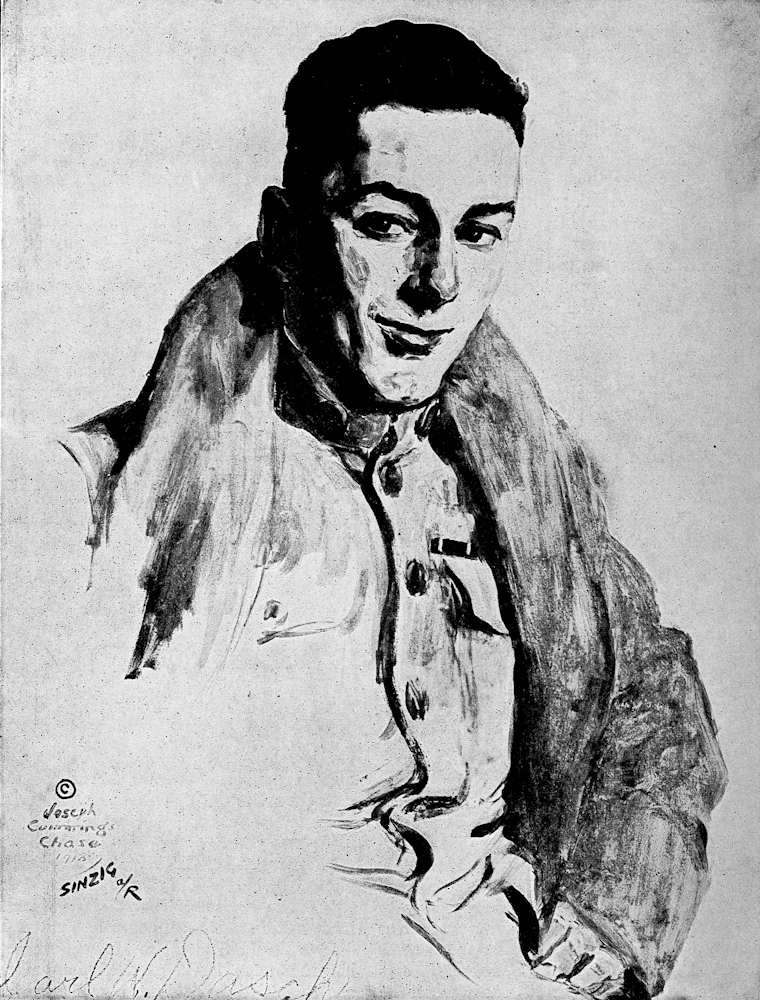
Drawn by Joseph Cummings Chase.
Private Carl W. Dasch
42nd, Division, 167th Infantry, Headquarters Company
On July 26th-August 1, 1918, near Croix Rouge Farm, he carried messages between the firing lines and battalion headquarters, at the same time picking up wounded men and carrying them out of the barrage to the first-aid station. During the whole series of engagements he did not sleep and his physical energy was taxed to the utmost.
Captain Bobo was resting up in April, 1917, and contemplating his next venture when Uncle Sam decided that this world had not been made for Germany and advised the Kaiser of our intention to prove it. Bobo hurried to the first recruiting station. And then the San Francisco army doctors played their trick.
They turned him down.
“THE JOLLY OLD RED CROSS”
“The way the army doctors talked to him made the young man wish ardently that instead of being a poor little anemic lad, who could do nothing but swim seven miles and sail schooners through typhoons and knock over tigers, he were one of those brawny athletes who had trained indoors on stenography, dress-goods salesmanship, and cigarettes and therefore were being uproariously welcomed into a selective service army by local draft boards.
“‘But,’ cried young Mr. Bobo in effect, ‘I’m telling the world fair that I want to go to France. And I want what I want when I want it. Now what other speedy way is there of getting to France besides the—Holy mackerel! I’ve got it! The jolly old Red Cross.’”
Bobo wondered, when he was going across, if the Red Cross would ever allow him to sneak close enough to the front “to get gassed or shot or something.”
When Bobo landed in France with the First Division he was assigned to the very humble task of serving soldiers with cocoa and sandwiches. He took up the task seriously, and did his work well, but then he got tired. Finally he got enough courage to suggest a plan to General O’Ryan.
The army doctors were constantly sending men back from the front line because of some physical defects. Steve Bobo wanted the General to give him permission to establish a “Divisional Rest Camp” and fill it with those “darn fine fellows” whom the surgeons were throwing out. “Most of those men,” he said, “are volunteers, and all of them are the best sort of fighters. Instead, then, of sending them back to the rear for reclassification, turn them over to me, sir, we’ll show you something.”
“That was done. Day by day into the Bobo ‘Divisional Rest Camp’ came the men, sad beyond measure because the surgeons had found something in their anatomical architecture which was slightly out of kilter. Daily Captain Bobo put his unpromising material through a series of setting-up exercises. Thus it was that in next to no time he had surrounded himself with a Red Cross unit of husky youngsters who, as Lieut. Colonel J. Leslie Kincaid, Judge-Advocate of the Division, since has phrased it, ‘preferred to live in that part of hell which has no fire escapes.’ By the time Captain Bobo had completed his organization he had forty-seven men in his Red Cross unit, with every man-jack in the outfit carrying papers to prove that the only reason he was not carrying a rifle was that an army surgeon had got the fool notion the man was not physically able to stand the gaff.
“Cried Captain Bobo, when all had been made ship-shape, ‘We’re set, men: Let’s up and at ’em.’ And forward went the fightingest band of Red Cross ‘invalids’ that ever slapped a German dead and then piled him into an ambulance to try to save his life. Up with the front line fighting men, the little Red Cross band found themselves in no time, and, on occasions, hundreds of yards in advance of the front line trenches, out in a sunlit No Man’s Land.”
KNEW HOW TO GET ’EM
Lieutenant-Colonel Kincaid remembers a little something about Bobo and “his Rough-necks” on a particular occasion.
“I merely want to say,” he remarked, “that in the middle of the Hindenburg show Captain Bobo said ‘Presto!’ and ten ambulances appeared from nowhere at a moment when, believe me, ambulances were needed.
“Colonel Montgomery, weeping for ambulances, thought of Captain Bobo. He gave the Red Cross man the high sign, and Captain Bobo just brushed aside a lot of flying metal and stepped close enough to Colonel Montgomery to ask the Colonel what was on his system. ‘Ambulances,’ shouted the Colonel, ‘but I don’t know where to get ’em.’ ‘I do,’ answered Captain Bobo. ‘If you’ll give me a fast car I’ll flush a whole covey of ambulances, sir.’
“Colonel Montgomery commandeered General O’Ryan’s racing car and Captain Bobo climbed in. The Captain stepped on the accelerator and exploded toward Paris, a trip of 158 miles. And toward the middle of the next afternoon back came Bobo hellbent with ten ambulances in his wake. We were too busy then to ask him where he had got them, but when things had quieted down for a moment some days later we made inquiries. And we got this Bobo person’s number. Let me tell you in confidence—don’t repeat this to a soul, remember—this Bobo is an ambulance stealer. He and his gang were out and out Red Cross crooks. He had crashed into Paris, grabbed up every ambulance standing along a curb, bamboozled the drivers into believing that they were to take his orders, and had crashed out of Paris again at the head of his string of sputtering booty; and made straight for the front again at a time when I don’t know what we would have done if it hadn’t been for Captain Bobo and his ambulances.”
O’Malley takes up the story again: “Bobo and his associates had had no sleep for almost thirty-six hours.
“They were dirty, unshaven, haggard; nevertheless, they spent that night and all the next day picking up the white-faced, shattered boys who lay among the shell holes groaning with the thirst horrors which only those who have lost pints of blood know. Back to the ‘battalion aid post’ the lads were brought by Captain Bobo and his buddies, or variously to ‘first stations,’ which sometimes were within 200 yards of the front line trenches—to dressing stations, or to the main dressing station back at ‘railhead.’ And there the sufferers received attentions, which sometimes meant a merciful anesthetic and sometimes the grimy but gentle fingers of Captain Bobo on cold, white eyelids as he closed the staring eyes forever.”
Bobo and his daredevils became an institution with their division. Where danger lay, so long as there were wounded there, Bobo’s squad gloried.
“One day, the Captain and his Red Cross crew learned that if they wanted to get their ambulances out to where the wounded lay they would have to circle the toe of a wooded knoll over an open road on which rained machine gun bullets every time anything alive showed itself to the Huns concealed in the woods on the hill. But they wanted to get to the wounded.
“They started their engines and ‘stepped on ’em’ so hard that the little ambulances would bang out into the open and whiz around the marked turn joyously, while the phut-phut-phut-phut of the Hun machine guns whipped the atmosphere into ribbons and the splinters from the racing ambulances flew high in air. Then they had to come back around that open turn again, and they went out again and back, and out and back, their ambulances looking a bit worm-eaten when the day was over but the Captain and each of the other Red Cross drivers still ‘all in one piece.’”
PRETTY GOOD MEN TOO
O’Malley tells the story of two of the Captain’s drivers—Privates Freddy Schroeder and Leo Smith, both from New York City—who were engaged in their customary hilarious sport when word came to the little Red Cross band that a medical detachment was out beyond the hindside of No Man’s Land and that it had been marooned there for thirty hours without food or water. “Zipp went Red Cross rowdies Freddy and Leo in their tawney ambulances decorated with the big Red Cross—fairest of targets for a German gentleman. And this time when the drivers, their ambulances loaded with grub and water, came to an open stretch of road they got not only machine gun bullet storms but Hunnish high explosives. And as they were sailing along through the metal storm on a straight stretch of open highway, a German shell exploded just ahead of them, so close that they barely had time to come to a stop on the edge of the crater. They were about to reverse and back off to where they had come from when another shell bit the road just behind them and made another crater.
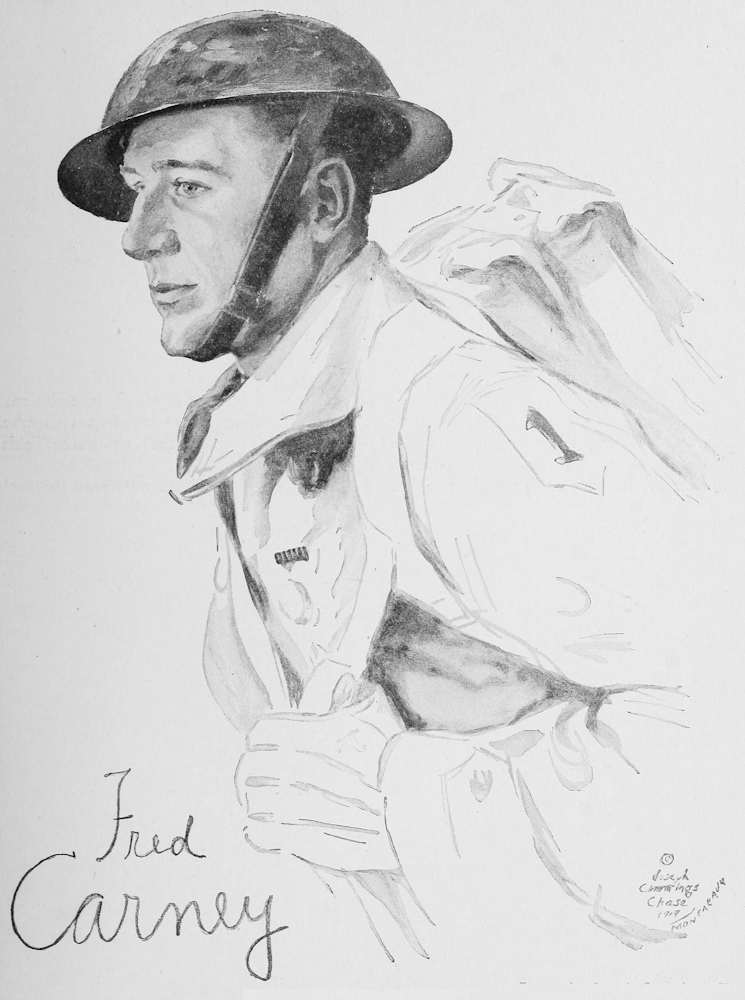
Drawn by Joseph Cummings Chase.
Private Fred Carney
1st Division, 26th Infantry, Company “G”
He was cited for extraordinary heroism in action between the Argonne and the Meuse. With great coolness and bravery under machine-gun and shell fire, he maintained liaison between his battalion and company and assisted in reorganizing his platoon after the platoon commander was wounded.
“There were Freddy Schroeder and Leo Smith on an ‘island platform’ of the road, with seemingly nothing left to do but to abandon their ambulances and crawl to safety the best they could. They didn’t do anything of the kind. Right out in the open they tugged at every sizable chunk of débris in sight and built a sort of bridge across the forward shell hole and went onward and brought welcome food and water to the marooned detachment. And in their own good time they came back over their ‘bridge’ again, jumped out and built another ‘bridge’ of the same kind over the second shell hole, and about dusk, sailed victoriously to their Red Cross quarters unharmed.
“Finally there was another day that must be told of. It was the day at St. Souplet when two of the stricken residents of the little town crawled back to our lines and told the Mayor of Busigny (which had just been captured from the Huns) that many civilians, dozens of whom were wounded, were hiding in the cellars of St. Souplet. None of them dared show himself. The German patrols were still poking about the town and their machine guns were sweeping the village streets. Shells were dropping and death threatened the hidden ones in the cellars in other ways, especially in the form of gassing, the poisonous gas naturally tending to work downward to the cellars and other subterranean passages where the men, women, and children of St. Souplet lay hidden.
RESCUES A VILLAGE
“Somebody would have to do something about it. Who was always doing something or other about something? Battling Bobo and his Red Cross band!
“To dash into the streets of St. Souplet would not help much because the dash would end in a patter of lead and a bouquet of whiz-bangs that would leave nothing but a shell hole where ambulances an instant before had been. Nevertheless young Captain Bobo and his men ‘had’ to get there. The Captain called together his Red Cross band, which that day numbered only thirty-five huskies, the others being absent on other work or ill. Captain Bobo explained the situation and asked the thirty-five how many of them would care to volunteer to go into St. Souplet with him—to go up to our front line trenches in the broad light of day and beyond, on into the buildings of a town still thoroughly held by the Germans. Pause a moment, reader, and guess how many of the thirty-five Red Crossers volunteered.... Reader, you’re a wonder: you guessed the exact number the very first time!
“And so the thirty-five started forward with Captain Bobo, scooting along in their ambulances parallel to the fighting lines for a little distance and then making a dash across lots to a grove which stood at an advanced spot where, up to that time, no American soldier had set his foot. And while an amazed American Army looked on, the little band made the woods and disappeared among the trees while hell cracked all around them.
“Providence and Steve Bobo were with them. In the heart of the little clump of trees they found an old road which ran through a ravine to the nearest back alleys of St. Souplet. When they had come to a place where the old road climbed out of the ravine preparatory to entering the town, Captain Bobo jumped off the leading ambulance, gave his followers the high sign, and again gathered them about him for final directions. And Bobo and his band left their ambulances in the protecting ravine and began to crawl on their bellies across the last of the fields and into the town.
“They followed by preference the backdoor route when they had wormed across the last field and straightened up to find themselves in St. Souplet. Even so it was necessary at times to make a dash for it across open streets, a dash that must be completed before the astonished German gentry at far ends of the streets could begin to pepper the thoroughfare with the machine gun bullets. Always, however, Battling Bobo and his band beat the bullets to it.
“In the black cellars of the village they rooted around. Old women lay huddled in the underground gloom; one of them, a very old lady, had been shot through both thighs three days before and, quite unattended, lay cowering in her cellar until Captain Bobo dragged her forth and carried her back to where his ambulances lay hidden. There were old men, little children, young girls for whom the horror of their nights of hiding in the Boche infested village had a terror greater even than gas and the shriek of shells. One by one Bobo and his men carried the sufferers into back yards, through the winding alleys, back of protecting buildings, and so to the wooded ravine, where the ambulances were filled with the stricken villagers of St. Souplet and the bundles of scant belongings which they hugged to their trembling bosoms. Then the dash back through the grove and across the sunlit No Man’s Land to final safety—not final for the Red Cross band, for as soon as they had carried their first load of refugees behind the American lines they turned around and did it all over again, and again, and again. For four hours at one stretch they worked like beavers to save the villagers of St. Souplet, then organized a second series of trips and put in eight hours more darting to and from the town or squirming into its alleys and cellars. And Battling Bobo and his band got the villagers finally to safety without the loss of a Red Cross man, despite the fact that the ‘Jerries’ were systematically shelling the village from the first moment the Red Cross rescuers entered it until the last villager had been saved.”
There were forty-seven Red Cross men in Bobo’s band. To this day the Captain is trying to find out why only twenty of them were cited for exceptional heroism.