TWO HEROES OF HILL 60
Reading edition
Oxford Graduate and Green-Grocer’s Assistant Win Their Spurs in the Same Crisis
Sir John French has described the fight for Hill 60 as “the fiercest fight in which British troops have ever been engaged.” The hill is southeast of Ypres. Its possession was essential to the British, for it dominated the surrounding country. The Germans held it, commanding excellent artillery observation toward the west and northwest. For months the British had been working to mine it. After much hard work the sapping was complete and one hundred tons of explosives placed in position.
Saturday, April 17, 1915, was the appointed day for the great event. The explosion was timed for seven o’clock in the evening, and, according to program, up went the hill—Germans and all. It was like an earthquake. Simultaneously the artillery opened on the spot and poured in shells at the rate of five a minute. At a quarter past seven the infantry attack was launched, and the British were in possession of the ruins.
Then came the second phase—the holding of Hill 60, which was the hardest task of all, for the German reinforcements came to the assault by the thousands; but as fast as they came rifle and gun fire mowed them down.
During the next few days the Germans continued to attack ferociously, so much importance did they attach to the position.
A private in the East Surreys, writing in the London Evening News, gave the following vivid word-picture of the battle:
“The fight on Hill 60 was awful. The Germans used every kind of explosive, from small bombs to shells that shook the ground like an earthquake.
“This went on from four o’clock in the afternoon to about four the next morning. Every German gun for miles around was trained on that hill.
“Some of the German shells were filled with a stinking acid, which blinded one. I would rather take my chance in half-a-dozen bayonet charges than face such an awful bombardment again. The enemy charged four times, but we beat them back each time, and kept the hill until we were relieved next morning.”
It was in these nerve-racking engagements that Second Lieutenant Geoffrey Harold Woolley and Corporal Edward Dwyer were awarded their honors for distinguished service.
FROM CURATE TO SOLDIER
Lieutenant Woolley is the youngest son of Rev. G. H. Woolley, Danbury, Essex. He was educated at St. John’s School and Queen’s College, Oxford. While at the University he joined the Officers’ Training Corps. He studied for Holy Orders, and is all but a curate, inasmuch as he was on the eve of being ordained when, at the age of twenty-three, he decided to give his first service to his country.
Lieutenant Woolley has been described as a typical specimen of muscular Christianity. He excels at cricket, tennis, and football, and played the greater game of war with all his heart and soul.
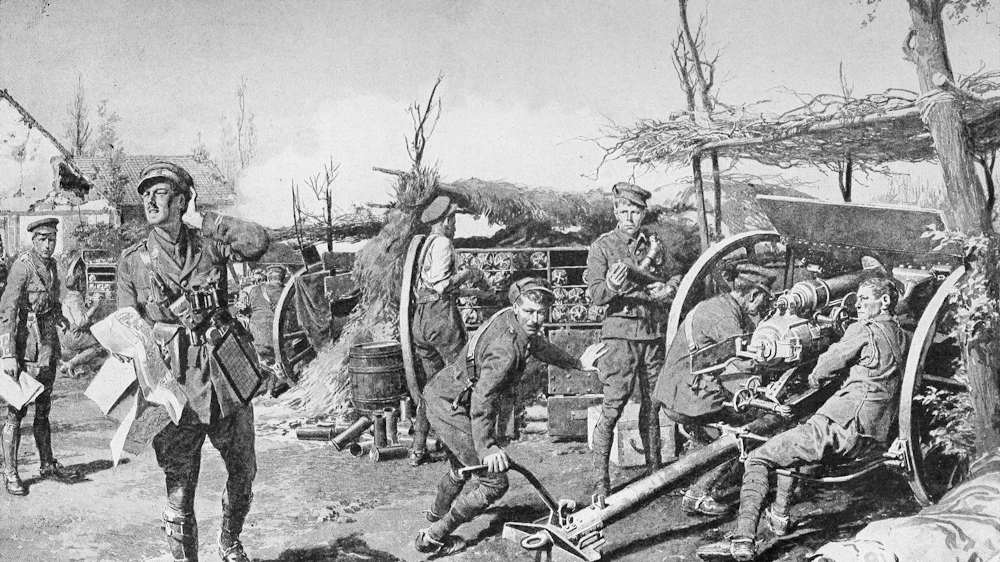
© New York Herald.
Directing the Fire of a British Battery
In the foreground the officer in charge of the battery is receiving information from observers who are able to trace the course of each shot.
He received his commission in the 9th Battalion London Regiment, popularly known as the Queen Victoria Rifles. With the experience of the Officers’ Training Corps to help him, the young lieutenant soon made himself very efficient, and when, in November, 1914, the Queen Victoria Rifles embarked at Southampton for the front, he had already become very popular with his men, and shown high promise as a leader. Soon after landing in France the regiment was at the front, near Ypres, where it was usefully employed, chiefly in trench work.
G. A. Leask in Heroes of the Great War says:
“On the very first day that he went into the trenches, Lieutenant Woolley showed his mettle. A hand grenade was flung into his trench; without a moment’s hesitation the young officer picked it up, and before the fuse had burned to the charge, flung it out. His prompt and plucky act saved not only his own life, but the lives of at least six or seven of his men.
“On the night of April 20-21 the Germans made a desperate attack on the trench held by Lieutenant Woolley’s regiment. The Queen Victoria Rifles fought with dogged determination not to be excelled by the most seasoned Regulars. Every German gun for miles around was trained on the hill. Again and again the Germans charged with the ferocity of despair.
“One by one Lieutenant Woolley’s superior officers—a major, captain, and a lieutenant—had been killed.
“The force under Lieutenant Woolley numbered at the start 150, including some Regulars. As the German attack grew fiercer, he noted how his little company was being thinned. The young officer did not despair. He was in sole command of Hill 60, and he realized that a hard and terrible time awaited them before relief came, but he summoned up all his courage and made up his mind to hold on at all costs. He went up and down the line calling to his brave men to ‘stick it’ and he infused all with his dauntless spirit.
“A particularly fierce onslaught by the Germans commenced. Guns raked the trench with shells, enemy troops swarmed up, throwing bombs. Lieutenant Woolley moved among his men, giving orders as coolly as if on parade. The already diminished band of heroes dwindled more and more. Lieutenant Woolley knew that the situation was perilous, but he had no thought of giving in. The knowledge that so much depended upon him stirred his blood, and called forth every ounce of his fighting spirit and powers of leadership.”
A DETERMINED BOMBER
“He organized counter-attacks and led his men in throwing bombs at the vastly superior force of the enemy. Standing on the parapet of the trench, fully exposed to the enemy, Woolley hurled bomb after bomb. His men urged him to seek shelter, but he refused. For some time this amazing contest continued, a handful of British against thousands of Germans. But this little band of heroes by their superb bravery, led by a hero, kept the enemy at bay. When welcome relief eventually came, the company of 150 men had been thinned to 20-14 Territorials and 6 Regulars, a pathetic proof of the dauntless fight put up by those men.”
The second hero of Hill 60 is one of the most popular medal winners of the war. Lance-Corporal Edward Dwyer at the time he obtained the coveted decoration was only eighteen years old, and had been a green-grocer’s assistant before the war.
“This boy hero took the public imagination by storm, and with the possible exception of Sergeant O’Leary, no V.C. was more noticed on his return to England. He received enough hero-worship to last a lifetime. When home on leave Dwyer was bombarded by the attentions of admirers, kissed by women in the streets, and, as he confessed, subjected to greater trials than on the bomb-swept slopes of Hill 60.”
TOO MUCH FUSS FOR HIM
“There was something romantic about the slim boy of eighteen who proved himself so heroic in the field, and his handsome appearance and jolly ways captivated every one. As his father confessed, with no little humor, ‘They’re making such a fuss that Ted wants to get back to the battlefield for a rest.’”
Dwyer had been fighting in France for nine months when the struggle at Hill 60 provided his great opportunity.
“During a particularly fierce attack on the morning of the 20th, Lance-Corporal Dwyer was in a trench on the side of Hill 60, about fifteen yards distant from where the Germans had entrenched themselves. So close were they, in fact, that Dwyer says he could actually hear them ‘talking their lingo.’ His section had suffered severely, and Dwyer risked his life by tending many of them as best he could. Some he brought from the open to the side of the trench, leaving the comparative safety of his position in order to save their lives.
“Then, later on, he heard some one call out: ‘The Germans are coming!’
“He looked through a spy-hole in the parapet and saw a number of the enemy creeping silently and stealthily across the intervening space between the trenches.
“Like the methodical soldier he is, Dwyer had kept a number of hand grenades, some fifty, all ready to fire.
“Thus provided, he gallantly sprang on to the parapet of the trench. The Germans were creeping forward, thinking to surprise the British, but they had reckoned without Lance-Corporal Dwyer. He stood fully exposed to their fire, and threw his deadly missiles steadily and with excellent effect. For five minutes this eighteen-year-old hero stood all alone hurling grenade after grenade at the oncoming foe.
“The Germans, led by an officer, showed great stubbornness. Had they known that a lad of eighteen alone was guarding the trench, they would have doubtless redoubled their efforts to capture it. Young Dwyer kept throwing his grenades. He had now sent twenty into the ranks of the enemy; now he had used up thirty. At this juncture the officer who was leading the Germans was hit, and this loss seemed to damp the ardor of the attackers.
“Dwyer, however, began to show the first signs of uneasiness. His stock of grenades was fast running out. He had only half a dozen left, soon these had each found a target. Then in the nick of time reinforcements arrived, and the trench was saved. Dwyer alone had saved the situation.”