FIRST OF ITS KIND
Reading edition
Eye-witness Account of a Duel at Sea between Great Steamers Built for Passenger Traffic
Early in the war the Cunard trans-Atlantic steamer Carmania was converted into an auxiliary cruiser. Painted black from stem to stern (that was before the art of “camouflage” was introduced), and mounted with eight 4.7 guns, she left Liverpool for a reconnoitering cruise in the South Atlantic. Between 600 and 700 miles east of the coast of Brazil there is a small island of rock known as Trinidad (not to be confused with the West Indian Island of that name). The Carmania came in sight of this island one morning toward the end of September and discovered three steamers in the vicinity. As soon as these steamers caught sight of the piratical looking Carmania they moved about uncertainly for a time and then made off. But when it was apparent that the black intruder was alone, the largest of the three steamers turned back. This ship proved to be the Cap Trafalgar, a magnificent steamer, the chief of the Hamburg-South American Line, built for the special purpose of successful competition with the British Royal Mail in securing the South American passenger traffic and shipping trade. She too was equipped as an auxiliary cruiser, with eight 4.1 guns, up to date, their newness offsetting the extra caliber of the Carmania’s older guns.
The tonnage of the Carmania was 19,524, that of the Cap Trafalgar, 18,710. Splendid targets, both “so colossal,” said a writer, “as to be beyond the possibility of a failure to hit with any gun-layer.” A well-matched pair—ocean-going palaces, taken from their peaceful pursuits, transformed into war machines, neither having any appreciable advantage over the other as a belligerent, and now ranged against each other for a decisive duel. There was a fair field, too, for the two steamers seen with the Cap Trafalgar continued their retreat and disappeared across the horizon, though one returned later.
It was the first sea duel of its kind. Never before had two floating hotels played at gun fire with each other, each intent on sending the other to Davy Jones’s locker if possible. When the action began the vessels were separated by about 8,000 yards, and their nearest approach was about 4,000 yards. As the sinking of its enemy was the aim, the guns of each combatant were directed at the water line of the other. Of the first few shells fired by the Cap Trafalgar, three made holes in the Carmania at and above the water line, one tore through the stewards’ quarters, one smashed the lower deck galley and carried away the fire main leading to the bridge and fore-part of the ship, the latter the most serious damage.
A report of the engagement written two hours after, by one who took part in it was published in the War Album De-Luxe, from which the following is taken:
A DISTURBED LUNCHEON
“One never saw such a scatter as when we sat down to lunch and ‘Action!’ was sounded! Feeling ran high that this time we were in earnest; everyone was at his post in the twinkling of an eye. Ten minutes afterwards the conflict started, at a range of about six miles, both ships closing rapidly. The din that followed was unnatural and terrifying, and men’s hearts leaped to their mouths, for here was death amongst us. But the heat of work changed white faces to red. Blood once seen revives savagery in the human breast, and all our thoughts, after those first few moments, were concentrated in the grim work at hand, which was to sink as speedily as possible the monster that was vomiting red and steaming arrogantly towards us.
“By a clever maneuver our captain turned the ship round just as the enemy was bringing his pom-poms into play as well as the big guns, and brought our starboard battery, fresh and eager, to bear. Then we turned into demons, in a scene that had turned diabolical. Screaming shrapnel, returned by salvos of common shell, splinters everywhere, lumps of iron, patches of paint, a hurricane of things flying, hoarse shouting, and unintelligible sounds from dry throats, men discarding garments, and laughing with delirium—over all a white pall hiding the ghastly work.
“What matter that a shot cannoned down the after companion and laid low three of the whip party? Volunteers were not wanting to close in the breach and keep up a brisk supply of ammunition to the hungry guns. Or that a shot glanced off the shield of No. 1 gun, past the officer in charge, and blew away the neck of a corporal of Marines passing projectiles along the deck, leaving him leaning over the magazine hatchway, head dangling down, and dripping blood on to the madmen working below? Or that a shell burst by the feet of a man carrying another one in his hands?
“Word went round that we were on fire forward—the bridge, in fact, was blazing. A shell had torn through the cabins below, setting them alight, and the flames by this time reached and enveloped the bridge, since water could not be turned on in the first instance, as the main on the lower deck had been shot away. But the ill news was more than compensated for by the frenzied announcement that the enemy was also on fire and listing, moreover, on his side. So our main control was gone. The captain, first lieutenant, and navigating party had to leave the bridge to the flames—not before gaining us victory, however, by the splendid way they handled the ship in heading off the enemy, preventing him from turning round and bringing his idle guns on the port side to bear, and by keeping him on our starboard quarter so we were able to use five of our guns to his four.
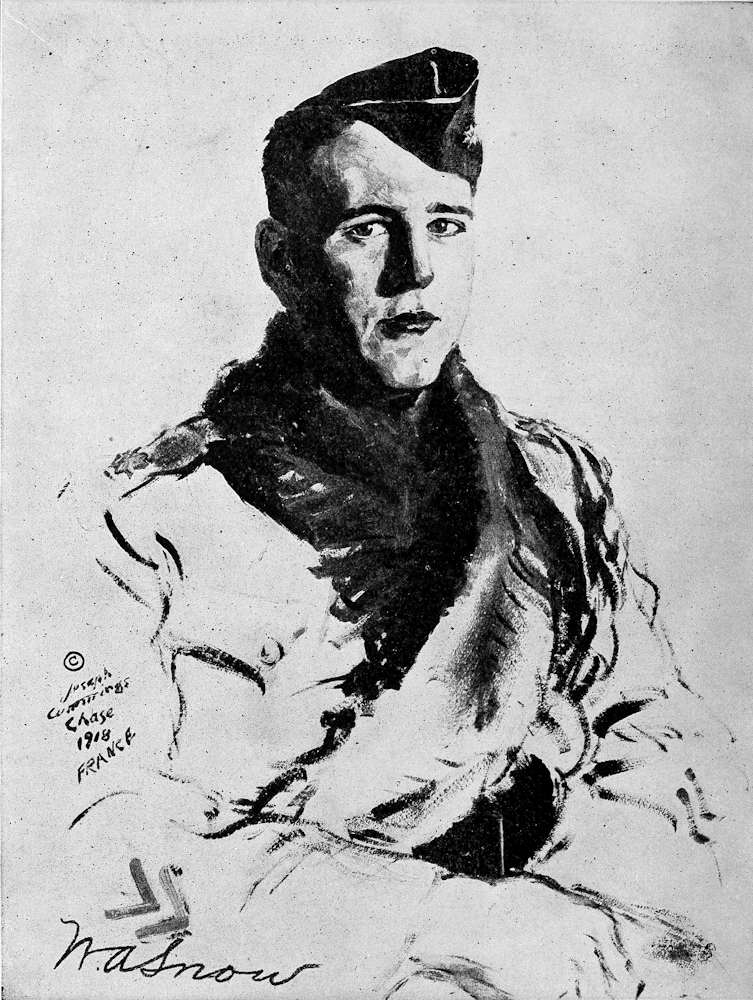
Drawn by Joseph Cummings Chase.
Major William A. Snow
2nd Division, 2nd Engineers, Company “E”
He was cited four times in Division orders and twice recommended for the Distinguished Service Cross. He went into the first line at Verdun March, 1918. When the British were attacked by the Germans in the vicinity of Beauvais, in April, he received his majority in time to be in command of a battalion at Château-Thierry.
“The enemy listed a little more, and our work was done; his shooting became higher and more erratic, then stopped altogether. We ceased firing, and turned our attention to fighting the flames roaring up on high in the fore part of the ship. Luckily, we were able to stop the engines and keep the ship before the wind. The bridge and all its precious fittings and contents were doomed, as also the cabins below it; the officers who occupied them lost all their effects. A fireproof door in the staircase leading to the lower cabins effectually kept the fire from spreading in this direction, otherwise there might not have been very much left of the Carmania. The action raged hotly for an hour; after that, desultory firing was continued until the end.
“Of the two colliers that accompanied the enemy, one steamed away at the commencement of the action and was never seen again. The other, and smaller of the two, followed suit until he noticed the plight of his escort, and returned to pick up the survivors. Anon, an order went round the decks: ‘All firemen down below.’ The firemen had been doing yeoman service, running hoses and buckets of water to the scene of the fire, just as the stewards had distinguished themselves by taking round water and limejuice to the guns’ crews under shell fire, and also helping with carrying away the wounded. The reason for this order was ominous. The yeoman of signals had sighted smoke on the horizon to the north, and made out a bunch of funnels. It could not but be the Dresden, or whatever German cruiser the armed merchantman we fought was in company with, returning to the assistance of her consort, who had been signaling to her during the action. A great pity, indeed, one of our cruisers was not in touch with us at the time. What a fine haul it would have been!
Vale, CAP TRAFALGAR!
“Just as we got the fire well in hand, and were starting to run to the American coast, we beheld the most awe-inspiring sight of our lives—the last moments of an ocean leviathan. The wounded ship, distant from us about five miles, suddenly lurched over on the starboard beam-ends, looking for all the world as if she were about to turn turtle. Lower and lower she went, until her huge funnels were level with the water, pointing in our direction like two tunnels side by side, and dense clouds of smoke and steam escaped from all parts of her as from a volcano in a high state of activity. As quickly again, the mammoth righted herself; down, down went her bows; up and up her stern, till quite one-third of the hull stood upright to the sky; then, with a majestic plunge, she slid beneath the waves, game to the end, for the last to disappear was the German flag.
“A ring of foam and half a dozen boats crowded with dark forms were all that were left at 2 p.m. of the brave Cap Trafalgar and her ornate saloons and winter gardens, the ship that conveyed Prince Henry of Prussia on his triumphant tour of the South American Republics.”
The casualties of the Carmania are reported to have amounted to nine men killed and twenty-six wounded out of four hundred and twenty-one hands all told, a low percentage owing to the wide distribution of the various parties. The survivors of the Cap Trafalgar landed at Buenos Ayres consisted of eighteen officers and two hundred and ninety-two men, which would give her casualties at about eight officers and one hundred men if she carried the same number of men as the Carmania.
Seventy-nine direct hits were counted on the Carmania, and innumerable small holes from splinters; her boats were riddled, as also masts and ventilators; her rigging and wireless aerial were shot away.