NOT TO BE FORGOTTEN
Reading edition
The Men Who Captained the Merchant Ships Are Among the Heroes of the War
By telling the story of Captain Frank M. Custance, of the Royal Navy Reserve, as typical of the stories of a coterie of merchant ship men in the service, Mr. Ralph E. Cropley most interestingly reminds the public that the war was not altogether won by the men in the trenches. The merchant ship commanders played some small part in the winning. Indeed, Mr. Cropley goes somewhat further. He concludes his story of Captain Custance, which appeared in the New York Evening Post, with this paragraph:
“Without their valor this war would have been over long ago and Germany would have won. I say this without reserve, for it is the truth. It has only been by their untiring sacrifices that the soldiers have gotten to the trenches at all and been kept supplied with munitions and food. The merchant ship men have done work which gold cannot pay for and never have thought of themselves—simply of the great cause which to them has meant the end of cruelty.”
Though Captain Custance is an English seaman he is familiarly known to Americans who have sailed between New York and Bermuda in the winter or to the Land of the Midnight Sun in summer, for he was Captain of the tourist boat Arcadian that made those trips in the different seasons. He was up among the Norwegian fords when England entered the war, and it was a question whether he could save his ship by evading the Germans. Not that he personally had any question about it. He proceeded to act with the calm assurance characteristic of his conduct in normal sailings, quietly determined to get safely away. So, excellent seaman that he was, “in the darkness of that famous Monday night of Aug. 4, 1914, without a pilot, he took her through the dangerous ford to sea. ’Twas indeed a feat.”
But there were dangers at sea, too, for it was necessary to avoid any ship or craft that heaved in sight, and constant vigilance, with much dodging, was necessary before he got into Liverpool with his American passengers saved from anything so unpleasant and perilous as drifting in open boats on the high seas. With equal success he landed them in New York some days later, their number having been added to by Americans stranded in England.
TURNED TO MINE-SWEEPING
Then the Arcadian was dismantled and turned into a transport, and Captain Custance took her back to England filled with Canadian troops. But wanting a more war-like job he appealed to the Admiralty and eventually was assigned to the perilous duty of mine-sweeping, to keep the sea about the Orkneys free from the floating or sunk mines, to the sowing and planting of which the Germans were devoting their devilish activities. When it is borne in mind that Captain Custance was then 46 years old, with wife and several children, one may appreciate the patriotic zeal that kept him in this dangerous employ for two years. During that time he stuck at it with never a glimpse at his family until he was called to London to have the King confer on him the D. S. O.
Those broad-beamed boats known as trawlers in which the fishermen ply their calling were the instruments employed in mine-sweeping, and admirable they were for the business, but comfortless enough for other purposes. Said the Captain in a letter: “It’s no joke monkeying about in a tiny craft hunting ‘tin fishes.’ In daylight it’s bad enough, but at night it’s extremely dangerous, as one can’t see the sea, and one is liable to half swamp oneself in turning. And as far as any comfort below goes, there isn’t any. Everything is damp and cold, and the steward loses the greater part of your food in bringing it to you, and what you finally receive is a cold, unpalatable mess. Yet, by God! it’s something to be out here having a chance to bag a bally German swine.”
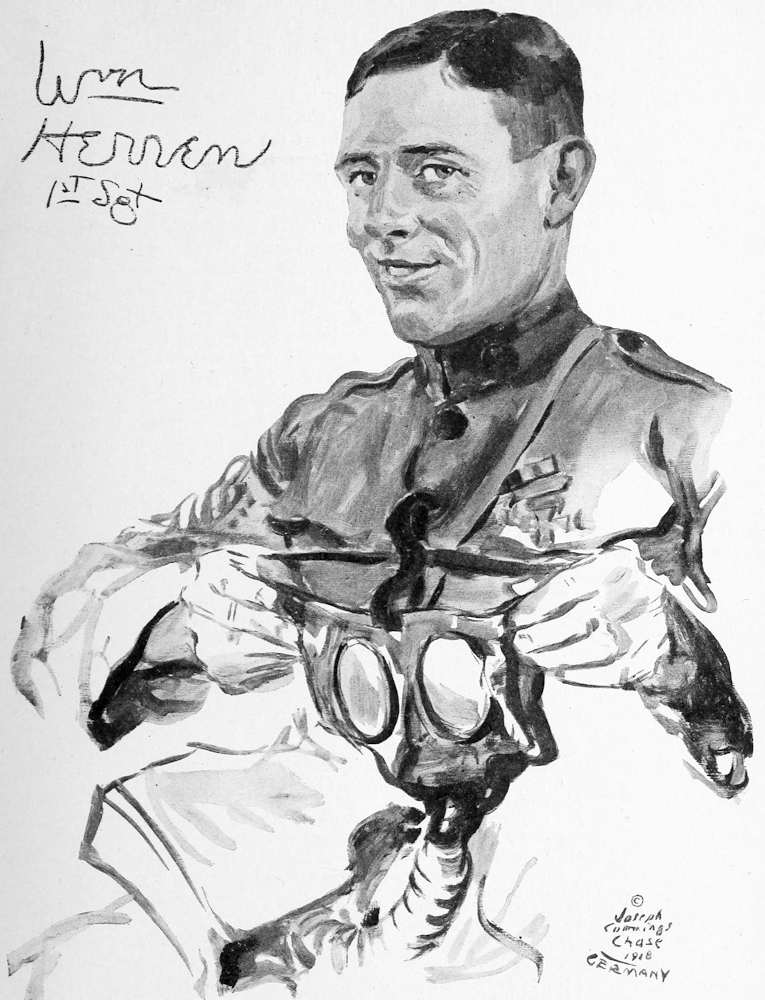
Drawn by Joseph Cummings Chase.
Sergeant William Herren
58th Infantry, Machine-Gun Company
His company was fighting near Villa Savage. The majority of their machine guns were destroyed. On the morning of April 7, 1918, Sergeant Herren went through a deathly artillery bombardment in order to get more machine guns and ammunition for his company. With his reinforcements and bravery he enabled the right flank of his company to advance, and capture a German machine-gun position and repulse counter-attacks.
Besides the danger from mines there was the excitement of submarine shelling of the fleet every now and then. In one attack of that kind Custance’s trawler struck a mine and sank. After that the Captain was given a steam yacht, no longer at her best, the Mingary, in which he did patrol work, visited and overhauled neutral ships, and kept a weather eye out for submarines and mines.
The performance that gained him the D. S. O. was the day after the Jutland naval fight, when the German fleet had fled, leaving only the submarines to prowl and finish off the wounded if possible. The dreadnought Warspite was one of the wounded and poorly protected by destroyers as she toiled along with deranged steering gear. The Captain saw three submarines maneuvering against the Warspite, and despite the fact that the chances were all against him in an attempt to beat off three submarines with his little yacht and its tiny guns Custance rushed the Mingary pell mell to the rescue, acting with such suddenness that he took one submarine by surprise and was able to ram it, got so close that he could use his guns on the next one and sink it and so thoroughly scared the third one that it submerged instantly without an offer of fight.
Later the Captain was in command of the Maid of Honor in convoying colliers across the English Channel by night. There were no lights, there was no signaling by whistle, there was traffic both ways, troop ships, darkness everywhere. Skilled navigators were necessary—men of the merchant ship sort. Out of all his convoys going or coming, only three ships were torpedoed, only two being lost.
In the final part of the war he crossed and recrossed the Atlantic in convoy. It was then that the Justicia was torpedoed. “She remained afloat for twenty-four hours, and Custance would have saved her if a German had not dived under the ring of patrol boats that surrounded her and fired a finishing torpedo.”
In getting off the dying Justicia Custance nearly lost his life, yet, says Mr. Cropley, “I received a very apologetic letter saying he was sorry he hadn’t been able to save the cigarettes he was bringing over to me.”