JULES VERNE VINDICATED
Reading edition
How Capt. Paul Koenig of the Deutschland Turned Incredible Fiction Into Practical Reality
There was a very positive thrill throughout the world when the startling report was published that a German submarine had crossed the Atlantic and, on July 10, 1915, entered an American port. It had not been believed possible at that time for a submarine to make so great and perilous a voyage, and the first news of the unique achievement was somewhat sceptically received. But when there was no remaining doubt that the Deutschland, dodging and evading British hostile craft, had actually voyaged from Bremen to Baltimore, Capt. Paul Koenig, commander of the U-boat, was prominently head-lined in the press.
This historic event was interesting not only as something new and wonderful in marine annals, but there was a graver interest in the demonstration of the fact that distance from the base of operations was no sure protection from submarine warfare. No little alarm was manifested in the United States for a time. But this subsided, and the romantic side of the exploit appealed to the dullest imagination.
When Capt. Koenig returned to Germany he wrote his experiences in book form, parts of which have been translated into several languages. No more absorbing story than Koenig’s own could easily be written, and from an American version of it the following excerpts were made.
After leaving port the Deutschland traveled submerged until they were far out in the North Sea on their westerly course. It was about two o’clock in the morning. Capt. Koenig thought it safe to rise to the surface and gave orders for the emptying of the tanks. But as the boat approached the surface it began to toss and plunge in a way that gave warning of a storm above. The nearer the surface the wilder the antics of the boat, which occasionally indulged in regular leaps. The emptying of the tanks went calmly on nevertheless, Capt. Koenig being of the order of men not to be moved from a purpose by so inconsiderable a thing as an ill-mannered sea. They got to the surface without too much disorder. Then says Capt. Koenig:
“I was just about to give orders to put on the oil-engines—when—what was that? That dark stripe over there—wasn’t that a smoke-flag? Donnerwetter! It’s a destroyer!
“With one leap I am back in the turret and have closed the tower-hatch. ‘Alarm—submerge quickly—depth rudder—go to twenty meters.’
“The whole boat trembles and shakes under the increased pressure and makes a couple of real jumps; it literally reels in the wild sea. Will it not go down pretty soon? With a sudden jerk the Deutschland darts below the surface and now, bending her bow lower and lower, rapidly descends into the depths. The light of the just dawning day disappears from the turret windows, the manometer shows in quick succession, two, three, six, ten meters. But the bow drops lower and lower.
“The boat had bent forward in an angle of 36 degrees and stood on its head, as it were. Its bow rested on the sea’s bottom and its stern was violently swinging back and forth. The manometer showed a depth of about fifteen meters. I quickly realized our situation. It was something less than comfortable.
“We were revealing our position by a peculiar buoy, and we expected momentarily to hear the crashing blow of a shell in the stern. But everything remained quiet. The screws could no longer betray us. Also it probably was still too dark up there, and the destroyer perhaps had enough of its own troubles in the wild sea.
“There must have been a combination of several causes. Aside from the fact that only in the most extraordinary and rare cases is it possible for a big boat to submerge against a high sea, it is conceivable that in the haste which was forced upon us by the destroyer the tanks were not completely emptied of air.
“But, above all, I recall that my first thought was the cargo. ‘Is the cargo safely stored? Can it lose its equilibrium?’ Curious as it may sound in retrospect, that is what I instinctively thought of. A ‘big steamer’ captain doesn’t easily get rid of his second nature, even on a U-boat.
A WASH, A FEAST AND A NIGHT’S REST ON THE OCEAN BOTTOM
“We have submerged and placed ourselves on the bottom. We are in no hurry. Why should we not for once give ourselves a little rest? Our resting-place was rather deep, but therefore safer and calmer.
“This night on the bottom of the sea was truly a recreation for us all. One could for once take a good wash and go to bed in peace, without fearing to be frightened at the next moment with a ‘Hey-a’ in the speaking-tube.
“But before resting we had a regular banquet. Both the phonographs were playing and the glasses were raised, filled with French champagne.
“Our good Stücke, who was our steward, kitchen boy, and maid of all work, at the same time served us in such a dignified manner as if he were still a steward in the dining-room of the Kronprinzessin Cecile, as if he had never been in French captivity for nearly a whole year, in order to develop his ability in our company at the bottom of the sea.
“Again we come to the surface the next morning. The pump is working with a hissing noise as we climb upward. On the twenty-meter depth the boat loses its stability.
“First, we can see it on the manometer, then it is noticed on the depth rudder, which becomes more difficult to handle. And as the boat at times moves in unexpected jumps we realize there must be a considerable sea above.
RISING TO THE SURFACE
“I now carefully rise to the periscope depth and proceed for a time in this position and am looking around. Nothing can be seen except a stormy army of white wave-crests. This weather suits me exactly, as we need not be on our guard so very closely.
“I decided therefore to rise to the surface. But before this is done the boat must be placed across the wind, as the long heavy hull would not otherwise be able to climb out of the water.
“At slow speed, we place the Deutschland right across the seas. The boat rolls fearfully. It feels just as if the soul would shake out of its body, and now it obeys the deep rudder and its nose rises slowly out of the water.
“When we are completely out of the water the ship makes the alarming motions of a pendulum all around the compass. Then comes the unpleasant moment when we have to turn the ship slowly into its course.
“Protected by the thick conning tower windows, which the heavy seas are continually washing over and streaming down, with arms and legs ready to withstand the sharp twistings of our craft, I keep watch on all sides.”
They were getting out of the North Sea into the Atlantic currents, in an increasing storm. The boat plunged and tossed sickeningly and the navigation was hard work. Finally they were free of the turbulent sea and rode into the ocean proper and its less angry motion.
OUT INTO THE BROAD ATLANTIC
“The reception of the Atlantic can not be called cordial. We undoubtedly had got accustomed to much during the past days, but I decide as far as possible to save my men’s nerves so that they will be able to withstand that which was about to come. I therefore selected the southerly course, hoping to get better weather, but I was not entirely successful. The seas continually sweep over the boat from stem to stern, because it is too heavy to be lifted out of them as other steamers are.
“It certainly was not pleasant in the conning-tower, but it was a thousand times better than below deck, where the crew, because of the unbroken rolling of the ship, began to suffer on account of seasickness in the close and stagnant air. Many an old sailor offered himself on the altar of Neptune for the first time.
“On the third day the storm begins to abate, the sea becomes calmer, and we can open all the hatches in order to get air and dry out. All who were off duty came up to stretch themselves on the deck in the sunshine and pull themselves together again after their confinement and suffering during the rough weather, which certainly was necessary. With pale faces, worn out by sleepless nights, they came out of the hatches, but hardly had they reached the fresh air and had felt the beautiful sea-wind blowing on their cheeks refreshingly before the dear cigars or pipes were produced.”
Following days were fair for a time and the boat rode the surface. It was the daily practice on fair days to put the Deutschland through her diving exercises so important to efficiency in a sudden emergency. A very considerable part of the westward trip was made on the surface, though storms and the prospect of unfriendly encounters often enough sent them below.
A DUMMY SMOKE-STACK
“During the calm days we had prepared a clever disguise which would change us from a submarine to a regular steamer. Out of sail-cloth we had made a smoke-stack which, with steel rings, we could fasten to the periscope and raise it up. To cover the conning-tower we had a dressing of sail-cloth so that it would look like the deck-house on a small freight-steamer. In this way we made ready for any possibility and directed our course through the beautiful sunshine until one evening at half-past seven a steamer appeared ahead of us on the port bow. We knew at once that he would pass close if we continued on our course. We changed it a little, swinging off a few points in order to test our disguise.
“The smoke-stack is hoisted on the periscope and bellies out in the wind. In order to make it more real we build a fire in the lower opening, using cotton soaked in oil for fuel. At the same moment the conning-tower disappears under the cover, which trembles in the breeze. The oily cotton loses its honor and only stinks. There is no smoke coming from it. Every one is standing blowing with cheeks puffed out until our ‘tradelose,’ a foxy Berliner, fetches an air-pump and gets a big flame in our fake stoke-hole. With one hurrah his trick is rewarded; above the smoke-stack’s upper opening we could see a slender stream of smoke only to diminish to nothing in the next minute. We roar with laughter and again make ready to proceed with our dummy smoke-stack minus smoke.
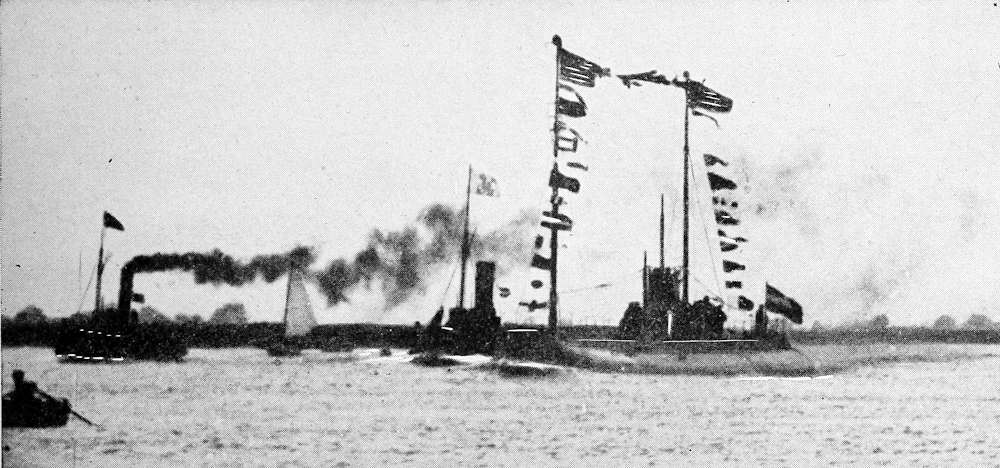
© International Film Service.
The Deutschland Arriving at Bremen, Having Returned from a Trans-Atlantic Voyage
“When our boatswain, Humke, comes with a jar filled with tar, the air-pump again starts to work, and at last big clouds of smoke pour out of the funnel. The effect was great. The steamer, which was at a distance, suddenly changes its course and comes straight for us.
“This we had never expected. I therefore order the mast taken down and make ready for diving. Our canvas covering disappears from the conning-tower and with a deep bow the smoke-stack comes down.
“As soon as the steamer sees this change in our make-up, fear fills his heart. He changes his course and flees, throwing thick, black clouds of smoke which we admire not without a feeling of jealousy.
“Without hindrance we again hoist our funnel. The masts are raised. And while our steamer speeds away in her wild flight we laugh so the tears run down our cheeks.
“Our fine disguise which was intended to let us pass unnoticed had instead attracted the steamer’s attention to us. He undoubtedly took us for a wreck or a ship in distress and came toward us with the kind intentions to save us. When he could suddenly see himself the target for the devilish cunning of a foxy U-boat he fled precipitately.
“What did the people of the steamer think when they recovered from their scare? Maybe they felt proud to have been able to escape from the heartless ‘pirate.’ And we, who would have been so proud if our disguise had worked a little better, were preparing to sink below the surface to avoid him.
“Well, we thought, ‘better luck next time,’ and we improved our invention with the result that two days later, while throwing off solid clouds of smoke, we passed by a steamer which we met without causing the least suspicion.”
And so without mishap or misadventure the Deutschland fared to her destination, tarried some while in the American port where officers and men were discreetly entertained, the United States being a neutral country then. Suddenly, mysteriously she put to sea again. Many were the rumors of disaster to her—for the return trip was long and beset with peril from paroling and watchful destroyers eager to catch sight of her; but in due course and in triumphant contradiction of reports of her destruction the first authentic news was of her safe return to the home harbor.