“A VALIANT GENTLEMAN”
Reading edition
So Comrades Named Dick Hall, One of the First of Ours to Die
Speaking at the Lafayette Day banquet given in New York the evening of Sept. 6, 1916, M. Jusserand, the French Ambassador, referring to the service of Americans in France before the United States entered the war, said:
“Serving in the ambulances, serving in the Legion, serving in the air, serving Liberty, obeying the same impulse as that which brought Lafayette to these shores, many young Americans leaving home and family have offered to France their lives. Those lives many have lost, and never, even in antique times, was there shown such abnegation and generosity, such firmness of character: men like that Victor Chapman, who died to rescue American and French co-aviators nearly overcome by a more numerous enemy, and whose father, so justly admired for his gifts of mind and heart, decided that his son’s remains should be buried where he had fallen: ‘Let him rest with his comrades’; or that Richard Hall, killed by a shell while on the search for our wounded and whose mother hesitated to accept a permit to visit his flower-wreathed tomb at the front, because French mothers are not allowed to do so; or that Harvard graduate, the poet of the Legion, Alan Seeger, who felt that his hour could not be far remote and in expectation of it had written from the blood-soaked battlefield where he had fought for Liberty. The Frenchman who goes up is possessed with a passion beside which any of the other forms of experience that are reckoned to make life worth while seem pale in comparison. It is a privilege to march at his side—so much so that nothing the world could give could make me wish myself anywhere else than where I am.”
And Emory Pottle, in telling for the Century the story of a “Christmas at Pont-à-Mousson” (1915) when he and his fellows of the American Ambulance Service in that sector had a “bonne fête,” superintended by Mme. Marion and pretty little thirteen-year-old Jeanne, says:
“It was a gay meal, recklessly, happily so. No one in the sector to which we were attached was wounded that day. That, maybe, was the real holiday note. Though it may seem incredible, the meal ended with a huge plum pudding.
“It ended, too, with something very grave and as I now think of it, very beautiful. The festival meal and the gifts were forgotten in the face of it. For it was, oh! not strangely, one of those events which lift men, if ever so briefly, out of their daily selves into unseen things. Our chief of Section was called to the telephone. He came back—we all saw it—with saddened face. ‘Fellows,’ he said slowly, ‘Richard Hall of Section III has been killed, blown off his car by a stray shell in the Vosges. He is the first of us all to go.’
“We stood very silently and soberly about the table. Such news drove home abruptly, cruelly by reason of our Christmas gaieties—just what being there involved to us, to those who loved us. Very often we had jested and joked about death. None of us was a coward, I think; but—Hall dead—the first of the lot of us—dead—so far from home—Christmas!
“‘Boys, let’s drink to him, the first of us to lay down his life for France. Here’s to Dick Hall, good old scout!’
“So we drank, and I think no man there that night, where danger and death were always brooding darkly, failed to feel the dignity and honor of his calling.
A MOTHER’S GIFT TO THE CAUSE
“A long time after, the mother of Richard Hall said to a friend of mine—said with clear, sad, gentle eyes—‘I am glad to give my boy to so great a cause!’ And we on the edge of the sinister Bois le Pretre, when the news of the boy’s death came to us that Christmas day, felt, too, somehow, somewhere within us, that the cause was great, was ours.
“Late that night I stood alone for a time under the starry sky of that strange hell we inhabited. Oddly enough, I felt, so I recall, a calmness and a courage, even a sort of happiness, new and strange. Though its approaches might be loud and frightening, I knew again that ‘the ways of death are silent and serene;’ an honorable death, a death of one’s own choosing for an ideal, for a cause.”
An extract from a letter written to his parents on Decoration Day, 1916, by Louis P. Hall, Jr., next older brother of Richard—he, too, valiant in the Ambulance Service—gives an intimate glimpse of the qualities of heart and mind that endeared Richard Hall to his fellows and to all who knew him:
“To-day at two I attended a beautiful memorial exercise. It was held at the monument to Washington and Lafayette in the Place des États-Unis, here in Paris. And during these exercises I took a little part when my officers and myself placed a great floral tribute at the base of the monument among the many others. On the tri-color ribbons of this tribute from the American Ambulance were these words: ‘To Richard Hall and the other Americans who gave their lives for France.’
“And so it is, as you well know, that I have thought a great deal of Dick to-day. I believe I can recall almost every time I saw him during our last three months together in Alsace with the circumstances of each meeting. I can even remember many of the times and places we passed each other on the road. He invariably smiled as we waved to each other in passing, just as if he were as pleased to see me as I was to see him. And I wonder if that really could be true! How I did admire and love him as I knew him there in a life which brought forth all the best from a boy who had no worst. And coupled with his splendid character, indeed a part of it, was that fine reserve which never courted an open show of devotion from me. But he was my own brother and always must be my brother, what more could I have asked?... Though we were often miles apart for days at a time, each was doing his little share in alleviating that endless physical pain and bitter human suffering which made our own hardships seem as nothing. And there was always our next meeting, sometimes down in the valley, sometimes at a post in the mountains, when we would talk things over; but even then neither told the other all his inmost thoughts, for in such work our very depths were touched and stirred as they never had been touched and stirred before.”
FROM DARTMOUTH TO FRANCE
Richard Nelville Hall, less than 21 years old when killed, was the youngest son of Dr. and Mrs. Louis P. Hall, of Ann Arbor, Michigan. In June, 1915, he was a senior at Dartmouth College and with other members of that class he enlisted with the American Ambulance Corps for a period of three months, and was assigned to Section Three. When his term was up there was such urgent need of men and the new enlistments were so few that Dick volunteered to remain in service until he could be spared more easily. About that time Louis P. Hall, Jr., his next older brother, enlisted and surprised Dick by appearing in the yard of the American Ambulance Corps in Paris. Dick had just driven in from the firing line. The meeting can be appreciated only by those who know what a bond of affectionate devotion united the brothers, and which is expressed in the foregoing quotation from Louis’ letter to his parents dated Decoration Day, 1916.
But even when recruits came the work of the Ambulance Corps was such that the need of men was increased, and Dick continued to drive his ambulance, postponing a little further his expected return home. There was terribly fierce fighting in the Vosges in that period, it will be remembered, and the demands upon the ambulance driver were almost incessant, the peril of it constant, gathering up the wounded from the battle front and hurrying them to a place of safety. For five months he had made those hazardous trips from battle front to safety station, unhesitatingly, devoted, inspired by the consciousness that he was engaged in saving, not in destroying life, his work not for France alone but for humanity.
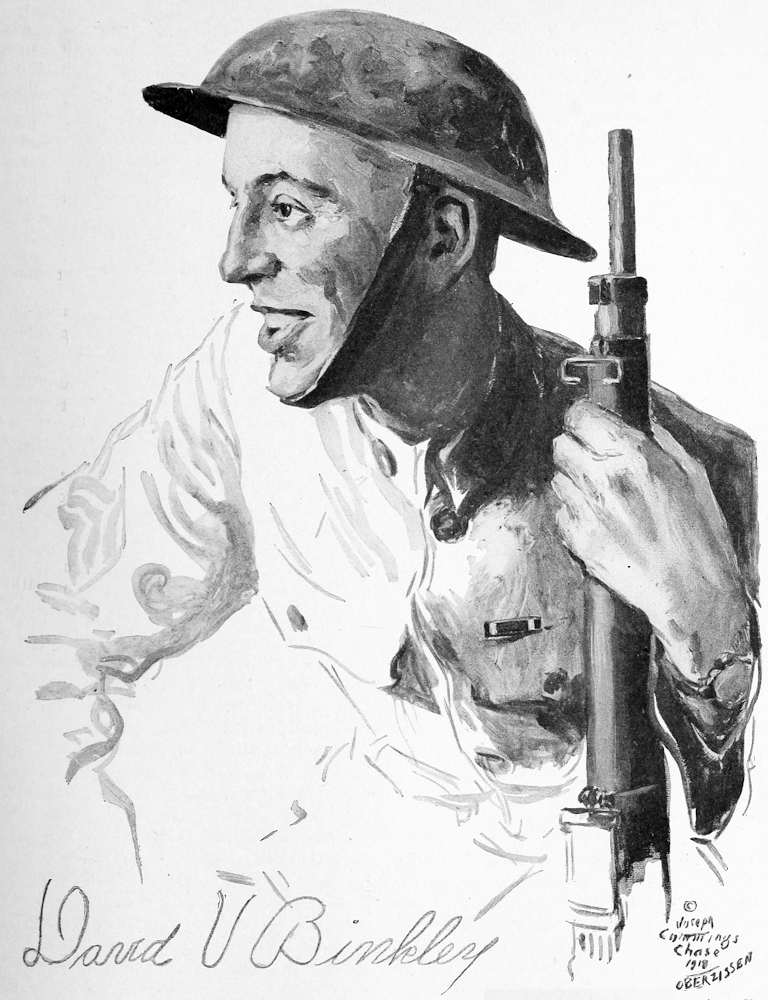
Drawn by Joseph Cummings Chase.
Sergeant David U. Binkley
42nd Division, 168th Infantry, Company “I”
While a private, Sergeant Binkley, on July 28, 1918, sought and obtained permission to rescue his corporal who was lying severely wounded in the open near Sergy, northeast of Château-Thierry, France. He crossed an open area that was swept for more than 50 yards by enemy machine guns, reached the corporal and carried him safely back into the lines.
Lovering Hill, the chief of the section, says of him: “I have never known any one who always showed so much dévouement in his work. He was the steadiest of all, and the most reliable. He never slacked up in times when work was dull, when day in and day out was the same grinding monotony; and in times of activity after many hours without rest or sleep, he was always cheerful and stuck to the work with a tenacity which was astounding. His frankness and straightforwardness, his cheerfulness and good nature, his kindness—for he was always the first to help his comrades—made him beloved by all of us, and by most of the French with whom he came in touch, who admired the wholehearted way in which he worked. In the technical matter of the upkeep of his car he was my special delight, for both his car and his equipment were always in perfect order.”
The incidents of the days preceding the death of Hall have been indicated briefly in a tribute written soon after the fatality. There had been something of a respite from fighting, but on December 21 “the mountains spoke” and all the cars rolled upwards toward the post of Hartmanns-Weilerkopf—taken and retaken a score of times, a bare, brown, blunt shell-ploughed top where before the forest stood—up, elbowing and tacking their way through battalions of men and beasts. From one mountain slope to another roared all the lungs of war. For five days and five nights, scraps of days—the shortest of the year—nights interminable—the air was shredded with shrieking shells—intermittent lulls for slaughtering after the bombardment—then again the roar of the counter-attack.
THE TRAVELED ROAD
“All this time, as in all the past months, Richard Nelville Hall calmly drove his car up the winding shell-swept artery of the mountain of war—past crazed mules, broken-down artillery carts, swearing drivers, stricken horses, wounded stragglers still able to hobble; past long convoys of Boche prisoners, silently descending in twos guarded by a handful of men; past all the personnel of war, great and small (for there is but one road on which to travel, one road for the enemy’s shell); past abris, bomb-proof, to arrive at the Poste de Secours; where silent men moved mysteriously under the great trees, where the cars were loaded with an ever ready supply of still more quiet figures (though some made sounds), mere bundles in blankets. Hall saw to it that these quiet bundles were carefully and rapidly installed, then rolled down into the valley where little towns bear stolidly their daily burden of shells thrown wantonly from somewhere in Bocheland over the mountain to somewhere in France—the bleeding bodies in the car, a mere corpuscle in the full crimson stream, the ever-rolling tide from the trenches to the hospital, of the blood of life and the blood of death. Once there, his wounded unloaded, Dick Hall filled his gasoline tank and calmly rolled again on his way. Two of his comrades had been wounded the day before, but Dick Hall never faltered. He slept when and where he could, in his car, at the poste, on the floor of our temporary kitchen at Moosch—dry blankets or wet blankets of mud, blankets of blood—contagion was pedantry, microbes a myth.”
It was over this shell-swept, torturous road that Dick Hall was driving his car on its final errand of mercy when, in the first hours of the Christmas morning, death made friends with him. Some three hours later he was found by Matter, one of his comrades, the first to pass along the mountain road. It was between 3 and 4 o’clock of the morning. Matter and Jennings, who came a little later, bore the body back in Matter’s car to Moosch, where his brother, Louis Hall, learned what had happened. Death had been instantaneous. A fragment of shell had penetrated his brain. Though he had other injuries (the car was utterly demolished), we have the testimony of Abbé Klein, the chaplain, that “even in death his face preserved the expression of smiling radiance, that frank and kindly nature that his comrades had learned to love in the months he had been with them.”
“There in the small hours of Christmas morning where mountain fought mountain—on that hard bitter pass under the pines of the Vosgian sweep, there fell a very modest and valiant gentleman,” says the memorial from his comrades of Section Three, adding:
“Dick Hall, we knew you, worked with you, played with you, ate with you, slept with you, we took pleasure in your company, in your modesty, in your gentle manner, in your devotion and in your youth—we still pass that spot, and we salute. Our breath comes quicker, and our eyes grow dimmer, we grip the wheel a little tighter—we pass better and stronger.”
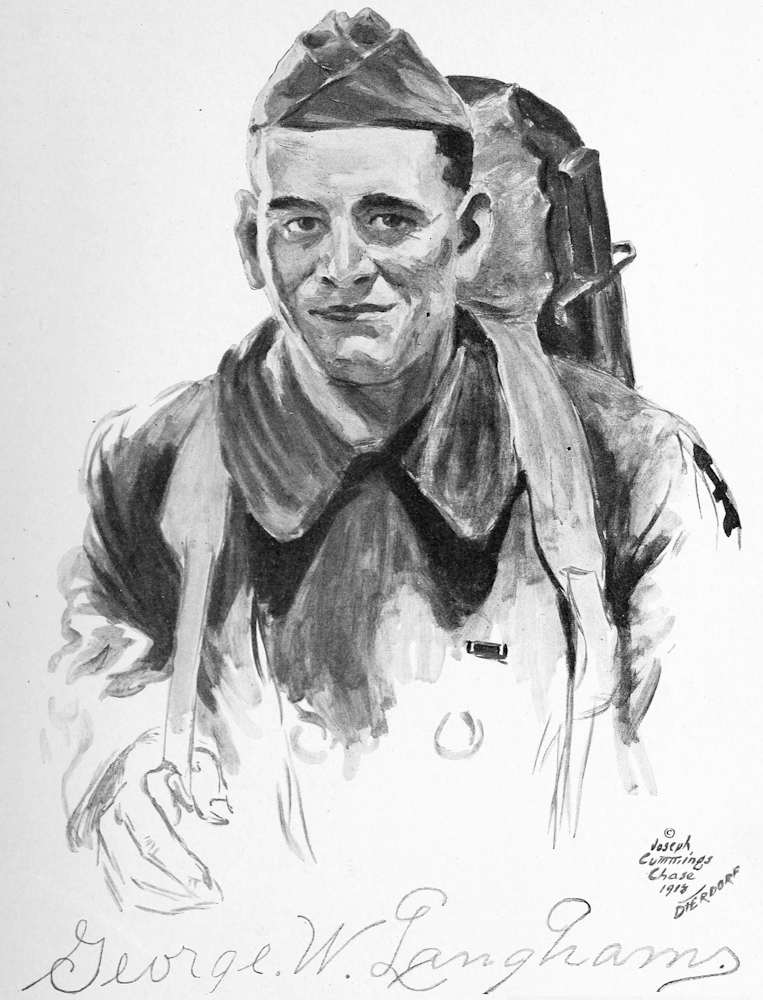
Drawn by Joseph Cummings Chase.
Private George W. Langham
32nd Division, 128th Infantry, Company “H”
Though he was severely gassed near Juvigny, north of Soissons, France, August 20-September 2, 1918, he remained on duty with his company while it was in the front line. Later he aided in the work of carrying wounded men across the area covered by artillery and machine-gun fire.
THE LIVING DEAD
The funeral services were held in the little Protestant Chapel five miles down the valley while the guns roared in a fierce battle raging for the possession of Hartmanns-Weilerkopf. At the conclusion of the ceremony Hall’s citation was read and the Croix de Guerre was pinned to a fold of the tri-color that wrapped his coffin. At the head of the grave was placed a wooden cross with the simple but all sufficient inscription, “Richard Hall, an American who died for France, December 25, 1915.” The Alsatian women heaped flowers on the grave, and after kept it decorated and cared for. When the United States formally entered the war there was a further ceremony, when a French General laid a palm on the grave in the presence of Louis Hall and the American Corps.
But Richard Hall was one of those fortunate servants whose service and humanity did not end with death. Very soon after he was killed, as a tribute to his memory a new ambulance car was sent to France to be driven by Louis Hall. It was the gift of a lady. Another followed, the gift of a New York gentleman, and a third ambulance was sent by Dr. and Mrs. Louis P. Hall, who also kept a memorial bed in the American Ambulance Hospital at Neuilly until the end of the war. In addition to that they established a Loan Fund of $2,000 in the University of Michigan (Ann Arbor was Dick’s birthplace, his father a professor in the University) and $500 was given to Dartmouth. In the same spirit of carrying on Dick’s work his parents’ efforts resulted in the sending of $18,000 to the “Fatherless Children of France” and ten thousand garments to the children of the Frontier.
An editorial in the Philadelphia Press had this to say of Richard Hall:
“Much more glorious is the death of this man than is that of the fighting soldier. His was a devotion, not to country and fireside and altar, but to an abstract conception of duty. There can be a selfishness, of a refined kind, to be sure, in even the greatest bravery shown by the soldier who is fighting for the preservation of his native land. Thoughts of his near and dear ones in that land inspire his actions and nerve his body and will for them. To the alien nurse, physician, hospital attendant there is no such inspiration. For them the inspiration must come from the depth of their humanity, and cannot be tinged with the slightest touch of self. German or Hun, Briton or Serb or Frenchman are all the same in their eyes if they are suffering from wounds or disease. Americans have a right to be proud of a fellow countryman like Richard Hall.”