THE PAINTER SOLDIER
Reading edition
Though Exempt by Age the Love Art Deepened Bade Him Fight for France
Elsewhere in this volume is told how an American poet, Alan Seeger, gave his life for France. Here is the story of a French painter who, freely offering his life, gave what was even more precious to him than life. You may know the name Lemordant, and you may know the work signed by that name; if not, what pleasanter introduction to both than some words by Mary Fanton Roberts in the Touchstone? She says:
“Perhaps all unconsciously, this heroic French artist-soldier has found the truth about democracy, and he tells it to us with lightning strokes and splendid color. In all of his pictures he is a painter of the simple people: of the workmen, the peasants, the sailors, the fishermen, and women. And he paints them working joyously with strength and exhilaration and interest. He paints them running in the meadows and dancing on the shore and laughing into each other’s faces. He paints them as great workmen, great lovers. They seem, these men and women, in their bright-colored clothes and their vivid faces, as much a part of the essential beauty of life as white clouds racing over the blue sky on a windy day, as the amethyst water through which the women splash bringing in the nets; they are as genuine as the yellow shore where the brilliant fishing-boats lie, as the poppies in the field, and the tulips in the home-gardens.”
WOULD NOT REMAIN BEHIND
He was 37 years old when the war began, an age that entitled him to remain behind in the Home Defense Corps, but he chose to go to the front. Mr. Charles LeGoffic relates, in the Touchstone, the war experiences of painter Lemordant, the experiences of a veritable hero, hero exceptional. His first engagement of consequence was at Charleroi, where he was wounded and where he won a lieutenant’s commission.
One night during the battle of the Marne, on the outskirts of the forest of Guebarre, his attention was attracted by some suspicious movements on the right. He crawled out, revolver in hand, followed by four men of his section, to investigate.
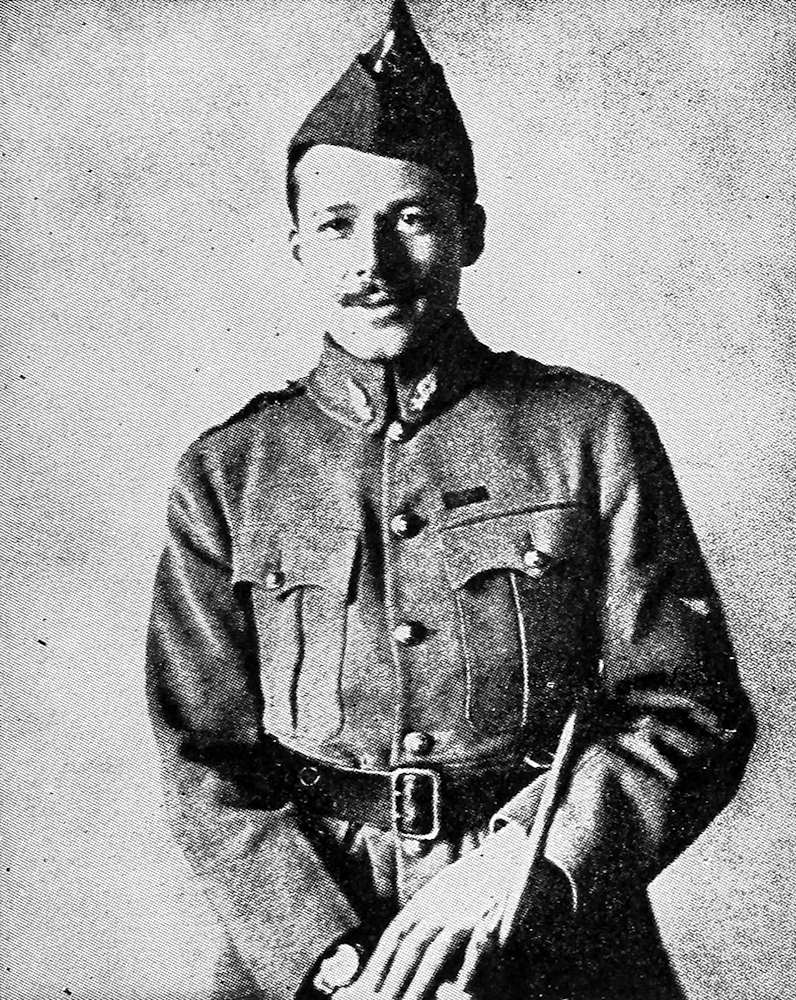
© Brown Bros.
Victor Chapman
Another American who gave his life as a flyer in the Lafayette Escadrille.
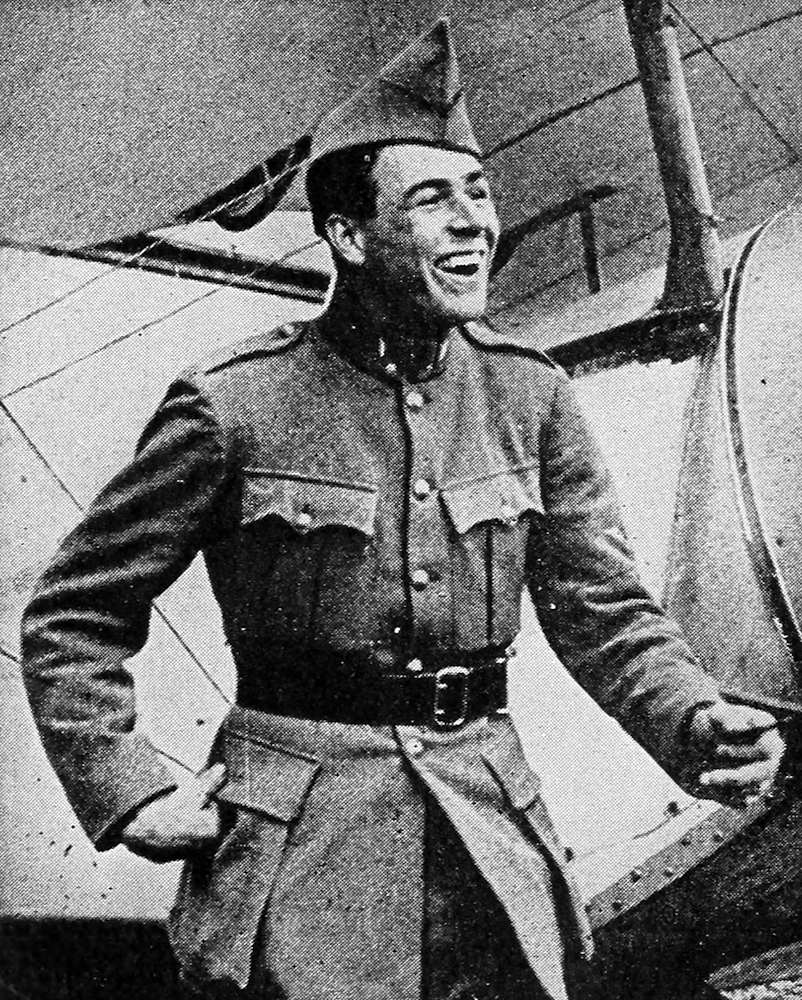
© Paul Thompson.
Norman Prince
One of the organizers of the Lafayette Escadrille, who was killed in action in France.
“He was not mistaken; at that spot, between two companies, our line showed a slight opening, a ‘break’ which the Germans were trying to enter. Lemordant sent one of his men to alarm the nearest company, and was making a half-circle toward his own company when a huge Boche ruffian appeared in the darkness and fired at him pointblank. The bullet shaved his cheek; other bullets whistled about. The little troop had been winded, and there was only one way to get out of it, that was to reply by a general fire that would give the impression of an attack in force. The enemy would perhaps be impressed by it, and in any event this volley would put companies out on the alert. In fact, on both sides the firing became general, even the artillery took part in it; a seventy-seven burst near Lemordant, wounded him in his right side and threw him into the air with his full equipment. The wound was not serious, but Lemordant fell in such a way as to dislocate his hip-bones and to tear his muscles. Fainting, he was carried away to a field-hospital, where he remained until the ninth. The enemy was now in full retreat. On the eighth we had crossed Le Petit Morin, on the ninth we lay at Montmirail and at Champaubert, on the battlefields of the Napoleonic epic, and the birth of victory came to the armies of the Republic in the same cradle where the Imperial star had shed its last rays.
“Lemordant refused to be sent to a base hospital. He was not yet strong. He could scarcely walk, the two wooden splints which they had placed over his pelvis came out of position at each sudden movement; but the splendid conscience of a leader of men had awakened in this idealist, this dreamer who but yesterday was so highly prejudiced against the military profession. He knew that in war-time an officer only holds his men by his own example and moral authority.”
AN OFFICER’S OBLIGATION
“‘An officer,’ he said to me, ‘literally must give all his existence, all his life-blood to his country; he must not spare a drop; less than any other is he allowed to invoke the relief of the “slightly wounded,” which permits him to go to some luxurious hospital in the Côte d’Azur and there appeal to the tender hearts of the Sisters of Charity. Wounded, sick, limping, he must be able to say to his soldiers who are complaining, “But do I not march, too?” Then they will follow him.’
“On the morning of October 4, 1914, the 41st attacked near Monchy-le-Preux.... All went well at first. From time to time, whenever the ground was uneven, they rushed forward; a few unlucky ones are dropped out on the way. With the rest, Lemordant, although himself wounded in the hand, reached the enemy trench and carried it.
“A second bullet at this moment grazes his right temple; a third, a little while after, wounds him on the top of his skull. It is now broad day, but it is northern weather, gray, cheerless, dark, uncertain. In the four great stages of his military life this painter soldier knew different climates; he has run the tone-scale from the burning blue of Charleroi to the bottomless night of Craonnelle, with the clear starlit heaven of the Marne between.
“Is it of that he thinks, if it be that, in such a moment, he can think of anything except the safety of his men?
“Confused movement on the plain—on his right frantic silhouettes which stand bolt upright, whirl about, collapse; another section of his company engaged on the same side is caught on the flank by machine guns set up in a sort of blockhouse behind a mound, in front of a pile of ruined huts. Without hesitating, with the firmness of decision which never abandons him in the most critical circumstances, Lemordant gets his men together, rallies the fugitives, and throws himself on the blockhouse—the battery of machine guns is put out of action. But Lemordant, climbing the slope, receives a bullet pointblank which goes through his right knee.
“It is his fourth wound of the day, and his men wish to carry him off; he refuses, feeling that his presence is more necessary than ever. In spite of the pain he merely had his leg set in splints, then, fortifying the positions on the side toward the enemy, he sends a runner to Major Bernard to keep him in touch with his advance and to call for supports. The man is killed on the way. Another meets the same fate, and in the interim the German counter-attack breaks loose.
“It is launched by a whole company, and it is terrifying to see this gray wave rolling over the plain, rising, sinking, rising again, and growing at each rush which brings it nearer the mound. Lemordant, by rigid demand, compels his men not to fire, to control their nerves. The charge gets within twenty meters of the mound, where it gathers itself up to come over in a single mass with the cry ‘Vorwärts!’
“‘... Rapid fire—fire at will!’ roars Lemordant.
“The charge vacillates, stops. Our men leap out of the trench to charge in turn. Lemordant, though wounded in the hand, in the forehead, on the head, and in the knee, charges with them, supported by a young soldier of his section. Chance brings him face to face with the Oberst-leutnant, who commands the counter-attack and whom he seizes by the throat; just then a fifth bullet strikes him over the right eye, breaking the frontal bone. It seems to him that his head has burst and that his eyes have spurted out into space. He falls heavily. It is all over!”
WHY THE NIGHT SO LONG
“How was he finally saved? He does not know yet. Wounded within the enemy’s lines, left for dead, he lay there four full days without care and for forty-eight hours he was unconscious. When he came to himself it was difficult to collect his thoughts. He did not know where he was. Around him was total darkness, and it did not pass away. He heard the groans, the death-rattle of the dying, the voices of the wounded who called to him. He dragged himself in their direction and asked them questions. Why did the night last so long? They answered that it was broad daylight—and he understood.
“‘... I had thought of everything,’ he said to me. ‘Of death, of the most horrible wounds, but not of that!
“‘... But as long as that too was necessary!’
“Yet his martyrdom was not finished, and the worst of all perhaps remains. How shall I tell of that fearful suffering in wretched lazarettos, in the dung-heaps where the Germans laid our wounded in the villages behind the front! Most of them stayed there forever. He, with greater vitality, was carried to Cambrai, and from there stage by stage was transported to a hospital in Bavaria.
“Melancholy journey! If he saw nothing, at least in the railway-stations he heard the yells of the mobs which crowded on the passage of the French wounded to gloat over their sufferings. Eventually his condition improved a little; his eyes, one pushed out of its socket, the other driven back in his head by the breaking of his frontal bone, had been put back in place; he began to see, he could even draw a few lines and make out large characters. But the idea of escape mastered him; two unsuccessful efforts had sent him to the guardhouse; on the third he was ordered to a reprisal camp; his departure was fixed for the next day. Calm and serene as ever, he wished before going to finish the series of addresses on the history of painting which he had undertaken for his fellow prisoners. In the course of the conference Lemordant wished to run over his notes; he could no longer make them out! A halo danced in front of him, obscuring everything! He had such a sense of anguish that he had to stop. But by a concentration of the will he mastered himself and improvised the rest of his address in a voice in which there was only the slightest trembling. At the end of the address the battalion chief leaped to the platform and took Lemordant in his arms.”
FOR THE LAST LOOK
“‘... What has happened to you?’ Then when he learned: ‘Ah, my poor friend, surely in your condition they can not send you to a reprisal camp; courage, you shall go to France!’
“The commander of the guardhouse himself, feeling a sense of pity when he learned what had happened, offered to telephone to the camp commander and ask for a cancellation of the order. Lemordant refused; he wished to owe nothing to the destroyers of his country. He started for the reprisal camp. But there his blindness classified him almost immediately among the severely wounded who were listed for exchange. Switzerland received him for a time. At last arrived the moment when he could cross the French frontier.
“He had waited for that moment with a sort of religious ecstasy. Blind, wounded in the back and side, with a broken knee, and a high fever, he hoped for a miracle, but expected one only from himself, from the power of his own will. He had asked the Red Cross nurses who had charge of him to tell him the moment when the train crossed the frontier. He would see it—see at least something belonging to it, no matter what—a hedge, a length of rail, a pebble, a tuft of grass. They did what he asked, took him to the door of the compartment, and there he exerted all his strength, all his will-power. It was not to be!
“The frontier was left behind; he fell back fainting—totally blind!”