A PICARDY HEROINE
Reading edition
The Story of Marcelle Semmer, Who Held Up the Advance of a German Army Corps
French heroines were not few; indeed to be a woman of France was to be a heroine in those slow grinding years of the war that tired the soul, as it trampled the life of that country. But none of them was of greater courage or of more resolutely self-sacrificing purpose than a young woman of Picardy, a mere girl, Marcelle Semmer. She was the daughter of a phosphate factory owner, an Alsatian, who had quitted Alsace in 1871 rather than remain as a subject of Germany.
The story of her deeds was first given to the public by a lecturer at the Sorbonne, Paris, and was repeated by the Paris correspondent of the Times, but her fame had already run throughout the armies of France, and the Republic had honored her.
After the defeat of the Allies at Charleroi, the French tried to make a stand along the Somme, but being unable to resist the overwhelming mass of the invaders, they fell back across a canal in the vicinity of Marcelle Semmer’s home. The enemy were in close pursuit. As the last group of the French crossed the bridge, Marcelle rushed forward and raising the drawbridge, threw into the canal the control key, without which the draw could not be lowered. This remarkable evidence of presence of mind and coolness was hardly to have been expected from a girl in such terrifying circumstances. The act was a daring one, as the advancing Germans did not hesitate to fire at her as well as at the retreating soldiers; but realizing that it would hold up the advance of the Germans she unhesitatingly confronted the danger. It was the saving grace for the French, for it was not until the next morning that the Germans were able to get together boats enough to form a pontoon across the canal. The retreat had the advantage of those precious hours of the hold-up.
Though the risks were great, Marcelle remained in the village during the German occupation in order to be of possible assistance to the French. And she did render assistance. There was near the village Eclusier a subterranean passage used in the working of a phosphate mine, and in this passage Marcelle managed to conceal at different times sixteen French soldiers who had got separated from their command in the retreat from Charleroi and Mons. There she fed them, furnished them with civilian clothes and aided their escape into the French lines. It was not until she was helping the seventeenth to escape that she was caught and dragged, with a French soldier, before the local commandant. Asked if she meant deliberately to aid the soldier to escape, she replied firmly:
“Yes. He is not the first. I helped sixteen others to get away. Do what you please with me. I am not afraid to die.”
With little ceremony she was ordered to be shot. She was taken out for the purpose. The firing squad was drawn up and only waited the order to fire when suddenly there was a roar of French artillery bombarding the town and the position of the Germans around Eclusier. It was an unexpected French advance, and without thought of the girl the firing squad joined the confusion of men hurrying to the shelter of their defenses. Marcelle made her escape to the friendly subterranean passage. The French occupied Eclusier.
TWICE SAVED FROM THE GERMANS
The Somme lay between the opposing armies, and in the vicinity of Eclusier it forms a marshy lake. At flood the water covered the lines so that soldiers often lost their way, and here Marcelle found another means of serving France.
The correspondent says:
“Being thoroughly acquainted with the neighborhood, she used to pilot parties of soldiers. This brought her again close to death. While leading a squad of men who wanted to dig an advanced trench in the village of Frise she fell into the hands of a party of Germans.
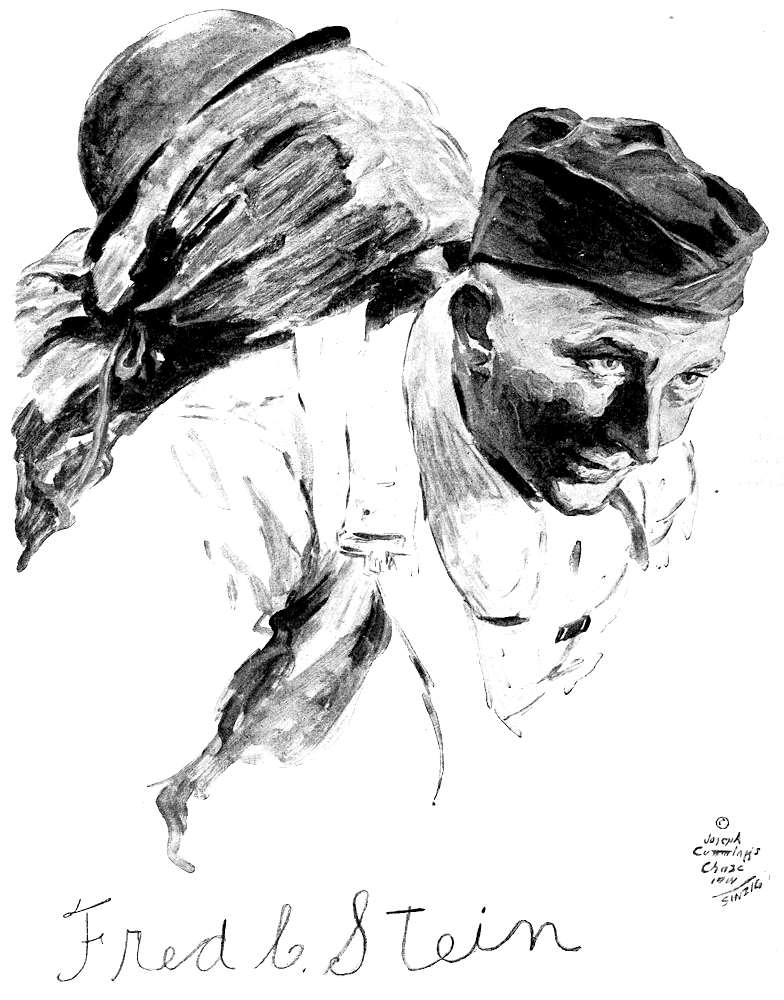
Drawn by Joseph Cummings Chase.
Corporal Fred C. Stein
32nd Division, 125th Infantry, Company “F”
Close to Romagnes, on October 9, 1918, Stein captured a strong enemy machine-gun nest. He received two wounds while endeavoring to operate the machine gun, and then received another wound which was in the arm and almost disabled him.
“They locked her up in the little village church of Frise. On the morrow, she felt sure, they would shoot her.
“But once more luck and the French artillery were her salvation. The French across the Somme began a lively bombardment of Frise. One shell blew a large hole in the church wall. Through this hole, unperceived by her captors, Marcelle crawled. Creeping past the Germans scattered through Frise, she soon tumbled, safe and sound, into the nearest French trench.
“By this time her fame had spread and rewards began to shower upon her. She got the Cross of the Legion of Honor, and some time later the War-Cross. In spite of all she had gone through, she persisted in staying in the Somme country and continued to work for the cause of France. For fifteen months she remained, despite shot and shell, in her little Somme village, taking care of wounded soldiers. Also among her charges was a woman of 90, too feeble to travel to a safer place. Marcelle looked out for her night and day with unflagging devotion.
“Everywhere soldiers knew and admired her. One English General ordered his soldiers to salute when she passed and refrain from addressing her unless she spoke first.”
Under the strain of her volunteer work she finally came near to a breakdown and was persuaded to go to Paris. There she entered a nurses’ school to qualify for the care of the wounded, work being necessary to her to shut away her personal sorrows, as everything she possessed or held dear the war had taken from her.
All this and more was told at the Sorbonne Conference, and then, says the Times correspondent, the narrator made a dramatic gesture and exclaimed:
“‘This little heroine of Picardy, this admirable girl, this incarnation of the qualities of the woman of France, this girl of simple origin, flawless dignity, of serious mind, and gentle ways, this girl of indomitable will-power, is here, ladies and gentlemen, here among you, in this room! And I feel that I am the spokesman for every one of you when I now extend to her the expression of our respect, our gratitude, our admiration!’
“The auditors, every man, woman and child of them, leaped to their feet, mad with enthusiasm. They craned their necks to catch a glimpse of the heroine. Unable to escape them, the young girl stood up, blushing. Through the great hall of the Sorbonne, where the most famous people of the world had been honored by France, swept a storm of cheers. A reward more splendid than the Cross of the Legion of Honor, than the War-Cross, than the salutes of soldiers at the front, had come to Marcelle Semmer.”