ONE OF OUR BOYS
Reading edition
A California Youth of Heroic Soul Who Gave His Life to England
We are constantly hearing of the hundreds of Americans who laid down their lives under the French colors. It was part of the debt we owed France. England, too, when she joined in the war for liberty, found many Americans hastening to her aid, and among the lives that were taken under her flag in the “great venture” was that of Harry Butters, a young Californian whose death in France called forth nation-wide eulogies in Great Britain.
Young Butters, after a preliminary education at San Francisco, went to England and entered Beaumont College at Windsor. There amid England’s rural charms and the spell of England’s old traditions, he learned to love the country which sheltered him.
At the outbreak of the war, Butters went back to America. He could not stay, however. There was a call to rise and to go. He went back to England and enlisted. It was as an officer of the British Army that he died.
The London Observer voices England’s praise and love of the American:
“This American boy—and what a straight, upstanding pattern of youth and strength he was—owed us no duty and he gave us all. He gave it not impulsively nor in adventurous recklessness, but with a settled enthusiasm belonging to the ‘depth and not the tumult of the soul.’ How much he gave is worth considering. His personal endowments and opportunities were such that when he made up his mind to quit everything in his bright California and to come into the war, his choice was heroic in the fullest sense of that word.
“When he went back to America after leaving college, he was a young man of mark, framed to excel both in sport and affairs. He was very tall, supple, active, frank, and comely of face, as gay as he was good-looking. You saw by a glance at his hands that he had a born instinct for management and technique. He had been a good deal at sea. He knew all about horses and motor-cars. He was a crack shot and a fine polo-player. His business ability was shown as soon as he took over the management of his father’s estates. With this practical talent that could turn itself to anything he had other qualities. One remembers what a delightful, level, measuring glance he used to give suddenly from under his brows when he had finished rolling a cigarette and went on with his keen questioning about men and things. To talk with him was to receive a new and promising revelation of the mind of young America. Like so many of our own young soldiers in their attitude toward politics, he was not content with either of the old parties in the United States. He thought that his own generation, if it was earnest enough, might make a better hand both of social problems and world-relations. He hoped to play his part. Although he always thought of himself in a fine spirit as “an American citizen,” he wanted the United States to take a full share in the wider life of the world, and especially to work as far as possible for common ideals with the whole English-speaking race.
WARM HEARTED AND FEARLESS
“So when the news of the war came to San Francisco, he put aside as fair a prospect of wealth, success, happiness, and long life as could well open before a young man, and determined to throw in his lot with the old country and the Allies in the fight for civilization against all the armed might of lawless iniquity which had flung itself on Belgium.
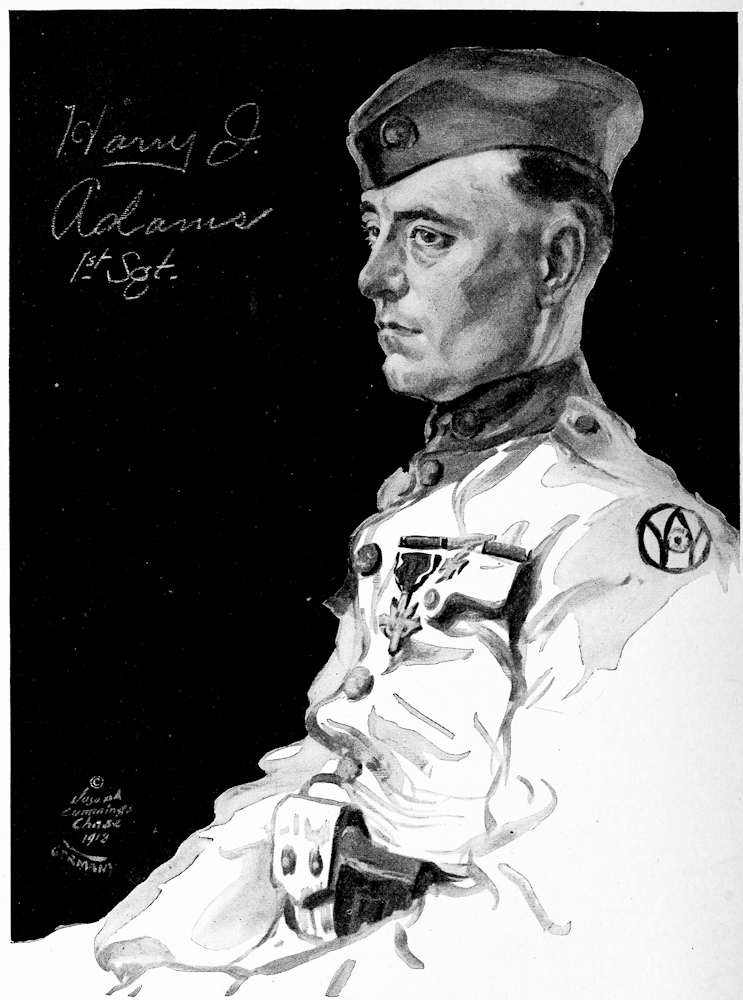
Drawn by Joseph Cummings Chase.
Sergeant Harry J. Adams
89th Division, 353rd Infantry, Company “K”
Following a retreating German into a house in the town of Boullonville on September 12, 1918, he fired the remaining two shots in his pistol through the door and ordered the surrender of the occupants. By his bravery, coolness and confidence he captured, single-handed, 375 prisoners.
“He was then twenty-two. He arrived in England in the early part of 1915 to join the British Army, and no military eye could doubt that the British Army had got a rare recruit. Harry Butters got his first commission in the 11th Royal Warwickshire Regiment. Afterward his technical faculty found more congenial scope when he transferred to the Royal Field Artillery. While training, he stayed a good deal at the rectory, Stow-on-the-Wold, Glos. The rector writes: ‘He was a warm-hearted, fearless young officer, as fine an American gentleman as ever crossed the Atlantic.’ It is much to say, but it is true.”
“His captain writes that, ‘He was with his guns, and no one could have died in a nobler way. He was one of the brightest, cheeriest boys I have ever known, and always the life and soul of the mess.... We all realized his nobility in coming to the help of another country entirely of his own free will, and understood what a big heart he had. He was loved by all.’
“He is in it to the finish, indeed, with comrades of his adoption, who have passed with him. He takes his last sleep out there with so many of the brave and true where none was braver and truer than he, and among the recollections of the great war, his name will not be forgotten. Beaumont will take care of that. In his old college we doubt not he will have his permanent memorial. In our thoughts the flags of Britain and America cover his heart with double honor. We shall never see them entwined again without thinking of him. No American can read these lines without being proud of him. No Briton can read them without feelings deeper, more moved than can be said in any words. We are grateful, as he would have liked, to his America that bred him.”
Mrs. Denis O’Sullivan, the widow of the famous Irish singer who was so eulogized by Mark Twain in his “Memoirs,” wrote to friends about the boy she affectionately called “stepson,” though there was no such tie between them:
“Do you remember in poor Synge’s ‘Riders to the Sea’—the old mother says that now her last son is drowned, she will be able to sleep o’ nights?
“The harrowing anxiety of every day in this time of war is over for me, too. On July 22, as you know, Gerard, my first stepson, was killed. And on August 31, at night, too, my last—Harry Butters—they were both as dear to me as my own—but Gerard had his own people here—he was not dependent on me, while in a way, Harry had only me—his sister was six thousand miles away. I haven’t been able to say much of him these last months as he had been getting the carbon copies of my letters to you. Yet it was so often on the tip of my fingers to enlarge upon the boy—his charm, his capabilities.
“More still upon the drama of his last experiences—from the moment when he burst into Aldwych his first day in uniform, so big, so startlingly handsome—above all, so gay—a shout of ‘stepmother!’ that raised the dust in that crowded, smoky refuge where the hundreds of tired Belgians looked around in astonishment that anyone left in the world could be so fresh, so dazzling—through those months of his watch beside his guns or directing fire from his exposed shell-swept hillside—that awful moment when the enemy found the range and poured death down upon the shelter that was no shelter—when all the other officers within call took refuge there, fourteen in all, Harry, the youngest, but the one who dashed out under fire to carry what was left of one of his telephonists to the first-aid station—a poor mangled mass of humanity, still breathing and crying out, a deed that in a smaller war would have meant the Victoria Cross, but in this, only one of a thousand such daily—after it his sudden collapse from the shock—(‘No one knew it, stepmother! I managed to bluff it through!’) But his colonel had been through the same experience and backed the doctor up in sending him to the base for a few days.
“Then his June leave, luckily due anyway, brought him over to No. 7 where he could be petted and taken care of—but it was a quiet Harry—no less clear-eyed and vigorous, but so, so tired.
“Then Winston Churchill and Garvin trying to make him take three weeks’ extra leave, the boy’s refusal, his return to France, some weeks in the ammunition column, where, knowing him to be comparatively safe, I could carry an easier heart, then a hasty line: ‘Just going up to one of the batteries to replace a casualty. It’s too bad it comes while I’m in bad shape, but it can’t be helped, and it surely is what I’m here for, after all. Don’t worry any more than you can help.’
“That was August 22, only short notes after that, though he could find time to write, ‘I’m going to try to get over to Gerard’s grave. If I can find some flowers I’ll decorate it for you.’
“His friend, Captain Zamora, to whom he’d given my address, could not have been with him at the last, for he had also had shell-shock and was with the ammunition column, but he wrote on the 1st of September that Harry had been with his guns the night before, when the call came, had gone in apparently the best of spirits—and the same shell killed him and his battery commander.
“It has been so beautiful this week. I’ve never seen a harvest-moon more wonderful. One can only think what a world it is—and Harry and Gerard both out of it.”