“BUCKEYES” OR “SPEARHEADS”
Reading edition
How the Ohio Doughboys Managed to Pick Up a New Nickname in France
The “Buckeye Division,” the 37th Ohio, got a new nickname for itself at Montfaucon in September, 1917. It was called “Spearheads” because of its ability to start a drive and carry on until its objectives were reached and captured. In a history of the Division Jack Koons (of the Cincinnati Inquirer), who was one of the Spearheads, tells in a breezily entertaining manner of the first experience of the boys going “over the top.”
Montfaucon had been held for over three years by the Germans, and was one of the so-called “invulnerables.”
The division historian says:
“Just before dusk on the night of September 25 the men began to enter the trenches. Blankets, overcoats, packs, and all unnecessary equipment were piled in large salvage heaps. Behind the lines, crouched beneath leafy screens of camouflage, was the artillery. At 10.25 o’clock the first gun spoke and all along the line great splotches of red seared the sky and the boom, screech, and crack of the gigantic pieces echoed and reëchoed through the hills. Far across the landscape, rising from the plain and standing out upon the horizon, was Montfaucon. The white walls of the city could be seen distinctly in the daytime. A church steeple, long ago deserted by worshipers, stood, a vacant monument to the ravages of the foe. In the advance against Montfaucon it was necessary to advance approximately twelve kilometers, through two dense woods, a marshy land, up a sharp slope, another plain, and then a sharp ascent into the town. It was later learned that a German Division Headquarters was located in the town.”
© Committee Public Information.
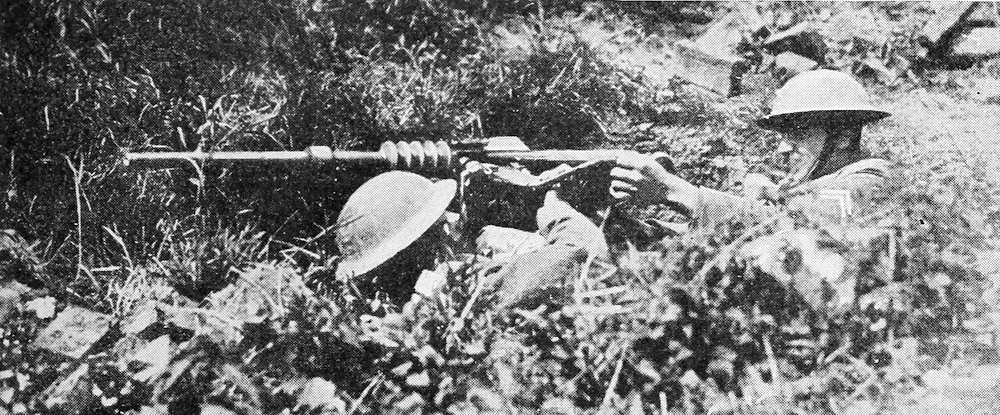
Machine Gun in Action
AT THE ZERO HOUR
“Patrols advanced into No Man’s Land as the artillery cut away barbed-wire entanglements. The great guns rose into a rumble and death rode through the night on shells—bound toward Germany. At 2.25 o’clock in the morning of September 26 the barrage rose and thundered in volume. Like the roll of a mighty drum the sound could be heard for more than a hundred miles. At 5.05 o’clock the barrage rested on the German front lines—rested there for twenty-five minutes, cutting forests to the ground and demoralizing the enemy who fled into the deepest dugouts. At 5.30 o’clock, the zero hour, the boys from Ohio went over the top. Every county and village in the State was represented in that attack.
“On and on they went. Machine-gun nests, carefully camouflaged with the hellishness shown only by the German, were discovered and destroyed. Here and there in the woodland Hun snipers were busy—but not for long. Men fell by the wayside in agony, refused assistance from comrades, and urged the men to go forward. That was the true Ohio spirit. The spirit that drove the Germans back mile after mile, that resulted in the capture of not only Montfaucon, twenty-four hours later, but Cierges and Ivoiry. These towns had been held by the Germans for four long years and were wrested away and liberated by Ohioans in forty-eight hours. In the prisoner cage were huddled approximately 1,100 prisoners, many officers among them.
“Relief came to the tired, fighting crew on September 30. Back they came a laughing, joking, dirty, sleepy division of fighting men—no longer boys. Behind them, buried in the fields of eastern France, slept those sons of Ohio who had given their lives, their all.”
NOW THE FINAL EPISODES
“At 5.25 o’clock on the morning of October 31 ‘Fritzie’ on watch along the Lys River was rudely awakened from his dreams of German beer and sauerkraut to face a typical go-get-’em barrage. It was a typical American barrage. Five minutes of drumfire. Five minutes of hell, fire, and damnation. Five minutes of terror. Across the Lys River scurried the Ohioans. Paddling in the icy water on logs and planks, the ‘doughboys’ went over, carrying rifles and machine guns. Engineers began to build bridges. For a few minutes the Germans hesitated, but it didn’t take them long to decide. Back they went to previously arranged positions. Here they planned to stop the infantry, but they were mistaken. In twenty minutes the Ohioans had reached their first objective. Three hours later they passed their second objective and dug in for the night. As they dug in the Germans dug out and started for the Escaut River. On the second day members of the 37th Division drove on through Cruyshautem and Huysse to the banks of the Scheldt (Escaut) River. Here, under a veritable rain of shrapnel and machine-gun fire, they established and held the only bridgeheads to be erected over this river during the war.”
THEIR LAST OVER
“In this drive through the fertile fields and populated country which had grown dormant under the four years of iron-hand rule of the Hohenzollern, more than twenty towns were liberated. Hundreds of men, women, and children, laughing, crying, cheering, greeted the men as they advanced and entered towns. The yellow, red, and black flags of Belgium appeared mysteriously from hiding places and swayed in the breeze. Apples and bottles of wine were resurrected and slipped down the throats of the boys in olive drab. Up ahead at Heurne, near Audenarde, the Americans were raising Cain with the Germans, who were falling back along the river.
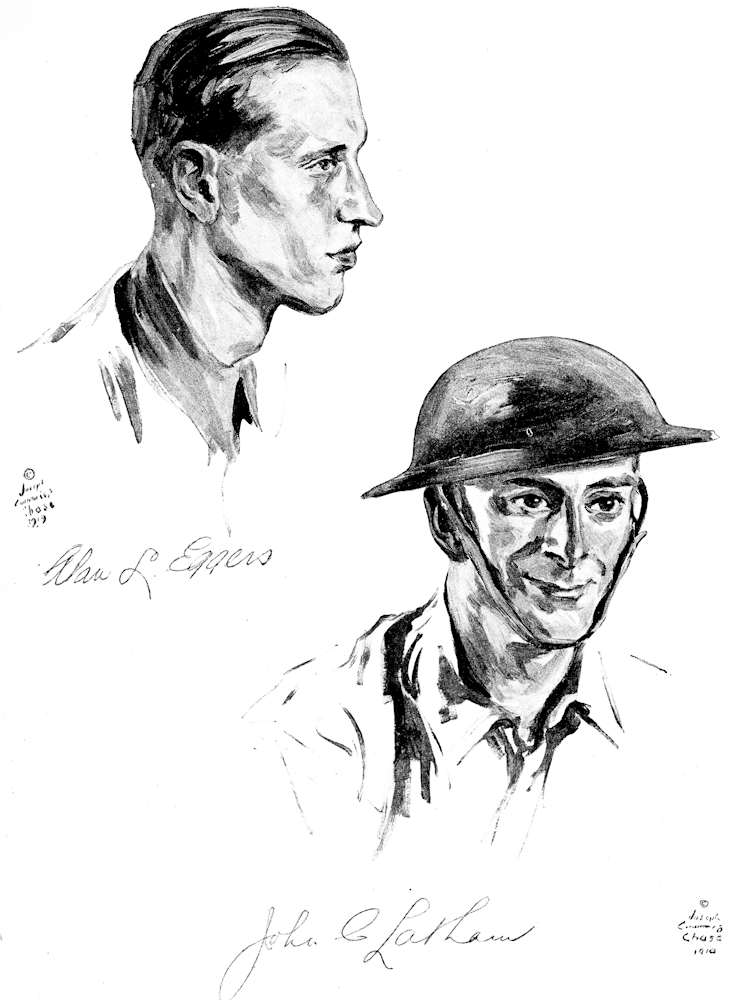
Drawn by Joseph Cummings Chase.
Sergeants Eggers and Latham
27th Division, 107th Infantry, Machine-Gun Company
In action against the enemy near La Catelet, France, on September 29, 1918, Eggers and Latham separated from their platoon in a smoke barrage, and took shelter in a shell-hole within the enemy’s line where an American tank was disabled with three men inside; it was in a heavy fire from enemy guns; but the two sergeants rescued the men in the tank, one, an officer, was wounded, and conveyed them all to a nearby trench—returned to the abandoned tank which was in a violent rain of artillery fire—dismounted the Hotchkiss gun and returned with it to the trench, where the wounded men were and there effectively protected themselves from the enemy until night time, when they were able to take the wounded officer and tank crew to their own trenches.
“On November 4, 1918, the Division was relieved by a French division and hiked thirty kilometers to Thielt, the largest town they had been in since leaving Montgomery, Ala. Here they brushed away the dirt and dust, waxed and grew fat until November 9. On that date the Division advanced again past Deynze to Synghem. With peace rumors flashing through the air, on the morning of November 10, the 37th Division went over the top again, crossing the Escaut River north of their first sector, and drove the Prussian Guards before them. It was here that news of the armistice arrived on the morning of November 11. Orders had been received to suspend hostilities at eleven o’clock. At ten o’clock the men were prepared to follow another barrage.
“Squatting in ‘funk’ holes, the men carelessly rolled cigarettes and waited for the hour to tick around. The announcement was made. ‘Hostilities had ceased.’ Calmly, confidently they clambered to the ground. Across the fields the Germans were moving away. There was no exchange of shots. Another cigarette. The war was over.”