A CHALLENGE DUEL
Reading edition
The Guns of Both Armies Suspend Fire as Captains Ball and Immelman Fight in Air
It was often said in the early months of the war that the air combats revived the spirit of ancient chivalry. It was true for a time, but German treachery and ruthlessness soon changed the character of the upper warfare. When the raider and the dastard entered, gallantry necessarily gave way to grim and merciless antagonism.
There were many, though, on both sides who felt that no glory came to aviation from methods of frightfulness and reprisals for such frightfulness and to the last there were instances of clean, brave fights. One of the last duels on the knightly lines of conduct was that in which Captain Immelman, “The Falcon” of the German army, met Captain Ball, one of the most brilliant airmen of the British Royal Flying Corps. Immelman had a record of some fifty-one British airplanes downed. Captain Ball wanted to wipe out this record, and the daring German at the same time; so one day he flew over the German lines and dropped the following note:
“Captain Immelman:
I challenge you to a man-to-man fight to take place this afternoon at two o’clock. I will meet you over the German lines. Have your anti-aircraft guns withhold their fire, while we decide which is the better man. The British guns will be silent.
“Ball.”
Ball was by that time quite renowned. The Germans were aware of his official record. He had taken part in twenty-six combats, had destroyed eleven hostile machines, driven two out of control, and forced several others to land.
In these combats Captain Ball had gone up alone. On one occasion he had fought six hostile machines, twice he had fought five machines, and once four. When leading two other British aeroplanes he had attacked an enemy formation of eight. On each of these occasions he had brought down at least one enemy.
The Germans knew all that, but evidently Ball had picked an opponent worthy of him not only in skill but in courage and chivalry, for that day the answer to the note was dropped from a German machine:
“Captain Ball:
Your challenge is accepted. The guns will not interfere. I will meet you promptly at two.
“Immelman.”
CHEERS FROM OPPOSING TRENCHES
Far and wide along the trenches the word was spread. Firing stopped as though a flag of truce had been hoisted. Germans and English left covers and sought positions of vantage from which to watch the battle royal. At the appointed time both flyers rose promptly and made their way over “No Man’s Land.”
“Cheering arose,” relates an eye-witness.
“There were wild cheers for Ball. The Germans yelled just as vigorously for Immelman.
“The cheers from the trenches continued; the Germans’ increased in volume; ours changed into cries of alarm.”
Immelman was known to have a method of attack peculiar to himself. Instead of approaching his adversary from the side, he maneuvered to get squarely behind him. His study was to hold the nose of his machine almost on the tail of the aircraft he was pursuing. This gave him, Abbot points out, what used to be called in the Navy a raking position, for his shots would rake the whole body of the enemy airplane from tail to nose with a fair chance of hitting either the fuel tank, the engine, or the pilot. Failing to secure the position he coveted, this daring German would surrender it with apparent unconcern to the enemy, who usually fell into a trap. For just as the foeman’s machine came up to the tail of Immelman’s craft the latter would suddenly turn his nose straight to earth, drop like a stone, execute a backward loop and come up behind his surprised adversary, who thus found the tables suddenly turned....”
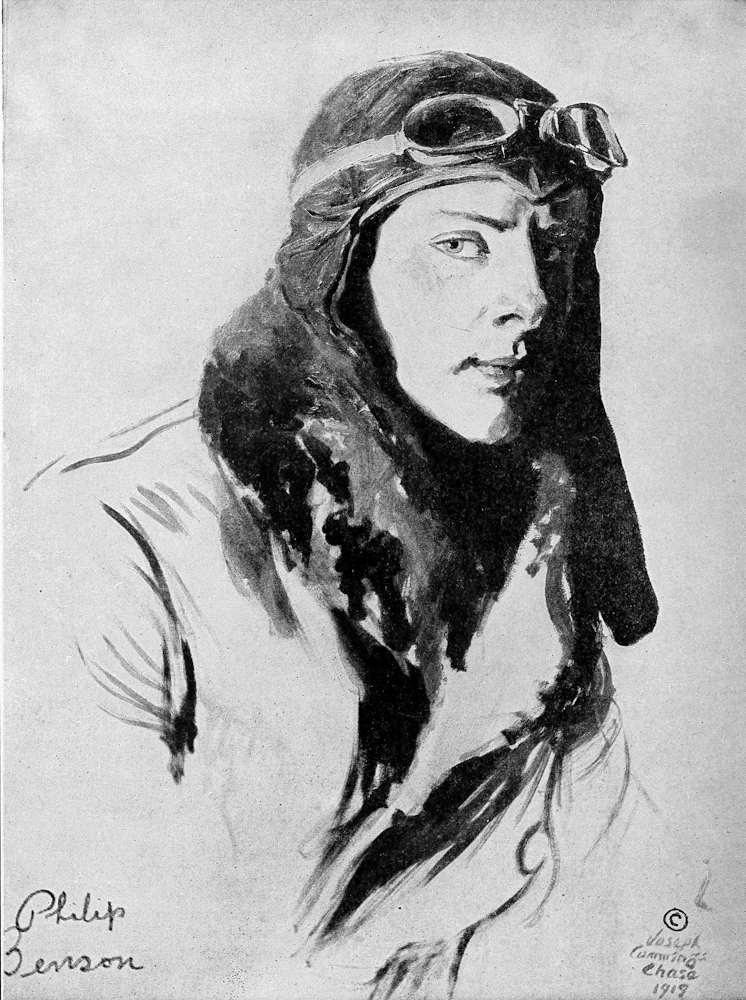
Drawn by Joseph Cummings Chase.
1st Lieut. Philip Benson
Volunteered for night bombing and was particularly efficient in “chassi” work. He gave the Germans a taste of their own medicine—by dropping bombs on German towns and firing upon German supply trains.
We have left the description of the duel with the English in alarm.
“Ball,” continues the eye-witness, “thousands of feet above us and only a speck in the sky, was doing the craziest things imaginable. He was below Immelman and was apparently making no effort to get above him and thus gaining the advantage of position. Rather he was swinging around, this way and that, attempting, it seemed, to postpone the inevitable.
“We saw the German’s machine dip over preparatory to starting the nose-dive.
“‘He’s gone now,’ sobbed a young soldier at my side, for he knew Immelman’s gun would start its raking fire once it was being driven straight down.
“Then in a fraction of a second the tables were turned. Before Immelman’s plane could get into firing position, Ball drove his machine into a loop, getting above his adversary and cutting loose with his gun and smashing Immelman by a hail of bullets as he swept by.
A WREATH FOR HIS VICTIM
“Immelman’s airplane burst into flames and dropped. Ball from above followed for a few hundred feet and then straightened out and raced for home. He settled down, rose again, hurried back, and released a huge wreath of flowers, almost directly over the spot where Immelman’s charred body was being lifted from a tangled mass of metal.
“Four days later Ball too was killed.”
Shortly before his death Ball wrote to a friend: “You will be pleased to hear that I have ten more Huns, and that my total is now 40—two in front of my French rival. Oh, I’m having a topping time! To-day or to-morrow I’m being presented to Sir Douglas Haig. Am very pleased. I just want to get a few more if I can.”
Ball’s wish was gratified. He got more than a few more and then—died as he had so often lived—fighting against great odds, for when last seen, on the evening of May 7, 1917, he was high above the enemy’s lines engaging three German machines at once.
What slender hope had been left for him was shattered by the War Office intimation that Ball had been killed. The brave young officer lost his life at a village 5½ miles east of La Bassée.