“DOC OF THE FIFTH”
Reading edition
The Conversion of the Rev. J. H. Clifford, “Y” Worker, into A Hero Among Marines
Not every one understands that a soldier of the Lord has in him the material out of which to make a very effective soldier where shot and shell play havoc. The young men of the Army, Navy and Marines who went over to France to offer their lives in defense of their country’s ideals, discovered, in the experiences of the trenches, a something that rather cheapened in their estimation the forms and didactic solemnity of conventional religion. They had learned a more intimate thing, and it is the testimony of many clergymen that the “boys” found words only too cheap where works were in order. They had no hankering for sermons. They had caught an intimate understanding from the Unknown. They did not want to be preached to.
Therein lies the secret of the affectionate familiar devotion of the men of the regiment to “Doc of the Fifth.” It is a story that has been told widely in the press, and has been requoted in numerous periodicals, but it is a delightful instance of what may be called the quiet heroisms of life.
The Rev. John H. Clifford, minister of the Baptist Church in Tucson, Arizona, felt the urge to service on the other side when the United States began sending its boys to the fighting front. He promptly tendered himself as a “Y” worker, was accepted and sent abroad. His assignment carried him to the 5th Regiment of Illinois in the Vosges. He went prepared to do his duties as a minister of the Gospel and a servant of man.
He wore the blouse and tunic of the chaplain, insignia that indicated to some of the “Boys” that superior altitude of moral pretension and holier-than-thouness they were unwilling to acknowledge too cordially. So when he tried to begin his work with the men of the 5th, he was greeted by the declaration, “We don’t want any damned parsons around here,” and for two weeks they held aloof, ignoring the efforts to establish religious services.
But the Rev. John H. Clifford wasn’t a clergyman merely, he was a man—and he understood men. And this valuable asset incited a course of action destined to win the confidence and affection of those under his care. Instead, therefore, of standing on dignity and attempting to command the respect supposedly “due to the cloth,” he went to the men. He joined them in their hikes. He entered into their interests. He was ever ready to do his share and bear the equal hardships with them. They began to warm toward him, and finally, as one of the Marines put it, he was “adopted as a Leatherneck,” and he became to them “Doc”—“Doc of the Fifth.”
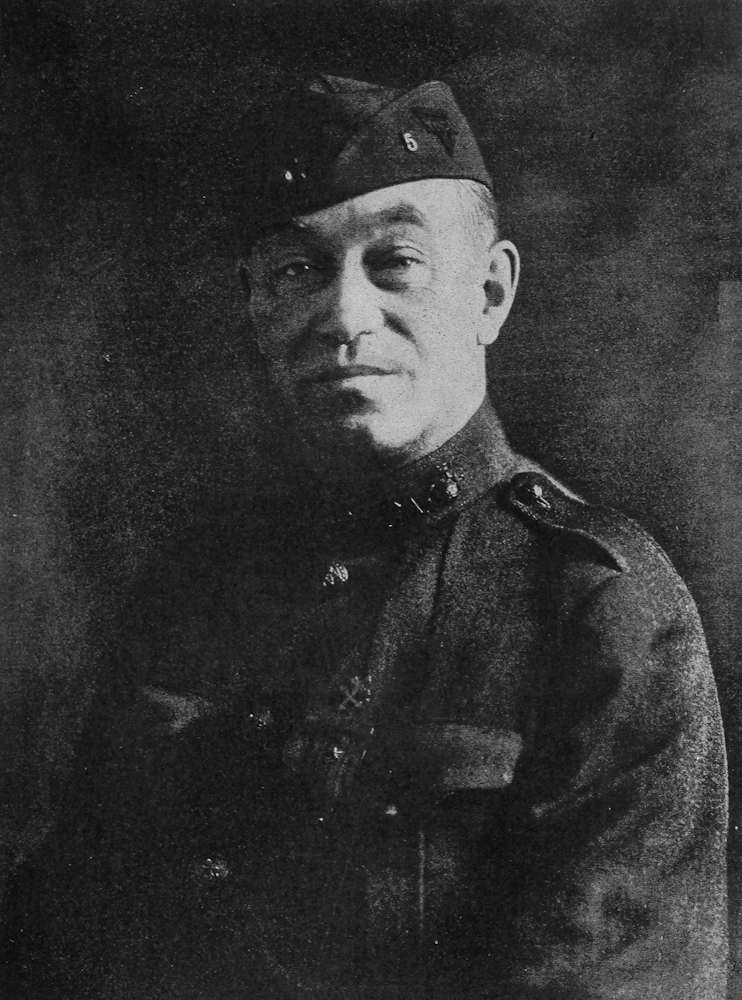
Rev. J. H. Clifford of the Fifth Marines
Entering the service as a “Y” worker, Rev. Clifford later became attached to the Fifth Marines and remained with that organization throughout its fighting. The men became so fond of him that they named him “Doc of the Fifth” and attached the Globe, Anchor and Eagle to his collar.
SO THEY MADE HIM A MARINE
Then one night the boys of the 45th Company sat reasoning together and came to the flattering conclusion that “Doc” was still a trifling distance from them in the matter of regimental distinction, and needs must be brought into more intimate harmony with them. The Marine’s Magazine tells us that they secretly removed his blouse and tunic and had the company tailor sew on Marine buttons and attach the Globe, Anchor and Eagle to his collar. When “Doc” appeared at chow with his new decorations the officers were aghast, but later General (then Colonel) Doyen authorized him to wear them and there they have remained.
“I am prouder to wear the Globe, Anchor and Eagle than I am to wear the Croix de Guerre which was given me after I had the opportunity of helping General Catlin when he was wounded,” said Dr. Clifford. “Any one of the boys would have done anything he could for the general in similar circumstances, but not everyone is awarded an emblem by the Marines themselves. A token of affection from such men as those is the greatest honor.”
IN THE THICK OF IT AT BELLEAU WOOD
He was with the 5th Regiment through that fame-winning Belleau Wood battle, and has endless stories to tell of experiences in that terrible fight, some of them amusing as an afterthought, though they were not so regarded at the time. For example, the experience when he and a stretcher bearer were crawling through the grass toward the trench where General Catlin lay seriously wounded. Shells were dropping and machine-gun bullets were slashing all about.
“Keep closer down, Doc,” was the constant admonition of the stretcher bearer, “closer down.”
“The lad didn’t realize, I guess,” Doc says, “that I was perfectly willing to get closer to the earth but my stomach prevented my doing so.”
He says of the awful days in Belleau Wood, where his life was repeatedly in danger:
“It was glorious to be with the boys there, as they saved Paris and made history. Out of the 1,600 men in the 3rd Battalion, there were only 200 left after ten days in Belleau Wood. Many a time the rosary I carried was covered with blood as one of those brave boys grasped it for the last time.” (Creed made no difference at a time like that.)
“I could relate instances of individual heroism for hours at a time. I lay by the side of Top Sergeant Grant of the 20th Company while he picked off nine Germans consecutively at 400 yards; that’s Marine Corps marksmanship for you.
“‘Anything I can do for you, boy?’ I asked him.
“‘No, Doc,’ he said, ‘but you might pray while I aim.’
“‘I’ve been doing that,’ I told him, ‘every time you squeeze the trigger.’ Later I saw him blown to pieces by a shell.
“Then there was the chap named Young who saw Major Berry wounded and threw himself in front of him as a shield from the bullets that were flying like hail. Later, when I spoke to him about his act, he merely said, ‘I’ve done nothing.’ A few days afterward when he had volunteered to perform a dangerous mission in the town of Lucy and was doing what he would probably have called ‘nothing,’ he, too, was killed by a bit of shell.
“One of the boys saved me when I was stunned by shrapnel and in my stupor started to walk toward the German line. He saw where I was headed and got Doc out of that pretty quick. Then I was paralyzed by another piece of shrapnel and was taken to a Paris hospital. But I was lucky. I was out again in five weeks and got back at the front just in time to be with my boys when the great drive opened on July 18 at Soissons.”
During that intense fighting he was again at the side of the men of the 5th to lend a hand whenever possible. One wounded Marine asked him for a smoke, which was forthcoming, but the lad was unable to take it, his hands were both shot.
“Light it for me, will you, Doc?” he said, and Doc did, although he hadn’t had any practice for more than thirty years.
Another story he tells is of a runner who, before one of the battles, asked him to lead a prayer meeting. Although somewhat astonished by the request, Doc complied and the meeting was duly held in a dugout. Later an officer was questioning the runner concerning his whereabouts.
“I was in the dugout at a prayer meeting,” said the boy.
“A prayer meeting?” demanded the officer.
“Yes, sir,” persisted the lad, “and it was a damned good prayer meeting.”
Besides the Croix de Guerre, Dr. Clifford proudly wears the blue Cross of Lorraine, given him by an officer in that province.