ALOIS THE SILENT
Reading edition
He Planned to End the War by Slaying Its Instigator and Failing—Died
One of the hero-martyrs of Belgium was Alois Van Keirsbilk, a well-to-do citizen of Thielt, beloved of his townspeople, a man of family, and a zealous patriot. He did what he might to serve, and many, they say in Thielt, were the services rendered. But there came a day when the rumor went round that the German Kaiser and his entourage were to visit Thielt, and Van Keirsbilk suddenly conceived a great project for the salvation of Belgium, for the liberation of the world from the nightmare of war. Egbert Hans tells the story of Alois Van Keirsbilk and it was first published in its completeness in the New York Times of Sunday, June 22, 1919. But a little abbreviated, it is here reproduced as Hans told it:
“Thielt was the headquarters of the Fourth German Army and sheltered the Commander-in-Chief with a staff of hundreds of officers. Alois Van Keirsbilk was chief conductor on the railway between Thielt and Bruges. Also he was the chief of a secret organization which had only one object—‘help to our boys and death to the enemy.’ The organization was in communication with the Belgian army through spies who made regular trips into Holland across the ‘cable of death,’ and many a German plan originated at headquarters in Thielt failed, thanks to the activity of Alois and his men.
“It was not long before Alois saw his chance for a big stroke. The Kaiser was coming to Thielt on the first of November. A desperate attack was to be made against the Belgian forces along the Yser and from there on against Ypres and Dunkirk, and Wilhelm II in person was to inspect the preparations.
“Kill the Kaiser and the war will be over, was the firm conviction of Alois and his friends, and they set to work. Alois acquired all the information that his organization could procure as to the movements and schedule of the imperial visitor, and sent all the details to his agents in the Belgian army, with the request that airmen be sent at the opportune moment ‘to kill the Kaiser!’
“Only one of the three messengers who were sent out reached the other side of the electric cable, for at that time the guards were doubled. But one was sufficient, and when the first of November came Alois felt confident that something would happen.
“THE BEST LAID PLANS”
“The big dinner at which the Kaiser and his staff were to gather around the table, and for which all the best silver in town had been requisitioned, was to begin at 2 o’clock. At that moment anxious eyes watched the sky toward the west. Would they come, the airmen with their bombs to do the deed that would finish the war? Would they be in time?
“At 2.15 there was a speck in the blue sky. It grew bigger and bigger, and bigger, and soon the watchers distinguished three flying machines. In haste Alois communicated with his friends. Barely had those who were warned taken shelter when the first explosion was heard. Then for a few minutes the town of Thielt shuddered as bomb after bomb exploded.
“It was a well-managed raid and the daring airmen escaped in safety, but it was all in vain. There had been a sudden change in the Kaiser’s schedule and the war lord had left Thielt at 2 o’clock sharp. During the bombardment his motor cars were speeding along the road to Bruges and his life was safe.
“But the commander of the Fourth German Army raged in his private office at the kommandatur. The secret of the visit had plainly got out. The Kaiser, the idol of 70,000,000 Germans, had barely escaped death. The guilty had to be found and punished.
“A contra-spy system was organized at once and large sums were promised for any bit of information. Slowly but surely Alois was drawn into the net woven by a most minute and complete investigation. On Feb. 2 he was summoned to the kommandatur and taken prisoner. Already three of his coöperators were there.
“It was then that Alois Van Keirsbilk showed the courage which won for him the name of ‘the Silent Hero.’ He knew that one word spoken lightly might betray the whole of his organization, and his last word to his friends who were still free had been, ‘Do not let my absence or death scare you; but keep up the work that we have been doing.’ After his arrest nothing could induce him to speak even a word. All devices, old and new, were tried by the kommandatur—tortures as well as promises, the menaces of a cruel death, and the promise of life in luxury. It was all in vain. Perhaps Alois thought of the many lives he had in his hands. Anyway, he remained silent.
“He was condemned to death on Feb. 25, and then the Germans created and applied as devilish a scheme of mental torture for a human being as could be devised. Alois had two children, and a third was to be born soon.
“‘On the day that new life enters your home your life will end unless you speak,’ said the German inquisitor. Undoubtedly Alois thought of his wife, who would be calling for him that day more than ever. Perhaps he thought of the new baby also. Nevertheless he was still true to his name, ‘the Silent.’
“On the 5th of April a little girl was born in the Van Keirsbilk home. It might seem unbelievable, but evidently the Germans had waited for the event. On the same day they sent official word to ‘Madame Van Keirsbilk’ that if she desired to see her husband still alive, she could see him that day at 3 o’clock in the prison at Ghent. A merciful neighbor nurse saw to it that the message did not reach the mother, then nursing her day-old baby. Instead the eldest girl, 10 years old, was sent to the prison to see her father. Full of joy, in her happy ignorance, she exclaimed:
“‘Oh, father, you must come home with me. We have a little sister, and mother wants to show it to you. Come, father!’
“But father could not come. He pressed his little girl in his arms. He could not tell her she would never see him again, for he wanted to spare the mother, who had to live for the children. Not a word did he say. One kiss, and the big prison gate closed after the child, while her father prepared himself to die.
FACED DEATH A HERO
“His end came next morning at half-past five in the cour of the prison. Four Belgians were to fall that day. When Van Keirsbilk arrived at the place of execution three were already lying dead against the wall. For some unknown reason he went to the muzzles of twelve German rifles alone.
“He refused to be blindfolded. ‘Let not a German hand touch me in this solemn moment when I die for my country. I have no fear of your bullets,’ the Belgians heard that he said, and erect he waited for the moment when his agony would come to an end. A few seconds later his body, with those of his comrades in death, was thrown into the ditch.
“In the afternoon of the same day a German soldier knocked at the door of the ‘Widow Van Keirsbilk’ and delivered a parcel to the devoted neighbor who was caring for the new baby and its mother. The woman opened it, and with horror found that it contained the suit of clothes of the unhappy master of the house. That was the German announcement of his death.
“Loving friends managed to keep the news from the widow for several days, although the continual absence of her husband plainly made her fear. But one morning she was looking through the window into the street, when the church bells began to ring for a funeral service. The people attending looked up at her and nodded with sympathy. None told her, but perhaps the unhappy woman read the pity that was in the eyes of the passers-by. Nobody knows, but suddenly a terrible look of suspicion came into her eyes. She rushed downstairs, where the neighbor nurse was preparing the meal for the children, and, seizing her by the arms, cried out:
“‘Who is dead? For whom are the bells ringing? Is it for Alois? Tell me, or I will run out into the street and find out. I must know where Alois is. I must know it if he is dead.’ Then and there the sad news had to be broken, and the widow of Alois began a time of lonely misery only broken by the struggle to keep her three children fed and clothed.”
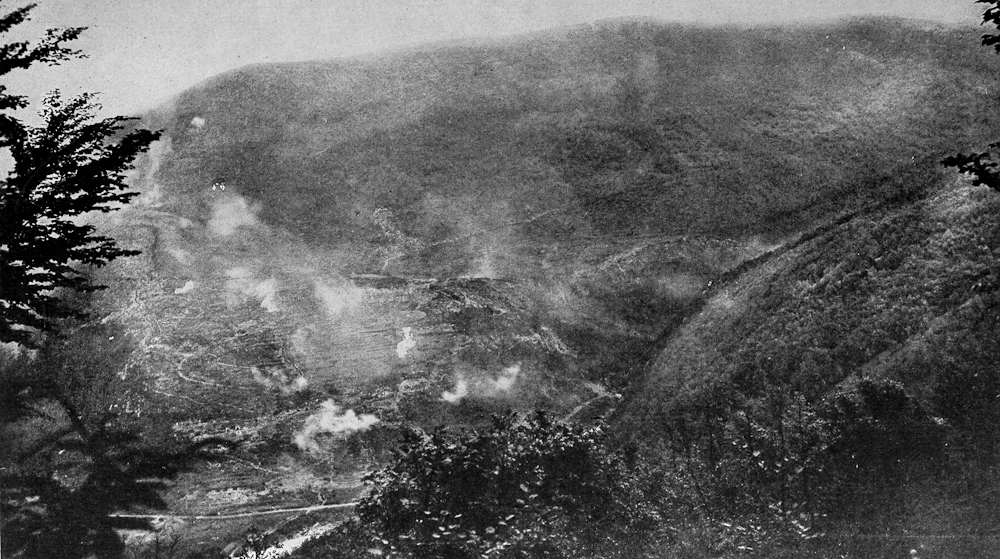
Courtesy of Red Cross Magazine.
A Long-Range Bombardment
Italian artillery bombarding Austrian trenches on a distant mountain-side, preparatory to a general attack.
Egbert Hans concludes his story of Alois the Silent:
“To-day the Belgian flag flows again from the tower of Thielt and the thrifty people of Flanders are busy rebuilding their homes. Many of the men are missing; some died on the battlefield, others in prison, but all died fighting for the small strip of land they called their own, and those who remain cherish the memory of their heroes. They will tell their stories to their children and grandchildren, thus adding another page to the glorious history of Flanders, and among those stories will be that of Alois Van Keirsbilk, who tried to end the war by ending its instigator, and who failed and died, silent.”