AN AMERICAN WONDER
Reading edition
The Brief but Greatly Achieving Career of Lieut. Frank Luke, Jr.—His Mysterious End
Innumerable are the instances, never to be reckoned, of the sudden meteoric flame of splendid daring—the sudden flash of the courageous soul in achievement, and the equally sudden extinction—that a thousand attested circumstances assure us characterized the terrible passing of the Great War. Happily for the world, always the better for new evidence that “divinity still lives in the hearts of men,” very many of those deeds of devoted heroism have been written into history for the inspiration of high-minded youth.
There was no experience more aptly described as meteoric than that of Frank Luke, Jr., who joined the 27th Aero Squadron near Château-Thierry late in July, 1918, did brilliant service in that connection, and before the end of September had utterly disappeared from the knowledge of men—one of the missing never definitely accounted for.
Frank was a Phoenix, Arizona, boy, barely twenty when he entered the service. After a period of training in Texas he was sent to France and had further training at Issoudun and was then sent to join the squadron near Château-Thierry. He was an enthusiast for flying, never getting enough of it. It was like second nature to him, and he adhered to no rules but his own, apparently indifferent to safety regulations when in the air, and so impatient of restrictions that he almost invariably got lost from his flight when it went out in formation. This gave rise among his fellows to the belief that he was afraid to follow, his getting lost being the deliberate result of “funk.” In course of time, however, they came to understand that Frank Luke held no acquaintance with fear. He simply had a method—method and initiative—and put his abilities to their most effective use. It was so good a method, so wisely reasoned and so admirably executed that in the space of seventeen days he shot down eighteen enemy balloons and planes.
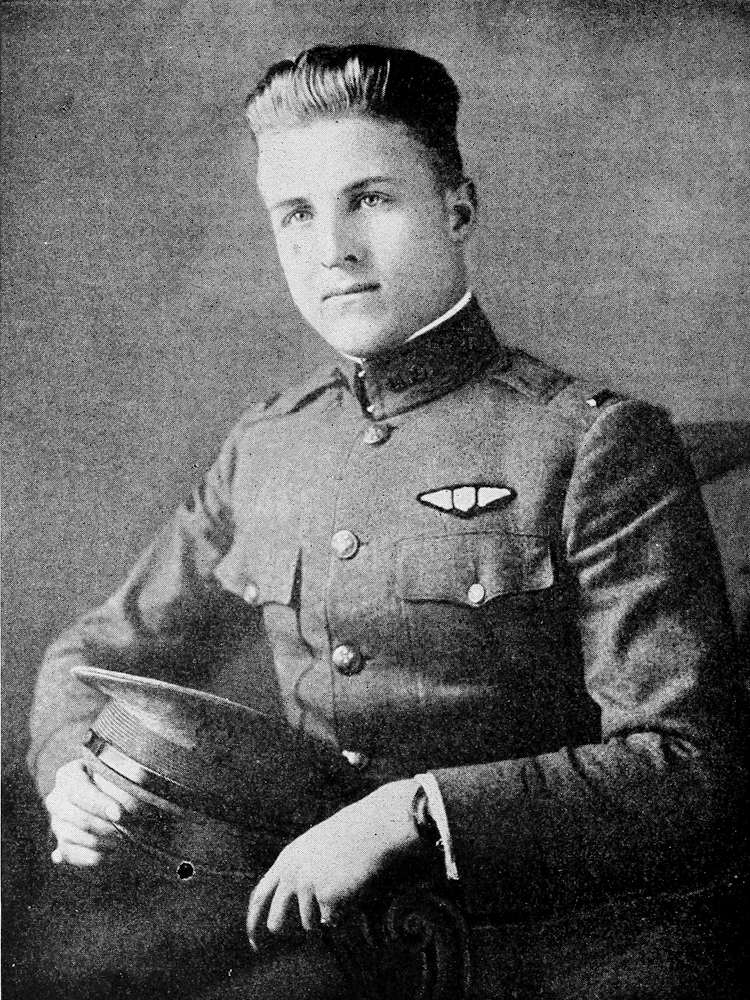
Lieutenant Frank Luke
He joined an Aero Squadron near Château-Thierry, late in July, 1918, and before the end of September he disappeared without being heard from again.
Lieut. Col. Harold E. Hartney, Chief of Gunnery in the Air Service, at that time Commander of the Squadron to which Luke belonged, gave an account of the young aviator’s first exploit. August 6, 1918, the First Pursuit Group, which included the 27th Squadron, was operating on the Château-Thierry sector. The work was seriously interfered with by heavy barrages of pursuit planes maintained by the enemy to prevent Allied reconnaissance over the territory being evacuated. Col. Hartney says:
HIS FIRST EXPLOIT
“Lieut. Luke believed that if he could get across the opposing lines unobserved and far enough, he would be able to take the enemy formations unaware and swoop down upon the unsuspecting rear man, shoot him down and get away in safety. Accordingly one day he went off on his own at great altitude and crossed over into enemy territory. Far below him he spied an enemy formation of six machines dropping down to land on their own aerodrome. Perfectly aware of the odds against him, he swooped from 15,000 feet to 3,000 feet in one long dive, speeding at approximately 200 miles an hour, closed in on the rear man, and from a distance of no more than twenty yards sent him crashing down.
“The enemy formation had been taken completely by surprise. Before they could realize what had happened or engage Luke in combat the latter dropped to an elevation of less than 400 feet, and, zigzagging, made his way home, dodging anti-aircraft fire and machine-gun nests until he crossed the lines. By then he was completely out of gasoline and was compelled to make a forced landing near the front line. He had seen the enemy machine crash to earth, but was unable to give the location, and therefore he could not get from eye-witnesses on the ground the confirmation required to make the victory official.”
That feat indicated the man. It was very soon apparent that on the occasions when he was “lost” he was off on adventures of his own, planning actions and studying the means to execute them,—qualifying himself for what he conceived to be his most valuable and effective service. He was a veritable hunter.
The morning set for the opening of the St. Mihiel offensive, Sept. 12, 1918, the clouds hung low and the weather was such that ordinarily it would have been regarded as altogether unfit for flying. But Luke was not to be deterred by it. He was off at dawn in quest of enemy planes or balloons and after many vain explorations he finally discovered a German balloon at the extreme right of the American sector, but operated against a portion of the line allotted to other flyers. He returned to his aerodrome, and on reporting the balloon learned that it had been doing great damage by an enfilading fire, but that it had been attacked repeatedly without success both by American and French aviators. Luke offered to destroy the balloon and set off with Lieut. Fritz Wehner, his flying partner. The statement of eye-witnesses from the ground was that Luke dived suddenly out of the clouds taking the balloon wholly by surprise, but the balloon-gun which he was handling for the first time jammed when he attempted to discharge it. He rose into the clouds, got the gun free, immediately dived again and fired the heavy incendiary bullet that sent the balloon down in flames.
DOWNED THREE BALLOONS IN ONE DAY
Two days later he sent another balloon flaming down in somewhat more exciting circumstances. While he was speeding with an escort of other pilots, to attack three enemy balloons operating at an unusually low altitude, his escort became engaged with a formation of Fokkers. This would have made it seem to many pilots unwise to proceed with the attack; but Luke took advantage of the fight above to dive down and begin the assault on one of the balloons which, after several attempts, he succeeded in shooting down, though machine bullets and anti-aircraft shells and flaming onions were showered about him. As the balloon fell burning, Luke flew down to close range and turned loose his machine gun on the Huns on the ground with the desired result of many casualties. When he got back home he found that his machine was so full of bullet holes that a very few more taps would have weakened it enough to bring it down in collapse. But within five minutes he was in another machine and begging leave to go on a further quest.
At 5 o’clock that afternoon he sent down the second balloon in flames. Later he discovered attempts being made to send up another balloon north of Verdun; he hastened back to his squadron and asked to be ordered out at dusk to surprise and destroy the big bag.
He left with instructions not to descend on the balloon until 7.50 (that being for the benefit of his protective escort who would follow him down a few moments later). Precisely at 7.50 the watchers on the aerodrome saw the balloon flare in the darkness and fall to the ground.
And so the story runs; each new adventure a companion thriller to the others, every machine in which he flew being more or less riddled with bullets, and the miracle is that the daring youth passed so many hazards unscathed. Col. Hartney is authority for the statement that balloon strafing is in reality “the most dangerous exploit any man in any branch of the service can undertake.”
Frank Luke in seventeen days accounted for eighteen enemy balloons and planes. He was the first American flyer to win the Congressional Medal of Honor.
HIS END A MYSTERY
But there is an end to successful adventures as to other things, and the brilliant career of this Arizona lad came to abrupt conclusion, leaving the shadow of mystery as to just how the hero passed on. Here is the story of the last exploit as Col. Hartley tells it:
“His next official victory was on Sept. 28, when he shot down a German Hanoveraner airplane which was being escorted by a single-seater Fokker.
“That evening he did not return to his own aerodrome, but remained all night with the French squadron and went out the next day for the express purpose of destroying three balloons. The wonderful story of his exciting fight against hopeless odds and of his glorious death need not be dwelt upon. For his work on Sept. 29 he was awarded the Medal of Honor.
“Briefly, what happened was that he flew over an American aerodrome and dropped a weighted message. The message asked that a lookout be kept for three drachens over on the German side. He was next seen to go over in that direction at a very high altitude, and when very nearly over the drachens was attacked by ten enemy machines. He engaged all of them single-handed and crashed two of the ten. Then he dropped—out of control, as it seemed, but most likely only pretending to be so. When he reached the level of the balloons he shot them down one after another in flames—all three of them. The anti-aircraft guns were very busy about the second balloon. After that he disappeared.”
Beyond this all that is known is more or less speculative. Jan. 3, 1919, the Graves Registration officer of Neufchateau reported to the Chief of the A. E. F. Air Service on the subject of the grave of an unknown American aviator, killed Sept. 29, 1918, in the village of Murvaux (Meuse), and asked for possible information to identify the body. “Reported as having light hair, young, of medium height and rugged physique. Reported by the inhabitants that previous to being killed this man brought down three German balloons, two German planes and dropped hand bombs, killed eleven German soldiers and wounded a number of others. He was wounded himself in the shoulder and evidently had to make a forced landing, and upon landing opened fire with his automatic and fought until he was killed. It is also reported that the Germans took his shoes, leggings and money, leaving his grave unmarked.”
Supporting the report is an affidavit (Jan. 15, 1919) signed by twelve inhabitants of the village that gives the foregoing facts in detail and adds this:
“Certify equally to have seen the German Commandant of the village refuse to have straw placed on the cart carrying the dead aviator to the village cemetery. This same officer drove away some women bringing a sheet to serve as a shroud for the hero, and said, kicking the body, ‘Get that out of my way as quick as possible.’”
Two of the villagers placed the body on the cart.