SPYING AT ITS WORST
Reading edition
The German Secret Service System the Scrap Basket of Official Honor
Though the knowledge of an enemy’s plans, purposes and preparatory measures is of the highest importance in military campaigning, and though the utmost of courage and daring are often necessary to obtain the required information, the office of the spy has, from time immemorial, been contemned of men. There was but one fate for the captured spy under military rule. Even when the bravery and devotion of the adventuring spy have been admitted to admiration there has remained the instinctive aversion to the office. The reason for the almost universal mental attitude is that spying usually, if not invariably, involves treachery, the betrayal of trust and confidence gained by professions of friendship and sympathetic opinion. The word “spies” stirs the spleen of wholesome minded persons. It implies craft, duplicity, perversity. Few men have been willing to confess themselves spies. However greedily the sensational or adventure-loving reader may follow the narrative of the experiences, the desperate chances, the hazards, the daring risks, the narrow escapes of the successful spy, there is nevertheless a regretful wish that the valor, the intelligence, had found a nobler medium of expression.
But because there is such a thing as fearless, generous self-sacrifice in the performance of undertakings or obligations that come under the general classification of spying, it is perhaps unfortunate that no attempt has been made to discriminate what may be termed honorable (in a military sense) espionage from ignoble spying. Surely there is a vast distinction between the soldier who volunteers to penetrate an enemy’s lines to ascertain particular facts and the person who under the protection of social or official privilege wins trust only to betray it. In the second class there probably is no more despicable violation of moral responsibility recorded in the history of nations than the German intrigue against the United States when this country was still at peace with Germany. The indictment is clearly drawn in a few words in the Flag Day address of President Wilson, June 14, 1917. He said speaking of the German Government:
“They filled our unsuspecting communities with vicious spies and conspirators and sought to corrupt the opinion of our people in their own behalf. When they found they could not do that, their agents diligently spread sedition amongst us and sought to draw our own citizens from their allegiance—and some of these agents were men connected with the official embassy of the German Government itself here in our own capital.”
ITS DIPLOMATIC AIDS
Their Ambassador, Count Johann von Bernstorff; their military attaché, Capt. Franz von Papen; their naval attaché, Capt. Karl Boy-Ed; their financial agent, Dr. Heinrich Albert, were the diplomatic and social spies who engineered and supplied with necessary information the vicious under-agents of the spy system of which sedition and violence were the shameful instruments.
With patient diligence, John Price Jones, a newspaper man, attached to the New York Sun, collected—from documentary evidence, from Secret Service officials and by means of his own investigation over a period of eighteen months—a vast amount of valuable and exact information, the vital part of which Small, Maynard and Company subsequently published in book form, under the title The German Secret Service in America. The information in that book, substantiated by governmental and other evidence, is authoritative, and we are indebted to it for much of the matter in this article.
Of the organization of the spy system he says:
“Count von Bernstorff, once his nation had declared war upon France and England, went to war with the United States. As ambassador, diplomatic courtesy gave him a scope of observation limited only by the dignity of his position. A seat in a special gallery in the Senate and House of Representatives was always ready for his occupancy; he could virtually command the attention of the White House; and senators, congressmen and office-holders from German-American districts respected him. Messengers kept him in constant touch with the line-up of Congress on important issues, and two hours later that line-up was known in the Foreign Office in Berlin. As head and front of the German spy system in America, he held cautiously aloof from all but the most instrumental acquaintances: men and women of prominent political and social influence who he knew were inclined, for good and sufficient reasons, to help him. One woman, whose bills he paid at a Fifth Avenue gown house, was the wife of a prominent broker and another woman of confessedly German affiliations who served him lived within a stone’s throw of the Metropolitan Museum and its nearby phalanx of gilded dwellings (her husband’s office was in a building at 11 Broadway, of which more anon); a third, woman intimate lived in a comfortable apartment near Fifth Avenue—an apartment selected for her, though she was unaware of it, by secret agents of the United States.
BAIT FOR INGÉNUES
“During the early days of the war the promise of social sponsorship which any embassy in Washington could extend proved bait for a number of ingénues of various ages, with ambition and mischief in their minds, and the gracious Ambassador played them smoothly and dexterously. Mostly they were not German women, for the German women of America were not so likely to be useful socially, nor as a type so astute as to qualify them for von Bernstorff’s delicate work. To those women whom he chose to see he was courteous, and superficially frank almost to the point of naïveté. The pressure of negotiation between Washington and Berlin became more and more exacting as the war progressed, yet he found time to command a campaign whose success would have resulted in disaster to the United States. That he was not blamed for the failure of that campaign when he returned to Germany in April, 1917, is evidenced by his prompt appointment to the court of Turkey, a difficult and important post, and in the case of Michaelis, a stepping-stone to the highest post in the Foreign Office.
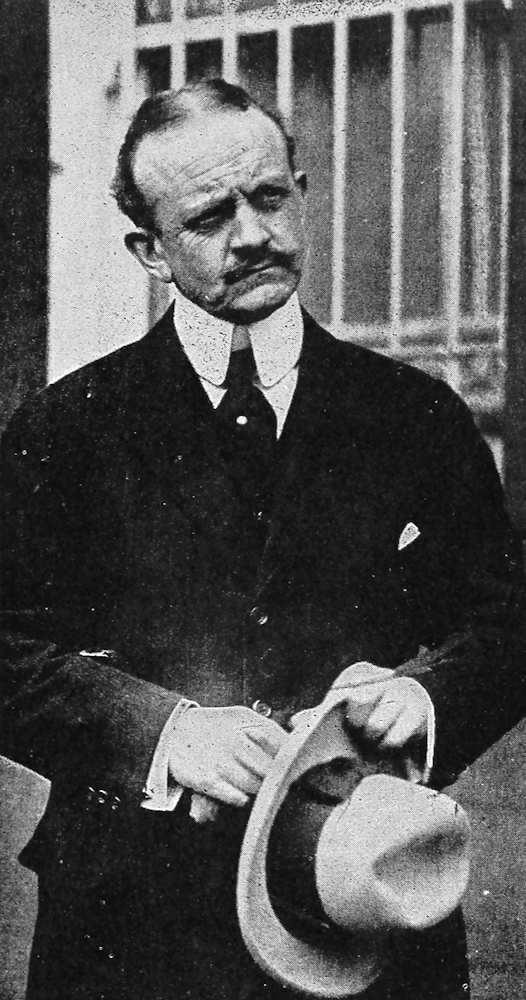
© Underwood and Underwood.
Count Johann von Bernstorff.
German ambassador to the United States at the time the Lusitania was torpedoed. One of his many acts of duplicity was the sending of a secret message to Germany asking for funds to be used to influence members of the United States Congress.
“Upon the shoulders of Dr. Heinrich Albert, privy counselor and fiscal agent of the German Empire, fell the practical execution of German propaganda throughout America. He was the American agent of a government which has done more than any other to coöperate with business towards the extension of influence abroad, on the principle that ‘the flag follows the constitution.’ As such he had had his finger on the pulse of American trade, had catalogued exhaustively the economic resources of the country, and held in his debt, as his nation’s treasurer in America, scores of bankers, manufacturers and traders to whom Germany had extended subsidy. As such also he was the paymaster of the Imperial secret diplomatic and consular agents.
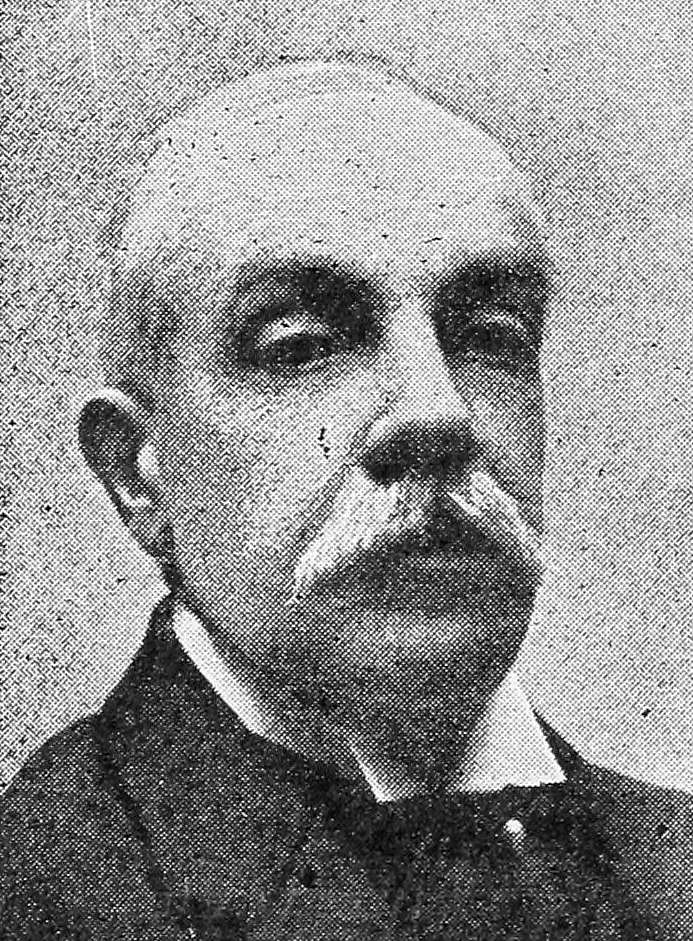
© Bain.
Dr. Dumba
Austrian Ambassador
“You could find him almost any day until the break with Germany in a small office in the Hamburg-American Building (a beehive of secret agents) at No. 45 Broadway, New York. He was tall and slender, and wore the somber frock coat of the European business man with real grace. His eyes were blue and clear, his face clean-shaven and faintly saber-scarred, and his hair blond. He impressed one as an unusual young man in a highly responsible position. His greeting to visitors, of whom he had few, was punctilious, his bow low, and his manner altogether polite. He encouraged conversation rather than offered it. He had none of the ‘hard snap’ of the energetic, outspoken, brusque American man of business. Dr. Albert was a smooth-running, well-turned cog in the great machine of Prussian militarism.
CORRUPTION FUND OF MILLIONS
“Upon him rested the task of spending between $2,000,000 and $3,000,000 a week for German propaganda. He spent thirty millions at least in secret agency work, also known by the uglier names of bribery, sedition and conspiracy. He admitted that he wasted a half million.
“His methods were quiet and successful, and his participation in the offenses against America’s peace might have passed unproven had he not been engaged in a too-absorbing conversation one day in August, 1915, upon a Sixth Avenue elevated train. He started up to leave the train at Fiftieth Street, and carelessly left his portfolio behind him—to the tender care of a United States Secret Service man. It contained documents revealing his complicity in enterprises the magnitude of which beggars the imagination. The publication of certain of those documents awoke the slumbering populace to a feeling of chagrin and anger almost equal to his own at the loss of his dossier. And yet he stayed on in America, and returned with the ambassadorial party to Germany only after the severance of diplomatic relations in 1917, credited with expert generalship on the economic sector of the American front.
“Germany’s military attaché to the United States was Captain Franz von Papen. His mission was the study of the United States army. In August, 1914, it may be assumed that he had absorbed most of the useful information of the United States army, which at that moment was no superhuman problem. In July of that year he was in Mexico, observing, among other matters, the effect of dynamite explosions on railways. He was quite familiar with Mexico. According to Admiral von Hintze he had organized a military unit in the lukewarm German colony in Mexico City, and he used one or more of the warring factions in the southern republic to test the efficacy of various means of warfare.
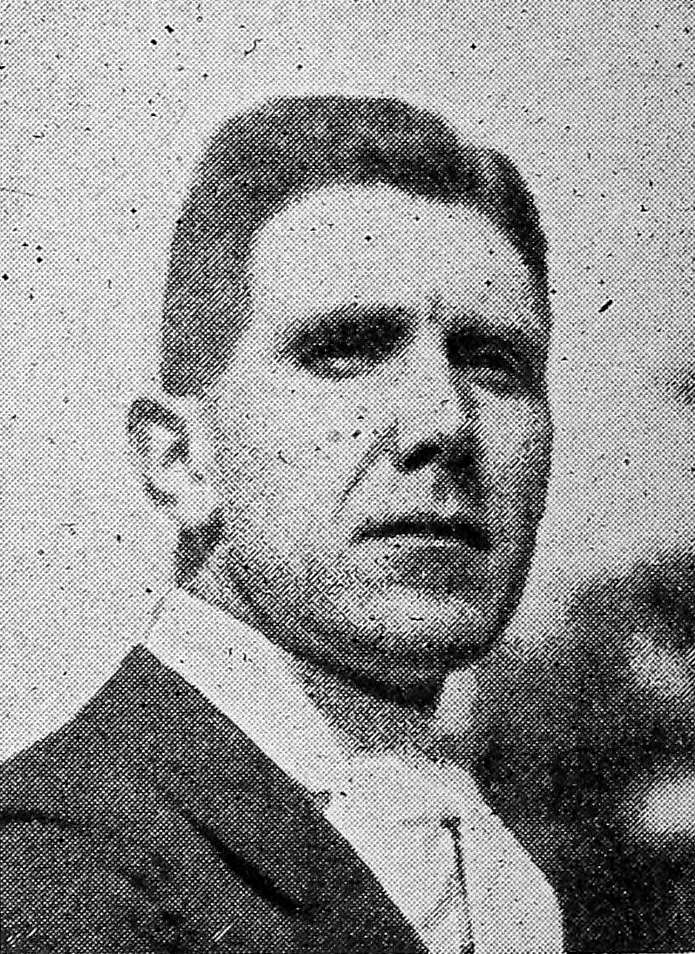
© Bain.
Captain von Papen
German Military Attaché
“Von Papen operated from New York after the outbreak of war. “German reservists who had been peaceful farmers, shopkeepers or waiters, all over the United States, were mobilized for service, and paraded through Battery Park in New York shouting ‘Deutschland, Deutschland über alles!’ to the strains of the Austrian hymn, while they waited for Papen’s orders from a building near by, and picked quarrels with a counter procession of Frenchmen screaming the immortal ‘Marseillaise.’ Up in his office sat the attaché, summoning, assigning, despatching his men on missions that were designed to terrorize America as the spiked helmets were terrorizing Belgium at that moment.
“... Although von Papen marshaled his consuls, his reservists, his thugs, his women, and his skilled agents, for a programme of violence the like of which America had never experienced, the military phase of the war was not destined for decision here, and there is again something ironical in the fact that the arrogance of Captain von Papen’s outrages hastened the coming of war to America and the decline of Captain von Papen’s style of warfare in America.
BOY-ED, A TURKISH HALF-BREED
“The Kaiser’s naval attaché at Washington was Karl Boy-Ed, the child of a German mother and a Turkish father, who had elected a naval career and shown a degree of aptitude for his work which qualified him presently for the post of chief lieutenant to von Tirpitz. He was one of the six young officers who were admitted to the chief councils of the German navy, as training for high executive posts.... His duties took him all over the world as naval observer, and he may be credited more than casually with weaving the plan-fabric of marine supremacy with which Germany proposed in due time to envelop the world.
“He impressed diplomatic Washington in 1911 as a polished cosmopolite. Polished he was, measured by the standards of diplomatic Washington, for rare was the young American of Boy-Ed’s age who had his cultivation, his wide experience, and his brilliant charm. He was sought after by admiring mothers long before he was sought after by the Secret Service; he moved among the clubs of Washington and New York making intimates of men whose friendship and confidence would serve the Fatherland, cloaking his real designs by frivolity and frequent attendances at social functions. His peace-time duties had been to study the American navy; to familiarize himself with its ship power and personnel, with its plans for expansion, its theories of strategy, its means of supply, and finally, with the coast defenses of the country. He had learned his lesson, and furnished Berlin with clear reports. On those reports, together with those of his colleagues in other countries, hinged Germany’s readiness to enter war, for it would have been folly to attempt a war of domination with America an unknown, uncatalogued naval power. (It will be well to recall that the submarine is an American invention, and that Germany’s greatest submarine development took place in the years 1911-14.)
“And then, suddenly, he dropped the cloak. The Turk in him stood at attention while the German in him gave him sharp orders—commands to be carried out with Oriental adroitness and Prussian finish. Then those who had said lightly that ‘Boy-Ed knows more about our navy than Annapolis itself’ began to realize that they had spoken an alarming truth. His war duties were manifold. Like von Papen, he had his corps of reservists, his secret agents, his silent forces everywhere ready for active coöperation in carrying out the naval enterprises Germany should see fit to undertake in Western waters.
“America learned gradually of the machinations of the four executives, Bernstorff, Albert, Papen and Boy-Ed. America had not long to wait for evidences of their activity, but it was a long time before the processes of investigation revealed their source. It was inevitable that they could not work undiscovered for long, and they seem to have realized that they must do the utmost damage at top speed. Their own trails were covered for a time by the obscure identities of their subordinates. The law jumps to no conclusions. Their own persons were protected by diplomatic courtesy. It required more than two years of tedious search for orthodox legal evidence to arraign these men publicly in their guilt, and when that evidence had finally been obtained, and Germany’s protest of innocence had been deflated, it was not these men who suffered, but their country, and the price she paid was war with America.
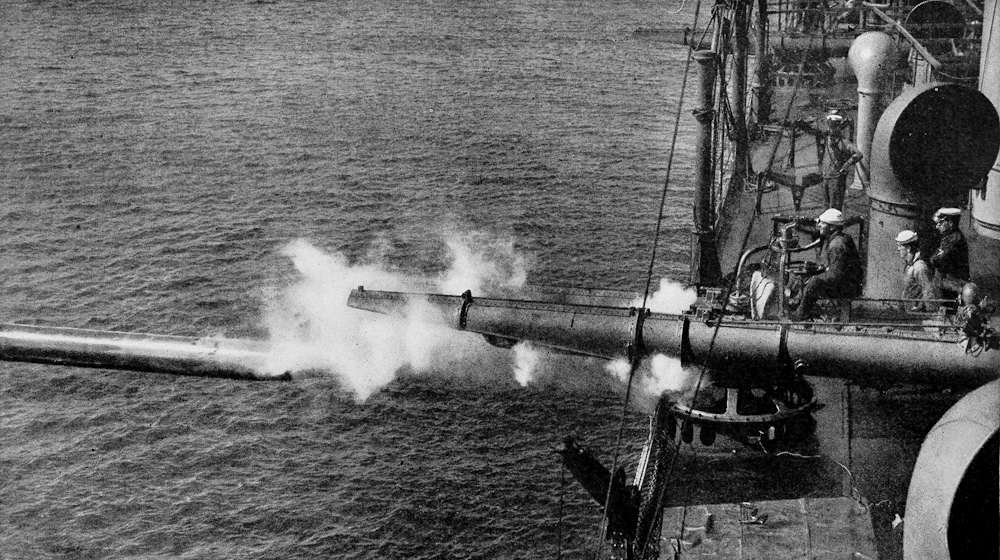
Courtesy of Leslie’s Weekly.
A Deadly Torpedo Leaving the Tube of an American Destroyer
A Whitehead torpedo at the instant it leaves the tube. This tube is above the water line. Torpedo-boat destroyers carry both this kind of tubes and submerged ones. The torpedo, when fired from above the water, submerges itself to a depth determined by the adjustment of its horizontal steering gear, and thereafter runs its course at an even depth beneath the surface.
GERMANY’S SECRET ARMY
“A hundred or more of their subordinates have been convicted of various criminal offenses and sent to prison. Still more were promptly interned in prison camps at the outbreak of war in 1917. The secret army included all types, from bankers to longshoremen. Many of them were conspicuous figures in American public life, and of these no small part were allowed to remain at large under certain restrictions—and under surveillance. Germany’s army in the United States was powerful in numbers; the fact that so many agents were working destruction probably hastened their discovery; the loyalty of many so-called German-Americans was always questionable. The public mind, confused as it had never been before by the news of war, was groping about for sound fundamentals, and was being tantalized with false principles by the politicians. Meanwhile Count von Bernstorff was watching Congress and the President, Dr. Albert was busy in great schemes, Captain von Papen was commanding an active army of spies, and Captain Boy-Ed was engaged in a bitter fight with the British navy.”
But long after the departure of the principals for their native land the enterprises they had inaugurated persisted.
Among the pre-war activities the German government made a contract with Dr. Karl Buenz, American head of the Hamburg-American Line, for the provisioning, during war, of German ships at sea, the contract being jealously guarded in the German Embassy at Washington. Merchant ships were to be used for the purpose. July 31, 1914, a cablegram from Berlin called on Dr. Buenz to begin filling his contract. The first ship to be loaded (with coal) was the Berwind, and the question arose as to who among the conspirators should apply for the clearance papers. Finally G. B. Kulenkampff, a banker and exporter, was directed to do so. He swore to a false manifest of the cargo and got the papers. The Berwind carried food as well as coal for the provisioning of German warships to be found at secretly designated points, and her destination was not Buenos Ayres as the clearance papers declared, so the United States was unwittingly a party to German naval operations, on the third day of the war, by German mendacity. The Berwind sailed for a little island known as Trinidad (not the British West Indian island) about 70° east of Brazil, and there her cargo was transferred to five German ships, one of which was the Kap-Trafalgar, presently sunk by the British auxiliary cruiser, the Carmania, which steamed into view while the Trafalgar, the Berwind and one other of the vessels were still at Trinidad.
It is interesting to know that most of the ships chartered for this lawless purpose did not carry out the intention. The Unita was one of them and we are told:
“Her skipper was Eno Olsen, a Canadian citizen born in Norway. Urhitzler, the German spy placed aboard, made the mistake of assuming that Olsen was friendly to Germany. He gave him his ‘orders,’ and the skipper balked. ’“Nothing doing,” I told the supercargo,’ Captain Olsen testified later, with a Norwegian twist to his pronunciation. ‘She’s booked to Cadiz, and to Cadiz she goes!’ So the supercargo offered me $500 to change my course. “Nothing doing—nothing doing for a million dollars,” I told him. The third day out he offered me $10,000. Nothing doing. So,’ announced Captain Olsen with finality, ‘I sailed the Unita to Cadiz and after we got there I sold the cargo and looked up the British consul.’”
Under the Buenz contract twelve ships were either purchased or chartered at a total cost of $1,419,394, and it is said that of their shiploads of supplies less than $30,000 worth were ever transferred to German war vessels. Buenz, after much delay in the proceedings, was sentenced to eighteen months’ imprisonment in the Federal penitentiary at Atlanta.
THE WIRELESS TREACHERIES
The Sayville Wireless Station on Long Island was for a long time a successfully controlled medium for the direction of spy and propaganda work in this country as well as for communication with wireless stations in Germany, in Central and South America, with wireless ships interned, etc., etc. To this and the other German-owned commercial plants in the United States Capt. Boy-Ed added amateur stations of more or less extended radius as auxiliaries. But owing to complaints of frequent interference with regular messages, the “United States presently ordered the closing of all private wireless stations, and those amateurs who had been listening out of sheer curiosity to the air conversation cheerfully took down their antennæ. Not so, however, a prominent woman in whose residence on Fifth Avenue lay concealed a powerful receiving apparatus. Nor did the interned ships obey the order: apparatus apparently removed was often rigged in the shelter of a funnel, and operated by current supplied from an apparently innocent source. And the secret service discovered stations also in the residences of wealthy Hoboken Germans, and in a German-American ‘mansion’ in Hartford, Connecticut.”
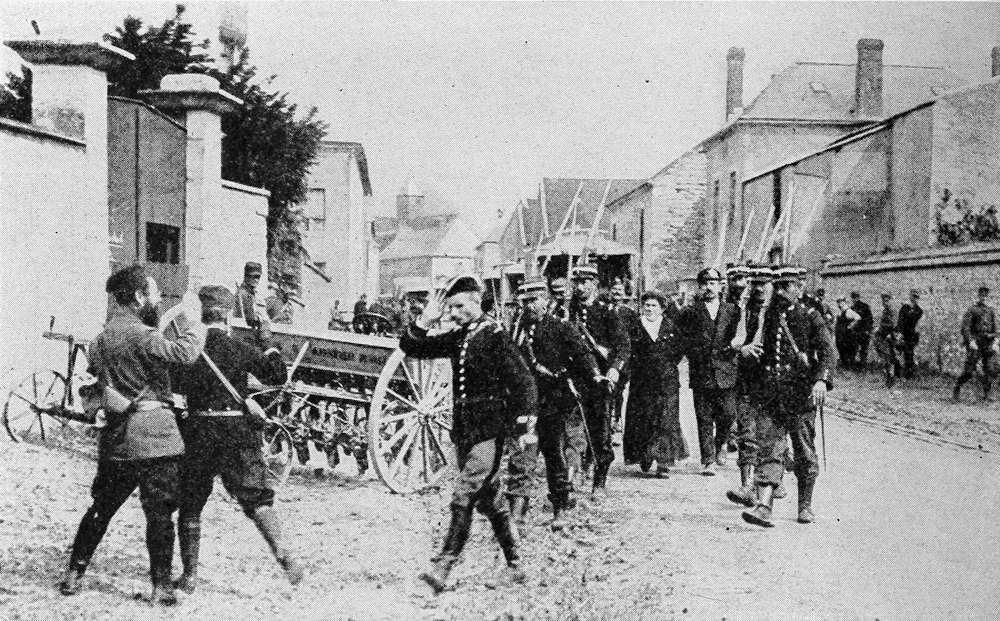
© Underwood, and Underwood.
German Spies in France
After living for ten years in France, they were discovered giving information to the Germans by telephone. They confessed and were shot.
Later suspicions were aroused by the activities of the German wireless, but the German operators were not at once removed. The United States began taking down the seemingly meaningless jargon that came every morning from the Nauen Station near Berlin. It was two years later, however, that a key to the jumble was discovered and the code revealed. Two codes in fact were found.
“The chief significance of the discovery of the two codes is their conclusive proof that while von Bernstorff was protesting to the American government that he could not get messages through to Berlin, nor replies from the Foreign Office, he was actually in daily, if not hourly, communication with his superiors. Messages were sent out by his confidential operators under the very eyes of the American naval censors. After the break of diplomatic relations with Berlin, in February, 1917, the authorities set to work decoding the messages, and the State Department from time to time issued for publication certain of the more brutal proofs of Germany’s violation of American neutrality. The Ambassador and his Washington establishment had served for two years and a half as the ‘central exchange’ of German affairs in the western world. After his departure communication from German spies here was handicapped only by the time required to forward information to Mexico; from that point to Berlin air conversation continued uninterrupted.”
It may be noted in passing that Captain Karl Grasshof of the cruiser Geier, that took refuge from the British by tying up in Honolulu harbor, gave high proof of the German nice sense of honor in respect of hospitality. He instituted a series of afternoon concerts by the ship’s band, that the music might drown out the noise of the wireless apparatus as he sent messages to raiders at sea or threw off false reports in English, the purpose of which was to make trouble between the United States and Japan. He said at one time that von Papen inspired this peculiar treachery, but afterwards denied it.
TO INVADE CANADA
On the military side, one of von Papen’s brilliant projects was to organize the German reservists in the United States into an army for the invasion of Canada. The plan was to transport men and guns by night from ports of the Great Lakes by means of powerful motor boats and attack defenseless lake cities, the object being to arouse such fear in the Canadians that they would keep their troops for home defense instead of sending them to the aid of England. This, however, was a project from which the craftier Bernstorff recoiled as smacking too much of open violence. Then von Papen proposed a scheme to blow up the Welland Canal as a terrorizing job. The plot was ascribed to “two Irishmen, prominent members of Irish associations, both of whom had fought in the Irish rebellion.”
The spy, Horst von der Goltz, was the active agent in the preliminary steps, such as recruiting men for the job, securing explosives, etc., Papen, in the name of Steffens, supplying the money and giving the necessary instructions. But after being carried forward almost to the point of action the Welland enterprise was, for some unknown reason, suddenly abandoned and the dynamite (three hundred pounds in suitcases), which had been taken to Niagara Falls, was left with an aviator, and Goltz, with his immediate associate, Constance Covani, a private detective, returned to New York. Von Papen was much provoked by the failure of his second plan to terrorize Canada. Goltz was sent on some commission to Germany in October, sailing on a forged passport, got safely to Berlin and, on his return trip in November, was arrested in England, spy fashion. After a protracted imprisonment, Goltz agreed to turn State’s evidence against his fellow conspirators. A number of arrests resulted, and the plots against Canada were fully revealed.
As more and more precise rules for the issue of passports were made by the government the difficulties of the conspirators in making direct communication with Berlin increased correspondingly. It devolved upon von Papen to provide for the supply of passports to meet the needs of couriers and others who could not get passports in their own names.
“The military attaché selected Lieutenant Hans von Wedell, who had already made a trip as courier to Berlin for his friend, Count von Bernstorff. Von Wedell was married to a German baroness. He had been a newspaper reporter in New York, and later a lawyer. He opened an office in Bridge Street, New York, and began to send out emissaries to sailors on interned German liners, and to their friends in Hoboken, directing them to apply for passports. He sent others to the haunts of tramps on the lower East Side, to the Mills Hotel, and other gathering places of the down-and-outs, offering ten, fifteen or twenty dollars to men who would apply for and deliver passports. And he bought them! He spent much time at the Deutscher Verein, and at the Elks’ Club in 43rd Street where he often met his agents to give instructions and receive passports. His bills were paid by Captain von Papen.”
MANUFACTURING PASSPORTS
The passports secured in this way by von Wedell and by his successor, Carl Ruroede, Sr., in the employ of Oelrichs & Co., were supplied to reservist officers whom the General Staff had ordered back to Berlin, and also to spies whom von Papen wished to send to England, France, Italy or Russia. Among the latter was Anton Kuepferle, who was captured in England, confessed and killed himself in Brixton jail.
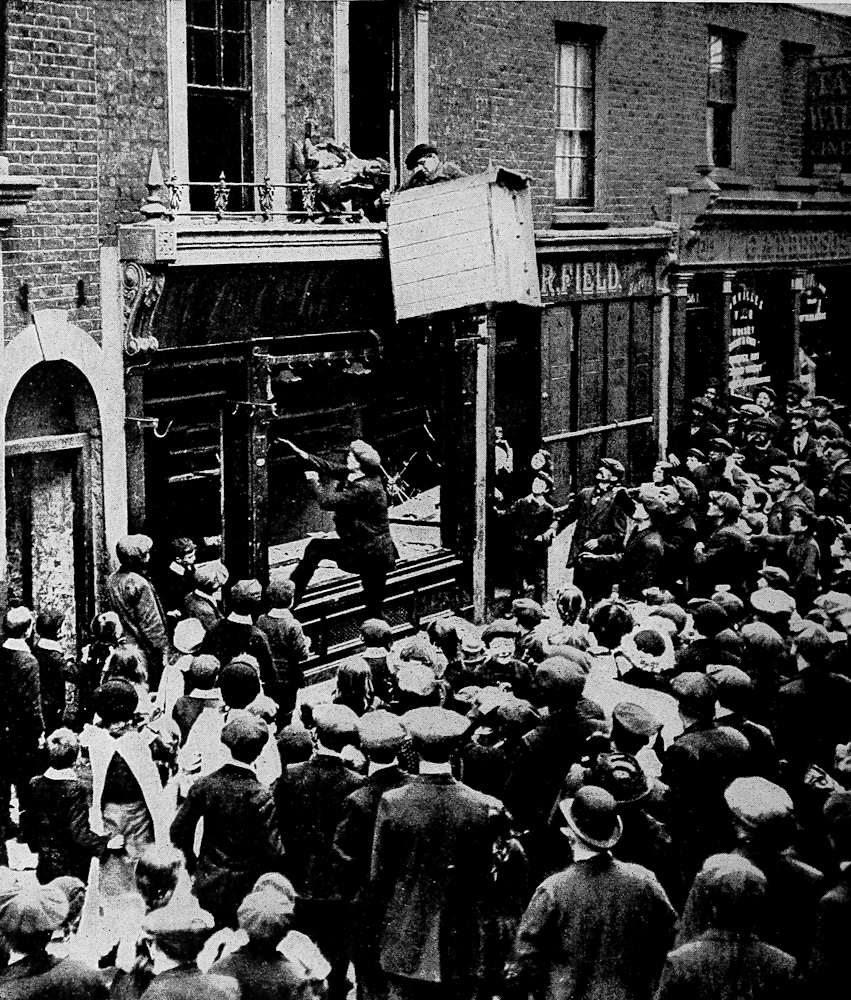
© International News.
Anti-German Riots in Britain
The destruction of the Lusitania by a German submarine caused anti-German riots in many parts of the world. These started in Liverpool when the bodies of dead members of the crew were brought to their homes there, and spread rapidly to other parts of the United Kingdom. The photograph shows the looting of a German’s residence in High Street, London.
When it became obvious that passports must be serving the ends of persons other than those to whom they were issued the government demanded that each passport should have the photograph of the bearer. But this did not disconcert the conspirators, as The German Secret Service in America tells us. It says: “The Germans found it a simple matter to give a general description of a man’s eyes, color of hair, and age to fit the person who was actually to use the document; then forwarded the picture of the applicant to be affixed. The applicant receiving the passport would sell it at once. Even though the official seal was stamped on the photograph the Germans were not dismayed.
“Adams [Albert G. Adams, a United States Secret Service agent, who had insinuated himself into Ruroede’s confidence] rushed into Ruroede’s office one day waving a sheaf of five passports issued to him by the government. Adams was ostensibly proud of his work, Ruroede openly delighted.
“‘I knew I could get these passports easily,’ he boasted to Adams. ‘Why, if Lieutenant von Wedell had kept on here he never could have done this. He always was getting into a muddle.’
“‘But how can you use these passports with these pictures on them?’ asked the agent.
“‘Oh, that’s easy,’ answered Ruroede. ‘Come in the back room. I’ll show you.’ And Ruroede, before the observant eyes of the Department of Justice, patted one of the passports with a damp cloth, then with adhesive paste fastened a photograph of another man over the original bearing the imprint of the United States seal.
“‘We wet the photograph,’ said Ruroede, ‘and then we affix the picture of the man who is to use it. The new photograph also is dampened, but when it is fastened to the passport there still remains a sort of vacuum in spots between the new picture and the old because of ridges made by the seal. So we turn the passport upside down, place it on a soft ground—say a silk handkerchief—and then we take a paper-cutter with a dull point, and just trace the letters on the seal. The result is that the new photograph dries exactly as if it had been stamped by Uncle Sam. You can’t tell the difference.’
NABBED AT SEA
“Through Adams’ efforts Ruroede and four Germans, one of them an officer in the German reserves, were arrested on January 2, on the Scandinavian-American liner Bergensfjord outward bound to Bergen, Norway. They had passports issued through Adams at Ruroede’s request under the American names of Howard Paul Wright, Herbert S. Wilson, Peter Hanson and Stanley F. Martin.
“Von Wedell himself was a passenger on the Bergensfjord, but when he was lined up with the other passengers, the Federal agents, who did not have a description of him, missed him and left the vessel. He was later (January 11) taken off the ship by the British, however, and transferred to another vessel for removal to a prison camp. She struck a German mine and sank, and von Wedell is supposed to have drowned.”
An explicit letter from von Wedell to von Bernstorff dispelled any possibility of doubt that the German Ambassador was fully cognizant of the false passport frauds.
“Ruroede was sentenced to three years in Atlanta prison. The four reservists, pleading guilty, protested they had taken the passports out of patriotism and were fined $200 each.
“The arrest of Ruroede exposed the New York bureau, and made it necessary for the Germans to shift their base of operations, but did not put an end to the fraudulent passport conspiracy. Capt. Boy-Ed assumed the burden, and hired men to secure passports for him.”
But the increased vigilance and thoroughness of the British reduced this service to a negligible quantity before the entrance of the United States into the war squelched it entirely.
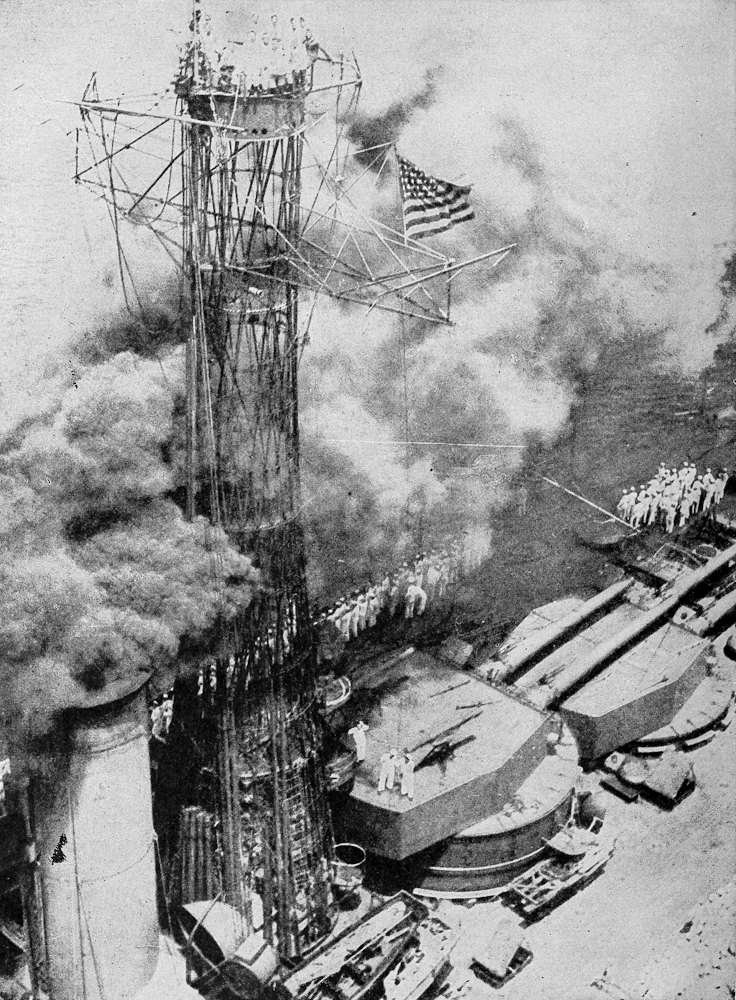
© Underwood and Underwood.
From the Fighting Top of the Battleship Wyoming
The Wyoming is 562 feet in length, of 26,000 tons displacement, and carries twelve 12-inch and twenty-one 5-inch guns.
An incident in connection with the arrest of Ruroede is related by French Strother in his story “Fighting German Spies” published in The World’s Work. Ruroede “was being urged by the Assistant United States District Attorney to ‘come across’ with the facts about his activities in the passport frauds, and he had stood up pretty well against the persuasions and hints of the attorney and the doubts and fears of his own mind. About eleven o’clock at night, as he was for the many’th time protesting his ignorance and his innocence, another agent of the Bureau of Investigation walked across the far end of the dimly lit room—in one door and out another—accompanied by a fair-haired lad of nineteen.
“‘My God!’ exclaimed Ruroede, ‘have they got my son, too? The boy knows nothing at all about this.’
“This little ghost-walking scene, borrowed from Hamlet, broke down Ruroede’s reserve, and he came out with pretty much all the story, ending with the melancholy exclamation ‘I thought I was going to get an Iron Cross; but what they ought to do is to pin a little tin stove on me.’”
A SENSATIONAL CAPTURE
In addition to von Papen, Dr. Albert and Boy-Ed, one of Bernstorff’s effective agents was Wolf von Igel, who was the leader of the dynamite men of the conspiracy. He set up at 60 Wall Street ostensibly in the “advertising” business. Attention was attracted to him by the fact that his visitors during the two years he was undisturbed were Germans who had nothing whatever to do with advertising. Moreover, conspicuous in his office was a large safe bearing the insignia of the German Imperial Government. Suspicions were aroused and by degrees these suspicions were strengthened by circumstances and incidents that indicated von Igel as a German agent. Therefore, as the New York Times reported, one morning in April, 1916, while von Igel was engaged preparing a mass of papers taken from the safe for transfer to Washington, the office was entered by four United States Secret Service agents from the Department of Justice, who made their way past the guardians always on duty, put von Igel under arrest, and undertook to seize the papers. The German was powerful and brave. With the aid of one associate he stubbornly fought the officers, striving to rescue the papers, to close the safe, to get to the telephone and communicate with his superiors. Revolvers were drawn by the Secret Service men. They produced no effect upon the intrepid von Igel.
“This is German territory,” he shouted. “Shoot me and you will bring on war.”
There was no shooting. But after a protracted struggle the defenders were overpowered and the papers seized. The German Embassy at once entered its protest. These were official papers. They were sacrosanct. The diplomatic prerogative of a friendly nation had been overridden and the person of its representative insulted. To this the State Department replied that the invaded premises at 60 Wall Street were described in the contract as a private business office for the carrying on of advertising, and that von Igel had not been formally accredited as a German representative.
When the papers were examined by the Department of Justice the reason for von Igel’s determined fight became apparent. Here, in the form of letters, telegrams, notations, checks, receipts, ledgers, cashbooks, cipher codes, lists of spies, and other memoranda and records were found indications—in some instances of the vaguest nature, in others of the most damning conclusiveness—that the German Imperial Government, through its representatives in a then friendly nation, was concerned with—
Violation of the laws of the United States.
Destruction of lives and property in merchant vessels on the high seas.
Irish revolutionary plots against Great Britain.
Fomenting ill-feeling against the United States in Mexico.
Subornation of American writers and lecturers.
Financing of propaganda.
Maintenance of a spy system under the guise of a commercial investigation bureau.
Subsidizing of a bureau for the purpose of stirring up labor troubles in munition plants.
The bomb industry and other related activities.
One of the most significant papers in the von Igel collection was a letter directly convicting von Papen of paying money to a plotter (Paul Koenig, manager of an alleged Bureau of Investigation established by the Hamburg-American Steamship Company for secret service purposes) designing to blow up merchant ships sailing from the port of New York. Koenig had reported the make of the bombs which it was proposed to use. They were made to look like lumps of coal, to be concealed in the coal laden on steamers of the Allies. By this or other means thirty ships carrying munitions to the Allies were sunk.
MORE BERNSTORFF CRAFT
Closely related to and to some extent under the guidance of von Igel was the German and Austro-Hungarian Labor Information and Relief Bureau, with central headquarters at 136 Liberty Street, New York City, and branches in Cleveland, Detroit, Bridgeport, Pittsburgh, Philadelphia, and Chicago. The head of the enterprise was Hans Liebau, from whom it took its familiarly accepted name of the “Liebau Employment Agency.” During the trying days which followed the arrest of the Welland Canal conspirators it was unwaveringly asserted that the Liebau concern was a bona fide employment agency and nothing else, with no object other than to secure positions for German, Austrian, or Hungarian workmen seeking employment. That was for publication only. In von Igel’s papers the truth appears, brought out by the refusal of the Austro-Hungarian Embassy to continue its subsidies to the bureau.
That the Austro-Hungarian Embassy had taken official cognizance of the bureau previously, however, is disclosed in the letter written by the Ambassador to the Austro-Hungarian Minister for Foreign Affairs, which was found in the possession of James F. J. Archibald by the British authorities August 30, 1915. In this letter the Ambassador stated:
“It is my impression that we can disorganize and hold up for months, if not entirely prevent, the manufacture of munitions in Bethlehem and the Middle West, which, in the opinion of the German Military Attaché, is of importance and amply outweighs the comparatively small expenditure of money involved.”
Representations on behalf of the bureau’s efficiency were made, under date of March 24, 1916, in a letter to the German Ambassador, von Bernstorff:
“Engineers and persons in the better class of positions, and who had means of their own, were persuaded by the propaganda of the bureau to leave war material factories.”
The report comments with unconcealed amusement upon the fact that munitions concerns innocently wrote the bureau for workmen (which, of course, were not furnished) and continues in reviewing later conditions in the munitions industry:
“The commercial employment bureaus of the country have no supply of unemployed technicians.... Many disturbances and suspensions which war material factories have had to suffer, and which it was not always possible to remove quickly, but which on the contrary often led to long strikes, may be attributed to the energetic propaganda of the employment bureau.”
The captured documents contained letters and communications that established intimate relations between the German Diplomatic Service and the Irish revolutionary movement. Among others was the letter concerning a Justice of the New York Supreme Court, Daniel F. Cohalan, beginning, “Judge Cohalan requests the transmission of the following remarks.” The remarks are then quoted as follows:
“The revolution in Ireland can only be successful if supported from Germany, otherwise England will be able to suppress it, even though it be only after hard struggles. Therefore help is necessary. This should consist, primarily, of aerial attacks in England and a diversion of the fleet simultaneously with Irish revolution. Then, if possible, a landing of troops, arms, and ammunition in Ireland, and possibly some officers from Zeppelins. This would enable the Irish ports to be closed against England and the establishment of stations for submarines on the Irish coast and the cutting off of the supply of food for England. The services of the revolution may therefore decide the war.”
“He asks that a telegram to this effect be sent to Berlin,” the letter continues. It is but fair to say that Judge Cohalan has denied making the request.
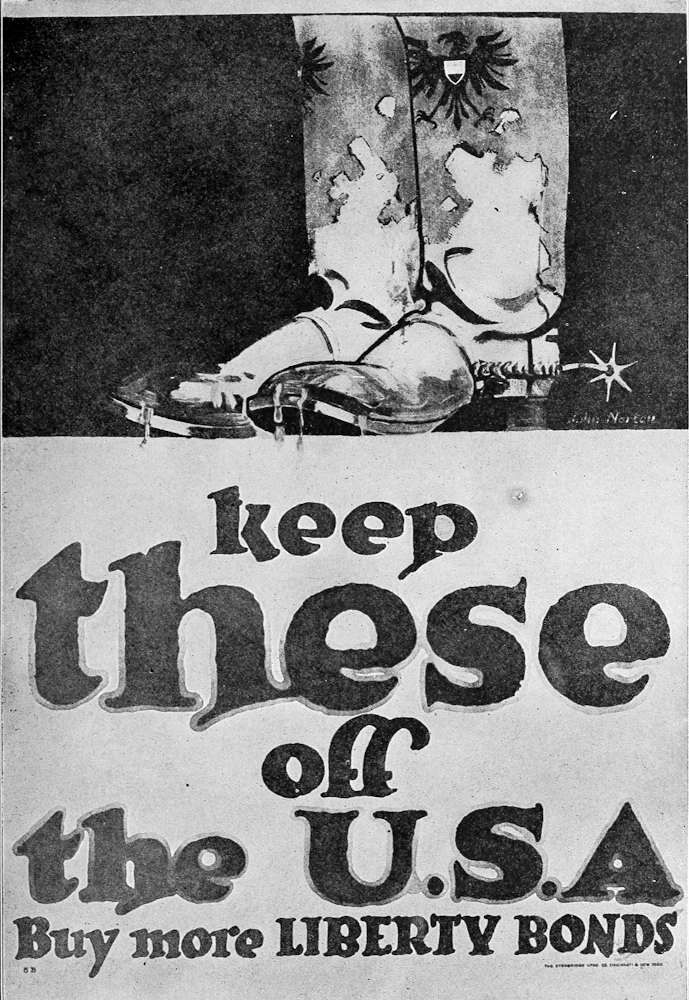
Poster for the Fourth Liberty Loan
Other documents revealed the German Secret Service dealings with Sir Roger Casement, subsequently executed by the British for treason, but though the Department of Justice had this incriminating evidence, it did not reach the Attorney General until the afternoon following the arrest of Casement. The cause of Casement’s arrest was not, therefore, information furnished by the Department, as was loosely charged at the time.
LANSING’S REVELATION
The most sensational of the revelations of German plotting in the United States was made by Secretary Lansing on September 21, 1916, when he published without comment a telegram written by Ambassador Bernstorff himself and asking his government for $50,000 to be used in influencing Congress. This was not one of the papers taken from von Igel, but was of much later date, and Mr. Lansing stated that the cablegram had not been sent to Germany through the State Department, leaving it to be implied that it went by way of some neutral legation.
There was a veritable storm of excitement in Congress over the imputation of bribery, some Congressmen in the heat of the moment intimating that they knew what members had benefited from the fund. But later it was made evident that Bernstorff had no idea of bribery but of starting a volume of letters and telegrams from various parts of the country to influence Congressmen against a declaration of war. Some time afterwards Secretary Lansing made public the fact that when Bernstorff asked for the $50,000 to influence the American Congress he was already aware that Germany was about to resume her ruthless submarine warfare which she had assured the United States would be abandoned.
THE BOLO PASHA FOLLY
The most amazing instance thus far discovered of the German government’s lavish waste of the German people’s money for useless intrigues in other countries is that revealed after the arrest of Paul Bolo, alias Bolo Pasha, in Paris, Sept. 29, 1917. The following account is taken from the New York Times Current History:
“Bolo had long been under suspicion and had been temporarily under arrest several weeks before, but only upon receipt of important evidence from the United States was he imprisoned without bail. He is a Frenchman, born at Marseilles, and, according to an article in the Paris Matin, is a brother of an eloquent French prelate of that name. He has had an adventurous career in various countries, including Egypt, and at the beginning of the war he was penniless; but when in Switzerland in March, 1915, he met Abbas Hilmi, former Khédive of Egypt, and apparently concluded an arrangement by which he was to receive $2,500,000 to be used in influencing the French press in favor of a German peace. The plan was approved by Gottlieb von Jagow, German Foreign Minister, who was to pay the money partly through the ex-Khédive and partly through Swiss and American banks.
“In accordance with this arrangement $1,000,000 was paid by roundabout methods through Swiss banks, to avert suspicion. Abbas Hilmi and an associate are said to have collected $50,000 as a commission. After that time Bolo Pasha and Abbas Hilmi seemed to have fallen out, for their relations ceased. At the time of his arrest Bolo was said to have received $8,000,000 from Germany, of which $2,500,000 had been traced to the Deutsche Bank. Large portions of this sum were said to have been paid through an American channel. The actual facts, now proved by the documents, go far toward confirming those original estimates.
“Bolo arrived in New York on February 22, 1916, and left on March 17 following. He had rooms at the Plaza Hotel, and was careful not to be seen in public with German agents. He saw Bernstorff secretly in Washington.
“When the French government got an inkling of his traitorous activities it appealed to Governor Whitman of New York for evidence, and ten days’ work by Merton E. Lewis, the Attorney General of the State, assisted by an expert accountant, resulted in sensational disclosures which were made public on the evening of October 3. The evidence, which included photographic reproductions of many telltale checks, letters, and telegrams, revealed the fact that Count Bernstorff, then German Ambassador at Washington, had eagerly fallen in with Bolo’s proposition to betray France by corrupting the press in favor of a premature peace and had advanced him the enormous sum of $1,683,500 to finance the plot. The State Department and Ambassador Jusserand examined the evidence and attested its genuineness.
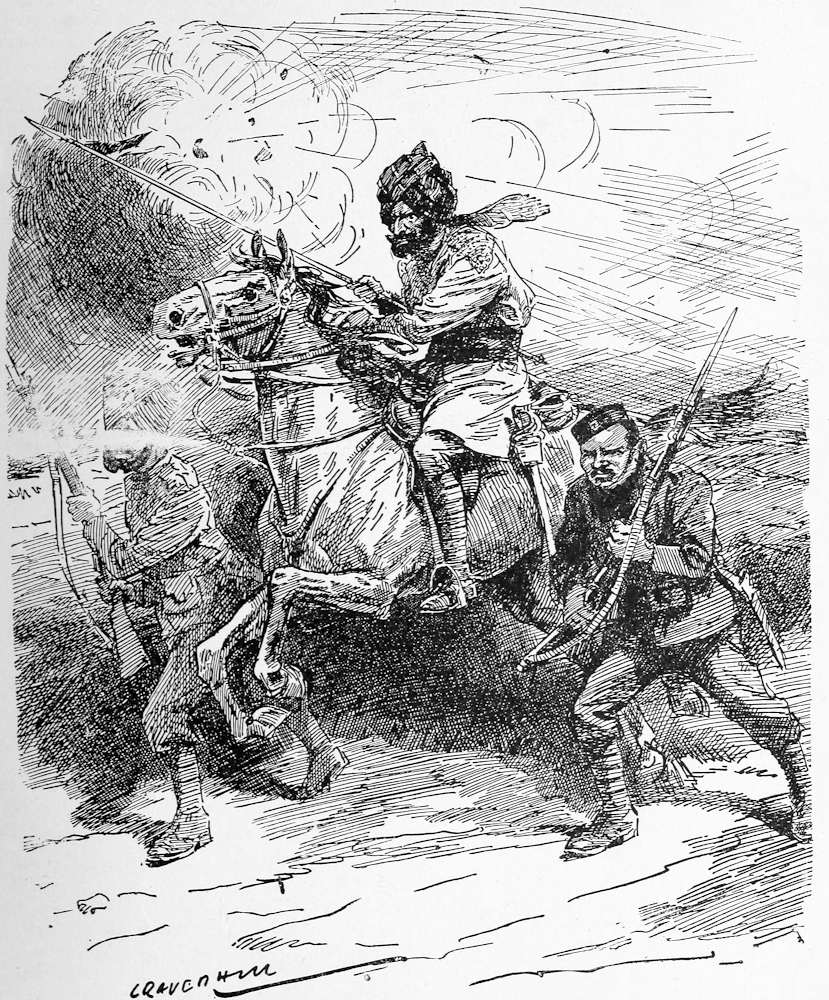
From Punch, Sept. 9, 1914.
India for the King
The man on horseback is a Hindu. To his right is a Mohammedan, to his left a Parsee. This cartoon from Punch depicts the loyalty of the natives of India in the World War.
“Many banks had been used to confuse and hide the transaction, but the persons and agencies who figured knowingly in it are Bolo Pasha, Ambassador von Bernstorff, and two bankers—Hugo Schmidt, former New York agent of the Deutsche Bank of Berlin, who acted as Bernstorff’s financial agent, and Adolph Pavenstedt, former head of the New York banking house of G. Amsinck & Co.
“Of the mass of documents exhibited by Attorney General Lewis, the most important was a letter written by Bolo Pasha to the New York City branch of the Royal Bank of Canada on March 14, 1916, three days before he sailed to return to France. That letter reads:
“‘New York, March 14, 1916.
“‘The Royal Bank of Canada, New York, N. Y.
“‘Gentlemen: You will receive from Messrs. G. Amsinck & Co. deposits for the credit of my account with you, which deposits will reach the aggregate amount of about $1,700,000, which I wish you to utilize in the following manner:
“‘First—Immediately on receipt of the first amount on account of this sum pay to Messrs. J. P. Morgan & Co., New York City, the sum of $170,068.03, to be placed to the credit of the account with them of Senator Charles Humbert, Paris.
“‘Second—Establish on your books a credit of $5,000, good until the 31st of May, in favor of Jules Bois, Biltmore Hotel, this amount to be utilized by him at the debit of my account according to his needs, and the unused balance to be returned to me.
“‘Third—Transfer to the credit of my wife, Mme. Bolo, with agency T of Comptoir National d’Escompte de Paris a sum of about $524,000, to be debited to my account as such transfers are made by you at best rate and by small amounts.
“‘Fourth—You will hold, subject to my instructions, when all payments are complete, a balance of not less than $1,000,000.
“‘Yours truly, “‘Bolo Pasha.’
“That is how the $1,683,500, which was the exact amount Bernstorff ordered Schmidt to place at the service of Bolo, came into the latter’s actual possession.
BERNSTORFF THE MASTER MIND
“Direct evidence that Count Bernstorff was the master mind behind the plot on this side of the Atlantic came to light in five dispatches that were made public by Secretary Lansing on October 5. These messages were exchanged in the Spring of 1916:
“‘The Department of State communicates to the press the following telegrams bearing upon the case of Bolo Pasha, exchanged between Count von Bernstorff and Herr von Jagow, German Minister of Foreign Affairs.
“‘Number 679, Feb. 26. I have received direct information from an entirely trustworthy source concerning a political action in one of the enemy countries which would bring peace. One of the leading political personalities of the country in question is seeking a loan of one million seven hundred thousand dollars in New York, for which security will be given. I was forbidden to give his name in writing. The affair seems to me to be of the greatest possible importance. Can the money be provided at once in New York? That the intermediary will keep the matter secret is entirely certain. Request answer by telegram. A verbal report will follow as soon as a trustworthy person can be found to bring it to Germany.
“‘Bernstorff.’
“‘Number 150, Feb. 29. Answer to telegram Number 679. Agree to the loan, but only if peace action seems to you a really serious project, as the provision of money in New York is for us at present extraordinarily difficult. If the enemy country is Russia have nothing to do with the business, as the sum of money is too small to have any serious effect in that country. So, too, in the case of Italy, where it would not be worth while to spend so much.
“‘Jagow.’
“‘Number 685, March 5. Please instruct Deutsche Bank to hold nine million marks at disposal of Hugo Schmidt. The affair is very promising. Further particulars follow.
“‘Bernstorff.’
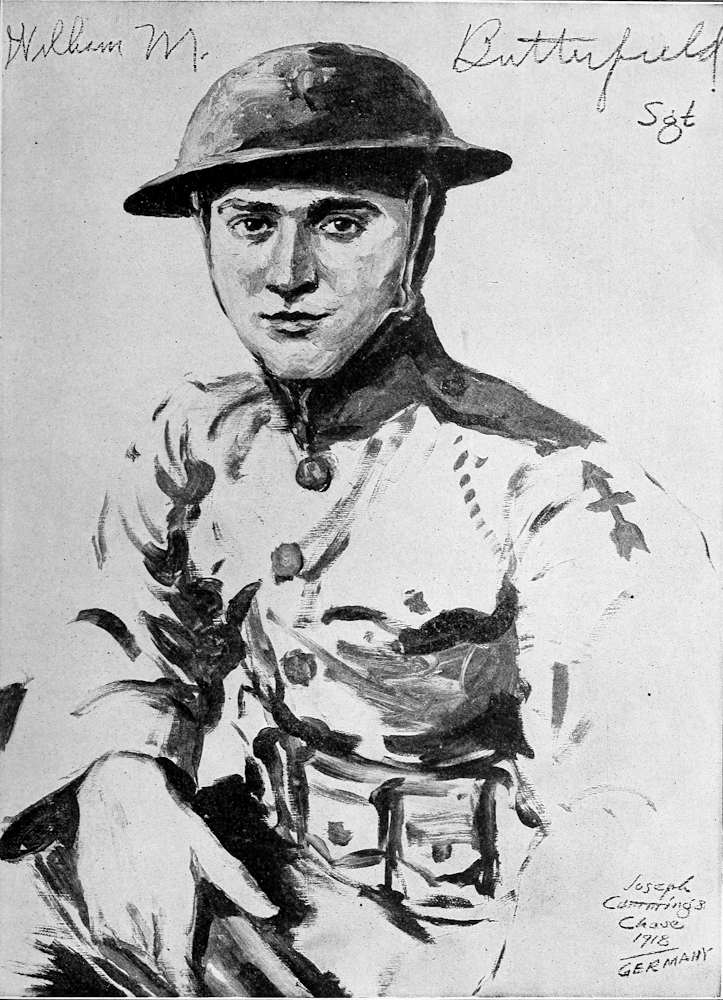
Drawn by Joseph Cummings Chase.
Sergeant William M. Butterfield
32nd Division, 125th Infantry, Company “G”
A descendant of the famous Rebel general, Milo J. Butterfield. He was made a corporal and requested to be reduced to the rank of private, in order to get to the front more quickly. He participated in three drives: Château-Thierry, Soissons, and Argonne. He was made a Sergeant in Company “G” as a reward for his splendid fighting in the latter offensive.
“‘Number 692, March 20. With reference to telegram Number 685, please advise our Minister in Berne that some one will call on him who will give him the passport Sanct Regis and who wishes to establish relations with the Foreign Office. Intermediary further requests that influence may be brought to bear upon our press to pass over the change in the inner political situation in France so far as possible in silence, in order that things may not be spoiled by German approval.
“‘Bernstorff.’
“‘Number 206, May 31. The person announced in Telegram 692 of March 20 has not yet reported himself at the legation at Berne. Is there any more news on your side of Bolo?
“‘Jagow.’
“In France the most sensational feature of the case was Bolo’s payment of $170,000 to Senator Charles Humbert, owner of Le Journal. The money was in part payment for 1,100 bonds of that newspaper. Senator Humbert immediately came out with a statement to prove that he was entirely unaware of the treasonable purpose of the purchases. He gave facts showing that Bolo Pasha had used his contract with Le Journal to extract money from Germany. On Oct. 12, the French Military Court appointed a sequestrator for the money advanced to Senator Humbert. It amounted in all to $1,200,000 and was handed over to the care of the Deposit and Consignment office, a section of the Ministry of Finance.
“Whatever the total number of millions extracted from the German government by Bolo Pasha, the utter futility of the expenditure, so far as Germany is concerned, must remain one of the most striking features of the case.”
A CONTINUING EVIL
The exposures of German intrigue and the departure from this country of the official representatives of Germany who had so grossly abused their diplomatic privileges did not by any means put an end to pro-German activities and expenditures. They were uninterrupted though necessarily transferred to channels of less commanding importance. What was true late in 1917, was practically true of the major part of 1918, before the armistice. Societies as well as individuals continued to distribute German money and carry on pro-German or anti-English propaganda. The New York Times said in October, 1917:
“The thing needs no proof. She is paying every man who will accept pay for the same purpose for which, before the war began, she was paying every man who would accept pay to handicap and weaken the arm of the American government.
“How are we to recognize the trail of her money? Before the war she was organizing strikes, blowing up factories, and purchasing the creation of a false public opinion against trading with the Allies. The outbreak of war somewhat altered her aims; there have been no purchased strikes lately and no dynamiting of factories. Her aim, which is always the same—the weakening of the government’s arm—can now be best attained by creating a false public opinion in favor of laying down our arms and consenting to peace before the objects of the war are attained. All her own moves from Berlin are now directed to that end, and when we find a movement in the United States which duplicates the moves from Berlin it is safe to assume that Germany is backing it in the same way in which she backed other movements, to quote von Bernstorff, ‘on former occasions.’
“It makes no difference that some of the men who are engaged in this movement may be merely foolish or deluded and not in receipt of money from Wilhelmstrasse. There are others who are, and these dupes are merely their tools. One and all they are doing the work for which Germany pays those who get the pay and those who do not. The ignorant zealot goes where the paid traitor sends him. That the ignorant zealot does not know the paid traitor is paid does not alter in the slightest the deadly effect of his action, the deadly effect calculated on and purposed by the German paymaster.”
The New York Tribune, commenting on the facility of espionage and propaganda by Germans, said:
“Conditions are incredible. These enemy aliens, acting as spies and carriers of information, are everywhere.
“They are going freely to and fro.
“They are in the Army and Navy.
“They occupy hundreds of observation posts.
“They are in possession of hundreds of sources of information of military value.
“They are in factories producing war-materials.
“They are in all the drug and chemical laboratories.
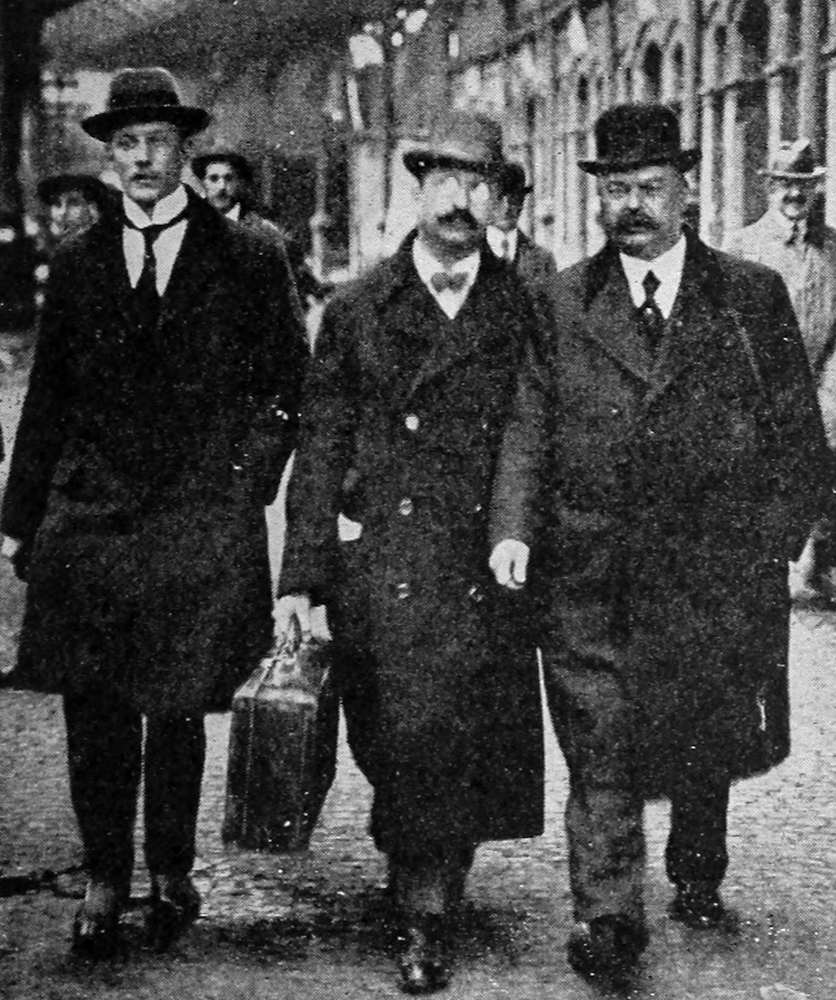
© Underwood and Underwood.
Tribitsch Lincoln
The man in the middle, exmember of parliament, is hand-cuffed to a detective. He confessed that he was a spy for the German government.
“‘If you discharge the Germans,’ says Herman A. Metz, a manufacturer of drugs and chemicals, ‘you will close every chemical plant in the country.’”
ORGANIZED PROPAGANDA
To quote again from The German Secret Service in America:
“Many of the peace movements which were set going during the first three years of the war were sincere, many were not. A mass meeting held at Madison Square Garden in 1915 at which Bryan was the chief speaker, was inspired by Germany. In the insincere class falls also the ‘Friends of Peace,’ organized in 1915. Its letterhead bore the invitation: ‘Attend the National Peace Convention, Chicago, Sept. 5 and 6,’ and incidentally betrayed the origin of the society. The letterhead stated that the society represented the American Truth Society (an offshoot of the National German-American Alliance), The American Women of German Descent, the American Fair Play Society, the German-American Alliance of Greater New York, the German Catholic Federation of New York, the United Irish-American Societies and the United Austrian and Hungarian-American Societies. Among the ‘honorable vice-chairmen’ were listed Edmund von Mach, John Devoy, Justices Goff and Cohalan (a trinity of Britonophobes), Colquitt of Texas, ex-Congressman Buchanan (of Labor’s National Peace Council fame), Jeremiah O’Leary (a Sinn Feiner, mentioned in official cables from Zimmermann to Bernstorff as a good intermediary for sabotage), Judge John T. Hylan, Richard Bartholdt (a congressman active in the German political lobby), and divers officers of the Alliance.
“The American Truth Society, Inc., the parent of the Friends of Peace, was founded in 1912 by Jeremiah O’Leary, a Tammany lawyer later indicted for violation of the Espionage Act, who disappeared when his case came up for trial in May, 1918; Alphonse Koelble, who conducted the German-American Alliance’s New York political clearing house; Gustav Dopslaff, a German-American banker, and others interested in the German cause. In 1915 the Society, whose executives were well and favorably known to the German embassy, began issuing and circulating noisy pamphlets, with such captions as ‘Fair Play for Germany,’ and ‘A German-American War.’ O’Leary and his friends also conducted a mail questionnaire of Congress in an effort to catalogue the convictions of each member on the blockade and embargo questions. Their most insidious campaign was an effort to frighten the smaller banks of the country from participating in Allied loans, by threats of a German ‘blacklist’ after the war, to organize a ‘gold protest’ to embarrass American banking operations, and in general to harass the Administration in its international relations.
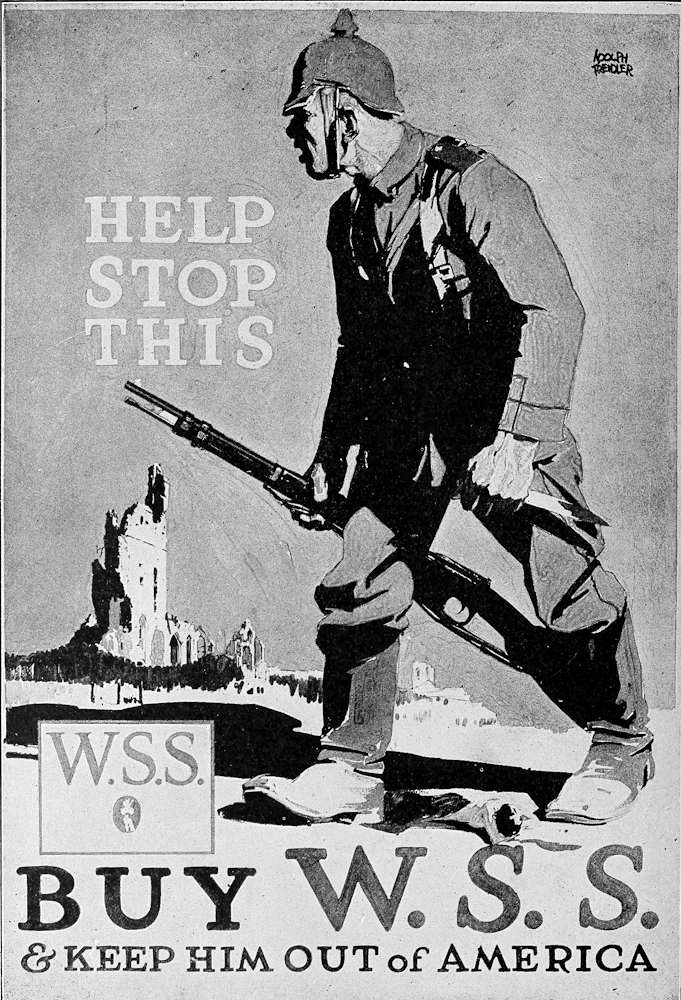
Prize Winning War Savings Poster
“So with their newspapers, rumor-mongers, lecturers, peace societies, alliances, bunds, vereins, lobbyists, war relief workers, motion picture operators and syndicates, the Germans wrought hard to avert war. For two years they nearly succeeded. America was under the narcotic influence of generally comfortable neutrality, and a comfortable nation likes to wag its head and say ‘there are two sides to every question.’ But whatever these German agents might have accomplished in the public mind—and certainly they were sowing their seed in fertile ground—was nullified by acts of violence, ruthlessness at sea, and impudence in diplomacy. The left hand found out what the right hand was about.”
PAUL KOENIG, THE ATLAS LINE’S MAN
One of the delectable agents of the Bernstorff-von Papen intrigues was a “bull-headed Westphalian” named Paul Koenig, who had been one of the Hamburg-American Line’s detectives in service with the subsidiary company, the Atlas Line. His duties brought him into close relations with sailors, tug-captains, wharf-rats, longshoremen and keepers of dives of the lowest sort. That experience, coupled with the fact that he was, as his apelike countenance suggests, crafty and brutal, made him an ideal man for von Papen’s more dastardly purposes, especially as Koenig had under him the company’s police force of ten or twelve men, obedient to his will. Here was a nice little organization ready to hand.
On von Papen’s request the Atlas Line put Koenig entirely at his disposal, and no time was lost in making use of his service. Under von Papen, Koenig became the chief of a majority of the German Secret Service groups in the eastern part of the country. Gradually his work extended to the execution of commissions for the higher-ups, Bernstorff, Dr. Albert, the curious Austrian Ambassador, Dr. Dumba, as well as the orders of von Papen. He was a sort of factotum to them on various occasions, guard, messenger, investigator, etc. But to preserve the air of unsuspicious employment the Line continued to pay his wages, his work for the conspirators being covered by special bills and von Papen’s special checks. Koenig kept a book in which were listed the names of hundreds of persons—German-Americans and Americans, clerks, army reservists, scientists, city and federal employees, etc.—indicating his wide range of sources of information and the effectiveness of his system of poisonous propaganda.
His staff had numbers and special initials as well as aliases for identification in correspondence and telephone or other communications. He provided against the tapping of his telephone wires by talking in code. His code seems to have been devised with some sense of humor in the possibility of sending listeners-in on wild-goose chases, which was often the result. Then to prevent being shadowed he had one or two of his own men trail him, ready to notify him by signal if he seemed to be the object of too persistent attention. It is said he had the trick, when being followed, of suddenly turning a corner and waiting until the detective came up, when, taking a good look to identify the follower, he would go on with a boisterous laugh. By this trick he came to know quite a number of the agents of the Department of Justice. Such a cunning and cautious fellow of course gave the police a deal of trouble to keep tabs on him. Mr. John Price Jones says in his book:
A SUPERSUBTLE KNAVE
“So elusive did he become that it was necessary to evolve a new system of shadowing him in order to keep him in sight without betraying that he was under surveillance. One detective, accordingly, would be stationed several blocks away and would start out ahead of Koenig. The ‘front shadow’ was signaled by his confederates in the rear whenever Koenig turned a corner, so that the man in front might dart down a cross-street and maneuver to keep ahead of him. If Koenig boarded a street car the man ahead would hail the car several blocks beyond, thus avoiding suspicion. In more than one instance detectives in the rear, guessing that he was about to take a car, would board it several blocks before it got abreast of Koenig.
“It was impossible to overhear direct conversation between Koenig and any man to whom he was giving instructions. Some of his workers he never permitted to meet him at all, but when he kept a rendezvous it was in the open, in the parks in broad daylight, or in a moving-picture theater, or in the Pennsylvania Station, or the Grand Central Terminal. There he could make sure that nobody was eavesdropping. If he met an agent in the open for the first time he gave him some such command as this:
“‘Be at Third Avenue and Fifty-ninth Street at 2:30 to-morrow afternoon beside a public telephone booth there. When the telephone rings answer it.’
“The man would obey. On the minute the telephone would ring and the man would lift the receiver. A strange voice told him to do certain things—either a definite assignment, or instructions to be at a similar place on the following day to receive a message. Or he might be told to meet another man, who would give him money and further orders. The voice at the other end of the wire spoke from a public telephone booth and was thus reasonably sure that the wire he was talking over was not tapped.”
But cunning, like vaulting ambition, sometimes “doth o’erleap itself,” and Koenig’s fall into the clutches of the law was due to that excess of caution that forbade him to trust any of his men or assistants. His rule was to employ no one man more than once in any service that gave him a “hold” on Koenig sufficient to warrant blackmail or threaten exposure. The detectives found this out, by observation. Then they noticed that one George Fuchs, a young relative with whom Koenig had been quite chummy at first, came to be seen less and less in his company. The detectives thereupon set about making the acquaintance of Fuchs and getting into his good grace. It did not take them long to learn that he was resentful of his unappreciative relative, and they gave sympathetic ear to his complaints. The desired result was the betrayal of Koenig to the authorities.