A TRUE HEROINE
Reading edition
The Type of Woman from Which Fate Fashions Jeannes D’Arc
Had there been a Myra Ivanovna in every sector of the Russian front in the wavering days, it is not extravagant to think the troops of the Czar might have resisted the propaganda as well as the guns of the Germans and pushed on—perhaps to Berlin. Myra was but twenty years of age, a Russian Sister of Mercy. She accompanied her brother, a military doctor, to the front. She was small, and weak and nervous, but she had a resolute will, an indomitable soul, and these gave energy and endurance to her body. She was one of the most active and tireless in ministering to the sick and wounded. The soldiers marveled to see so frail a creature perform such tasks as mark the duties of an ambulance nurse. Naturally, she inspired the devotion of those she served.
It was in 1915. There had been heavy and dogged fighting and there were many wounded. The ambulances and the nurses were kept busy. Then the Germans succeeded in outflanking the regiment to which Myra was attached, and poured a deadly fire into the trenches. M. Kupchinsky, correspondent at the front for a Petrograd paper, told her story. The London Morning Post translated it. Here it is:
“The ambulance near the 10th Regiment was not brought to the rear, despite the instructions of the commander. It was discovered that Sister Ivanovna was employed there in bandaging the wounded.
“‘Let the ambulance station go back,’ she said; ‘I shall stay here, where my hands are wanted.’
“The doctors and the wounded officers appealed in vain—she would not retreat until her brother ordered her to do so. No sooner, however, was the ambulance posted in a new situation than she moved back to her former position with a few volunteers. At this time the enemy’s reinforcements with machine guns opened a deadly fire from some heights commanding the position, and Ivanovna was slightly wounded by a bullet in the left arm. She bandaged the wound herself, and, without saying a word, continued her work.
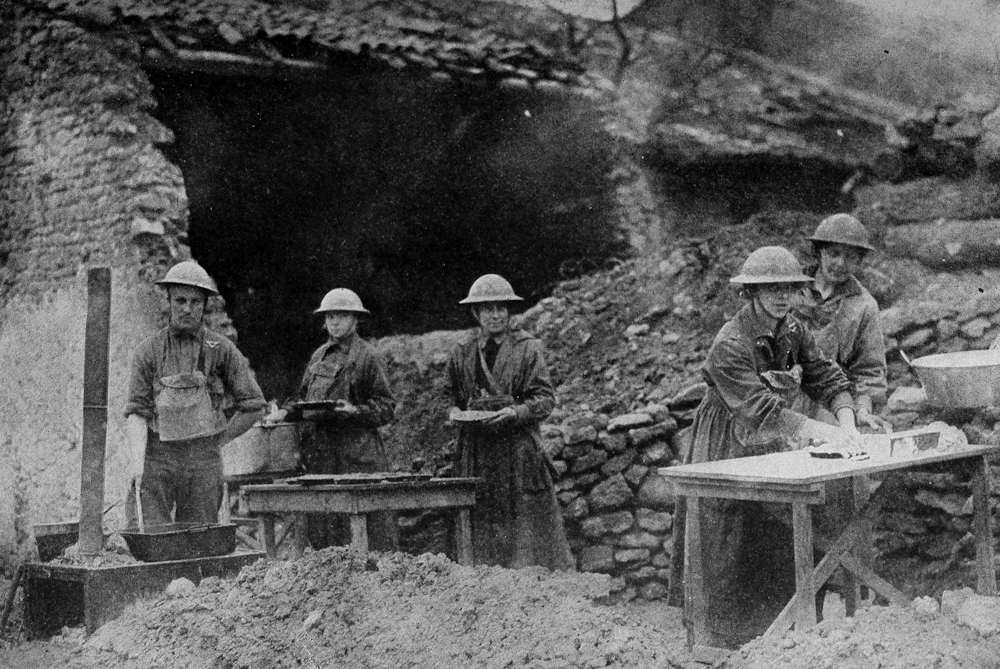
Women in the Salvation Army Followed the American Army Wherever It Went and They Served Doughnuts to Men in the Front Trenches
“The position of the regiment was a perilous one. Every moment the strength of the enemy was increasing, and the Russian ranks were decimated by their long exposure to heavy fire. It was necessary to strike a rapid blow, sharp and decisive; but officer after officer was brought in wounded, and at last word came that the commander himself had been killed. Men began to drop back from the front trenches. Indecision in the ranks threatened a panic.
SWORD IN HAND, SHE LED THE ATTACK
“Seeing that the men were wavering, and actuated by indignant horror at the unequal fight, Sister Myra Ivanovna drew a sword from the sheath of a dead officer and ran from the station. She was followed by some of the wounded soldiers, who, with tears in their eyes, implored her to return, and even tried to detain her by holding her arms, but she freed herself.
“Then, her eyes burning with excitement, she went forward. She was not alone, for the soldiers were anxious to defend this frail woman who was leading them back to the trenches, her sword raised in the air.
“The soldiers of the 10th Regiment were wavering in the trenches when, at the critical moment, Sister Myra, surrounded by a group of wounded soldiers, with uplifted sword, rushed toward the trench. At once there was a resounding ‘Hurrah!’ and the rifles of the exhausted soldiers commenced once more their deadly clicking.
“For a moment Sister Myra bent toward the occupants of the trench, and they heard the word ‘Golubebiki!’ (Dear ones). Then, rising to her feet, she ran forward, her sword flashing in the air. All the men followed her. But all the time the enemy machine-guns were steadily spitting forth their leaden pellets of death, and, though losing men with every step, the remnants of the company made a wild dash for the enemy’s trench, which they occupied after furious work with the bayonet. The enemy fled precipitately, but in the recesses of the trench, on the bloody ground trodden by the feet of the eager combatants, lay Sister Myra Ivanovna.
“Rough soldiers bent over her, and now that the excitement of the fray was over they wept as they tried vainly to arrest the flow of blood from a wound in her throat. She was carried out of the fire, but before she had proceeded far another bullet struck her, and she fell dead among the group of soldiers.”
“A true heroine,” writes Mr. Kupchinsky, “a type of the Russian woman who is guiding us to victory.”
Alas! that was in 1915.