“FORWARD, LANCERS!”
Reading edition
And Captain Grenfell’s Cavalry Troops Lived Over “the Charge of the Light Brigade”
The first officer in the British Army to win the Victoria Cross in the great war was Captain Francis O. Grenfell. He gained the coveted reward on August 24, 1914, almost at the commencement of the British fighting in Belgium, it was at the time of the great battle at Mons and the perhaps more momentous retreat that followed. The gallant little English army was struggling desperately to escape from the superior force of Germans, who gave it no rest. The cavalry was ordered to charge the enemy—to delay, head off and harass him as much as possible. Foremost among the Lancers—mounted soldiers carrying lances—who were always to the front in this dangerous and difficult undertaking, was Captain Grenfell of the 9th.
The German guns caused terrible execution. The German infantry came on in dense columns—like peas thrown out of a sack, as one soldier described it. They pressed hard on the whole of the main body of the army but especially dangerous was the position of the 5th Division. To relieve this section the 9th Lancers were ordered to charge.
“Although all knew they might be going to certain death,” as the story is told by G. A. Leask, “not one of the gallant men faltered. They sang and shouted like schoolboys as their horses thundered over the ground. They treated the charge in the spirit of sport. These dashing cavalrymen, as they rode straight at the German guns, presented one of the finest sights of the whole war. There has been little opportunity to engage in cavalry charges since. Grenfell rode at the head of his men, encouraging them by his coolness. One who took part in the charge has said that he was the life and soul of the squadron, shouting the loudest, always in the front, setting an example to his comrades by his fearless riding.
“At first all went well. Few of the Lancers had fallen, and the dashing cavalrymen were looking forward to a real fight at close quarters with the German gunners, who were playing such havoc among our troops. The men were in excellent spirits, although they knew their danger.
“INTO THE JAWS OF DEATH”
“Suddenly a murderous fire from the enemy pulled them up. Grenfell’s cheery voice rose above the awful din of bursting shells, urging his men to continue the charge. They recovered, and followed their leader. Then the enemy’s fire became hotter. It was like riding into the jaws of death. Twenty concealed German machine guns rained death on the horsemen at a distance of not more than 150 yards. Even then the gallant 9th did not waver, for they were led by a hero. Standing up in the stirrups and brandishing his sword Captain Grenfell called to his men to ride straight on. They cheered and obeyed. It now seemed as though nothing could stop this wild charge. Both men and horses had become infuriated.
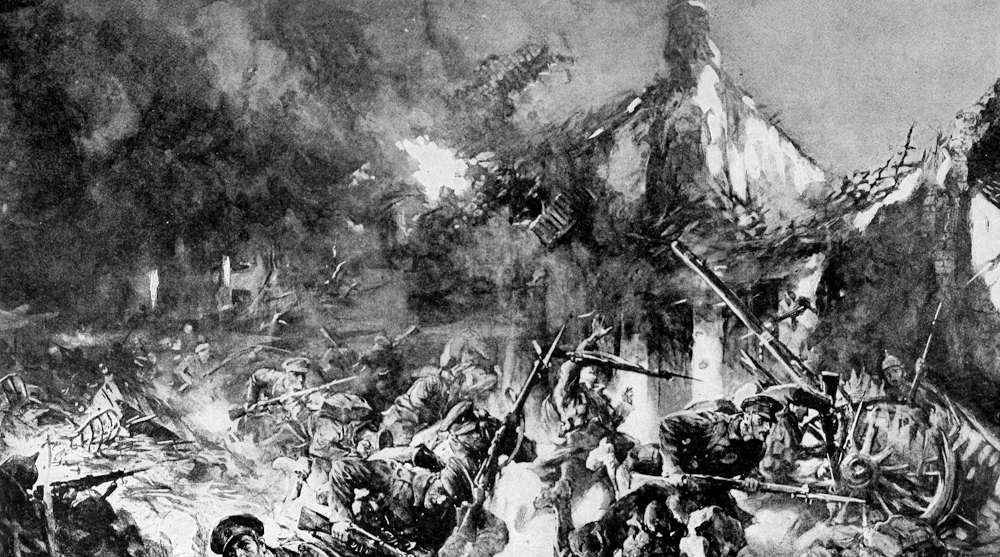
© New York Herald.
The Rifle Brigade Fighting Its Way Through Neuve Chapelle
This brigade is the youngest of regiments in the regular British Army. It was the first to enter the village of Neuve Chapelle.
“Grenfell himself seemed to bear a charmed life, while all around him empty saddles told their terrible tale. He did not come through the charge unscathed, but his wounds were not serious.
“The Lancers continued to sweep forward until finally held up by the enemy’s barbed wire, cunningly concealed in the long grass. The German trap had succeeded. To proceed farther was impossible, and in order to escape total annihilation the gallant horsemen reluctantly turned their horses’ heads and rode back. Of the 9th Lancers not more than forty came out of the ordeal.
“The charge of the Lancers had failed, but it will live forever in military annals. It proved to the world that the British cavalry was as dashing and brave as in the days of old.”
GRENFELL RESCUES THE GUNS
Grenfell’s second great exploit came on the same day. It was equally daring. When the survivors of the 9th Lancers rode off the field the Captain, although not seriously wounded, was greatly in need of rest. That, however, was not yet to be. He had espied a railway embankment, and quickly made for it with the men under his charge. When they arrived at the shelter they found a number of men of the 119th Field Battery, which had been put out of action and abandoned. There was the danger of the guns being captured by the enemy and turned against the English. It had been a great day for the artillery, no less than for the cavalry.
“This battery had been in action earlier in the day with the object of delaying the German advance and relieving the terrible pressure on the harassed infantry, who were being driven back from Mons by superior forces. The 119th Battery had given and received a terrific fire. One Germany battery had been silenced by the gunners, who were afterward attacked by three of the enemy’s batteries from different directions. The unequal contest was very fierce while it lasted. All the gunners had been killed by shrapnel, and the survivors of the battery were ordered to seek safety.
“Up till now it had been found impossible to attempt the rescue of the guns. They remained exposed to the German shells and would have been captured but for the gallantry of Captain Grenfell. An officer of the 119th Battery, Lieutenant Geoffrey Blemell Pollard, who had been trying to devise means to save his guns, came to where the Lancers were resting, and put the matter before them. Would they assist him to get the guns away?”
Captain Grenfell heard the lieutenant’s request. He carefully climbed to the top of the embankment, surveyed the position, and returned. He had seen that the Germans had now captured the guns.
Grenfell determined to get the guns, regardless of the cost. He asked for volunteers and before he had done speaking two dozen Lancers had given in their names. They did not need to be told that Grenfell would lead—they had been in the charge with him and knew that he would not send others to do his work. They would have followed him anywhere.
Grenfell led his little party of troopers into the open. Bullets were flying around, shrapnel was bursting near. “He was as cool as if he was on parade,” said a corporal who took part.
He led his men right into the hurricane of shot and shell. Every few minutes they stopped for breath, then on again. Advancing at a rapid rate they reached the guns.
“So unexpected was the charge of Grenfell’s squadron that the Germans, taken by surprise, fled in panic. Grenfell gave quick directions; rapidity of action was essential, for the Germans in the rear of the guns were pouring in a rapid fire. One gun was safely man-handled out of action. Grenfell was not the man to leave a task half-finished, and, braving the shells, he galloped back to the guns. By the time he reached them some of the battery’s horses had been brought up, and Grenfell assisted to hitch them to the guns. This done, the latter were galloped off the field. Not one gun of the 119th Battery was lost, and most of the wagons were recovered. Only three men were hit during the rescue operations. Thus ended one of the quickest and most gallant gun-saving exploits of the war.
“Later in the day Captain Grenfell was wounded. A bullet struck him in the thigh, and two of his fingers were injured. He was brought back from the firing-line, and an ambulance was sent for.
“While awaiting the ambulance a motor-car dashed along. ‘That’s what I want,’ said Captain Grenfell. ‘What’s the use of an ambulance to me? Take me back to the firing-line.’ He entered the motor-car and went back to fight....
“Captain Grenfell was twice invalided home, but on each occasion curtailed his rest in order to get back to the firing-line. He was killed while in command of the left section of the 9th Lancers on May 24, 1915. The Germans had broken through the line, but Grenfell held, and in the words of his Commanding Officer, Major Beale Browne, ‘saved the day.’”
Thus died one of the greatest heroes of the war, a soldier to his fingertips, a born leader, a true gentleman. His men loved him because they knew his worth. In his will he left his Victoria Cross—the most honorable decoration England bestows—to the men of his regiment, “to whom the honor of my gaining it was entirely due.”