GUTHRIE OF THE “KILTIES”
Reading edition
The First Canadian to Enlist Came Back with Scars of Twenty-two Wounds
Colonel Guthrie must have been born a fighter. Certainly ever since he was seventeen he showed the disposition of the warrior. His military career began with the outbreak of the South African War, when he proceeded to enlist in the Transvaal as a member of the famous Fourth Canadian Mounted Rifles. Guthrie made just one complaint about the campaign: “It ended too soon.” His adventurous spirit was not satisfied. He enlisted in the naval police. That, however, was not exactly what he wanted.
He returned to Canada in 1903. If civil pursuits were in order he would take them in the same spirit as an army campaign in the Transvaal. He studied law. When only twenty-seven he was elected a member of the legislature of New Brunswick. He was a success.
Perhaps he would have lived his life without further intensive physical experiences. The war saved him.
“It was August 4, 1914,” says the London Telegraph, “that fateful day upon which England declared war against Germany, closely following on the invasion of neutral Belgium. In a little theater up in the city of Fredericton, capital of the Province of New Brunswick, a large audience sat enjoying an interesting program. The second act had just ended. From the left wing of the stage walked the house-manager. A raised hand cut short the orchestra’s selection. Almost everybody knew what was coming. They had been expecting it for the last thirty hours. A silence fell over the entire house while nine words were pronounced by the house-manager:
“‘Our mother country has to-day declared war against Germany.’
“For a second—only a second—a lull fell over the audience. Then, as if prearranged, the orchestra struck up the strain of ‘God Save the King.’ From top to bottom the house was in uproar. Cheer after cheer rent the air. The audience as one stood singing the national anthem.
“Seated well up in front in the orchestra as the manager’s announcement was made was a man about forty-four years old. The audience, with the exception of this particular man, began to settle back in their chairs as the singing of ‘God Save the King’ was concluded. With a stride which was noticeably military he walked toward the rear of the theater and left the building. Less than two blocks away was a telegraph-office. The lone night operator, half dosing, jumped to his feet as the door opened, and the man who a few seconds ago had left the theater entered. He addressed a telegraph-blank to ‘Sir Sam Hughes, Canadian Minister of Militia,’ and then followed an offer to raise a company of soldiers for an overseas expedition.
HE RAISES A COMPANY
“‘Captain Percy Guthrie, Seventy-first York Infantry,’ the message which he handed the operator was signed. The first Canadian had volunteered his services to the King.
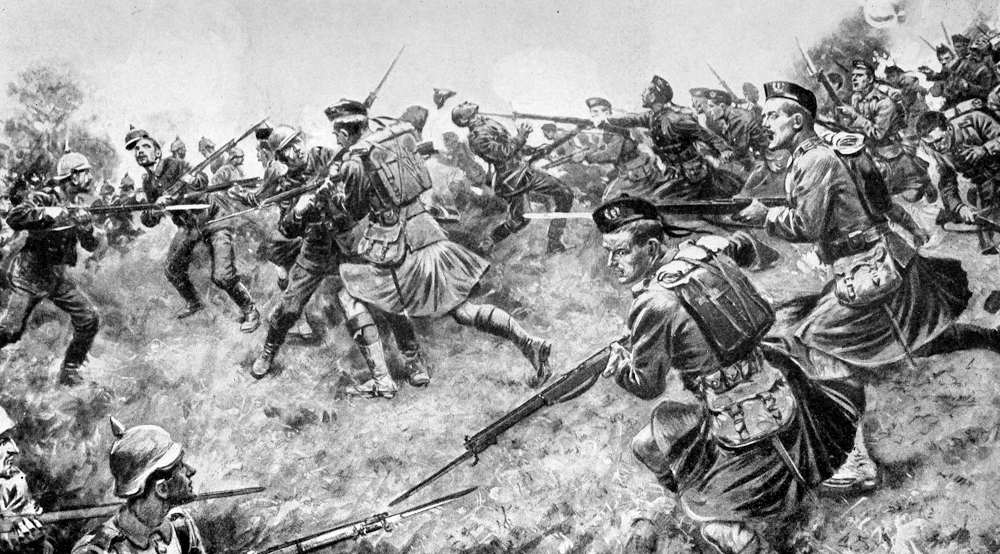
© New York Herald.
The Charge of the London Scottish
Subjected to a withering fire, the Scots were driven back from Messines three times. They finally rallied and took the position with the bayonet.
“Captain Guthrie returned at once to the theater, joined his wife, and witnessed the rest of the performance. The curtain came down, and with his wife, Captain Guthrie again headed to the telegraph-office. This time the operator was not thinking about sleep. He had just received a reply to Captain Guthrie’s telegram and was anxiously awaiting his return. The answer read: ‘Offer accepted. Proceed to recruit volunteers forthwith.’”
Guthrie raised his company and went to the front. He soon rose in rank, and at last was given command of a regiment of Scots.
Guthrie is said to possess almost a boyish exuberance of spirit, but of some things he will not jest. He will not even talk about them. Evidently the horror he has met with at the front has left a permanent impression. The following incident is told by a close friend of the Colonel’s, Charles K. Howard, representative of the Canadian Government Railway:
“On a night in the battle of Festubert the Tenth Canadians went over the trenches. The flares from the machine guns made the line as light as day. A piece of the German trenches was taken. The only injury that the Colonel at this portion of the scrap received were some tears in the legs from barbed wire entanglements, although he lost in three-quarters of an hour two-thirds of his battalion. The piece that was taken must be held until reinforcements came. These were a little slow in arriving. A captain held one end of the line while the Colonel, leading his men down the trenches, with his bombers cleared out another section. The German line began to give slowly. Step by step, they slid back around the traverses toward Givenchy. The Canadians gathered their strength and started to press forward. A brave Westphalian officer tried to hold his men and stem the tide. He stood up to his knees in mud, fighting until his last bomb was gone. The Colonel, at the head of his men, rushed upon the officer, who, weighing perhaps forty pounds less than the Colonel, was not daunted. He grasped the Colonel by both arms, holding him for a moment, and then, with the strength borne of despair, lifted him bodily into the air, holding him rigid so that he could not move.”
TAKES A MUD BATH
“The Canadians, dashing on behind, overbalanced the struggling pair, so that the Westphalian officer fell backward into the mud, with the Colonel on top. In the dark the Canadian soldiers did not know whether their leader had been killed or not. They did not take time to investigate. They rushed over the two struggling men, trampling them deeper and deeper into the mire of the trench. The Colonel found the throat of the German officer. The struggle was soon over, so that he could catch up to his men.”
During the attack on Ypres Guthrie resigned his position and asked to be sent to the Tenth. Of that engagement, Mr. Howard says:
“The Tenth had been badly battered in taking back from the woods four British guns that had been captured. The gallant Colonel Boyle, with seven machine-gun bullets in his body, had for two hours in the darkness of the night lain in a shell-hole surrounded by his men and in true Western style, with a revolver in each hand, had repelled repeated attacks. Then he was carried away to die, and Major MacLarinthe, second in command, leading the charge, was shot through the knee. After crawling forward with his men to a little clump of woods which he helped to capture he was shot through the head and killed. Major Ormand, too, fell wounded. Four officers of the thirty-one were left when it fell to the lot of Junior Lieutenant Guthrie, as he had become in order to go to the Tenth, to lead the battalion.
“During the succeeding days the fighting surged back and forth over Ypres’s hillsides, during which time the battalion suffered greatly from the gas-clouds that were let loose now and then.
“One time, when leading his men, the Colonel fell with a bayonet wound in the chin. On another occasion his nose was broken, but this did not put him out of action. He suffered from the concussion of a shell on another occasion and was knocked out for five hours. On another day he was put out of business by a gas-shell which exploded near him and he was dragged out of a ditch full of water by a British general, who forced him to emit the gas by thrusting his fingers down his throat. A scar on the knee shows where the Colonel was punctured with a bayonet-point. His hand has been ripped open by a bayonet which he held while grappling with an assailant. The outcome of it was that the Canadians held the line at Ypres until reinforcements came.”