WAS HE A COWARD?
Reading edition
The Singular Confessions of a Hollander Who Gave His Life for France
What is a coward? Is there any such thing as absolute bravery or absolute cowardice? When we characterize a particular person as a coward for failing to do, or refraining from doing, some specific thing are we quite sure that in the circumstances we would have acted differently? These are questions that suggest themselves when one reads what purport to be excerpts from the diary and letters of a confessed—or rather self-stigmatized coward, one Jan R——, a Hollander. He had lived in France some years, and soon after the outbreak of war became a naturalized citizen in order that he might join the French Army as a volunteer—not because he wanted to, but because he was ashamed to stay out.
The Atlantic Monthly published all that was suitable of the available material in a long and intensely interesting article which is a curious record of psychological study and introspection. It is highly probable that the experience was by no means unique. A candid statement by the most daring of our heroes possibly would contain the admission that there were moments when the reflections of the Hollander were similar to his own.
Jan R—— tells of morning awakenings from troubled sleep with “the oppression that something horrible was about to enter into his existence.” He felt a pang in his breast that he “should have to take part in the fighting. There was no escape.” He suffered a fear, a shifting fear that he “could sometimes suppress but never drive out.” The life in the training camp somewhat eased his emotions as he mingled with so many others, and at times he even got “flickerings of a desire to fight,” but it was not the real thing, he assumed; it was “more in the nature of artistic imagination.” In the distance was the rumbling and thudding of heavy gun fire, and as he heard it he felt “a strange respect and admiration, mingled with fear for the men in the first line of trenches.”
© Kadel & Herbert.
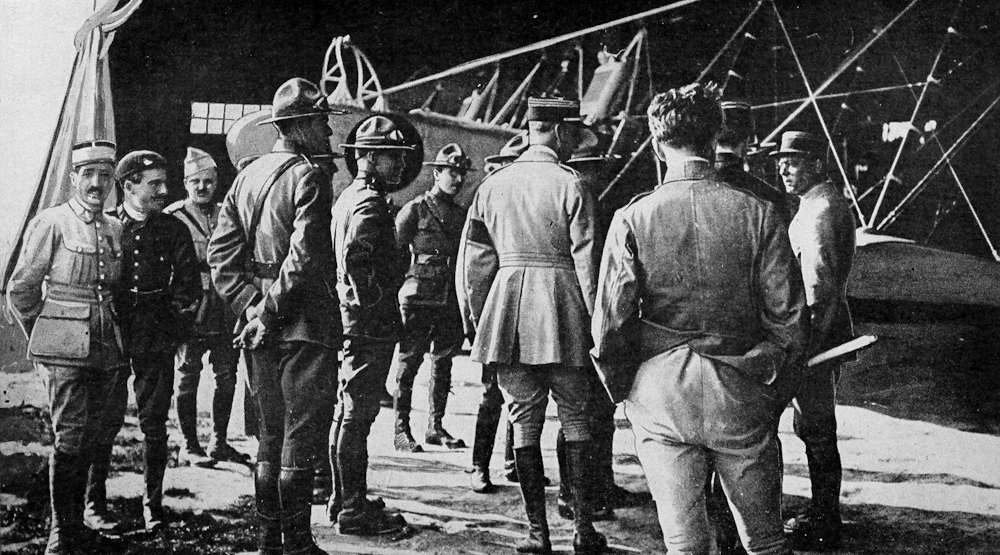
American and French Aviation Officers at an American Hangar
American aviators were among the first from the United States to do their part in the great war. There were a great many things that the French could tell our boys, and the men of the two countries coöperated in this as well as many other branches of the service.
“Before long our turn for the trenches will come. Most of the fellows are wishing for the time to come. At least that is what they say. I am dreading it. I am in earnest when I say that my life is of little value, even to myself. Yet I fear the trenches. Yesterday evening transports of wounded soldiers came past us repeatedly. Hearing the wailing and the groaning, seeing all the bloodiness made me sick.... The fear of the front suddenly overtook me. I violently reproached myself for having been so stupid as to enlist. There I was in the midst of this insane murder! And by my own free will!”
HE GOES TO THE FRONT
Finally his turn came for the front. One of his comrades was a youth named Gaston.
“The dear boy has become very much attached to me. He believes that I am a strong support for him! Must I weep at this, or laugh? Gaston has told me in great confidence that he gets occasional attacks of cowardice. And he asked me whether I did not despise him. He is terribly afraid that the fellows will notice it, but he did not mind confiding in me. Why in me? He says it is because he admires my imperturbable calmness so much. What could I reply? It seemed best not to tell him how things stood with me. Apart from the difficulties such a confession would cause me, I concluded that it would also be better for him to believe in my courage.”
THE BOY REGARDED HIM AS A HERO
“A hero! But there are real heroes and make-believe heroes; and they are not always easily distinguishable. I do not hide from myself that I belong to the make-believes. And yet, it is remarkable that I did not find the second week at the front as terrible as the first. It is not as bad there as it seems. When once you get accustomed to the idea that you may be dead in a day, or in an hour, or in a minute, and when you are clear as to your future, your mood is relieved from constant depression. Involuntarily you become kind and helpful to those about you, you do not get vexed over trifles, you are ready to make all sorts of sacrifices. Of course, if, in the midst of such a condition, a grenade suddenly drops into your trench, if you see three or four of your comrades getting killed, your misery returns, no matter how good an outward appearance you may keep up. At least, for a while. But then again the thought comes that getting wounded means rest and safety, and good care. And death? that is still less terrible. One boasts of reaching one’s destination along the shortest road! Is not death every one’s final destination?...
“It is peculiar that one can get so accustomed to danger.
“I have tried to account for it, and it appears to be like this: at first our thoughts are almost incessantly occupied with the frightful things that are about to happen. Then moments come—only a single one at first—in which our thoughts wander away, involuntarily, and dwell on something else. Suddenly fear returns. But the periods of repose become more frequent and of longer duration. And when they are disturbed by fear the painful shock becomes gradually less violent. Neither does fear itself ache so hard. And then the time approaches when one is conscious of fear only on occasions when there is a violent fire, or when men fall. That is my present condition. There seems to be a further stage in which one is rid of fear for good. So far I shall not get.”
One day he got a wound in the hip and was sent to the hospital. The nurses have gotten the idea that he is a hero. He accounts for it thus:
“A friend of Gaston’s is a distant cousin of one of the nurses. Gaston inquired after me, and apparently used that occasion to do a good deal of boasting. At any rate, some greatly embellished stories of my sangfroid have been going the rounds here. Without having to lie, I could say that all this was invented, or at least highly exaggerated. The consequence was that I was looked upon, not only as a hero, but as a giant of modesty as well. It is very annoying. However, to be honest, I must confess that now and then this undeserved praise gives me a feeling of satisfaction; I have always known that I was weak-minded.”
HE IS PROMOTED
“Back to the trenches and made a Corporal. A small thing, eh? Just the same, it made me happy. I was touched by the friendly spirit of the fellows. Gaston shook my hand at least six times, muttering, ‘Ah, mon vieux, mon vieux, how I have missed you!’ This does one good. And I had better not get lost in the question as to how much of all this attachment I deserve.”
Drawn by Joseph Cummings Chase.
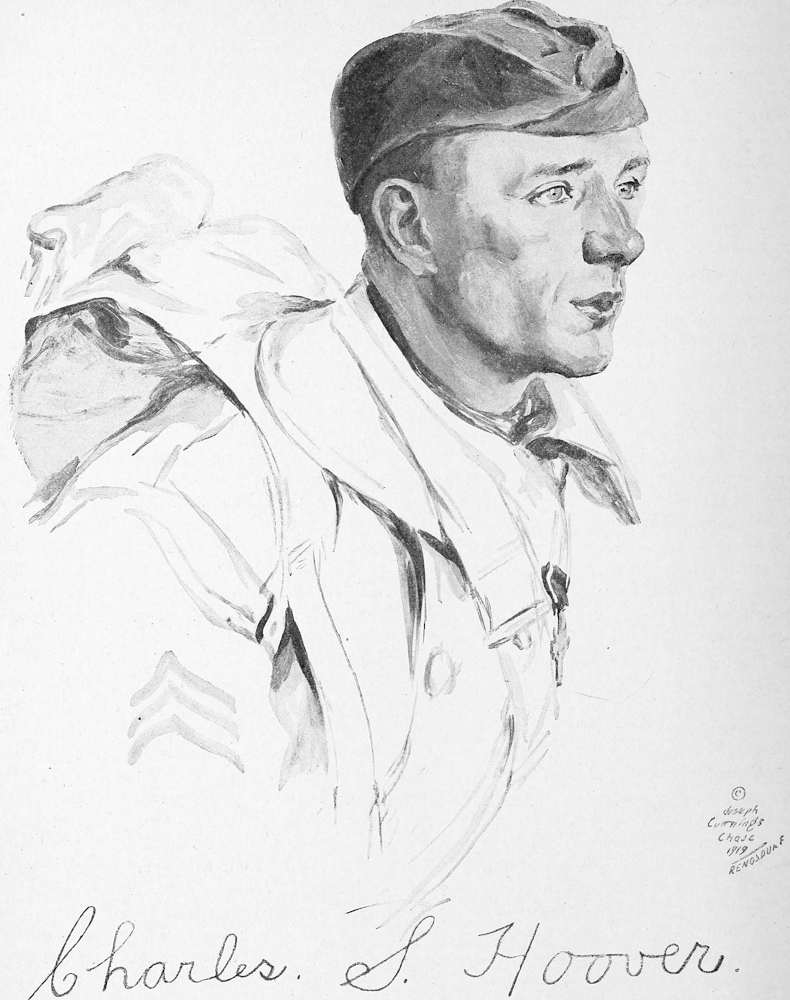
Sergeant Charles S. Hoover
32nd Division, 158th Field Artillery Brigade
During the offensive action near Brabant-sur-Meuse, Sergeant Hoover was in charge of two trench mortars. Wounded by shrapnel and knocked down by the explosion of bombs, he fired the one mortar that was undamaged until it was destroyed.
Finally comes the touchstone of character. Jan R—— wrote:
“In the early morning of the 13th the cannonading was resumed, and again we had hours of exhausting expectation. Toward noon we noticed that an unusual event was coming. The captain shouted something. I could not understand a word. Gaston understood: the wire entanglements in front of the first line of trenches had been shot to pieces. We had to hold ourselves ready. There was incessant telephoning.
“‘They are coming!’ some one yelled.
“I could not restrain myself any longer and looked over the edge of the trench.
“They were coming indeed; I saw them. In broad, irregular rows they were running toward us. Straight toward me, it seemed. And behind them, there came others, and still others, evermore. The German guns were silent now. And then suddenly ours began to roar with redoubled vigor.
“Holes, narrow clefts, and fissures were torn in the massive gray billows that came rolling toward us.
“‘Not a single one will get through!’ I heard some one shout.
“But behind the first wave came a second one, and a third one behind that. I saw them approach, losing in vigor, yet remaining strong.
“We were ready. In that moment I felt no fear! Like the others, I was burning to fly out of the trenches. Suddenly a strange silence came, and then the call: ‘Attaquez! Attaquez!’
“We clambered up, jumped over the edge of the trench, and ran forward. In front, to the left, to the right, everywhere there were French soldiers, storming forward.
“I saw the Germans coming nearer, in their dirty gray uniforms, in rows, in heaps, and in smaller groups, some even singly. I saw the glistening and flickering of their bayonets. I heard them yell and shout. My heart thumped so hard that I had difficulty in breathing. Around me our men were shouting loudly. I was shouting too, and felt relieved when I heard my own voice, however indistinctly. Now and then a rifle-shot could be heard. We were running fast. ‘En avant! En avant!’
“Suddenly I became aware of a desire to hold back a little, and thereby to postpone, if only for a single second, the terrible moment of the clash. I happened to be pushed by a comrade behind me and I flew forward again.
“At last we had reached the Germans. Six steps in front of me I saw Gaston bayoneting an officer. Not a second later the poor chap fell himself—hit by a rifle shot, as I learned later.”
“BRAVO, CAPORAL”
“Suddenly a big German stood before me, a deathly pallor on his face, his mouth drawn, his eyes crazed with fear. His terror gave me courage and a feeling of superiority. I jumped on him. He tried to defend himself, but, with all my strength, I plunged my bayonet into his body. ‘Bravo, caporal!’ I heard some one call. Scores of my comrades ran past. I tried to catch up with them, stumbled over a body, and fell, with my head to the ground. But immediately I got up again and ran forward, more slowly however; my legs felt weak and powerless. Forward again! The attack had been repulsed. The German guns began thundering again; we had to return to our trenches.
“I took the death of Gaston (and of many others) more calmly than I had feared. This is not so surprising after all. Death may strike any one of us at any moment. We have accepted that chance. But if that is our attitude toward ourselves, why should we not have it toward our friends?
“But it still seems strange to me that I can not reach a definite judgment on my action in this last fight. Certain it is that the circumstances absolutely required my doing what I did, even leaving entirely out of consideration the fact that to every one his own life is dearer than that of a stranger. I can not hesitate in the choice between a French soldier and a German soldier. But it is equally certain that killing men runs counter to my nature and is absolutely irreconcilable with ideas which I had always accepted without question. Efforts to remove the contradiction between these thoughts must inevitably fail. It is in this way that I seek to explain the fact that at one moment I am cheerful, and sing with the rest—that I am invariably rejoicing over my good luck in the last fight, not merely having escaped without even the slightest scratch, but having had besides the good fortune of killing two Germans; while the next moment I sit worrying silently, asking myself, ‘How did it come to be possible that you are taking part in this frightful war—as a volunteer?’”
He was to receive an answer on another plane. The story of Jan R—— seems to have concluded with the three words, “Fell at Souchez.”