HUMOR AND HEROISM
Reading edition
Glimpses of the Sunnier Side of the Men Who Played with Death
After relating many pitiful, tear-compelling incidents of wounded and dying soldiers in trench and in the temporary hospitals back of the front, an English Chaplain turned from the saddening episodes to some of the humorous phases of his experience among the men—humorous by contrast, that is, for some of the touches are more than prods to laughter; this for example:
“Once, in a hospital train, where a crowd of helpless men were being loaded in at a siding, I saw one man, groaning in agony from rheumatism, carried in. ‘Where are you wounded, old chap?’ asked the orderly. ‘Hoots!’ he replied, ‘I’m na wounded at a’; fling me onywhere, an’ luk after the rest.’” The Chaplain continues:
“There are countless streaks of humor and gleams of laughter even amid the sorrow-clouds of war. The mysterious diseases from which the soldier thinks he suffers sometimes puzzle you. He will proudly, and with a majestic solemnity, tell you that his illness has developed into ‘gasteria’—perhaps a more accurately descriptive name than science recognizes. More than one is sorry for his wife, who is distracted and harrowed by the ‘insinuendoes’ of her neighbors, a word almost worthy of a place in the dictionary. And many will tell you of chums who have broken down, and who were not really fit to serve, having been always of a ‘historical’ tendency. One almost feels a plea for heredity there.
“How grateful we were when we found occasions like these! For, though we were not downhearted, we were often war-weary. And frequently the good cheer of those whom we were there to comfort and strengthen really strengthened and comforted us.
MICKY FREE REVIVED
“I remember an Irishman, quite of the type of Micky Free in Lever’s novel, a rollicking, jolly child of the Emerald Isle, pretty badly battered, but with a sparkle in his eye at which you could have lit a candle. He was from Dublin. I thought I should speak cheerfully to him, so I said, ‘Well, now, aren’t you lucky to be here, instead of home yonder, getting your head broken in a riot?’ ‘Troth, I am, sir,’ said he. ‘Lucky to be here, anyway. And lucky is anny man if he’ll only get a grave to lie in, let alone a comfortable bed like this. Glory be! it’s myself that’s been the lucky one all the time.’ Near him lay another. ‘Don’t spake to him, your honor,’ said the first man with a laugh. ‘Sure, he’s a Sinn Feiner.’ But both of them were of opinion that the loyalty of the rebels might be awakened by contact with German shells. ‘Bring them out here, sir,’ said they, ‘and they won’t be Irishmen if they don’t get their dander riz with a whiz-bang flung at them. That would settle their German philandering. Sure, isn’t it too bad what we’ve been enduring to enable the spalpeens to stay at home, upsetting the State, flinging Home Rule back maybe a generation, with their foolishness, and we as good Irishmen as themselves can be?’
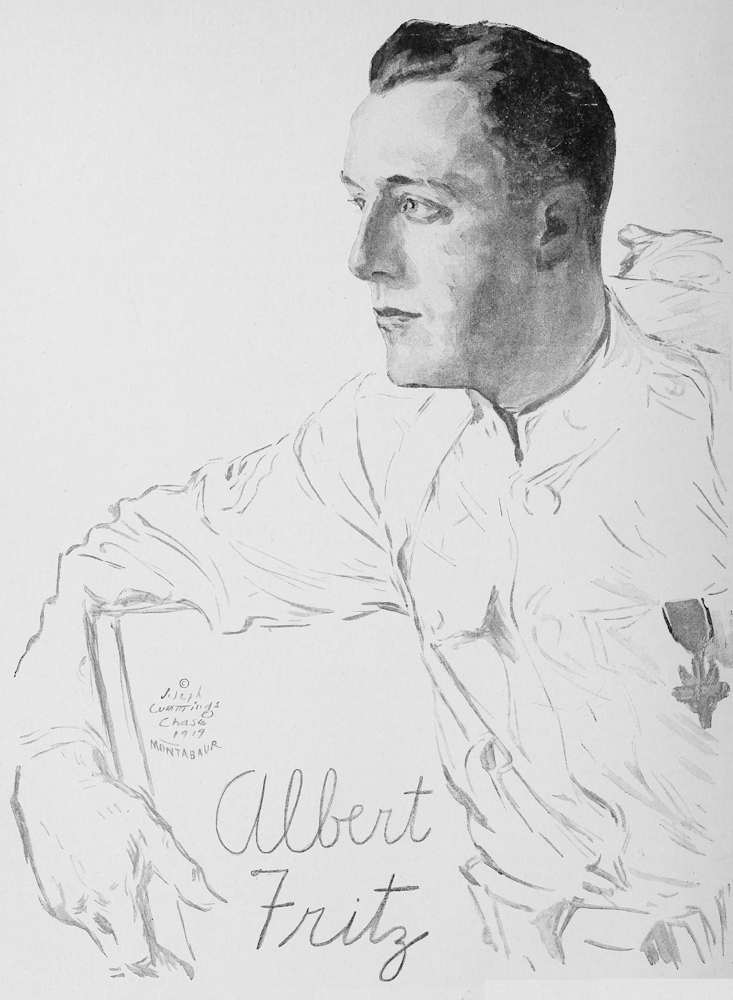
Drawn by Joseph Cummings Chase.
Private Albert Fritz
1st Division, 16th Infantry, Company “I”
Cited for extraordinary heroism in action south of Soissons, France, July 18-23, 1918. While attached to a machine-gun company as an ammunition carrier, he was wounded twice, but continued to carry ammunition while exposed to heavy shell fire.
“The infinite variety of classes that make up our present army is astonishing. I told once of a Gordon Highlander landing in Havre with a copy of the Hebrew Psalms in the pocket of his khaki apron to read in the trenches. I saw, among our own Gordons, an Aberdeen divinity student, as a private reading in the mud the Greek Testament and the Sixth Book of Homer’s Iliad. Anything, from that to the Daily Mail, represents the reading of our men. This variety is also very noticeable among our officers. We had the lumberman from the vast forests of the West beside the accountant from San Francisco; the tea-planter from Bengal; the lawyer from the quiet Fife town beside the Forth; the artist; the architect; and the journalist. And it was this mixture that made possible episodes of irresistible comicality.
GLAD TO MEET HAIG
“For instance, to prevent waste of petrol in ‘joy-riding,’ a French barrier at one place near us had guards set upon it under a British officer. One day a young northern subaltern, entirely fresh to military work, was in charge; and the tale goes that he stopped Sir Douglas Haig’s car, asking him to show his permit and declare his business. When the general did tell who he was, the boy was so taken aback that he is said to have stammered, ‘So pleased to meet you!’
“Again, a young officer told me that he was leading a well-known general around some trenches in the dark. They came to a traverse. ‘We’ll go round here,’ said the general, and the young fellow led the way. But a watchful Gordon leaped up suddenly with fixed bayonet, and, ‘Who goes there?’ The youth replied, ‘General Blank.’ ‘Ay, lad,’ whimsically replied the Scot, ‘ye’d better try again. That cock ’ll no fecht wi’ the Cock o’ the North.’
“Another, a verdantly green soldier of the King, almost freshly off the ploughed haughs of home, met an officer of high rank. He was carrying his rifle, but he huddled it under his arm, and awkwardly saluted with the open hand as though he had it not. The officer said, very kindly, ‘Here, my man, is the way to salute your superior with your rifle’; and he went through the proper regulation field-officer’s salute. But Jock, after coolly watching him, as coolly replied, ‘Ay, ay; maybe that’s your way o’t; but I hae my ain way, and I’m no jist sure yet whilk’s the richt gait o’t.’
“It would be worth while seeing this man after a few months’ training has brought him into the ‘richt gait o’t.’ In fact, the way in which the men have fallen into the habit of discipline is as wonderful as the way they leaped into the line of service for their country’s sake when they were not forced to go. I recall one, who was only a type of many. Up in the mouth of a West Highland glen is a little cottage on a croft. And the man there was the last of his race. When others passed out to the world-wide conflict, his mother, who was very old, opposed his going. But she died. And then he drew his door to, locked it, and went to share the battle for liberty which to-day is shaking the earth. There are far more men of peace than men of quarrel fighting for the soul-compelling things that are of value beyond this dying world, and these are made of the true victory stuff.
THEY ARE NOT TALKERS
“None are less given to talk of what they have done than the very men whose deeds thrill others. They just saw the thing that was needed; they seized the flying moment, and did the deed that makes men’s hearts stand still. They came out of it with something akin to the elation of the sportsman who has scored a goal. They saved their side in the game. That was what they aimed at, and they were satisfied.
“In my last battalion were two men who, working together, did breathless things without themselves being breathless. They enjoyed them. After one ‘stunt’ our people in the trench observed a man hanging on the enemy’s wire. His hand was slowly moving to and fro. They watched carefully, and saw clearly that he was signaling to them. A little group of officers gathered and considered the matter. But it was entirely impossible, they thought, to dream of attempting a rescue before darkness. So they resolved to get together a rescue party in the night and save. Meanwhile, however, these two worthies slipped away, crawled over No Man’s Land, and brought the poor fellow in. Rebuked for their temerity, their reply was, ‘We couldna thole the sicht o’ a chum oot yonder like that.’ Another time, after a bitter struggle in a patch of woodland between our line and the enemy’s, they came and reported that a man in khaki was to be seen moving from tree-stump to tree-stump, evidently in distress. ‘I think he’s daft,’ said one. And in the gloaming over they went, found him, and brought him in to safety. He had been wounded in the head and side, and left behind. The first day he had kept himself alive by drinking from the water-bottles of the dead; but he had lost his reason and his bearings, and was in despair when our brave fellows got him. And these men were killed later on by a slight accident down behind the lines.
“It was difficult to get away from the touch of one’s environment and to overcome that unwelcome realization of the grim surroundings. One morning we had a weird reminder. When we opened the door of our hut, there, on the threshold, lay an unexploded ‘dud’ shell which had fallen in the night. Had it done what had been intended, we should have been very suddenly off somewhere among the stars. It made one think a little of solemn and strange things, and feel more than a little thankful to behold again the light of the sun.
“People speak a good deal about the lust for blood and the fever-passion of battle. But our boys are not bloodthirsty.
NOT THE HUN TYPE
“A friend of mine, after a ‘scrap,’ saw a proof of this which almost cost him his life, as he had to resist the tendency to laugh, for he had been shot through the lungs. A big Scotsman, in a muddy kilt, and with fixed bayonet, had in his charge a German prisoner, who was very unwilling to get a move on. And Sandy shouted out to a companion on ahead, ‘Hey, Jock, he winna steer. What’ll I dae wi’ him?’ But Jock, busy driving his own man forward, just answered over his shoulder, ‘Bring him wi’ ye.’ Both of these men had the sweat of conflict not dry upon them. But they never for a moment thought of driving the bayonet into that reluctant foe, as the German would have done most readily. Of course, one does occasionally find the old grim warrior still, quite contented under hard circumstances, finding indeed the conditions a kind of real relief after the rust of peaceful days.
“This same friend, going one night along the trenches, almost thigh-deep in mud, came upon a grizzled Irishman, O’Hara, cowering in the rain. ‘Isn’t this a damnable war, O’Hara?’ said he. ‘Thrue for you, sir,’ was the unexpected reply. ‘But, sure, isn’t it better than having no war at all?’
“A campaign like this brings one into touch with strange bedfellows. A man I know told me, ‘In one place, during the early terrible days, we crept into a cellar, and I lay down to try to sleep. But I soon found this to be impossible, for I became aware of somebody that kept running to and fro in the dark, driving all the rest away. I went out, and spoke to the doctor, whom I met. “Oh,” he replied, “that’s only our lunatic.” It was, indeed, a poor fellow who had gone mad in the retreat; and they could meanwhile do nothing but carry him along with them.’ Perhaps the weirdest of all the strange mixtures whom I met out at the front was a young fellow at a mechanical transport camp. His father was a Russian Jew, his mother was English, his grandfather Dutch, and he himself was born in London and brought up in Glasgow. In a world of such widely international disturbance you almost expected him to go off into effervescence, like a seidlitz powder.
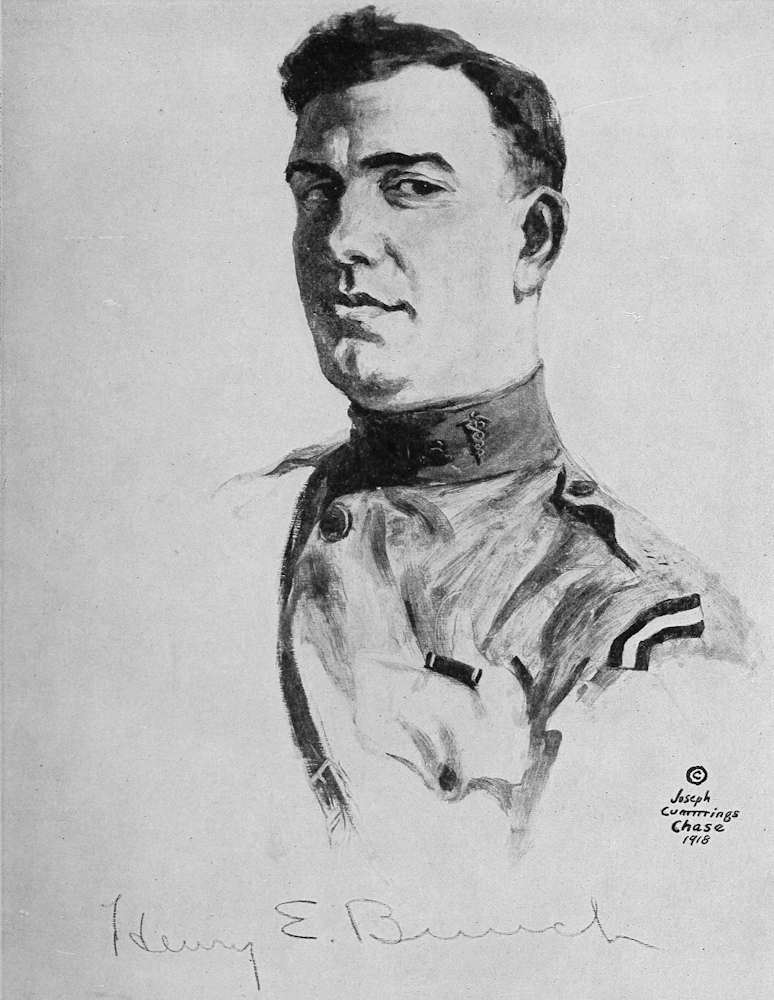
Drawn by Joseph Cummings Chase.
Major Henry E. Bunch
42nd, Division, 168th Infantry, M. C.
On October 13-16, 1918, he went out in advance of the front line near the Bois de Chatillon, France, to reconnoiter a site for an aid station and an ambulance route. Seeing a wounded officer lying about 300 meters from the enemy’s line, he went to his rescue and carried him through terrific machine-gun and rifle fire to a shell hole, where he administered first-aid.
DID NOT MERIT MERCY
“Amid the sorrows and the weariness of the times out there it was remarkable how closely laughter followed at the heels of tears. We had great fun over a colonel—not in our division—who was very unpopular. He did not know the depths of his unpopularity, but, deeming himself the best-beloved among his contemporaries, he was perfectly happy. One day, while he was sitting in front of his dugout reading an old newspaper, a sniper’s bullet passed quite close, and went ‘pip’ into the parados. He paid no attention, of course, for that was only a bit of the day’s work. But when another came, he thought it was an attention which carried civility a little too far. So he called a Scotsman to him, and said, ‘Go out, Jock, and nail that beggar.’ Jock crawled out, glad of the diversion, stalked the enemy, ‘winged’ him, and was running up to ‘feenish’ him, when the German held up his hands and cried, ‘Mercy, Englishman!’ But Jock replied, ‘Mercy? Ye dinna deserve nae mercy. Ye’ve missed oor colonel twice!’ I often wonder if Jock told the colonel how he had put it! Or is he still as happy as ever?
“It is told of Jock that, on another occasion, when a German held up his hands, after a good deal of dirty work with them, and said, ‘Mercy, Englishman. I’ll go to England with you!’ Jock replied, grimly and coolly, ‘Ay, maybe. But, ye see, that’s no exactly whaur I was gaun to send ye.’
“I was always much impressed by the Wesleyans, whom I often met in painful circumstances. I had never had anything to do with them till I came in contact with them wounded and suffering, but always most brave, patient, and truly religious. They bore their distresses without a murmur, and they died without fear. For they knew what they believed in. They had the gift of religion and the secret of a faith stronger than death. They were true mystics. I remember one day standing beside one of them who had been very dangerously stricken. His eyes were closed, and he was whispering continuously. I stooped down and listened. He was saying, over and over again, ‘Oh, God, remember me, and help me to get well, for the sake of those I love at home.’
SPEAKING TO GOD
“I was turning to slip away quietly, when he opened his eyes and said, ‘Whoever you are, don’t go, sir, I was only speaking to God.’ His religion was so intimate a possession that he did not need to apologize for knocking at the door of love with his prayer.
“Nothing could be more touching, and often at the same time funnier, than meeting men past military age who, sometimes for the sake of their boys serving, had slipped into the ranks, mentally folding down a corner of their birth-certificate over the date, and salving their consciences, as did one, who said to me, ‘I told them I was thirty-four—but I did not say on what birthday!’ I remember one old Scot, who could scarcely move, telling me, ‘I doot I’ll hae to get oot o’ this, an’ awa’ hame. Thae rheumatics is no good in the trenches; and they’re girnin’ at me again.’ Of course, he had ‘a laddie lyin’ up yonder,’ and a nephew, and ‘a guid-sister’s brither,’ and so on, like the rest. And, of course, if it were not for these pains he would be as good as ever he was! Some time later I met him in the rain, and asked how he felt now. ‘Oh,’ said he, ‘I’m just fine the day. I seen my youngest laddie gaun up, and I’d a word or twa wi’ him. I’ll be writin’ his mither the nicht aboot it. He was lookin’ grand. It was fine to get a roar frae him in the by-gaun.’
“I called on one old woman at home, and she told me that her husband had only the previous day, which was his birthday, gone off to France. ‘Eh,’ said she with unction, ‘he’s a good man, my man. I often think I was a lucky woman to have sic a man. D’ye ken—he never told a lie!’ ‘And yesterday was his birthday?’ I inquired. ‘And how old was he?’ ‘He was fifty-eight,’ was her answer. But when I asked how this modern rival of George Washington had got into the army with such an age, she innocently replied, ‘Ye see, he said he was thirty-twa.’
“How these elderly men endured for any length of time all the discomforts at the front was beyond understanding. They were, of course, frequently caught, when youth was more able to skip nimbly out of the way of death. The little, shell-swept graveyards at the front got many of them very soon.
RUNNERS AND M.P.’S
“I spoke elsewhere, some time ago, of some of the forgotten and overlooked departments of our army. There are plenty such, of course. But one cannot help recalling amongst them the battalion runners, who carry messages over No Man’s Land, or anywhere, from post to post, when air and earth are filled with hissing death, and who also act as guides up to the trenches. They are absolutely fearless. This type varies from the gaunt, silent figure, that stalks before you like an Indian through the dark, to the garrulous youth who talks all the time over his shoulder as he goes. One of the latter was leading up our men, and the colonel said to him, ‘I hear that these dugouts are wretched water-logged holes.’ ‘Deed, they are that,’ replied the guide. And then, gently, as if on a tender afterthought, ‘D’ye ken, sir, I’m often vexed for you; for I’m perfectly sure that you’re accustomed to something better than yon at home!’
“Another is the military policeman, who controls and guides the traffic at the cross-roads, and where there is danger of shells falling, in such places as the square at Ypres. There, amongst evidences of steady peril, stands this quiet man with the red band on his arm; and he steps forward to warn you that it is not safe to be there! I cannot forget one road, when we were moving up to the front. The stream of life flowing on towards the fighting area was like the Strand in London at its busiest. The policeman with uplifted hand was as powerful there as at home. In a moment, at the signal, limbers, guns, motor-lorries, ambulances, mounted men, and marching infantry stood motionless till permitted to go on again.
“The directions we got one day from an Irish policeman were unforgettable. He said, ‘It’s quite easy, your honor. You see, when you go into Albert, you don’t go into it at all. But you turn to the right, keeping well to the left all the way.’ We thanked him, and trusted to Providence, as we are apt to do where there is nothing else that can be done; and, following our directions in a general way, we reached our place in safety!
“Again, you will find, right up behind the front, the roadman busy, coolly filling up holes that shells have made, and behaving just as though he were working on a stretch of the Trossachs, or patching up the rut-worn tracks that the rain has damaged along by Loch Hourn.”
Of the airmen flying their graceful, birdlike craft, he says: “There can be no braver hearts than those. Many a time we looked up at them, sailing overhead, and wondered; and the roughest Tommy sends something like a prayer with them as they go.”