A LIVELY INTRODUCTION
Reading edition
An Ambulance Man’s First Twenty-four Hours at the Front Well Diversified
In a letter to his father, Dr. John B. Sullivan of Brooklyn, N. Y., an aid with the American Ambulance Field Service in France, Eugene Sullivan, who got quickly into the thick of things, tells the incidents of his first day where the Germans were busy. The letter appeared in the Brooklyn Eagle as follows:
“Well, after being assigned to section ... we went immediately to the front by going to ..., base of sector, and arriving there were picked up by section chief and then brought to section headquarters. Next morning, at eight, was sent out as aid to learn roads, stations, postes de secours, etc. First station at.... Arriving there I expressed my disappointment, because everything looked so quiet, except for the village, which, by the way, at one time must have been lovely, but Germans had destroyed everything—every single house and building—only a few houses had walls standing. At the improvised relay station, or poste de secours, I left the ambulance and strolled to the top of a hill.
“Here I could see and was in plain sight of a German observation balloon, and the German must have taken a dislike to my position, physique or otherwise, because before long some nice big high explosive shells started to come my way—so much so I had to postpone my sight-seeing tour and retire to the poste de secours and join the others who were in an abri, which is an enlarged rat-hole in the ground. While there an ambulance from a station nearer the first line of trenches came in with some blessés (wounded) and left word that he was going to ... to the first hospital. It was then up to us to go forward to Pont ... to take the place of this ambulance, who on his return would take our place at ... Well, all went well and we hid the ambulance at Pont ... in some bushes to wait for some poor fellow to get his ‘ticket’ for the hospital. Very little happened that day, except for the shells flying over our heads and a few airplane scraps, but no wounded. Toward evening an extra ambulance arrived, and we in the first ambulance got word to go still further to the front, to where they have never had an ambulance before, but on account of shell-fire had to wait until darkness.
“This was like preparing me for the inevitable, but finally we got a French soldier to guide us, and the driver, Harry Dunn, the soldier, and yours truly, aid, started. All went well until about half over the rocky and muddy road to Dublin I noticed the soldiers running like mad for the trenches. For a few seconds I didn’t realize what it meant, until a shell burst right near us and pieces went hissing right over the top of the ambulance. Right then yours truly grabbed his steel helmet from the guide, who was holding it, and just planted it on his head, and, believe me, thought of home, mother, etc., said a few prayers, and finally landed under the cover of the French dressing station.
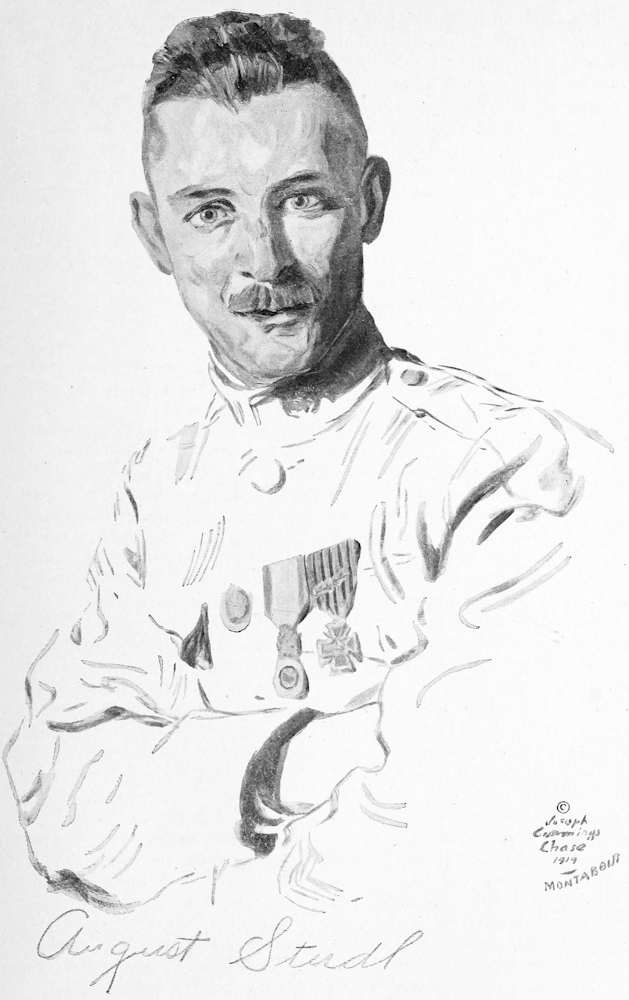
Drawn by Joseph Cummings Chase.
Sergeant August Steidl
1st Division, 26th Infantry, Company “A”
He showed exceptional bravery and control over his platoon while advancing through enemy machine-gun and artillery fire before he reached his final objective, which he took with great daring.
“Got well located and fixed a stretcher in lieu of a bed, and just about settled down to rest and sleep while waiting for candidates for ride in ambulance when the French batteries started up. They were a couple of hundred yards in rear of us and were firing over our heads, and I got up and stood at the door to see the fire of belching batteries, etc. Joe, each time one of those blame things went off my steel (crown) helmet just naturally rose off my head, but in a few minutes I got used to it and got well used to my surroundings and looked over everything. It seems all the fire of a couple of hours was just a small preliminary to an attack by a small company to jump into the German trenches, grab about a dozen prisoners and then back again—all so they could give the poor Boches the third degree for general information, etc.
WITNESSES AN AIR DUEL
“Finally, after all the firing, got a French soldier who had the good portion of his head left to take to the hospital, and as it was getting near daybreak we were ordered to ‘beat it’ under cover of darkness, or the little that was left of it. Got out all right, except that we darn near rode on top of a French battery, just as it was firing, only 100 feet in front of us, and, believe me, we hit only the high spots for about five miles. Got to hospital at ... O. K. and returned to ..., taking up our order of relief and settled down to enjoy some rest. Nothing doing for a couple of hours until just about 8 a.m., when our tour of duty (twenty-four hours) was finished, when a lot of machine-gun fire attracted our attention to the sky.
“There we saw—in my opinion—the most wonderful and yet most horrible duel between two airplanes, French and German. Saw every move they made, until finally the German—or Boche, we call them—machine broke into flames and immediately the observer of the German machine jumped 7,000 feet to his death, leaving his pilot to finish the struggle; but although the poor wretch made a grand effort to right his plane after a fall like a rocket for 1,000 feet, the tail of his machine and one wing broke off and just dropped.
“While dropping, the flames must have got to him, for he finally jumped, too, and his machine fell one way and he, all in flames, a little farther away. All the while the Frenchman in his victorious machine was flying—really dropping—and followed him down, making a spiral dive, and landed almost as quick. We jumped into our ambulance and hurried to the spot, and the sight which greeted us was horrible. I had my camera with me, but just couldn’t snap the picture. The victorious aviator then reached the spot and stood smilingly over the body while various ones took the picture.
“The German balloon observers took it all in and when the crowd of us gathered they had their artillery just drop some shells among us, so we ‘beat it,’ and that was the end of my first twenty-four hours on the front. Some baptism.
“A chap who came over with me—Osborn, of Dartmouth College—was only four days in active service with Section 28, and in going to the aid of one of his section ambulances got stalled himself and while repairing his car the Germans located him by a star shell which illuminates everything, and in this way they got a line on him and his ambulance. They paid no heed to red cross on ambulance, but let him have a shell, with the result that one leg was shattered and a piece of a shell went through his body and lung. The poor chap didn’t realize how seriously he was hurt or that he lost his leg later by amputation, but was apparently O. K., for on the morning of the day he died he was chatting merrily with every one, shaved himself and had a smoke. He even wrote a most wonderful and pathetic letter to his parents, and yet that night he died. Some say, or try to say, we don’t get under fire. I at least know what shell-fire is.”
At the date of the signing of the Armistice over 25 per cent. of the entire male population of the United States, between the ages of 18 and 31, were in military service. This represents a growth in the size of the American Army in 19 months of nearly twenty-fold, namely, from 189,674 in March, 1917, to 3,664,000 in November, 1918.