“THE PICTURES ARE GOOD”
Reading edition
That’s All That Observation Pilot Miller Cared About When the End Came
Among the men killed at Château-Thierry was John Q. Miller, of Fairview, N. C., first lieutenant of the air service, shot down July 24, 1918. He was one of the airmen of whom the public had probably not heard, for his courage and daring were not as spectacular as the bravery of Luke, Rickenbacker or Lufbery. At the time of his death he was the greatest observation pilot on the front, according to the story of Major Elmer R. Haslett in an issue of United States Air Service, the official publication of the Army and Navy Air Service Association.
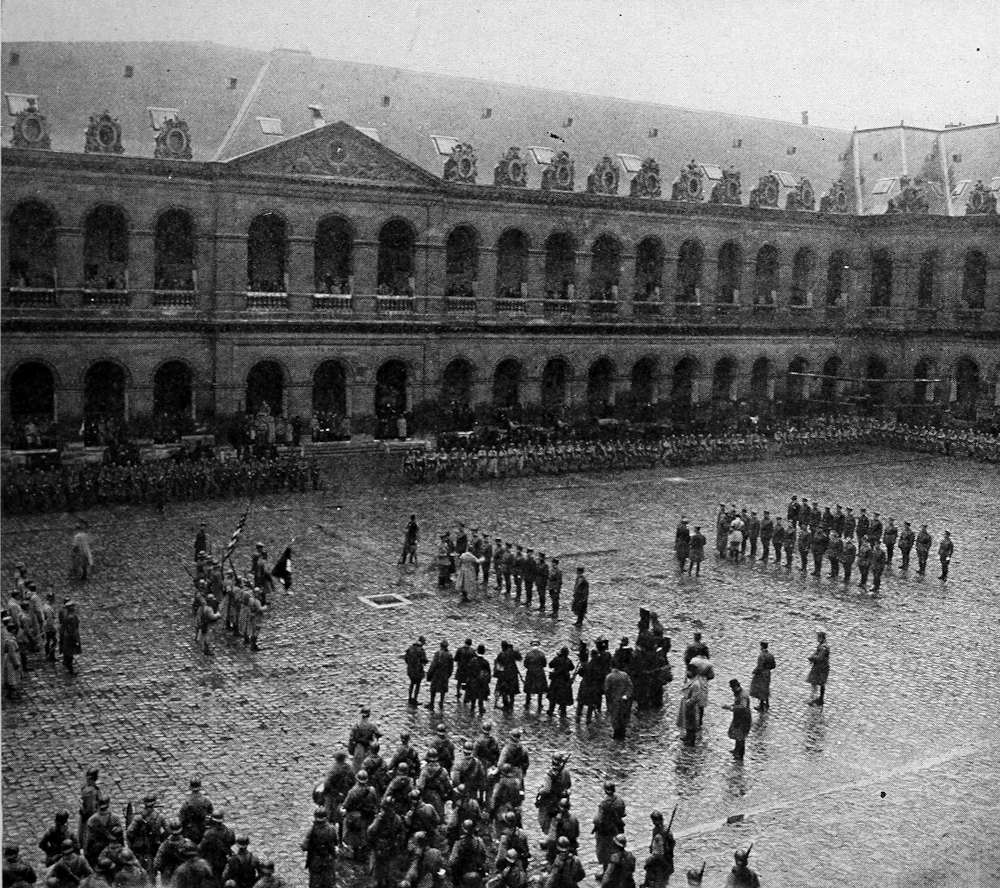
At the Tomb of Napoleon
In this historic spot a hero of the World War is being decorated for bravery.
The unsung, silent heroes of the air are the observation pilots, who at the risk of life go forward into impossible places to get pictures of enemy positions and come back with their machines riddled with shrapnel from “archie” fire. At the outset Miller, says Major Haslett, attracted attention for the serious way in which he took his work. He took assignment after assignment when he might have stayed back in the barracks, and never failed to complete his mission. Momentarily driven off by hostile aircraft or by too heavy “archie,” he would return to the job and come back with his pictures or observations, and his plane so full of holes that it had to be salvaged.
IN SPITE OF WOUNDS
Six Germans finally brought Miller and his observer down on his last trip over the lines, but not until the photographs had been made. Badly wounded, Miller pulled his plane out of a spin and landed his observer with the pictures. Major Haslett says:
“He gave the plane the gun, and they took off on Johnny’s last ride. The plane accompanying was piloted by Lieut. Baker and an observer by the name of Lieut. Jack Lumsden, both of whom were the very finest of our personnel. On this mission Thompson, I believe, was taking photographs—oblique views—which must be taken very low, in fact, dangerously low, in order that the advancing troops may see from the photographs exactly what is in front of them. It was a very poor day, and the clouds were low.
“As they were just finishing this perilous work, a drove of eleven Huns swooped out of the clouds and made for them. Five attacked Lumsden and Baker, and six attacked Thompson and Miller. Our boys were about two or three kilometers within the enemy’s lines, and, with such a superiority of numbers, of course, were immediately outclassed.
“The Hun planes surrounded Thompson and Miller, pouring in lead from all sides. Thompson, who had shot down a Boche before and had been in a number of scraps, was giving them the fight of his life. Miller was heading toward No Man’s Land. It is hard in such a fight to know exactly one’s location, and it is better to pick out one’s general direction when at such a low altitude, and be sure the plane is on the friendly side of the line before hitting the ground.
“While still about a kilometer within German territory, a bullet struck Miller in the chest and another in the arm. Thompson told me that Miller put his hand over the fuselage as if semi-conscious, then the plane started to go from right to left, climb and dive as if partly under control.
“As Thompson described it, it seemed as if Miller were doing his best to keep up his strength to go on with the flight. They crossed the lines, and as they did so Miller motioned to him in one of his conscious moments as if to point to home. He then put the plane into a dive.
“One of the German planes had dropped out of the combat, but the others were determined upon putting the plane down in flames or out of control. In these last few seconds they closed in with every gun concentrated on Miller. This fighting was so close that Thompson was aiming point blank. Miller was shot again; he made some sort of a motion as if falling forward.
MILLER’S RALLYING FEAT
“In a moment Thompson scored a direct burst into one of the planes; it made a sudden climb, then went into a tail spin from which it never recovered. Thompson swung his tourrelle round to get the one coming up on his tail. While himself falling, by sheer good fortune Thompson, fighting to the end, turned loose all he had, and the plane underneath his tail ceased firing, dived and fell within a hundred yards of the other he had just got.
“The three remaining Huns followed Miller down. One of them got Thompson in the arm and leg with an explosive bullet. The plane was out of control. By some miracle, Thompson says, as they were about to strike earth, Miller came out of his forward position, pulled the stick back, and the plane landed without a crash.
“Thompson had enough strength to jump out of the cockpit and run around to Miller, who, with a strength that was superhuman, was climbing out of the cockpit, bleeding profusely, his face ghostly white.
“He reached his arms up, man-like, and let them rest limply on Thompson’s shoulders. With closed eyes, and with a voice barely audible, he mumbled: ‘Thompson, God bless you! They got me, but I got you home, boy—and we brought the pictures back. Get a motorcycle, Tommy, and take them to headquarters. You write a report—I can’t, Tommy; you see I can’t, Tommy. And be sure to put in it that the pictures are good—that the mission was successful.’
“These were his last words, and he fell over unconscious. His wounds were of a hopeless nature, and he died without regaining consciousness a few minutes later in a sort of improvised dressing station in the front lines.
“Well, those are incidents in the life of the observation game.
“The official records credit Johnny Miller with the destruction of two enemy planes, and the French Government has bestowed upon him posthumously the Croix de Guerre with Palm, but those of us who had the pleasure of serving with him and who have lived to tell the tale credit Johnny Miller with having been just a plain, ordinary, brave fellow, who gave his life with all willingness to insure the successful completion of the mission to which his country assigned him.”