A “LEGENDARY HERO”
Reading edition
The Place in Fame to Which the French Assign Their Miracle “Ace”
In that charming French style of which he is a known master, Henry Bordeaux tells the story of a frail little boy, delicate as a girl and having the general appearance of one, with his long curls, his too pretty face, his pale complexion, his gentle manners. Because he was so frail of body and so uncertain of health he was closely looked after by the women of the household, which means, among other things, that he was quite thoroughly spoiled. The child looked like a little princess, as though adapted more to a future of effeminate surroundings, not like a boy in whose infant breast waited a great spirit.
One day, when the child was about six years old, it suddenly occurred to the father that they were taking a wrong course with the boy. After reflection he took the boy on his knee and said to him:
“I’ve a great mind to take you with me where I am going.”
“Where are you going, papa?”
“Where I am going only men go.”
“I wish to go with you.”
The father hesitated, but finally said:
“After all, it is better to be too soon than too late. Get your hat. I’ll take you.”
He took him to the hair-cutter’s.
“I’m going to have my hair cut,” said the father. “How about yours?”
“I wish to do as the men do,” the boy answered. And the beautiful curls were shorn.
There were tears when the mother folded her transformed darling to her breast, but the child stiffening proudly declared: “Je suis un homme!”
Bordeaux says here: “Il sera un homme, mais il restera longtemps un gamin aussi. Longtemps? Presque jusqu’à la fin—à ses heurs, jusqu’à la fin.”
It was Georges Guynemer, who not so very long after flamed out a boy hero of France, doing deeds that struck the world with wonderment, and while the world marveled vanished mysteriously, leaving no trace behind.
Small and feminine, educated chiefly by governesses and his sisters, later a day student at the Lyceum, afterwards for a time at Stanislas, he was not the stuff for a soldier, yet soldier he wished to be when France set out to repel the German horde. He was twenty years old then. He hastened to his father.
“I’m going to enlist.”
“You are in luck.”
“Ah! you authorize me!”
“I envy you.”
“Then as an old soldier you can help me. You can speak for me.”
“I will.”
But it was to no avail. He was not able to carry the equipment and endure the fatigue of a private, and the effects of a childhood’s illness made it impossible for him to serve in the cavalry. He was rejected—laughed at by some, be it said.
He made a second attempt to enlist with no better result. Says M. Bordeaux: “He returned with his father to Biaritz, pale, silent, mournful, in such a state of rage and bitterness that his face was distorted.” He wrote to his old preceptor at Stanislas: “If I have to lie at the bottom of an auto-camion I wish to go to the front; and I will go. I mean to serve, it doesn’t matter where nor how, it doesn’t matter in what branch, but go to the front, serve I will.”
That sort of spirit is not to be denied. Fate and circumstances make way for it.
He met the pilot of an airplane one day and in conversation with him asked: “How can one get into the air service?”
“See the Captain; you’ll find him at Pau.”
A SMALL BEGINNING
His parents, or rather his father, consenting, he was on his way to Pau next morning. He rushed to Captain Bernard-Thierry with his plea. The Captain objected. Georges pleaded, passionately, tearfully, begging even as a child for a desired object. The troubled captain made the only practicable concession—he would receive the youth as a mechanician student. The heavens opened. “That’s the thing! That’s the thing! I know automobiles.” And so it began, with hard work to the like of which he had never been accustomed, his endurance of which was problematical. But January 26, 1915, he was named as pilot student; March 10, 1915, he made his veritable first flight. In a letter to his father about this time he said: “I believe I am not making a reputation for prudence, but I hope this will come. I shall know soon.”
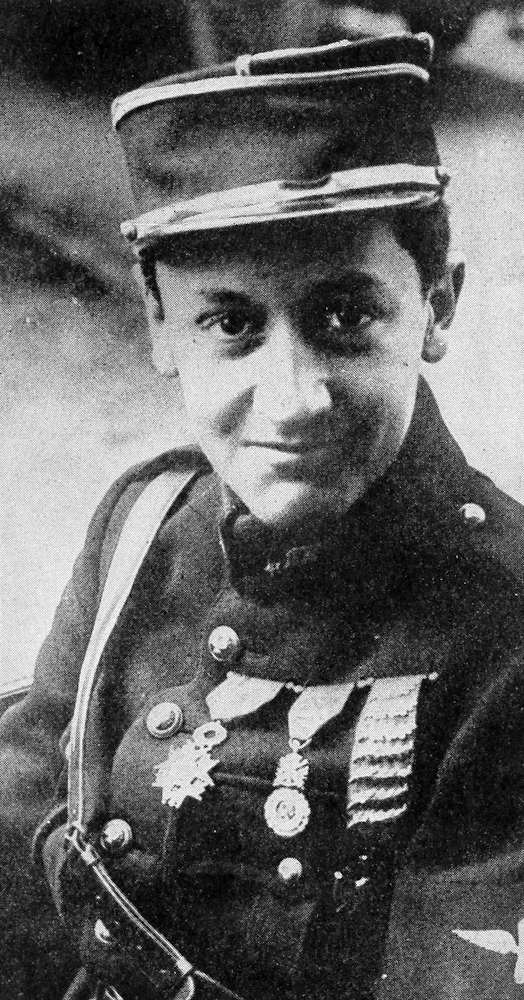
That reputation never came, on the contrary it was said of him: “Returning almost daily from his chases with his aeroplane and often his clothing riddled with bullets, hurling himself with absolute abandon against three, ten, fifteen or twenty enemy machines in formation, among which he usually succeeded in bringing down one or more; exulting in the number of wounds which his faithful planes brought home as if to bear witness to his charmed life, and encircling them with red paint to make them more conspicuous; on two occasions shooting down an enemy plane with a single bullet; on May 25, 1917, bringing down four enemy aeroplanes in one day—these extraordinary exploits coupled with the very extraordinary energy of this slim boy soon placed him upon a pedestal which raised him high above his comrades; and by reason of his many miraculous escapes from certain death, eventually surrounded him with a halo of fame unknown to the French populace since the day of Jeanne d’Arc.
© Underwood & Underwood.
Captain Guynemer,
France’s immortal knight of the air.
“Conqueror in fifty-three aerial combats wherein the result was officially established by the verification of three or more eye-witnesses, Guynemer brought down as many more German aeroplanes quite as effectively if less officially. His comrades in the escadrille knew this and respected their chief accordingly.
“Possessed of every decoration that a grateful nation could officially bestow upon him, conscious of a position in the public esteem that, tinctured as it was with the legendary, illumined him with more glory and worship than was accorded even to a Joffre or a Foch, Georges Guynemer fulfilled the expectations of his fellow countrymen, when on September 11, 1917, he disappeared from the eyes of the world while in the full exercise of his duty. The heavens swallowed him up, and to this day no reliable clue to his disappearance has been discovered. Small wonder then that the people of France in contemplation of this last exploit of their adored hero place his memory with one acclaim alongside the niche so long occupied by the heroic Jeanne d’Arc!”
MIRACULOUS ESCAPES
His fellows and the soldiers in general were devoted to him; and that their devotion was something profounder than lip-service one incident of his career, one of his narrow escapes, will attest. It was in September, 1916. He was far within the enemy lines combating seven machines when a shot penetrated the radiator of his engine and the motor stopped. He was then quite fifteen miles distant from his own lines and about twelve thousand feet in the air. There was nothing for it but to point his machine for home, with the least practicable slant, and trust to the glide sustaining him until he could reach home lines. The turn made, he gave all his attention to his pursuers, who, not suspecting his plight and having a lively respect for the generalship of the redoubtable “Ace,” seemed to think discretion the better part of valor, did not continue the chase but dived for their own quarters. The machine on its glide fell lower and lower as he approached the trenches and finally the German gunners recognized the craft as that of the dreaded young champion and the guns were leveled at him, and he was gliding through a veritable shower of bursting shrapnel. His machine was riddled and it was a grave question if it could reach the French lines. It crossed the German trenches a scant fifty feet above the heads of the enemy who stood up in the trenches in their eagerness to send a shot into the tattered plane that would bring it down.
© International Film Service.
A Duel Above the Clouds
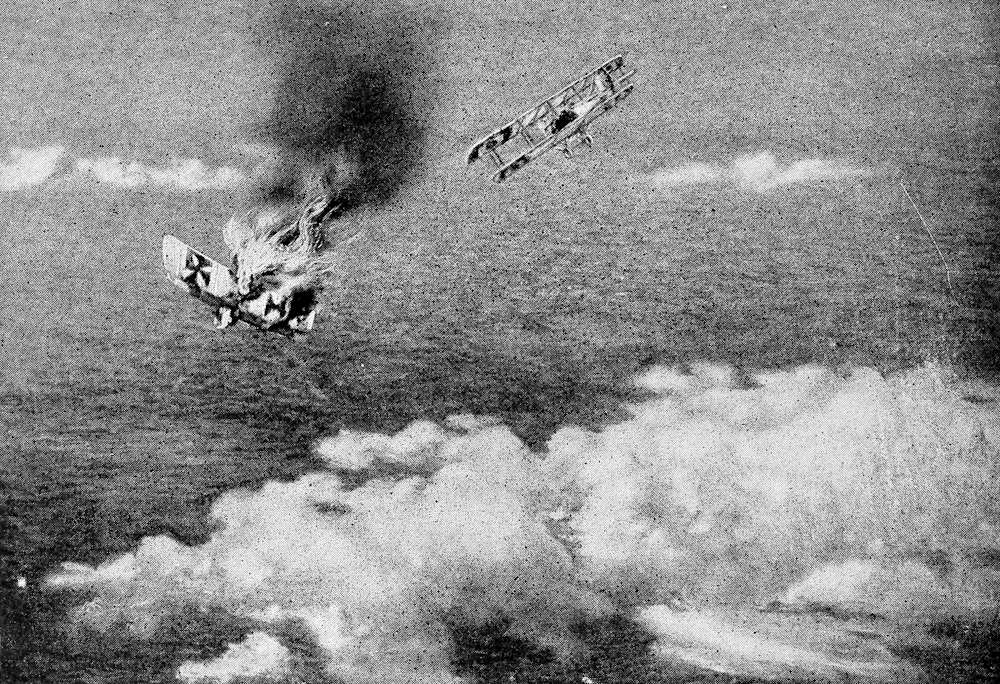
A German plane falling in flames after a fight with a French plane.
The French soldiers, who had watched the coming of the Cigogne through the rain of bullets and realized the helplessness of their idol, were recklessly and excitedly hanging over their trenches raging that they were powerless to help. Almost simultaneously with Guynemer’s consciousness of his inability to reach his lines the poilus perceived the fact and with yells they leaped to the rescue, scrambling from their trenches in a wild charge against the Huns.
The aeroplane fell into a shell hole some forty yards short of the French lines and was smashed to pieces, but the charmed pilot was thrown free of the wreck and was absolutely without injury when his rescuing comrades picked him up and surrounding him carried him hurriedly to their protecting trenches. He is credited with saying, when they marveled at his escape, “I was born on Christmas Eve. They cannot hurt me.”
M. Bordeaux, who is a loving biographer, devotes over three hundred pages to the events and deeds of the amazing hero, and there is not with it all an event recorded that is not worthy the record. Among them is an instance of the irony of fate that occasionally turns intended service into serious hurt. It was in September, 1916, in the Somme battle. Guynemer had shot down two Boche machines and was after a third at an altitude of 10,000 feet when a foolishly fired French shell meant for the enemy machine caught him in full flight, breaking a wing and taking off part of his radiator. Of course the machine began falling to the earth. By energetic efforts with the controls and the swing of his body Guynemer succeeded in checking the fall and establishing a glide, but he could not lessen the velocity with which he was approaching the ground. The catastrophe was witnessed by the troops and when the Spad crashed head first they ran to take up the remains of the doomed pilot. But when they reached the spot there stood Guynemer unharmed regarding mournfully the wreck of his machine. An idea of the force of the impact may be had from the fact that the nose of the machine was driven so deep that it could not be budged.
The jubilant soldiers lifted Guynemer to their shoulders and bore him to the General’s quarters. The General embraced him and ordered the troops to form for review. Then the adored aviator was led by the General down the lines. One can imagine the enthusiasm, the emotions of the French.
WON WITHOUT ARMS
Guynemer kept a diary of all his doings day by day, and his biographer makes free use of it. His method of entry was laconic. He never stressed a point. Take as an example of the style and as a character sketch of the man his entry of January 26, 1917, when he did that incredible thing, brought down and captured a two-seater enemy machine when he himself was without offensive arms. He went up in a borrowed machine of which he was sufficiently contemptuous. The day before he had not gone up. His only diary entry for that day was “Je regarde voler les autres et ronge.”
The translation of his entry for the 26th is as follows:
“Bucquet lends me his taxi. Gun sights nothing, simply an emptiness. What a layout! Line of aim worse than pitiful.
“12 o’clock saw a Boche at 12,000 feet. Up went the lift. Arrived in the sun. In tacking about was caught in nasty tail spin. Descending, I see the Boche 400 yards behind, firing at me. Recovering I fire ten shots. Gun jams completely. But the Boche seemed to feel some emotion and dived away full south with his motor wide open. Let’s follow him!
“But I do not get too close to him, for fear he will see that I can’t shoot. Altimeter drops to 5,000 feet above Estrées-Saint-Denis. I maneuver my Boche as nicely as I can, and suddenly he redresses and sets off towards Rheims.
“I essay a bluff. I mount to 2,000 feet over him and drop on to him like a stone. Made an impression on him but was beginning to believe it did not take when he suddenly began to descend. I put myself 10 yards behind him; but every time I showed my nose around the edge of his tail the gunner took aim at me.
“We take the road towards Compiègne—3,000 feet—2,000 feet again I show my nose, and this time the gunner stands up, takes his hands from his machine gun and motions to me that he surrenders. All Right!
“I see underneath his machine the four bombs in their resting place. 1,500 feet. The Boche slows down his windmill. 600 feet. 300 feet. I swerve over him while he lands. I make a round or two at 300 feet and see that I am over an airdrome. But not having any gun or cartridges I cannot prevent them from setting fire to their taxi, a 200 H. P. Albatross, magnificent.
“When I see they are surrounded I come down and show the two Boches my disabled machine gun. Some headpiece!
“They had fired 200 shots at me. My ten bullets that I fired before I jammed had struck their altimeter and the revolution counter, hence their emotion! The pilot told me that my aeroplane I shot down day before yesterday at Goyancourt had gunner killed and pilot wounded in the knee. Hope this unique confirmation will be accepted by authorities. It will make my 30th.”
THE FLIGHT INTO THE UNKNOWN
But after he had brought down his fiftieth, for some unaccountable reason a change came over Guynemer. He became nervous and irritable. He lost his old vivacity, nerve, dash, and with them his instincts of the air seemed to desert him. Friends urged him to rest, to give over fighting and direct his genius to teaching others to fly. But he answered: “They would say I would fight no more because France has no more decorations to give me”; and he had a jealous pride to work harder than ever, do even more valiant deeds. And he did work harder. He did take greater risks. He engaged in combats but was unable to win. Luck had turned and his chums, his comrades, knew him to be a sick man in no condition to fly. They ’phoned to their commanding officer in Paris begging him to come and take Guynemer away for a recuperative rest. Captain Brocard responded promptly. He arrived at the Dunkerque aerodrome at nine o’clock the next morning. But Guynemer had ordered his machine and taken flight half an hour before, accompanied, in another machine, by Lieut. Bozon-Verduras.
It was Sept. 11, 1918. It was Guynemer’s last flight. All that is known of it Bozon-Verduras tells. Somewhat northeast of Ypres, at an altitude of 12,000 feet, a two-seater enemy machine was discovered. Directing Lieut. Bozon-Verduras to take a position above to guard against rescue, Guynemer rushed to the attack. While on guard the Lieutenant detected a distant enemy formation and drove forward to intercept its course. But without seeing him the formation changed its course and the Lieutenant returned to position. He did not, however, see Guynemer’s machine, nor did several hours of extended search lead to any trace above or below of the vanished aviator. His fuel exhausted, the Lieutenant returned to the aerodrome hoping Guynemer might be there. But he was not. All day they waited for his return. He never returned. “Undoubtedly,” said some one of the men, “he has been taken prisoner.”
Says M. Bordeaux:
“Guynemer a prisoner! He had said one day, laughingly, ‘The Boche will never have me alive’—but his laugh was terrible. No one believed Guynemer to be a prisoner. What then?”
Nothing more is known. The Germans made contradictory and unreliable reports about his death. The simple minded among the French believe their hero an immortal, taken up into his native heaven. The lofty minded French name him “Héros légendaire, tombé en plein ciel de gloire, après trois ans de lutte ardente,” and this they have inscribed on a marble plaque in the crypt of the Panthéon, that temple which the French hold sacred as the “Sepulcher of Great Men.”