NOT DEAD BUT FIGHTING
Reading edition
Jim Gardener Quit the Trolley to Do His Bit and Did It Thoroughly
“When we went to war,” said James C. Gardener, “I figured it out this way: ‘I’m single and healthy and lots of other fellows are going over, and doggone me if I don’t go along and do my bit.’”
So he went down to the Marines’ recruiting office, in Baltimore, and enlisted. He was sent to Philadelphia and on June 6, 1917, he was one of 250 men put aboard the Hancock which went to New York for orders and on June 13 sailed for France.
Gardener had been a motorman on the Baltimore trolley, and when some months after he went to France the War Department, which did not then publish addresses, reported “J. C. Gardener killed in action” the Trolley Topics wrote an obituary of the motorman esteemed of his fellows; but as there was some uncertainty whether the J. C. Gardener killed was really the Baltimore boy, the obituary was withheld for more definite information. “Jimmie,” however, was mourned by his pals until there began to trickle through from one source and another rumors and reports that confirmed the doubt that the J. C. Gardener killed was really their “Jimmie.”
Then one day, the war over, there walked into a group of trolley-men at the Baltimore car barns a strapping fellow, six feet three, weighing 195, wearing a khaki uniform with three gold service chevrons and three gold wound stripes, a division citation cord for bravery on his left shoulder and the Croix de Guerre with palm on his breast, and the boys were doggone certain that Jimmie Gardener, motorman, was very much alive and able to give an account of himself. The Trolley Topics lost no time in possessing itself of that account, and to that semi-monthly organ of the United Railways and Electric Company we are indebted for some of the details of the fighting experience of this trolley hero whom the great Foch kissed on either cheek.
The Hancock, says Gardener was his twice by torpedoes on the way over, which “messed up both ends without crippling her very much.” He first saw action in a position “down below” St. Mihiel. He is quoted:
“It was about 4 a.m. of March 31st that they opened up with artillery. Right ahead of us was a graveyard. The shells first fell on the far side of the graveyard. Then they fell in the graveyard and tore up graves and generally ruined it. Then the shells began to crawl closer to us.
“There were four of us on guard and we reported the coming of the Germans to the officers, and the men were routed out of the dugouts. One little fellow named Roach—we called him the boy scout—was so excited that he put his trousers on backward and got his shoes on the wrong feet.
“He started with a box of ammunition for a gun and ran into another fellow with another box. The collision knocked him down and he rolled clear down a hill to the very place the gun crew was waiting for the ammunition.
“Some of us had been joking and I remember a fellow named Clark who said he wondered which of us would live to take the story back home. A buddy of mine named Hanky said, ‘You fellows write your notes to your mothers and sweethearts and I’ll take ’em back to them.’ Poor Hanky was killed in that fight.
“The fight lasted two hours. The point where I was had thirteen men to defend it. We had two Stokes guns.
“There were five hundred men in the party that attacked this point, or, to be exact, 498, according to the officers. We cleaned up the whole business. Seven of our thirteen men were killed.”
THAT LITTLE FELLOW ROACH
Gardener’s next serious engagement was in the Belleau Wood battle.
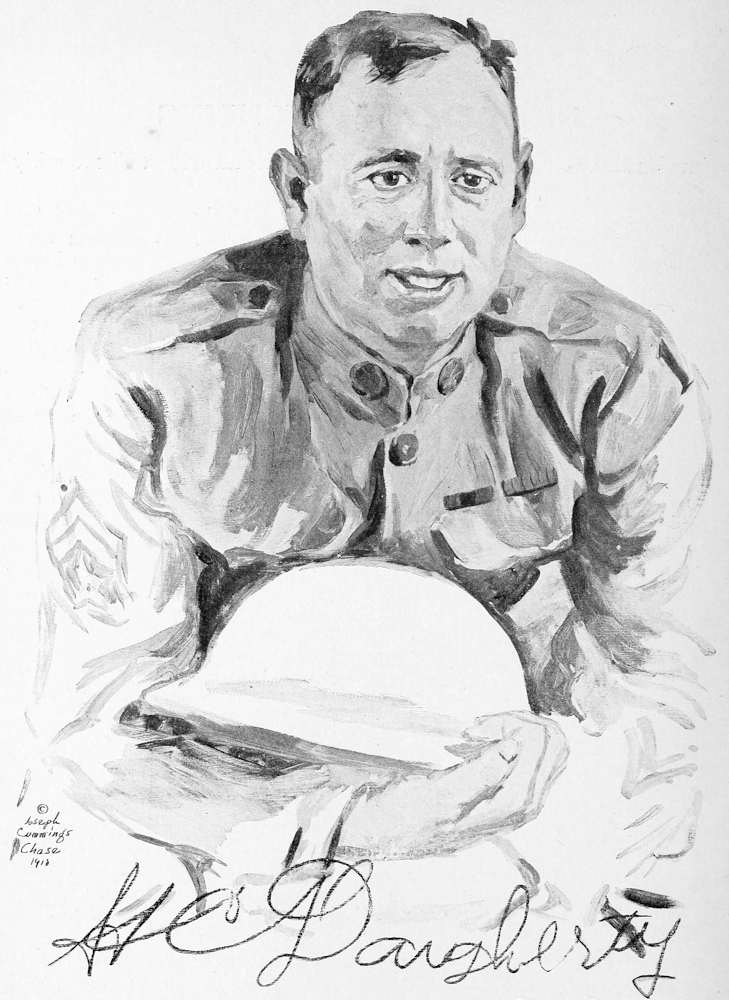
Drawn by Joseph Cummings Chase.
Color Sergeant Hardy C. Dougherty
1st Division, 18th Infantry, Headquarters Company
He was cited July 18-23, 1918, as a non-commissioned officer of splendid courage, energy and ability. When in command of reinforcements for the first line, he carried out his mission with complete success. Upon being relieved he returned to bring to safety on his back one of the seriously wounded of his detachment.
“We moved up to the woods gradually. We met Algerian troops belonging to the French Army. These Algerians claimed that they had been kept at the front too long. They were never taken to rest-camps or had any relief. Many of them committed suicide. They said they were tired of fighting. We met some that were running wild, shooting in all directions, and had to take shelter to keep from being hit by stray shots.
“We met many French moving back, too. They said that the Germans were very numerous in the woods.
“That little fellow, Roach, crawled out in a field, dug into a haystack and climbed to the top. From there he could see that Germans were hiding behind bushes farther on.
“He came back and said he was going to raid ’em. The officers said he didn’t have any right to do this without orders. ‘Well,’ said Roach, ‘this ain’t a regular battle, you know. This is just a little private party of my own.’ He said he wanted a dozen men to volunteer to go with him, and the dozen volunteered at once. I never saw a time when volunteers were called for among the marines that any one wanted to stay back. Everybody wanted to go.
“Well, Roach got his men as quick as he could count ’em. ‘Come on, fellows,’ he said: ‘I’m going to have them Germans for supper.’
“We cleaned up fifty of ’em.
“‘Did Roach or any of his dozen men get the Croix de Guerre for that?’ we asked.
“‘Oh, no,’ answered ‘Jimmie,’ ‘as I said, that wasn’t a regular affair. It was only Roach’s own party and there wasn’t nothing official about it.’ It was funny to see our bunch. Roach was a little fellow about five feet seven, and he chose as the second in command of his party a lanky artilleryman who was six feet eleven. The rest of us were just ordinary size, like me.’ (‘Jimmie’ Gardener is six feet three in his stocking feet and weighs 195 pounds!)
“That artilleryman had just drifted into our bunch somehow. They had put him out of the artillery because he had flat feet, and told him to go home. He said he didn’t want to go home. He wanted to fight, and he was going to stay with us whether he belonged with us or not, and he did.
“In a day or two we were put in trucks and hurried forward. We knew now that the Germans were pressing hard in their attempt to reach Paris. The French were falling back. We were run in those trucks directly between the retreating Frenchmen and the advancing Germans, and we got mixed up with the enemy so quickly that we simply tumbled out of the trucks oftentimes to engage in hand-to-hand fighting with the Huns.
“We went right at ’em, and this thing kept up for four days. We had nothing to eat, nothing to drink, nothing to smoke—and everybody longed for a smoke, even fellows who never smoked before they entered the service—and we had no sleep in all those four days and nights.
“A great deal of the time we were in close fighting. There was where the Germans failed. They were all right when they were twenty-five or thirty yards away and could use their rifles, but when it came to the bayonet they turned and fled.
“Sometimes we fought so close that it was impossible to use the bayonet. We had to knock ’em down with our fists first.
“Everybody said the odds were against us in this fighting. While we had some reserves there were only two regiments of us fighting and we were against three German divisions, including the Prussian Guards. But in four days we advanced one and a half miles.
“We suffered terrible losses. When we reached the town of Lucy, where we halted to be reorganized, there were only 150 men left in my company of 335 men.”
THE MAJOR SAID IT
“There was another company whose commander was killed and a major took charge. In the middle of the fighting he had lost so many men that a French officer advised him to retreat. ‘Retreat hell!’ he cried: ‘I’m going on as long as I and one man are left.’ It came near coming true, for when he reached Lucy he had just three men left with him out of an entire company.
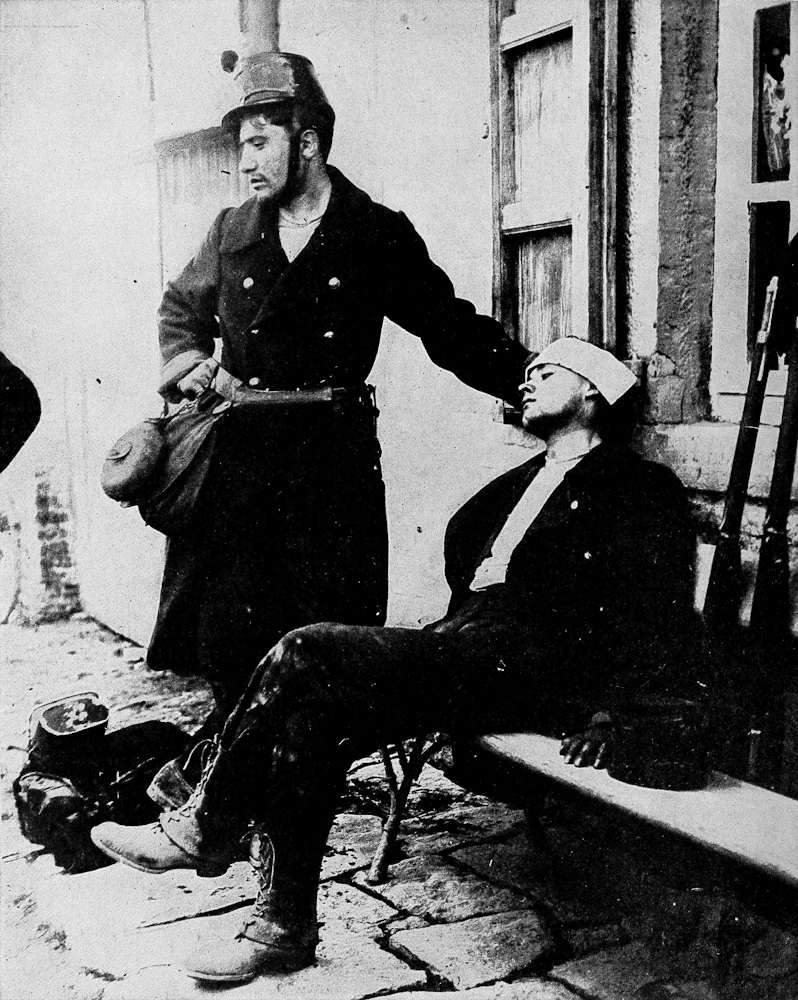
© Underwood and Underwood.
Brave to the Very End
Though physically wounded—often mortally—the spirit of the French soldiers never perished, but immortalized their efforts in conflict.
“We saw some horrible things in Lucy, At one house we found an old French woman, She said she was with her three daughters—16, 18, and 20 years old—when the Germans came, and they had remained there without any protection from the Huns who took charge of the house. We asked where her daughters were and she said they were upstairs and she guessed they were asleep.
“Several of us went to learn the fate of the girls and we found all three stretched out with their throats cut from ear to ear, and their bodies horribly slashed. The Germans had deliberately butchered them when they were forced out of the town.
“When we told the old lady of the fate of her daughters she was stricken with heart trouble and died in a few minutes, but before she died she asked that we bury her with the three girls in the little grove near her home. We did it although we were under fire the whole time, and eight of our men were killed while burying those French women.
“The next day we pushed on and got through the woods. That was the hottest fighting of all. The Germans used more artillery, and when the day was over the number of men in my company had again been reduced to about 150. Some companies had only a dozen or fifteen men left.
“One of the fellows killed that day was a fellow from South Baltimore who used to be a chum of mine before we went to war. His name was Halle. He said to me that morning: ‘Jim, I feel I’m going to get knocked off to-day. Never tell my people that I was killed. Just tell them that I am somewhere in France.’ He was killed and I haven’t told his people and never will, but they found it out through the War Department.
“We next went to the Marne. There we fought in the river. It was tough luck for a fellow to be wounded there, for as he sank down he was drowned. It was often close fighting, bayonet to bayonet in midstream, and must have been a pretty sight for people to look at if there’d been any spectators there, but it wasn’t very pretty for those in the fight.
“After the Marne battle our company’s ranks had to be filled again. Once more we had been reduced to about 150.
“Next we went to Château-Thierry and fought there for nine days, which was followed by a three-day hike to Soissons, which we reached on July 18, 1918. The next day we went over the top at 3 a.m.
“Ten minutes later I went down with a wound that crippled my ankle. I was gassed, too, and suffered shock. When I came to my senses in a hospital I had two other wounds that I didn’t know anything about. They told me that as the ambulance was carrying me to the rear it was struck by a shell which killed some of the other wounded men and presented me with a couple more wounds for good measure.
“Outside of having been in a bunch of hospitals in France and America that’s about all I know about the war,” concluded “Jimmie” Gardener.
“You haven’t told why you got the Croix de Guerre and the palm branch,” we suggested.
“Oh,” said “Jimmie.” “I was awarded the Croix with the six other fellows for cleaning up that bunch of 498 Germans in the quiet sector I told you about. The affair they gave me the palm for was rescuing a lieutenant who was wounded in the Belleau Wood fighting.
“I don’t know who the lieutenant was, but he was a newspaper man who had entered the fighting forces and he was out in advance of the line when he was wounded. Several of us volunteered to go out and bring him in, but we did not know exactly where he was. It was during the night and very dark. Along about four o’clock, as I was crawling along, I fell plumb into a shell-hole, and there he was with his leg shot off.”
“SORT OF SWIMMING-LIKE”
“I put my coat around him and bandaged his leg up as well as I could. Then he got his arms around my neck and I held on to him with one hand and dragged myself, sort of swimming-like, along the ground with the other.
“I had only an hour and a half before daybreak when the Germans would be able to see us, and in that time I managed to make about twenty yards to another shell-hole. We lay in that all day. The lieutenant suffered a great deal. I gave him what water I had in my canteen.
“When night came on we started again and before morning had made the rest of the distance—about sixty yards—to our trenches. The lieutenant got well. They say he is a great writer of books and things. He belongs in New York State somewhere.”
“Were you kissed when the Croix was presented to you?” we asked.
“Yes, General Foch pinned the badge on our coats and then kissed us on both cheeks. We were all smiling when the kissing was going on.”