O’LEARY STEPPED IN
Reading edition
And Faith, Never a Dumas Hero was a Marker to This Sergeant of the Irish Guards
He got the habit and trick of it early they say. He played outside the home cottage in Macroom, about forty miles from the city of Cork, charging imaginary foes, stick in hand, with so much vigor that the plump hens scuttled to cover. His mother at the door of the cottage demanded,
“An’ what is it ye are doin’ now, Mike?”
And the curly-haired youngster replied:
“I’m a sodger.”
Twenty years later the same mother stood outside the same cottage door in Macroom listening to the almost unbelievable story of a messenger who had dashed from Cork city by motor-car. Her son—her Mike—had won the great war medal. She heard how the world was ringing with the immortal exploit of Sergeant Michael O’Leary, V.C. Poems were being written about him. He had received an ovation in London such as kings might envy. And all this was no more than the brave Irish Guardsman deserved, for with his unaided strong right arm he captured an enemy position, and of ten Germans who stood in his path he killed eight and took the remaining two prisoners....
O’Leary was sent to the front in November, 1914. Mr. Leask has told the story.
All around the La Bassée district fierce fighting had raged since October. The 1st Battalion of the Irish Guards, in common with other regiments, now experienced the severities of trench warfare. At the end of January they were stationed near the La Bassée brickfield, and the Germans were subjecting them to a withering fire.
Copyrighted in U. S. A. by New York Herald.
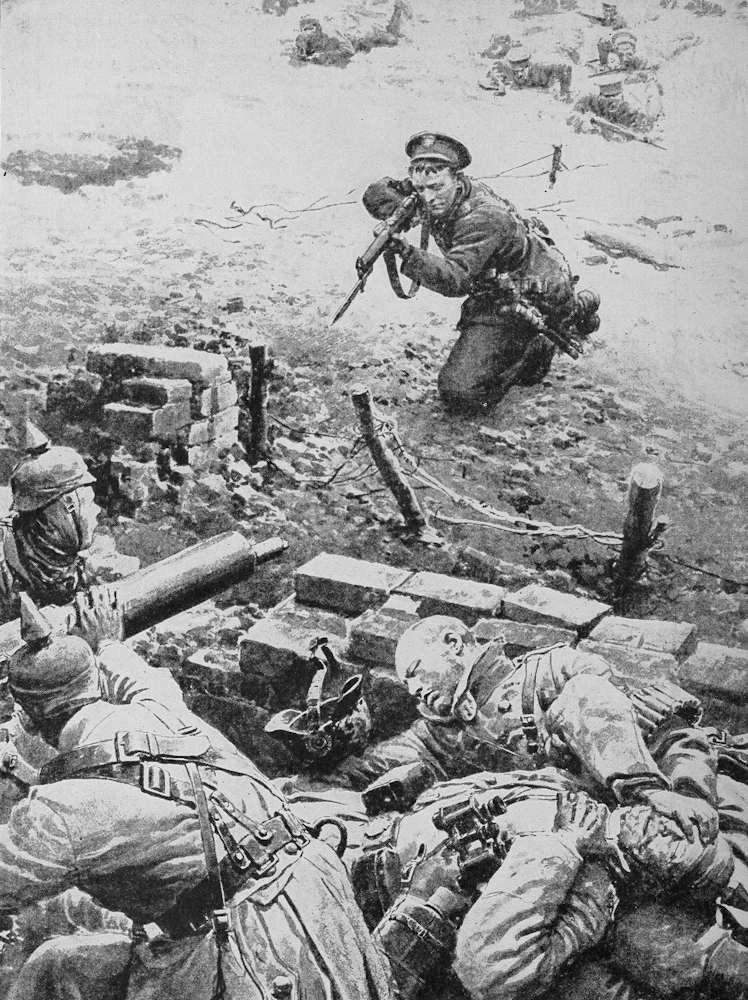
How Sergeant O’Leary of the Irish Guards Won the Victoria Cross
“He rushed on like one possessed, never looking behind to see if his comrades were following. A railway bank rose in front of him. He cleared it, and went on, heedless of risks....”
The last night of January the enemy’s fire was particularly hot. It was decided that the trenches were too expensive to hold. But before evacuating them the men were ordered to storm the enemy’s position.
In order to prepare the way for the assault, the artillery commenced one of the fiercest bombardments of the war up till then. The boom of the big pieces and the detonation of their shells were audible twenty miles away. The guns fired with such intensity in order to demolish what had become a regular bastion in the German lines, also to break down the barbed wire entanglements in front of the German trenches, and thoroughly to demoralize the enemy before the men stormed the positions.
No. 2 Company of the Irish Guards was ordered to keep up a hot rifle fire. This was to make the Germans keep under cover, no matter how much they wished to escape from the artillery. The diversion also caused the enemy to expect an attack from this direction, with the result that he concentrated his fire on the trench occupied by No. 2 Company.
Then No. 1, O’Leary’s Company, which was on the left of No. 2 Company’s trench, was ordered to charge. The Irish dashed over the parapet with a yell, their bayonets fixed, and rushed at the enemy in fine style. The distance they had to cover to reach the German positions was from 100 to 150 yards. The men were very eager to be at the enemy after their long spell in the trenches, and went for their foe at racing speed.
O’Leary soon outstripped his comrades. His Irish blood was up. “You would laugh if you saw us chasing the Huns and mowing them down,” he wrote to his parents.
CHARGE OF THE “MAD IRISHMAN”
He rushed on like one possessed, never looking behind to see if his comrades were following. A railway bank rose in front of him. He cleared it, and went on, heedless of risks, toward a strong barricade held by the Germans.
O’Leary paused at a little mound and looked around. In front of him was a deadly machine gun, trained on the trench occupied by the second company of Irish Guards. As already explained, their work was to deceive the enemy and the maneuver had proved successful. Their rifle fire had prevented the Germans from showing their faces, and they had not seen that the British were racing toward them.
When O’Leary reached the mound the Germans became aware of their danger and immediately prepared to turn the machine gun upon the advancing First company. It was a critical moment. O’Leary did not hesitate; he took deliberate aim with his rifle at the gun’s crew, five in number, and one by one they dropped as his unerring finger pressed the trigger. His bold move in a supremely dangerous situation had been successful. The machine gun was his. The lives of his comrades were saved. For an ordinary man this brave deed would have sufficed. But what O’Leary had just performed whetted his appetite for more.
Another barricade farther on had caught his eye. With daredevil audacity, he bounded toward it. The Germans then were prepared for him, but he “got his blows in first,” and killed three more Germans. The two remaining had no stomach for the “mad Irishman.” They promptly raised their hands, and O’Leary secured them as his prisoners.
He confessed afterward that his second exploit was a hazardous one. He had no bayonet at the time and had to trust solely to his marksmanship. His rifle was loaded with ten rounds, and eight of the bullets found a human billet. When the last two Germans surrendered he had no ammunition left, and had they not been demoralized by his sudden and audacious attack single-handed, the issue would have been different.
Sergeant O’Leary had killed eight Germans, captured a machine gun, taken two Germans prisoner, and carried two strong positions, from which the rest of the attacking party would have been heavily fired upon. Some one has said that this exploit was thoroughly Irish in method and execution, and that O’Leary deserves to rank as one of the greatest heroes of modern warfare.
Describing what happened afterward, Company-Quartermaster-Sergeant J. G. Lowry, of the Irish Guards, says:
“O’Leary came back from his killing as cool as if he had been for a walk in the park, accompanied by two prisoners he had taken. He probably saved the lives of the whole company. Had that machine gun got slewed round, No. 1 Company might have been nearly wiped out. We all quickly appreciated the value of O’Leary’s sprinting and crack shooting, and when we were relieved that night, dog-tired as we were, O’Leary had his arm nearly shaken off by his comrades.”
When on furlough O’Leary was fêted and cheered as no V.C. hero has been. He received a splendid welcome in Cork and in his native village. The greatest day in his life, however, was June 26, 1915, when Londoners turned out in tens of thousands to acclaim him in the streets. To honor him the London Irish organized a demonstration in Hyde Park, at which over 60,000 persons were present. O’Leary drove from the Strand to the Park in an open carriage, cheered all along the route by an admiring throng. O’Leary was a proud man but, as he afterward protested, he “didn’t know what all this fuss was about. Faith, a bit of a shindy is no great matter at all, at all!”