CORPORAL HOLMES’S WAY
Reading edition
And a Right Good Way to Win the V.C. and the Hearts of Men
Fred Holmes, corporal in the Yorkshire Light Infantry, was awarded France’s chief military decoration, the Médaille Militaire, for gallantry during the fight on the Aisne. The official account of the exploit is quite brief: Holmes saw a platoon of French struggling against heavy odds, whereupon he dashed over the river for a machine gun, carried it to the platoon, and turned it on the enemy, with such effect that the German pressure was immediately relieved. However, when Corporal Holmes’ name is mentioned men usually think of the thrilling record at Le Cateau which brought him the V.C.
The Yorkshire Light Infantry were in the very thickest of the fighting at Mons. At the little colliery town at Warmb they received a severe shaking from the enemy, but gave as good as they got. It was after the engagement at this place that the brave fellows, footsore and tired, but still cheerful, tramped many weary miles to the famous battlefield of Le Cateau.
It is not necessary to describe the stand made there, but only to mention a few facts, as recorded by G. A. Leask in his Heroes of the Great War, without knowledge of which Holmes’s feat would be unintelligible.
Orders were given to entrench, and the men set to work with zest, glad of the change from the continuous retreating. The task accomplished, the regiment lay down in the trenches, while the booming of the German guns grew ever louder.
At dawn of August 26 there was suddenly a fierce bombardment from the enemy’s artillery. According to Holmes, “We could feel the breath from their guns. It was awful.” The Yorks stuck to their trenches, firing incessantly. They had been told that French troops would reinforce them, but as the day dragged on no French appeared. The British artillery kept up a hot fire from behind Holmes’s trench, which suffered the proverbial discomfort of the unlucky victim between two fires.
Late in the afternoon the Yorks received orders to retire; to have remained longer would have meant annihilation. The troops retired in small sections, Holmes remaining with five men to the last to cover the retreat of the others.
Holmes was actually the last man to leave the trench. No sooner had he climbed over the parapet than he met the full brunt of the enemy’s fire, which by this time had become fiercer than ever. He had seen many of his comrades drop to earth, but his heart was undaunted. Suddenly, when he had proceeded a few yards from the trench, he felt his boot clutched and heard his name called.
“For God’s sake, save me, Fred!” said a feeble voice.
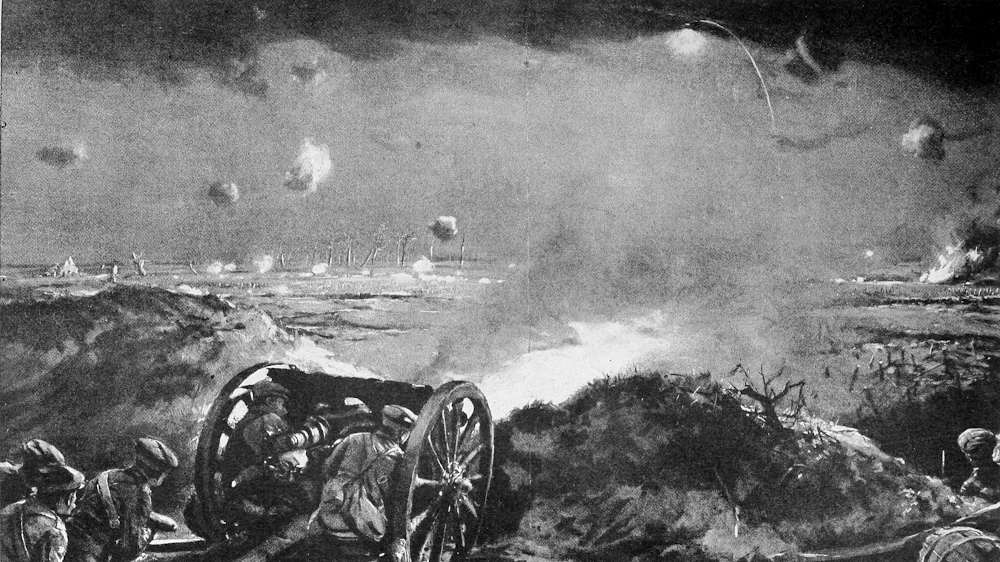
© New York Herald.
Firing at Close Range
A British fieldpiece, in an exposed position and without cover of camouflage, firing point blank at the enemy.
TAKES UP HIS FRIEND
Holmes paused. There at his feet, unable to move, was one of his chums, his knees shattered by shrapnel. Holmes had only a brief moment for reflection. To delay meant certain death. The problem was how best to help the poor fellow. To take him back into the trench was the quickest way out of the difficulty, and the easiest. Had he done this, the Germans would soon have discovered the wounded man, and in all probability would have put an end to him. Holmes quickly dismissed this plan and decided upon the nobler and more dangerous course. He determined to make a dash with the wounded man, trusting to Providence to reach his lines in safety.
He took the poor fellow in his stalwart arms, no light task, as his chum weighed twelve stone. Exerting his full strength, Holmes slung the man across his back. His only thought now was how to escape the bullets. All around him were the British dead and dying, heroes who had done their bit in the great battle.
A slight drizzling rain was falling; it made the ground slippery, so that when Holmes resumed his dangerous journey he had the utmost difficulty in avoiding treading on the men who were at his feet. With infinite care he succeeded in reaching more open ground.
After proceeding about one hundred yards he paused to take breath, for the burden on his back was a heavy load. At this stage his companion began to complain that Holmes’s equipment hurt him. Holmes laid the man down and removed the equipment. Knowing that he might have to make a long journey before he could reach assistance, he decided at the same time to drop his pack and rifle.
The next few hundred yards were the most difficult, for a hailstorm of bullets and shells raged around. Holmes could hear them whistling as he staggered painfully along. Had he not been possessed of a splendid constitution he must have given in, but he was determined at all costs not to give in. So he continued on and went doggedly forward, with clenched teeth and grim countenance.
On the way he came upon a wounded officer seated on the ground, his head between his hands. The officer looked up as he heard Holmes approach, and when he saw what the hero was doing suggested to him to leave the man with him and look after himself. This Holmes could not bring himself to do. Yard by yard he plodded steadily along. The poor fellow he was carrying began to lose heart. Holmes, although in terrible mental anguish himself, had to cheer him all the weary and dangerous way.
Slowly but surely he made progress. Half a mile, then a mile was passed. Holmes took another rest. Then on again, until he came to a church flying the Red Cross. The Germans were shelling this, so he picked up his chum once more and proceeded to another village, where at length he was able to deposit his charge in the careful keeping of the British Red Cross.
In all, Holmes carried his chum three miles, and every inch of the way was attended by danger from the enemy’s fire. It was certainly one of the most unselfish of the many courageous deeds which it is the purpose of this book to record.
In order to rejoin his battalion Holmes had now to make another dangerous journey across a fire-swept zone. His road lay past a hill, at the bottom of which was a British 18-pounder quick-firing gun. The horses were quietly grazing; the gunners and drivers lay around dead. Nearby was a trumpeter, a lad of seventeen, who was wounded. This lad shouted that the Germans were coming. Holmes looked round and saw that the enemy were surrounding the gun. Now, the true soldier has ever had a fondness for guns, and will die rather than let one fall into the enemy’s hands. It was in this spirit that Holmes now performed his second act of heroism.
Placing the trumpeter on one of the horses, he hitched the team to the gun, then thwacked them with a bayonet he had picked up, and swung into the saddle. The Germans were all around; some actually grasped at the reins. Holmes shouted to the horses, and they rushed madly forward. One after another he bayoneted the nearest Germans, while bullets whistled by his ears. The horse Holmes rode had its right ear shot off. For eight miles the ride went on until the rear of a British column was reached and all danger passed. The poor trumpeter had fallen off in the furious rush.